Table of Contents
- A Winter Morning in Pola: The Last Hours of Gallus
- From Side-Line Prince to Caesar: The Making of Gallus
- The House of Constantine and a World Drenched in Blood
- Antioch, Power, and the Dark Reputation of Gallus
- Constantius II and the Shadow of Civil War
- The Summons to the West: A Trap Set in Imperial Ink
- On the Road to Ruin: Intercepted Letters and Broken Loyalties
- Pola, Istria: A Remote Stage for Imperial Justice
- The Interrogation and the Final Decree of Death
- The Execution of Gallus: A Silent End to a Noisy Life
- News Reaches the East: Shock, Fear, and the Rise of Julian
- Voices of the Chroniclers: Ammianus, Philostorgius, and Others
- Politics Behind the Blade: Why an Emperor Kills His Caesar
- Faith, Superstition, and the Christian Empire in Crisis
- Pola After the Blood: Memory, Silence, and Forgotten Stones
- The Long Echo: How Gallus Shaped Julian the Apostate
- Modern Historians and the Problem of Gallus
- Conclusion
- FAQs
- External Resource
- Internal Link
Article Summary: In 354, on the rocky Adriatic coast at Pola in Istria, the Roman prince Gallus was quietly removed from the stage of history, his death ordered by his own cousin, the emperor Constantius II. This article follows the execution of Gallus from its immediate setting in a remote imperial outpost to the deeper forces within the Constantinian dynasty that made such a killing almost inevitable. It explores how a troubled youth, almost obliterated in earlier purges, rose to become Caesar in the East and then fell swiftly from favor amid accusations of cruelty, misrule, and treason. Through narrative reconstruction and analysis, we examine the political calculations that turned a recall to court into a death sentence, and how the execution of Gallus haunted the conscience and strategy of Constantius. We also trace the effects of the execution of Gallus on his younger half‑brother Julian, who would later become the emperor known as “the Apostate,” and whose view of power was forged in this furnace of family violence. Drawing on late antique historians and modern scholarship, the article shows how this single act at Pola reshaped imperial politics, Christian debates, and the fragile balance of the Roman world. Above all, it asks what the execution of Gallus reveals about a fourth-century empire trying to survive by devouring its own.
A Winter Morning in Pola: The Last Hours of Gallus
The sky over Pola, on the Istrian coast, would have been a hard, pale grey when the messengers came. The year was 354. The harbor below the town, flecked by the wind that rolled off the northern Adriatic, lay quiet beneath its ring of hills and Roman fortifications. This was no great capital, no glittering Antioch or Rome, but a provincial stage, deliberately chosen. Here, far from the eyes of the eastern soldiers who had once cheered his name, the execution of Gallus could take place with a minimum of risk and a maximum of control.
Gallus, once Caesar of the East, knew by that morning that his life hung by a thread. The road that had brought him from Antioch, through Thrace and across the Balkans, had been lined not with honors but with humiliations: his imperial escort stripped away, his retinue whittled down, his authority hollowed out step by step. In the last days at Pola, lodged in some fortified residence used by the imperial administration, he would have heard doors barred from the outside, footsteps of guards who did not bow as deeply as before, the echoing silence when his orders went unanswered.
The empire he served stretched from Britain to Egypt, but Gallus’ world had shrunk to a few dimly lit rooms and the cold stone around them. Once, as Caesar, he had presided over games in Antioch’s circus and dispensed justice from a gilded tribunal. Now, he waited, stripped of title and jewels, a man still in his twenties confronted with the full, impersonal weight of Roman imperial power. It is astonishing, isn’t it, how abruptly status could be reversed in a dynasty that claimed divine favor yet devoured its own sons?
He must have remembered his narrow escape from the slaughter that followed Constantine the Great’s death in 337, when so many of his male relatives were butchered in palace courtyards and military barracks. That massacre had swept away his father, Julius Constantius, and left Gallus and his younger half-brother Julian as survivors almost by accident. Childish memories of fear and confusion may have surged back in those hours at Pola, as he sensed that the long echo of that earlier violence was finally catching up with him.
Outside, in the harbor, ships creaked at anchor, and in the streets local Istrian traders haggled in Latin and Greek. To them, the arrival months before of a disgraced prince under guard had been little more than a rumor. Soldiers had been billeted; supplies requisitioned; an air of tense secrecy had spread. But Pola had seen executions before. Its amphitheater, looming above the bay, reminded everyone how Rome dealt with threats, whether foreign or domestic.
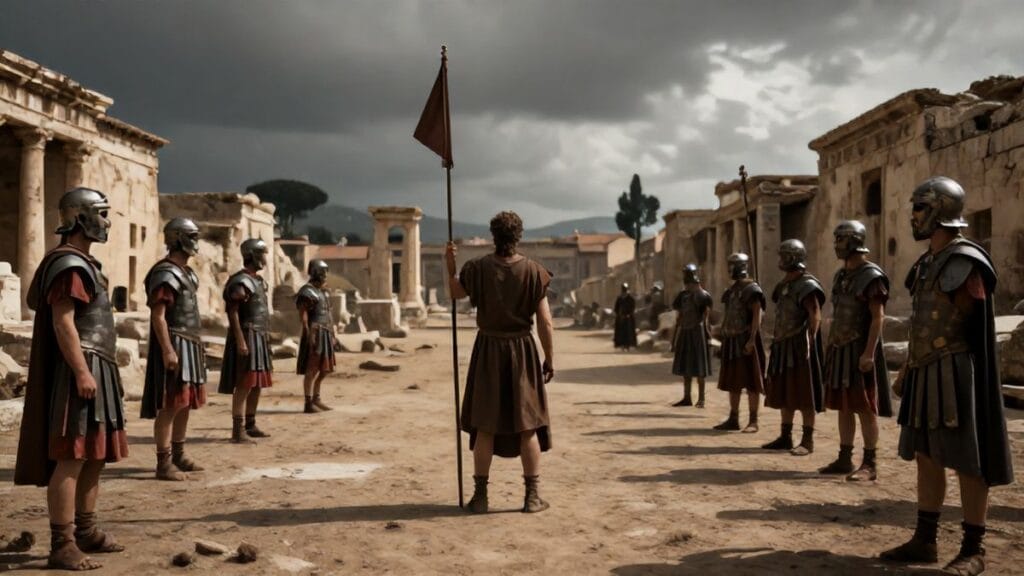
On that winter morning—the exact day lost to us—officers of the imperial household approached Gallus with the final decree. Not a public trial, not a grand senate session in Rome, but a quiet notification that the emperor Constantius II, his cousin and former benefactor, had confirmed the sentence of death. When we speak of the execution of Gallus, we are speaking not only of a single beheading in a distant outpost, but of the deliberate, nearly clinical closing of a chapter in the Constantinian experiment. Yet this was only the beginning of its consequences, for the blade that fell at Pola would send tremors through cities, armies, and churches across the Roman world.
From Side-Line Prince to Caesar: The Making of Gallus
To understand why Pola became the scene of such a grim finale, we must go back to Gallus’ beginnings. Born around 325, Gallus—Flavius Claudius Gallus in the long imperial style—was a child of the Constantinian house, but not of its central branch. His father, Julius Constantius, was the half-brother of the first Christian emperor, Constantine the Great, sharing the same father, Constantius Chlorus, but not the same mother. That distinction, subtle in happier dynasties, would prove decisive in a world where suspicion grew in the cracks of family trees.
Gallus’ mother, Galla, is a shadowy figure to us, and she died when he was still young. The boy thus grew up within a nexus of courts, tutors, and Christian bishops who clustered around the Constantinian princes. He was, by birth, a potential claimant to power but not its primary heir. Constantine’s own sons—Constantius, Constantine II, and Constans—towered over the extended family, raised as obvious successors who would divide the empire among themselves. Gallus and his younger half-brother, Julian, stood off to the side, valuable to the dynasty yet expendable in moments of crisis.
Those moments arrived swiftly. When Constantine the Great died in 337 at Nicomedia, his body had barely cooled before fear gripped the empire’s elites. The army, fiercely loyal to the deceased emperor, loomed as a decisive force in determining the next ruler. In such a volatile atmosphere, any adult male of Constantine’s bloodline looked either like a potential ally—or a rival to be removed preemptively.
The purge that followed has often been told, but rarely from the perspective of children like Gallus. In palaces in Constantinople and elsewhere, imperial kinsmen were rounded up and killed. Julius Constantius was among the victims. No trial process left behind a record; only a haze of horror remains. Ammianus Marcellinus, the most vivid of the late Roman historians, hints that the three sons of Constantine cooperated, tacitly or explicitly, in the slaughter to secure their own succession. The young Gallus, perhaps around twelve years old, survived—most likely because of his youth and political insignificance at that moment.
He spent his adolescence effectively under guard, shunted between cities such as Nicomedia and Macellum in Cappadocia, an imperial estate used less as a palace than as a gilded confinement. There, amid Christian churches and rural landscapes, he and Julian absorbed the works of Greek literature and philosophy but also the abiding lesson that family meant danger. The execution of his father, witnessed at a distance, seared into Gallus a fatalistic understanding of imperial politics: rulers killed not only their enemies but their own blood.
Years later, when he was suddenly raised to the rank of Caesar in 351, this background would matter. He was no polished urban aristocrat schooled in the senate’s delicate intrigues; he was a survivor of internal purges, a young man whose formative experience taught him that power was always precarious and that mercy was a luxury emperors could not afford. The making of Gallus as Caesar thus began long before his coronation robes touched his shoulders; it began in the echoing corridors where his relatives were led away to their deaths.
The House of Constantine and a World Drenched in Blood
The Constantinian dynasty, outwardly adorned with crosses and Christian symbols, was inwardly no less ruthless than the pagan houses that had preceded it. From 306 onward, when Constantine was first proclaimed emperor at York, his rule had involved a relentless calculus of survival: winning over soldiers, marginalizing rivals, sometimes killing them. He had ordered the execution of his own son Crispus and later his wife Fausta under circumstances that remain contested but undeniably brutal.
His sons inherited not only an empire but also this ingrained habit of eliminating threats. The partition of the Roman world after 337 placed Constantius II in the East, Constantine II in the West, and the younger Constans with an intermediate share. It did not take long for tension to erupt. Constantine II died in 340 during a failed invasion of his brother’s territory; Constans would be overthrown and killed by the usurper Magnentius in 350. By the time the dust settled, Constantius II—the same emperor who would later order the execution of Gallus—found himself the sole legitimate Augustus, but at the cost of years of war and staggering loss of life.
This was the climate in which decisions about Gallus were made: a world drenched in the blood of relatives and rivals alike. The new “Christian empire” did not usher in an age of gentle politics; instead, Christian rhetoric baptized very old instincts. Bishops at court preached about divine favor and punishment, while imperial secretaries drafted orders that sent men to their deaths. When Constantius considered appointing a junior emperor to help manage the East while he fought Magnentius, he was guided by both necessity and fear. He needed a Caesar—but one he could control.
Gallus, as a member of the extended family, seemed to offer a solution. His survival after 337 had left him with a kind of grim legitimacy. He bore the Constantinian name, yet he had not built up an independent power base. Kept at the margins, without armies of his own, he appeared pliable. In a dynasty where brothers had killed brothers, a cousin who owed his advancement entirely to Constantius might be the safest choice.
Thus in March 351, at Sirmium in the Balkans, Constantius II elevated Gallus to the rank of Caesar. The ceremony glittered with imperial pomp: the new prince was robed in purple, diadem fixed upon his head, and hailed by the army whose shields reflected the spring light. The message to the world was clear: the empire was united, the dynasty strong. But behind the celebrations, caution reigned. Gallus was packed off to the East not as an equal partner but as a subordinate, tasked with defending the frontiers and governing key provinces under the watchful eye of imperial officials loyal to Constantius.
That tension—between outward honor and inner distrust—would define Gallus’ short reign and help explain why, just three years later, the execution of Gallus at Pola would appear to Constantius less a crime than a grim necessity.
Antioch, Power, and the Dark Reputation of Gallus
Gallus and his young wife Constantina, a formidable woman and sister of Constantius II, traveled east to Antioch, the dazzling metropolis on the Orontes River. Antioch was a city of colonnaded streets, marble statues, and chattering crowds. It was also a cauldron of religious factions, local rivalries, and simmering resentments toward distant emperors. From this base, Gallus was expected to secure the eastern frontier against Persia and maintain order in the provinces of Syria, Palestine, and beyond.
In theory, he had considerable authority. He could issue edicts, judge legal cases, and command troops. In practice, his actions were hemmed in by senior officials sent by Constantius—praetorian prefects like Thalassius and Domitianus—whose loyalty ran upward to the Augustus rather than sideways to the Caesar. The arrangement was a recipe for friction. Gallus, conscious of his imperial blood and eager to assert his dignity, bristled at the condescension of these seasoned administrators. They, in turn, reported anxiously to Constantius about the temperament of their young master.
Stories about Gallus’ rule in Antioch come to us mainly through hostile voices, yet they are too consistent to ignore. Ammianus Marcellinus, who served in the eastern army and later wrote as a disillusioned observer, paints Gallus as suspicious, impulsive, and often cruel. During a grain shortage in Antioch, when the people rioted and smashed statues of imperial officials, Gallus did not calm the crowds with measured reforms. Instead, encouraged by Constantina, he unleashed punitive violence. Leading citizens were arrested and executed, sometimes on flimsy accusations of disloyalty.
One notorious case involved Theophilus, governor of Syria, and others in the administration. They were denounced, tortured, and killed on charges of treason. The imperial notary Eusebius, feared as an agent of Constantius, moved through the East collecting information and conducting interrogations. It was an atmosphere of whispered denunciations and public spectacles of punishment—a climate that, once stirred, was hard to control.
Whether Gallus himself delighted in cruelty or simply saw it as the only language power understood, we cannot know with certainty. Some later, sympathetic ecclesiastical writers tried to soften his image, presenting him as a pious prince caught in a web of intrigues. Yet the cumulative effect of the sources suggests that under pressure, Gallus resorted quickly to executions and that he sometimes bypassed proper judicial procedures. He had grown up in an empire where authority was constantly challenged and defended by force; in Antioch, he reproduced that pattern with a fervor that alarmed the very cousin who had promoted him.
Constantius received report after report of Gallus’ behavior: the trials, the confiscations of property, the growing alienation of the urban elites whose support was crucial. The emperor, fighting in the West against Magnentius and his supporters, could not afford a chaotic East. For a time, he tolerated the excesses, perhaps trusting Constantina to restrain her husband. But this was only the beginning of the unraveling. As the months went by, the distance between Sirmium and Antioch might as well have been an ocean; distrust flourished in the space that letters and couriers could not quite fill.
Constantius II and the Shadow of Civil War
By 353, Constantius II had finally defeated Magnentius and restored formal unity to the empire. The civil war that had consumed his attention—and his resources—was over. At last he could turn his gaze fully eastward again. What he saw troubled him deeply.
In his absence, Gallus had acted more like an independent ruler than a deputy. He had minted coins in his own name, presided with increasing grandeur over ceremonial events, and cultivated the adoration of soldiers stationed along the eastern frontiers. None of this, in itself, was extraordinary; Caesars always enjoyed some splendor. But with the civil war just concluded, Constantius was acutely sensitive to any sign that a junior emperor might seize the momentum of victory and turn it against him.
He also had to manage perceptions at court. The imperial household, especially the corps of secretaries and notaries, thrived on conveying information and shaping interpretation. Eusebius, that same notary dreaded in the East, was a formidable force in Constantinople. Reports of Gallus’ harsh judgments, of overreaching in fiscal matters, of flirtations with dangerous prophecies—all this was filtered, amplified, and presented to Constantius as evidence that his cousin was destabilizing the very provinces he was supposed to stabilize.
The emperor’s own personality played a part. Constantius II was a man of austere habits, deeply committed to the unity of the Church under his preferred theological formula, and profoundly wary of any challenge to imperial order. He had already shown, in his response to Magnentius, that he could wage relentless war to crush usurpers. The memory of his father’s struggles and the family slaughter of 337 would have reinforced his conviction that potential rivals could not be allowed to grow too strong.
Throughout 353 and into 354, Constantius weighed his options. To strip Gallus publicly of the rank of Caesar without a clear pretext risked scandal and unrest, especially among eastern troops who viewed Gallus as their own emperor in all but name. To leave him in place, however, was to invite further abuses and perhaps open rebellion. The solution he eventually chose bore the hallmarks of calculated imperial strategy: he would recall Gallus to the West under the guise of consultation and shared rule, only to isolate and neutralize him far from his power base.
In this sense, the execution of Gallus at Pola was only the final stroke of a long mental campaign waged by Constantius. The decision to kill did not arise in a single moment of rage; it emerged from years of fear, rumor, and political arithmetic. The shadow of civil war, still fresh in memory, made the emperor far less inclined to risk leniency. The Constantinian house had survived so many crises by cutting off its own diseased limbs; Gallus, in Constantius’ eyes, had become one of them.
The Summons to the West: A Trap Set in Imperial Ink
The recall of Gallus began with words carefully chosen on parchment. In 354, after the defeat of Magnentius and the consolidation of imperial power, Constantius sent letters to his cousin in Antioch. In them, he wrote not as a suspicious overlord but as a gracious Augustus inviting his loyal Caesar to share in the glory of victory and to consult on urgent matters of state. This was the bait: the suggestion of trust and shared responsibility.
To a man in Gallus’ position, the summons must have seemed both promising and dangerous. On the one hand, being called to the emperor’s presence could mean promotion—perhaps even the dream of joint rule as co-Augustus. On the other hand, the very distance between Antioch and the imperial court meant vulnerability. Once he moved west, he would be surrounded not by his own officers but by those of Constantius, in cities where the emperor’s word alone defined reality.
Constantina’s role here remains tantalizing and tragic. Some sources hint that she encouraged Gallus to accept the invitation, perhaps believing that her influence over her brother Constantius would protect them. Others suggest that she herself worried about the recall and urged caution. What is clear is that Constantina died on the journey, somewhere in Bithynia, before reaching her brother’s side. Her death removed Gallus’ most powerful advocate at precisely the moment when he most needed someone to interpret his actions sympathetically at court.
The journey itself unfolded in stages, each one stripping away layers of Gallus’ former majesty. In Constantinople, he was ostensibly honored, yet his movements were controlled. As he proceeded into the Balkans, he began to notice disquieting changes: the reduction of his escort, the reassignment of loyal guards, the quiet refusal of officials to obey his commands without reference to higher authority. The net was tightening, though he may not have fully grasped how carefully it had been woven.
Imperial letters can kill as surely as swords. What had begun as an invitation now functioned as a warrant. Constantius’ intention was clear to those executing his orders: separate Gallus from the eastern armies, undermine his capacity to resist, and bring him to a place where a small, loyal detachment could carry out whatever sentence the emperor would eventually pronounce. Pola, remote yet within the secure western sphere, emerged as a suitable location.
As Gallus moved closer to his fate, rumor outpaced him. In the East, whispers circulated among soldiers and civilians alike: had their Caesar been summoned for honors or for judgment? In the West, veterans of the Magnentian wars shrugged. They had seen too many princes rise and fall to be surprised by another turn of the wheel. To them, the execution of Gallus would be one more entry in a long ledger of imperial reckonings.
On the Road to Ruin: Intercepted Letters and Broken Loyalties
The journey from Antioch to Pola was not merely geographical; it was also a passage through layers of betrayal. As Gallus traveled, messages flew ahead of him, and some that were meant to follow him never arrived. In the delicate choreography of late Roman politics, letters were weapons and shields, their interception a form of silent assassination.
One episode, recorded by Ammianus Marcellinus, reveals the fragility of Gallus’ position. During the journey, and perhaps in growing desperation, Gallus is said to have sent letters to influential figures in the East, urging them to support him or at least to testify in his favor. These letters, however, did not reach their intended recipients. Instead, they were intercepted by imperial agents loyal to Constantius. To the emperor, such correspondence looked not like a plea for fairness but like an attempt to stir up resistance—a prelude to rebellion.
Even those who had once depended on Gallus for advancement now stopped responding. Provincial governors, military commanders, and bishops, all of whom had stood in his audience halls in Antioch, suddenly fell silent. The network of patronage that had sustained his authority dissolved as soon as it became clear that Constantius no longer favored him. This rapid collapse of support illustrates a hard truth about late Roman power: loyalty was tethered less to persons than to the imperial will. When that will shifted, friendships became liabilities.
Meanwhile, Gallus’ personal attendants dwindled. Officers who had accompanied him from the East were reassigned or quietly detached. Local garrisons, receiving advance notice from the emperor, treated him as a prisoner in all but name. To the public eye, the decorum of imperial rank was maintained—a purple-clad figure moving through cities, still afforded certain honors. But in the courtyards behind him, soldiers murmured about orders that forbade them to obey any directive from the Caesar without cross-checking with higher command.
In such an atmosphere, paranoia was not irrational; it was a reasonable response. Gallus, shaped by earlier experiences of family violence, must have felt the old dread closing in. Yet he still carried the title of Caesar, still believed in the sanctity of that role. Perhaps he imagined that once he stood face to face with Constantius, he could explain, justify, persuade. It is one of the cruel ironies of this story that he never received that audience. The decision to end his life would be implemented by others, far from the emperor whose security it was meant to protect.
By the time he reached Pola, the network of communications that might have saved him—or at least allowed an appeal—had been thoroughly severed. Broken loyalties, intercepted letters, and the emperor’s unspoken but unmistakable will converged to make the execution of Gallus seem almost inevitable. The trap set in imperial ink had sprung shut.
Pola, Istria: A Remote Stage for Imperial Justice
Pola, known today as Pula in modern Croatia, was a Roman colony with a long military and maritime history. In the fourth century, it served as a strategic port and administrative center on the northern Adriatic, far from the restive provinces of the East yet linked by sea and road to Italy and the imperial heartlands. Its amphitheater, one of the best preserved in the Roman world, still rises above the bay like a fossilized memory of imperial spectacle.
Why Pola? The choice was not accidental. Constantius needed a place where he could detain a high-ranking prisoner without provoking unrest. It had to be secure, with loyal troops, and removed from the eastern legions that might balk at the execution of a man they had once hailed. At the same time, it needed sufficient infrastructure—a governor’s palace, administrative buildings, reliable supply lines—to house and guard someone of Gallus’ status without drawing excessive public attention.
Pola provided that combination. Its harbor allowed for discreet movement of couriers and officials. Its distance from major metropolises ensured that news of what was happening there could be controlled, at least temporarily. The town’s Roman inhabitants were accustomed to the presence of garrisons and officials; the arrival of another imperial figure, even one under guard, would have stirred curiosity but not necessarily alarm.
In the late antique world, the geography of punishment mattered. Public executions in central cities could send powerful messages but also risked martyring the condemned or turning crowds volatile. More private executions in out-of-the-way places allowed emperors to remove problematic figures with minimal spectacle. The execution of Gallus belongs to this second category: an act of imperial justice, or vengeance, carried out away from the roar of the masses.
Within Pola, Gallus was likely housed in a fortified residence, perhaps an official praetorium or a large villa commandeered for the purpose. He would have been guarded by a detachment of troops whose loyalty to Constantius was beyond question. Their commander would have held sealed orders, to be opened only at the proper time. Every detail of his confinement—who could speak to him, what news he received, whether he was allowed to write—would have been regulated in light of the eventual goal.
Locals may have sensed that something unusual was afoot. Extra soldiers in the streets, sudden restrictions on access to certain areas, the appearance of high-ranking courtiers—they all hinted that an important decision was being played out behind closed doors. Yet for most inhabitants, daily life continued: markets opened, ships unloaded cargo, artisans labored in workshops. The drama of empire often unfolded like this, in parallel to the unbroken rhythm of ordinary existence.
In this quiet coastal town, on cliffs overlooking the restless sea, the climax of Gallus’ story would be reached. Pola became not just a backdrop but a symbol of how the late Roman state preferred to handle its dirtiest business: in remote corners, under the cover of routine, with as little noise as possible.
The Interrogation and the Final Decree of Death
Once Gallus was secured in Pola, the next phase began: interrogation. Roman emperors, especially those as methodical as Constantius II, preferred to cloak their acts of violence in the language of legal process. Even if the outcome was predetermined, procedures would be followed—questions asked, witnesses examined, charges articulated. It was not only a matter of form; it provided the emperor with psychological reassurance that he was punishing a criminal, not murdering a kinsman.
Officers of the imperial household, perhaps including notaries like Eusebius or regional governors, conducted the questioning. They would have presented Gallus with a catalog of accusations: abuse of power in Antioch; unlawful executions of officials; improper handling of public funds; possibly even conspiracy against the emperor. Some charges were likely grounded in fact—his harsh rule in the East was not mere propaganda—while others may have been exaggerated to furnish a stronger case.
How Gallus defended himself, we do not know. No transcript survives, no sympathetic advocate recorded his words. We can imagine him appealing to the extraordinary pressures under which he had governed, pointing to grain riots, Persian threats, and local corruption as reasons for his severity. He might have invoked his loyalty in confronting Magnentius’ supporters or highlighted Constantina’s presence as a guarantee of his commitment to the dynasty. All of that, however, would have been measured against the will of a distant emperor who had already decided that his cousin’s continued existence posed too great a risk.
The decree of death, once drafted, would have been sent to Constantius for confirmation. Here, the machinery of empire intersected with intensely personal drama. The same hand that signed edicts on taxation and religious policy was now authorizing the killing of a man who had once called him “brother.” Yet the document itself would have been dry, couched in bureaucratic Latin, citing reasons of state and the need to preserve public order.
Some later sources, including the Arian historian Philostorgius, hint at efforts by certain courtiers to temper the sentence or at least to delay it. If such attempts were made, they failed. Constantius, still haunted by the specter of usurpation and emboldened by recent victory, chose firmness over clemency. The execution of Gallus, to his mind, would deter other potential rebels and send a message to provincial administrators that misrule would not be tolerated, even in members of the imperial family.
Thus the final order arrived in Pola: Gallus was to die, quietly but decisively, at the hands of his own guardians. With that, the long arc of his troubled life—marked by early trauma, sudden elevation, and reckless rule—curved toward its grim conclusion.
The Execution of Gallus: A Silent End to a Noisy Life
The act itself was brutally simple. There was no arena spectacle, no display before a roaring crowd. The execution of Gallus likely took place in a courtyard or secluded enclosure within the complex where he was held. A handful of soldiers, an officer bearing the imperial rescript, perhaps a chaplain or local cleric—these were his final audience.
We do not know his last words. The sources are silent, offering no dramatic speeches, no pleas for mercy. That very silence has encouraged historians to imagine various endings: a defiant Gallus cursing the injustice of his cousin; a broken man mumbling prayers; a prince who had seen so much violence in his family walking calmly to the block, resigned to the logic that had always governed his world.
Decapitation was the typical method of execution for those of high status in the Roman state. It was swift and, at least compared to other punishments, considered relatively honorable. To strip Gallus of his purple robes, to remove the diadem from his head, and then to strike—these gestures compressed the entire drama of his rise and fall into a single moment. A man who had once sat in judgment over others was now the judged, subject to the same ultimate penalty.
In that instant, as the sword fell, years of imperial calculation crystallized. The execution of Gallus extinguished one line of potential succession and altered the emotional landscape of the Constantinian house. Somewhere far away, in the East, his younger half-brother Julian would eventually learn of the event and draw from it lessons that would shape his own conduct as Caesar and later Augustus. Constantius, informed of the act he had ordered, would add another name to the mental list of relatives sacrificed on the altar of security.
After the killing, the body of Gallus was likely buried without ceremony, perhaps in a local cemetery or an unmarked grave. No monumental tomb, no lavish inscriptions proclaimed his former glory. The empire preferred to forget its failed experiments. In official narratives, references to Gallus could be minimized or molded to fit a story of necessary justice: a misguided prince removed to preserve order.
Yet, as is so often the case, the attempt at erasure only ensured that later generations would ask more questions. How had it come to this? What did his death reveal about the nature of Roman power in a supposedly Christian age? And what unexpected consequences would ripple outward from that quiet courtyard in Pola, long after the blood had dried?
It is here that the execution of Gallus moves from being a localized tragedy to a turning point in the history of the late empire—a moment when fear, faith, and family intertwiningly reshaped the path Rome would take.
News Reaches the East: Shock, Fear, and the Rise of Julian
When word of Gallus’ death reached the East, it did not arrive as a clear, official bulletin. News traveled in fragments: a rumor whispered in a barracks, a merchant’s tale picked up in a port, a letter from a relative of a soldier stationed in the Balkans. At first, the reports may have been conflicting—some saying that Gallus had been arrested, others that he had been tried, still others that the execution of Gallus had already taken place in a distant town called Pola.
For eastern soldiers who had served under Gallus, the news provoked unease. Many had cheered his accession as Caesar just a few years earlier, seeing in him a representative of imperial authority close at hand, someone who understood their frontier struggles. His removal raised questions: if a Caesar could be recalled, humiliated, and killed, what security did any imperial favor really offer? Yet open protest was rare. The army, disciplined by years of campaigns and paymaster to a sprawling state, had little appetite for a fresh civil war.
Among the urban elites of Antioch and other cities, reactions were complicated. Some felt relief. Gallus’ harsh rule and erratic justice had earned him numerous enemies. Landowners who had lost property to confiscations, officials who feared being denounced at any moment, clergy who resented his alliances with rival factions—they may have welcomed his fall. Others, however, saw in his execution a chilling demonstration of the emperor’s readiness to sacrifice kin. If a cousin could be eliminated so abruptly, what about governors, bishops, or generals who fell out of favor?
Most poignant was the impact on Julian, Gallus’ much younger half-brother. Still a relatively obscure figure at this time, living in western cities under close supervision, Julian had already survived the massacre of 337 that claimed his father and other relatives. The news from Pola confirmed his darkest suspicions: the Constantinian dynasty was as much a danger to its own members as to external enemies. When Constantius later elevated Julian to the rank of Caesar in 355 and sent him to Gaul, the young man accepted with a wary heart, knowing that his brother’s fate could one day be his own.
Julian’s later reflections suggest that he never forgave Constantius for the killing of Gallus. In private letters and in his satirical work “The Caesars,” he alluded to the hypocrisy and cruelty he saw in his cousin’s reign. The execution of Gallus thus contributed directly to the mental and moral formation of the future “Apostate,” the last pagan emperor of Rome. The distrust seeded at Pola would bear fruit years later, when Julian, acclaimed Augustus by his troops in Gaul, marched east—not merely as a rival for power, but as a man seeking to escape the fate that had overtaken his brother.
In this way, the ripples from that execution extended far beyond Pola’s harbor. They reached the Rhine frontiers, where Julian fought the Alamanni; they reached Constantinople and Antioch, where theological disputes over Christ’s nature intertwined with debates about the legitimacy of emperors. The death of one Caesar helped shape the worldview of another, with consequences that would touch the entire Mediterranean world.
Voices of the Chroniclers: Ammianus, Philostorgius, and Others
Our knowledge of Gallus’ life and death depends heavily on a few key witnesses, each writing with his own agenda and limitations. Their voices, separated from the events by years or even decades, form a kind of chorus—discordant yet invaluable—through which we reconstruct what happened at Pola and why.
Ammianus Marcellinus, a Greek-speaking veteran of the Roman army who wrote his “Res Gestae” in Latin, is the most important of these chroniclers. Serving under the general Ursicinus in the East, Ammianus had direct experience with the political turmoil of Gallus’ reign. His portrayal of Gallus is largely negative: he emphasizes the Caesar’s cruelty, impulsiveness, and susceptibility to flattery, especially from his wife Constantina. Yet Ammianus is not a simple propagandist. He also criticizes Constantius II for his excessive suspicion and for allowing court eunuchs and notaries to manipulate him. Ammianus’ account of the execution of Gallus is concise but powerful, framing it as the predictable outcome of a toxic combination of misrule and imperial paranoia.
Philostorgius, an Arian Christian historian writing in the early fifth century, offers another perspective. His work survives only in fragments and later summaries, but it suggests a more sympathetic view of Gallus. Philostorgius was concerned primarily with theological debates—Arian versus Nicene interpretations of Christ’s nature—and he saw political events through the lens of those conflicts. In his narrative, Gallus appears less as a monster and more as a flawed, perhaps manipulated, actor within a larger drama of ecclesiastical strife. The execution of Gallus thus becomes part of a story about the suffering of rulers who aligned themselves, in Philostorgius’ view, with the right doctrinal camp but fell victim to hostile factions.
Ecclesiastical historians like Socrates Scholasticus and Sozomen, writing in the fifth century, offer brief mentions as well. They focus more on bishops and councils than on imperial politics, yet they cannot ignore an event as significant as the killing of a Caesar. Their accounts, derivative of earlier sources, tend to reinforce the image of Gallus as harsh and Constantius as unrelenting. Still, they add small but telling details, such as the sense of fear that gripped entire cities when news of his downfall spread.
Modern historians, from Edward Gibbon in the eighteenth century to scholars of late antiquity today, have sifted these sources with care. As the Cambridge historian Timothy Barnes has noted, the biases of Ammianus—admiration for military virtue, disdain for courtly intrigue—shape his depiction of both Gallus and Constantius. Yet, Barnes and others acknowledge that even a biased witness can preserve kernels of truth. The consistent emphasis on Gallus’ harshness, his precarious legitimacy, and the calculated nature of his recall to the West makes the broad outlines of the story hard to dispute.
Through this layered testimony, the execution of Gallus emerges not as an isolated cruelty but as a culmination of patterns visible throughout the Constantinian age: the tendency to exalt and then discard relatives, the reliance on court bureaucrats to manage information, the fusion of theological and political conflicts. The chroniclers, each in his way, preserve both the facts and the atmosphere—the sense of a world in which imperial power could be dazzling yet terrifyingly brittle.
Politics Behind the Blade: Why an Emperor Kills His Caesar
To reduce the execution of Gallus to a mere act of personal hatred or vengeance would be to miss its deeper political logic. Constantius II’s decision, cruel as it was, followed a grim rationality rooted in the realities of ruling a vast and fractious empire.
First, there was the issue of legitimacy. Gallus’ elevation to Caesar in 351 had been a strategic move, necessary to stabilize the East while Constantius fought Magnentius in the West. But once the civil war ended and the usurper was defeated, the rationale for sharing power weakened. A victorious Augustus, acclaimed across the empire, might naturally hesitate to leave a junior emperor in place who had developed his own base of support and habits of autonomy. Removing Gallus simplified the hierarchy and reduced the risk of competing centers of loyalty.
Second, the emperor had to think like a manager of reputations. Reports of Gallus’ brutality in Antioch threatened to stain the image of the imperial household. While Constantius was no stranger to harsh measures himself, he needed to demonstrate to urban elites, bishops, and provincial administrators that there were limits beyond which even a member of the dynasty could not go. By ordering the execution of Gallus, he could present himself as a ruler who punished wrongdoing impartially, at least in appearance. The message was clear: misrule and unauthorized terror were intolerable, no matter the culprit’s bloodline.
Third, there was the raw calculation of fear. Emperors in the fourth century lived under the constant threat of usurpation. Legions could proclaim their own candidates; frontier generals could march on central cities. In such a context, any Caesar with independent access to troops and resources represented a potential rival. Even if Gallus harbored no immediate plan to overthrow Constantius, his pattern of behavior—assertive, suspicious, harsh—suggested that he might one day choose that path, especially if encouraged by discontented officers. From the emperor’s perspective, it was safer to act preemptively.
Finally, we must not underestimate the role of the imperial court. Eunuchs, notaries, and high-ranking officials had their own interests. Some had clashed with Gallus or feared retribution if he retained power. They stood to gain from his downfall, whether in terms of influence, property, or simple security. By feeding Constantius selective information, emphasizing Gallus’ most alarming actions and interpreting his every move in the worst possible light, they could nudge the emperor toward a fatal decision. The blade that killed Gallus was guided as much by these invisible hands as by Constantius’ own.
Thus, when we contemplate the execution of Gallus, we are looking at a convergence of motives: the desire for a simplified power structure, the need to preserve imperial dignity, the paranoia bred by decades of civil war, and the manipulations of those who navigated the corridors of palace politics. The act was not an aberration but a symptom of a system in which killing one’s Caesar could be seen as a tragic but rational choice.
Faith, Superstition, and the Christian Empire in Crisis
The fourth century is often described as the era when Rome became a Christian empire, and indeed crosses appeared on standards, churches multiplied in cities, and bishops debated doctrine in councils attended by emperors themselves. Yet beneath this surface of piety, old habits of superstition and fatalism endured. The execution of Gallus unfolded within this tension between new faith and ancient fears.
Gallus was nominally a Christian prince, as were Constantius and most members of their family. He likely attended church services, listened to sermons, and participated in imperial religious festivals that honored Christ as the true victor over enemies. At the same time, both he and those around him seem to have consulted soothsayers, magicians, and interpreters of omens. Ammianus hints that Gallus was fascinated by prophecies, especially those that spoke of his destiny. In an empire where astrology stood side by side with Nicene or Arian creeds, such practices were not unusual.
Constantius, too, inhabited this mixed religious world. He was deeply involved in theological controversies, favoring a form of Christianity that stressed the Son’s subordination to the Father—a position later labeled “Arian” by its opponents. He convoked councils, exiled bishops, and believed that doctrinal unity was essential to imperial stability. Yet he also reacted intensely to portents and omens. Unusual natural phenomena, rumors of prophetic dreams, and the discovery of magical texts could all influence his decisions.
In this context, the execution of Gallus acquired a spiritual dimension in addition to its political rationale. To some Christian observers, it demonstrated divine judgment: a ruler who had abused his authority and shed innocent blood was himself delivered to the sword. To others, especially those sympathetic to Gallus’ theological alignments, it looked like persecution carried out under the guise of justice. Philostorgius, for instance, framed the event in terms of religious conflict, implying that court factions hostile to his brand of Christianity helped engineer his downfall.
Meanwhile, among the common people, rumors swirled about portents surrounding Gallus’ death. Eclipses, comets, strange animal births—such phenomena were interpreted by many as signs that the gods, or God, were displeased. Some claimed that disasters that followed—earthquakes, plagues, barbarian incursions—were punishment for the shedding of imperial blood at Pola. These interpretations may not appear in official chronicles, but they likely circulated in marketplaces and taverns, shaping popular memory.
The fusion of faith and superstition did not make the empire more humane. If anything, it added layers of moral justification to acts of violence. Emperors could convince themselves that by executing problematic relatives, they were acting as instruments of divine justice, purging sin from the body politic. The execution of Gallus, viewed through this lens, became not just a political necessity but a religious duty. That this justification sat uneasily alongside the gospel message of forgiveness did not trouble them as much as it might trouble us today.
In the end, the Christian empire of the fourth century was still very much Rome: pragmatic, ruthless, haunted by fate, and willing to sanctify almost any act in the name of order and orthodoxy.
Pola After the Blood: Memory, Silence, and Forgotten Stones
When the soldiers at Pola cleaned their blades and the last official left the makeshift execution ground, the town slipped back into its ordinary rhythms. A few locals might have whispered about the prince who had met his end in their midst, but over time even such whispers faded. Empires move on quickly from the deaths of inconvenient men. The amphitheater remained, the harbor remained, the hills and rocky shorelines remained, but the memory of Gallus dissolved into the wider sea of Roman stories.
The physical traces of his presence in Pola are gone, if they ever existed in any visible form. No inscription has been found commemorating him, and none was likely ever erected. His burial place, somewhere under the modern city or its environs, lies unmarked and unknown. Archaeologists excavate temples, houses, and baths, but they cannot point to a tomb and say with confidence, “Here lies Gallus, Caesar of the East.” The stones keep their secrets.
Yet memory does not reside only in monuments. It survives in texts, in whispered traditions, in the emotional topography of places. For centuries, Pola remained part of the shifting borderlands of empires—Byzantine, Venetian, Habsburg. Each layer added new stories, covering over older ones. Only with the rise of modern historical scholarship did the name of Gallus re-emerge in connection with the town, as classicists and historians pieced together late Roman narratives.
Today, visitors to Pula walk through its ancient streets, admire the majestic amphitheater, and read plaques about gladiators and traders. Few know that in 354, a young Roman prince met a quiet death somewhere nearby. The execution of Gallus has become one of those footnotes that lie buried beneath more glamorous events. Yet this very obscurity speaks volumes about the mechanisms of imperial forgetting. Rome, like many great powers, preferred to remember its triumphs and to conceal its sorrows, especially those of its own making.
Still, for those who pause to imagine, the landscape can come alive. Picture the cold air of an Istrian morning, the tramp of boots on stone, the murmur of Latin commands. Picture a man stripped of power but not of fear, walking toward a place from which he will not return. The harbor, the hills, the very sky above Pola witnessed that moment, even if they have nothing to say about it now. History, as the French historian Marc Bloch famously reminded us, is the science of men in time. Gallus was one such man, and Pola was the stage upon which his time ran out.
The Long Echo: How Gallus Shaped Julian the Apostate
To gauge the full impact of Gallus’ death, we must look not only at the immediate political aftershocks but also at the way his story shaped the mind and policies of his half-brother Julian. If Pola was the end of one trajectory, it was also the invisible beginning of another.
Julian was about six or seven years younger than Gallus, and their early years together in semi-confinement at Macellum left deep marks on him. He later recalled those days as ones of fear and insecurity, his education overshadowed by the knowledge that his father and other relatives had been murdered. Gallus, slightly older, would have been both a companion and a constant reminder of their precarious status. When news of the execution of Gallus reached him, Julian must have felt that whatever fragile protection family ties offered had now been definitively shattered.
When Constantius appointed Julian Caesar in 355 and sent him to Gaul, the younger man was determined not to repeat his brother’s mistakes. He adopted a style of rule sharply different from the harsh, fearful governance that had doomed Gallus in Antioch. In Gaul, Julian cultivated the goodwill of local elites, respected traditional institutions, and worked hard to present himself as a just and accessible ruler. Ammianus, who served under Julian and admired him greatly, contrasts this with Gallus’ imperious behavior in the East. The comparison is almost certainly shaped by hindsight, yet it hints at a conscious distancing on Julian’s part.
At the same time, Julian never forgot that he, too, could be recalled and eliminated at any moment. The fate of Gallus hung over him like a warning. When his own troops proclaimed him Augustus at Lutetia (modern Paris) in 360, Julian faced a choice similar to the one Gallus had faced earlier: submit to the emperor’s summons and risk a silent death in some remote town, or defy the summons and risk civil war. Remembering what had happened in Pola, Julian chose defiance. He marched east, not simply out of ambition but out of a conviction that obedience would lead to his destruction.
Thus, indirectly, the execution of Gallus contributed to the outbreak of yet another internal conflict. Although Constantius died before the two armies could clash, thereby allowing Julian to become sole emperor without direct battle, the tension had already exposed once again how brittle the system of co-rule and delegated authority had become. One Caesar had been killed for seeming too independent; another would rather risk confrontation than share his brother’s fate.
As emperor, Julian reversed many of Constantius’ policies, most dramatically in matters of religion. He abandoned Christianity, at least publicly, and attempted to restore traditional pagan cults as the empire’s unifying faith. Some scholars have suggested that this rejection of the Constantinian Christian legacy was also, in part, a rejection of the moral universe that had justified the killing of men like Gallus. Whether or not we accept that interpretation, it is clear that Julian’s vision of power was profoundly shaped by observing the lethal dynamics of his family from a young age.
Gallus, then, lives on in history not only as a tragic figure beheaded in Pola but as a spectral presence in Julian’s career. His story became a cautionary tale, a negative model against which Julian defined himself. The long echo of that Adriatic execution can be heard in the language Julian used about Constantius, in his suspicion of court informers, in his insistence on leading armies personally rather than relying on distant subordinates. A life cut short at Pola helped determine the choices of an emperor who, for a brief, intense period, tried to reshape Rome itself.
Modern Historians and the Problem of Gallus
Modern scholarship approaches Gallus with a mixture of curiosity and frustration. He is, in many ways, an elusive figure. His reign as Caesar lasted only about three years; no surviving laws bear his personal stamp in a way that allows us to reconstruct his policies systematically; and the main narrative source, Ammianus, openly disliked him. Historians must therefore work with incomplete and biased evidence, weighing possibilities rather than delivering certainties.
Some commentators, following Ammianus closely, see Gallus as a cautionary case of a psychologically damaged prince given too much power too quickly. From this perspective, his childhood trauma, cloistered adolescence, and sudden elevation combined to produce a ruler who governed by fear because he lived in fear. His execution at Pola then appears as a grim but understandable attempt by Constantius to repair the damage and reassert control over a misgoverned East.
Others are more inclined to consider Gallus as a scapegoat for broader structural problems. They note that grain shortages, urban unrest, and bureaucratic corruption were endemic in the fourth-century empire, not unique to his tenure. From this angle, Constantius’ regime may have found it convenient to blame Gallus for issues that stemmed from deeper fiscal and administrative strains. Killing him allowed the emperor to claim that the problem had been localized and removed, without addressing the underlying causes.
There is also a minority view that emphasizes political intrigue at court. According to this interpretation, powerful officials around Constantius—men such as the notary Eusebius and certain praetorian prefects—felt threatened by Gallus’ attempts to assert his own authority and to purge local enemies. By framing his actions in the worst possible light and intercepting any letters that might have defended him, they gradually nudged the emperor toward condemnation. The execution of Gallus would thus be less a response to objective misrule and more the outcome of a successful bureaucratic conspiracy.
Whatever position one takes, the “problem of Gallus” highlights a recurring challenge in late Roman studies: how to interpret figures for whom the surviving evidence is sparse, contradictory, and shaped by winners’ narratives. The execution of Gallus is one of those focal points where all the difficulties converge. We know it happened; we know roughly where and why; but we cannot fully enter into the minds of the protagonists. We must content ourselves with reconstructing the plausible contours of their fears and ambitions.
Recent historians of late antiquity, by embedding Gallus’ story within broader analyses of imperial governance and Christianization, have shifted the emphasis from character flaws to structural dynamics. They ask not simply “Was Gallus cruel?” but “What does his fate tell us about how emperors managed distant provinces, handled information, and justified violence in a Christian idiom?” In this reframing, the execution of Gallus becomes a case study in the tensions of fourth-century rule—a small but revealing window into a world on the cusp of profound transformation.
Conclusion
The execution of Gallus at Pola in 354 was at once a personal tragedy and a political event of lasting significance. On a human level, it marked the end of a life scarred from childhood by the brutalities of the Constantinian household—a boy who watched his father and relatives die, a young man vaulted to imperial dignity, and finally a prince led to a quiet beheading in a remote coastal town. His story encapsulates the volatility of family ties in an age when kinship and power were inseparably bound.
On a political level, his death reveals the inner workings of a Christian Roman empire still governed by old Roman instincts. Constantius II, faced with the challenges of civil war, provincial unrest, and theological discord, chose to secure his position by eliminating a Caesar who had become more liability than asset. The careful recall, the staged interrogation, the distant execution—all demonstrate a pattern of rule in which violence was cloaked in legality and justified as necessary for order.
The consequences of that act rippled far beyond Pola. They shaped the outlook of Julian, whose later defiance of Constantius and brief pagan restoration were forged in the shadow of his brother’s fate. They influenced how soldiers and officials understood the risks of proximity to power. They highlighted the fragility of the Constantinian system of multiple emperors, a system that often ended not in harmonious cooperation but in accusations, recalls, and deaths.
In the end, the execution of Gallus prompts us to reflect on the nature of stability in any empire. How much violence can a state justify in the name of order before it undermines the very legitimacy it seeks to protect? For Constantius, killing Gallus seemed a rational choice; for Julian, it became a warning; for us, it is a lens through which we glimpse a world where faith and fear intertwined, where the purple robes of Caesar provided neither moral clarity nor personal safety.
Pola’s stones may be silent, but the questions raised by that winter morning in 354 still echo. They remind us that history is not only about dates and places, but about the enduring dilemmas of power, loyalty, and the cost of security paid in human lives.
FAQs
- Who was Gallus?
Gallus, formally Flavius Claudius Gallus, was a member of the Constantinian dynasty, the son of Julius Constantius and a cousin of Emperor Constantius II. Surviving the family purge of 337, he was elevated to the rank of Caesar in 351 and sent to govern the eastern provinces from Antioch. His troubled tenure, marked by harsh justice and political friction, ended with his recall and execution at Pola in 354. - Why was Gallus executed?
Gallus was executed primarily because Constantius II came to see him as a dangerous liability. Reports of his cruelty and misrule in Antioch, combined with fear that he might turn his position and troops into a base for rebellion, persuaded the emperor to remove him. Court officials’ hostility and intercepted letters that suggested Gallus was seeking outside support reinforced the decision to have him quietly killed at Pola. - Where did the execution of Gallus take place?
The execution of Gallus took place in Pola, in the Roman province of Istria on the northern Adriatic coast, today’s Pula in Croatia. Chosen for its strategic remoteness and secure garrison, Pola allowed Constantius to carry out the sentence far from the eastern legions that might have resented the killing of their former Caesar. - How was Gallus killed?
Ancient sources are brief on the exact method, but the consensus is that Gallus was beheaded, the standard form of execution for high-ranking individuals in the Roman world. The act was almost certainly performed in a controlled, semi-private setting within a fortified compound, without public spectacle, to avoid unrest and to underscore the clinical nature of imperial justice. - What role did Constantius II play in the execution?
Constantius II ordered the recall of Gallus from the East, sanctioned the investigations into his conduct, and ultimately confirmed the death sentence. Although he did not wield the sword himself, the execution of Gallus was carried out on his authority and reflected his determination to prevent any potential rival from destabilizing the empire after years of civil war. - How did Gallus’ death affect Julian the Apostate?
Gallus’ death deeply influenced his younger half-brother Julian, who saw in it proof that proximity to power in the Constantinian house was lethal. When Julian himself became Caesar and was later summoned by Constantius, he chose to defy the summons, fearing a fate like Gallus’. This defiance contributed to a new civil conflict and shaped Julian’s subsequent rule and religious policies. - What are the main ancient sources for the execution of Gallus?
The primary narrative source is Ammianus Marcellinus, a former soldier whose “Res Gestae” provides detailed, if biased, accounts of Gallus’ rule and downfall. Additional information comes from ecclesiastical historians such as Philostorgius, Socrates Scholasticus, and Sozomen, who mention the event briefly and interpret it within the broader context of church politics and imperial behavior. - Was the execution of Gallus considered legal under Roman law?
From the perspective of imperial Roman law, yes. The emperor’s authority allowed him to order the arrest, interrogation, and execution of even high-ranking officials and relatives. Procedures were followed to give the appearance of due process, but in practice the will of Constantius II was decisive. Whether we see this as justice or as a politically motivated killing depends on our interpretation of the evidence. - Did religion play a role in Gallus’ downfall?
Religion formed part of the backdrop rather than the direct cause. Gallus was a Christian ruler operating in a fiercely contested theological landscape, and some sources frame his fate in terms of doctrinal struggles. However, the immediate reasons for his execution were political and administrative: fears about misrule, potential rebellion, and the need for Constantius to demonstrate control after prolonged civil wars. - How do modern historians view Gallus today?
Modern historians tend to see Gallus as a complex, somewhat tragic figure—neither the pure villain of hostile accounts nor an innocent victim. Many emphasize that his behavior in Antioch was harsh and destabilizing, but they also stress the systemic pressures of ruling distant provinces and the manipulative role of court politics. His execution is often interpreted as a revealing example of how fragile and violent imperial power remained in a supposedly Christianized Rome.
External Resource
Internal Link
Other Resources
- Encyclopaedia Britannica – general search for the exact subject
- Google Scholar – academic search for the exact subject
- Internet Archive – digital library search for the exact subject