Table of Contents
- A Winter Night in Orléans: Flames on the Loire
- A Kingdom at a Crossroads: France in the Early Eleventh Century
- Orléans, Royal City and Sacred Stage
- Whispers in the Cloister: The Birth of a Suspected Heresy
- The Circle Around the Queen: Courtiers, Clerics, and Suspicion
- Beliefs Under Fire: What the Heretics of Orléans Were Accused Of
- From Rumor to Investigation: How the Case Was Built
- The Royal Court Reacts: King Robert II and Queen Constance
- The Cathedral as Tribunal: Interrogations and Confessions
- December 1022: The Day of Judgement
- Into the Fire: The Execution of Heretics in Orléans
- Shockwaves Through Christendom: Reactions and Rumors
- Shaping a New Weapon: From Orléans to the Medieval Inquisition
- Memory, Myth, and Silence: How Chroniclers Told the Story
- Politics in the Flames: Royal Authority and Episcopal Power
- Everyday People and Hidden Doubts: Social Echoes of the Orléans Burnings
- Modern Historians Return to Orléans 1022
- From Heretics to Martyrs? Reimagining the Condemned
- Conclusion
- FAQs
- External Resource
- Internal Link
Article Summary: On a cold December night in 1022, in the royal city of Orléans, a group of clerics and laypeople were condemned and burned alive, an episode later remembered as the execution of heretics orleans 1022. This article retraces the world in which that fire was lit: a fragile French kingdom, a Church searching for unity, and a city where royal power and sacred authority were tightly interwoven. Through narrative reconstruction, we follow the suspicions that formed around a circle close to Queen Constance, the accusations of strange doctrines, and the rituals of interrogation that led to the stake. We also examine how chroniclers framed the execution of heretics orleans 1022, how later generations turned the condemned into symbols, and how historians today question what those men and women really believed. The story moves from intimate human fear to broad political consequences, showing how this local drama prefigured larger mechanisms of surveillance and persecution in medieval Europe. Along the way, the execution of heretics orleans 1022 appears both as a brutal singular event and as a dark milestone in the emergence of formalized repression of dissent. By weaving analysis and storytelling, the article invites readers to stand amid the crowd in Orléans, to hear the crackle of the pyre, and to consider why the memory of those flames has never quite gone out.
A Winter Night in Orléans: Flames on the Loire
The winter of 1022 settled over Orléans like a leaden sky. The Loire ran slow and dark beneath its bridges, and a wind from the north drilled through woolen cloaks and threadbare tunics. In the cramped wooden houses huddled within the city walls, people drew closer to their hearths, watching the embers sink and flare, hoping that their own flames would hold out until spring. But on one particular December night, another fire was prepared in the streets—one that would burn not for warmth, but for spectacle and for fear.
The execution of heretics orleans 1022 began, not in some hidden field or distant forest, but at the very heart of royal and ecclesiastical power. Torches were lifted high as clergy, nobles, and commoners pressed toward the place of execution, drawn by curiosity, horror, or devout anticipation. For days, the rumor had traveled through Orléans: clerics, some from the very chapter of the cathedral itself, had been unmasked as enemies of the faith, deniers of the sacraments, corrupters of souls. Heretics, the word whispered, each time a little louder, a little more certain. Now, the crowd had gathered to see how heresy would be answered.
Some in that throng must have shivered not only from the cold. To see a priest or canon, whom one might have heard preach or chant the office, dragged to a pyre was to glimpse a terrifying possibility: that the Church might conceal in its own ranks those it named monstrous. Yet as the condemned were led forward, guarded by armed men and surrounded by bishops and royal officers, the old rhythms of public punishment asserted themselves. People jostled for a better view. Mothers pulled their children close, hissing warnings about the dangers of disobedience, of questioning what must never be questioned.
For the king, Robert II—known later as “the Pious”—and his formidable queen, Constance of Arles, this was more than a spectacle. It was a statement. The execution of heretics orleans 1022 would proclaim that in their kingdom, within the orbit of their favored city, there was no room for those who undermined the fragile fabric of Christian unity. The fire would be a sermon, one to be understood even by those who could not read the Scriptures, who knew nothing of theology beyond the gestures of the Mass. They would see flames consuming living bodies, and they would remember.
Yet behind the authority of the Church and the majesty of the crown were ordinary faces: the heretics themselves, whose exact beliefs we know only through the words of their enemies. Their names surface faintly in the chronicles—a cluster of canons and lay followers, people once integrated into the sacred and social life of Orléans. They had eaten with their neighbors, walked in the same markets, listened to the same bells. Now, in the hour before dawn, they waited to be consumed by a ritual that would outlive them in memory far longer than their own words or thoughts ever could.
It is astonishing, isn’t it, how much of what we call “history” begins like this—in the flare of torches and the murmur of a frightened crowd, amid the clash of doctrine and doubt. To understand the execution of heretics orleans 1022, we must first step back from the roaring fire and look at the world that produced it: a realm of fragile kingship, contested authority, and a Church straining to define precisely who belonged within its boundaries, and who must be burned out of them.
A Kingdom at a Crossroads: France in the Early Eleventh Century
At the time of the executions in Orléans, the Kingdom of France was still a young and uncertain thing. The Capetian dynasty, with Robert II seated upon its throne, controlled more a patchwork of loyalties than a unified state. Royal authority fanned out from the Île-de-France like ripples, weakening as it stretched into the domains of powerful counts and dukes. Castles rose from hilltops, each the center of a small world of peasants, warriors, and lesser lords. The king’s banner was respected in theory, but in much of his supposed realm, his word traveled only as far as his envoys could safely ride.
It was an age still shadowed by the memory of collapse. The Carolingian empire that had bound much of Western Europe under a single imperial ideal had long since fractured. Local warfare, feudal rivalries, and the persistent specter of famine had left scars on communities. People measured their lives in short spans of uncertainty: seasons of hunger or abundance, outbreaks of violence, the relentless arrival of death through disease or childbirth. Into this landscape, the Church offered something more enduring, or so it claimed—a cosmic order, an unbroken chain from Christ to the bishop to the local priest, and through him to every baptized soul.
Robert II himself was a king simultaneously devout and deeply political. Nicknamed “the Pious,” he cultivated an image of sacred kingship. He attended liturgy with visible devotion, supported monastic reform, and participated in movements like the “Peace of God” that sought to limit private warfare under spiritual sanctions. Yet such piety did not mean gentleness. The same king who endowed churches also led armies and made hard decisions when facing those he believed threatened the unity of the realm or the purity of the faith.
Heresy, in this world, was not simply a private religious deviation. It was a tear in the social fabric, a risk to the spiritual and political order that bound king, bishops, monks, warriors, and peasants into a single Christian society. To question the sacraments was to undermine the very rituals through which power and community were affirmed: baptisms, marriages, oaths, coronations. To preach alternative paths to salvation was to weaken the authority of bishops and priests, who mediated the sacred in everyday life.
Historians have often noted that the early eleventh century experienced a series of religious anxieties. Reformers criticized lax clergy and called for stricter monastic observance. Laypeople, too, were drawn into waves of fervor, as relics were carried from town to town and peace councils assembled crowds in their thousands. Against this background, rumors of new and secret teachings—of groups who rejected the sacraments, who denied the real presence of Christ in the Eucharist, who mocked the cross—could spread quickly and be met with horror.
It is within this deeply religious but highly unstable kingdom that the drama of the execution of heretics orleans 1022 unfolds. The heretics were not just local eccentrics; they appeared as a direct challenge to the fragile harmony that Robert II and his bishops were attempting to impose on a fragmented society. To understand how the fire at Orléans could be lit, we must next look at the city where it burned.
Orléans, Royal City and Sacred Stage
Orléans, in 1022, stood as one of the key jewels in the Capetian crown. Perched along the Loire, it commanded important river routes and lay within the core territory of the French kings. The city’s churches and monasteries, its bustling markets and timber houses, gave it a weight that far exceeded many neighboring towns. It was a place where royal visits were frequent, where processions could display the visible unity of crown and altar.
The cathedral of Sainte-Croix dominated the city’s skyline. There, the canons—elite clerics attached to the cathedral chapter—recited the daily offices, managed church lands, and advised the bishop. These men were not simple parish priests. They were educated, often drawn from well-connected families, at the intersection of sacred responsibility and worldly influence. Some had studied in the schools of Reims or Chartres; others learned their theology from local masters whose teachings might range widely within the accepted framework of Christian doctrine.
Orléans was also a city with a royal presence. King Robert II had a special relationship with it, and his movements linked the court and the cathedral in a shared orbit. Royal charters were issued there; councils might be held within its walls. Queen Constance, of Provençal origin and known for her strong will, brought with her a circle of courtiers and confidants, some of whom inevitably mingled with the local clergy. In this atmosphere, ideas could circulate quickly, and personal tensions might easily become political concerns.
Daily life in Orléans mixed the sacred and the mundane. Pilgrims crossed paths with merchants hauling barrels, monks seeking alms with soldiers boasting in taverns. Church bells punctuated the rhythms of trade and labor. At dawn, the ringing of the bells called the faithful to prayer; at dusk, they ushered in rest and fear of the dark. Through it all, the cathedral’s canons moved with measured steps, leading processions, chanting in choir, teaching, confessing, advising.
That some of these very men would later be named heretics struck contemporaries like a thunderclap. The scandal was not that obscure lay visionaries or wandering preachers had fallen under suspicion—events like that could be dismissed as marginal. The true horror lay in the accusation that the heart of the city’s sacred life harbored enemies of the Church. The execution of heretics orleans 1022 was thus not only a matter of doctrine; it was a public cleansing of a defiled center, a ritual reassertion that Orléans was, and would remain, a faithful city under a faithful king.
But this was only the beginning. Before the flames came the whispers, the private gatherings, and the sense—at least among some observers—that something was not quite right in certain circles of the cathedral and the royal court.
Whispers in the Cloister: The Birth of a Suspected Heresy
The story does not start with a shout, but with a murmur. Sometime in the years before 1022—our sources do not agree precisely when—a small group of clerics in Orléans began to meet more closely, to speak in ways that others found disquieting. Among them were canons of the cathedral, men of learning and reputation. They debated questions of purity and sin, of the true nature of the Church, of how a soul might be saved in a world where corruption seemed to seep into every institution.
The cloister could foster such conversations. There, under the arcades, men walked and talked in low voices, exchanging ideas carried from other schools and cities. Perhaps a traveler brought tales of Eastern ascetics, or of small groups who claimed to live more purely than the ordinary faithful. Perhaps an ambitious master pushed his students toward more daring interpretations of Scripture. The line separating orthodoxy from heresy, though real, often looked hazy in the twilight of discussion.
We know the names of some alleged leaders: Stephen and Lisois, often described as canons who enjoyed favor at court; other chroniclers mention unnamed clerics whose learning was considerable. They reportedly attracted lay followers, including some women, who admired their austere way of life and perhaps their critique of moral laxity among the clergy. In a time when many priests were married, when simony and concubinage were widely denounced by reformers, voices calling for radical purity could sound both appealing and dangerous.
As the meetings continued, suspicions ripened. A servant might overhear a phrase he did not understand and repeat it in distorted form. A fellow cleric, uncomfortable with the fervor of his colleagues, might confide in a superior. In a world where spiritual unity was prized, such circles could easily be painted as secret societies, where hidden rites replaced the familiar sacraments. Later accounts hint that these alleged heretics avoided the Mass, rejected the sign of the cross, and scoffed at relics. Whether accurate or exaggerated, such rumors ignited anxiety.
There was another element that made these whispers especially dangerous: proximity to the queen. Several sources suggest that some of the suspected heretics had the ear of Constance, or at least moved within her household. If true, then unease about their beliefs could swiftly become unease about their influence over the kingdom itself. A king seeking to uphold divine order could not ignore odd doctrines flourishing so close to his throne.
In the cloister and the court, the stage was being set. What had begun as discussion, or even as a quest for stricter spiritual life, would be slowly transformed—through fear, politics, and the harsh logic of doctrinal boundaries—into the narrative of a heresy that had to be burned out of Orléans.
The Circle Around the Queen: Courtiers, Clerics, and Suspicion
To understand how the accused came under such intense scrutiny, one must look at the intricate web surrounding Queen Constance. She was a foreign-born consort, from the south of France, bringing with her styles of piety, political alliances, and personal loyalties that did not always sit easily with northern elites. Chroniclers hint that she could be imperious and jealous of her prerogatives, a formidable partner to a pious but sometimes indecisive king.
Constance extended her favor to certain clerics in Orléans, perhaps valuing their learned counsel, their eloquence in preaching, or their ability to navigate the world of royal ritual. If some of these men were later condemned as heretics, their closeness to the queen added both fuel and complexity to the situation. Was the court itself compromised? Did these advisors whisper doctrines into royal ears that undermined the Church?
Sources like the chronicler Paul of Saint-Père de Chartres, writing a few decades later, portray the Orléans heretics as having hidden in plain sight, veiling corrupted beliefs beneath respectable outward behavior. He describes them as “wolves in sheep’s clothing,” a familiar biblical image used whenever insiders are cast as traitors. In his account (as translated in a modern study), their proximity to power makes their betrayal all the more heinous.
We must remember that the medieval court was a cauldron of rivalry. For every favored cleric, there was another who felt sidelined; for every counselor rising in the queen’s esteem, another feared losing influence. In such an environment, accusations of doctrinal error could be sharpened into weapons. A whisper of heresy, passed to the right ears, might undo a rival more effectively than any direct challenge.
Was this what happened in Orléans? The sources do not give us full clarity, but they allow us to see the outlines: a court sensitive to any threat, a queen whose circle stirred jealousy, and a group of devout yet unconventional clerics who might have seemed, to some, too rigid, too proud, or too critical of accepted practice. In that tension, suspicion grew. What had begun as a few concerned comments about unusual teachings hardened into formal accusations that would soon demand royal judgment.
Beliefs Under Fire: What the Heretics of Orléans Were Accused Of
The doctrines ascribed to the Orléans heretics are a patchwork, filtered through hostile pens. No writings by the accused survive; what we “know” comes from those who condemned them. This alone should caution us. Yet the accusations themselves reveal what contemporaries most feared.
Chroniclers charged that the Orléans group rejected the sacraments, particularly the Eucharist. They reportedly denied that the bread and wine of the Mass became the body and blood of Christ, asserting instead that such rites were empty or even idolatrous. They are said to have refused baptism for their children, to have scoffed at the sign of the cross, and to have despised the veneration of saints’ relics. In other words, they were accused of tearing down the visible scaffolding of medieval Christian life.
Some accounts go further, linking them to a sort of dualism—a belief in a radical opposition between good and evil principles, flesh and spirit. They allegedly condemned marriage, saw the material world as corrupt, and embraced an asceticism that separated them from ordinary believers. These ideas echo, in distorted form, later heretical movements like Catharism, though the connections are uncertain. Modern historians debate whether the Orléans group actually held such views, or whether chroniclers projected later fears backward onto this earlier case.
The charges had an emotional charge as well. The accused were said to have hidden their doctrines behind a mask of holiness, feigning piety to ensnare the simple. They avoided churches, praying instead in private gatherings. They called the visible Church a “synagogue of Satan,” or so their enemies claimed. In a world where salvation was mediated through the very institutions they rejected, such teachings seemed not just erroneous, but diabolical.
We should note that some elements in the accusations mirror criticisms already circulating among reform-minded clergy. Many pious voices in the early eleventh century deplored the moral corruption of priests, the sale of church offices, and the laziness of monks. It is possible that the Orléans group took such critiques further, questioning not just the failings of individuals but the validity of the entire institutional Church. If so, their fate stands as a grim warning about where the line of permissible criticism lay.
Whatever the precise content of their beliefs, the narrative solidified: within the sacred heart of Orléans, a group of clerics and followers had embraced doctrines that struck at the foundations of Christian society. The execution of heretics orleans 1022 would be justified, in contemporary eyes, as a necessary defense against teachings that could, if left unpunished, spread like disease.
From Rumor to Investigation: How the Case Was Built
How did rumor become prosecution? Somewhere between the cloister and the royal palace, informal worries turned into formal action. Bishops and royal counselors, alerted to the alleged heresy, began to inquire more systematically. In an age before police forces or centralized courts, such inquiries were fragile things, dependent on testimony, reputation, and pressure.
Witnesses were questioned—servants, neighbors, perhaps other clerics. Did they see the accused attending Mass? Did they hear them mock the sacraments? Did they refuse to cross themselves or to venerate relics? Each detail, once recorded, crystallized into evidence. Even ordinary eccentricities—too much fasting, avoidance of popular devotions—could be interpreted as signs of hidden doctrine.
King Robert II and Bishop Thierry of Orléans (or possibly his successor, depending on conflicting chronologies) faced a difficult balance. To ignore the accusations would risk appearing indifferent to doctrinal purity. To act too harshly, without clear proof, might destabilize the city and court. Yet as reports multiplied, the momentum toward a public reckoning grew almost inevitable.
One by one, the alleged heretics were summoned, questioned, and pressed to clarify their beliefs. Sources suggest that promises and threats were used. Those who recanted might be spared; those who persisted would face the severest penalties. Medieval justice in such cases was as much about performance as about substance. Confession—whether voluntary or extracted—turned speculation into fact. Once the accused acknowledged even parts of the charges, the path narrowed toward condemnation.
At some point, the decision was made to convene a formal assembly in Orléans, with the king in attendance. The case would no longer be handled quietly. It would be staged, in the presence of cleric and lay elites alike, as a dramatic illustration of royal and episcopal resolve. The execution of heretics orleans 1022 was thus born out of a process that began in frightened whispers and evolved, step by step, into the machinery of public punishment.
The Royal Court Reacts: King Robert II and Queen Constance
When Robert II and Constance decided to appear in person at Orléans, they transformed the affair from a local ecclesiastical problem into a matter of royal concern. The king, famed for his devotion, could not allow dangerous doctrines to germinate in the very city that symbolized his rule. By attending, he underscored that the unity of faith and the unity of the realm were inseparable.
Chroniclers later portrayed Robert as deeply offended by the heresy, his piety stirred into righteous anger. The presence of alleged heretics within the cathedral chapter struck at the very core of his vision of a Christian kingship. In supporting stern measures, he reinforced his alliance with reform-minded clergy who wanted a Church free from corruption and error. The spectacle of royal power standing shoulder to shoulder with episcopal authority would have reassured many troubled observers.
Queen Constance’s role is more ambiguous in the sources. Some hints suggest she initially favored certain accused clerics, perhaps seeing them as spiritual advisors or allies at court. If so, the revelation of their alleged beliefs would have been not only a theological but a personal shock. To distance herself from them—or to appear to do so—became essential. A medieval queen’s reputation was fragile; association with heretics could be politically fatal. Thus the very fact that some accused had enjoyed her patronage may have made their condemnation all the more ruthless, as if to erase any shadow they cast upon her.
By the time the royal couple arrived in Orléans for the decisive assembly, the outcome was, in truth, largely fixed. Still, their presence gave the proceedings solemnity and weight. Those who doubted the gravity of the charges now saw that the king himself considered the matter worthy of his attention. For the accused, the sight of the crown and its retinue must have been chilling. They stood not only before bishops and fellow clerics, but before the embodied power of the kingdom.
In that charged atmosphere, the line between religious deviation and treasonous disobedience blurred. The execution of heretics orleans 1022 would be presented as a necessary act to protect both souls and the realm from subversion. The next stage would unfold not in back rooms, but beneath the vaulted arches of the cathedral.
The Cathedral as Tribunal: Interrogations and Confessions
The cathedral of Sainte-Croix, normally a place of liturgy and contemplation, became a court. Beneath its arches, where incense usually climbed toward painted ceilings, words of accusation and defense now rose instead. The canons’ stalls, carved and worn by years of use, stood witness as some of their own members were called to account.
The accused—clerics in their vestments, lay followers in their everyday garb—were summoned one by one or in small groups. Bishops questioned them: Did they attend Mass? Did they believe that the consecrated host was truly the body of Christ? Did they revere the cross and the relics of the saints? Did they accept baptism as necessary for salvation? To each, the answers carried enormous weight.
Several chroniclers insist that the accused remained obstinate, refusing to recant. They allegedly mocked the sacraments before their judges, or held firm to doctrines condemned as blasphemous. It is impossible to know how much of this reflects reality and how much is rhetorical embellishment; medieval narratives of heresy trials often exaggerated the stubbornness of the condemned. Yet we can imagine the pressure of those moments, the tension between the desire to live and the refusal to utter words one believes false.
The atmosphere would have been theatrical as well as judicial. The king and queen present, bishops and abbots seated in honor, courtiers watching, lesser clerics and perhaps some notable townspeople admitted to witness the drama. Every question, every faltering reply, became part of a larger performance about the nature of authority and belief. If, as some historians suggest, at least a few of the accused expressed nuanced positions rather than outright denial of doctrine, such subtleties would likely have been flattened under the weight of the occasion.
When confessions came—whether forced by fear, coaxed by promises, or genuinely offered—they sealed the fate of the accused. A man who admitted to denying the sacraments, or to teaching others to do so, placed himself outside the protective circle of the Church. In an era before prisons could conveniently swallow dissenters, bodily punishment, even death, appeared the only adequate response to such spiritual contagion.
By the end of the proceedings, verdicts had been reached. Some were judged guilty of heresy and handed over to secular authorities for execution. Others may have recanted and received lesser penances—pilgrimages, public humiliations, or expulsion from office. The chroniclers focus almost exclusively on those who went to the stake, for their fate formed the climax of the story. The execution of heretics orleans 1022, long remembered, would now move from the echoing vaults of the cathedral to the raw open air of the execution ground.
December 1022: The Day of Judgement
And so the day came. Cold seeped into stone and bone alike as Orléans awoke to the news that sentences would be carried out. There is no surviving detailed timetable, no hour-by-hour description, but it is not difficult to imagine the unfolding of events, for medieval executions followed rhythms that were both practical and symbolic.
At dawn, the condemned were likely confined in a secure space, under guard. Priests may have been sent to exhort them to recant, to save their souls even if their bodies were lost. Some might have been offered one last chance to renounce their doctrines and accept a lesser punishment. Those who refused stood under a sentence that was as much spiritual as physical: they were cut off from the community, declared outside the protection of Christ’s Church.
The city stirred. Word spread from house to house, shop to shop. Children tugged at their parents’ sleeves, asking if they would be allowed to see the spectacle; elders muttered about the terrifying nature of heresy. Market stalls were set up, for even days of death brought business. For many, the event would be a story retold for years: “I was there when the heretics burned.”
Sometime later, the procession formed. The condemned were brought out, perhaps bound, perhaps in simple tunics without clerical insignia. They were paraded through streets lined with onlookers toward the place where the pyre was waiting. Soldiers kept the path clear; clerics walked alongside, chanting psalms or litanies. The king and queen may have watched from a position of honor, or perhaps their representatives presided if they chose a more distant stance.
To those in the crowd, each step of the condemned was laden with meaning. Here were not ordinary criminals—thieves, murderers, brigands—but men and women accused of poisoning the soul of the city. In their destruction, people were told, lay the restoration of purity. The execution of heretics orleans 1022 was framed not as vengeance, but as purification, a terrible medicine.
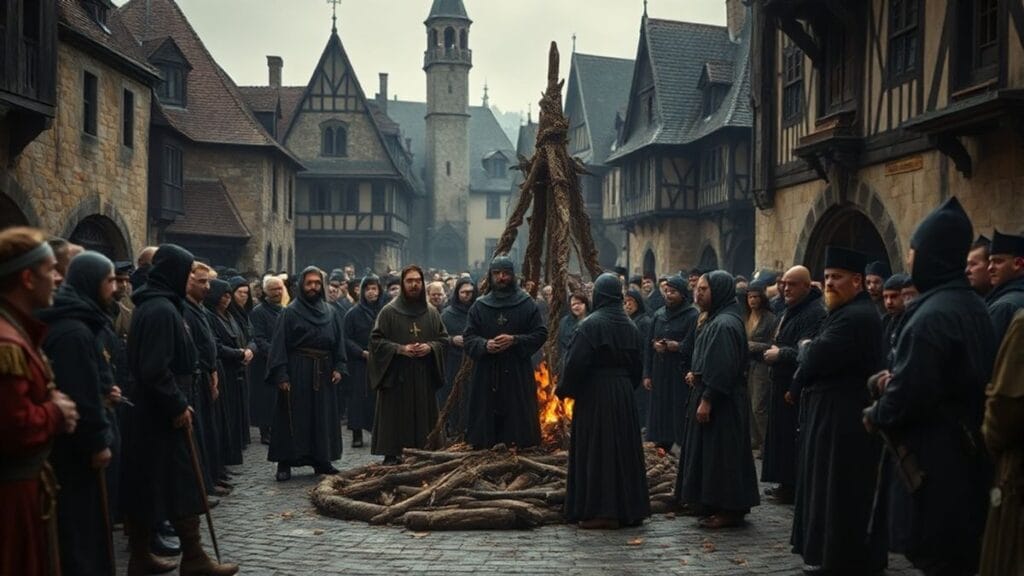
The pyre waited, wood stacked high, likely near one of the city gates or open spaces where a large crowd could gather. The air would have been thick with the smell of smoke and animals, with the murmur of voices that fell silent as the first flames were kindled. The condemned stood before the fire, with the city and its rulers arrayed against them. Their final words, if any, are lost to us. Only the crackle of burning timber and the shouts or prayers of the spectators echo faintly down the centuries.
Into the Fire: The Execution of Heretics in Orléans
At the heart of this story lies the fire itself. The condemned were tied to stakes or placed on a structure that would collapse as the flames rose. Execution by burning was not yet as frequent in early eleventh-century France as it would become in later centuries, but it already carried powerful symbolism. Fire purified; it destroyed utterly; it left little behind but ashes that could not be venerated as relics.
Chronicles speak of the heretics being “consumed by flames before the people,” an image as theatrical as it is brutal. The crowd watched as the fire took hold, climbing up clothing, devouring flesh. Some would have made the sign of the cross; others shouted, either in condemnation or in a kind of nervous relief. Children clung to their mothers, torn between horror and fascination. The smell of burning human bodies, once known, is not easily forgotten. For those present, the execution of heretics orleans 1022 would become a memory lodged as much in the senses as in the mind.
In medieval Christian thought, the fire on earth foreshadowed the fire of hell. The condemned were portrayed as already receiving in their bodies the punishment their souls deserved. Yet there was an ambiguity, too. Some clerics—perhaps even a few near the scene—might have been troubled. Was there no other way? Could not these doctrinal errors have been corrected by preaching, by penance, by exile? The choice of burning showed the desperation and determination of authorities who saw no room for compromise.
Nevertheless, the official narrative insisted on unanimity. The chronicler Ralph Glaber, writing in the following decades, described how, after the Orléans heretics refused to recant, “they were delivered to the secular arm and burned alive before all the people of the city,” concluding that such an example turned many back from error and confirmed the faithful in their beliefs (as cited in one modern translation). The story became one of triumph: false teachers exposed, justice carried out, orthodoxy vindicated.
But behind such neat accounts, we should imagine the individual faces: a canon who once sang at the altar, now screaming as the flames reached him; a laywoman, drawn to a movement promising higher purity, now choking on smoke; a young follower, barely grown, whose life ended before it truly began. Their ashes scattered over the soil of Orléans, mingling with the dust of forgotten soldiers and unnamed peasants. In that mingling, the stark lines between orthodox and heretic blur. History, however, would remember them above all as the ones burned so that others might fear.
And fear did spread. News of the execution of heretics orleans 1022 radiated outward through letters, sermons, and gossip, altering how many in Western Christendom imagined the dangers of hidden doctrine and the legitimate means to combat it.
Shockwaves Through Christendom: Reactions and Rumors
News traveled more slowly in the eleventh century than it does today, but it traveled nonetheless. Monks walking from monastery to monastery, traders along the Loire, messengers bearing royal letters—all carried with them stories of what had happened in Orléans. In abbeys and cathedral schools, the case was discussed as a troubling sign of the times: heresy had appeared not at the edges of Christendom but within its beating heart.
For some, the event confirmed long-standing fears that the devil sought to infiltrate the Church itself. The image of learned clerics rejecting the sacraments and mocking the cross played directly into fantasies of diabolical plots. Preachers could now point to Orléans as a warning: even those who appeared most pious might conceal dangerous beliefs. The faithful were called to vigilance; bishops, to renewed efforts at doctrinal discipline.
Others saw the episode as part of a wider wave of unrest. Reports circulated of strange groups in places like Arras and Aquitaine, accused of similar doctrines, though the connections are tenuous. Modern scholars suggest that the Orléans case contributed to a growing awareness among ecclesiastical elites that dissent might not be limited to isolated individuals, but could take more organized forms. The idea of heresy as a collective threat, requiring coordinated response, would grow in the wake of such events.
Rumors embroidered the facts. Some claimed that the Orléans heretics practiced obscene rituals, a common slander against unpopular religious groups. Others insisted that they were part of a broader network, reaching into other cities and courts. In the absence of precise information, fear filled the gaps. Each retelling nudged the story closer to legend, further from the lived experiences of the men and women who had died in the flames.
Yet behind the rumors lay real institutional consequences. Bishops discussed how better to inspect the beliefs of their clergy; kings considered how dissent within the Church might weaken their own legitimacy. The execution of heretics orleans 1022 thus became both a cautionary tale and a precedent, a remembered instance that could justify harsher measures in the future, whenever unusual teachings surfaced.
Shaping a New Weapon: From Orléans to the Medieval Inquisition
The Orléans burnings did not immediately create the robust machinery of persecution that we know as the medieval Inquisition. That would only emerge more than a century later, in the thirteenth century, under the pressure of movements like Catharism and Waldensianism. But historians often see the execution of heretics orleans 1022 as an early signpost along that dark road.
Before Orléans, heresy in the Latin West was typically handled in ad hoc ways: local bishops might confront deviant preachers; secular authorities might exile or, more rarely, execute particularly recalcitrant offenders. There was no standardized set of procedures, no specialized “inquisitors,” no central register of condemned doctrines. The Orléans case, however, illustrated the potential of a more coordinated response: king and bishops acting together, a formal assembly, interrogation under pressure, and finally, a highly public execution by fire.
In the decades that followed, Church councils increasingly discussed heresy as a systemic problem. They urged bishops to be vigilant, to investigate rumors, and to impose strong penalties where needed. The memory of earlier cases, including events at Orléans, gave these calls historical grounding. If heretics could infiltrate a royal city once, they could surely do so again.
When, in the thirteenth century, papal inquisitors like Bernard Gui began compiling manuals for the interrogation and punishment of heretics, they drew upon a legacy of past encounters. One can trace a conceptual line backward, through the repression of Cathars in Languedoc and the burning of alleged apostates in various cities, to the earlier, more improvised episode in Orléans. In this sense, the flames of 1022 cast a long, if uneven, shadow over later centuries.
None of this was inevitable. History is not a straight path. Yet the combination, in Orléans, of royal involvement, episcopal authority, doctrinal fear, and public execution created an example that later generations found compelling. The execution of heretics orleans 1022 showed that when faced with ideas deemed fundamentally subversive, authorities might bypass lesser punishments and turn directly to fire. That precedent would be invoked again and again.
Memory, Myth, and Silence: How Chroniclers Told the Story
The story we tell today about Orléans 1022 is filtered through a few surviving medieval voices, each with its own agenda and limitations. Chroniclers such as Ralph Glaber, writing in Burgundy, and Paul of Saint-Père de Chartres, closer to the scene, offered accounts that blend reportage with moralizing. They sought not just to record, but to teach and to warn.
Glaber, for instance, framed the episode as an example of divine providence: false teachers were unmasked and punished, proving that God would not allow wickedness to fester within His Church indefinitely. He highlighted the obstinacy of the heretics, their supposed disdain for sacred things, and the salutary fear their deaths inspired in others. The individual inner lives of the condemned did not concern him; they served rather as stock figures in a drama of good versus evil.
Other writers added details that may reflect local rumors rather than hard fact. Some accused the heretics of secret nocturnal meetings, of promiscuity masquerading as “spiritual love,” of magical practices. Such charges echo standard tropes used repeatedly in medieval anti-heretical literature. As the historian R. I. Moore has argued in “The Formation of a Persecuting Society,” the construction of the “heretic” as a dangerous internal enemy involved the accumulation of such stereotypes, regardless of the reality on the ground.
Strikingly absent from the record are the voices of the accused themselves. No confession in their own hand, no letters explaining their beliefs, no testimony offering an alternative narrative survives. Their silence is not accidental; it is part of the victory of those who burned them. Fire destroys not only bodies, but archives. The execution of heretics orleans 1022 thus lives in asymmetrical memory: we have abundant words about the heretics, but none from them.
This imbalance has forced modern historians into detective work, piecing together what little can be known while acknowledging the distortions of the sources. Was there truly a coherent heretical “sect” in Orléans, or was a loose circle of rigorist thinkers recast as a conspiracy after the fact? Did they genuinely deny all sacraments, or were subtle critiques of clerical practice inflated into theological revolt? No definitive answer is possible. We walk on uncertain ground, guided by texts that were already, from the outset, instruments of condemnation.
Politics in the Flames: Royal Authority and Episcopal Power
Behind the religious drama of Orléans lay a more worldly story about power. The early Capetian kings, still consolidating their fragile hold on the throne, relied heavily on the Church to legitimize their rule. Bishops served as royal counselors, abbots as political allies; in return, kings protected ecclesiastical privileges and intervened in disputes. The Orléans heresy offered a chance for Robert II to demonstrate publicly his commitment to safeguarding orthodoxy, thereby strengthening his moral authority.
For the bishop of Orléans, the case was equally significant. To admit that heretics had flourished within his own chapter could be seen as an admission of negligence. By leading, or at least participating in, a decisive crackdown, he turned vulnerability into proof of vigilance. The burnings sent a message not only to potential dissenters, but also to other clergy: episcopal oversight would be firm, and deviation would not be tolerated.
The queen’s position, as we have seen, sharpened the political stakes. If some of the accused had indeed enjoyed her favor, their condemnation allowed rivals at court to reassert their own influence and to emphasize the dangers of unconventional counselors. Aligning herself with the verdict, Constance could signal her loyalty to established doctrine and to the coalition of bishops and lords who supported the action.
In a society where written law was patchy and local custom varied, such dramatic acts of punishment helped shape norms. By participating in the execution of heretics orleans 1022, royal and episcopal authorities effectively declared that certain forms of belief were not merely erroneous but criminal in a way deserving of death. The boundary between sin and crime shifted, taking on a more clearly defined theological edge.
Later rulers would invoke similar logics. If the king was “very Christian” (rex christianissimus), then defending his subjects from doctrinal error was part of his mandate. If the bishop was shepherd, then beating back the wolves justified even violent means. In the flames of Orléans, the sword and the crozier appeared united against a common enemy, their convergence forging patterns that would recur throughout the Middle Ages.
Everyday People and Hidden Doubts: Social Echoes of the Orléans Burnings
What did the ordinary inhabitants of Orléans make of all this? The chronicles, focused on kings and bishops, rarely tell us. Yet we can attempt to imagine the social echoes left by the burnings, beyond the trembling satisfaction that “justice” had been done.
For some, the event must have confirmed their trust in the Church and the crown. To see the powerful act decisively against those described as enemies of the faith reassured them that cosmic order still held. Parents could point to the blackened ground where the pyre had stood and tell their children: “There, the heretics burned. Never stray from the path of the Church.” Fear became a tool of catechesis.
Others, however, may have felt unease. What if a neighbor they had liked, a priest they had respected, was among the condemned? What if the accused had, in fact, seemed holier than most, stricter in morals, more demanding of themselves? One can imagine quiet conversations in back rooms: “They say he denied the sacraments, but I heard him speak often of Christ. Could it be a mistake?” These doubts would mostly remain unrecorded, but they must have existed.
Such events also shaped how people handled their own religious questions. A person troubled by the corruption of local clergy, or perplexed by certain doctrines, would think twice before voicing their concerns too loudly. The memory of the execution of heretics orleans 1022 functioned as a warning: speculation could be dangerous; spiritual innovation could be deadly. Conformity, at least in outward expression, was the safer path.
Yet dissent and doubt do not vanish in the face of fear; they go underground. It is possible that, in the years after 1022, small circles in Orléans and beyond continued to discuss questions about the sacraments and the nature of the Church, but with greater discretion. If so, their traces have been wiped away by time, leaving only the official record of one highly visible crackdown.
Modern Historians Return to Orléans 1022
In the nineteenth and twentieth centuries, as the critical study of medieval history expanded, scholars turned fresh eyes on the Orléans episode. They compared the few surviving accounts, weighed their biases, and situated the event in broader patterns of social and ecclesiastical change. Their conclusions have been varied, sometimes sharply debated.
Some historians, like the early twentieth-century scholar H. F. Delaborde, emphasized the seriousness of the doctrinal deviations reported, seeing in the Orléans heretics precursors to later dualist movements. Others, particularly in the second half of the twentieth century, have grown more skeptical. They note how closely the charges align with stock accusations leveled elsewhere, and how convenient the narrative is for church authorities eager to display their vigilance.
R. I. Moore and other social historians have placed the execution of heretics orleans 1022 within what Moore famously called “the formation of a persecuting society”—a gradual process in which Western Europe, between the eleventh and thirteenth centuries, developed systematic ways of identifying, categorizing, and repressing internal enemies, including heretics, Jews, lepers, and others. From this perspective, the Orléans case is less about the specific beliefs of a small group and more about the evolving strategies of power.
More recent work has also attended to the gendered and social dimensions of the story. Were women among the condemned, as some chronicles hint? If so, what does that tell us about lay female religious aspirations and the anxieties they provoked? Did the movement appeal especially to certain strata—wealthy townspeople seeking more demanding piety, or frustrated clerics blocked from advancement? These questions remain open, but they point to a richer, more complex picture than the stark dichotomy of orthodox versus heretic allows.
Modern historians are, in a sense, like the people of Orléans gathering around the smoldering remains of the pyre, trying to make sense of what has happened. But unlike the onlookers of 1022, they are armed not with dogma but with critical tools, aware that the only voices we hear clearly are those of the victors. Their efforts cannot resurrect the dead or recover lost testimonies, but they can remind us that behind every label of “heresy” lay human beings whose thoughts and hopes were more tangled than their accusers admitted.
From Heretics to Martyrs? Reimagining the Condemned
In some modern retellings, the Orléans heretics have been recast not as foes of truth but as early martyrs of conscience—people who sought a purer faith and paid for it with their lives. This reversal reflects contemporary sensibilities, suspicious of institutions and sympathetic to dissenters. Yet it raises delicate questions: how far can we go in rehabilitating those about whom we know so little?
On the one hand, the brutality of their fate speaks for itself. Whatever their precise beliefs, they were killed publicly for what they thought and taught. No theft, no murder, no bodily crime was necessary to bring them to the stake. Their execution stands as a reminder that, in certain societies, ideas alone can be deemed so dangerous that they justify the destruction of those who hold them. In this sense, the execution of heretics orleans 1022 can indeed be seen as a dark milestone in the history of persecution for belief.
On the other hand, we must resist the temptation to project onto them modern ideals they may not have shared. They were products of their time, steeped in the same biblical and liturgical culture as their judges. Their likely goal was not the creation of a secular sphere of free opinion, but the attainment of what they saw as truer Christianity. If they criticized the Church, it was probably not in the name of pluralism but in the name of a more demanding, more exclusive truth.
Perhaps the most honest approach is to hold both aspects in tension. We can condemn the cruelty of their deaths, and the lopsided nature of the surviving testimony, without confidently declaring them saints of our own causes. We can, however, let their story trouble us. It asks: how do communities draw lines around truth? When does defense of cherished beliefs slide into violence? And what becomes of those whose convictions place them on the wrong side of those lines?
In remembering the execution of heretics orleans 1022, we remember, too, the fragility of religious freedom and the ease with which sincerely held faith can become the fuel of literal and metaphorical fires. Their ashes, long since scattered, continue to speak—not in words, but in the questions they leave behind.
Conclusion
The flames that rose in Orléans in December 1022 illuminated far more than a freezing winter sky. They cast light on a kingdom groping toward stability, on a Church anxious to define orthodoxy, and on a society in which belief and belonging were deeply intertwined. The execution of heretics orleans 1022 was not an isolated burst of cruelty; it was a convergence of fear, power, and conviction in a moment when the boundaries of acceptable faith were being redrawn.
By tracing the path from whispered suspicions in the cloister to a public pyre beside the Loire, we have seen how complex and contingent that convergence was. Personal rivalries, royal politics, reformist zeal, and genuine anxiety about salvation combined to turn a circle of clerics and followers into a spectacle of punishment. Chroniclers fixed the meaning of the event as a triumph over error, yet their own narratives, shot through with stereotypes and silences, reveal how much remains unknowable about the inner lives of the condemned.
In the centuries that followed, the memory of Orléans 1022 contributed, directly or indirectly, to the emergence of more systematized forms of repression, culminating in the medieval Inquisition. Yet even as we trace that line, we must remember that alternatives were possible, that the choice of fire was one path among many. To revisit this episode today is to confront not only the violence of the past, but also the enduring tension between the desire for shared truth and the danger of enforcing it with the instruments of death.
Standing imaginatively among the crowd of Orléans, we can feel both the certainty and the fear that drove people to watch the fire without turning away. Their world is not ours, yet the questions that burned there remain uncannily familiar. How do we live with difference? What do we do when deeply held convictions collide? The execution of heretics orleans 1022 offers no easy answers—only a stark reminder that the way we answer such questions can leave marks on human bodies, and on human memory, that last a very long time.
FAQs
- Who were the heretics executed in Orléans in 1022?
The heretics executed in Orléans in 1022 were a group of clerics—mainly canons of the cathedral of Sainte-Croix—and some lay followers, including possibly a few women. Their names are only partially preserved in the sources, with figures like Stephen and Lisois mentioned as leaders. They formed a circle known for strict piety and unconventional views, which authorities ultimately labeled as heretical. - What exactly did the Orléans heretics believe?
The precise beliefs of the Orléans heretics are unknown, because no writings from them survive. According to hostile chroniclers, they rejected key sacraments such as the Eucharist and baptism, denied the veneration of the cross and relics, and promoted an austere, possibly dualist spirituality. Modern historians caution that these accusations may reflect stereotypes rather than an accurate doctrinal summary. - Why was the execution of heretics orleans 1022 significant?
The execution was significant because it was an early, highly public use of burning as a punishment for heresy in the Latin West, carried out with both royal and episcopal participation. It demonstrated that dissenting religious ideas could be treated as a grave social and political danger, and it helped shape later patterns of anti-heretical persecution, including the development of inquisitorial procedures. - How reliable are the sources about the Orléans heretics?
The sources are few and biased. The main accounts come from ecclesiastical chroniclers writing after the event, who aimed to justify the condemnations and to warn against heresy. They provide valuable information but also rely heavily on standard anti-heretical tropes. Because the voices of the condemned themselves are entirely missing, historians must interpret the sources critically and acknowledge large areas of uncertainty. - Were women involved in the Orléans heresy?
Some chronicles suggest that women were among the followers of the condemned clerics, attracted by their emphasis on purity and intense spirituality. There are hints that at least a few women may have been executed alongside the male leaders, though details are scarce. Their presence highlights the appeal that alternative religious movements could have across gender and social lines. - Did the Orléans case directly lead to the creation of the Inquisition?
No, the formal medieval Inquisition only emerged in the thirteenth century, more than a hundred years after the Orléans burnings. However, the case contributed to a growing awareness among church and royal authorities that heresy might require coordinated, sometimes violent responses. As such, it forms part of a longer trajectory that eventually produced more systematic mechanisms of investigation and repression. - How do modern historians interpret the Orléans executions?
Modern historians are divided. Some see the Orléans group as genuine theological radicals, perhaps precursors to later dualist sects. Others argue that we are mostly seeing the construction of an internal “enemy” by church authorities eager to tighten control. Many now emphasize the broader social and political context, viewing the execution of heretics orleans 1022 as a key moment in the gradual formation of a more persecutory medieval society.
External Resource
Internal Link
Other Resources
- Encyclopaedia Britannica – general search for the exact subject
- Google Scholar – academic search for the exact subject
- Internet Archive – digital library search for the exact subject