Table of Contents
- On the Road to Al-Kudr: Medina in a Time of Siege
- After Uhud: A City Wounded, A Community Under Threat
- Rumors from the Desert: The Ghatafan Challenge Emerges
- Mustering the Saddle: The Prophet’s Decision to Strike First
- Forty Horsemen in the Night: The Force That Rode to Al-Kudr
- Through Sand and Silence: The March Across the Harrah and Beyond
- The Wells of Al-Kudr: Geography, Water, and Power
- A Raid Unfought: How the Battle at Al-Kudr Never Happened
- Booty, Camels, and Calculations: The Material Outcome
- Hearts and Loyalties: Bedouin Tribes Caught Between Powers
- Psychological Warfare in the Hijaz: Restoring the Aura After Uhud
- Voices from the Campfire: Anecdotes and Reported Eyewitness Fragments
- From Oasis Skirmishes to Imperial Horizons: The Strategic Legacy
- Memory and Manuscript: How Historians Reconstruct Al-Kudr
- Religion, Risk, and Reward: Spiritual Readings of the Expedition
- Echoes in Later Campaigns: Lessons Carried into the Confederates’ War
- Al-Kudr in Modern Imagination: Between Devotion and Critique
- Conclusion
- FAQs
- External Resource
- Internal Link
Article Summary: In the blistering summer of 625 CE, still reeling from the wounds of Uhud, the small community of Medina prepared for yet another clash—the expedition of al-kudr, a little-known but revealing desert operation directed against the Ghatafan tribes near a watering place north-east of the city. This article follows that expedition from its roots in Medina’s precarious political situation to the moment a small mounted force rode out under Muhammad’s command, determined to pre-empt a tribal raid before it reached the city’s vulnerable fields and herds. It traces the careful use of geography, intelligence, and speed that turned what might have been a violent confrontation into a lopsided show of force, ending without pitched battle yet reshaping tribal calculations. Along the way, it explores the experiences of the riders, the anxieties of farmers and families left behind, and the strategic thinking of a leader experimenting with deterrence in a hostile landscape. Drawing on early Arabic chronicles and later scholarship, the narrative situates al-Kudr within the wider tapestry of the early Muslim–tribal conflicts that surrounded Medina. It also examines the social and economic aftermath of the raid—the distribution of captured camels, the forging of alliances, and the subtle shifts in prestige among tribes of the Hijaz. Above all, the article argues that the expedition of al-kudr, though bloodless and easily overlooked, reveals how power in seventh-century Arabia could be asserted not only on the battlefield but at the margins of the desert, where control of a single well could tilt the balance between hunger and survival, humiliation and honor. Yet behind the sparse lines of the chronicles, there remain silences, contradictions, and contested memories, which this account explores with both narrative vividness and critical distance.
On the Road to Al-Kudr: Medina in a Time of Siege
The story of the expedition of al-kudr begins not at a lonely watering place, but within the crowded lanes and palm groves of Medina, a city that in 625 CE felt perpetually under siege. The wounds of the battle of Uhud were still fresh—literal wounds on the bodies of the veterans who limped through the markets, and invisible ones in the collective memory of a community that had tasted both triumph and sudden reversal. Medina’s people were farmers, craftsmen, traders, and migrants from Mecca, but they were also, increasingly, soldiers. Every raid, every rumor, every distant dust cloud on the horizon was weighed for its potential to become the next disaster.
At dawn, the muezzin’s call rose over a city that had become a garrison. Near the edges of the cultivated land, boys herded goats under watchful eyes; women drew water, casting quick glances towards the open desert; elders traded verses of poetry that remembered older tribal wars. Stories of Quraysh vengeance circulated in whispers: caravans might be gathering, allied tribes might be plotting, assassins might be on the move along the caravan tracks. Though the walls of Medina were not high, the sense of being encircled was growing. In that atmosphere, any news from the nomadic tribes surrounding the oasis carried the weight of threat.
From the north and the east, messengers arrived on foaming camels, bringing tidings of the Ghatafan—a powerful collection of Bedouin tribes whose grazing lands stretched across the Najd. Their name already evoked danger. For generations, the Ghatafan had raided and been raided, extracting tribute, seizing herds, and defending fiercely their own access to pasture and water. Now, reports suggested, elements of these tribes were being stirred against Medina, possibly with the encouragement of the Quraysh of Mecca. And at the heart of the whispers lay a place called al-Kudr, a humble watering point that would soon become the stage on which Medina’s new strategy of pre-emptive action would be tested.
In this tense climate, the expedition of al-kudr was conceived not as an isolated adventure but as one line in a longer script of survival. The city’s leadership understood that they could not wait passively for threats to coalesce and strike. They would have to meet danger in the open desert, on its own shifting terms, far from the safety of their own streets and orchards. Al-Kudr, as a name, meant little to most inhabitants—a dot in the wasteland, where only herders and scouts would pass. But before long, it would symbolize a new kind of warfare in the Hijaz: swift, calculated, and aimed as much at minds as at bodies.
After Uhud: A City Wounded, A Community Under Threat
To understand why a minor well like al-Kudr could draw the full attention of Medina’s leadership, one must first return to the slopes of Mount Uhud. Only months earlier, the Muslim community had marched out brimming with confidence, only to endure a painful setback when archers abandoned their positions and Quraysh cavalry swept around the flank. Though not a decisive defeat—the Quraysh withdrew without storming Medina—the psychological shock was immense. Many of the city’s most respected companions lay dead. The enemies of the Prophet in the surrounding regions interpreted Uhud as proof that the new community could bleed.
In the nights after the battle, Medina was haunted by silence. Mothers waited for sons who did not return; widows adjusted their garments in mourning; fathers recited the names of the fallen in trembling voices. The Qur’an itself would later allude to these days of fear and grief, when the believers wondered if God had turned away from them. Politically, too, the consequences were alarming. Tribal leaders who had been calculating their interests began to reconsider. If the Quraysh could inflict such damage so near to Medina, perhaps the new movement was not as invincible as its followers claimed.
The Ghatafan, with their long-standing rivalry against many of the Hijaz tribes, watched these developments closely. Situated farther inland, in the drier lands beyond the cultivated belts, they had little direct interest in Medina’s date palms. But alliances in Arabia were fluid, and opportunities to pressure a rising power could not be ignored. The Quraysh, licking their own wounds yet eager to maintain pressure, looked to such tribes as potential partners—client raiders who could harry Medina’s flanks while Mecca plotted larger coalitions.
Within the city, the Prophet’s authority was being tested in subtler ways. Some hypocrites—those who professed Islam outwardly while harboring hostility—whispered that the community’s future was bleak. Others fretted about the economy: with men away at war, who would bring in the harvest? In that context, the idea of allowing hostile raiders to approach unchallenged was unthinkable. The fields north and east of Medina, stretching towards Najd, contained the livelihood of hundreds of families. A single successful raid could strip the city of livestock, burn stored grain, and deepen the sense of vulnerability left by Uhud.
Thus, the expedition of al-kudr was shaped by more than strategy. It emerged from an atmosphere of wounded pride and fragile hope. The leadership needed a clear demonstration that Medina was not paralyzed by fear, that it would not crouch behind its palm trunks waiting for the next blow. An offensive ride into the semi-nomadic territories would serve as both a search for intelligence and a declaration: the community remained mobile, watchful, and capable of bringing the fight to its enemies, even in the wake of apparent setback.
Rumors from the Desert: The Ghatafan Challenge Emerges
In Arabia, news traveled in snatches of verse, in caravan gossip, in offhand remarks exchanged at wells. A freed slave might overhear a boast; a traveling merchant might notice unfamiliar banners near a spring; an old woman might remember when a similar pattern of movement preceded raids in years past. It is from such fragments that historians later reconstruct the context of the expedition of al-kudr. According to early chroniclers like Ibn Ishaq—preserved later by Ibn Hisham—reports reached Medina that a band from Ghatafan was regrouping near a watering place known as al-Kudr, with an eye toward raiding the outskirts of Medina’s territory.
Al-Kudr lay in a region where the line between settled and nomadic life blurred. Beyond the irrigated lands, the earth became a patchwork of gravel plains and low ridges. Wells like al-Kudr were lifelines; around them, the tents of climbers in the tribal hierarchy might gather for a season. For Ghatafan, such places served as staging grounds, allowing raiding parties to water their mounts, rest, and plan their routes. For Medina, any concentration of hostile riders at such a place posed an immediate risk. If not confronted, they could sweep suddenly towards the oasis, seize livestock, and vanish back into the desert before a response could be organized.
Yet rumors are not plans, and not all reports are accurate. Perhaps, in the initial telling, Ghatafan intentions were exaggerated; perhaps they were merely testing the waters, sending scouts closer to Medina’s sphere of influence as a warning. But in an environment where hesitation could mean disaster, the leadership leaned toward caution. They chose to interpret the movements near al-Kudr as the embryonic form of a raid and to respond accordingly.
The political backdrop was equally complex. Ghatafan was not a single tribe but a confederation, including branches such as Abs and Dhubyan, each with its own leaders and rivalries. For some of these groups, an alliance with Quraysh promised spoils and prestige; for others, neutrality or quiet engagement with Medina might be more attractive. A swift, forceful demonstration at al-Kudr could influence those calculations. If Medina could show that it could reach deep into Ghatafan territory and return safely—with livestock, no less—tribal elders might reconsider the risks of joining any open coalition against the Prophet.
Thus, the expedition of al-kudr was also an intervention in the fluid marketplace of allegiance that characterized seventh-century Arabia. By striking before Ghatafan raiders could move, Medina sought to change the mental equation of would-be opponents. It’s astonishing, isn’t it, that the fate of a growing religious and political community could hinge on how a group of desert horsemen interpreted the vulnerability of an oasis hundreds of kilometers away?
Mustering the Saddle: The Prophet’s Decision to Strike First
When the reports about al-Kudr reached Medina, the Prophet Muhammad convened his closest companions. In such councils, which later tradition preserves only in outline, discussions would have weighed risk against necessity. The city could ill afford to lose more fighting men so soon after Uhud—but it could even less afford to signal timidity. The decision, as recorded in early sources, was to dispatch a small, mobile force under the Prophet’s own leadership, targeting the Ghatafan gathering at al-Kudr before it could descend upon Medina’s lands.
The size of this detachment is striking. Many accounts mention around forty horsemen; some add a handful of foot soldiers. This was not a grand army marching with banners unfurled, but a lean strike force, designed for speed and surprise. The Prophet’s presence at its head was itself a message. By riding out personally, he transformed what might have been a mere punitive raid into an assertion of central authority. The leader of Medina was not a distant commander giving orders from behind walls, but a figure willing to share the dust, thirst, and danger of his men.
At the same time, the choice of such a small contingent reveals an appreciation of the realities of desert warfare. Large columns are slow and thirsty; they raise so much dust that any element of surprise is lost. A handful of riders, on the other hand, could traverse harsh ground at speed, living light off the land, choosing less-frequented routes. In the calculus of the expedition of al-kudr, surprise and psychological impact outweighed the need for overwhelming numbers.
Preparations began quietly. Water skins were checked for leaks; saddles were inspected; mounts were chosen not for beauty but for stamina. The men selected were likely those with experience in raiding and scouting, individuals who knew how to navigate by the stars and the shapes of distant hills. Within Medina, as the column assembled near the edge of the settlement, families watched in anxious silence. They had seen such scenes before, but now the stakes felt higher. After Uhud, any departure of fighting men stirred fears: would they return, or would their names join the list of martyrs recited in mournful cadence after the evening prayer?
Still, as the small force rode out, there was also a fragile sense of defiance. Here was a community refusing to be caged by its recent losses. The road to al-Kudr, though still only a trace across rock and sand, was also a road away from the image of victimhood and towards a new identity: of a people capable of seizing the initiative, even when hurt and outnumbered in the wider region.
Forty Horsemen in the Night: The Force That Rode to Al-Kudr
Imagine, for a moment, the line of horsemen as they left behind the last of Medina’s palm groves. The late-afternoon sun slanted low, throwing long shadows; the city’s sounds—children’s voices, hammers on wood, the soft splash of water—faded into the background. Ahead lay the stony uplands and the open desert. Each rider carried more than a spear or a sword: he bore the expectations of a community that needed a victory, however small, to steady its sense of direction.
Names are not preserved for all who rode that day, but early historians list several prominent companions among the participants in raids of this period: skilled horsemen like Abu Dujana, scouts who had learned the routes through years of caravan work, and veterans of Badr and Uhud who, despite their wounds, insisted on accompanying their leader. Their horses, Arabians bred for endurance, tossed their heads impatiently, sensing the tension in their riders’ bodies.
The Prophet, riding among them, balanced multiple roles: military commander, spiritual guide, and symbol of unity. To some of the younger men, he was the embodiment of courage under pressure, having endured the blows of Uhud and yet remained resolute. To the older companions, he was also the one who had transformed their personal feuds and tribal loyalties into a broader vision of community. Now, as they moved towards al-Kudr, that vision would be tested against the pragmatics of tribal politics and the harshness of the land.
The expedition of al-kudr was not a march into the unknown; the Prophet and several companions had traveled along these routes before, whether in trade journeys or earlier incursions. Still, each campaign carried its own uncertainties. Would Ghatafan scouts detect their movement? Would the men at al-Kudr stand and fight, or scatter into the desert? Would an ambush lie in wait behind some innocuous ridge? In desert warfare, knowledge of the terrain was as crucial as courage. The riders scanned the horizon, noting landmarks: a jagged rock formation, a dry riverbed, a line of acacia trees hinting at groundwater beneath.
At night, the small force likely traveled under dim starlight, resting their horses in short intervals, conserving energy. Whispered conversations moved from speculation about the enemy to more intimate topics: families, memories of Mecca, quiet recitation of verses. The combination of martial purpose and spiritual contemplation marked these early expeditions; as later Muslim historians would emphasize, their protagonists saw themselves not as mere raiders but as participants in a larger struggle for the survival of a faith and a way of life.
Through Sand and Silence: The March Across the Harrah and Beyond
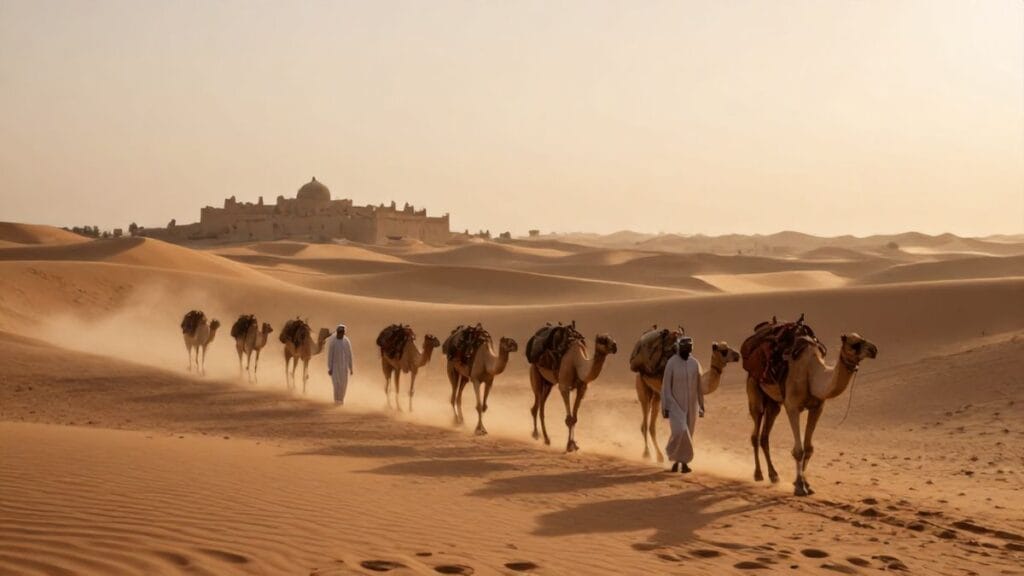
The road from Medina to al-Kudr led first across the harrah—a black, lava-strewn plateau that still today encircles parts of the city. Riding across this rough ground was exhausting; the horses’ hooves struck stone, raising sparks, while riders had to pick their way carefully to avoid injury. Yet for a small force seeking concealment, such terrain was an asset. Few raiding parties or caravans chose the harshest routes; by skirting the edges of the harrat, the expedition could reduce the chances of crossing paths with Ghatafan scouts.
Once beyond the rocky belt, the land opened into rolling gravel plains. Here, the sky seemed to expand to impossible dimensions, and the horizon was a thin, wavering line. The slightest rise could conceal an entire band of men; the slightest depression could hide a well. The air was dry enough to crack lips and parch throats within hours. Water discipline became a matter of survival. It is likely that the riders rationed their supplies strictly, sipping enough to stave off dizziness but not so much as to deplete their skins before reaching known springs.
In some later chronicles, we read of how the Prophet’s campaigns often moved in ways that confounded local expectations—taking less common routes, marching at unusual hours, doubling back to throw off potential trackers. While exact details for al-Kudr are sparse, the same pattern of tactical creativity likely applied. The very fact that the Ghatafan band was caught off-guard, as the sources agree, implies an approach that avoided obvious paths.
It was in this in-between world—neither settled nor entirely nomadic—that the ideological and political stakes of the expedition of al-kudr were most visible. Each well was a node in a network of power; each cairn of stones might mark a tribal boundary or a remembered battle. For centuries, Arabian tribes had waged war and made peace along these routes, defending or contesting access to pasture and water. Now, a new factor had entered the equation: a religiously defined community with its base in an oasis city, reaching out beyond its traditional territory to shape events farther afield.
As the riders drew nearer to their destination, the silence of the desert, broken only by the creak of leather and the soft clink of metal, must have pressed upon them. For all their training and faith, they were still a small group, far from support, advancing into the possibility of confrontation with an enemy that might outnumber them. Yet this was not reckless rashness; it was calculated risk, made necessary by the precarious balance of power in the Hijaz.
The Wells of Al-Kudr: Geography, Water, and Power
Al-Kudr itself was, in purely physical terms, unremarkable. It was one of countless water sources that dotted the arid lands around Medina—a cluster of wells or a spring surrounded by sparse vegetation, perhaps a few thorny shrubs and low acacias. But in Arabia, water transformed mere points on a map into strategic prizes. Whoever commanded a well like al-Kudr controlled not only drinking water but also the movement of herds and the safety of caravans passing nearby.
For semi-nomadic groups such as branches of Ghatafan, encamping near al-Kudr provided several advantages. It allowed them to graze their animals on whatever scrub and grass could be found, while positioning themselves along routes that led towards Medina’s north-eastern approaches. From such a base, they could fan out to raid, then retreat quickly to favorable ground. Even if they did not intend an immediate large-scale incursion, their very presence at al-Kudr sent a signal: Medina’s frontier was porous, and its hinterland contested.
Early Muslim chroniclers, in typically succinct style, tell us that when the Prophet’s force reached al-Kudr, the Ghatafan group scattered, leaving behind animals that were then seized as booty. Behind those bare lines lie layers of meaning. Geography had shaped behavior. A raiding party dependent on water sources could not risk being encircled near a well; to be trapped there meant death or capture. Thus, when they realized that a determined, organized force had descended on their camp, these tribesmen chose flight over battle, preserving their lives but sacrificing their livestock.
The choice of al-Kudr by Ghatafan, and the choice to ride there by the Muslims, reveals how early Islamic warfare intertwined with older patterns of desert life. The expedition of al-kudr was not about capturing a fortress or besieging a city. It was about who could appear, unannounced, at the right place at the right time, leveraging knowledge of wells and pastures into political advantage. In this sense, it echoed countless pre-Islamic raids—yet its implications reached further, because it formed part of a systematic strategy to secure Medina’s economic base and radiate its influence outward.
Standing at the edge of the well, one might have seen only a circle of muddy water, stamped by hooves and ringed with camel dung. Yet through the eyes of the riders who arrived that day, al-Kudr was both prize and warning: prize, because the enemy’s herds could be driven away; warning, because the very fact of hostile presence there demonstrated how closely the desert was watching Medina’s rise.
A Raid Unfought: How the Battle at Al-Kudr Never Happened
When military history is told, attention naturally gravitates to great clashes—lines of infantry, showers of arrows, the thunder of cavalry charges. The expedition of al-kudr offers almost none of this. According to the most reliable accounts, by the time the forty-odd horsemen from Medina descended upon the vicinity of al-Kudr, the Ghatafan band had already melted away, alerted by scouts or startled by the sudden appearance of an organized force. What remained were the traces of a camp and, crucially, the herds of camels and livestock that the raiders had either been too slow to drive away or forced to abandon in haste.
Thus, the “battle” of al-Kudr became, in effect, a confrontation unfought. Swords stayed largely sheathed; lances were not broken in close combat. The casualties, if any, were minimal. Yet to dismiss the expedition on these grounds is to misunderstand the nature of power in its context. The fact that Ghatafan chose flight rather than stand-up confrontation was itself a significant victory for Medina. It suggested that, despite Uhud, the aura of the Prophet’s leadership remained potent enough to unsettle desert fighters used to intimidation rather than being intimidated.
The riders from Medina captured a substantial number of camels and perhaps other livestock. For a city whose economy relied heavily on animals for transport, milk, and trade, such booty was far from trivial. But the real prize was moral. As the expedition of al-kudr concluded without a bloody engagement, it still managed to reverse, if only symbolically, the traumatic narrative of Uhud. Instead of being surprised and nearly encircled by Quraysh forces, the Muslims now had surprised a hostile group and sent them scattering. In the language of tribal honor, this inversion mattered deeply.
In later retellings, Muslim historians would often highlight campaigns that ended without major bloodshed as signs of divine favor and strategic wisdom. To win spoils and deter enemies without exposing one’s followers to heavy losses was no mean feat. One can imagine the relief among Medina’s families when the news arrived: an enemy group dispersed, booty taken, and the men returned alive. Yet behind the celebrations lay a more sober recognition: Ghatafan had not been annihilated, merely chastened. They remained a force in the region, their memory of al-Kudr now mingling with fresh grievances.
Nonetheless, as a case study in pre-emptive strategy, the expedition of al-kudr occupies a distinct place. It demonstrated that Medina could operate in a radius extending well beyond its immediate fields, and that it was able to respond swiftly to potential threats even with limited manpower. In the ledger of tribal calculations, this would be carefully noted.
Booty, Camels, and Calculations: The Material Outcome
When the small force returned to Medina leading strings of captured camels, the visual impact was undeniable. Children ran alongside, counting the animals; elders peered at the markings to guess which Ghatafan clans had lost them. The city, so recently accustomed to seeing its own wounded and dead return from battle, now watched the opposite: the spoils of a successful raid, taken without sustaining serious losses. For a community whose material resources were stretched thin, this mattered immensely.
According to Islamic law as it would later develop, war booty (ghanīma) was to be divided with a fifth reserved for the Prophet and the communal treasury, and the rest distributed among the fighters according to established shares. While the precise legal framework was still evolving in 625 CE, the basic principle of just distribution was already present. At al-Kudr, this meant that each participant in the expedition received tangible reward for his risk and endurance. A single camel could transform a man’s economic standing, allowing him to transport goods, support a family more securely, or participate in future trading ventures.
Yet the distribution of spoils was not merely an economic affair. It carried political and spiritual weight. By ensuring that those who had ridden to al-Kudr were compensated fairly, the Prophet reinforced loyalty and morale. Those who had stayed behind, whether due to age, illness, or the need to guard Medina, saw that participation in the community’s defense brought visible fruits. The expedition of al-kudr thus linked sacrifice and reward in a way that solidified the social fabric rather than fraying it with jealousy.
From the perspective of Ghatafan, the loss was painful. Camels were wealth, status, and survival rolled into one. To lose them without even fighting was a bitter pill. Tribesmen who had boasted of their readiness to challenge Medina now faced elders asking hard questions: Why had they not stood their ground? How could they have allowed their herds to fall into enemy hands? In the subtle economy of honor, these questions might do as much damage as the material loss itself.
Some modern historians, such as W. Montgomery Watt, have argued that such expeditions served as a form of “economic warfare,” redistributing resources from hostile tribes to the nascent Muslim polity and thereby consolidating its base. Whether one agrees with this framing or not, the basic reality is clear: al-Kudr diverted Ghatafan wealth towards Medina at a moment when the city needed both the sustenance and the psychological lift that visible, shareable success could bring.
Hearts and Loyalties: Bedouin Tribes Caught Between Powers
In the background of events like the expedition of al-kudr loomed the complex mosaic of Bedouin politics. Tribes such as Ghatafan, Abs, Dhubyan, and others had long histories of rivalry and alliance. They were not mere pawns of Mecca or Medina; they were actors in their own right, weighing which rising power to accommodate, resist, or exploit. The arrival of Islam—and with it, a new kind of centralized authority emanating from a settled oasis—posed uncomfortable questions for these desert groups.
For a Ghatafan elder sitting in the shade of his tent, hearing of al-Kudr would have been a moment of calculation. On the one hand, supporting Quraysh efforts against Muhammad promised potential booty and the preservation of the old religious order centered on the Ka‘ba and its tribal cults. On the other hand, overt enmity towards Medina now clearly carried risks. Its riders could reach deep into territory long assumed to be beyond the effective reach of any single city-state.
Individual tribesmen, too, found themselves torn. Some were intrigued by reports of Muhammad’s message—its insistence on one God, its calls for justice, its critique of old feuds. Others saw in Islam a threat to the cherished autonomy and honor codes of the desert. But irrespective of belief, everyone understood the language of power. The expedition of al-kudr translated theological claims into the familiar idiom of raids, spoils, and deterrence.
Beyond Ghatafan, other Bedouin groups were watching. Would Medina retaliate every time its territory was probed? Did it possess the stamina to launch repeated expeditions, or was al-Kudr an exception born of desperation after Uhud? These were not abstract speculations but matters of life and death. To misjudge the resolve of a rising power could lead to the burning of tents, the loss of herds, or the enslavement of families.
In this sense, the human consequences of al-Kudr extend beyond the immediate participants. They include the fearful conversations in far-off encampments, the reassessment of alliances, and the subtle shifts in the stories that poets recited by night. In those stories, Medina was no longer merely a distant oasis with a new prophet; it was an actor whose horsemen might appear suddenly at wells once thought secure.
Psychological Warfare in the Hijaz: Restoring the Aura After Uhud
Power, especially in its early stages, is as much about perception as about material force. After Uhud, the perception of the Muslims’ invincibility had been punctured. Enemies whispered that God had abandoned them; hesitant allies wondered if they had backed the wrong side. In such a climate, the expedition of al-kudr was a deliberate exercise in psychological warfare.
By riding out swiftly, seizing the initiative, and returning with booty, Medina projected an image of resilience. The message to Mecca and its tribal partners was clear: the setback at Uhud had not broken the community’s will to act. The message to Medina’s own inhabitants was equally important: their faith and their political project remained viable; they were capable not only of defending but of punishing.
Psychological effects were reinforced through narrative. As the story of al-Kudr spread, it was told and retold with variations in emphasis. Some recounted the fear on the faces of Ghatafan scouts as they realized they had been outmaneuvered; others highlighted the discipline and unity of the Muslim riders. While early sources remain sparse on colorful detail, it is inevitable that campfire retellings added vivid touches—a near-encounter in the dark, an exchanged challenge shouted across the sand, a moment of hesitation before the enemy broke and fled.
Yet behind the celebrations lay a quieter, more introspective dimension. The participants in the expedition of al-kudr would have compared their emotions to those felt during and after Uhud. Instead of the chaos of a pitched battle, they had experienced the tension of a hunt—the careful approach, the adrenaline of surprise, the sudden emptiness when the enemy chose not to stand and fight. Some may have felt a strange anticlimax: they had steeled themselves for a clash that never came. Others were simply grateful for a victory that did not demand more graves in Medina’s cemetery of martyrs.
In the aggregate, these psychological currents helped to restore something intangible yet critical: the aura of a community under divine and competent leadership. That aura would be tested repeatedly in the years to come, but al-Kudr stands as one of the early, understated efforts to repair it.
Voices from the Campfire: Anecdotes and Reported Eyewitness Fragments
The chronicles of early Islam, as compiled by later historians, preserve mostly the bare skeletons of events: dates, places, numbers, brief notes on outcomes. Yet scattered within them are occasional threads of anecdote that allow us to imagine the more intimate side of the expedition of al-kudr. Even when these details are sparse or debated, they help us approach the human texture of the story.
One oft-cited motif in descriptions of such raids is the moment when scouts first sight the enemy’s camp—from a rise in the land, or through the shimmer of heat at a distance. We can picture a pair of mounted men from Medina cresting a low hill and freezing in place as they spy the dark shapes of tents and the pale forms of camels clustered around the wells of al-Kudr. They count: how many fires, how many animals, how many visible warriors? They listen for the jangle of arms, the barking of dogs. Then they slip back to report, their hearts pounding with the knowledge that a miscalculation could cost every man in the detachment his life.
Another fragment, preserved in later biographies, tells of companions speaking respectfully yet frankly to the Prophet about the risks of particular operations. While we lack a verbatim record of any such exchange before al-Kudr, it is not hard to imagine a veteran of Uhud voicing concern: “Messenger of God, we are few, and these are desert men on their own ground.” The reply may have been a combination of reassurance and clear-eyed strategy: they would rely on surprise, on God’s favor, and on their discipline to avoid being drawn into an unfavorable pitched battle.
Upon reaching the abandoned camp at al-Kudr, there must have been a moment of eerie stillness. Saddles lay overturned; embers smoldered where fires had been hastily quenched; half-eaten scraps of food testified to a hasty departure. For the Muslims, relief at the absence of a waiting ambush mingled with a certain sense of anticlimax. They had come prepared to fight; instead, they were now herdsmen, rounding up terrified camels that bellowed and strained at their ropes.
Later, around Medina’s own campfires, such images would have been replayed. Some riders would boast of their role in the pursuit; others might dwell more on the uncertainty of the approaching march, recalling how every shadow at the horizon had seemed a potential enemy. In the telling and retelling, the expedition of al-kudr took on a life beyond its day or two of actual action. It became part of the shared memory of courage under uncertain conditions, of a time when the community was small enough that every such ride felt personal.
From Oasis Skirmishes to Imperial Horizons: The Strategic Legacy
Viewed from the vantage point of later centuries, when Muslim armies would cross into Syria, Iraq, and beyond, the seizure of some Ghatafan camels at an obscure well might seem trivial. Yet the pattern represented by the expedition of al-kudr contributed to the institutional memory that later commanders, consciously or not, would draw upon. It illustrated principles that would recur again and again: pre-emption, mobility, attention to logistics, and the strategic use of limited manpower.
First, the decision to strike at al-Kudr showed an understanding that threats must be met early, before they mature. This principle would echo in later campaigns against tribal confederations and in clashes with Byzantine and Sasanian forces, where rapid, focused action at key nodes—fortresses, river crossings, caravan routes—could prevent a more dangerous convergence of enemies.
Second, the reliance on small, highly mobile contingents presaged the raiding tactics that characterized much of early Islamic warfare on the fringes of empires. In Iraq and Syria, Muslim forces would repeatedly deploy cavalry to probe, harass, and outflank larger armies. The riders to al-Kudr, though few and operating on a much smaller scale, were practicing the same art: using speed and surprise to substitute for mass.
Third, campaigns like al-Kudr helped to normalize the idea that Medina—and by extension, later capitals—had the right and duty to project force beyond their immediate walls to secure distant peripheries. In pre-Islamic Arabia, raids were often private ventures, conducted by clans or sub-tribes for their own gain. The expedition of al-kudr, by contrast, was a state action, directed from the center, framed in moral and communal terms, and distributing its spoils according to an emerging public law. This shift from private raiding to state-managed expedition would underpin the transformation of tribal war bands into the armies of a burgeoning empire.
Finally, the psychological component—the conscious effort to demonstrate resilience after Uhud—foreshadowed the importance Muslim leaders would place on maintaining morale and the perception of divine favor in later, far more complex theaters of war. Victories and disciplined withdrawals alike would be narrated in ways that reinforced the community’s self-understanding as guided and protected, even when outnumbered.
Thus, while the expedition of al-kudr occupies only a few lines in early chronicles, it is a small but telling piece of a much larger story: how a vulnerable oasis community learned to act like a state, and then like the nucleus of an empire.
Memory and Manuscript: How Historians Reconstruct Al-Kudr
Our knowledge of the expedition of al-kudr comes primarily from Muslim historiography written generations after the events, drawing on oral traditions preserved by families and transmitters. The earliest extant biography of Muhammad, that of Ibn Ishaq (d. 767), as edited and transmitted by Ibn Hisham (d. 833), includes brief notices of such expeditions, often listing them in chronological order with spare commentary. Later historians like al-Tabari would incorporate these accounts into more expansive universal histories.
These sources, invaluable as they are, pose challenges. They are not modern battle reports; they intermingle piety, didactic aims, and tribal memory. Chains of transmission (isnads) were supplied to vouch for the authenticity of reports, yet historians must still ask: who told this story first, and what did they wish to emphasize or conceal? A tribe embarrassed by flight at al-Kudr might have downplayed its involvement; companions proud of their participation might have highlighted their courage while glossing over moments of doubt.
Modern scholars have approached the material with a mixture of respect and critical scrutiny. Some, like the German orientalist Julius Wellhausen, regarded early raid narratives as partly shaped by the need to justify later legal and political norms. Others, such as Fred Donner, have argued that while embellishments exist, the underlying pattern of small-scale expeditions, including the one at al-Kudr, is historically plausible and consistent with what we know of Arabian warfare at the time. As Donner notes in his work on the early Islamic community, “These raids, though often militarily minor, played a crucial role in defining boundaries, securing resources, and reinforcing communal solidarity.”
Archaeology offers limited help in this particular case. Wells like al-Kudr leave few distinctive traces that can be unambiguously tied to a specific event fourteen centuries ago. The desert tends to preserve silence as much as memory. Thus, historians must reconstruct the expedition primarily through texts, cross-referencing mentions, considering the reliability of transmitters, and situating al-Kudr within the broader narrative of campaigns between Badr, Uhud, and the Battle of the Trench.
This process of reconstruction is itself part of the story. It reminds us that what we call “history” is a mosaic assembled from fragmentary tesserae—reports, genealogies, legal discussions, pious tales. The expedition of al-kudr as we know it is both an event that happened and a narrative that has been told and retold, each time emphasizing different aspects. To read it critically is not to dismiss it, but to encounter it with both imagination and discipline.
Religion, Risk, and Reward: Spiritual Readings of the Expedition
For the believers of Medina, the expedition of al-kudr was not just a matter of security policy; it was a test of faith. Participation in such ventures was framed in sermons and Qur’anic recitations as part of a broader struggle in God’s path. The willingness to ride into the desert, facing thirst, fatigue, and potential death, was interpreted as a sign of trust in divine guidance and reward.
Within this religious framework, the outcome at al-Kudr took on spiritual meaning. The lack of heavy casualties, the dispersal of the enemy, and the capture of booty without pitched battle were seen as manifestations of divine aid. Passages of the Qur’an that spoke of God causing enemy hearts to tremble or granting provision from unexpected sources would have resonated powerfully in the wake of such an expedition. Even if no verse explicitly referenced al-Kudr, the logic of the sacred text and the lived experience of the riders intertwined.
At the same time, theologians and jurists in later generations would use examples like the expedition of al-kudr when discussing the ethics of war. Could Muslims initiate action against hostile tribes before being attacked? What obligations existed to offer terms, warnings, or invitations to Islam? While opinions varied, many saw in pre-emptive expeditions a precedent for striking those credibly preparing aggression, especially when they had a history of hostility and raiding. In this reading, al-Kudr exemplified defensive pre-emption rather than aggression.
Spiritual reflection did not ignore the human cost—wives waiting for news, the fear felt in the night, the enduring trauma left by earlier battles. But it sought to subsume these experiences into a narrative of meaningful sacrifice. To those who rode, the knowledge that their actions were framed as worship as well as warfare may have offered solace. If they returned with camels, that was a worldly benefit; if they died, they hoped for a martyr’s reward. In between lay the everyday grit of marching, scouting, and obeying commands under harsh sun.
Thus, the expedition of al-kudr sits at the intersection of strategy and spirituality. It cannot be understood fully as merely a raid, nor merely as a religious test. It was both, simultaneously—a fusion that characterized much of the early Islamic movement.
Echoes in Later Campaigns: Lessons Carried into the Confederates’ War
The months and years after al-Kudr would see Medina face even greater dangers, foremost among them the siege known as the Battle of the Trench (al-Khandaq), when a vast confederation of Meccan, Ghatafan, and other forces converged to crush the young community. In that desperate hour, the memory of earlier expeditions, including al-Kudr, would have influenced both friends and foes.
For Ghatafan leaders deliberating whether to join the Meccan coalition, the recollection of how a small Medinan force had penetrated to al-Kudr and carried off their camels could cut both ways. On one hand, it might increase their desire for revenge and their willingness to risk an open alliance against Muhammad. On the other, it served as a reminder that Medina was not a passive victim but a determined, mobile adversary that had already struck them once on their own terrain. The calculus of risk, honor, and potential gain became more complex.
Within Medina itself, the experience of conducting campaigns like the expedition of al-kudr honed organizational skills. The city learned how to mobilize quickly, how to manage limited supplies, and how to coordinate scouting with main forces. Protecting wells and controlling access to water remained a recurring theme, now not only in distant places like al-Kudr but also in the trenches and defensive works dug around Medina to deny the enemy easy approach.
When the great confederation finally arrived and encamped outside Medina, the city’s defenders could draw psychological strength from earlier episodes of resilience. They had seen their leader return safely from raids into intimidating territory; they had watched him turn precarious situations into opportunities. Al-Kudr, alongside other expeditions, formed part of the prehistory of that more famous siege, teaching lessons of patience, vigilance, and the importance of denying the enemy easy victories.
In this way, the modest, almost bloodless expedition of al-kudr reverberated far beyond its own narrow frame of time and place. Its echoes are faint but discernible in the strategies, alliances, and memories that shaped the critical confrontations of the Medinan period.
Al-Kudr in Modern Imagination: Between Devotion and Critique
Today, the expedition of al-kudr occupies a curious place in Muslim and scholarly consciousness. For many devout Muslims, it is one among dozens of prophetic campaigns listed in biographies and lessons, evidence of the Prophet’s steadfastness and strategic foresight. It may be mentioned in sermons as an example of taking initiative in the face of threat, of relying on God while also planning carefully. In such devotional contexts, the focus lies on loyalty, courage, and trust in divine protection.
Modern historians and critical readers, meanwhile, often approach al-Kudr through different lenses. Some see in it an illustration of how early Islam navigated the blurred line between defensive and offensive action, between spiritual community and political state. Others examine it as part of a broader pattern of resource acquisition and tribal subjugation in the Hijaz, asking hard questions about the ethics of pre-emptive strikes and the treatment of defeated tribes. One historian has noted, for instance, that “expeditions like al-Kudr, economically modest though they were, helped to erode the independence of surrounding tribes and draw them into the orbit of the Medinan polity.”
These differing perspectives sometimes collide. Devotional narratives can feel threatened by critical analysis, while purely political readings can underestimate the sincere religious convictions that motivated many participants. Yet a fuller understanding of the expedition of al-kudr emerges when we allow it to be complex—neither romanticized nor reduced to cynical self-interest.
In popular culture, al-Kudr rarely appears. It has not inspired epic films or novels; its lack of dramatic battle scenes makes it an unlikely focus for visual storytelling. But precisely because it is understated, it offers a valuable corrective to simplistic images of early Islamic history as a succession of spectacular battlefield triumphs. It shows a leader and a community grappling with uncertainty, taking measured risks, and finding ways to exert influence without always resorting to large-scale bloodshed.
For readers today, whether believers or not, the story of al-Kudr invites reflection on familiar themes: how communities respond to trauma, how they manage threats on their frontiers, how they balance ideals with survival. In the lonely well of al-Kudr, we glimpse not only the concerns of seventh-century Arabs but also enduring human questions about power, fear, and resilience.
Conclusion
The expedition of al-kudr, near Medina in 625 CE, unfolded far from the monumental battlefields that so often dominate our understanding of the past. No famous general fell there; no city walls were stormed; no sweeping tactical maneuvers were recorded in ornate detail. And yet, in that quiet operation against a Ghatafan band encamped by a nondescript well, we can see the early Muslim community learning how to survive—and how to shape its environment in the face of relentless pressure.
Born from the trauma of Uhud and the constant fear of raids, the decision to ride to al-Kudr was both strategic and symbolic. Strategically, it denied a hostile group the chance to strike first, secured valuable livestock, and demonstrated that Medina’s reach extended beyond its palm groves into the rough lands of Najd. Symbolically, it helped to mend a wounded sense of invincibility, showing followers and foes alike that the Prophet and his companions remained active, mobile, and unbroken.
Through the lens of this seemingly minor expedition, we glimpse the interplay of geography and politics, of tribal honor and religious conviction. Al-Kudr reminds us that in early Islam, as in many historical contexts, the frontiers of a community were not fixed lines on a map but shifting zones of negotiation, where wells and grazing grounds could become arenas of power. It also underscores how psychological warfare—shaping perceptions of strength and resolve—mattered as much as capturing ground.
Finally, the story of al-Kudr invites us to respect the fragility and contingency of the early Muslim project. There was nothing inevitable about its survival. Each decision—whether to wait or to ride, to risk a small force or hold it in reserve—carried heavy consequences for a community still small enough that every death was felt personally. That a modest, largely bloodless ride to a desert well could play a role in securing Medina’s future is a testament to how, in history, even the quietest expeditions can reverberate across centuries.
FAQs
- What was the expedition of al-Kudr?
The expedition of al-Kudr was a small, pre-emptive military operation led by the Prophet Muhammad in 625 CE against a Ghatafan tribal group reportedly gathering near a watering place called al-Kudr, north-east of Medina. The Muslim force, numbering around forty mounted men, surprised the enemy camp, causing its occupants to flee and leaving behind camels and other livestock that were seized as booty. - Why did Medina launch this expedition?
Medina organized the expedition of al-kudr to counter a perceived threat from Ghatafan tribes who were believed to be preparing a raid against the city’s hinterland. Coming soon after the traumatic battle of Uhud, the expedition aimed to protect Medina’s economic resources, deter future attacks, and restore confidence in the community’s ability to act decisively. - Where exactly was al-Kudr located?
Al-Kudr was a watering place—likely a cluster of wells or a small spring—situated to the north-east of Medina, in the direction of the Najd plateau. Its precise modern location is uncertain, but early sources consistently describe it as lying within territory frequented by Ghatafan and related tribes, at some distance beyond Medina’s cultivated zone. - Did a major battle take place at al-Kudr?
No, there was no major pitched battle during the expedition of al-Kudr. When the Muslim detachment approached, the Ghatafan group at the wells apparently chose to scatter and flee rather than engage in direct combat. As a result, the Muslims captured livestock but did not fight a large, set-piece engagement. - Who participated in the expedition?
Most early reports agree that the Prophet Muhammad himself led the expedition, accompanied by a small group of companions—around forty mounted fighters, possibly with a few additional men on foot. While the sources do not preserve a complete list of names, they suggest that experienced horsemen and veterans of earlier battles were chosen for their mobility and familiarity with desert routes. - What was the outcome for the Ghatafan tribe?
Ghatafan suffered the loss of camels and other livestock left behind in their hurried departure from al-Kudr. Although they avoided heavy casualties by not fighting, the material loss and the humiliation of flight damaged their prestige. The event also demonstrated to Ghatafan and other tribes that Medina could project force into their territory, complicating their future calculations about open hostility. - How important was this expedition in the larger context of early Islam?
Militarily, the expedition of al-kudr was small, but its significance lies in strategy and psychology. It showed that Medina would not remain on the defensive after Uhud, that it could act quickly on intelligence, and that it was willing to confront hostile tribes far from its own fields. In the evolving pattern of campaigns around Medina, al-Kudr helped shape the perception of Muslim resolve and reach. - What sources describe the expedition of al-Kudr?
The expedition is mentioned in early Arabic sīra (biographical) and historical works, notably in the tradition of Ibn Ishaq as edited by Ibn Hisham, and later in al-Tabari’s chronicle. These accounts are brief but consistent on key points such as the target (Ghatafan), the location (al-Kudr), the leadership (the Prophet), and the outcome (enemy flight and capture of livestock). - How do historians today assess the reliability of these reports?
Modern historians generally regard the basic outline of the expedition—its timing, location, and outcome—as plausible and consistent with known patterns of Arabian warfare. While they acknowledge that later transmitters may have simplified or moralized the narrative, most see no strong reason to doubt that a small, successful pre-emptive raid took place at al-Kudr as described in the traditional sources. - What does the expedition of al-Kudr tell us about early Muslim warfare?
It illustrates several key features: reliance on small, mobile forces; careful attention to geography and water sources; the use of pre-emptive action against perceived threats; and the integration of material aims (capturing booty) with broader political and spiritual goals (deterring enemies, reinforcing communal solidarity). In this way, al-Kudr offers a window into how the early Muslim community balanced survival, faith, and strategy.
External Resource
Internal Link
Other Resources
- Encyclopaedia Britannica – general search for the exact subject
- Google Scholar – academic search for the exact subject
- Internet Archive – digital library search for the exact subject