Table of Contents
- A February Decree That Shook an Empire
- Spain Before the Storm: Empire, Enlightenment, and Suspicion
- The Society of Jesus in the Spanish World
- From Lisbon to Madrid: The Shadow of Earlier Expulsions
- The Night of 27 February 1767: A Secret Becomes Law
- The Silent Knock: Arrests in Madrid and Castile
- Across the Atlantic: Shockwaves in New Spain and Peru
- Tears at the Dockside: The Forced Voyages into Exile
- Inside the Court: Charles III, the “Squillace Riots,” and the Enlightened Ministers
- The Official Charges: “Reasons of State” and the Black Legend of the Jesuits
- Colonial Upheaval: Missions, Indigenous Peoples, and the Emptying of the Frontiers
- Books, Classrooms, and Confessions: The Social Void Left Behind
- Exile in Italy: Letters, Memoirs, and the Memory of a Lost America
- From Expulsion to Suppression: A Global Order Under Siege
- Legacies in the Spanish World: From Bourbon Reforms to Independence
- The Return of the Jesuits and the Persistence of Memory
- Historians, Myths, and the Long Debate Over Guilt and Innocence
- Conclusion
- FAQs
- External Resource
- Internal Link
Article Summary: On 27 February 1767, a royal decree in Madrid launched the expulsion of the Society of Jesus from Spain and its colonies, transforming overnight the religious, intellectual, and political landscape of an entire empire. This article traces how a secret order, carried by couriers through the night, uprooted thousands of Jesuits from universities, missions, and churches from Castile to California and from Cartagena to Manila. It explores the mixture of Enlightenment reform, state anxiety, and court intrigue that framed the expulsion of the society of jesus as an act of “reason of state.” Moving chronologically, the narrative follows the soldiers’ knocks at midnight, the weeping crowds at the ports, and the long, bitter journeys to Italian exile. The article also examines the consequences for indigenous missions, colonial education, and the spread of new political ideas that would later nourish independence movements. Along the way, it engages with historians’ debates over whether the Jesuits were victims of slander or architects of their own downfall. Ultimately, the story shows how a single decree could reveal the fault lines of empire and the fragile balance between conscience and crown. It is a tale of power, faith, and memory that continues to shape how we understand authority and dissent in the early modern world.
A February Decree That Shook an Empire
On a cold winter’s evening in Madrid, in the closing days of February 1767, a small circle of ministers gathered in guarded silence around King Charles III. The empire they ruled was still one of the largest on earth, its territories stretching from the Basque country to the Philippines, from the forests of Paraguay to the high plateau of New Spain. Yet beneath the ritual calm of court life, suspicion and calculation had been hardening into a decision that would change the face of Spanish Catholicism forever. That decision, set down under wax seal and trusted only to a handful of men, was the expulsion of the Society of Jesus from every corner of the Spanish monarchy.
It is astonishing, isn’t it, that the fate of thousands could be bound up in a few sheets of paper and the resolve of one king? The document, once signed, contained a simple but devastating command: all Jesuits were to be arrested on the same night and transported immediately to the coast, then shipped into exile, never to return to Spanish domains. The decree would cross oceans and mountain ranges, carried by couriers who had been sworn to absolute secrecy, timed so that in Mexico City, Lima, Bogotá, and Manila, the same drama would unfold almost simultaneously. The expulsion of the society of jesus was not an accident of passion, but a carefully orchestrated stroke of statecraft.
Yet behind the calm legal language lay human lives: confessors who had guided the consciences of nobles, teachers who had instructed generations of creole youths, missionaries who had built fragile communities at the edge of the known world. When the order was made known—first to ministers, then to provincial officials, and finally to the soldiers who would execute it—a web that had taken two centuries to spin across the Spanish world was about to be torn apart in the course of a few nights. This article reconstructs that slow tightening of the noose and the sudden snap, following the decision from royal council chambers to remote mission chapels on the fringes of empire.
The expulsion of the Society of Jesus in 1767 was neither the first nor the last blow dealt against the Jesuits in eighteenth-century Europe, but in the Spanish case it was unusually sweeping. It extended across continental Spain, the kingdoms of Naples and Sicily under Bourbon influence, and the vast overseas colonies of Spanish America and Asia. To understand why such an act became possible—and why it seemed, to many of its authors, both necessary and unavoidable—we must begin with the uneasy marriage between an “enlightened” monarchy and an old, powerful religious order that had long served the crown, but never fully submitted to it.
Spain Before the Storm: Empire, Enlightenment, and Suspicion
On the eve of 1767, Spain was living a paradox. Officially, it remained the Catholic monarchy par excellence, still proud of its role as defender of the faith. Yet the Bourbon rulers who had replaced the Habsburgs in the early eighteenth century were deeply influenced by the currents of the European Enlightenment. They aspired to govern through “reason,” efficiency, and centralization, to reform what they saw as a decaying and fragmented imperial machine. At the same time, they feared the circulation of ideas and institutions they could not fully control. Few institutions embodied this contradiction more vividly than the Society of Jesus.
The Jesuits had long been a pillar of Catholic orthodoxy, forged in the crucible of the Counter-Reformation. Their schools, seminaries, and missionary stations bound Europe to far-flung frontiers, from China to the Amazon. But their global reach, relative autonomy, and intense internal discipline also made secular rulers wary. They were directly subject to the pope, not to local bishops or kings. They cultivated the education of elites and maintained vast networks of correspondence. To ministers steeped in the new language of “sovereignty,” this looked less like loyal service and more like a power within a power.
Spain itself was emerging from a painful period of war and humiliation. The War of the Spanish Succession, which had opened the century, cost the monarchy several European territories and exposed the need for administrative overhaul. Bourbon reformers, drawing inspiration from France, spoke of “regenerating” the empire and pruning away abuses, privileges, and intermediaries that hindered royal authority. Under Philip V, Ferdinand VI, and finally Charles III, new ministers pushed for fiscal centralization, military modernization, and administrative rationalization. In this atmosphere, every corporation—whether a trade guild, a town council, or a religious order—fell under a sharper gaze.
Culturally, too, the winds were shifting. Enlightenment thinkers in Spain, sometimes called “ilustrados,” devoured translated works of French and Italian philosophes. Though they remained loyal Catholics, many were critical of what they deemed superstition, backward practices, and clerical interference in worldly affairs. They especially criticized bodies they saw as obstacles to educational reform and economic modernization. It is no coincidence that some of the leading lights of this movement circled around Charles III, particularly once he moved from ruling Naples to the Spanish throne in 1759.
The expulsion of the society of jesus would later be justified as a necessary step to free the crown from clerical meddling and to clear the path for rational reform. But in these pre-1767 years, the tension was still largely latent. Jesuit colleges remained prestigious; Jesuit confessors still whispered in noble ears. The Society was both insider and outsider, essential and suspect. It took a series of shocks—from Lisbon to Madrid’s own streets—to transform latent suspicion into open hostility, and to sharpen the idea that the Jesuits were not simply a religious order, but a political threat.
The Society of Jesus in the Spanish World
To grasp the scale of what the expulsion meant, one must picture how deeply enmeshed the Jesuits were in the fabric of the Spanish world by the mid-eighteenth century. Since their arrival in the sixteenth century, they had become educators, preachers, confessors, and missionaries, woven into both elite and popular life. Their colleges dotted the Iberian Peninsula, standing alongside universities as centers of learning. In cities like Salamanca, Seville, and Valladolid, parents of rank quietly competed for places for their sons at Jesuit institutions, convinced that no one taught Latin, logic, and rhetoric quite like they did.
Across the Atlantic, their presence was even more striking. In Mexico City and Lima, Jesuit colegios educated future lawyers, clerics, and bureaucrats—creole elites who would later be among the protagonists of independence. In frontier zones such as Paraguay, the Chaco, the Californian coast, and northern New Spain, Jesuit missionaries organized reducciones, or mission towns, bringing together dispersed indigenous peoples under their guidance. These communities were at once experiments in Christianization, economic organization, and cultural mediation. The Jesuits learned local languages, compiled dictionaries and grammars, taught new agricultural techniques, and often acted as buffers between indigenous communities and rapacious colonial settlers.
Economically, the Society of Jesus controlled significant assets. Their colleges and missions possessed lands, vineyards, cattle herds, and workshops whose income supported their educational and religious work. Their management was often efficient, and their estates were carefully administered. To some observers, particularly reform-minded officials, this looked uncomfortably like a “state within a state,” sheltered by religious privilege from the fiscal demands that increasingly burdened ordinary subjects. Critics muttered that the Jesuits hoarded wealth and used it to bolster their independence, while defenders countered that their resources sustained schools, missions, and charitable works the crown could not fund.
Spiritually, their influence was no less important. Jesuit directors of conscience served as confessors to nobles, court officials, and wealthy merchants. Their spiritual exercises and retreats shaped the inner life of many devout laypeople. Their sermons drew crowds in major cities; their missions in the countryside stirred popular fervor. They were, in short, deeply embedded in both the vertical and horizontal networks of power in the empire. To pluck them out would be like tearing a major artery out of a living body. That is precisely what the expulsion of the society of jesus sought to do.
Yet for all their integration, the Jesuits’ supra-national identity remained a sore point. They pledged obedience to a general in Rome, and ultimately to the pope, not to the kings whose realms they inhabited. Their international correspondence tied Lima to Rome, Mexico City to Prague, Manila to Paris. News, ideas, and opinions flowed along these channels in ways that no secular administration could fully supervise. In a world where rulers increasingly equated sovereignty with surveillance and command, such a network could easily be cast as subversive. The more effective the Jesuits were, the more their very success made them vulnerable.
From Lisbon to Madrid: The Shadow of Earlier Expulsions
The drama of 1767 did not emerge from a vacuum. It unfolded in the shadow of earlier confrontations that marked the eighteenth century as an age of assault on the Society of Jesus. The most important of these, for Spain, occurred across the border in Portugal. After the devastating Lisbon earthquake of 1755, the powerful minister Sebastião José de Carvalho e Melo—better known as the Marquis of Pombal—moved to reconstruct not only the ruined city, but the political order itself. Determined to centralize royal power and break aristocratic and clerical resistance, Pombal targeted the Jesuits as obstacles to reform and as alleged conspirators.
By 1759, Pombal had secured the expulsion of the Jesuits from all Portuguese dominions. The stated reasons were multiple: accusations of trade irregularities in the Amazon, complaints about Jesuit influence over education, and—most explosively—claims that Jesuits had been implicated in a plot to assassinate King José I. Modern historians tend to treat these charges with skepticism, viewing them as politically orchestrated. Yet what mattered for contemporary observers, including those in neighboring Spain, was the spectacle of a fellow Catholic monarchy casting out the Society with papal acquiescence or at least reluctant tolerance.
Spain watched closely. The Portuguese expulsion sent a clear signal: it was now thinkable, even fashionable in some European courts, to discipline or eliminate the Jesuits in the name of “reason of state.” France would follow suit in the early 1760s, with the French parlements (high sovereign courts) condemning the Society and forcing its suppression in the kingdom. Pamphlets circulated, painting the Jesuits as economic speculators, political intriguers, and doctrinally suspect casuists. These texts crossed the Pyrenees and the Atlantic, translated or simply smuggled in, contributing to a transnational “black legend” about the Order.
Charles III, who had himself ruled Naples—where the Jesuits had strong roots—could not remain indifferent. When he ascended the Spanish throne in 1759, he brought with him ministers shaped by the same reformist currents that had influenced Pombal. They admired the notion of a streamlined, disciplined state with reduced ecclesiastical privileges. France’s moves reinforced the impression that the Society was out of step with the spirit of the age. By the mid-1760s, key advisors in Madrid were already contemplating whether the Spanish monarchy, too, should sever its long relationship with the Jesuits.
In one respect, though, the Spanish case was unique. The Jesuits were even more entrenched in Spanish America than in Portugal’s smaller, more scattered colonies. Any move against them would not only alter the religious balance at home, but send shockwaves through the colonial order. This awareness did not deter reformers; it tempted them. For they also believed that the Jesuit-dominated missions and colegios in the Americas hindered more direct royal control. In their vision, the expulsion of the society of jesus would be the key that unlocked a broader program: Bourbon reforms in administration, economy, and ideology.
The Night of 27 February 1767: A Secret Becomes Law
The decisive turning point came with the royal pragmática of 27 February 1767. The document, drafted in utmost secrecy, bore a chilling clarity. It ordered that all members of the Society of Jesus in Spain and the Indies—priests, brothers, novices alike—be arrested simultaneously, stripped of their possessions, and conducted under guard to ports where ships awaited to take them to the Papal States. They were forbidden ever to return to Spanish territories. Their properties were to be confiscated in the name of the crown.
The wording, as preserved in contemporary copies, justified the measure “for just causes and urgent, hidden reasons, which I reserve in my royal breast.” This formula of “hidden reasons” would become infamous. It signaled at once the sovereign’s absolutist prerogative and his refusal to articulate publicly the specific charges that had driven the decision. As one historian later wrote, “few sentences so succinctly express the logic of enlightened despotism” (J. Lynch, Bourbon Spain). The king claimed to act on information he alone possessed, superseding both ecclesiastical courts and public debate.
After the decree was signed, the machinery of secrecy sprang into motion. Copies were prepared under guard and entrusted to royal couriers, who left Madrid in different directions, each carrying a sealed packet addressed to a regional captain general or viceroy. Inside were not only the text of the expulsion order, but detailed instructions for its implementation: the date and hour at which it was to be opened, the precise manner in which Jesuit houses were to be surrounded, and the steps for securing libraries, archives, and treasuries. The success of the operation depended on perfect coordination and absolute surprise.
“Not a whisper must escape,” one instruction warned. Any delay, any hint, might allow the Jesuits to flee, hide valuables, or rally popular resistance. For nearly a month, while the packets crossed Castile, Aragon, Andalusia, and Galicia, and while others rode towards Mexico City, Bogotá, Lima, and Manila, the condemned men went about their routine unaware that their world was already legally condemned. They preached Lenten sermons, examined students, heard confessions. In their chapels, they prayed for the health of the king whose signature had already sealed their exile.
The expulsion of the society of jesus, then, began as an act of pure concealment: knowledge carefully restricted to a handful of ministers and trusted officers. But secrecy had its costs. Because the reasons were not publicly articulated, rumor rushed in to fill the void. As word would spread in subsequent months, different groups would project their own fears and hopes onto the unexplained decision. Was it punishment for supposed Jesuit involvement in riots? A blow in some hidden diplomatic struggle? A response to Rome? Or simply the will of a king tired of sharing influence?
The Silent Knock: Arrests in Madrid and Castile
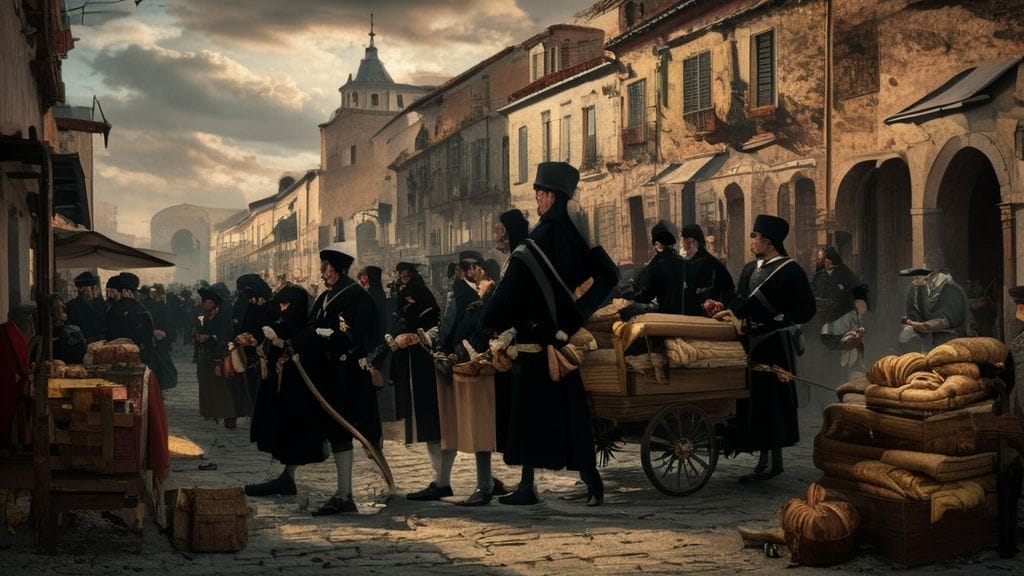
The chosen night came in early April 1767, after enough time had passed for the decree to reach distant commands. In Spain itself, the operation unfolded in a choreographed silence. Just before dawn, detachments of soldiers appeared in the streets around Jesuit residences. Doors were not battered down in theatrical fashion; instead, officers knocked, presented the royal order, and requested admittance. The aim was to avoid scenes of violence that could ignite public sympathy.
In Madrid, the College of San Isidro and the professed house found themselves suddenly encircled. Bleary-eyed rectors and brothers, summoned to the entrance, listened as officers read the words of the king. Reactions varied: some priests reportedly turned pale and were unable to speak; others asked quietly for time to gather a few personal objects. A number demanded to see the written order; when it was shown, they kissed it out of habit, a gesture of loyalty that now felt tragically ironic. Within hours, chests were being packed, and the Jesuits—under guard but largely unshackled—were marched through streets they had known for decades.
Accounts from witnesses speak of stunned silence among onlookers, followed by murmurs and tears. In some Castilian towns, local populations knelt as the procession passed, asking for blessings from the expelled priests. Women wept openly; merchants stopped their business to watch. In a few places, stones were reportedly thrown—not at the soldiers, but at windows from which curious officials watched, as if to mark them as co-responsible. But overall, the government’s bet on surprise worked: there was little organized resistance, only scattered emotional outbursts.
The logistics were formidable. In the kingdoms of Castile and Aragon alone, several thousand Jesuits had to be counted, assembled, and transported. Their internal lists—registers of members—were seized to prevent escapes and to ensure that no one was “lost” in the process. Libraries and archives, some containing unique manuscripts and scientific observations, were locked up and inventoried. The crown would later sell or redistribute many of these holdings, but in the rush of 1767, the priority was control, not preservation.
From the interior, the expelled men were directed to specific ports—mostly Cartagena, Alicante, and Cádiz—where ships, often hired from foreign merchants, waited to carry them away. Even here, the authorities alternated between firmness and a certain reluctant compassion. They allowed the Jesuits to carry a limited amount of personal belongings, clothes, and devotional items. But they refused to discuss the reasons for the expulsion, repeating mechanically that it was the king’s sovereign will. “We are treated,” one Jesuit reportedly wrote, “as criminals without a crime.”
Across the Atlantic: Shockwaves in New Spain and Peru
While Spain itself reeled from the operation, parallel scenes unfolded thousands of miles away. In Mexico City, the viceroy Antonio María de Bucareli had received the sealed packet weeks earlier. He, too, waited for the appointed night before revealing its contents to his closest military commanders. The instructions were clear: surround every Jesuit house, college, and mission headquarters in New Spain, arrest their inhabitants, and send them to Veracruz for embarkation. The scale of the undertaking in the Americas dwarfed that of the peninsula.
New Spain alone had dozens of Jesuit institutions, from the prestigious Colegio de San Ildefonso in Mexico City to missions in Sonora, Sinaloa, and the Californias. In Quito, Bogotá, Lima, and Charcas (Upper Peru), similar networks existed. The expulsion of the society of jesus thus meant uprooting not only urban scholars but also frontier missionaries who lived among indigenous communities often far from colonial centers. To bring them to the coast, soldiers and officials had to traverse deserts, jungles, and high Andean passes.
When the order was executed in Mexico City, residents awoke to see soldiers outside the colleges and churches where Jesuits had long ministered. As in Spain, the arrests were conducted in relative calm. Rector after rector heard the decree, protested respect for the king’s person, and submitted. Yet the ripples were different here. Creole families, whose sons and brothers had studied under the Jesuits, took the blow more personally. In Lima, Quito, and Guanajuato, rumors spread that the crown was turning against American-born elites, using the Jesuits—who were often creoles themselves—as scapegoats.
In remote missions, the shock could be brutal. In the Paraguayan and Chiquitos missions, Jesuits had lived for years among Guaraní and other indigenous communities, building towns, teaching crafts, and organizing communal agriculture. Similar patterns existed in the missions of northern New Spain and on the Californian coast. When royal emissaries arrived, often after weeks of travel, to present the order of expulsion, they confronted not only puzzled missionaries but also indigenous communities that had grown to trust the black-robed fathers as intermediaries against colonial abuse.
In some places, indigenous leaders pleaded with officials to let their missionaries stay. They argued that the Jesuits had protected them from forced labor and slave raids, had taught them new skills and mediated disputes. A few isolated uprisings flared when it became clear that the fathers were indeed leaving. The colonial authorities, wary of provoking a wider revolt, tried to assure communities that other clergy would replace the Jesuits. But everyone knew that new priests, often unfamiliar with local languages and customs, could not easily step into their shoes.
Tears at the Dockside: The Forced Voyages into Exile
The final Spanish act of the expulsion played out at the water’s edge. In ports from Cádiz to Cartagena, from Veracruz to Callao, the expelled Jesuits were loaded onto ships bound primarily for the Papal States, particularly the port of Civitavecchia. The logistical problems were immense: feeding and housing hundreds of men at staging points, preventing escape, and chartering enough vessels to carry them across often treacherous seas. Delays and overcrowding were inevitable.
Eyewitness accounts describe harrowing scenes at the docks. In Cádiz, crowds gathered as the Jesuits, many elderly, were marched aboard. Relatives and former students tried to approach, but soldiers held them back. Shouts of farewell mixed with the clatter of rigging and the creak of planks beneath heavy crates of books and personal effects. Some Jesuits, exhausted or ill, had to be carried up the gangplanks. Others knelt on the quay to kiss the ground one last time before boarding. A few sailors reportedly refused to serve on the ships, superstitiously fearing divine punishment for participating in what they saw as a sacrilege.
The transatlantic voyages from America were longer and more dangerous. Ships departing from Veracruz and Cartagena carried not only Jesuits but also soldiers, sailors, and supplies, making conditions cramped. In their letters and later memoirs, some exiled priests recalled the suffocating heat of the holds, the storms that tossed their vessels, and the seasickness that felled even the strongest. Disease sometimes broke out; a number died en route and were buried at sea, their bodies consigned to the depths without the familiar rituals of their order.
When they reached Italian waters, a grim irony awaited. The Papal States, under pressure from Bourbon monarchies, were not eager to receive a flood of exiled Jesuits they could hardly support. Negotiations between Madrid and Rome about where to disembark and how to house the arrivals were fraught. At various points, authorities in Corsica or in other Mediterranean ports balked at taking in additional groups. There were episodes where ships laden with Jesuits lingered offshore for days, denied entry while diplomats haggled over their fate.
For the expelled men, exile meant both physical displacement and spiritual disorientation. They had been torn from their communities, their missions, their schools, their carefully ordered lives. Many had grown up in Spain or America, but now found themselves in a foreign landscape, dependent on uncertain stipends and the goodwill of local clergy. “We are like leaves torn from our tree and left to the wind,” one exiled Jesuit from New Spain is said to have written. Yet amid grief and bitterness, a new phase of Jesuit activity began: the writing of histories, memoirs, and treatises that would keep alive the memory of the worlds they had lost.
Inside the Court: Charles III, the “Squillace Riots,” and the Enlightened Ministers
To understand why Charles III signed the expulsion decree, we must step back into the corridors of power in Madrid. Charles came to the Spanish throne after ruling Naples, where he had already built a reputation as an “enlightened” monarch—practical, reform-minded, impatient with what he saw as obsolete privileges. In Spain, he surrounded himself with ministers of similar disposition, men like the Count of Aranda and the Florentine-born Leopoldo de Gregorio, Marquis of Esquilache (Squillace), who championed administrative and economic reforms.
Esquilache in particular became a lightning rod. He pushed through measures aimed at modernizing urban life: improving street lighting, cleaning up markets, and—most controversially—banning the traditional long capes and wide-brimmed hats that masked faces and facilitated crime. In March 1766, popular unrest exploded in Madrid and other cities in what became known as the “Esquilache riots.” Crowds protested food prices, clothing regulations, and the perceived arrogance of foreign ministers. The king, shaken, eventually yielded on some points and dismissed Esquilache, who went into exile.
In the turmoil’s aftermath, attention turned to the question: who had stirred up the people? Many among the royal circle suspected the Jesuits. Their preachers, after all, had immense influence over popular opinion, and their urban colleges provided spaces where grievances could be murmured. While proof was scarce, the idea that the Jesuits were behind the riots suited ministers who already viewed the Society with distrust. The Esquilache crisis became, in effect, the emotional catalyst that allowed long-standing suspicions to harden into a policy of expulsion.
Aranda and other ministers argued that only decisive action could reassert royal authority and prevent future uprisings. They painted the Jesuits as manipulative, encouraging disobedience under a veneer of piety. In private memoranda, they combined the memory of the riots with broader concerns about Jesuit wealth, educational control, and ultramontane allegiance to Rome. The king, stung by the humiliation of 1766, increasingly accepted their diagnosis. If his reforms were to move forward, if he were to rule as a truly sovereign monarch, he could not tolerate a religious corporation that claimed immunity and wielded such influence.
Modern historians are divided about how central the Esquilache riots truly were in the decision. Some argue that they were the decisive trigger; others see them as one factor among many, perhaps exaggerated later for propaganda purposes. But there is little doubt that the riots fed into a narrative, deliberately cultivated at court, that the Jesuits posed a latent threat to public order. Within that narrative, the expulsion of the society of jesus could be justified not merely as a doctrinal measure, but as a matter of security and “police,” in the eighteenth-century sense of maintaining the good order of the state.
The Official Charges: “Reasons of State” and the Black Legend of the Jesuits
Even as the king maintained that the true motives for the expulsion were locked in his “royal breast,” officials and publicists soon began to circulate justifications. These texts form what one might call the official indictment of the Society. They drew on old stereotypes and new accusations, weaving them into a coherent, if tendentious, portrayal of the Jesuits as unfit to remain in the Spanish world.
First, there was the charge of political intrigue. The Jesuits were accused of meddling in affairs of state, of influencing royal confessors to favor narrow clerical interests, and of corresponding with foreign powers. In the fevered atmosphere after the Esquilache riots, insinuations about their role in stirring up urban crowds took on a life of their own. “No corporation,” claimed one memorandum, “should hold power over the hearts of subjects that competes with that of the sovereign.” The Society, it suggested, had overstepped the proper boundaries of religion.
Second came allegations about wealth and economic behavior. Critics pointed to the extensive lands and estates controlled by Jesuit colleges and missions, arguing that these resources were insufficiently taxed and often managed in ways that distorted local economies. The Paraguayan missions, in particular, were portrayed as quasi-autonomous republics, where Jesuits allegedly prevented indigenous peoples from integrating into the colonial order. Pamphleteers painted a lurid picture of “Jesuit theocracies” that defied royal oversight.
Third, intellectual and doctrinal critiques were marshaled. The Jesuits’ emphasis on probabilism in moral theology and their flexible approach to casuistry had long irritated rival orders and some bishops, who saw these trends as slippery and permissive. Enlightened officials, influenced by Jansenist and Gallican ideas from France, accused the Society of encouraging superstition and of resisting reforms in education. Their schools were said to prioritize scholastic hairsplitting over useful knowledge such as mathematics, natural sciences, and political economy.
It is important to note that much of this indictment blended half-truths with exaggeration. Jesuit property did exist, but often supported extensive educational and missionary work. Their missions did shelter indigenous communities, but rarely in complete defiance of royal authority. Their theology was complex, not simply lax. Yet in the heated climate of the 1760s, nuance was a casualty. The black legend of the Jesuits proved politically useful. By casting the expulsion of the society of jesus as a measure to protect the state from a corrupt and seditious corporation, the crown could present its act not as an attack on religion, but as a defense of both true faith and good government.
One contemporary apologist of Charles III went so far as to write, in a widely circulated tract, that “the monarch who frees his subjects from the occult domination of false pastors performs the most Christian of labors, for he restores the proper order willed by God.” The language is revealing: the expulsion was framed as both an assertion of temporal sovereignty and a purification of spiritual life. Many ordinary Spaniards and colonials, however, who had loved their Jesuit confessors and teachers, were not easily convinced by such rhetoric.
Colonial Upheaval: Missions, Indigenous Peoples, and the Emptying of the Frontiers
In Spanish America, the most immediate and far-reaching consequences of the expulsion were felt in the missions. Jesuit reductions in Paraguay, Chiquitos, Moxos, and the northern frontiers of New Spain had been pillars of colonial frontier policy for decades. They served as buffers against rival European powers, as defenses against slave raiders, and as laboratories for integrating indigenous peoples into Christian, semi-urban life. When the Jesuits were removed, these delicate structures wobbled.
In Paraguay, for example, the missions had gathered tens of thousands of Guaraní into settled communities, teaching them agriculture, music, and crafts, and organizing work under Jesuit supervision. While the system was paternalistic and undoubtedly served imperial interests, many Guaraní found in it a degree of stability and protection they lacked elsewhere. When royal officials arrived in 1767 to enforce the expulsion, they faced not only logistical challenges but profound human confusion. Who would lead the choirs? Who would manage the workshops? Who would mediate disputes when the fathers were gone?
The crown attempted to replace the Jesuits with secular priests or members of other orders, but they were often fewer in number, less familiar with local languages, and less prepared for the demanding work of mission administration. Over the following decades, many of the missions declined. Some indigenous inhabitants left to work on colonial estates, while others drifted back into scattered forest communities. The once-renowned “Jesuit reductions” became, in many cases, faded towns, their elaborate churches crumbling, their orchestras silent.
On the northern frontiers of New Spain, including Sonora and the Californias, similar patterns emerged. Jesuit missionaries had painstakingly forged relationships with indigenous groups, built small chapels and agricultural plots, and recorded local languages. Their departure left gaps that colonial authorities struggled to fill. In some regions, unrest followed, with indigenous groups resisting the arrival of new missionaries or rebelling against colonial demands once the Jesuit intermediaries were gone.
Politically, the expulsion also signaled to creole elites that no institution, however venerable, was safe from royal intervention. Many American-born Jesuits, exiled to Italy, would later write histories that idealized their mission work and criticized the crown’s ingratitude. These texts, circulating clandestinely back in the Americas, helped foster a sense of shared creole identity and grievance against the metropolis. The very act that sought to strengthen royal control in the colonies thus contributed, indirectly and over the long term, to the emergence of ideas that would fuel independence movements in the early nineteenth century.
Books, Classrooms, and Confessions: The Social Void Left Behind
Beyond frontier missions, the expulsion of the society of jesus created a palpable void in urban and intellectual life. Jesuit colleges had for generations been among the principal educational institutions in both Spain and Spanish America. Their curricula, though critiqued by some Enlightenment reformers as overly scholastic, nonetheless trained large numbers of students in languages, rhetoric, philosophy, and basic sciences. Their libraries housed rich collections of books, including works often unavailable elsewhere.
When the Jesuits were expelled, these colleges were closed or transferred to other authorities. In Spain, some were converted into royal seminaries or secular institutions under state supervision. In the Americas, colonial governments likewise redistributed buildings and endowments. But the process was uneven and sometimes chaotic. Teachers had to be found, curricula rewritten, disciplinary systems reimagined. For years, in some places, standards slipped as the new regimes found their footing.
Intellectually, the absence of Jesuit scholars was keenly felt. Members of the Society had contributed to astronomy, botany, geography, and history, particularly in the Americas. Jesuit savants in New Spain and Peru had measured meridians, catalogued plants, and observed comets. Their correspondence with European colleagues fed into broader scientific debates. Once expelled, these men continued their work in exile, but their direct participation in the intellectual life of the Spanish world was abruptly severed.
Socially and spiritually, too, the gap was significant. Jesuit confessors had guided the consciences of nobles and artisans alike. Their convents and residences had functioned as centers of spiritual exercises, sodalities, and charitable activity. For many laypeople, the sudden disappearance of familiar priests felt like a personal loss. New confessors, from other orders or secular clergy, took their place, but relationships of trust built over decades could not be replicated overnight.
Some historians argue that the expulsion inadvertently advanced certain Enlightenment goals. By placing former Jesuit colleges under state or episcopal control, it opened space for curricular reform and the introduction of new disciplines. The crown also used confiscated funds to support other educational initiatives. Yet even if this is partly true, the immediate effect was dislocation. The story is not a simple one of reaction replaced by progress, but of one complex network of institutions violently uprooted and another, more uncertain arrangement put in its place.
Exile in Italy: Letters, Memoirs, and the Memory of a Lost America
For the expelled Jesuits themselves, exile in Italy became a second life organized around memory, writing, and quiet resilience. Many Spanish and American Jesuits were settled in towns across the Papal States—Ferrara, Bologna, Faenza, Ravenna—where they lived in former colleges, now effectively turned into refugee houses. They received modest pensions, often insufficient, and struggled with illness, aging, and nostalgia.
Cut off from their former ministries, they turned to the pen. Exiled Jesuits from New Spain and Peru, in particular, began to write extensive histories of their homelands, their missions, and the indigenous cultures they had come to know. Figures such as Francisco Javier Clavijero and Juan Ignacio Molina composed works that described the geography, flora, fauna, and peoples of Mexico and Chile with remarkable detail and sympathy. These writings, published in Italian or Latin, aimed partly to correct European prejudices about the New World and partly to preserve the memory of a life that could no longer be lived.
In one celebrated passage, Clavijero lamented: “I have lost my country, but not the memory of it. If my body is confined here, my mind roams freely over the valleys and mountains of Anáhuac.” Such texts reveal not only scientific curiosity but emotional attachment. The expulsion of the society of jesus had severed bonds of soil and community, but it could not extinguish affection. Ironically, by forcing American-born Jesuits into exile, the Spanish crown helped create a generation of creole intellectuals who wrote for a European audience yet remained deeply loyal to their American identities.
These exiled writings would later be cited by nineteenth-century nationalists as foundational works in the intellectual construction of Mexico, Chile, and other countries. The Jesuits themselves did not necessarily advocate political independence; many still regarded the Spanish monarchy with a mixture of betrayal and lingering loyalty. But their descriptions of American landscapes, their insistence on the dignity of indigenous cultures, and their critiques of European arrogance fed into a broader current that questioned the naturalness of colonial subordination.
Life in exile was not only about scholarship. There were also communities to sustain, spiritual routines to maintain, and internal debates to navigate. Some Jesuits hoped that the papacy might secure their restoration to Spanish territories; others, more pessimistic, resigned themselves to permanent displacement. As the 1770s and 1780s progressed, a darker cloud gathered: the broader crisis of the Society itself, culminating in its suppression by Pope Clement XIV in 1773. The men expelled in 1767 found themselves, a few years later, not merely exiles from Spain but members of an order officially dissolved.
From Expulsion to Suppression: A Global Order Under Siege
The Spanish expulsion formed part of a wider, coordinated campaign by Bourbon and other Catholic monarchies to reshape the relationship between church and state in the eighteenth century. Portugal’s 1759 expulsion and France’s suppression of the Jesuits in the early 1760s had set precedents. Spain’s 1767 move added enormous weight to the anti-Jesuit cause, given the vastness of its empire. Naples, Parma, and other Bourbon-ruled territories followed suit. By the early 1770s, the Society of Jesus had been expelled or suppressed in most Catholic states of Europe.
Under this concerted pressure, the papacy found itself in an impossible position. The Jesuits were, on paper, the pope’s obedient soldiers, a principal instrument of Counter-Reformation policy and global mission. But Clement XIII and his successor Clement XIV faced monarchs who threatened to break with Rome or to confiscate church property if the Society was not sacrificed. After years of diplomatic wrangling, Clement XIV issued the brief Dominus ac Redemptor in 1773, formally suppressing the Society of Jesus throughout the Catholic world.
For the Jesuits expelled from Spain in 1767, the 1773 suppression was a second, deeper blow. Their condition shifted from being exiles of one sovereign to being members of a dissolved order. Their houses in Italy were reorganized; some priests were incardinated into local dioceses, others lived in a kind of limbo. The sense of betrayal deepened. The expulsion of the society of jesus from Spain had been justified as a political measure; the papal suppression now clothed their misfortune in a universal, ecclesiastical form.
Yet the Society did not die. In Russia and Prussia, ironically, Protestant or Orthodox rulers allowed Jesuits to continue their work, seeing them as useful educators. Over time, these surviving communities helped preserve the Jesuit tradition. When the Society was officially restored in 1814 by Pope Pius VII, it was these lineages that provided the seed. The memory of 1767, however, remained sharp among Spanish and American Jesuits. They had learned, at great cost, how fragile the bonds between church and monarchy could be—and how quickly political calculations could override centuries of shared labor.
Legacies in the Spanish World: From Bourbon Reforms to Independence
In the Spanish world, the long-term consequences of the 1767 expulsion rippled through the late eighteenth and early nineteenth centuries. At the level of state policy, it formed part of the broader Bourbon reform program. Freed, as they saw it, from Jesuit obstruction, ministers pushed forward with measures to increase tax collection, reorganize colonial administration into intendancies, promote commerce, and strengthen military defenses. In some regions, lands once held by Jesuit colleges or missions were sold off or integrated into royal domains, altering local property relations.
Yet the human and cultural void left by the Jesuits had subtler effects. Creole elites who had been educated in Jesuit institutions often felt a lingering resentment. Some admired aspects of Bourbon reform; others increasingly chafed under metropolitan control. The exile writings of American Jesuits, circulating through private channels, nourished a sense that America had its own history, its own dignity, and its own grievances. They portrayed the expulsion of the society of jesus as emblematic of a deeper misunderstanding between Spain and its overseas subjects.
As political crises mounted at the turn of the nineteenth century—especially after Napoleon’s invasion of Spain in 1808 and the subsequent collapse of royal authority—these long-gestating sentiments helped shape the ideological landscape of independence movements. Leaders like Miguel Hidalgo, José María Morelos, and Simón Bolívar came from worlds where the memory of the Jesuit expulsion still lingered. They drew more on Enlightenment and liberal ideas than on Jesuit theology, but the sense that the crown could arbitrarily crush venerable institutions and disregard colonial voices colored their view of the imperial relationship.
Not all consequences were revolutionary. In Spain itself, the post-Jesuit educational landscape evolved gradually. New institutions emerged; some of them, influenced by Enlightenment ideals, embraced experimental sciences and practical disciplines. But the suspicion of powerful religious corporations persisted, surfacing again in the anticlerical struggles of the nineteenth century. The expulsion became a reference point, a precedent cited by later governments to justify asserting control over church property and education.
In literature and memory, the event acquired a tragic hue. Nineteenth-century romantic writers evoked the image of old Jesuit priests being torn from their cloisters, of abandoned missions swallowed by forest. For others, including liberal polemicists, 1767 represented a necessary step in shaking off obscurantism. The ambiguity of its legacy mirrors the ambiguity of the eighteenth century itself: an age of both enlightenment and repression, of reform and displacement.
The Return of the Jesuits and the Persistence of Memory
After the restoration of the Society of Jesus in 1814, the path back into the Spanish world was neither quick nor smooth. Political turmoil—Napoleonic wars, constitutional experiments, civil conflicts—meant that the position of religious orders remained unstable. In some periods, especially under conservative regimes, Jesuits were welcomed back to resume educational and pastoral work. In others, particularly during liberal ascents, they were again viewed with suspicion and occasionally expelled.
Yet the Jesuits did return, gradually rebuilding communities in both Spain and independent Latin American countries. They founded new colleges, engaged in missionary activity, and participated in debates over education and social justice. Their nineteenth- and twentieth-century history would be marked by new tensions and new accommodations, but the memory of 1767 remained part of their institutional consciousness. In Jesuit histories and internal narratives, the expulsion of the society of jesus from Spain and its colonies in 1767 stands as a crucial chapter—a collective trauma that shaped their understanding of the risks of close entanglement with state power.
For lay society, the memory persisted in different forms. In some regions, local traditions preserved stories of beloved Jesuit missionaries, turned into near-folk saints in popular imagination. Ruins of former missions became sites of nostalgia and, eventually, heritage tourism. In urban settings, former Jesuit colleges repurposed as secular institutions bore architectural traces of their original owners, reminders of a past when the boundaries between religion, education, and governance were differently drawn.
In modern historiography, the event has undergone reevaluation. Earlier nationalist narratives sometimes portrayed the expulsion as a clear-cut triumph of state over church, or alternatively as a straightforward injustice. Recent scholarship, however, emphasizes the complexity of motives and consequences, highlighting both the Society’s genuine power and its contribution to culture and science, both the monarchy’s reformist aims and its authoritarian methods. The story remains a fertile ground for exploring how empires manage dissenting or semi-autonomous institutions, and what happens when those management strategies turn drastic.
Historians, Myths, and the Long Debate Over Guilt and Innocence
From the nineteenth century onward, historians and polemicists have argued over the meaning of the 1767 expulsion. Catholic apologists often depicted the Jesuits as innocent martyrs of Enlightenment despotism, victims of slanderous campaigns orchestrated by jealous rivals and overreaching ministers. Liberal critics, conversely, viewed the Society as a reactionary force that had long hindered progress and deserved to be curtailed. Both perspectives, in their starkness, simplified a more tangled reality.
Modern historical research, drawing on archival materials from Spain, Rome, and various American repositories, paints a nuanced picture. It confirms that the Jesuits did indeed wield considerable influence, controlled substantial resources, and often resisted reforms they considered harmful to their mission. It also shows that many accusations leveled against them were exaggerated or instrumentally employed by ministers seeking to extend state power. The Esquilache riots, while real and alarming, lack clear evidence of Jesuit orchestration. Economic criticisms of the missions often ignored their protective role for indigenous communities.
On the royal side, historians emphasize the logic of Bourbon governance. The eighteenth-century Spanish monarchy sought to be both Catholic and sovereign, to harmonize religious mission with centralized authority. When conflicts arose, especially with an international order like the Jesuits, the crown tended increasingly to favor sovereignty. The expulsion of the society of jesus thus emerges as a dramatic illustration of “enlightened absolutism”: the use of rationalized administration and secret decrees to reshape the institutional landscape in the name of the common good, but without broad consultation or accountability.
One influential scholar, John W. O’Malley, has argued that “the story of the Jesuits in the eighteenth century is not merely that of victims, but of a complex, dynamic institution meeting an equally complex world” (O’Malley, The Jesuits: A History). This perspective helps us move beyond simple moralizing. The expulsion was both an act of state violence and a response to genuine tensions; it was both a tragedy for many individuals and a turning point in the long negotiation between church and state.
What remains, after sifting through the myths and counter-myths, is a recognition of profound human costs. Behind the abstractions of “reform” and “corporation” stand the faces of teachers, students, indigenous villagers, and urban parishioners whose lives were disrupted. History’s task is not to idealize or demonize, but to knit together these strands into a narrative that does justice to the complexity of the past.
Conclusion
The expulsion of the Society of Jesus from Spain and its colonies in 1767 was at once a sudden rupture and the culmination of long-building tensions. Conceived in secrecy and justified in the language of “hidden reasons” and “reasons of state,” it revealed the ambitions and anxieties of a monarchy striving to embody enlightened absolutism. By targeting a powerful, transnational religious order that had served the crown for two centuries, Charles III and his ministers signaled that no institution could stand between the sovereign and his vision of reform.
Yet the act’s consequences exceeded any single ministerial plan. It ripped teachers from classrooms, missionaries from remote villages, confessors from their penitents. It disrupted indigenous missions on fragile frontiers and reshaped the educational and intellectual landscape of both Spain and Spanish America. In exile, Jesuits from Mexico, Peru, Chile, and Spain turned to the pen, creating works that would help lay the cultural foundations of new nations. The wound inflicted by the expulsion of the society of jesus thus became, paradoxically, a source of creative memory and identity.
Looking back, we can see in 1767 a drama of power and conscience that transcends its immediate time and place. It forces us to ask how states respond to institutions they cannot fully control, how reform and repression intertwine, and how communities survive violent dislocation. The story resists simple moral verdicts. It invites instead a sustained reflection on the fragile balance between authority and autonomy, between the claims of the state and the freedoms of belief and association.
In the end, the empire that expelled the Jesuits would itself fragment, while the Society, after suppression and restoration, would endure in new forms and new contexts. The night of arrests, the weeping at the docks, the long voyages into exile, and the silent, crumbling missions in distant forests remain haunting images. They remind us that history’s turning points are lived, above all, in the intimate space where policy meets person, where decrees written in royal palaces collide with the everyday worlds of ordinary men and women.
FAQs
- Why did Charles III expel the Jesuits from Spain and its colonies?
The expulsion resulted from a combination of political, economic, and ideological factors. Charles III and his reformist ministers believed the Jesuits wielded excessive influence over education, wealth, and public opinion, and suspected them—without firm evidence—of involvement in the Esquilache riots of 1766. Influenced by Enlightenment ideas and by earlier expulsions in Portugal and France, the court came to see the Society as an obstacle to centralized, “rational” governance. The decision was framed as a matter of “reasons of state,” with the king explicitly reserving the deepest motives in his “royal breast.” - How many Jesuits were affected by the 1767 expulsion?
Historians estimate that roughly 5,000 to 6,000 Jesuits were expelled from the Spanish monarchy, including those in the Iberian Peninsula and in overseas colonies in the Americas and the Philippines. They were arrested almost simultaneously, transported to ports, and shipped mainly to the Papal States in Italy, where many lived out their lives in exile. - What happened to Jesuit missions in the Americas after the expulsion?
Jesuit missions, particularly in regions like Paraguay, Chiquitos, Moxos, and the northern frontiers of New Spain, were handed over to secular clergy or other religious orders. However, these replacements often lacked the numbers, training, or linguistic skills of the Jesuits. Many missions declined over subsequent decades, with indigenous populations dispersing or being drawn into more exploitative colonial labor systems. The once-vibrant “reductions” largely lost their distinctive character. - Did the expulsion contribute to Latin American independence movements?
Indirectly, yes. Many American Jesuits exiled to Italy wrote histories and scientific works about their homelands that celebrated local landscapes, cultures, and identities. These writings nurtured a sense of creole pride and highlighted grievances against metropolitan authority. While the Jesuits themselves did not typically call for independence, their works later influenced leaders and intellectuals involved in independence movements by reinforcing the idea that America possessed its own distinct history and dignity. - Were the Jesuits ever allowed to return to Spain and Spanish America?
The Society of Jesus was officially suppressed by Pope Clement XIV in 1773 and restored by Pope Pius VII in 1814. After restoration, Jesuits gradually returned to both Spain and independent Latin American countries, though their presence was periodically challenged by liberal governments. Over the nineteenth and twentieth centuries, they re-established educational institutions and missions, but the memory of the 1767 expulsion remained a powerful part of their institutional identity. - What happened to Jesuit properties and schools after the expulsion?
Jesuit properties—lands, buildings, and movable goods—were confiscated by the crown. Many colleges were converted into royal seminaries or secular schools, and mission lands were redistributed or sold. While some resources were used to fund other educational or charitable projects, the transition was uneven and often disruptive. Educational quality sometimes suffered in the short term, even as the crown sought to introduce more “modern” curricula over time. - How do historians today view the 1767 expulsion?
Contemporary historians tend to see the expulsion not as a simple case of persecution or liberation, but as a complex episode in the broader history of church–state relations and imperial reform. They recognize the Jesuits’ considerable power and occasional resistance to change, while also acknowledging the politically motivated exaggeration of their faults. The expulsion of the society of jesus is now studied as a key example of enlightened absolutism in action, with far-reaching consequences for education, missions, and the eventual rise of new national identities in the former Spanish colonies.
External Resource
Internal Link
Other Resources
- Encyclopaedia Britannica – general search for the exact subject
- Google Scholar – academic search for the exact subject
- Internet Archive – digital library search for the exact subject

