Table of Contents
- Dawn Over Stanley: The Sudden Beginning of the Falklands War
- The Falkland Islands: A Remote Jewel Amidst Imperial Legacies
- The Historical Roots of a Territorial Dispute
- Britain and Argentina: Clashing Nationalisms at the South Atlantic
- The Military Build-Up Before the Storm
- Argentina’s Bold Move: The Invasion of April 2, 1982
- The Shockwaves Reach London: Political and Public Reactions
- Margaret Thatcher’s Resolve: The Road to Retaking the Islands
- Life Under Occupation: The Islanders’ Perspective
- The British Naval Task Force Sets Sail
- Warfare in Harsh Seas: The Battle for Control
- Air, Sea, and Land: The Campaign Unfolds
- The Human Cost of War: Soldiers, Civilians, and Families
- International Reactions: Cold War Context and Global Diplomacy
- The Fall of Stanley: Liberation and Surrender
- Aftermath for Argentina: Political Turmoil and the Junta’s Collapse
- Britain’s Military and Political Ascendancy Post-War
- The Falklands Today: Memory, Sovereignty, and Identity
- Lessons from the Conflict: Warfare, Diplomacy, and National Pride
- The Falklands War in Historical Perspective
- Conclusion: Echoes from the South Atlantic
- FAQs about the Falklands War
- External Resource
- Internal Link
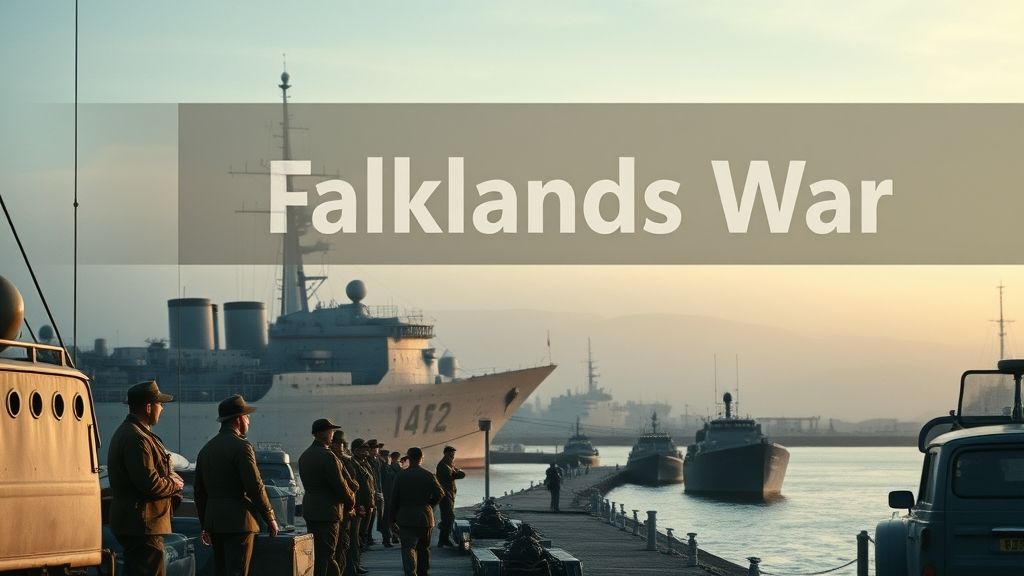
On the crisp morning of April 2, 1982, a quiet sun rose over the calm blue waters of the South Atlantic, casting golden hues on the modest town of Stanley, the capital of the Falkland Islands. Yet, beneath this peaceful veneer, the island’s silence was about to be shattered. At dawn, Argentine forces descended upon the islands, igniting a conflict that would send shockwaves through two nations and capture the world’s attention. The Falklands War had begun — a war both brief and brutal, steeped in layers of colonial history, nationalist fervor, and human tragedy.
Dawn Over Stanley: The Sudden Beginning of the Falklands War
The tranquility of the Falklands was shattered when, without warning, Argentine troops landed on the shores of the islands. Soldiers swiftly took control of key government buildings and raised their national flag over Stanley’s main square. For the islanders, British subjects loyal to the Crown, this incursion was more than a political power-play; it was a moment of existential dread.
The operation, codenamed Operation Rosario, was meticulously planned yet executed with a speed and decisiveness that left the British military and government stunned. Within hours, Argentina had claimed control over the Falklands, propelling both countries into a state of war.
The Falkland Islands: A Remote Jewel Amidst Imperial Legacies
The Falkland Islands, an archipelago of roughly 780 square miles, lie some 300 miles east of Argentina’s southern coast. A harsh, windswept territory of rugged coastlines and sparse human settlement, the islands have long held strategic and symbolic importance far beyond their size.
Discovered and disputed by European powers since the 17th century, the Falklands were a relic of imperial rivalry. Britain had claimed sovereignty since 1833, establishing a small but steadfast community of predominantly British settlers. Yet, Argentina had consistently asserted its own claim, rooted in geography and an interpretation of post-colonial sovereignty.
Standing on the edge of the world, the islands became a curious symbol: a reminder of the waning British Empire and the lingering pains of Latin American nationalism.
The Historical Roots of a Territorial Dispute
The origins of the Falklands dispute reach back centuries. Spanish and French explorers first sighted the islands in the 1600s, but it was Britain’s claim in 1833 that remained uncontested until the late 20th century — at least militarily. Argentina, inherited from the Spanish Empire, felt an unyielding right to the archipelago, branding British presence as colonial occupation.
Throughout the 19th and early 20th centuries, diplomatic tensions simmered, punctuated by negotiations and muted protests. Yet, these diplomatic efforts rarely threatened real conflict. The islands remained a quiet outpost, isolated and largely forgotten by the world, until the winds of nationalism in Argentina stirred unrest over what was perceived as an imperial injustice.
Britain and Argentina: Clashing Nationalisms at the South Atlantic
By the late 1970s, the political atmospheres in London and Buenos Aires couldn’t have diverged more. Britain was grappling with economic hardship and debating its global role post-empire. Conversely, Argentina was ruled by a military junta desperate for legitimacy and popularity amid economic decline and social unrest.
The Argentine dictatorship saw reclaiming the Falklands as a unifying, patriotic cause that could bolster its fractured standing. British Prime Minister Margaret Thatcher, determined to assert national sovereignty and defend British citizens abroad, viewed the islands as non-negotiable.
The rivalry became a combustible mixture of wounded national pride, strategic considerations, and political necessity.
The Military Build-Up Before the Storm
In the months preceding April 1982, Argentine forces discreetly prepared their assault. Rapid deployments of troops, naval vessels, and aircraft funneled surreptitiously toward the South Atlantic, signaling an ominous intention. British intelligence, though aware of rising tensions, underestimated the likelihood of invasion.
Ships patrolled the seas; soldiers trained on distant Argentine bases. Yet it was the secrecy and speed of Argentina’s plan that would catch the UK off guard.
Argentina’s Bold Move: The Invasion of April 2, 1982
At 02:30 AM, under cover of darkness and equipped with a fleet of amphibious ships and special forces, Argentine troops stormed onto the beaches near Stanley. The operation was swift and efficient, combining naval superiority with ground tactics aimed at overwhelming the modest British garrison.
Argentine forces quickly surrounded key installations, compelling the small contingent of British Royal Marines, vastly outnumbered and outgunned, to surrender after brief resistance.
“The visual of that first morning remains etched in my memory,” recalled a local islander decades later. “One moment, we were going about our daily lives, the next, a foreign flag fluttered above our homes.”
The Shockwaves Reach London: Political and Public Reactions
News of the invasion reverberated through London’s corridors of power with stunning immediacy. The British government, initially caught off-guard, faced an urgent dilemma: how to respond to a remote colonial conflict thousands of miles away amid domestic economic troubles and geopolitical complexity.
For Prime Minister Thatcher, the issue transcended mere territory; it was about principle, national honor, and the safety of British subjects. “We cannot and will not abandon the Falklanders,” she declared in a tone that assured the nation of decisive action.
Public opinion rallied, and the government swiftly authorized a military task force to retake the islands.
Margaret Thatcher’s Resolve: The Road to Retaking the Islands
The British response was swift and resolute. Thatcher, known for her steely will, ordered the formation of a naval expeditionary force — a daunting feat considering the Falklands’ remote location some 8,000 miles from Britain.
Mobilizing aircraft carriers, destroyers, submarines, and transport ships, as well as troops from the Royal Marines and Paratroopers, the UK set a course for war. The decision was fraught with risk and potential for international criticism, but British leadership saw no alternative.
Life Under Occupation: The Islanders’ Perspective
The occupation was a wrenching time for the Falkland Islanders. Though of British descent and identity, the residents found their homes under foreign military rule. Daily life was marked by curfews, restrictions, and the uncertainty of war.
Yet, islanders demonstrated resilience. Many suffered quietly, preserving their culture and loyalty amidst the turmoil. Their stories of courage, fear, and hope offer a poignant human dimension often overshadowed by military narratives.
The British Naval Task Force Sets Sail
On April 5, the British task force steamed from Portsmouth, beginning a perilous 8,000-mile journey to the South Atlantic. This deployment was one of the largest British military mobilizations since World War II.
The operation demanded extraordinary logistical coordination: fueling at sea, maintaining communications, and preparing troops for harsh weather and potential combat. The morale aboard the ships was a mix of patriotism, anxiety, and steely determination.
Commander Sandy Woodward, leading the naval forces, later reflected, “We knew the odds were tough, but the mission was clear. We were fighting not just for territory, but for British honor.”
Warfare in Harsh Seas: The Battle for Control
The conflict evolved rapidly over the following weeks. Naval engagements, air skirmishes, and amphibious assaults defined the campaign. The South Atlantic’s weather — cold, windy, and unpredictable — added an extra layer of hardship.
One of the war’s most dramatic moments was the sinking of the Argentine cruiser ARA General Belgrano by the British submarine HMS Conqueror, a controversial strike that escalated hostilities. Around the same time, the British lost the destroyer HMS Sheffield to Argentine air attack, a sobering reminder of the war’s deadly cost.
Air, Sea, and Land: The Campaign Unfolds
The British land campaign began when troops landed at San Carlos Water on May 21, enduring air attacks and challenging terrain. Fierce battles for control of key points—the Goose Green settlement and Mount Tumbledown—ensued.
The determined British advances pushed Argentine forces back, marked by acts of heroism and tragedy. Arthur “Boots” Bowers, a British paratrooper, recounted the harrowing night assaults with a mix of fear and resolve. “Every step forward was a fight for survival and for the freedom of those islands.”
The Human Cost of War: Soldiers, Civilians, and Families
By the war’s end in mid-June, over 900 lives were lost — two-thirds Argentine, one-third British. For families on both sides, the conflict inflicted profound losses and enduring scars.
The war’s brutal reality contrasted sharply with its geopolitical abstractions. Letters from soldiers revealed longing for home; islanders mourned neighbors caught in the crossfire. The Falklands War was not just a tale of strategy and politics, but also one of human sacrifice.
International Reactions: Cold War Context and Global Diplomacy
Caught in the wider context of the Cold War, the Falklands conflict drew varied international responses. The United States supported Britain diplomatically and logistically, reflecting their “special relationship,” but tensions with Latin American countries mounted.
The United Nations called for negotiations, but these faltered amid hardline positions. The war underscored how regional conflicts could ripple onto the global stage, entangling alliances and ideologies.
The Fall of Stanley: Liberation and Surrender
On June 14, 1982, after weeks of combat, Argentine forces in Stanley surrendered. British troops marched victoriously through the streets as the Union Jack rose once again.
For many, it was a moment of relief and triumph; for others, a somber acknowledgment of the war’s heavy price. The liberation marked the culmination of a complex and painful chapter in both countries’ histories.
Aftermath for Argentina: Political Turmoil and the Junta’s Collapse
The Argentine defeat shattered the ruling military junta’s hold on power. Popular anger and shame fueled protests and political upheaval, leading to the return of civilian government in 1983.
The war’s consequences permeated Argentine society, prompting national reflection about governance, military roles, and regional ambitions.
Britain’s Military and Political Ascendancy Post-War
In the UK, the victory bolstered Margaret Thatcher’s government, reinforcing her image as the “Iron Lady” and revitalizing national pride. The conflict revived faith in Britain’s global influence and triggered military modernization.
Yet, questions lingered about the costs and ethics of reclaiming distant territories through force.
The Falklands Today: Memory, Sovereignty, and Identity
Today, the Falklands remain a British Overseas Territory, fiercely proud of their British identity. Annual commemorations and memorials honor the fallen. Argentina continues to assert sovereignty claims, keeping the dispute alive diplomatically.
The islands’ story is embedded in a broader conversation about colonial legacies, self-determination, and the complexities of national identity.
Lessons from the Conflict: Warfare, Diplomacy, and National Pride
The Falklands War revealed much about modern conflict: the importance of logistics, intelligence, and rapid deployment. It highlighted the potent mix of nationalism and geopolitics, and the limits of military power to resolve long-standing disputes.
The war’s legacy urges careful reflection on the human costs beneath the strategic calculus.
The Falklands War in Historical Perspective
Though short-lived, the conflict remains a vital case study in late 20th-century history — a clash over remote islands that exposed global power dynamics, national ambitions, and the enduring shadows of empire. It draws historians, diplomats, and strategists alike into debates about sovereignty, war, and remembrance.
Conclusion: Echoes from the South Atlantic
The dawn raid on Stanley rippled through time, becoming more than a territorial skirmish. It was a profound human drama — of courage, loss, pride, and the desire for belonging. The Falklands War reminds us that even in remote corners of the world, history can unfold with intensity and consequence, shaping lives and nations alike.
Though decades have passed, the conflict’s echoes persist — in memories, in politics, and in the hearts of those who lived its unfolding, forever marked by the clash of flags over those windswept islands.
FAQs about the Falklands War
Q1: What sparked the Falklands War in 1982?
The conflict began when Argentina invaded the British-controlled Falkland Islands on April 2, 1982, seeking to assert sovereignty long claimed by Buenos Aires but held by Britain since 1833. Rising nationalistic fervor and political motives in Argentina triggered the sudden military action.
Q2: How long did the Falklands War last?
The war lasted about ten weeks, from April 2, 1982, until the Argentine surrender on June 14, 1982.
Q3: Who were the main military forces involved?
On the British side, units included the Royal Navy, Royal Marines, Paratroopers, and various army regiments. Argentina deployed naval, air, and ground forces, including elite commando units.
Q4: What role did geography and weather play in the conflict?
The remote location, severe weather, rough seas, and rugged terrain complicated military operations for both sides, impacting navigation, logistics, and combat conditions.
Q5: What were the political consequences for Argentina after the war?
Argentina’s defeat led to the collapse of the military junta and the restoration of civilian democratic government by 1983.
Q6: How did the war affect British politics?
The victory strengthened Margaret Thatcher’s government, enhancing her leadership reputation and renewing British confidence in international affairs.
Q7: Are the sovereignty disputes over the Falklands resolved today?
No. While the UK maintains control and the islanders strongly support British sovereignty, Argentina continues to claim the islands diplomatically, maintaining a contentious dispute.
Q8: What legacy does the Falklands War hold in military history?
The conflict is studied for its demonstration of rapid deployment, naval warfare, and the complex interplay of political strategy and military action over a remote territory.