Table of Contents
- The Last Dawn Over Acre: The Final Day of the Crusader States
- The Siege That Sealed a Century of Conflict
- The Origins of the Crusader Kingdoms in the Levant
- Acre: The Jewel of the Crusader Mainland
- The Mamluks Rise: A New Power in the East
- European Politics and the Fragmentation of Crusader Support
- Preparations for the Siege: Defending the Last Bastion
- The Arrivals and Alliances: Knights, Merchants, and Mercenaries
- The Mamluk Army Encircles Acre: A City on the Brink
- The First Assault: Breaching the Walls of Hope
- Resistance within the Walls: Courage and Despair
- The Fall of the Towers: The Turning Point of May 1291
- The Evacuation and the Massacre: Human Tragedy Unfolds
- The End of Crusader Rule on the Mainland: What It Meant to the Levant
- The Displacement of Populations: Refugees and Diaspora
- The Legacy of Acre in European and Middle Eastern Memory
- How the Fall of Acre Reshaped Mediterranean Geopolitics
- Crusader Myth and the End of an Era in Literature and Art
- Lessons from Acre: Historical Reflections on Faith, War, and Power
- Conclusion: The Sunset of the Crusader Kingdoms and the Dawn of a New Middle East
- FAQs About the Fall of Acre and the Crusader States
- External Resource
- Internal Link
The Last Dawn Over Acre: The Final Day of the Crusader States
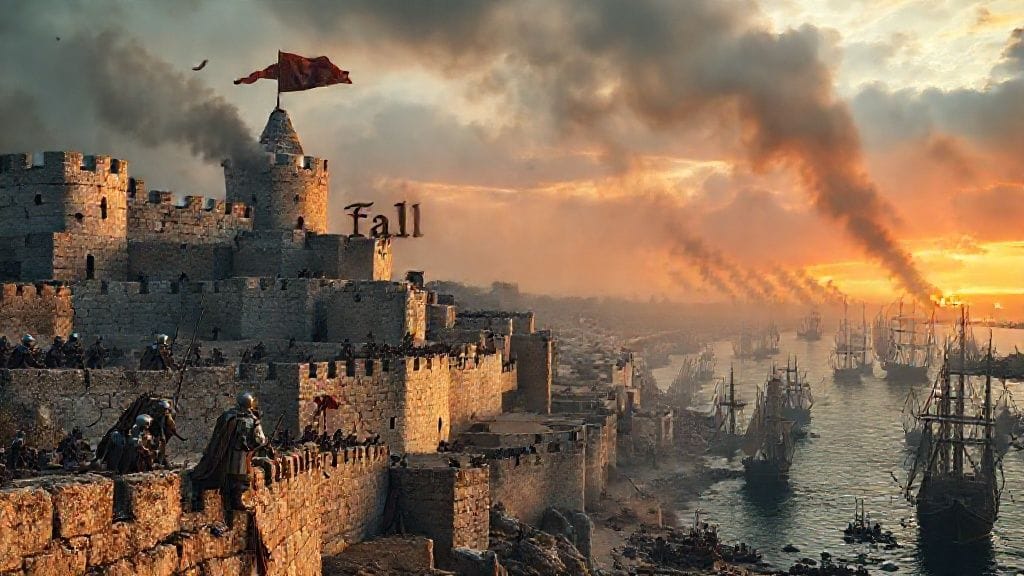
On a misty morning of May 18, 1291, the sun rose over the ancient harbor city of Acre, its golden light washed over battlements and busy harbors. Yet, beneath this tranquil veneer, a profound anxiety gripped the defenders and residents alike. For generations, Acre had been the shining beacon of Christian power in the Levant—a remnant fortress of the Crusader states that once sprawled across the Eastern Mediterranean. But on this day, it was about to fall, ending in a catastrophic blaze the hopes of Western Christendom in the Holy Land.
The city’s narrow streets were thick with the sounds of clashing steel and shouts of desperation, as Mamluk forces who had encircled the city launched their final assault. The air was filled with the acrid smells of smoke, blood, and salt from the sea breeze. As the walls tumbled and knights and civilians alike reeled, a centuries-old chapter in global history closed. The fall of Acre did not only mark the loss of a fortress—it marked the definitive end of Crusader presence on the mainland of the Levant, reverberating through generations on both sides of the Mediterranean.
The Siege That Sealed a Century of Conflict
The siege of Acre in 1291 was an apex event – the culmination of nearly two centuries of crusading zeal, military expeditions, fragile alliances, and cultural collisions. This event was not merely a clash of armies but a profound emblem of a broader narrative: the struggle for religious, economic, and political supremacy in the Eastern Mediterranean.
For the Crusader states, Acre was all that remained, a fortress city whose walls guarded remnants of a once sprawling Christian kingdom infused with ideals of pilgrimage and conquest. For the Mamluks, the Egyptian-based Islamic power, Acre represented the final obstacle to securing a contiguous and secure domain from Egypt through the Levant and beyond.
The siege itself unfolded as a tightly orchestrated military operation by the Mamluk Sultan al-Ashraf Khalil, employing engineering, relentless attacks, and psychological warfare. Against overwhelming odds and in spite of the courage of seasoned knights and their allies, the defenders faltered. The city’s fall was total—and devastating.
The Origins of the Crusader Kingdoms in the Levant
To understand the gravity of Acre’s fall in 1291, we must journey back a century and a half, to the dawn of the Crusades in the late 11th century. In 1099, after a grueling campaign during the First Crusade, the Christian armies captured Jerusalem, establishing the Kingdom of Jerusalem alongside other Crusader states such as the County of Tripoli and the Principality of Antioch.
These states were not permanent colonies but precarious strongholds carved out amidst hostile territories and diverse cultures. Their survival depended heavily on European support, shifting alliances with local powers, and maintaining control over key ports for supply and reinforcements.
Acre soon rose as a vital node—a trading hub, a military base, and a symbol of Christian resolve in the East.
Acre: The Jewel of the Crusader Mainland
By the late 13th century, Acre stood as the last significant bastion of the Crusader presence on the mainland. Its walls, bastions, and harbor had been fortified over decades, reflecting its unmatched strategic and symbolic importance.
A kaleidoscope of peoples called Acre home: knights from the military orders such as the Templars and Hospitallers, European merchants from Italian city-states like Venice and Genoa, Muslim and Christian locals, along with a medley of pilgrims and refugees. The city was a melting pot of cultures, wealth, and faith—a fragile mosaic holding fast in a turbulent region.
Yet despite its fortifications and diversity, Acre was isolated. The collapse of other Crusader holdings like Jaffa and Tyre had left it vulnerable. Its survival hinged on the hope of reinforcements from Europe—a hope growing increasingly dim as rival powers in the West turned their gaze elsewhere.
The Mamluks Rise: A New Power in the East
The Mamluks, a military caste composed initially of slave soldiers, had risen to power in Egypt by the mid-13th century. Combining disciplined armies with strategic vision, they had driven the Mongols back at Ain Jalut in 1260 and gradually expanded their influence into Syria and the Levant.
One of their primary aims was to extinguish the Crusader states, which to them represented foreign intrusion and a threat to Islamic rule. Sultan al-Ashraf Khalil, succeeding his father Baibars—one of the most formidable Mamluk leaders—resolved that Acre must fall.
Their campaign was not merely military; it was an assertion of religious and political legitimacy, a unification of the Levant under Islamic rule, and a strategic effort to secure Egypt’s northern frontier.
European Politics and the Fragmentation of Crusader Support
Behind the walls of Acre, the distant echoes of Europe’s internal struggles grew louder. The waning of fervor for crusading endeavours was felt across the continent. Monarchs were preoccupied with domestic conflicts, economic transformations, and emerging nation-states.
Papal calls for new crusades often met with indifference or half-hearted responses. The once-powerful military orders faced dwindling resources and political challenges. The Italian city-states, whose merchant fleets had been crucial to maintaining supply lines, had their own rivalries and agendas.
The patchwork of European support proved inadequate against the might of the rigorous Mamluk war machine.
Preparations for the Siege: Defending the Last Bastion
As reports of Mamluk forces massing in surrounding territories grew, the defenders of Acre hastened preparations. Cannons and ballistae were readied; walls were reinforced, and the city’s ever-tangled politics were temporarily set aside in the face of existential threat.
Tensions simmered between the military orders and the merchant factions, yet necessity forged a fragile unity.
Knights drilled in the courtyards; civilians stocked provisions; and messages were dispatched across the sea imploring for reinforcements which ultimately failed to arrive in time.
The Arrivals and Alliances: Knights, Merchants, and Mercenaries
In the final weeks, reinforcements did trickle into Acre—veteran knights, pilgrims caught in transit, and mercenaries lured by the promise of spoils or religious duty.
The infamous Templar Grand Master, Guillaume de Beaujeu, took command of the defense with grim determination. Venetian and Genoese ships continued operating in the harbor, but their interests sometimes clashed with the military orders regarding command and strategy.
Amidst this cacophony of allegiances, the defenders prepared for a battle that would determine the fate of the Christian presence in the Levant.
The Mamluk Army Encircles Acre: A City on the Brink
By early May 1291, the Mamluk forces had completely surrounded Acre. Camps sprawled across the hillsides, siege engines rattled the stone walls, and constant skirmishes drained the city’s manpower.
Under the blistering Levantine sun, the defenders could hear the relentless footsteps of an army intent on erasing their foothold.
Inside the city, anxiety mingled with resolve. Families huddled in cellars; monks prayed ceaselessly; knights repaired breaches and sallied forth on desperate sorties.
The stage was set for a brutal closing act.
The First Assault: Breaching the Walls of Hope
On May 16th, the Mamluks launched their first full-scale assault. Bolts and stones rained upon the walls, while engineers worked feverishly to dismantle fortifications.
The knights responded with valor, hurling themselves into the fray to repel ladder climbers and battering rams. Yet the Mamluks’ numbers and siege tactics slowly gained advantage.
Underground tunnels were discovered and flooded, while fire was used as a weapon against gates and towers.
The tension in Acre’s streets was unbearable—hope flickered but refused to be extinguished.
Resistance within the Walls: Courage and Despair
Throughout May 17th, the defenders maintained a precarious grip. Leaders like De Beaujeu orchestrated counterattacks with tactical finesse, inspiring their troops amid fear and fatigue.
Meanwhile, civilians bore the brunt of siege life—starving, wounded, and terrified.
Stories emerged of knights shielding their retreating companions, of merchants hiding treasures to prevent them from falling into enemy hands, and of families forced to confront imminent death.
In the grand narrative of history, these human moments reveal the profound cost of crusading ambition and conflict.
The Fall of the Towers: The Turning Point of May 1291
By the dawn of May 18th, the Mamluks breached critical sections of Acre’s walls. The ancient towers, symbols of resistance, tumbled under sustained bombardment and assault.
The city’s defenders were overwhelmed. Despite desperate fighting, the gates were forced open and the Mamluk armies poured inside.
The battle turned into a chaotic melee. The streets ran with blood, the cries of the wounded filled the air, and the city that had stood as the last Crusader stronghold was on the verge of collapse.
Grand Master Guillaume de Beaujeu fell in combat, a poignant symbol of the city's fate.
The Evacuation and the Massacre: Human Tragedy Unfolds
As order broke down, mass evacuations to the harbor became scenes of desperate chaos. Ships tried to rescue as many as possible, but the narrow ports and overwhelming numbers meant many were trapped.
Historical accounts recount merciless slaughter. Men, women, and children were caught in the whirlwind of destruction.
Survivors scattered—some to Cyprus, others to European ports—their displacement marking a painful diaspora.
The fall of Acre was not just a military defeat but a human catastrophe that echoed beyond the battlefield.
The End of Crusader Rule on the Mainland: What It Meant to the Levant
Acre’s fall extinguished the last Christian foothold on the Levantine coast. The map of the Middle East shifted irrevocably.
The Mamluks consolidated their control of the region, establishing a durable political order that would last until the Ottoman ascendancy centuries later.
For the local populations, the change brought both relief from the perpetual conflict and new dynamics of power and culture.
Yet for Europe, the loss was a staggering blow to religious and political ambitions in the East.
The Displacement of Populations: Refugees and Diaspora
The exodus following Acre’s fall created waves of refugees—former knights, merchants, artisans, and peasants all dumped into foreign lands.
Cyprus became a temporary refuge, swelling with those fleeing the Mamluk advance. European courts grappled with the social and economic ramifications of these displaced populations.
This diaspora contributed to cultural exchanges but also to the fading of crusading fervor as practical realities intruded on ideological dreams.
The Legacy of Acre in European and Middle Eastern Memory
Acre’s fall entered legend and lament. Western European chronicles mourned the loss as a catastrophic blow against Christendom.
In the Levant, the event was celebrated as a triumphant moment of Islamic resurgence.
Over time, Acre became a symbol of the incomplete and complex legacy of the Crusades—a reminder of cultural encounters that shaped Mediterranean history.
How the Fall of Acre Reshaped Mediterranean Geopolitics
With the disappearance of Crusader states, new dynamics emerged in Mediterranean and Near Eastern politics.
Trade routes shifted, naval power balances altered, and powers like Venice and Genoa recalibrated their influence.
The Mamluk Sultanate enjoyed increased prestige, while Europe increasingly turned its focus inward or toward new horizons, including the eventual Age of Discovery.
Crusader Myth and the End of an Era in Literature and Art
The trauma of Acre’s fall seeded a rich vein of myth and memory—songs, poems, and art that immortalized knights and pilgrims.
These cultural artifacts oscillated between glorifying crusader valor and questioning the futility of endless holy wars.
Even Renaissance humanists reflected on Acre as a poignant symbol of the clash between civilizations.
Lessons from Acre: Historical Reflections on Faith, War, and Power
Acre stands as a cautionary tale in the annals of history. It teaches about the dangers of overreliance on ideals without pragmatic coalition-building.
It exposes the costs of religious intolerance and geopolitical fragmentation.
And it reminds historians that human courage and tragedy are intertwined in the tides of war.
Conclusion: The Sunset of the Crusader Kingdoms and the Dawn of a New Middle East
The fall of Acre on May 18, 1291, closed a vivid, turbulent chapter in world history. It was the end of centuries-long Crusader ambitions in the Levant, a dramatic turning point that reshaped regional politics and cultural identities.
Yet, in the ashes and memories of Acre, the seeds of future encounters—between East and West, faiths and empires—were sown.
This singular event is more than a military defeat; it is a profound story about human hope, conflict, and the flux of history.
FAQs About the Fall of Acre and the Crusader States
Q1: What was the significance of Acre in the Crusader states?
Acre was the last major stronghold and commercial hub of the Crusader states in the Levant, symbolizing Christian presence and power in the region.
Q2: Who led the Mamluk forces during the siege of Acre?
Sultan al-Ashraf Khalil commanded the Mamluk army, orchestrating the final assault that led to the city's fall.
Q3: Why did European support for the Crusader states decline before Acre’s fall?
European political fragmentation, internal conflicts, and waning religious zeal reduced military and financial aid to the Crusader states.
Q4: What happened to the Knights Templar during the fall of Acre?
The Knights Templar fought fiercely to defend Acre; their Grand Master Guillaume de Beaujeu died in combat, symbolizing the military orders' demise in the Levant.
Q5: How did the fall of Acre affect the local populations?
Many were killed or displaced; survivors fled to Cyprus or Europe, creating refugee waves and reshaping demographics.
Q6: What was the impact of Acre’s fall on Mediterranean geopolitics?
It solidified Mamluk control over the Levant, shifted trade routes, and marked a turning point away from Crusader ambitions toward new regional dynamics.
Q7: How is the fall of Acre remembered in history?
In Europe, it was mourned as a tragic loss; in the Middle East, celebrated as liberation. It remains a key moment symbolizing the complex interactions between East and West.
Q8: Did the fall of Acre end the Crusades completely?
While it ended Crusader states on the mainland, the Crusading movement continued in other forms but lost much of its early territorial ambitions.

