Table of Contents
- The Last Dawn of Byzantium: Constantinople on the Eve of Siege
- The Ottoman Crescent Rises: Mehmed II’s Ambition and Vision
- The Impenetrable Walls of Theodosius: A Fortress Clinging to Survival
- The Gathering Storm: Forces Assembled for an Epic Clash
- The Siege Begins: Cannon Fire and the Thunder of the Ottomans
- Defenders’ Spirit: The Last Stand of Byzantium’s Brave Few
- The Secret Tunnel and the Naval Gambit: Desperate Moves Amidst Silence
- The Fall of the Golden City: Final Hours and Breach of the Walls
- Constantinople in Flames: The Sacking and Aftermath
- The Last Emperor: Constantine XI’s Fate Sealed in Myth and History
- The Birth of Istanbul: Transformation of a City Across Continents
- The Fall’s Ripple Effect: Europe Awakens to a New Reality
- The Shift of Power: From Byzantium to Ottoman Supremacy
- Cultural and Religious Reverberations: Orthodoxy, Islam, and the West
- The Siege Legacy in Memory and Mythology
- Reassessing the Fall: Modern Historiography and Debates
- The Impact on Trade and the Age of Exploration
- The Role of Technology: Artillery’s Dawn and Changing Warfare
- The European Response: Calls for Crusade and Fragmented Efforts
- Enduring Symbols: How Constantinople Lives in Literature and Art
- Conclusion: The End of an Era, The Dawn of Another
- FAQs
- External Resource
- Internal Link
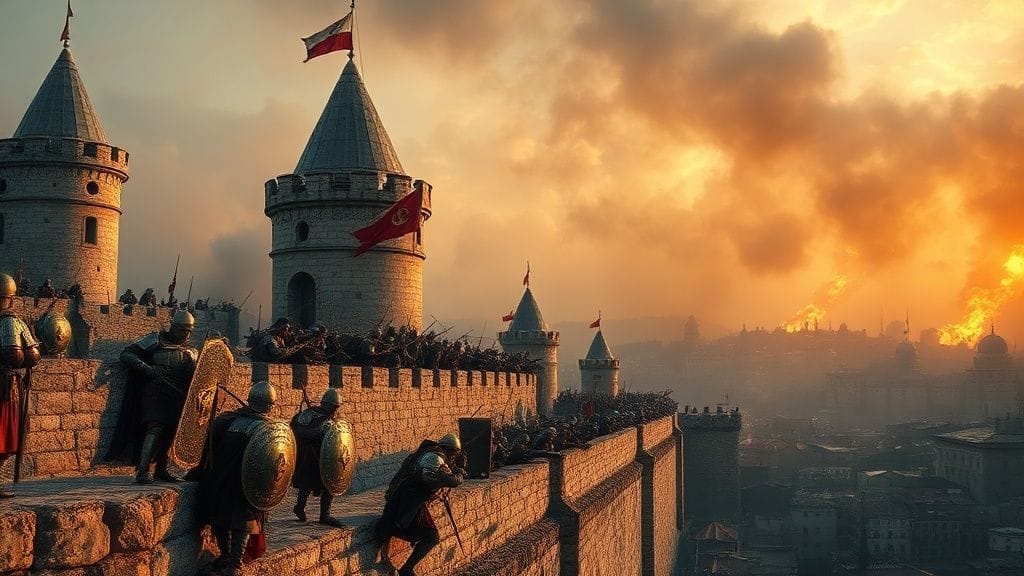
The sun’s first light broke over Constantinople’s massive walls on the morning of May 29, 1453. It painted golden hues on centuries-old towers and the domes that crowned the city’s silhouette—a final, fleeting glow before a day destined for history books. On one side stood the dwindling defenders, haggard yet undaunted, their eyes fixed on the horizon where Mehmed II’s countless banners fluttered like an ominous tide. On the other, the Ottoman army, a formidable sea of determination and innovation, prepared to sweep into what was once the heart of a sprawling empire.
The air was thick with tension—echoes of prayers mingling with the metallic clang of armor tightened for what would be the last stand of the Byzantine Empire. This was no ordinary siege; it was a poignant, profound collapse of an ancient world, the fall of Constantinople, a city that had for over a millennium embodied the link between East and West, between antiquity and the modern age. By nightfall, the city, battered and broken, would fall under Ottoman control, forever changing the course of history.
This is the story of that event—its causes, its drama, its aftermath—and why, centuries later, its legacy still stirs the imagination and reshapes our understanding of civilizations in convulsion.
The Last Dawn of Byzantium: Constantinople on the Eve of Siege
To grasp the profound drama of Constantinople’s fall, one must first stand on its ancient ramparts in spring 1453. The city, once the unrivaled jewel of the Roman world, was now a shadow of its former grandeur. The long struggle for survival had thinned its population to a mere 50,000 souls—traders, monks, soldiers, and noble families squeezed behind the massive Theodosian Walls.
Byzantium, as the empire was still called by its people, was an anachronism—a medieval splinter of the mightiest empire that had shaped the Mediterranean for a millennium. Political intrigue, economic isolation, and relentless pressure from emerging powers had reduced this once-mighty bastion to a fragile enclave.
Yet, for Constantine XI Palaiologos, the city’s last ruler, every stone and every soul mattered. In his mind burned the desperate hope that reinforcements might arrive from the West, either from the Pope or the kings of Europe. But the great powers were distracted—fractured by their own rivalries and the shadow of the rising Ottoman Empire, which was no longer a distant menace but an existential threat at the doorstep.
The Ottoman Crescent Rises: Mehmed II’s Ambition and Vision
If Constantinople represented a civilization in decline, then Mehmed II embodied a new epoch. Ascending the Ottoman throne at just 19, Mehmed was a warrior and a visionary steeped in Islamic scholarship and the art of statecraft. His ambition was breathtaking: the conquest of Constantinople was not merely a political or military goal; it was destiny, a fulfillment of centuries of Ottoman expansion.
Mehmed's forces showcased the Renaissance of warfare: sophisticated artillery, organized logistics, and a determined, disciplined army. He understood that seizing this city meant controlling the vital Bosporus Strait—a gateway that linked the Black Sea to the Mediterranean, securing not only trade but the prestige and spiritual capital of empire.
Under Mehmed, the Ottoman Empire was no longer a frontier power; it was poised to become the supreme imperial force in Eurasia. Every decision, every cannonball fired, was a step towards realizing this vision.
The Impenetrable Walls of Theodosius: A Fortress Clinging to Survival
The defenders of Constantinople clung to old truths: The Theodosian Walls, built in the 5th century, had repelled Persian invaders, Avars, Arabs, Crusaders, and countless Ottoman assaults. Their imposing double ramparts, moats, and towers gave the Byzantine defenders hope.
However, the nature of warfare was changing. No matter how thick the stones, they were vulnerable to the new age of gunpowder and cannons. The most fearsome weapon in Mehmed’s arsenal was the giant bombard cast by a Hungarian engineer, Urban. This massive cannon could hurl stones over a mile away, battering the walls relentlessly.
Despite these fears, the defenders used every trick in their arsenal: repairing breaches by night, making sorties against Ottoman siege lines, and holding council with grim determination. The siege, they knew, might be their death sentence—but they faced it with dignity.
The Gathering Storm: Forces Assembled for an Epic Clash
Over 80,000 Ottoman soldiers encircled the city. It was a vast army including infantrymen, cavalry, archers, artillery units, and engineers. The numbers were staggering compared to Constantinople’s few thousand defenders, including Genoese mercenaries, local militias, and monks wielding swords more than faith.
Mehmed’s strategy was meticulous: cut off all supplies, bomb the walls into submission, launch coordinated attacks when the opportunity arose—and if necessary, storm the breaches in force. He also deployed a navy to blockade the city from the sea, striving to choke Constantinople’s lifeline.
Inside the walls, food was scarce, morale fragile. Yet, the defenders’ allegiance to Emperor Constantine and the spiritual force of the Orthodox Church forged a bond of resilience. Every day was a test of endurance, courage, and desperation, with death lurking in every shadow.
The Siege Begins: Cannon Fire and the Thunder of the Ottomans
On April 6, 1453, the Ottoman cannons opened fire. The groan of the great bombard echoed across the city as massive stones slammed against the Theodosian Walls, sending showers of rock and dust skyward. The siege had officially begun.
Unlike previous Ottoman sieges that relied on starvation, Mehmed combined brutal artillery barrages with relentless assaults. Days melted into weeks as Ottoman bombards fired hundreds of shots daily, dismantling towers, crushing gates, and eroding Byzantine defenses.
Meanwhile, the defenders fired their few remaining cannons and arrows, repelling assaults and launching daring sorties to disrupt Ottoman siege works. The contrast was stark: old medieval valor versus the new thunder of gunpowder.
Defenders’ Spirit: The Last Stand of Byzantium’s Brave Few
Among the defenders, the Genoese captain Giovanni Giustiniani emerged as a paragon of bravery and discipline. Leading the crucial defense of the land walls, his bold counterattacks staggered the Ottomans and inspired the city’s inhabitants.
Constantine XI, for his part, led from the front. Tales recount him praying in the Hagia Sophia alongside his troops, sharing their fate as a spiritual and political leader. His presence embodied hope for the city’s survival, even as despair crept like a shadow.
Citizens and soldiers alike understood the magnitude of their plight. They fought not merely for survival but for civilization itself—a fleeting stand against the inevitable tide of history.
The Secret Tunnel and the Naval Gambit: Desperate Moves Amidst Silence
The siege was not without intrigue and subterfuge. The Ottomans sought to undermine the city’s morale and defenses through various strategies—one notable was the attempt to dig tunnels beneath the walls, aiming to collapse them.
On the water, the Byzantines’ few ships clashed with the Ottoman fleet commanded by Admiral Baltaoglu. The control of the Golden Horn was vital, and in a stunning maneuver, the Ottomans dragged their ships over land to bypass the chain blocking the harbor—an audacious act demonstrating Mehmed’s tactical genius.
These episodes revealed the complexity and desperation characterizing the siege, a chess game played across land and sea with high stakes.
The Fall of the Golden City: Final Hours and Breach of the Walls
By late May, the walls were frail. On the morning of May 29, after weeks of bombardments, an Ottoman assault struck near the Gate of St. Romanos (present-day Edirnekapı). The defenders were exhausted but fought fiercely.
A critical breach occurred after the vanguard seized part of the walls. The Ottoman troops poured in, street fighting erupted, and the city’s defense unraveled. Constantine XI reportedly removed his imperial insignia and joined the melee, disappearing in the chaos—a final act of defiance.
The fall was swift and brutal. What had seemed impregnable less than a month ago was now overrun, the defenders crushed beneath overwhelming numbers and weapons.
Constantinople in Flames: The Sacking and Aftermath
With the walls breached, Constantinople’s population faced devastation. For days, the city became a battlefield for loot, violence, and despair. Churches, palaces, and homes were pillaged or burned.
Yet amid this destruction, Mehmed II displayed pragmatic vision. After the initial violence subsided, he ordered protection for some churches and extended religious freedoms to Christians, a gesture that laid groundwork for Ottoman governance.
The cultural heart of Byzantium was broken, but the city’s soul endured—soon to be transformed into Istanbul, the jewel of the Ottoman Empire.
The Last Emperor: Constantine XI’s Fate Sealed in Myth and History
Constantine XI Palaiologos’s death marked the end of the Byzantine Empire. His exact fate remains shrouded in mystery—some say he fell fighting on the walls, others propose he vanished to become a legendary figure awaiting the empire’s rebirth.
This ambiguity fueled a powerful mythos: a "last emperor" who would return in the empire’s darkest hour. For Greeks, the fall was both tragedy and prologue—a source of mourning and national identity.
The Birth of Istanbul: Transformation of a City Across Continents
The Ottomans swiftly began reshaping Constantinople. Mosques replaced churches, markets revived trade, and immigrants from across the empire re-populated the city. The Hagia Sophia, once the central cathedral of Eastern Christianity, was converted into a mosque—a potent symbol of the new order.
Istanbul became a vibrant meeting point of cultures, religions, and commerce—a bridge between Europe and Asia. Its skyline changed, but the city’s pulse remained strong. The Ottoman conquest was not only conquest but rebirth.
The Fall’s Ripple Effect: Europe Awakens to a New Reality
News of the city’s fall shocked Europe. Constantinople had been seen as a bastion against Islamic expansion and a symbol of ancient Christian civilization.
Panic spread through capitals as trade routes from the East were threatened. Attempts at new crusades were proposed but largely fragmented and ineffective. The fall forced European powers to seek new routes—planting seeds for the Age of Discovery.
The Shift of Power: From Byzantium to Ottoman Supremacy
The conquest marked the definitive shift in power from the Byzantine world to the Ottoman Empire. The Ottomans soon expanded their reach into the Balkans, the Middle East, and North Africa, reshaping geopolitics for centuries.
The fall of Constantinople symbolized not just a city’s fall but an empire’s eclipse, heralding an era where the crescent would eclipse the cross in southeastern Europe and beyond.
Cultural and Religious Reverberations: Orthodoxy, Islam, and the West
The fall had deep religious consequences. The Byzantine Orthodox Church was thrown into new relationships under Ottoman Islamic rule. Meanwhile, Western European Christianity fractured further, deepening the distrust between East and West.
Constantinople’s fall also spurred theological debates about the legitimacy and future of Christian kingdoms in the East, shaping religious identities and political alliances for generations.
The Siege Legacy in Memory and Mythology
Centuries after, the siege remains a powerful symbol. For Greeks, it is a poignant loss and a reminder of resilience. For Turks, it marks the triumph of a rising empire and the dawn of their age.
Stories, poems, and artworks commemorate the event, each nation weaving its narrative around glory, tragedy, faith, and destiny.
Reassessing the Fall: Modern Historiography and Debates
Contemporary historians examine the siege through lenses of military innovation, political failure, and cultural transformation. Some highlight Mehmed II’s genius; others lament European inertia.
The fall of Constantinople serves as a case study in the transition from medieval to early modern worlds—the clash of empires, religions, and technologies.
The Impact on Trade and the Age of Exploration
With the Ottomans controlling vital trade routes, European nations sought new ways to reach Asia, stimulating voyages that eventually uncovered the Americas.
Constantinople’s fall indirectly propelled navigators like Columbus and Vasco da Gama to reshape the globe’s map forever.
The Role of Technology: Artillery’s Dawn and Changing Warfare
The siege highlighted artillery’s revolutionary impact on military architecture and siege warfare. It demonstrated that ancient fortifications could no longer guarantee security.
This led to new fortress designs and military strategies across Europe—marking the beginning of the gunpowder age.
The European Response: Calls for Crusade and Fragmented Efforts
The Pope and some monarchs called for crusades, but political rivalries and differing priorities stifled any unified response.
The fall underscored Europe’s fragmentation and the growing gulf between East and West—not only in faith but in politics and culture.
Enduring Symbols: How Constantinople Lives in Literature and Art
From Byron’s poetry to modern films, the fall of Constantinople continues to inspire. It symbolizes the fall of empires, the clash of civilizations, and the persistence of memory.
Artists and writers have captured the drama, blending history with myth, reminding us how deeply this event resonates across human consciousness.
Conclusion
The fall of Constantinople on May 29, 1453, was more than a military conquest; it was the shuttering of a millennium-old world and the dawn of modern history. It cries a story of valor and loss, of empires rising and falling, of technology and faith intertwined.
Yet amid the ruins, life found a way. The city reinvented itself, becoming a crossroads where East met West in new harmony and tension. The story of Constantinople’s fall reminds us that history is never linear—too often it is a tapestry of endings birthing new beginnings.
It challenges us to reflect on resilience and transformation, on the fragility of civilization, and the enduring power of hope.
FAQs
1. Why was Constantinople so strategically important in 1453?
Constantinople controlled the Bosporus Strait, a crucial trade route between the Black Sea and Mediterranean. Its location bridged Europe and Asia, making it a vital military and commercial hub.
2. Who was Mehmed II, and why was his role significant?
Mehmed II, called “the Conqueror,” was the young Ottoman sultan who planned and led the siege. His use of artillery and strategic vision transformed the Ottoman Empire into a dominant power.
3. What role did technology play in the siege’s outcome?
The Ottomans deployed massive cannons, including the famous “Basilica” bombard, which could breach the city’s ancient walls—ushering in a new era of gunpowder warfare.
4. How did the fall affect the Byzantine Empire?
The fall marked the definitive end of the Byzantine Empire and the Eastern Roman legacy, shifting power entirely to the Ottomans.
5. What was Europe’s response to the fall of Constantinople?
Europe was shocked but largely ineffective. Divided by internal conflicts, the powers failed to mount a coordinated crusade, instead turning to finding new trade routes.
6. How did the fall influence the Age of Exploration?
The Ottoman control over traditional trade routes pushed European nations to seek alternative paths to Asia, indirectly spurring discoveries like the Americas.
7. What happened to Constantinople after the Ottoman conquest?
It was transformed into Istanbul, the Ottoman Empire's capital. Religious and cultural landscapes changed, but the city flourished as a cosmopolitan nexus.
8. Why is Constantine XI’s death surrounded by myth?
His fate was never precisely documented. Stories depict him as a heroic figure who died fighting or disappeared, waiting to return—a powerful symbol of hope.

