Table of Contents
- A Winter Sky Over the Pyrenees: Setting the Stage at Montségur
- The Cathar Vision: A Faith Deemed Impossible
- Languedoc Before the Storm: A Land Between Worlds
- From Preachers to Crusaders: The Birth of the Albigensian Crusade
- Fire and Sword in Languedoc: The Road to Refuge
- The Fortress in the Clouds: Montségur as Citadel and Sanctuary
- Everyday Life on the Rock: Perfects, Peasants, and Knights
- The Long Shadow of Inquisition and Royal Power
- Countdown to 1243: Why Montségur Had to Fall
- The Siege Begins: Summer 1243 on the Razor-Edge Ridge
- Hunger, Fear, and Faith: Inside the Besieged Stronghold
- The Final Assault and the Negotiated Surrender
- March 16, 1244: Flames at the Foot of the Mountain
- Ashes in the Wind: Political and Social Consequences
- From Heresy to Legend: How Memory Shaped Montségur
- Historians, Myths, and the Search for the “Cathar Treasure”
- Montségur in the Modern Imagination and Occitan Identity
- Echoes of a Pyre: What the Fall of Montségur Tells Us Today
- Conclusion
- FAQs
- External Resource
- Internal Link
Article Summary: On a cold March day in 1244, a lonely fortress on a Pyrenean peak became the stage for one of the most haunting finales in medieval Europe: the fall of Montségur. This article follows the rise of the Cathar movement, the violence of the Albigensian Crusade, and the gradual tightening of royal and papal power that made Montségur the last great refuge of a defeated faith. Blending narrative and analysis, it reconstructs the siege, the daily life of those trapped within the walls, and the stark choice that awaited them at the end: conversion or death by fire. The fall of Montségur did not only extinguish a community; it also marked the symbolic end of a more plural, semi-autonomous Languedoc and the triumph of centralized French monarchy and inquisitorial orthodoxy. Yet behind the rhetoric of heresy, the story is also one of human courage, doubt, and loyalty under impossible pressure. Later centuries would transform these flames into legend, weaving tales of lost treasures, secret doctrines, and romantic resistance. By retracing the events and their consequences, the article explores how the fall of Montségur still echoes in debates about power, belief, and cultural identity. Its story reminds us that when an idea is declared intolerable, the battlefield often becomes memory itself—and memory rarely obeys the victors.
A Winter Sky Over the Pyrenees: Setting the Stage at Montségur
On the morning of 16 March 1244, the mountain of Montségur, a jagged spur of limestone in the County of Foix, rose like a ship out of a sea of mist. Snow clung to the shaded folds of the Pyrenees, and the air was so thin and sharp that each breath seemed to carve the lungs. At the summit, a fortress crowned the rock, narrow and elongated along the razor-back ridge. Below, on a windswept platform partway down the slope, carpenters and soldiers had prepared a wooden enclosure—a gigantic, obscene nest of timber. Soon, it would become a stake.
Men, women, and children emerged from the stronghold in a slow procession, watched by ranks of mailed soldiers from the royal armies of France and their allies. These people were called “heretics” by the Church and “bons hommes” and “bonas femnas” by those who loved them. They walked with an unnerving calm, as if the mountain wind had hardened into their bones. Chroniclers would later calculate that around 200 individuals—perhaps 210, perhaps 220—went down that path. Numbers blur; what remains is the image of a community on the move toward its own annihilation.
This was the fall of Montségur in its starkest form: not merely a military surrender, but a ritualized conclusion to a conflict that had burned across Languedoc for decades. The siege, the negotiations, the final choice—conversion to the faith of Rome or death by fire—were all part of a long story, inscribed not only in papal bulls and royal decrees, but in songs, whispered prayers, and the grim testimonies later recorded by inquisitors. When the flames rose against the mountain that day, they illuminated more than one heresy; they lit up the slow transformation of an entire region and the tightening grip of an emerging kingdom.
Yet this was only the end of the visible story. To understand why this bleak morning became a turning point in European history, one has to travel back along the roads that led to Montségur: the paths of preachers and merchants, troubadours and barons, popes and kings. The fall of Montségur was not an isolated tragedy, but the last act of a drama in which faith, politics, culture, and identity were so entangled that to attack one strand meant tugging at them all. The mountain, remote as it seemed, sat precisely where these threads crossed.
The Cathar Vision: A Faith Deemed Impossible
Long before the siege, long before the soldiers of the northern French barons marched into the South, Montségur existed first in the realm of the mind—as a refuge for a particular way of believing. The people who sought sanctuary there in the thirteenth century were adherents of a Christian movement that we know today as “Catharism,” a label probably derived from the Greek katharoi, meaning “the pure.” Medieval opponents also called them Albigensians, after the city of Albi, though their geographical spread stretched far beyond its walls.
Cathar belief was not a neat, codified system. It varied from place to place and from teacher to teacher. But there were core ideas that alarmed the authorities of the Roman Church. Many Cathars embraced a radical dualism: the conviction that the world of matter was the creation of an evil or inferior principle, while the true God reigned in the spiritual realm alone. This world, dense and flawed, was a prison for the soul. Bodies, with their appetites and pains, were temporary cages. To escape, one needed the consolamentum, a single sacrament of baptism in the spirit, administered most often at the end of life.
They rejected the authority of the Catholic priesthood, denying the legitimacy of many sacraments, especially those that bound the believer to this material existence—marriage, for example. The cross, that central symbol of Christianity, was to some Cathars a tool of torture rather than an emblem of salvation. They read the Gospels, often in the vernacular Occitan tongue, and saw in Christ a messenger of the true, good God, come to awaken souls from the illusion of the flesh. As historian Emmanuel Le Roy Ladurie observed, the Cathar faith was “a metaphysical revolt against the weight of matter and the scandal of suffering.”
This theology might seem abstract, yet it had concrete social implications. It undermined hierarchies of wealth and birth, offered spiritual authority to men and women alike, and rested on a sharp contrast between the “Perfects”—those who had received the consolamentum and lived austere lives of abstinence—and the ordinary believers or “Credentes,” who supported them, hoping to receive the sacrament before death. The Perfects renounced meat, sexual relations, and the oaths that underpinned feudal society. They moved from house to house, preaching and working, “as poor as the apostles,” in the words of shocked clerics who nonetheless admired their integrity.
It is astonishing, isn’t it? For all the Church’s accusations, people in Languedoc often found Cathar Perfects more spiritually convincing than many Catholic clergy. Here were men and women who lived out the poverty and detachment they proclaimed, who accepted no tithe and demanded no fees. In the eyes of Rome, however, they threatened not only doctrine but order itself. If oaths were sinful, what became of the bonds between lords and vassals? If marriage was not a sacrament, what of inheritance, lineage, and the legal fabric of Christendom? A faith that dismissed the material world as the creation of an evil power was, in effect, a seed of social dynamite.
Languedoc Before the Storm: A Land Between Worlds
To see why Catharism flourished in the South, one must picture Languedoc on the eve of the crusades. This was a region of river valleys and walled towns, vineyards and bustling fairs, balanced between the authority of the Capetian kings in the north and the influence of the Crown of Aragon and other Iberian powers to the south. Politically fragmented, it was held together by a network of counts, viscounts, and lesser lords, many of them more interested in local autonomy and profit than in the abstract claims of distant monarchs.
The language that people spoke here was Occitan—la lenga d’òc—one of the first European tongues to host a robust literary culture. Troubadours composed intricate poetry about love, honor, and virtue; courts patronized musicians and storytellers. Merchant caravans carried wool, wine, and spices between the Mediterranean and the Atlantic. Jewish communities, sometimes tolerated, sometimes pressured, added to the patchwork of belief and practice. Catholic clergy were present, of course, but they competed with other voices and values for the loyalty of souls.
This was not a utopia. Feudal violence, family rivalries, and local wars punctuated daily life. Yet there was a certain elasticity in religious practice, a tolerance born not so much of principle as of pragmatism. Lords like Raymond VI of Toulouse were reluctant to persecute their subjects for doctrinal deviations that did not obviously threaten their rule. Cathar Perfects could preach openly in some villages; their patrons could shelter them without immediately becoming pariahs. Languedoc was a frontier zone—not of geography alone, but of ideas.
Into this environment, Cathar teachers arrived like sparks in dry grass. They offered a spiritual alternative to the wealth and worldliness of some local bishops and abbots. They spoke in the language of the people, sat at their hearths, and addressed their questions about evil, suffering, and the apparent distance of God. It is no coincidence that inquisitorial registers from the later thirteenth century, such as those from the town of Montaillou, are filled with memories of Cathar visitors, hidden altars, and whispered consolations. The movement had sunk deep roots.
For the papacy in Rome and reform-minded clergy across Europe, this situation was intolerable. Languedoc looked like a laboratory of disobedience: lords slow to enforce decrees, bishops unable to discipline their flock, and a populace willing to listen to what the Church labeled heresy. The stage was set for an experiment in something new: an internal crusade, directed not against distant Muslims in the Holy Land, but against fellow Christians on European soil.
From Preachers to Crusaders: The Birth of the Albigensian Crusade
At first, Rome tried persuasion. In the early thirteenth century, a young Castilian cleric named Domingo de Guzmán—later known as Saint Dominic—walked the roads of Languedoc with a handful of companions, engaging Cathar Perfects in public debates and preaching a reformed, austere Catholicism. Cistercian monks, themselves champions of monastic poverty, were dispatched as legates to confront the so-called heretics. The strategy was clear: to defeat the Cathars not with the sword, but with a holier, more convincing version of the Church.
The results were mixed at best. Dominic’s efforts left an institutional legacy—the Dominican Order—but did not decisively reverse the spread of Cathar belief. Local lords remained reluctant to use force against their subjects. Then, in 1208, something happened that transformed a campaign of words into a campaign of steel. Pierre de Castelnau, a papal legate, was assassinated on the banks of the Rhône, allegedly by retainers linked to Raymond VI of Toulouse. It was the spark Pope Innocent III needed.
In a thundering call to arms, Innocent declared a crusade against the heretics of Languedoc, promising indulgences to northern French nobles who took up the cross. What followed was the Albigensian Crusade, a half-century of intermittent warfare that would ravage the region. It was a war wrapped in religious language but driven also by territorial ambition. Dukes and counts from the north saw in Languedoc fertile lands and lucrative cities; the Capetian monarchy saw a chance to extend its direct influence beyond the Loire.
The first blows were brutal and emblematic. In 1209, crusader forces descended on Béziers. When the city fell, the massacre was so indiscriminate that later chroniclers attributed to the papal legate Arnaud Amalric the chilling phrase, “Kill them all; God will know His own” (“Caedite eos. Novit enim Dominus qui sunt eius”), although historians debate the exact wording. Whether or not those words were actually spoken, they captured the crusaders’ logic: better to annihilate a population than to risk leaving heretics alive.
From Béziers to Carcassonne, from Lavaur to Minerve, the crusade advanced in waves of siege and surrender. Cathar communities were broken, scattered, or driven underground. Some Perfects were burned; others fled into more defensible territories. The Count of Toulouse, alternately resisting and negotiating, watched his power erode. The northern noble Simon de Montfort emerged as a ferocious leader of the crusader army, carving out domains from conquered lands. In this collapsing landscape, strongholds in the foothills of the Pyrenees and the County of Foix gained new importance. One of them, perched on its improbable peak, began to attract increasing attention: Montségur.
Fire and Sword in Languedoc: The Road to Refuge
As the Albigensian Crusade raged on through the first decades of the thirteenth century, it rewrote the map of power in Languedoc. Cities that had once controlled their own affairs now trembled before crusader garrisons or royal bailiffs. The Count of Toulouse faced excommunication, dispossession, and humiliating treaties. Resistance did not disappear, but it became fragmented, reduced to pockets of loyalty around certain families and fortresses.
For the Cathar faithful, especially the Perfects, the world was closing in. Their meeting places in towns and villages were raided; their protectors were pressured to expel them. The Church, emboldened by crusader victories, began to formalize a new machinery of repression: the inquisition. Initially carried out by bishops and later entrusted to Mendicant orders like the Dominicans, inquisitorial procedures standardized the interrogation of suspected heretics, the recording of testimonies, and the imposition of penances or harsher punishments.
In this tightening net, certain strongholds became not just refuges, but symbols. Montségur, long associated with the lords of the area and perhaps used as a defensive site since earlier centuries, was rebuilt and fortified in the early 1200s. Around 1204, Raymond de Péreille, a local lord, received permission to restore the castle on the pog—the rocky peak. Over the following decades, it attracted Cathar Perfects fleeing from less secure environments. By the 1230s, Montségur had become, if not the “capital” of Catharism (as some romantic accounts would later claim), then at least a key center of its surviving leadership.
The mountain’s geography made it naturally defensible. Rising to about 1,200 meters above sea level, its summit could only be reached by steep paths along exposed ridges. The main enclosure hugged the narrow crest, protected by walls and towers. But fortresses do not live on stone alone. Villages and agricultural lands in the surrounding valleys sustained the community. Messengers and sympathizers maintained contact between Montségur and other bastions of resistance, such as the castle of Puilaurens or the lands of the Count of Foix.
The road to refuge, however, was not only physical. For many Cathars, Montségur took on an almost metaphysical dimension. It was the last high place, closer to the heavens than to the persecuting world below. Stories would later elevate it to a kind of earthly reflection of the spiritual kingdom they longed for. In reality, as always, life on the rock was more complex: politics and piety intertwined, local loyalties and grand ideals wrestling within the same cramped stone walls. Still, each new wave of persecution pushed more believers toward the mountain, feeding the perception that here, at least, one might find a breathing space while the rest of Languedoc burned.
The Fortress in the Clouds: Montségur as Citadel and Sanctuary
Seen from the valley, Montségur must have looked impossible—a grey ridge set almost vertically against the sky, its walls appearing as a thin crown along the top. To climb to the castle was to cross thresholds, leaving behind the world of fields and markets for an environment where every gesture was shaped by the constraints of altitude and stone. It is no coincidence that later pilgrims who retraced those steps described the ascent as a kind of secular pilgrimage, a penance written in sweat and breathlessness.
By the 1230s and early 1240s, Montségur was both a military bastion and a religious center. The lord of the place, Raymond de Péreille, shared authority—formally or informally—with key Cathar figures, notably the bishop of the Cathar Church of Toulouse, Guilhabert de Castres. In the cramped halls and courtyards, Perfects in simple dark tunics rubbed shoulders with knights in chainmail, cooks, servants, artisans, and visiting peasants. The community was not enormous; estimates usually range from a few hundred to perhaps five hundred inhabitants at the height of its occupancy, but numbers fluctuated as refugees arrived or departed.
Montségur’s defenses were respectable but not invulnerable. The walls followed the contours of the rock, with towers positioned to survey the approaches. Cisterns collected rainwater; storerooms held grain, salted meat, and other provisions. Yet the fortress relied heavily on external supplies brought by pack animals along precipitous paths. It was not a self-sufficient world apart; it was a node in a network.
What made Montségur extraordinary was less its architecture than its role as a sanctuary for a persecuted faith. In an age when public Cathar worship had become nearly impossible in many towns, here Perfects could hold their assemblies, administer the consolamentum, and deliberate about the future of their Church. Somewhere within those walls, decisions were made about where to send preachers, whom to trust, whom to admit. The castle’s chapel, though dedicated in Catholic fashion, likely saw rites that Rome considered abominations but that the participants experienced as their last link to the divine.
Beyond the daily routines, there was a sense of being at the edge of a precipice—spiritually as much as physically. Everyone in Montségur knew that their safety was provisional. Reports of arrests, trials, and burnings elsewhere in the region arrived with every messenger. The inquisition’s reach lengthened each year; the Capetian monarchy, under Louis IX (the future Saint Louis), was consolidating its grip on the South. Inside the fortress, faith and fear coexisted in uneasy balance, framed by the vertiginous drop on all sides.
Everyday Life on the Rock: Perfects, Peasants, and Knights
To imagine Montségur solely as a stage for theological debate and military planning would be to miss much of its reality. It was also a place of washing and cooking, of mending boots and patching cloaks, of arguments over food rations and whispered conversations in the cold corners of shared rooms. Within the walls, social distinctions persisted, even as Cathar ideals sought to soften them.
The Perfects, men and women, tried to live according to strict rules. They abstained from meat and from sexual relations, avoided lies and oaths, and spent much of their time in prayer or service. Yet they depended on the labor and material support of the Credentes, who worked the fields, tended animals, and carried goods up the mountain. Some families had chosen to climb to Montségur together; others had left kin behind in the valleys, hoping to rejoin them when the storm passed. Children played in the narrow passages, growing up with the sheer cliffs as their horizon.
Knights and soldiers, meanwhile, had their own rhythms. They drilled, maintained weapons, and patrolled the walls. Some believed in Cathar teachings; others were more ambivalent but loyal to their lords or hostile to northern intruders. The County of Foix, to which Montségur was closely tied, had a tradition of balancing between obedience to the crown and resistance. The fortress’s garrison represented that ambiguous stance—defiant, but aware of the enormous forces arrayed against them.
Religious rituals punctuated the community’s life. Perfects offered blessings, heard confessions of a sort, and consoled the sick and fearful. When a Credent requested the consolamentum, it was a solemn moment; receiving it meant committing henceforth to the Perfects’ austere discipline. Because of that, many delayed until they felt death approaching. In besieged Montségur, with death a more imminent prospect for everyone, the emotional weight of this sacrament must have been particularly heavy.
At night, when the wind howled around the walls and the stars seemed to hang just above the battlements, conversations turned to the future. Would help come from the Count of Foix, from Aragon, from anyone? Could the inquisition’s zeal abate? Or was this, as some probably suspected, the last chapter? No chronicle has preserved those intimate doubts and hopes in full, but inquisitorial records, noting later confessions, hint at the mixture of courage and desperation that defined the community. The fall of Montségur, when it came, would test each of these threads to the breaking point.
The Long Shadow of Inquisition and Royal Power
Outside the mountain, time was not on Montségur’s side. The early 1230s marked a turning point in the struggle between local autonomy and centralized authority in Languedoc. The Treaty of Paris in 1229 forced the Count of Toulouse to cede significant territories and accept humiliating conditions. It also provided a framework for the continued presence of royal officials and the institutionalization of inquisitorial activity.
The inquisition, harsh and legally innovative, operated through a mix of fear and bureaucratic persistence. Suspects were summoned to testify, neighbors were asked to denounce one another, and records were meticulously kept. The process could lead to imprisonment, confiscation of property, or burning at the stake for unrepentant “relapsed” heretics. As historian Mark Pegg has noted, this was not merely a policing operation; it was an attempt to reshape communities from within, to sever the social ties that sustained heterodoxy.
The Capetian monarchy, meanwhile, moved steadily to bring the South within its orbit. Royal judges and tax collectors appeared in towns that had previously answered only to regional lords. Fortresses of dubious loyalty were surveilled; alliances were tested. For the king and his advisors, a place like Montségur—harboring a semi-autonomous lord and a known concentration of heretics—was more than a theological problem. It was a challenge to royal sovereignty on a key frontier.
Pressure grew in overlapping circles. The bishop of Albi, the Archbishop of Narbonne, papal legates, and royal envoys all had reasons to demand decisive action. How could they claim that heresy had been crushed in Languedoc, that the sacrifices of the Albigensian Crusade had not been in vain, while a mountain citadel continued to shelter the very movement they had sworn to eradicate? Montségur, once a marginal stronghold, had become a focal point of embarrassment. Its fall, increasingly, was not optional. It was necessary.
Countdown to 1243: Why Montségur Had to Fall
In the years immediately preceding the siege, a series of incidents pushed Montségur to the top of the target list. Cathar Perfects based there did not remain quietly on their rock. They moved through the surrounding territories, administering the consolamentum, preaching, and maintaining networks of supporters. To the inquisition, Montségur was not just a refuge—it was a command center.
Worse still, from the perspective of the authorities, there were violent reprisals against inquisitors associated with the mountain’s orbit. In one notorious episode, an inquisitor and his entourage were ambushed and killed in the region, an act many suspected had been planned or at least encouraged by people linked to Montségur or its allies. Whether or not the castle’s leaders directly ordered the attack, the impression among Church officials was clear: as long as Montségur stood, so did an organized resistance.
Behind these immediate triggers loomed broader strategic concerns. The County of Foix straddled a key corridor between France and the Iberian kingdoms. A fortress that served simultaneously as a spiritual headquarters for heresy and a potential rallying point for political dissent could not be tolerated by a monarchy intent on securing its frontiers. The Papacy, concerned that the fervor of the Albigensian Crusade might fade without a definitive victory, also pushed for action. The symbolism of a final triumph, crowned by the fall of Montségur, was too potent to ignore.
Thus, in 1243, the decision was taken to besiege the mountain. A coalition force comprising royal troops, local levies loyal to the crown or the Church, and contingents from neighboring lords prepared to encircle the pog. The siege, from the outset, was as much a psychological maneuver as a military operation. Time, hunger, and isolation would be wielded as weapons alongside stone-throwers and crossbows. On the mountain, the defenders steeled themselves. They had survived so many storms; perhaps they believed they could survive this one too. The fall of Montségur, however, had already begun—if not yet in flames, then in the patient tightening of a noose.
The Siege Begins: Summer 1243 on the Razor-Edge Ridge
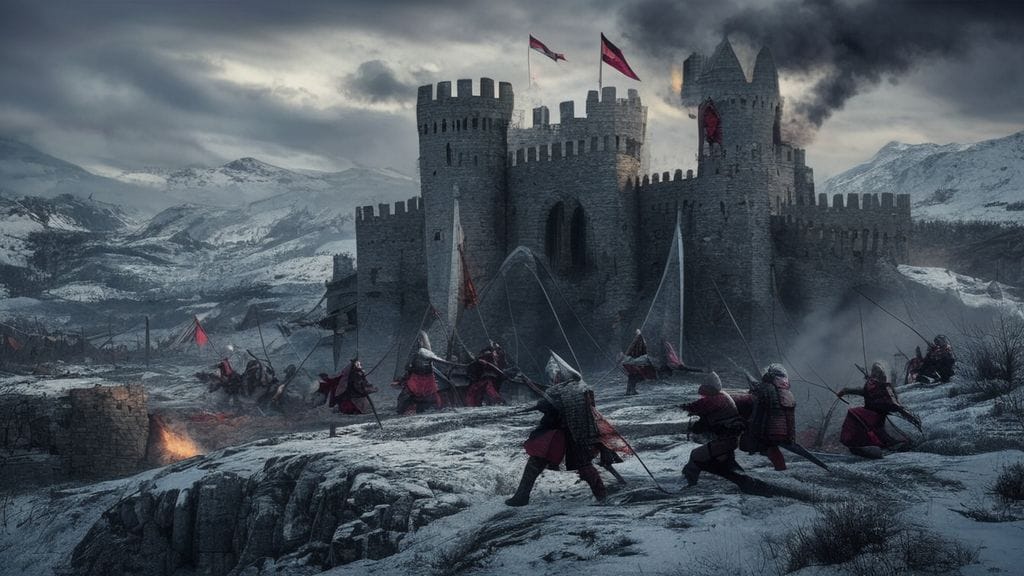
The siege of Montségur formally began in the late spring or early summer of 1243. Encamped on surrounding hills and in the valleys below, the besieging forces erected tents, dug trenches, and prepared engines of war. Their banners—a patchwork of royal lilies and local heraldry—fluttered in the mountain winds. For the soldiers, this was another assignment, grueling but comprehensible: starve out a fortress, fend off sorties, wait for the inevitable.
For the people within Montségur, the start of the siege was both terrifying and curiously clarifying. The ambiguous lull of previous years, with its mixture of hope and dread, was over. Now there was an enemy at the gate, visible from the battlements. Scouts reported the number of troops, the positioning of siege engines, the construction of outworks blocking possible escape routes. Sober councils were held to assess supplies. How long could they last? Who might still come to their aid?
The defenders did not remain passive. Archers and crossbowmen on the walls harassed the besiegers, targeting engineers and officers. At least once, small groups attempted daring sorties down the cliffs, hoping to disrupt the siege works or bring back intelligence. There are fragmentary references to a temporary relief or the arrival of reinforcements loosely associated with the Count of Foix, but if such efforts occurred, they were not enough to break the blockade.
Siege warfare at this time relied heavily on patience. While catapults and trebuchets could damage walls, they were cumbersome and took time to assemble. The besiegers had to contend with the same terrain that protected Montségur: steep slopes that made dragging equipment an ordeal, narrow approaches exposed to missile fire, and unpredictable mountain weather. Yet these hardships were offset by a crucial advantage: control of the surrounding countryside. Every path that might have brought food or escape was watched.
As summer turned toward autumn, the siege settled into a rhythm of tension. The castle’s cisterns still held water; the storerooms, though not overflowing, were not empty. The besiegers endured cold nights and boredom, waiting for hunger or despair to do their work. On the mountain, the community remembered earlier campaigns in which strongholds had held out, or in which political winds had shifted just in time. Perhaps something similar would happen again. Perhaps not. No one could yet see the pyre that would one day dwarf all these calculations.
Hunger, Fear, and Faith: Inside the Besieged Stronghold
The longer a siege lasts, the more its true battlefield moves inside the walls. Within Montségur, the months of encirclement gnawed at body and mind alike. Rations were cut gradually. Meat, already shunned by the Perfects, became scarce for everyone. Grain had to be stretched; dried vegetables and whatever could be foraged or preserved were rationed with increasing severity. Each snowfall that winter of 1243–1244 brought not only cold, but the unspoken question: how many more can we endure?
Illness spread in cramped quarters. Children coughed; the old shivered uncontrollably. Arguments flared over small slights, then were smothered out of necessity. The presence of the Perfects, however, gave the defenders a spiritual focus. In dim chambers lit by oil lamps, they spoke of endurance, of the transience of the material world. Some likely framed the siege as a trial permitted by the good God to test and refine souls, or as the predictable fury of the lower, evil principle that ruled the visible universe.
These interpretations could be both consoling and deeply demanding. To believe that the body was a prison and the soul’s true homeland lay elsewhere might make hunger and fear bearable. It also sharpened the stakes of every decision. To betray the faith in hopes of saving one’s skin would not just be cowardice; it would be a form of cosmic treason. Yet humans are not made of dogma alone. Behind the public displays of steadfastness, some must have secretly weighed the possibility of surrender and conversion, especially those with young children or aging parents depending on them.
At the same time, the defenders still hoped for negotiation. Throughout medieval warfare, sieges often ended not in total annihilation but in terms hammered out between captors and captives. Could an arrangement be found that would spare at least some lives, or allow the non-heretical among them to leave unharmed? Envoys and messages passed between the castle and the besiegers. Each day of delay, though costly in food, kept alive the chance of a less terrible ending.
In those circumstances, the religious life of Montségur intensified. More Credentes may have sought the consolamentum, aware that their future was shrinking to weeks or days. For the Cathar bishops and Perfects, this meant a heightened sense of responsibility. To grant the sacrament was to bind the recipient to a discipline they might barely have time to live out—but also to affirm that their true life lay beyond the reach of royal edicts and inquisitorial verdicts. Later accounts would speak of the extraordinary number of Perfects present at the fall of Montségur, suggesting a deliberate concentration of the movement’s spiritual elite. If so, the community had made a quiet, radical choice: to gather its light on a single, doomed peak.
The Final Assault and the Negotiated Surrender
By early 1244, the military balance had tipped decisively in favor of the besiegers. Weather, attrition, and the slow degradation of supplies inside Montségur weakened the defenders. Then came a tactical blow that would prove decisive. Utilizing the rugged terrain, a contingent of attackers managed to seize a rocky outcrop overlooking part of the fortress—a position from which they could harass the walls at much closer range and disrupt any remaining lines of movement along the ridge.
From that moment, the siege entered its final phase. Missiles rained down more frequently; defenders found fewer safe spots on the battlements. The psychological effect of seeing the enemy above them, on ground that had once seemed secure, was profound. Montségur was no longer only besieged; it was partially overmastered.
Recognizing the gravity of the situation, the castle’s leaders—both secular and religious—convened to discuss their options. A hopeless last stand, fighting until the last warrior fell on the walls, was one possibility, and it would have matched a certain martial ideal of honor. Yet such a course would leave no room for negotiation, no opportunity to save even a fraction of the community. Another option was to seek terms while they still had something to offer: an intact fortress, hostages, and the symbolic prize of a prominent Cathar center.
Parley followed. Messengers descended from the rock and returned with proposals. The details of the negotiation have not survived in full, but the broad outline is clear. A surrender was agreed upon. The defenders would yield the fortress; in return, their lives would be spared—except for those identified as unrepentant Cathar Perfects. The latter would have a grace period of fifteen days to consider their choice. If they renounced their beliefs and accepted the doctrines of the Church, they would be absolved. If they refused, they would face the stake.
It was an offer sharpened like a blade. For many among the garrison and the civilian population, this meant a path, however painful, to survival. For the Perfects, it presented a dilemma that cut to the heart of their faith. The fall of Montségur would not be a simple conquest; it would be, by design, a test of conscience.
March 16, 1244: Flames at the Foot of the Mountain
The fortnight that followed the agreement must have been among the most intense and introspective in Montségur’s history. Word spread that the castle would be surrendered, that the siege would end, that many lives would indeed be spared. Yet for the Perfects—and for some Credentes who, in those days, requested and received the consolamentum—it was also a period of preparation for death.
Accounts differ on exact numbers, but most modern historians accept that roughly two hundred Cathar Perfects and committed believers chose not to recant. They were fully aware of what that meant. To abjure their faith publicly would be to betray the God they believed ruled the spiritual realm and to acknowledge the authority of a Church they considered captive to the evil principle of matter. To stand firm was to accept being classified as obstinate heretics and condemned to the flames. For them, the fall of Montségur was no mere political defeat; it was the threshold of martyrdom.
On or about 16 March 1244, under a cold, bright sky, the condemned were led out of the fortress. Some sources suggest they descended a special path toward a prepared site on a lower terrace, where a large fenced area stuffed with wood awaited them. There was no formal auto-da-fé in the later Spanish sense—no elaborately choreographed ritual—but there was certainly a deadly liturgy in the eyes of the Church: the obstinate heretics were delivered over to secular justice for execution, their souls entrusted, ironically, to the God whose nature they had so differently conceived.
Witnesses, whose echoes reach us only through later reports and inquisitorial records, describe an astonishing calm among the victims. Many are said to have entered the enclosure singing or praying. Families clung together; Perfects encouraged one another. The pyre was lit. Flames, fed by dry timber and the mountain wind, roared upward, devouring clothing, hair, flesh. Smoke rose toward the castle above and out across the valleys below. The smell, the sound, the heat—these are the elements that no chronicle can fully convey.
For the besiegers, this was the grim climax of their long campaign. Heresy, at least in this citadel, had been literally consumed. For the survivors allowed to leave—those who had abjured, or who had never been Cathar at all—the day mixed relief with trauma. They walked away from the mountain carrying memories they could not share openly for fear of renewed suspicion. The fortress itself, soon occupied by forces loyal to the crown and the Church, became a symbol of triumph for official chroniclers. But beyond the formal narratives, among the people of the South, the fall of Montségur would take on another meaning: the story of a community that chose conviction over life.
Ashes in the Wind: Political and Social Consequences
With the smoke of the pyre still fading into the mountain air, the practical consequences of the fall of Montségur began to unfold. Militarily, the conquest removed a stubborn outpost that had offered both shelter and inspiration to Cathar networks. Without Montségur, the remaining pockets of open resistance fragmented further. Some Perfects who had escaped earlier or hidden during the surrender continued to travel secretly in the region, but their days of gathering openly in fortified sanctuaries were effectively over.
Politically, the fall consolidated the transformation of Languedoc from a loosely autonomous region into a realm increasingly dominated by the French crown. The County of Foix, though not entirely subdued, had to recalibrate its stance, acknowledging the futility of overtly sheltering heresy. The message was clear: no lord, no matter how remote his castles or steep his mountains, could safely defy both king and pope in concert. Royal and ecclesiastical power had fused into a formidable alliance.
Socially, the effects were more diffuse but no less profound. The destruction of a visible Cathar center accelerated the process by which heresy was driven into the shadows. Families that had once hosted Perfects now faced a stark choice: complete conformity or the constant risk of denunciation. The inquisition did not disband after Montségur; if anything, it was emboldened. Registers from the later thirteenth century testify to continued investigations, confessions wrung from frightened villagers, and the slow erosion of the old religious pluralism of the region.
Yet beneath the surface, memory preserved what institutions tried to erase. Stories of the fall of Montségur circulated in whispers, in songs, in the half-spoken language of grief. Children who had seen the flames grew into adults who remembered the faces of those who walked into the fire. In some villages, as anthropologist-historian Emmanuel Le Roy Ladurie later suggested in his study of Montaillou, old sympathies toward the “bons hommes” persisted, transmuted into vague respect for ancestors who had suffered unjustly.
Economically, too, the region changed. Confiscated lands passed into the hands of nobles loyal to the crown or Church institutions. The integration of Languedoc into the French realm brought new commercial opportunities but also new taxes, legal norms, and cultural pressures. Occitan language and customs did not vanish, but they increasingly coexisted with northern French influences. The fall of Montségur was thus both a local catastrophe and a chapter in the broader story of French state-building.
From Heresy to Legend: How Memory Shaped Montségur
History seldom ends where the chroniclers close their manuscripts. In the case of Montségur, the physical event—the siege, the surrender, the pyre—was only the foundation on which centuries of legend would be built. For a long time, the story remained mostly local, held in the memories of the people of the Pyrenean foothills. The Church itself, having “resolved” the problem of heresy there, had little reason to commemorate the site, except perhaps as a reminder of its victory.
In the early modern period, as interest in regional pasts grew, antiquarians and clerics began to take note of the ruined fortress on its improbable peak. Some Catholic authors repeated official narratives, framing the episode as a necessary purge of dangerous errors. Others, influenced by changing sensibilities, showed a certain discomfort with the scale of the violence. The victims might still be called heretics, but there was an emerging awareness that their destruction had involved profound cruelty.
The Romantic age of the nineteenth century transformed Montségur’s memory dramatically. Poets, novelists, and nationalist thinkers in the South of France, seeking symbols of regional identity, rediscovered the site as a stage for resistance and tragedy. The Cathars, once denounced as enemies of the faith, were reimagined as precursors of spiritual freedom, proto-Protestants, or even forerunners of modern rationalism, depending on the interpreter’s agenda. The fall of Montségur became an emblem of the death of an alternative, perhaps more tolerant civilization crushed by northern French and papal might.
Occitanist intellectuals, advocating for the recognition of the Occitan language and culture, embraced Montségur as a kind of martyr’s mount. Pilgrimages, both literal and figurative, were made to the ruins. Speeches invoked the memory of the “bonas gents” who had died rather than betray their convictions. The story was embellished, simplified, reshaped—less a matter of precise historical reconstruction than of symbolic resonance. One could stand amid the toppled stones and feel, or imagine, a connection across the centuries to those who had once walked there in defiance.
This myth-making did not erase the complexities of the original events, but it did give them new life. The fall of Montségur, once a detail in medieval Church history, became a touchstone in debates about intolerance, cultural domination, and the relationship between center and periphery. In the process, facts and fictions intertwined in ways that continue to challenge historians and fascinate visitors.
Historians, Myths, and the Search for the “Cathar Treasure”
Among the most persistent legends associated with Montségur is that of a hidden Cathar treasure spirited away from the fortress before its surrender. The story, popularized in the nineteenth and twentieth centuries, suggests that shortly before the fall, a small group of Perfects managed to slip past the besiegers, carrying with them either vast material wealth or, in some versions, sacred texts and secret knowledge. The treasure’s nature shifts with the teller: gold and jewels in one account, the Holy Grail in another, esoteric wisdom in yet another.
Serious historians tend to treat these claims with skepticism. There is little contemporary evidence for a dramatic escape of this kind. Yet the very persistence of the legend reveals something important about how the fall of Montségur has been imagined. People are reluctant to accept that a community could vanish wholly into smoke and ash. The idea that something precious—whether material or immaterial—escaped the flames offers a more consoling ending. As one modern scholar dryly put it, “When an episode ends with a pyre, the human imagination instinctively searches for a door.”
Academic studies of Catharism and Montségur in the twentieth century, drawing on inquisitorial records, archaeological work, and comparative religious history, have offered a more sober but no less compelling picture. Historians such as Jean Duvernoy and Anne Brenon have painstakingly reconstructed the beliefs, networks, and daily lives of Cathar communities, challenging earlier romantic or polemical depictions. The fall of Montségur, in their work, is not the extinguishing of some cosmic secret, but the destruction of a fragile, very human religious experiment.
At the same time, historians acknowledge that many questions remain. How uniform was Cathar doctrine in practice? To what extent did local lords genuinely embrace the faith, as opposed to using it as a political bargaining chip? How did ordinary villagers reconcile official Catholicism with the attraction of the Perfects’ teaching? In trying to answer these questions, scholars must constantly navigate between the Scylla of romanticization and the Charybdis of reductionism.
One perhaps surprising outcome of this scholarship has been a re-evaluation of the inquisition’s records. Once viewed solely as instruments of repression, they are now also mined as precious, if biased, windows into medieval mentalities. Through these testimonies—voices coaxed or coerced in darkened rooms—we catch glimpses of people remembering Montségur, describing those who died there, and explaining why they did or did not follow their path. In that sense, the true “treasure” of Montségur may be the fragile archive of human experience it left behind, preserved in ink rather than gold.
Montségur in the Modern Imagination and Occitan Identity
Today, visitors who climb the steep path to the ruins of Montségur encounter more than a historical site. They enter a landscape charged with layers of meaning accumulated over nearly eight centuries. Tourist brochures speak of “Cathar castles,” a label that simplifies but also markets the region’s medieval past. Locals organize commemorations, theatrical reenactments, and conferences. The modern village of Montségur below the pog lives, in part, from this traffic of memory.
For many in the broader Occitan cultural movement, Montségur remains a powerful symbol. It stands for the resilience of a language and a way of life that have often been marginalized within the French nation-state. Occitan songs interpret the fall of Montségur as an allegory of cultural suppression; speeches on the anniversary of the 1244 pyre often blend historical reflection with contemporary political critique. The site thus links the medieval struggle over heresy with modern debates about minority cultures and centralization.
At the same time, Montségur has attracted a variety of spiritual seekers and esoteric currents. New Age groups, neo-gnostics, and others drawn to non-orthodox spiritualities see in the Cathars kindred spirits, projecting onto them ideals of nonviolence, simplicity, and inner enlightenment. Books and documentaries present the Cathars as guardians of a secret wisdom suppressed by a jealous Church. While historians rightly caution against such projections, they are part of the site’s contemporary life.
Standing amid the tumbled stones and looking out across the blue distances of the Pyrenees, one can understand this pull. The geography itself invites contemplation. The story of the fall of Montségur, with its mixture of steadfastness and horror, speaks to enduring human questions: What is worth dying for? How does a community face annihilation? Can power ever fully extinguish belief?
Yet behind the romantic vistas and interpretive overlays, the historian’s task remains: to keep in view the concrete men, women, and children who inhabited this place in 1244, with their particular accents, fears, and hopes. They did not know they were living through an event that would inspire novels and manifestos centuries later. They only knew that the horizon was closing, and that they had to decide what, in that narrowing space, they could not surrender.
Echoes of a Pyre: What the Fall of Montségur Tells Us Today
In the twenty-first century, the fall of Montségur might seem impossibly distant—a medieval episode of siege warfare and theological controversy, written in a language of heresy and orthodoxy that no longer structures most people’s lives. Yet the questions it raises are uncomfortably familiar. How do societies respond to beliefs they deem dangerous? Where is the line between defending common values and enforcing conformity by violence? Who gets to define “truth” in a community, and what happens to those who dissent?
The alliance of papal and royal power that brought down Montségur was motivated by a genuine conviction that Cathar ideas threatened the salvation of souls and the stability of Christendom. It was also driven by more worldly calculations of territory and authority. That entanglement of idealism and interest, of fear for the common good and desire for control, recurs in many settings. As one modern historian noted, reflecting on the Albigensian Crusade and its aftermath, “To eliminate what we fear in others, we often erect structures that later generations recognize as more terrifying still.” The machinery of inquisition, refined in Languedoc, would leave a long shadow in European history.
At the same time, the story of those who died at Montségur complicates simple narratives of victimization. They were not passive. They made choices—often stark, sometimes ambiguous. Some recanted; others did not. Some had previously cooperated with local powers; others had challenged them. To reduce them either to saints or to fanatics is to strip them of their humanity. The true power of their story lies in its refusal to offer easy heroes and villains.
For historians, the fall of Montségur is also a reminder of the fragility of our sources. We know the Cathars primarily through the words of their enemies and a few later accounts colored by nostalgia or polemic. Reconstructing their voices requires patient, critical reading and a willingness to accept gaps. The mountain keeps some of its secrets.
And yet, standing at the edge of the ruined walls, with the wind tearing at one’s clothes and the valleys opening below, one cannot escape the sense that this place has something urgent to say. It speaks of the costs of absolute certainty, whether wielded by inquisitors or by those who face them. It whispers of the endurance of memory, which, even when burned in one generation, flares up again in another as legend, as protest, as questioning. Above all, the fall of Montségur reminds us that history’s grand shifts—state-building, religious conflict, cultural change—are lived, at ground level, by communities forced to make impossible decisions in the shadow of forces they can barely comprehend.
Conclusion
The lonely rock of Montségur, crowned with its ruined walls, stands today as both monument and question mark. In March 1244, this fortress at the edge of the County of Foix became the stage for a brutal convergence of faith, power, and fear. The siege, the negotiated surrender, and the decision of around two hundred Cathar Perfects and believers to choose the pyre rather than recant crystallized decades of conflict between a heterodox religious movement and an increasingly centralized alliance of Church and crown. The fall of Montségur was at once a local catastrophe and a symbolic ending to the Cathar experiment in open community.
Yet endings in history are rarely complete. The flames that consumed the victims at the foot of the mountain did not erase their memory. Instead, over centuries, that memory was refracted through many lenses: official triumphalism, local mourning, Romantic reinvention, nationalist and regionalist appropriation, esoteric speculation. Each generation, confronting its own tensions between orthodoxy and dissent, found something in Montségur’s story that spoke to its concerns. Historians, sifting carefully through polemics and fantasies, have tried to restore the human texture of the community that once lived and died there.
In the end, Montségur challenges us not simply to take sides between persecutors and persecuted, but to reflect on the conditions that make such confrontations possible. It asks what happens when a society decides that certain ideas cannot be tolerated, and how those decisions intertwine with ambitions for political control. It also invites us to consider the courage—and the cost—of holding to a conviction when the price is everything one has in this world.
Looking up at the pog, or standing upon it, we are confronted not only with the tragedy of 1244, but with the enduring human capacity to remember, reinterpret, and draw meaning from the past. The fall of Montségur, for all its distance, remains a mirror in which we can still glimpse our own struggles over belief, identity, and power. The smoke has long since blown away on the mountain winds, but the questions raised by that day’s flames have not yet burned out.
FAQs
- What was the fall of Montségur?
The fall of Montségur refers to the surrender and capture of the fortress of Montségur in the County of Foix on 16 March 1244, after a months-long siege by forces loyal to the French crown and the Roman Church. It culminated in the mass execution by burning of around two hundred Cathar Perfects and committed believers who refused to renounce their faith. The event is widely seen as the symbolic end of organized Cathar resistance in Languedoc. - Who were the Cathars at Montségur?
The Cathars were members of a Christian movement that flourished in parts of southern France and elsewhere in the twelfth and thirteenth centuries. Many at Montségur were “Perfects,” spiritual leaders who had received the sacrament of the consolamentum and lived according to strict rules of poverty, chastity, and nonviolence. Others were lay believers, the “Credentes,” who supported them and hoped to receive the consolamentum before death. - Why did the Church and the French crown attack Montségur?
Montségur had become a major refuge and organizational center for Cathar leaders at a time when the Church was determined to eradicate what it considered a dangerous heresy, and the French monarchy was consolidating its control over Languedoc. The fortress symbolized both religious defiance and political semi-independence. Its destruction was intended to demonstrate that neither heresy nor local autonomy could withstand the combined pressure of papal and royal power. - How long did the siege of Montségur last?
The siege began in 1243, likely in the late spring or early summer, and lasted until March 1244—roughly ten months. During this time, the garrison and the civilian population endured increasing shortages, harsh weather, and mounting military pressure, culminating in a negotiated surrender that left the fate of the Cathar Perfects to be decided by their willingness to recant. - Did anyone escape with a “Cathar treasure” before the fall?
Legends claim that a small group escaped Montségur with a great treasure, sometimes described as gold and jewels, sometimes as sacred texts or even the Holy Grail. However, there is no firm contemporary evidence to support these stories. Most historians regard the treasure legend as a later romantic invention, reflecting the refusal to believe that such a community could leave nothing tangible behind. - How many people died in the final execution at Montségur?
Contemporary and near-contemporary sources vary, but most modern estimates suggest that around two hundred people—often cited as approximately 210 to 220—were burned in the great pyre at the foot of the mountain on 16 March 1244. These were primarily Cathar Perfects and believers who declined the offer to recant their faith. - What happened to Catharism after the fall of Montségur?
After the fall of Montségur, Catharism as an organized, publicly visible movement declined rapidly. Some Perfects and believers survived in hiding or in more remote areas, and traces of Cathar belief persisted in parts of Languedoc into the later thirteenth century. However, the combined pressure of the inquisition, political centralization, and social change gradually extinguished Cathar communities as a coherent religious alternative. - Can I visit Montségur today?
Yes. The ruins of the fortress of Montségur can be visited, and a marked path leads from the modern village up to the site on the pog. The climb is steep but offers sweeping views of the surrounding Pyrenees. Information panels and local museums provide historical context, though visitors should keep in mind that much of what survives architecturally dates from later reconstructions rather than the exact structures standing in 1244. - Why is the fall of Montségur considered important for French history?
The fall of Montségur forms part of the wider Albigensian Crusade period, during which the French crown extended its authority over Languedoc and curtailed the power of regional lords. It symbolizes the victory of centralized monarchy and Roman orthodoxy over local autonomy and religious pluralism. As such, it marks a step in the formation of a more unified French kingdom. - How do historians today view the Cathars and the events at Montségur?
Modern historians approach the Cathars and the fall of Montségur with a mixture of sympathy and critical distance. They reject both medieval demonization and some modern idealizations, instead emphasizing the Cathars’ complex beliefs, their social context, and the interplay of religious conviction and political interest in their persecution. The fall of Montségur is seen as a tragedy rooted in genuine theological conflict and in the harsh logics of medieval power.
External Resource
Internal Link
Other Resources
- Encyclopaedia Britannica – general search for the exact subject
- Google Scholar – academic search for the exact subject
- Internet Archive – digital library search for the exact subject

