Table of Contents
- The Evening That Changed the World: November 9, 1989
- A Divided City: Berlin in the Cold War Era
- The Berlin Wall: Symbol of Division and Oppression
- Roots of Discontent: East Germany Before the Fall
- Winds of Change: The Soviet Union’s Shifts Under Gorbachev
- The Rising Tide of Protest: Citizens Demand Freedom
- Unexpected Decision: The Press Conference That Triggered History
- The Rush to the Wall: Thousands Converge on Checkpoints
- The Guards’ Dilemma: From Orders to Open Gates
- Moments of Joy and Chaos: Crossing the Wall for the First Time
- The Fall’s Immediate Political Impact on East Germany
- Reactions from the West and Global Powers
- The Ripple Effect: Collapse of Eastern European Communist Regimes
- Germany’s Road to Reunification: Challenges and Triumphs
- Cultural and Social Aftershocks of the Wall’s Fall
- The Wall in Memory: Museums, Memorials, and Narratives
- The Berlin Wall in Global Imagination: From Fear to Hope
- Lessons from 1989: Freedom’s Fragile Yet Powerful Force
- Conclusion: The End of an Era, The Birth of a New World
- FAQs: Understanding the Fall of the Berlin Wall
- External Resource
- Internal Link
The Evening That Changed the World: November 9, 1989
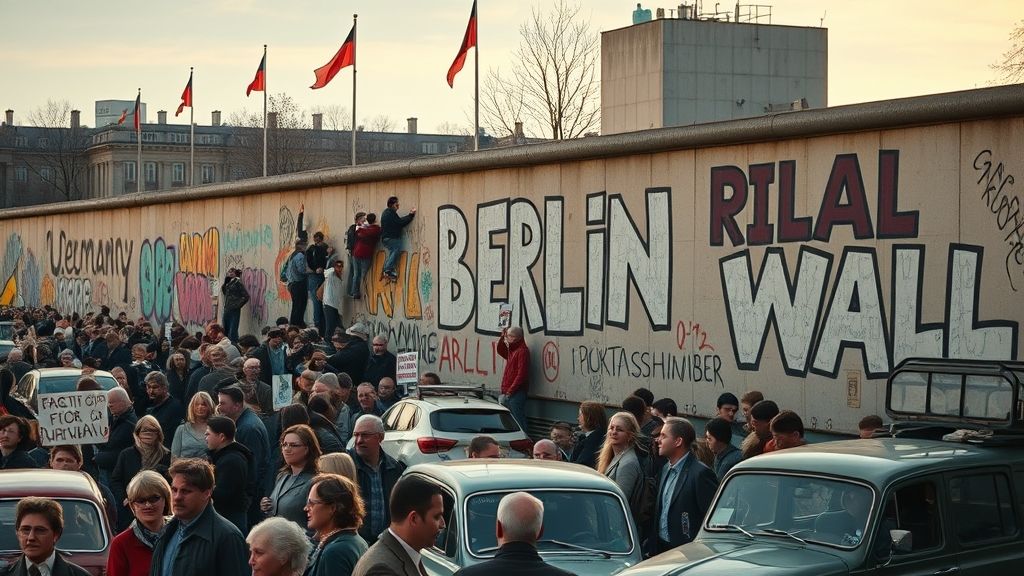
On a crisp autumn evening, under the pale November sky, a crowd gathered near the once-imposing concrete slab that had carved Berlin in two for nearly three decades. What began as tentative whispers and cautious glances soon morphed into a surging wave of elation, crossing borders previously thought impenetrable. The Berlin Wall, emblem of repression and Cold War hostility, was no longer a barrier but a bridge—with thousands of East Germans overwhelming the checkpoints, stepping onto western soil, embracing families, strangers, and freedom itself.
It was a moment suspended in time, surreal yet palpable. Cameras flashed. Tears fell. Laughter and music filled the air where only months before stood watchtowers and gunfire warnings. “I’ve never seen anything like it," whispered Hans, a young Berliner who had spent his entire life behind the Wall. “The Wall wasn’t just brick and wire; it was all the pain and hopes of generations. Watching it fall… it was like watching history breathe out.”
But this night was only the climax of a story decades in the making—a story not just about a wall but about ideology, power, human resilience, and the inexorable yearning for freedom.
A Divided City: Berlin in the Cold War Era
Berlin, the heart of Germany, lay shattered after World War II, carved into four sectors controlled by the victorious Allied powers: the United States, the United Kingdom, France, and the Soviet Union. But in the split of a wartorn metropolis, the seeds for the Cold War’s most potent symbol were sown.
West Berlin became an island of Western democracy encased within East German territory dominated by the Soviet-backed German Democratic Republic (GDR). Over time, the ideological chasm widened profoundly: capitalism and democracy on one side; communism and authoritarianism on the other.
As East Berliners sought to escape to the West via Berlin’s unique geography, the East German government responded with a brutal solution—the Berlin Wall, erected overnight on August 13, 1961. Concrete barriers, barbed wire, watchtowers, death strips—Berlin was cleaved physically and psychologically into two worlds.
The Berlin Wall: Symbol of Division and Oppression
Beyond mere concrete and metal, the Wall deeply embodied the Cold War’s global tensions. It was a monument to division, a scar on the urban and human landscape. Families separated, careers and dreams stifled, lives lost attempting to breach the barrier.
Winston Churchill’s famous phrase “an iron curtain” took literal form here. The Wall was the physical manifestation of a world bifurcated by ideology, a stark reminder of how far the postwar world had strayed from unity and peace.
Yet, it was also a constant reminder of resistance. East Germans, aided by Western broadcasts and daring escape attempts, refused to accept the Wall’s permanence. Their struggle was a silent testimony to the human spirit’s refusal to be caged.
Roots of Discontent: East Germany Before the Fall
Throughout the 1970s and ’80s, the GDR was experiencing growing economic stagnation and social unrest. Despite its facade of stability, dissatisfaction ran deep beneath the surface.
A heavily surveilled society, controlled by the infamous Stasi secret police, saw dissent slowly simmer but rarely erupt openly. Yet, the flow of people defecting to the West prior to the Wall’s construction signaled a systemic failure.
By the late 1980s, fuelled by international pressures and domestic hardship, protests began to flare. Citizens organizing in churches and public squares demanded rights, reform, and dignity.
“People were simply tired,” recalled Sabine, a former East Berliner. “Tired of fear, tired of silence, of being second-class in their own land. It was a quiet revolution that became loud overnight.”
Winds of Change: The Soviet Union’s Shifts Under Gorbachev
Mikhail Gorbachev’s ascent to Soviet leadership in 1985 introduced policies that would unknowingly dismantle the Cold War edifice. His reforms—Glasnost (openness) and Perestroika (restructuring)—allowed for freer discourse and economic experimentation.
Suddenly, the rigid Soviet line was loosening. Neighboring Eastern Bloc states watched, some inspired, others fearful. The Soviet Union’s commitment to preserving communist hegemony was no longer absolute.
East Germany’s leader, Erich Honecker, initially resisted reform, but the tide was relentless. Soviet disengagement effectively removed the prop holding up the GDR’s authoritarian regime.
The Rising Tide of Protest: Citizens Demand Freedom
Through 1989, protests multiplied—from Leipzig’s Monday demonstrations swelling into mass gatherings, to open calls for travel freedom and political pluralism.
The famous chant, “Wir sind das Volk!” ("We are the people!"), echoed through streets packed with thousands, demanding recognition and democracy.
Government crackdowns failed to suppress this awakening. Instead, growing numbers from all walks of life—students, churchgoers, workers—joined the calls for change.
Unexpected Decision: The Press Conference That Triggered History
November 9, 1989, began as a typical day. But a hurried announcement by East German official Günter Schabowski sent shockwaves rippling across the city.
In a live press conference, Schabowski mistakenly declared that new travel regulations allowing East Germans to cross the border were effective immediately, without official clarification.
The statement was broadcast—“The border is open”—and thousands surged toward checkpoints, demanding passage.
The Rush to the Wall: Thousands Converge on Checkpoints
At first, border guards were overwhelmed. Crowds of jubilant East Berliners approached with passports and visa papers, expecting closure and bureaucratic delays.
Instead, confronted with masses and unclear orders, many guards lowered their weapons and allowed passage. The Wall’s gates were thrown open, and the flood of East Germans crossed into West Berlin, embraced by cheering crowds.
The Guards’ Dilemma: From Orders to Open Gates
The border guards faced an impossible choice—follow rigid orders to shoot or open the gates to an unprecedented popular movement.
Many were ordinary men, unsure, caught between duty and conscience. Some had families waiting on the other side. Their decision not to fire was pivotal, turning a political crisis into a celebration of freedom.
Moments of Joy and Chaos: Crossing the Wall for the First Time
The emotion was overwhelming. Embraces, tears, laughter, even singing filled the night air. People climbed atop the Wall, chipping at concrete with hammers and chisels, taking souvenirs of a regime crumbling before their eyes.
West Berliners opened their arms, offering food, warmth, and companionship. The night blurred the lines between oppressed and liberator.
The Fall’s Immediate Political Impact on East Germany
East Germany’s ruling party was shaken to its core. Honecker had already resigned weeks earlier, replaced by Egon Krenz, who could not stem the tide.
The Wall’s opening signaled the beginning of the regime’s rapid demise. Calls for free elections grew louder. The GDR’s political system, long entrenched, faced total collapse.
Reactions from the West and Global Powers
Western leaders welcomed the event with cautious optimism. U.S. President George H.W. Bush hailed it as a “victory for freedom.” Yet, questions abounded about the repercussions for NATO, the Soviet Union, and European balance.
Soviet leader Gorbachev refrained from intervention, signaling a new era in East-West relations.
The Ripple Effect: Collapse of Eastern European Communist Regimes
The fall of the Berlin Wall sent shockwaves beyond Germany. Nations such as Poland, Hungary, and Czechoslovakia accelerated reforms and revolutions.
The Iron Curtain began to dissolve. The Cold War’s ideological divide slowly eroded, pointing toward a new world order.
Germany’s Road to Reunification: Challenges and Triumphs
Less than a year later, on October 3, 1990, Germany was officially reunified. But reunification was complex—merging economies, legal systems, and identities posed formidable challenges.
Yet, the will of the German people and international support made it possible. Germany emerged as a key player in a new Europe.
Cultural and Social Aftershocks of the Wall’s Fall
The Wall had shaped identity for generations. Its fall sparked cultural festivals, reconciliation efforts, and an explosion of artistic expression reflecting on trauma and hope.
Berlin itself transformed from a divided city to a vibrant, diverse capital, symbolizing unity and resilience.
The Wall in Memory: Museums, Memorials, and Narratives
Today, preserved segments of the Wall stand as powerful reminders. Museums document stories of escape and suffering; memorials honor those who died trying to cross.
The Wall is not forgotten but reinterpreted—as a warning and a testament to freedom’s cost.
The Berlin Wall in Global Imagination: From Fear to Hope
Internationally, the Wall’s collapse reshaped perceptions. Once a global icon of oppression, it became a beacon of hope—proof that entrenched systems could be dismantled peacefully.
This transformation continues to inspire movements fighting for freedom worldwide.
Lessons from 1989: Freedom’s Fragile Yet Powerful Force
The Wall’s fall teaches us about the power of peaceful protest, historical contingency, and the human desire for liberty.
It reminds us that even the most entrenched powers can crumble when confronted by collective will.
Conclusion: The End of an Era, The Birth of a New World
The fall of the Berlin Wall was more than bricks tumbling down: it was the collapse of an era defined by division, fear, and mistrust. It signaled the triumph of hope over oppression, the rekindling of human dignity, and the reimagining of a united Europe.
In the faces of those who crossed the border that night, we see the courage to dream and the power of history to reshape futures—reminding us, even decades later, that freedom, once tasted, can never be fully contained.
FAQs
1. What led to the construction of the Berlin Wall in 1961?
The Berlin Wall was built by East Germany to stop the mass exodus of citizens fleeing to West Berlin and West Germany, which was causing political embarrassment and economic strain on the GDR.
2. How did Mikhail Gorbachev’s policies influence the fall of the Berlin Wall?
Gorbachev’s reforms signaled a relaxed stance toward Eastern Bloc control and a move away from military intervention, empowering movements for freedom in satellite states including East Germany.
3. Why did the border guards open the gates on November 9, 1989?
Faced with large crowds and unclear orders due to a confusing press statement, border guards chose not to use force and allowed East Germans to cross, sparking the Wall’s fall.
4. What was the international reaction to the Wall’s opening?
World leaders expressed cautious optimism, seeing it as a victory for democracy but also contemplating the implications for Cold War geopolitics.
5. How did the fall of the Berlin Wall affect the rest of Eastern Europe?
It emboldened reform and revolution across Eastern Europe, accelerating the collapse of communist regimes and the end of the Cold War.
6. What were the main challenges during German reunification?
Challenges included economic disparity, integrating differing political systems, and overcoming cultural and social divisions between East and West.
7. How is the Berlin Wall remembered today?
It is commemorated through museums, preserved Wall segments, memorials, and educational programs, serving as a reminder of the costs of division and the value of freedom.
8. What lasting legacy did the fall of the Berlin Wall leave on global history?
It marked the Cold War’s end, catalyzed democratic transitions worldwide, and symbolized the triumph of popular will over authoritarianism.