Table of Contents
- The Last Rays of Byzantium: Trebizond on the Eve of August 1461
- The Geopolitical Puzzle of the Pontus Region
- The Empire of Trebizond: A Byzantine Isolate in a Changing World
- Mehmed II: The Sultan’s Eye on Trebizond
- A Fortress on the Edge: The Defenses of Trebizond
- The Siege Begins: Ottoman Forces Encircle Trebizond
- Emperor David Komnenos: The Last Stand
- Diplomacy and Desperation: Appeals for Aid that Never Came
- The Tenacity of Trebizond’s People: Between Hope and Hunger
- The Final Assault: August 15, 1461 – The Fall of Trebizond
- Mehmed’s Magnanimity: The Fate of Emperor David and His Court
- Trebizond Transformed: From Byzantine Principality to Ottoman Province
- The Aftermath: Regional and Global Reverberations
- The End of an Era: The Last Byzantine Enclave Disappears
- Cultural Legacies: Trebizond’s Artistic and Intellectual Heritage Post-Conquest
- The Fall in the Eyes of Contemporaries and Chroniclers
- Revisiting the Siege in Modern Historiography
- The Memory of Trebizond in Modern Turkey and Greece
- Lessons on Resilience and the Transformation of Empires
- Conclusion: The Enduring Echo of August 15, 1461
- FAQs About the Fall of Trebizond
- External Resource
- Internal Link
The Black sea stretched endlessly, its cold waves colliding with the ancient walls that had stood for centuries. Trebizond, perched triumphantly on the scenic cliffs of the Pontus region, was on the brink of oblivion. It was August 1461—a date that marked not just the fall of a city, but the sunset of a Byzantine dream that flickered desperately against the sweeping tide of Ottoman ambition.
The Last Rays of Byzantium: Trebizond on the Eve of August 1461
Imagine standing on the ramparts of the fortress overlooking the vibrant harbor of Trebizond, feeling the salty wind brush against your face, while hearing the anxious murmurs of townsfolk reinforcing barricades. The sun beat down on the white stone of the walls and the terracotta roofs below. The once-glorious empire, now reduced to but a fragile principality clinging to its survival, was about to face an adversary whose vision and power would redraw the map of the known world.
Trebizond—the last flame of Byzantine sovereignty—held on for nearly three centuries past the fall of Constantinople in 1453. It was a place suspended in time, a jewel of classical art, piety, and commerce, enriched by a thousand years of Eastern Roman history. Yet, on this August day, the world was watching the final act of its autonomy.
The Geopolitical Puzzle of the Pontus Region
To understand why Trebizond mattered so much, we must step back and unravel the complex tapestry in which it was entangled. Located on the southeastern shores of the Black Sea, connected by treacherous mountains to the interior of Anatolia and surrounded by turbulent relations with neighboring powers, Trebizond sat at a crossroads—not only of trade routes but of identities.
By the mid-15th century, the Ottomans ruled the core of the former Byzantine lands and were expanding aggressively in Anatolia and the Balkans. Yet Trebizond remained, somewhat anachronistic, a Byzantine outpost surrounded by Ottoman-controlled territory and small Turkmen and Georgian principalities. Its survival was testament to geographic isolation and diplomatic balancing acts but also a source of constant tension.
The Empire of Trebizond: A Byzantine Isolate in a Changing World
Founded in 1204 by Alexios I Megas Komnenos, Trebizond represented a splinter Byzantine polity that survived for over 250 years after the Latin sack of Constantinople emptied imperial coffers and destroyed political unity. It inherited Byzantine traditions, culture, and a claim to imperial authority with its own emperors—a last remnant of a once-mighty empire.
Yet, increasingly, Trebizond seemed more a relic than a rising power. Economically dependent on trade—especially exporting silk and other goods across the Black Sea—and diplomatically isolated, it struggled to defend its territory militarily. Its rulers oscillated between appeasing the Sultan and courting Western allies.
Mehmed II: The Sultan’s Eye on Trebizond
Mehmed II, known as Mehmed the Conqueror, had already demonstrated his formidable will by taking Constantinople in 1453, a feat once dreamed impossible. Yet this accomplishment did not satisfy him. Trebizond remained a thorn in his plans to consolidate and legitimize Ottoman dominance over the former Byzantine lands.
This emperor of a dynamic and expanding empire had a vision: controlling all key trade routes around the Black Sea and the hinterlands of Anatolia. Trebizond’s strategic location on the Black Sea coast made it a natural target for absorption. But Mehmed was patient, meticulous, and, above all, relentless.
A Fortress on the Edge: The Defenses of Trebizond
Trebizond's defenses were formidable in their own right, a fortress city fortified by steep cliffs and massive stone walls. The city overlooked a natural port filled with merchant ships from Venice, Genoa, and beyond, a hub of Black Sea commerce.
But fortifications alone could not protect a city whose population was limited and whose resources were stretched thin after decades of precarious sovereignty. The city’s leadership had prepared for a siege but lacked the manpower and external support to withstand the advanced military might of the Ottomans.
The Siege Begins: Ottoman Forces Encircle Trebizond
In the spring of 1461, the Ottoman army began its deadly encirclement. Mehmed's forces advanced steadily but without haste; he understood the psychological weight of a prolonged siege. His commanders established camps and supply lines in the surrounding hills, cutting off Trebizond from external aid or escape routes.
The city's defenders, though outnumbered, fought with the stubborn bravery of men defending their homes and their legacies. Every sortie, every breach repelled was a thread in the fabric of hope that the siege might end without total destruction.
Emperor David Komnenos: The Last Stand
Emperor David Komnenos, the last ruler of Trebizond, is a figure painted with shades of both tragedy and valiant resolve. Born into a dynasty that could claim descent from Byzantine emperors, David inherited a precarious throne at a moment when the world was closing in around him.
David’s options were painfully limited. His appeals for assistance to Christian powers in the West found little response—Europe was still reeling from the fall of Constantinople, embroiled in its own conflicts. With the Ottoman armies tightening their grip, David prepared for the inevitable.
Diplomacy and Desperation: Appeals for Aid that Never Came
Desperation led David to attempt delicate diplomacy. Messages were sent to Genoa and Venice, maritime republics engaged in trade and politics, hoping these states might see Trebizond’s survival as essential to their Black Sea interests.
Yet, practical help was scarce. The Western Christian world was disjointed, distracted by internal rivalries and fears over the growing Ottoman power. Thus, Trebizond was left to face its fate largely alone.
The Tenacity of Trebizond’s People: Between Hope and Hunger
Inside the walls, the city’s population endured the slow suffocation of siege warfare. Food shortages, disease, and the psychological toll of bombardment tested their spirit. Chroniclers speak of desperate measures, of families huddled in the dark, waiting for a salvation that never came.
Yet the people of Trebizond persisted, clinging to the hope that either divine intervention or human mercy might spare their city.
The Final Assault: August 15, 1461 – The Fall of Trebizond
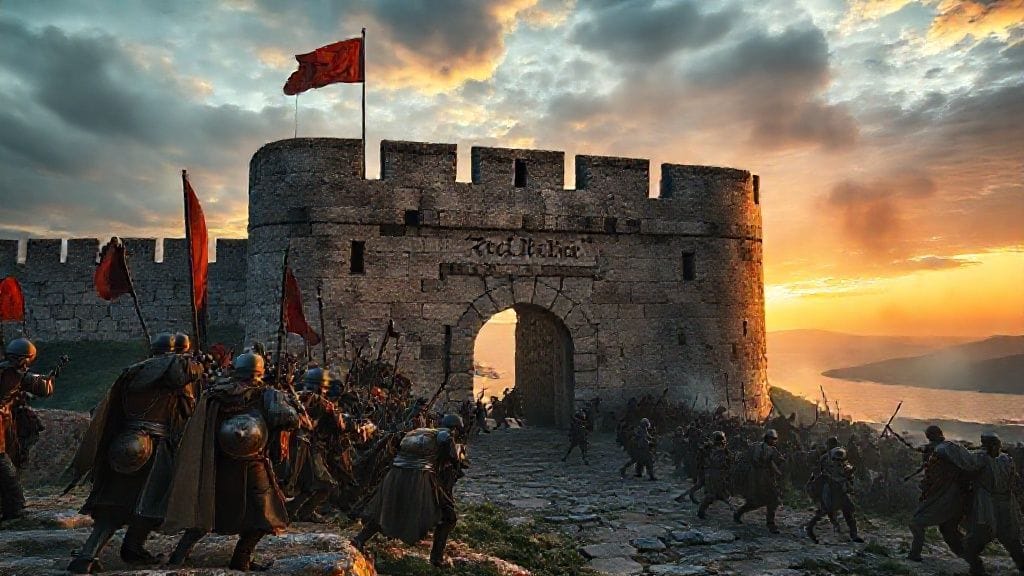
The climax came suddenly. On August 15, the Ottoman forces launched a decisive and overwhelming assault, breaching the city’s defenses after weeks of attrition. Chronicles tell of fierce street fighting, the crash of walls falling, and the sobering realization among defenders that Trebizond’s age had come to a close.
The fall was both catastrophic and strangely respectful. Mehmed’s forces took control, but rather than a wholesale massacre, the Sultan ordered mercy toward the civilians and nobility, signaling a different mode of conquest—pragmatic and consolidate rather than purely destructive.
Mehmed’s Magnanimity: The Fate of Emperor David and His Court
Emperor David and his family were captured, but instead of execution, they were brought to Constantinople. Mehmed treated them with a sort of magnanimity, significant in an era when conquerors often dealt brutally with deposed rulers.
David lived out his days under house arrest, a symbol of the end of Byzantine imperial legitimacy but a living testament to the complex human dimension of the Ottoman expansion.
Trebizond Transformed: From Byzantine Principality to Ottoman Province
With the fall of Trebizond, Mehmed integrated the territory into his empire, renaming it Trabzon and using it as a critical port and gateway to the Caucasus and Persia. He installed Ottoman governors and fostered Islamic institutions, but Trebizond retained elements of its rich Greek cultural heritage.
The city evolved from a Byzantine stronghold into a vibrant Ottoman provincial center, blending its past with the new realities of empire.
The Aftermath: Regional and Global Reverberations
The fall marked the completion of Ottoman dominance over the Eastern Mediterranean and the Black Sea littoral. It secured critical trade and military routes, buttressed the Sultan’s authority, and sent ripples across Europe and Asia.
For Christian Europe, it was another blow in the steady Ottoman advance; for Muslims and Eastern traders, it was an era of promise and opportunity under the new order.
The End of an Era: The Last Byzantine Enclave Disappears
With Trebizond's collapse, the Byzantine Empire—already reduced to a shadow after Constantinople’s fall—ceased to exist in any meaningful form. The ancient empire's centuries-old legacy, its mosaics, laws, and traditions, were absorbed or transformed in an Ottoman imperial framework.
This moment marked the literal and symbolic end of an epoch that had shaped the medieval and early modern world.
Cultural Legacies: Trebizond’s Artistic and Intellectual Heritage Post-Conquest
Remarkably, the cultural achievements of Trebizond survived. Manuscripts, architectural styles, and traditions influenced Ottoman arts and politics. The Komnenoi dynasty’s patronage of iconography and literature left echoes in Eastern Orthodox and Islamic worlds alike.
The city remained a crossroads where East met West—in language, religion, and culture.
The Fall in the Eyes of Contemporaries and Chroniclers
Contemporary chroniclers—Ottoman, Greek, Venetian—recount the fall with a mixture of awe, sorrow, and pragmatic acceptance. The Ottoman perspective emphasized triumph and divine favor; Christian sources lamented the loss of the last bastion of Byzantine civilization.
Eyewitness accounts, letters, and historiographies serve as windows into the human drama behind the conquest.
Revisiting the Siege in Modern Historiography
Modern historians have reevaluated the event, examining its complexities beyond simple conquest narratives. Recent scholarship highlights the interplay of politics, identity, and culture, and the nuanced role of the local population.
The fall is seen as both an inevitable outcome of power shifts and a case study in resilience and cultural transformation.
The Memory of Trebizond in Modern Turkey and Greece
Today, Trebizond (Trabzon) is a vibrant modern city in Turkey, its layered history visible in architecture and dialects. For Greeks and the Eastern Orthodox diaspora, it remains a poignant symbol of loss and heritage.
Both countries contend with its memory, recognizing the city's place at the crossroads of civilizations.
Lessons on Resilience and the Transformation of Empires
The fall offers lessons on the resilience of small states amidst great empires, the limitations of military power, and the cultural negotiations essential to survival.
It prompts reflection on the cycles of history—the collapse of empires, the birth of new orders, and the endurance of identity amid change.
Conclusion
The fall of Trebizond on August 15, 1461, was more than the loss of a city—it was the final shuttering of a door to Byzantine legacy and a powerful moment in the rise of the Ottoman Empire. Behind the battle lines, there were lives transformed, hopes dashed, yet an enduring spirit that transcended defeat.
In the heart of the Black Sea coast, where cliffs meet waves beneath an expansive sky, the echoes of Trebizond’s past remind us that history is not merely dates and facts, but the vibrant stories of human courage, ambition, loss, and renewal.
FAQs About the Fall of Trebizond
Q1: Why was Trebizond important to both the Byzantine and Ottoman empires?
A1: Trebizond’s strategic location on the Black Sea coast made it a crucial trading hub and military outpost controlling access to the Caucasus and eastern Anatolia. For Byzantines, it was a last bastion of imperial tradition; for Ottomans, it was essential to consolidation of power in the region.
Q2: How did Mehmed II prepare for the conquest of Trebizond?
A2: Mehmed II assembled a large, well-coordinated army, cut off Trebizond’s supply lines, and maintained tight siege logistics, balancing direct military pressure with psychological and diplomatic measures.
Q3: What happened to the last emperor, David Komnenos?
A3: David was captured and sent to Constantinople, where he lived under respectful house arrest. Mehmed’s treatment reflected a strategic clemency aimed at stabilizing the newly conquered region.
Q4: Did any Western powers come to Trebizond’s aid during the siege?
A4: Appeals were made to Venice and Genoa but no significant military assistance arrived, as Western powers were preoccupied with other conflicts and fragile alliances.
Q5: How did the local population fare after the Ottoman conquest?
A5: Inhabitants were largely spared massacres; many adapted to Ottoman rule, though some emigrated. The city retained a diverse populace with continuing Christian and Muslim communities.
Q6: What cultural influences did Trebizond maintain after its fall?
A6: Trebizond’s art, literature, and religious traditions influenced Ottoman culture, preserving Byzantine elements in religious iconography and manuscript production.
Q7: How is the fall of Trebizond remembered today?
A7: It is commemorated as the end of Byzantine sovereignty and a pivotal moment in Ottoman history, holding symbolic importance in both Turkish and Greek historical narratives.
Q8: Why is the date August 15 significant in the fall?
A8: August 15 is the Feast of the Dormition of the Virgin Mary, a sacred day in Orthodox Christianity, adding spiritual poignancy to the day Trebizond fell—a city deeply devoted to Orthodox tradition.

