Table of Contents
- A City on the Edge of Two Worlds
- From First Crusade to Frontier County
- Merchants, Monks, and Mercenaries: Life in the County of Tripoli
- The Mamluk Ascendancy and the Shadow over the Coast
- Bohemond VII, Factional Strife, and the Weakening of Tripoli
- Sparks of Ruin: The Burning of the Muslim Quarter and the Breaking of Truce
- Al-Mansur Qalawun Prepares the Noose
- The Siege Begins: Encirclement by Land and Sea
- Inside the Walls: Fear, Famine, and Fractured Loyalties
- Engines of Destruction: Trebuchets, Tunnels, and Naval Blockade
- The Breach at Dawn: 26 April 1289
- Slaughter, Slavery, and Silence: The Human Cost of Conquest
- Rebuilding as Tripoli al-Mansuriyya: A New Islamic Port Arises
- Echoes and Survivors: Refugees, Orders, and the Road to Acre
- Memory, Chronicles, and Competing Narratives
- The Fall of Tripoli in the Long Decline of the Crusader States
- Long-Term Political and Cultural Consequences in the Eastern Mediterranean
- Conclusion
- FAQs
- External Resource
- Internal Link
Article Summary: On 26 April 1289, the fall of Tripoli 1289 marked one of the last great blows to the remaining Crusader states in the Levant, ending nearly two centuries of Latin rule in the city. This article follows the story from the First Crusade to the final collapse, exploring how merchants, warlords, monks, and refugees shaped the fragile County of Tripoli. It traces the rise of the Mamluk Sultanate under Qalawun, the erosion of Tripoli’s defenses through internal feuds and diplomatic failures, and the grim siege that culminated in massacre and enslavement. Through both Latin and Arabic chronicles, the narrative examines how the fall of Tripoli 1289 was remembered differently on each side of the Mediterranean. The story also shows how this defeat accelerated the demise of the Crusader presence, foreshadowing the fall of Acre in 1291. By placing the fall of Tripoli 1289 within a broader web of trade, politics, and religion, the article reveals it as not just a military event, but a turning point in Mediterranean history. In the end, the ruins of the Latin city gave way to a reborn Muslim port, leaving behind a contested legacy of faith, profit, and loss.
A City on the Edge of Two Worlds
In the spring of 1289, Tripoli stood like a stone ship facing the sea, its walls battered by wind and history alike. To a sailor approaching from the west, the city seemed prosperous and alive: masts clustered in the harbor, warehouses lined the waterfront, and the air carried the sharp scent of salt mingled with spices from faraway markets. Yet behind this bustling façade, the foundations of Latin Tripoli were crumbling. On every horizon, danger gathered—Mamluk armies to the east, competing Italian merchants in the harbor, and bitter rivalries simmering within the city’s narrow streets. The fall of Tripoli 1289 would not arrive as a sudden thunderbolt, but as the final crack in a structure long weakened from within.
Tripoli was a frontier city, perched between Christendom and Islam, between the Latin West and the Arabic East, between pious ideals and commercial pragmatism. Pilgrims passed through its gates on their way to holy sites, but so too did silk, sugar, timber, and grain. Armored knights from France or England brushed shoulders with Greek sailors, Jewish moneylenders, Syrian Christians, and Muslim traders. Different tongues echoed across the markets—French, Italian, Arabic, Greek, Armenian—creating a polyglot hum that defined daily life. It is astonishing, isn’t it, to imagine that such a place, so deeply entangled with the currents of the Mediterranean world, could vanish almost overnight.
By 1289, the once-expansive network of Crusader states had shrunk to a thin strip of besieged coastline: Acre, Tyre, Beirut, and Tripoli were the last significant outposts. The dream born in the First Crusade—of enduring Christian principalities in the Holy Land—had faded into a nervous vigil. The fall of Tripoli 1289 would be a signal, clear to all, that the end was close. Yet for those living inside the walls, on that final eve, life still held a semblance of routine. Bakers rose before dawn to tend their ovens. Priests prepared to chant the offices. Children ran between the stalls of the souks. Few could have grasped that they were living the last days of a city that had taken nearly two centuries to build.
But this was only the beginning of the story. To understand why Tripoli fell, and why its fall mattered so deeply, we must step back into the previous centuries—to the fervor of the First Crusade, to the carving up of the Levant into Latin lordships, and to the fragile social fabric that bound conquerors and conquered in an uneasy coexistence. Only then can we trace, step by step, how this coastal stronghold journeyed from triumph to catastrophe, until 26 April 1289 became a date etched into the chronicle of both East and West.
From First Crusade to Frontier County
The story of Tripoli as a Latin county begins not with its fall, but with a siege in the opposite direction. After the capture of Jerusalem in 1099, the victors of the First Crusade turned their eyes northward along the Levantine coast. Control of ports was essential: they were lifelines for pilgrims and supplies, and stepping stones for further expansion. The region around Tripoli, then an important Muslim-ruled city under the Banu Ammar dynasty, offered both strategic promise and rich resources.
In 1102–1103, Raymond IV of Saint-Gilles, count of Toulouse and one of the principal leaders of the First Crusade, laid siege to the area. Failing to capture the city outright, he established a fortified camp on a nearby hill which would evolve into the fortress of Mons Peregrinus, the “Mount of the Pilgrim.” This stronghold, overlooking the coastal plain, symbolized the stubborn determination of the Latins. For years, it stood as a thorn in the side of Tripoli’s defenders, a constant reminder that the Franks intended to stay. The eventual fall of Tripoli to the Crusaders in 1109, after protracted conflict and shifting alliances with local Muslim rulers, gave birth to the County of Tripoli, the last of the four main Crusader polities to be established in the Levant.
The new county stretched from roughly Tortosa (modern Tartus in Syria) in the north to the environs of Beirut in the south, though its boundaries ebbed and flowed with the tides of war. It was, from the start, a precarious creation. Unlike the larger Kingdom of Jerusalem, with its holy prestige, or the Principality of Antioch, with its formidable hinterland, Tripoli was a narrower strip of land wedged between mountains and sea. Yet it possessed strengths of its own: fertile coastal plains, access to timber from the Lebanon mountains, and a growing role in Mediterranean trade.
The counts of Tripoli—Raymond’s successors—ruled as feudal princes, granting fiefs to knights and religious military orders, while trying to impose a Latin aristocratic order atop an overwhelmingly non-Latin population. The majority of inhabitants were Arabic-speaking Muslims and Eastern Christians—Maronites, Greek Orthodox, Armenians, and others—who had their own traditions, rights, and grievances. As historian Steven Runciman once noted in another context, Latin states in the East were “islands of Europe in an Eastern sea,” and Tripoli was among the smallest of these islands, constantly buffeted by regional storms.
For decades, the county endured through a mix of diplomacy, military readiness, and occasional ruthlessness. It cooperated and quarreled with its Latin neighbors; it forged truces with surrounding Muslim rulers when convenient; it welcomed merchants whose money could finance defenses. Yet embedded within its apparent stability was a chronic vulnerability: the county depended on distant Western powers who were often distracted by their own wars or politics. Each Crusade might bring reinforcements, but the interludes between them left the coastal states exposed. Over a century and a half, this pattern wore down their strength and their ability to respond to new threats—threats that, by the thirteenth century, took the form of the rising Mamluk Sultanate.
Merchants, Monks, and Mercenaries: Life in the County of Tripoli
To understand how the fall of Tripoli 1289 was experienced, we need to imagine not only armies and fortifications, but the texture of everyday life in the city. The Latin counts governed from strong castles, yet the pulse of Tripoli itself beat in its harbor and its markets. Venetian, Genoese, and Pisan ships arrived with cloth, oil, weapons, and luxury goods. In return, they took aboard sugar from coastal plantations, cotton and grain from the hinterlands, and timber from the high slopes of Mount Lebanon. The sea connected Tripoli to ports as distant as Marseille, Pisa, and Constantinople.
In the streets, a visitor might see armored Frankish knights striding past hooded Muslim scholars discussing law beneath an awning, or Jewish scribes carrying ledgers from a warehouse to a counting house. Latin churches rose beside Eastern Christian monasteries; mosques, though less prominent in the Latin period, still existed in certain quarters, especially early on or under truce conditions. The city was divided into neighborhoods where particular communities clustered: Syrian Christians in one area, Italian merchants in another, noble compounds near the fortified core.
Religious orders were deeply embedded in the landscape. Benedictine and Cistercian monasteries cultivated lands granted by the counts. Hospitallers and Templars held castles along the frontier, garrisoning the edges of the county. These orders were warrior-monks, bound by vows but also by military obligation. Their commanderies in and around Tripoli served as nodes of both spiritual and strategic significance. In times of threat, they could raise troops; in times of apparent peace, they were major landowners and sometimes political actors in their own right.
Life in Tripoli was often uneasy and tense, but not uniformly violent. Trade required predictability; tax revenue required a degree of security. Periods of truces with neighboring Muslim powers allowed the rhythms of commerce and agriculture to continue. Local Muslim peasants, paying rent or tax in kind, tilled fields owned by Frankish lords or church institutions. Eastern Christian communities, like the Maronites of the mountains, negotiated their standing with the count, sometimes serving as allies against shared enemies.
Yet above this semi-functional coexistence hovered a permanent sense of fragility. Raids could erupt at any time. Caravan routes were vulnerable. Each change of ruler in Damascus, Cairo, or Aleppo could upend existing truces. Children grew up with stories of lost lands and recurrent sieges; widows of knights knew that the sea might never bring their husbands home. The county was a frontier society, defined as much by anxiety as by opportunity. In that atmosphere, the smallest spark—an insult in a marketplace, a raid on a village—could ignite a blaze with far-reaching consequences.
The Mamluk Ascendancy and the Shadow over the Coast
By the mid-thirteenth century, a new power had emerged that would define the fate of the remaining Crusader states. The Mamluks, slave-soldiers who had risen through the ranks in Egypt, seized control of the sultanate. Under rulers such as Baybars (r. 1260–1277) and later Qalawun (al-Mansur, r. 1279–1290), they transformed Egypt and Syria into a formidable, centralized military machine. Their origins as soldiers of servile status made them ruthlessly disciplined. Their ideology, framed as the defense and restoration of Muslim lands, gave them a potent rallying cry. Their strategic aim was clear: to remove the Latin enclaves from the eastern Mediterranean coastline.
The fall of Tripoli’s inland sister, the great fortress city of Krak des Chevaliers (Hisn al-Akrad), in 1271 demonstrated the new Mamluk approach. They besieged relentlessly, combined land and siege-engine warfare with diplomatic pressure, and offered terms calculated to divide defenders. When Krak, long a symbol of Hospitaller power, surrendered, the psychological impact reverberated across the remaining Latin territories. The Mamluks followed with campaigns that rolled up smaller strongholds, tightening the ring around the coastal cities.
Tripoli watched these developments with growing alarm. The city’s leaders understood that they were next in line. But the Mamluks were not merely conquerors wielding the sword; they were also astute diplomats. They negotiated truces with some Crusader outposts while attacking others, preventing a unified Latin response. They leveraged disputes between Italian maritime republics, whose rivalries often weakened the defensive potential of the coastal states.
From the Mamluk perspective, Latin Tripoli was both a military and an ideological target. It was a base from which raids or new Crusades could be launched inland; it was also a visible symbol of a foreign Christian presence in lands that Muslim rulers considered part of the dār al-Islām. Chroniclers in Cairo and Damascus wrote of their sultans’ campaigns as a kind of restoration, reclaiming territories lost in earlier centuries. The fall of Tripoli 1289 would be celebrated in these accounts as the fulfillment of a long-delayed justice.
By the late 1280s, the diplomatic framework that had occasionally shielded Tripoli was unraveling. Earlier truces between the county and the Mamluks were set to expire or had already lapsed. The papacy in the West called for new Crusades, but responses were slow, fragmented, and poorly funded. Meanwhile, the Mamluk war machine, with its regiments of heavily armored cavalry and engineers experienced in siege warfare, was now fixated on eliminating one of the last Latin enclaves. Like a storm gathering offshore, the threat loomed larger with each passing year.
Bohemond VII, Factional Strife, and the Weakening of Tripoli
If an external storm was forming, the house of Tripoli was also being eaten away from the inside. The last count, Bohemond VII (r. 1275–1287), inherited a county already strained by internal divisions. Young and relatively inexperienced, he was caught between competing factions: local barons guarding their privileges, Italian merchant communities vying for supremacy, and the powerful military orders defending their own interests. Rather than uniting the city in the face of external threat, these rivalries produced a long and bitter civil conflict.
One major axis of tension ran between the Genoese and the Venetians, whose commercial colonies in Tripoli were effectively fortified enclaves within the city. Each republic sought favorable tariffs, docking rights, and judicial prerogatives. When disputes escalated into violence, they dragged in local nobles and mercenaries as allies. Another conflict pitted Bohemond against the Embriaco family, influential nobles in the region, and against the Templars, whose fortress of Tortosa and presence in Tripoli gave them clout Bohemond saw as threatening.
The resulting civil war was not merely a matter of bruised egos; it physically scarred the county. Castles were attacked, lands were ravaged, and lives were lost that might otherwise have been used to defend against Mamluk incursions. In one especially brutal episode, Bohemond captured and, according to some sources, executed key members of the Embriaco clan, deepening resentment and creating lasting enmity. The Hospitallers and Templars, normally pillars of defense, sometimes found themselves entangled in these feuds or forced into uneasy compromises.
The papacy and Western monarchs were not blind to this destructive infighting. Envoys and letters urged the county to make peace, warning that disunity would invite disaster. Yet distance, pride, and entrenched interests made compromise elusive. By the time a semblance of order had been restored, Bohemond’s health failed. He died in 1287 without a male heir, throwing the succession into confusion. His sister, Lucia, claimed the county, but her authority in Tripoli itself was contested; some factions looked instead to the commune of citizens or to external backers.
Thus, when danger finally came in force from Cairo, Tripoli was governed by a fragile coalition: Lucia negotiating her position, the Italian merchant communities guarding their privileges, and the city’s knights and citizens unsure whom to trust. The fall of Tripoli 1289 would be shaped as much by this political fragmentation as by the might of the Mamluk army. A fortress divided against itself, however stout its walls, cannot long resist a determined and unified foe.
Sparks of Ruin: The Burning of the Muslim Quarter and the Breaking of Truce
If one were to search for a single event that turned Tripoli’s fate from perilous to doomed, many chroniclers would point to a rash act of violence within the city’s own streets. In the late 1280s, a Muslim quarter still existed in Tripoli, populated by merchants and residents who lived there under the protection of truce agreements with the count and city authorities. Their presence symbolized a delicate balance: even in a Crusader-ruled city, Muslim subjects and visitors could reside, provided taxes were paid and order maintained.
At some point—sources differ on the exact date, but the episode falls in the brief period before the siege—a group of Tripolitan notables or factions, perhaps driven by anti-Muslim sentiment, economic resentment, or political calculation, attacked this quarter. Houses were looted, the neighborhood was set ablaze, and many of its inhabitants were killed or expelled. The incident was a flagrant violation of the conditions under which these Muslims had been promised safety. It also sent a clear message to Cairo and Damascus: Tripoli could not be trusted to uphold its agreements.
Arab chroniclers, writing under Mamluk rule, interpreted this as the final straw that convinced Sultan al-Mansur Qalawun to act decisively. One account, echoing the sentiments of several Arabic histories, portrays Qalawun as deeply angered by the betrayal of these Muslims who had lived under truce, and as feeling honor-bound to avenge them. Whether or not his reaction was as personal as portrayed, the political implications were undeniable. Tripoli had offered the Mamluks an invaluable casus belli, a moral justification to embark on a campaign that they likely already desired for strategic reasons.
From the Latin side, the burning of the Muslim quarter appears in more muted tones, if at all, in surviving sources. Latin chroniclers were often more focused on noble lineages, battles, and papal politics than on the lives of non-Latin communities within the cities. Yet even in sparse references, one senses unease. Some may have recognized that such violence endangered the fragile web of truces that kept the county alive. Whatever the full motives behind the attack, its consequences were stark: it shattered remaining trust and hardened Mamluk resolve.
By violating the protection granted to Muslim residents, Tripoli’s leaders had not only committed a moral breach but also undermined their own diplomatic leverage. After this, pleas for renewed truce or negotiation would sound hollow. The fall of Tripoli 1289 was set in motion not merely by external designs, but by this combustible intersection of local hatred, economic tension, and political miscalculation within the city’s own walls.
Al-Mansur Qalawun Prepares the Noose
News of the outrage in Tripoli reached Egypt at a time when Qalawun was already consolidating his power and advancing a program of anti-Crusader warfare. Having secured his authority against internal rivals and external threats like the Mongols, he could now focus more fully on the Levantine coast. The surviving Latin enclaves—Acre, Tyre, Tripoli—were seen in Cairo as dangerous outposts of Western interference and as potential allies of future Mongol or Cypriot campaigns.
In 1288–1289, Qalawun began to assemble an army specifically aimed at Tripoli. Mamluk campaigns were not haphazard raids; they were carefully planned operations. Call-up orders went out to emirs across Syria and Egypt, summoning contingents of cavalry, infantry, and engineers. Siege equipment—massive mangonels and trebuchets, battering rams, and materials for constructing wooden towers—was gathered and transported northward. Blacksmiths forged arrowheads and armor, carpenters prepared beams and mantlets, and supply officers organized provisions for the long march and siege to come.
Envoys and scouts carried messages to allied or vassal rulers and surveyed the terrain around Tripoli. The coastal plain, the positions of nearby castles, the approaches from the mountains—all were studied with the trained eye of veterans who had already reduced more formidable fortresses. The Mamluk fleet, though less famous than its cavalry, was also mobilized. Ships were prepared to patrol the coast, interdict relief from Cyprus or other Crusader ports, and support operations from the sea.
While these preparations unfolded, diplomatic channels did not entirely fall silent. There may have been attempts from Tripoli or from Western monarchs and the papacy to forestall the coming storm. Yet the political winds now favored Cairo. Calls for a new Crusade went largely unanswered; Western kings were preoccupied with wars in Europe. Whatever letters sailed between harbors carried more hope than realistic support. The balance of power in the eastern Mediterranean had shifted decisively toward the Mamluks, and Qalawun knew it.
By early 1289, the army was ready to move. Chroniclers describe a host numbering in the tens of thousands, though medieval figures often exaggerate. Even if scaled down, the Mamluk force clearly outmatched anything Tripoli could muster. As the columns advanced north, dust rising behind them on the roads of Syria, the fate of the county of Tripoli was, in many respects, already written. Only the exact manner of its ending remained to be decided on the fields and walls before the city.
The Siege Begins: Encirclement by Land and Sea
In March 1289, the Mamluk army appeared before Tripoli. For those watching from the city’s walls, the sight must have been terrifying: banners rippling in the wind, ranks of armored cavalry stretching as far as the eye could see, supply trains and siege engines lumbering behind. The city, although fortified, was not prepared to face such a force unaided. Hopes rested on stout walls, on the courage of its garrison, and on the chance that aid might come from Cyprus or other Latin ports.
Qalawun’s commanders moved systematically. Camps were established around the city, cutting off land-based routes of communication and supply. Artillery positions for trebuchets were surveyed and constructed. Sappers began to examine weak points in the walls, probing for places where undermining might be possible. The Mamluk fleet took up positions off the coast, seeking to prevent Christian ships from slipping into the harbor with men or food.
Tripoli’s leadership scrambled to respond. Lucia of Tripoli, whose rule in the city had only recently been accepted after strong resistance from the citizenry, found herself suddenly tested in the most extreme way. The commune of Tripoli—an association of local notables and merchants who had claimed a political voice in the city—was wary of her authority but even more fearful of the besieging army outside. The Italian communities, particularly the Genoese, had their own fortified quarters and ships, and they now had to decide how far they would commit to the city’s collective defense.
Messages were dispatched urgently to Cyprus, where King Henry II of Lusignan ruled. Cyprus, with its predominantly Frankish nobility and substantial resources, was the nearest potential source of relief. Some ships did arrive bearing reinforcements, and there were efforts to organize a more substantial relief expedition. Yet coordinating large-scale aid across the sea required time that Tripoli did not have. Each day of siege tightened the noose.
Within weeks, Tripoli was effectively surrounded. From the walls, defenders could watch Mamluk engineers assembling giant stone-throwers, their arms and counterweights slowly taking shape. At night, they would hear the sounds of hammers, shouted orders, and the low murmur of an army at work. Fires burned in the Mamluk camp, dots of light encircling the city like a deadly necklace. For many within the walls, especially those who remembered earlier sieges, this felt different—larger, more methodical, and more inexorable. The fall of Tripoli 1289 now seemed less like a distant possibility and more like a looming certainty, waiting only for the first stones to fly.
Inside the Walls: Fear, Famine, and Fractured Loyalties
Life under siege is measured in dwindling supplies and rising fear. As the weeks passed, Tripoli’s inhabitants felt both. Grain prices climbed as merchants hoarded or sold cautiously, uncertain how long stocks would need to last. Fresh produce from the surrounding countryside, once a daily arrival, ceased abruptly. Fishermen could still ply the waters near the harbor, but venturing too far risked encounters with Mamluk ships. Bread became coarser, meat scarcer, and lines grew longer at wells and bakeries.
The city’s authorities tried to impose rationing and to maintain order. Soldiers guarded storehouses, attempting to prevent looting or hoarding. Patrolling knights and militiamen watched for rumors and sedition as much as for spies. Yet beneath the surface, old resentments simmered. Some of the citizenry distrusted Lucia and the noble elite; others blamed the Genoese or Venetians for not committing more fully to the defense; still others whispered that the sins of the city had brought this catastrophe upon them. Preachers seized on the moment to call for repentance and steadfastness, filling churches with frightened worshippers beseeching divine aid.
Tripoli’s diverse religious communities reacted in different ways. Latin Christians crowded into their churches; Greek and Maronite congregations prayed according to their own rites; Jewish residents, who had long lived in the city, watched warily and weighed their prospects should the Mamluks prevail. Muslims inside the walls—if any remained in significant numbers after earlier expulsions and violence—now occupied an especially precarious position, suspected of sympathy with the besiegers outside. The delicate coexistence that had once made Tripoli a vibrant crossroads was breaking down under the pressure of fear.
Families made urgent decisions. Some wealthy households tried to secure passage by ship, paying inflated sums to find berths on vessels daring enough to slip in or out of the harbor. Others, lacking such means, fortified their homes, hiding valuables, stocking food, and preparing for the possibility of street-to-street fighting. Children asked their parents why the walls shook and thundered; parents had no comforting answers. Every day, the soundscape of the city changed: conversations grew hushed, replaced by the whistling of stones from Mamluk engines and the crash of impact against towers and battlements.
Even as fear mounted, defenders did not simply cower. Knights and soldiers repaired damaged sections of the wall by night, hauling stones and timber to patch breaches. Archers took up positions on parapets, ready to loose arrows at any massing of besiegers. The military orders, especially the Hospitallers, contributed seasoned warriors; some accounts suggest that contingents from Cyprus or other ports bolstered the garrison. Yet compared to the mass outside, they were few in number. Their courage could not conjure men or food from thin air.
Engines of Destruction: Trebuchets, Tunnels, and Naval Blockade
In medieval siege warfare, patience and engineering could achieve what sheer bravery could not. The Mamluks specialized in both. Once their siege machines were in place, the landscape around Tripoli transformed into a hellish theater of destruction. Massive trebuchets hurled stones—sometimes weighing hundreds of kilograms—against the walls. Each impact sent shudders through the masonry, knocking loose stones, splintering beams, and sending showers of debris down upon defenders unlucky enough to stand nearby.
The attackers also employed sappers, who dug tunnels toward the foundations of towers and walls. When these tunnels reached their targets, they would be filled with combustible material—wood, brush, even animal fat—and then ignited. As the supports burned, the ground beneath a section of wall could collapse, opening a breach for assault. Defenders countered by digging their own tunnels to intercept or collapse those of the attackers, a deadly underground chess game played in darkness and stifling air.
From the sea, the Mamluk fleet exerted additional pressure. Naval skirmishes occurred around the harbor mouth, as any ship attempting to enter or exit risked interception. Supplies that once might have slipped into Tripoli under cover of darkness now had to run a gauntlet of watchful Mamluk vessels. The blockade was not always perfect—no medieval cordon entirely was—but it strained the city more each day. Relief from Cyprus, if it came at all, arrived in dribs and drabs, insufficient to change the balance.
The city’s defenders responded with all the means at their disposal. They mounted their own smaller engines along the walls, firing stones and incendiaries at Mamluk positions. Crossbowmen and archers targeted engineers and sappers, seeking to slow the work of destruction. Raids were launched at night, small bands of men trying to burn or dismantle siege machines under cover of darkness before retreating behind the walls. Such efforts had local successes but could not halt the overall momentum of the siege.
As the weeks stretched into more than a month, the damage accumulated. Cracks spread along towers, parapets crumbled, and certain sections of the wall visibly sagged. Defenders had to choose where to allocate their dwindling manpower: to the most threatened sectors, to the harbor, to the gates. Every choice left some angle vulnerable. The fall of Tripoli 1289 in this sense was an engineering verdict as much as a political or religious one: stone and mortar, battered beyond their capacity, could not endure indefinitely against sustained bombardment and tunneling conducted by a state that had made such warfare a specialty.
The Breach at Dawn: 26 April 1289
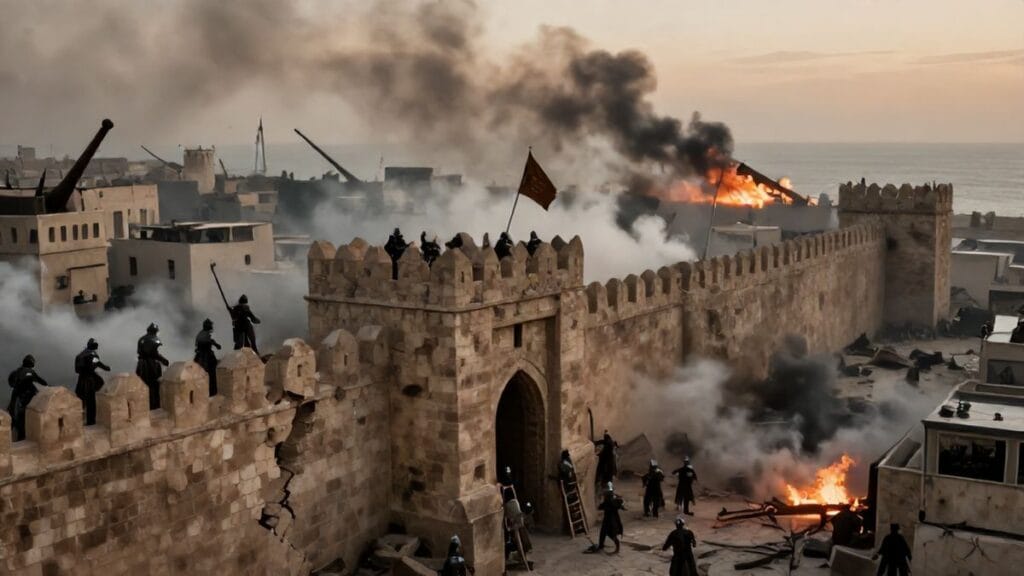
The final act came with the swiftness of a storm long brewing. On or just before 26 April 1289, Mamluk efforts culminated in a decisive breach. One or more sections of Tripoli’s walls, undermined and shaken by continuous bombardment, gave way. Whether through a coordinated collapse triggered by sapping or simply cumulative damage from trebuchet fire, the result was the same: a gaping wound in the city’s defenses, wide enough for assault troops to pour through.
At dawn, Mamluk soldiers surged forward. Trumpets and drums signaled the assault, echoing across the plain and into the stricken city. Defenders rushed to the breach, forming desperate lines amidst rubble and dust. Knights on foot, their horses useless in such tight quarters, planted themselves like living shields, swords and maces in hand. Militia from the city, some barely trained, joined them, wielding spears, axes, whatever weapons they could grasp.
The fighting at the breach was savage and close. Chroniclers describe hand-to-hand combat, bodies clogging the narrow passage, and waves of Mamluk warriors pressing forward under covering fire from their own archers and engines. The defenders, outnumbered and exhausted, could not hold indefinitely. Each time they pushed attackers back a few paces, new waves replaced the fallen. At some point in those terrible hours, the defensive line broke. Mamluk troops began to fan out from the breach into the city’s interior.
Panic spread like fire among the inhabitants. Bells rang out in churches; shouts carried down every street. Some tried to reach the harbor in hopes of boarding any vessel that might still be there. Others barricaded doors, hoping against hope that they might be overlooked in the chaos. Flames rose as buildings caught fire, whether from deliberate arson, misdirected missiles, or the accidental spread of cooking and storage fires disturbed by combat.
For those on the walls, the realization must have been crushing. Months of fear and weeks of exhausting labor had not been enough. The fall of Tripoli 1289, a phrase that would later sit as a date in chronicles and histories, was in that moment an unfolding catastrophe of screams, smoke, and splintering wood. Lucia of Tripoli and other leading figures may have attempted escape by sea or sought refuge in fortified compounds; accounts differ on their exact fates and movements in the final hours. What is certain is that, once the breach was fully exploited, Tripoli as a Latin-ruled city ceased to exist in any meaningful defensive sense. The conquerors were inside the walls.
Slaughter, Slavery, and Silence: The Human Cost of Conquest
Conquest in the thirteenth-century Levant was rarely gentle, and the capture of Tripoli was no exception. Once Mamluk troops gained the upper hand within the city, killing and looting spread rapidly. Latin and local Christian sources lament the massacre that followed; Arabic sources, while acknowledging the violence, often frame it as a rightful retribution or as a routine aspect of victory over a treacherous foe. As in so many sieges of the era, there was little mercy for armed defenders found still resisting.
Civilians fared only marginally better. Many men of fighting age were killed outright. Women and children, and surviving men, were taken as captives—spoils of war under the legal and religious norms that governed such conflicts. They faced uncertain futures: some would be sold in slave markets in Egypt or Syria, others incorporated into households as servants, a few perhaps eventually ransomed by relatives or religious orders raising funds in the West. The trauma of sudden enslavement, of families torn apart and identities reduced to commodities, is difficult to overstate.
Religious buildings and cultural treasures were not spared. Latin churches and monastic houses, some of which had stood for generations, were looted and desecrated. Reliquaries of saints, sacred vessels, illuminated manuscripts—all objects of devotion and art—were seized, melted down, or lost. Libraries that had accumulated over decades, if not centuries, disappeared in the flames or in the violent redistribution of property. The Latin city that had grown from Raymond of Saint-Gilles’ siege in 1109 was, in a matter of days, stripped of its institutions and its memory-laden spaces.
One Latin chronicler, the continuator of the “Gestes des Chiprois,” wrote with unmistakable grief about the catastrophe, emphasizing the destruction of the city and the suffering of its inhabitants, and seeing in it a sign of divine punishment for the sins and disunity of the Franks. On the other side, the prominent Mamluk historian al-Maqrizi, writing in a later generation, treated the conquest of Tripoli as part of a larger narrative of the restoration of Muslim rule along the coast, placing the event within a sequence of triumphs that would culminate at Acre. Between these perspectives lies the raw human reality of streets choked with bodies and the sound of weeping beneath curling smoke.
When the killing subsided and the last pockets of resistance were crushed, an eerie quiet must have fallen over the ruined city. The sea still lapped at the shore, indifferent; the sun still rose and set on the same horizon. But the Tripoli that had existed for nearly 180 years under Latin counts was gone. The silence that followed the sack was not merely physical, but cultural and spiritual—the muting of one voice in a region where many had once spoken, argued, and traded together. The fall of Tripoli 1289 was not only a military defeat; it was the obliteration of a complex urban organism, with all the stories and relationships that had animated it.
Rebuilding as Tripoli al-Mansuriyya: A New Islamic Port Arises
For the Mamluk state, the conquest of Tripoli was not an end but a beginning. Qalawun had no intention of allowing the site to lie fallow or of leaving behind a ghost town vulnerable to future raids. Instead, he ordered the construction of a new city slightly inland from the ruins of the old, often referred to in Arabic sources as Tripoli al-Mansuriyya—“the Victorious Tripoli,” bearing his honorific title al-Mansur. This relocation, away from the earlier coastal site and closer to defensible terrain, reflected both strategic calculations and a desire to mark a clear break with the Latin past.
Under Mamluk administration, the rebuilt Tripoli developed as a Muslim city integrated into the commercial and administrative networks of the sultanate. Mosques replaced Latin churches as the dominant religious architecture; a congregational mosque (jami‘) would have been established as a focal point, alongside smaller neighborhood mosques. Madrasas (Islamic schools), khans (caravanserais), and baths were constructed, knitting the city into the broader fabric of Mamluk urban life visible in places like Cairo, Damascus, and Aleppo.
Trade, the lifeblood of the region, resumed under new auspices. Muslim merchants now navigated the harbor with greater assurance, and Christian traders—especially Italians—returned under the terms of commercial treaties rather than as quasi-rulers. The fall of Tripoli 1289 did not end Mediterranean commerce; it reoriented it. Latin powers negotiated capitulations and trade agreements with the Mamluk sultans, securing rights to establish fondacos (trading enclaves) and to conduct business under carefully regulated conditions. Profit, as often in the medieval world, found ways to bridge ideological divides.
Local populations also adapted. Eastern Christian communities, such as the Maronites of Mount Lebanon, maintained their presence in the surrounding region, now under Muslim rule rather than Latin. Some of the city’s earlier inhabitants, if they had fled before or during the siege, may have cautiously returned to live under the new regime, though the demographic balance inevitably changed. New settlers arrived from other parts of the Mamluk domains, bringing with them their own customs, dialects, and networks of kin.
Over time, the outlines of the Latin city faded from view, buried under new foundations or left as weathered remnants near the coast. Memory of its existence persisted in chronicles and in the inherited stories of local communities, but the physical landscape came to embody the Mamluk victory. In this sense, Qalawun’s project succeeded: he did not just destroy a Crusader stronghold; he replaced it with a city that served his state’s purposes and symbolized the new balance of power in the eastern Mediterranean.
Echoes and Survivors: Refugees, Orders, and the Road to Acre
If the walls of Tripoli fell in stone, they also fell in human lives scattered across the sea. Those who escaped the sack became refugees, carrying with them little more than memories and perhaps a few salvaged possessions. Many fled to Cyprus, the nearest Frankish-ruled island, whose ports received ship after ship filled with the displaced. Quays in Famagusta and Nicosia filled with exhausted families, disoriented clergy, and disarmed soldiers, all trying to find new footing in an unfamiliar yet culturally related world.
The military orders—Hospitallers and Templars—absorbed heavy losses but also managed to extract remnants of their personnel and treasure. Their castles in the region had already been dwindling, and Tripoli’s fall accelerated their concentration elsewhere. The Hospitallers would, in time, shift their center of gravity first to Cyprus and then to Rhodes, reinventing themselves as a maritime power. The Templars, though still formidable in 1289, were moving inexorably toward their own destruction in the early fourteenth century, not from Muslim foes but from European monarchs and the papacy.
In Acre, the largest remaining Crusader city, the news of Tripoli’s fall struck like a thunderclap. The writing on the wall became impossible to ignore. If Tripoli, with its strong walls and long history, could not stand against the Mamluk onslaught, how long could Acre hope to endure? Yet commerce and daily life there, as in all cities facing imminent danger, did not immediately cease. Merchants continued their dealings, preachers called for moral reform and external aid, and diplomats attempted to spin the disaster into a rallying cry for a grand new Crusade.
But the tide of history was running the other way. The fall of Tripoli 1289 convinced many observers that the age of the Crusader states was nearing its end. European rulers, dealing with their own conflicts, proved unwilling or unable to commit the enormous resources needed to reverse the Mamluk gains. While small expeditions and volunteers still trickled eastward, they no longer had the weight or unity of the earlier Crusades.
For the refugees themselves, the loss of Tripoli became a personal wound. Families that had lived for generations in the city carried with them a sense of exile and dispossession. Nobles whose titles had been tied to lands around Tripoli now held empty claims. Chroniclers, clerics, and wandering minstrels transformed their stories into laments and warnings, preserving the memory of the city’s fall for audiences who would never see its shores. In this way, the fate of Tripoli became part of a broader narrative of loss that suffused the final years of the Crusader presence in the Holy Land, culminating in the cataclysm at Acre in 1291.
Memory, Chronicles, and Competing Narratives
The fall of Tripoli 1289 did not live only in the ruins and the rebuilt city; it also lived in the words used to describe it. Latin and Arabic chroniclers, writing from different cultural and political perspectives, shaped how later generations would understand the event. Each side emphasized certain themes and downplayed others, creating narratives that both reflected and reinforced broader worldviews.
Latin chroniclers, particularly those associated with Cyprus and the remaining Crusader outposts, often framed Tripoli’s loss as a tragedy brought on by sin, disunity, and neglect from the wider Christian world. They lamented the internal strife of the county, the feuds among nobles and merchants, and the failure of Western monarchs to heed calls for aid. Their recounting of the siege and sack is full of pathos: women and children enslaved, churches desecrated, and the faithful slaughtered. Divine judgment is a recurring motif; God, in this reading, allowed the city to be punished in order to chastise and perhaps purify the Christian community.
Arabic historians, such as Ibn al-Furat and later al-Maqrizi, embedded Tripoli’s fall within a triumphant arc of Mamluk victories over the Crusaders and the Mongols. They stressed the justness of Qalawun’s campaign, especially in light of the alleged betrayal and massacre of Muslims residing under truce within the city. In their accounts, the conquest is not merely a war of expansion but an act of redress and a reassertion of legitimate sovereignty over coastal territories. They praised the courage and discipline of the Mamluk troops, and they often highlighted the spoils and captives as signs of divine favor.
Between these two poles, other voices can be faintly discerned: local Eastern Christians, Jewish communities, and perhaps even some of the city’s Muslim residents whose experiences do not fit neatly into either grand narrative. Their stories, rarely preserved directly, survive only as shadows in the accounts of others. Yet we can infer that their loyalties and sufferings were complex. For a Maronite peasant whose land had been farmed under Latin and then under Mamluk rule, the rulers changed but the burdens of taxation and the risks of war may have felt depressingly constant.
Modern historians attempt to weave these strands together, cross-referencing Latin, Arabic, and archaeological evidence to reconstruct a more nuanced picture. One citation often noted, for example, is from the “Gestes des Chiprois,” which details the politics surrounding Lucia’s accession and the communal government of Tripoli, highlighting how internal discord made the city vulnerable. On the Arabic side, the chronicle of Ibn al-Furat provides a detailed account of Qalawun’s campaign, including troop movements and the ideological framing of the siege. By placing such sources in conversation, scholars can move beyond triumphalism or lament alone, toward an understanding of Tripoli as a place where many histories intersected.
Yet even with modern analysis, the emotional charge of the event remains. For descendants of communities once tied to the Crusader states, the fall of Tripoli 1289 can evoke a sense of lost heritage. For those emphasizing the history of Islamic resurgence in the region, it stands as a symbol of successful resistance against foreign domination. These layered memories remind us that history is never simply a catalogue of dates and facts; it is also a battleground of meaning.
The Fall of Tripoli in the Long Decline of the Crusader States
While the siege and sack of Tripoli were devastating in themselves, their larger significance lies in how they fit into the long, uneven decline of the Crusader states. From the heady days following the First Crusade—when Latin princes carved out kingdoms and counties from Antioch to Jerusalem—the trajectory of these polities had never been straightforward. They faced repeated invasions, shifting alliances, and internal crises. Victories like the capture of Damietta or the brief successes of the Third Crusade alternated with disasters such as the battle of Hattin in 1187 and the loss of Jerusalem.
By the late thirteenth century, the Latin presence had been whittled down to a few fragile enclaves. Military defeats at the hands of Ayyubid and then Mamluk forces had cost them key inland fortresses and much of their agrarian base. The economy of the remaining coastal cities shifted increasingly toward commerce and diplomacy rather than conquest, relying on Italian maritime republics and on negotiated truces. The social fabric of places like Acre and Tripoli became more cosmopolitan and more mercantile—vibrant, yes, but less suited to prolonged, unified military resistance.
In this context, Tripoli’s fall was both symptom and accelerant. It demonstrated, in stark form, that the Mamluk sultans possessed the resolve and the means to eliminate even long-established Latin strongholds. It removed one of the last buffer zones between the Mamluk military machine and Acre, exposing the principal remaining Crusader city to direct assault. It also generated a new wave of refugees and dispossessed warriors, who might bolster Acre’s population but also strain its resources and feed its anxieties.
Moreover, the fall of Tripoli 1289 shattered any lingering illusions that the remaining Latin enclaves could survive indefinitely through clever diplomacy and commercial ties alone. The notion that economic interdependence would temper Mamluk ambitions gave way to the realization that, for the sultanate, ideological and strategic imperatives ultimately overshadowed the benefits of allowing Latin lordships to remain. Once Tripoli was gone, the logic of the campaign pointed inexorably toward Acre.
Two years later, in 1291, that logic bore deadly fruit when Sultan al-Ashraf Khalil, Qalawun’s son, besieged and captured Acre, ending nearly two centuries of substantial Latin territorial presence in the Holy Land. In retrospect, Tripoli’s fall appears not as an isolated tragedy but as the penultimate act in a larger drama. The county’s destruction signaled that a door was closing, not just on one city, but on an entire chapter of Mediterranean history in which European Crusader states existed as intrusive yet enduring neighbors to Muslim polities.
Long-Term Political and Cultural Consequences in the Eastern Mediterranean
The consequences of Tripoli’s fall rippled far beyond the charred remains of its walls. Politically, the consolidation of Mamluk control over the Levantine coast reshaped the balance of power in the eastern Mediterranean. With the Crusader states gone from mainland Syria and Palestine, the Mamluk sultanate now held an unbroken stretch of coastline from the Sinai to roughly the borders of Cilicia. This empowered Cairo not only as a military hegemon but also as a gatekeeper of commerce between the Mediterranean and the Indian Ocean.
European powers, particularly the Italian maritime republics, had to adjust to this new reality. No longer could they deal with semi-dependent Latin princes in cities like Tripoli, extracting concessions or installing friendly regimes. They now negotiated with a centralized, militarily confident state. Commercial treaties—capitulations—became instruments of policy, granting limited privileges in exchange for recognition of Mamluk sovereignty and often carrying restrictions on the transfer of war matériel. Trade continued, even flourished, but under conditions increasingly set in Cairo rather than in Acre or Tripoli.
For the wider Christian world, the psychological blow was substantial. The Crusades had, for nearly two centuries, tied European imagination to the fate of the Holy Land and its surrounding territories. The loss of Tripoli and later Acre forced a reorientation. Attention turned more to the Iberian Peninsula, where the Reconquista continued, and to conflicts within Europe itself, such as the struggles between monarchs and the papacy. While calls for new Crusades against the Mamluks or, later, the Ottomans did not cease, they no longer centered on recovering the old Latin states in Syria, which were effectively erased from the political map.
Culturally, the disappearance of Latin Tripoli did not mean the disappearance of all cross-cultural exchange. On the contrary, the Mamluk period saw a flourishing of artistic, architectural, and intellectual activity, some of which absorbed influences from earlier Crusader contacts. Pilgrims from Europe still visited the Holy Land, now under Muslim rule, securing safe-conducts and guides from local Christian communities. Italian communities in Mamluk ports continued to serve as conduits of ideas and technologies between the Islamic world and Europe.
Locally, the new Islamic Tripoli became a center of scholarship and religious life. Madrasas trained jurists in the Shafi‘i and Hanafi schools of law; Sufi lodges provided spiritual guidance; and scholars produced works in theology, law, and poetry. The city’s identity shifted but remained deeply tied to the maritime and mountain landscapes that had always defined it. Over generations, memories of Latin rule receded, becoming, for many inhabitants, a distant episode overshadowed by the more immediate concerns of Mamluk governance and, later, Ottoman incorporation.
In this way, the fall of Tripoli 1289 illustrates a recurring pattern in history: cities rise and fall, empires expand and contract, yet the underlying networks of trade, culture, and human interaction adapt and endure. The particular Latin-Christian imprint on Tripoli vanished violently, but the city itself remained, transformed yet still a place where worlds met along the rim of the sea.
Conclusion
The fall of Tripoli 1289 was at once a dramatic military event and the culmination of a long, complex history. Born from the ambitions of the First Crusade, the County of Tripoli stood for nearly two centuries as a fragile enclave of Latin rule in a predominantly Muslim and Eastern Christian region. Its bustling markets, polyglot streets, and fortified walls embodied both the possibilities and the tensions of life on a frontier between worlds. Yet from its inception, the county was vulnerable: dependent on distant Western powers, internally divided, and surrounded by powerful neighbors.
By the late thirteenth century, the rise of the Mamluk Sultanate under rulers like Baybars and Qalawun transformed that vulnerability into fatal exposure. Strategic brilliance, disciplined armies, and a clear ideological goal to eliminate the Crusader enclaves converged with Tripoli’s internal feuds and diplomatic blunders—embodied starkly in the burning of its Muslim quarter—to make catastrophe almost inevitable. The siege of 1289, methodical and relentless, exposed every weakness in the city’s defenses, physical and political alike, until its final breach and sack.
In the immediate aftermath, the human cost was staggering: thousands killed or enslaved, communities uprooted, centuries of institutional and cultural life obliterated in days. Yet from the ruins, a new city emerged under Mamluk rule, reshaping the landscape and integrating Tripoli more fully into an Islamic political and commercial network. Trade resumed, though on new terms; local populations adapted; and the memory of Latin Tripoli gradually faded from the lived experience of its inhabitants even as it endured in chronicles and distant laments.
Placed in the broader arc of Crusader history, Tripoli’s fall signaled that an era was ending. Within two years, Acre too would be lost, and with it the last major Latin stronghold in the Levant. The eastern Mediterranean entered a new phase in which Mamluk, and later Ottoman, authority would dominate, while Western Europe turned its energies elsewhere. Yet the story of Tripoli remains instructive: it reveals how cities at the crossroads of cultures can flourish and fracture, how internal division can magnify external threat, and how the fates of ordinary people—merchants, peasants, children—are shaped by decisions made in courts and camps far beyond their sight.
Today, as historians sift through chronicles, ruins, and legends, Tripoli’s fall offers a window into the tangled web of faith, power, and commerce that bound the medieval Mediterranean together. It reminds us that behind every line in a chronicle—“and the city fell”—lies a world of lives disrupted, dreams destroyed, and new realities painfully born.
FAQs
- What was the County of Tripoli before its fall in 1289?
The County of Tripoli was one of the four main Crusader states established in the Levant after the First Crusade. Founded formally in 1109 after a prolonged siege of the Muslim-held city, it stretched along a portion of the Syrian-Lebanese coast and was ruled by Latin counts who governed a diverse population of Muslims, Eastern Christians, Jews, and Western settlers. The county’s economy relied heavily on maritime trade and on agricultural production in the coastal plains and mountain hinterlands. - Who led the Mamluk forces that captured Tripoli in 1289?
The Mamluk forces that captured Tripoli were led by Sultan al-Mansur Qalawun, ruler of the Mamluk Sultanate based in Egypt. Qalawun had already overseen successful campaigns against other Crusader fortresses and saw Tripoli as both a strategic and symbolic target. Under his command, a large, well-organized army with powerful siege engines besieged the city, ultimately breaching its defenses and capturing it on 26 April 1289. - Why did the Mamluks decide to attack Tripoli when they did?
Several factors converged to prompt the Mamluk assault. Strategically, Tripoli was one of the last remaining Latin strongholds on the Levantine coast, and its elimination was part of a broader Mamluk policy to remove the Crusader presence. Politically and morally, the reported burning and massacre of the Muslim quarter in Tripoli, whose inhabitants had been living under truce, provided Qalawun with a strong justification for war. Additionally, the internal weakness and factional strife within the county made it a tempting and timely target. - How did internal divisions in Tripoli contribute to its fall?
Internal divisions deeply undermined Tripoli’s ability to defend itself. During the rule of Bohemond VII, bitter conflicts erupted between the count, local noble families like the Embriacos, the military orders, and competing Italian merchant communities. These feuds drained resources, eroded trust, and weakened centralized authority. When Bohemond died and Lucia’s contested rule began, the city was politically fragile. This disunity hampered coordinated defense and made effective diplomacy with the Mamluks far more difficult. - What happened to the inhabitants of Tripoli after the city was captured?
After the city was breached and captured, many of its inhabitants suffered violent fates. Armed defenders were commonly killed in combat or executed afterward. Civilians, particularly women and children, were taken as captives and sold into slavery, dispersed across the Mamluk domains. Some wealthier residents and members of the elite managed to escape by sea to places like Cyprus, but for many ordinary people, capture, death, or forced displacement marked the end of their lives in Tripoli. - Did the city of Tripoli cease to exist after 1289?
Tripoli did not cease to exist, but it was fundamentally transformed. The Latin city was heavily damaged and depopulated during the conquest, and the Mamluks decided to rebuild a new Tripoli slightly inland, often called Tripoli al-Mansuriyya. Under Mamluk rule, it became a predominantly Muslim city integrated into the sultanate’s administrative and commercial systems, with new mosques, madrasas, and urban structures replacing the Latin churches and institutions. - How did the fall of Tripoli affect the remaining Crusader states?
The fall of Tripoli had a profound impact on the remaining Crusader states, especially Acre. It removed a crucial outpost and buffer, demonstrating that even long-established and fortified Latin cities could not withstand a determined Mamluk offensive. Refugees and survivors from Tripoli flooded into other Latin centers, straining their resources. Perhaps most importantly, Tripoli’s fall signaled that the Mamluks were committed to a final campaign to eliminate the Crusader presence, a campaign that would culminate in the fall of Acre in 1291. - What sources do historians use to study the fall of Tripoli 1289?
Historians draw on a combination of Latin and Arabic chronicles, such as the “Gestes des Chiprois” on the Latin side and works by Ibn al-Furat and al-Maqrizi on the Arabic side. They also use papal correspondence, charters, and legal documents relating to the county’s internal affairs, as well as archaeological evidence from the region. By comparing and contrasting these sources, scholars can reconstruct the political context, the course of the siege, and the aftermath with greater accuracy. - Why is the fall of Tripoli 1289 considered historically significant?
The event is significant because it marked the destruction of one of the last major Crusader states in the Levant and paved the way for the final Mamluk assault on Acre. It illustrates the interplay between military power, internal political weakness, and ideological motivations in the late Crusader period. Additionally, the fall of Tripoli reshaped trade and political relationships in the eastern Mediterranean, reinforcing Mamluk dominance along the coast and forcing European powers to renegotiate their presence in the region. - Can we still see traces of the medieval events in modern Tripoli?
While much of the Latin-period city was destroyed or built over, modern Tripoli in Lebanon still bears traces of its layered past. The medieval Mamluk city, with its mosques, khans, and old quarters, is particularly visible and reflects the post-1289 reconstruction under Islamic rule. Archaeological work and historical topography help identify older layers and sites associated with the Crusader period, although the exact locations and remains of some Latin structures are debated and partially obscured by later development.
External Resource
Internal Link
Other Resources
- Encyclopaedia Britannica – general search for the exact subject
- Google Scholar – academic search for the exact subject
- Internet Archive – digital library search for the exact subject

