Table of Contents
- The Dawn of a New Nation: Independence Day in Kuala Lumpur
- The Historical Canvas: Malaya Before Independence
- Colonial Legacies and the Stirring of Nationalism
- The Rise of Political Awareness and Unity
- The Lingering Shadow of World War II
- The Emergency Struggle: A Precursor to Freedom
- Key Figures in the Independence Movement
- Negotiating Sovereignty: The Road to London
- The Federation of Malaya Agreement: Terms and Triumphs
- August 31, 1957: Kuala Lumpur’s Moment of Glory
- The Proclamation Ceremony: Symbolism and Speeches
- The Role of the British Crown and Transition of Power
- Public Sentiment: Joy, Hope, and the Challenges Ahead
- The Birth of Nationhood: Political and Social Structures
- Early Challenges of the New Federation
- The Ethnic Mosaic: Unity in Diversity
- Economic Foundations and Development Plans
- Malaya’s Place in Regional and World Politics
- Cultural Renaissance and National Identity Formation
- The Legacy of 1957: Independence in Retrospect
- The Path to Malaysia: Evolution and Expansion
- Commemorating Independence: National Celebrations Today
- Challenges to Remember: Lessons from History
- Conclusion: Independence, Freedom, and the Ongoing Journey
- FAQs About Malayan Independence
- External Resource
- Internal Link
The Dawn of a New Nation: Independence Day in Kuala Lumpur
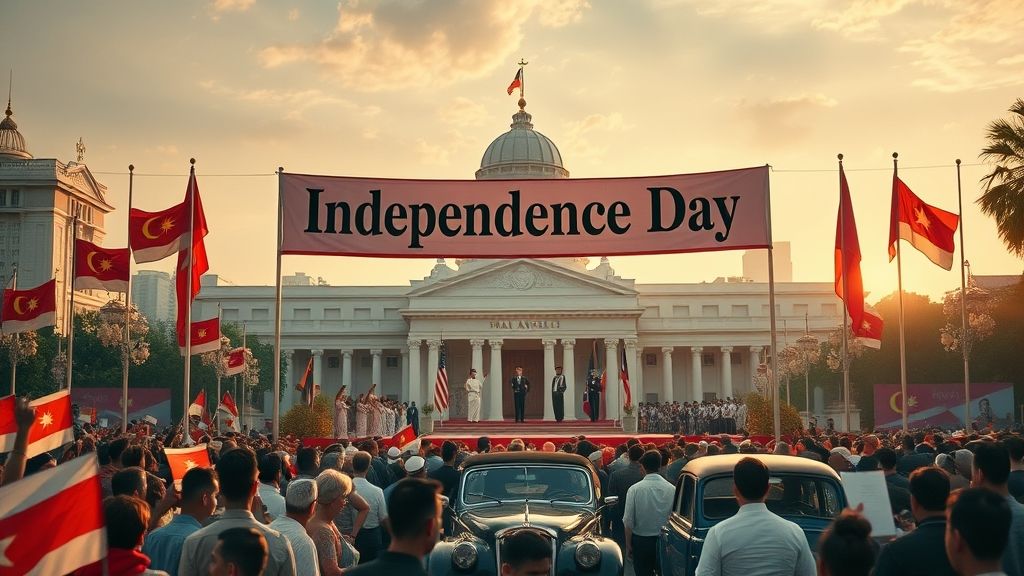
The morning of August 31, 1957, in Kuala Lumpur was bathed in a soft, golden sunlight that seemed to herald the birth of a new dawn—not just for the city or the peninsula, but for an entire people yearning for self-determination. Crowds gathered at Merdeka Stadium, their eyes fixed on the fluttering flags, their hearts pounding with a tempest of emotions: pride, relief, hope, and an aching remembrance of the struggles endured. As the Union Jack was lowered and the new flag of Malaya raised amid cheers that echoed across the ridges and valleys, a palpable sense of liberation electrified the air. For the first time in centuries, the people of Malaya stood as citizens of a sovereign nation—a federation bound by shared dreams and complex realities.
Yet, as this euphoric moment unfolded, it signaled not an end but a beginning—a chapter riddled with trials and triumphs, setbacks and steadfast determination.
The Historical Canvas: Malaya Before Independence
To understand that historic August day, one must step back into the layered history of Malaya—a land shaped by centuries of indigenous kingdoms, spice trade, colonial conquest, and cultural ferment. The peninsula’s strategic position along the Strait of Malacca turned it into a coveted prize from the 15th century onwards, first for Malacca Sultanate rulers, then for European powers.
By the 19th and early 20th centuries, the British Empire had firmly entrenched its domination, both economically and politically. The peninsula was a patchwork of nine Malay sultanates, British settlements, and federally administered territories. Tin mining, rubber plantations, and trade hubs flourished under colonial rule, but so did social stratification and ethnic divides between Malays, Chinese, Indians, and others.
Despite economic prosperity, deep political aspirations simmered beneath the surface. The colonial system governed with a firm hand, imposing indirect rule through sultans but denying true political agency to the local population.
Colonial Legacies and the Stirring of Nationalism
Throughout the 20th century, national consciousness in Malaya evolved unevenly but irreversibly. The British introduced western education, and many young Malays, Chinese, and Indians were exposed to new ideas about self-rule, justice, and equality. The aftermath of two global wars and the ideology of decolonization sweeping Asia and Africa fanned the flames of nationalism.
Organizations such as the United Malays National Organisation (UMNO), the Malayan Chinese Association (MCA), and later the Malayan Indian Congress (MIC) emerged, voicing communal concerns yet gradually inching towards cooperation. The tensions between ethnic groups, nurtured by colonial “divide and rule” policies, presented serious obstacles to the dream of a unified, independent Malaya.
Yet the dream persisted, far beyond ethnic lines.
The Rise of Political Awareness and Unity
It was in the crucible of hardship and hope that new political forces rose, spearheading a coalition that would redefine Malaya's future. UMNO formed in 1946, articulating Malay interests but recognizing the necessity of alliances, especially as ideas of multi-ethnic representation gained ground.
The People's Action Party (PAP), though primarily Singapore-based, influenced Malayan politics, emphasizing secularism and social justice. The diverse political landscape was complex—sometimes fractured, often cautious—yet it moved inexorably toward the moment where collective will could challenge imperial authority.
The Lingering Shadow of World War II
The Japanese occupation of Malaya from 1941 to 1945 dramatically shifted the political landscape. It broke British invincibility myths and revealed cracks in colonial governance. The experience left scars but also empowered nationalist leaders who had often operated covertly under Japanese rule.
Post-war reconstruction was turbulent: the Emergency war against communist insurgents unfolded, imperial powers attempted to restore order, and gradually political negotiation replaced outright military confrontation.
The Emergency Struggle: A Precursor to Freedom
The Malayan Emergency (1948-1960), a guerrilla war fought between Commonwealth forces and the Malayan Communist Party, loomed large in the independence narrative. While primarily an anti-communist campaign, this struggle shaped British attitudes toward Malaya’s future.
The Emergency underscored the unacceptability of violent upheaval for some, while for others it emphasized the urgent necessity of political reform over military suppression. Britain gradually acknowledged that sustainable peace required political concessions—not just force.
Key Figures in the Independence Movement
The face of Malayan independence is inseparable from Tunku Abdul Rahman, often hailed as the Father of Independence. Charismatic, skilled, and pragmatic, Tunku navigated a maze of competing interests—colonial officials, sultans, ethnic leaders—to forge a consensus.
His deputy, Tun Abdul Razak, and other prominent politicians like Dato Onn Jaafar and Tan Cheng Lock played pivotal roles in shaping political alliances. These leaders’ ability to balance tradition and progress, unity and diversity, optimism and realism was instrumental in the birth of the nation.
Negotiating Sovereignty: The Road to London
The journey to independence passed through tense negotiations in London in 1956 and 1957. British officials, wary of the communist threat and eager to leave once stability was assured, entered into talks with Malayan leaders who demanded full sovereignty, democratic governance, and protection for their cultural identities.
The resulting Federation of Malaya Agreement would be a landmark treaty, carefully crafted with provisions to safeguard Malay privileges while accommodating non-Malay communities. These negotiations were fraught with tension, but the final accord represented a breakthrough.
The Federation of Malaya Agreement: Terms and Triumphs
The Agreement created a federal government with powers over defense, foreign affairs, and finance, while state rulers retained their symbolic status. It promised a parliamentary democracy, civil liberties, and equality under the law—though with affirmative measures for Malays.
Critics later pointed to the compromises and limitations embedded in the Agreement, yet at the time it was hailed as a monumental step forward. The British government’s willingness to cede control sent shockwaves through imperial circles; the world watched Malaya’s experiment with intense interest.
August 31, 1957: Kuala Lumpur’s Moment of Glory
When independence dawned on August 31, Kuala Lumpur was alive with anticipation. Streets decorated in green, yellow, and blue—the colours of the new flag—overflowed with joyous crowds. Merdeka Stadium was packed with dignitaries, Malaysians of all ethnicities, and representatives from abroad.
At 9:30 a.m., the Union Jack descended, replaced swiftly with the freshly stitched Jalur Gemilang—“Stripes of Glory.” Tunku Abdul Rahman’s voice rang out during his historic speech, proclaiming Malaya’s sovereignty: “Let us all unite to build a Malaya that will be peaceful, progressive and united.”
The scene was electric, reminiscent of other post-colonial ceremonies globally but stunning in its unique blend of pageantry, cultural symbolism, and heartfelt emotion.
The Proclamation Ceremony: Symbolism and Speeches
Every element of the ceremony was carefully choreographed to reflect unity amidst diversity. Traditional Malay royal attire, Chinese lion dances, Indian drumming—all merged seamlessly with British military bands and parliamentary formalities.
The sultans of the nine states played a role, proclaiming their acceptance of the new constitution. British Governor-General Sir Donald MacGillivray handed over the instrument of sovereignty. Photographs and newsreels captured scenes that became iconic, circulating worldwide and broadcasting Malaya’s emergence onto the world stage.
The Role of the British Crown and Transition of Power
Though independence marked a break, Malaya chose to remain a constitutional monarchy within the Commonwealth, recognizing Queen Elizabeth II as a symbolic head of state represented by a Yang di-Pertuan Agong (King) elected among the Malay rulers.
This arrangement eased transitions, maintaining diplomatic ties and British ties in defense and trade. It was a pragmatic compromise, a bridge from colonial subjugation to full sovereignty.
Public Sentiment: Joy, Hope, and the Challenges Ahead
The streets of Kuala Lumpur reflected a mosaic of individual stories—farmers, shopkeepers, students, laborers—each embracing the promise of independence with their own mixture of relief and apprehension.
Newspapers captured extensive public reactions, many writing of a "Malaya reborn," yet voices of caution reminded citizens of the work ahead: overcoming poverty, unifying diverse communities, and forming effective governance.
The Birth of Nationhood: Political and Social Structures
Post-independence, Malaya’s political system was based on parliamentary democracy, with UMNO leading the Alliance Party coalition representing the major ethnic groups.
Constitutions, legal frameworks, and civil institutions defined a modern state, but these initial structures were fragile and evolving, reflecting both local traditions and western ideals.
Early Challenges of the New Federation
Independence did not erase decades of social grievances overnight. The Emergency was ongoing in the jungles and tensions between communities simmered beneath the surface. Economic disparities and rural underdevelopment posed immediate tests.
Yet, leadership remained optimistic; development policies, rural education, and national integration programs were swiftly launched, embedding hope in practical progress.
The Ethnic Mosaic: Unity in Diversity
Malaya was, and remains, a plural society—Malay, Chinese, Indian, and indigenous peoples each contributing to the national fabric.
The challenge was formidable: fostering an inclusive identity without erasing cultural distinctiveness. This balancing act became a defining theme in Malayan, and later Malaysian, politics.
Economic Foundations and Development Plans
Independence gave Malaya control over its natural resources: rubber, tin, palm oil—critical to global markets. The government prioritized diversification and industrialization to reduce economic reliance on primary commodities.
Policies emphasized rural development, infrastructure, education, and foreign investment, setting the stage for the rapid growth witnessed in subsequent decades.
Malaya’s Place in Regional and World Politics
At independence, Malaya was welcomed into international institutions and positioned itself as a moderate leader in Southeast Asia. As decolonization swept the region, Malaya’s peaceful transition and stable political model attracted admiration.
Relations with neighboring Singapore, Indonesia, and expanding Commonwealth nations shaped an evolving diplomatic profile.
Cultural Renaissance and National Identity Formation
Independence inspired artistic revival—a blossoming of Malay literature, music, and film alongside expressions from Chinese and Indian communities.
National holidays, symbols, and education fostered pride and a sense of shared destiny, an ongoing dialogue between tradition and modernity.
The Legacy of 1957: Independence in Retrospect
Sixty-plus years later, the day remains etched in national memory as the crucible of identity and sovereignty. While democracy faced tests, and society changed dramatically, the vision of a united Malaya endures.
The independence narrative informs contemporary debates on governance, social harmony, and Malaysia’s role in a globalized world.
The Path to Malaysia: Evolution and Expansion
The Federation of Malaya laid the groundwork for further federal enlargement—Singapore’s brief membership, Sabah and Sarawak’s entry in 1963, marking the formation of Malaysia.
This evolution reflected regional dynamics and the continual search for unity and stability amid diversity.
Commemorating Independence: National Celebrations Today
Each August 31, Malaysia commemorates Merdeka Day with parades, flag-raising, and reflections on unity and progress. Schools teach the history; citizens renew their vows to nationhood.
The holiday is a vibrant living memory, crucial to national cohesion.
Challenges to Remember: Lessons from History
The independence journey was neither flawless nor final. Ethnic tensions, economic inequalities, and political crises tested the federation.
But remembering the foundations laid in 1957 offers lessons on dialogue, compromise, and the complexity of forging a nation.
Conclusion
As the sun set on that landmark day in 1957, the Federation of Malaya stood not as an idyllic promise fulfilled but as a beacon of possibility amidst the challenges of history. Independence was not a single event but a collective journey—of ordinary men and women galvanized by extraordinary hope, layered with fraught negotiations and resilient ideals. Every flag raised, every speech uttered, every cheer heard in Merdeka Stadium signified not just freedom from colonial chains, but a solemn commitment: to build a nation where diversity found harmony, progress embraced justice, and sovereignty empowered dignity. The road since has been winding, sometimes rocky, yet never without purpose. And so Malaya’s independence story remains alive—not as a distant past, but as an ongoing narrative of a people daring to shape their own destiny.
FAQs
Q1: What were the main causes that led to Malaya’s independence in 1957?
A1: A combination of colonial exploitation, rising nationalism, the impact of World War II and the Japanese occupation, the Malayan Emergency, and effective leadership by local politicians created the conditions for independence. The British also recognized the untenability of colonial rule in the face of these pressures.
Q2: Who were the key figures in Malayan independence?
A2: Tunku Abdul Rahman is the most prominent leader, supported by Tun Abdul Razak, Dato Onn Jaafar, and Tan Cheng Lock. These figures built political coalitions and negotiated with the British to achieve sovereignty.
Q3: How did ethnic relations impact the independence process?
A3: Malaya’s multi-ethnic society posed challenges in uniting diverse groups—Malays, Chinese, Indians—each with distinct interests. Political parties representing these communities worked toward compromise, with the Alliance Party epitomizing this cooperation.
Q4: What role did the British government play in Malaya’s transition to independence?
A4: The British initially resisted but eventually negotiated the Federation Agreement, ceding sovereignty through a peaceful process that included constitutional safeguards and continued Commonwealth ties.
Q5: How significant was the Malayan Emergency in shaping independence?
A5: The Emergency underscored the threat of communism and political instability. Britain prioritized a political solution alongside military action, accelerating moves toward self-government to counter insurgency appeals.
Q6: What were the immediate challenges facing Malaya after independence?
A6: The new nation faced economic development needs, ethnic integration challenges, political stability, and continuing insurgencies. Crafting effective governance structures and inclusive policies was critical.
Q7: How does Malaya’s independence influence modern Malaysia?
A7: The independence foundation underpins Malaysia’s political system, national identity, and celebration of diversity. Contemporary issues still echo the early tensions and compromises of 1957.
Q8: How is Independence Day commemorated today in Malaysia?
A8: August 31 is marked by national parades, flag ceremonies, cultural performances, and reflections on history in schools and public discourse, reinforcing unity and patriotism.