Table of Contents
- Dawn Over the Channel: A Sky That Had Never Been Crossed
- From Montgolfier Dreams to Hydrogen Ambitions
- Two Men, One Sea of Clouds: Jean-Pierre Blanchard and John Jeffries
- Preparing to Defy the Wind: Calais, Winter 1784–1785
- The Morning of 7 January 1785: Fog, Frost, and Nerves of Steel
- Lifting from France: When the Earth Let Go
- Over the Grey Water: The Channel from Above
- Crisis in Mid‑Air: Throwing Everything Overboard
- Landfall in England: Crash, Survival, Triumph
- The First Aerial Crossing and the Politics of the Sky
- Public Wonder, Satire, and Fear: Europe Reacts
- Science in the Gondola: Data, Instruments, and Illusions
- From Balloons to Bombers: A Thin Line of Continuity
- Lives After the Flight: Glory, Decline, and a Fall from the Sky
- Myths, Misunderstandings, and the Memory of 1785
- Why This Flight Still Matters in the Age of Jets and Drones
- Conclusion
- FAQs
- External Resource
- Internal Link
Article Summary: The first aerial crossing of the english channel on 7 January 1785 was a fragile, almost desperate experiment that changed how Europe imagined distance, borders, and the sky itself. In a hydrogen balloon launched from France and drifting toward England, Jean‑Pierre Blanchard and John Jeffries risked their lives over a cold, grey sea that had only ever been crossed by ship. Their journey turned a contested stretch of water into a shared aerial corridor and suggested, for the first time, that nations could be linked from above, not just divided by waves below. This article retraces the background of balloon mania, profiles the two men who climbed into the gondola, and follows them minute by minute as they hovered between triumph and disaster. It then examines the political, scientific, and social consequences of the first aerial crossing of the english channel, tracing a line from that wicker basket to modern aviation and even aerial warfare. Along the way, it looks at the myths that grew around the event, the later fates of the aeronauts, and the way this fragile crossing has been remembered, romanticized, and at times forgotten. The narrative shows how a single, windswept morning in 1785 opened a new chapter in human history: the age in which we dared to leave the sea and claim the sky.
Dawn Over the Channel: A Sky That Had Never Been Crossed
On the morning of 7 January 1785, the English Channel lay like a sheet of dull metal, its winter waves hidden beneath veils of mist. From the French shore near Calais, fishermen and customs officials peered into the cold air at a spectacle that seemed at once absurd and terrifying: a great, swollen sphere of silk and varnish, shimmering faintly with the ghostly sheen of hydrogen, straining against ropes and human hands. Until that moment, the narrow sea between France and England had been an absolute frontier in one sense: it could be sailed, rowed, rowdily ferried by smugglers, but it could not be overflown. The first aerial crossing of the English Channel remained a line in the imagination rather than a fact in the world.
It was into that forbidden space that Jean‑Pierre Blanchard, a wiry French aeronaut with the demeanor of a man who lived on the edge of financial and physical ruin, and Dr. John Jeffries, a Boston‑born physician in English exile, intended to float. Their craft was not an airplane—no engines, no wings, no propellers. It was a balloon: a shimmering globe of gas with a wicker gondola below, ropes dangling, flags fluttering, instruments clattering, and two human beings whose lives depended entirely on the whims of the wind. Ship captains had long measured their worth by the skill with which they read currents and tides. Blanchard and Jeffries would entrust themselves to invisible rivers of air that few believed could ever be charted or mastered.
What they proposed was more than a stunt. It was a test of whether Europe’s new infatuation with balloons was a passing curiosity or the first hint of a revolution in travel, warfare, and global imagination. The first aerial crossing of the English Channel, if it could be completed, would compress a dangerous, often storm‑torn stretch of water into a few hours and prove that the sky itself could be a highway. Yet behind the boldness of the idea lay desperation: Blanchard’s finances were collapsing, Jeffries craved scientific renown and social acceptance, and both men knew that failure would not be an abstract scientific result. It would mean plunging into the freezing Channel with little hope of rescue.
As the pale winter light strengthened and the tide muttered against the beach, watching crowds fell into contradictory moods. Some cheered, eager for a spectacle in a time hungry for wonders. Others crossed themselves or muttered that mankind was trespassing into realms meant for birds and angels. Newspaper correspondents from both sides of the Channel sharpened their pens, ready to immortalize triumph or sneer at tragedy. But this was only the beginning of a story that had started decades earlier, with paper balloons flickering over French villages and philosophers arguing that man would never truly fly.
To understand the drama of that frosty January morning, one must step back into the fever of discovery that seized Europe in the 1780s, when fire, gas, and silk conspired to lift the human body off the ground for the first time. The first aerial crossing of the English Channel was not an isolated leap into the unknown; it was the crest of a rising wave of curiosity, performance, rivalry, and invention. It is astonishing, isn’t it, that within barely two years of humanity’s first tentative ascents, two men would be trusted—if that is the word—to hang their lives under a bag of invisible gas and drift between rival nations separated by centuries of war?
From Montgolfier Dreams to Hydrogen Ambitions
The saga of that Channel crossing truly begins far to the south, in the paper‑making town of Annonay in France, where two brothers, Joseph‑Michel and Jacques‑Étienne Montgolfier, spent the early 1780s playing with fire and air. In June 1783, they summoned the townspeople to watch as a massive paper and cloth envelope, filled with hot smoke and heated air, shuddered and then rose from the square. It climbed, to the gasps of the crowd, until it was a distant blot against the blue. In that instant, a boundary older than history crumbled: gravity, once a tyrant, became negotiable.
News traveled fast in the Europe of the Enlightenment. By autumn of 1783, the Montgolfiers had sent animals aloft at Versailles, and shortly afterward, men followed. Pilâtre de Rozier and the Marquis d’Arlandes drifted over Paris itself, looking down on the twisting streets and glistening river like gods observing a toy city. In the same year, another Frenchman, Jacques Charles, took a different path: instead of hot air, he used hydrogen gas—then called “inflammable air”—to fill a silk balloon. Hydrogen was far lighter than hot air and could keep a balloon aloft longer, though at a cost: it was dangerously explosive, difficult to contain, and technically demanding to produce in quantity.
These first ascents triggered what contemporaries would later call “balloonomania.” Prints and medallions, fans and playing cards, wallpaper and porcelain—all bloomed with balloon motifs. Poets rhapsodized about “aerial chariots.” Philosophers pondered the implications for travel, communication, perhaps even war. The Royal Society in London and the Académie des Sciences in Paris received careful reports of each experiment as if they were dispatches from a new continent. And yet, beneath the carnival atmosphere, a serious question remained: were balloons merely theatrical devices, fascinating but directionless, or could they be harnessed to go where men intended them to go?
Jean‑Pierre Blanchard wrestled with that question more fiercely than most. Born in 1753 in Les Andelys, Normandy, he had a restless mind and an engineer’s hands. Long before he touched a balloon, he had designed fanciful flying machines with beating wings and flapping tails, contraptions closer to mechanical birds than to modern craft. None worked, but his failures sharpened his appetite. When balloons appeared, he saw in them a simpler route to the air—an opportunity not merely to ascend, but to steer.
Blanchard favored hydrogen. Hot‑air balloons required fires beneath them, a dangerous proposition aloft and impractical for long‑distance travel. Hydrogen, if contained, promised sustained lift. Yet it also made the balloon less forgiving. Any leak could be fatal; any spark could ignite the gas. To cross the Channel, a balloon would need to remain sound for hours, drifting across a notoriously fickle stretch of water where the weather often changed quicker than a man’s mood. That, in 1785, was asking a great deal of silk, varnish, rope, and hope.
The very notion of crossing borders by air raised unsettling questions for governments. If a man could float above fortifications and patrols, what of spies, smugglers, or—most alarming of all—bombs dropped from the sky? As early as 1783, some military thinkers wondered whether balloon fleets could be used in war. As historian Richard Holmes later observed, “from the first day men rose into the sky, generals raised their eyes as well.” The first aerial crossing of the English Channel would not only be a technical feat; it would be a provocative statement about the porosity of frontiers in an age still defined by walls and warships.
Two Men, One Sea of Clouds: Jean-Pierre Blanchard and John Jeffries
At the center of this drama stood two men whose temperaments could not have been more different. Jean‑Pierre Blanchard was a showman, a man who understood that in the late eighteenth century science and spectacle were hardly separable. His early balloon ascents across Europe had attracted crowds, but also debts. He liked to advertise bold schemes—steerable balloons, parachutes, even plans to cross the Channel long before he had the means to do so. He wore a sort of austere flamboyance: thin, serious, often described as intense, yet deeply attuned to the power of publicity.
John Jeffries, by contrast, came from a world of careful records and quiet ambition. Born in Boston in 1745, he had studied medicine at Harvard and in London, where he trained in anatomy and surgery. A Loyalist during the American Revolution, Jeffries found himself on the losing side when the colonies broke from Britain. Forced into exile, he settled in London, carrying with him a sense of displacement and the desire to prove his worth in a society that regarded him as neither fully English nor comfortably American.
Jeffries believed in measurement. He was fascinated by the weather and the atmosphere, by the new instruments that promised to quantify the world: barometers, thermometers, hygrometers, electrometers. When he saw a balloon ascent by Blanchard in London in 1784, he recognized not just a novelty but a mobile laboratory, capable of sampling air at heights no mountain could offer. The two men met, and a partnership, half practical and half uneasy, was born. Jeffries offered funding and respectability; Blanchard provided experience aloft and a flair for making the impossible seem momentarily plausible.
But there was tension from the start. Blanchard, constantly on the edge of financial disaster, was fiercely protective of his reputation as an aeronaut. Jeffries, who hoped to record precise atmospheric data during a Channel crossing, insisted that he be recognized as a full participant, not merely a passenger. Their agreement, drafted with unusual formality, laid out their respective roles and, crucially, the matter of whose flags would be carried aloft. In the quarrels of these two men, one can hear the early friction between science as personal glory and science as collaborative enterprise.
In his detailed account of the flight, published later in London, Jeffries comes across as meticulous and earnest. He lists his instruments, reports temperature and pressure readings, and describes the balloon’s behavior with clinical calm even in moments of danger. Blanchard would later emphasize the daring of his own role, smoothing over the contribution of his companion. Between their two narratives, historians must triangulate, sensing in the omissions and exaggerations the bruises of pride that accompanied the first aerial crossing of the English Channel.
Yet whatever their personal rivalries, both men shared certain traits: courage, stubbornness, and a willingness to accept that death by drowning or explosion was an acceptable price for a few hours of drifting above the law of the sea. They were, in a sense, children of the Enlightenment and the theater, equal parts experimenter and performer. Without Blanchard’s reckless vision, the attempt might never have been made. Without Jeffries’ money and scientific zeal, it might never have left the drawing board.
Preparing to Defy the Wind: Calais, Winter 1784–1785
By late 1784, the plan had solidified: Blanchard and Jeffries would attempt to cross from France to England in a hydrogen balloon, departing from the vicinity of Calais when the wind blew steadily from the southeast. Simplicity in concept masked astounding complexity in execution. Hydrogen had to be produced on site by passing acid over iron filings, a laborious and dangerous process. The balloon envelope, made of silk coated in a varnish composed of linseed oil, turpentine, and other ingredients, had to be inspected for leaks that could render the whole endeavor futile—or explosive.
The winter weather added another layer of uncertainty. The Channel is rarely kind in January. Winds shift abruptly; fog clings to the water; icy rain lashes any surface bold enough to confront it. For a balloon, whose speed is only as great as the wind that carries it, such instability could mean the difference between a safe landfall and a helpless drift far out to sea. The men on the beach in Calais knew this. They scanned the skies not for inspiration but for consistency—a wind that might hold its direction for at least three or four hours.
The balloon itself was distinctive. Suspended beneath the inflated globe was a boat‑shaped gondola, an idea Blanchard had developed in part to reassure nervous patrons that if the balloon failed, at least they would have a vessel to float upon the sea. In practice, the wicker hull would have been a poor lifeboat in winter waters, but symbols matter in moments of high risk. Around the boat’s sides were arranged oars and a sort of primitive fan, devices with which Blanchard claimed he could “row” or “steer” the balloon. In reality, their effect on the craft’s motion would be marginal at best. The illusion of control, however, comforted spectators and sponsors alike.
In the days leading up to the flight, curiosity seekers flocked to the launch site. Local officials from Calais conferred over the possibility of international embarrassment should the attempt end in disaster just beyond their harbor. Some French patriots disliked the idea that a French aeronaut would risk his life to deliver a triumph on English soil, especially in a period still haunted by the memory of centuries of warfare. Yet others dreamed that the exploit would demonstrate French technical prowess whether the terminus was Dover, Canterbury, or a muddy field in Kent.
Jeffries, meanwhile, prepared his instruments. He carefully packed a Fahrenheit thermometer, a barometer, bottles for air samples, and other devices. He also, prudently, packed food, warm clothing, and life preservers—primitive cork belts that might, in theory, keep a body afloat. He would later note the weight of all these items with almost painful precision, a detail that would assume deadly importance once the balloon was over water and beginning to descend.
Political preparations accompanied the technical ones. Permissions had to be obtained for the ascent; letters of introduction secured for the hoped‑for reception in England. Blanchard arranged for commemorative medals to be struck; Jeffries prepared a flag bearing the arms of both nations. Both men understood that they were about to stage not just a leap in navigation, but a drama of Franco‑British relations at a moment when the ink on the Treaty of Paris, which had ended the American Revolutionary War two years earlier, was still drying.
By the first week of January, conditions began at last to align. The wind veered into the southeast. The hydrogen flowed into the balloon’s envelope, causing it to bulge and quiver as if breathing. In town, rumors swirled that the attempt was imminent. Sailors standing on the quays exchanged skeptical jokes: the air is no place for honest seamen. Yet they, perhaps better than anyone, understood the fatalism required to entrust one’s life to a medium as capricious as water—or air.
The Morning of 7 January 1785: Fog, Frost, and Nerves of Steel
At dawn on 7 January 1785, the sky over Calais was low and uncertain, smeared with clouds and veiled in mist rising from the cold sea. The air stung the skin; breath emerged in pale plumes. Blanchard and Jeffries arrived at the field shrouded in heavy clothing—layers that would soon become both protection and burden. Around them, laborers tightened ropes, inspected knots, and checked ballast barrels filled with sand, ready to be jettisoned in flight.
Jeffries later wrote that he felt a “mixture of anxiety and delight,” an awkward pairing that captures the emotional dissonance of such moments. Here he was, a physician trained to preserve life, about to risk his own in an experiment whose outcome was, by any rational measure, appallingly uncertain. Yet the prospect of measuring pressure and temperature over the Channel, of contributing original data to the fledgling science of meteorology, thrilled him. Blanchard, by contrast, exuded a colder resolve. He had ascended many times before and understood viscerally that confidence was part of the performance. Any hint of fear on his face would travel quickly through the crowd and return to him magnified.
Arguments flared even at the edge of history. Blanchard, it seems, had begun to doubt whether taking Jeffries onboard was wise. The extra weight, he claimed, could endanger the flight. Some accounts report that he even contemplated departing alone, leaving the American‑English doctor abandoned on the beach with his instruments and his dreams. Legal agreements and blunt insistence prevailed; Jeffries would join the ascent. But the quarrel soured the air around the launch, hinting at the sharp exchanges yet to come once the balloon was over water and every pound counted.
By mid‑morning, the balloon was ready. The great globe shimmered faintly; its surface, limp in places, suggested that imperfect hydrogen or tiny leaks might already be at work. Beneath it, the boat‑shaped gondola rocked gently as if upon an invisible tide. Spectators drew closer, straining to hear the last instructions shouted by Blanchard to his crew. Flags fluttered—British, French, and Blanchard’s own personal banner, emblazoned with devices that claimed the sky as a new domain of human endeavor.
At last, the moment came. Ballast was adjusted; coats and instruments settled; ropes gathered into waiting hands. With a shout, Blanchard signaled for release. Men let go. For an instant, nothing seemed to happen. Then the balloon, hesitatingly at first, then with gathering confidence, rose from the earth. The crowd erupted: cheers, cries, prayers, and the scattered curses of those who had wagered on failure. The basket skimmed briefly above heads and chimneys, then climbed into the chill air, bearing with it two men whose names would, for a time, be known across Europe.
Lifting from France: When the Earth Let Go
Those first minutes aloft were, in some ways, the most intoxicating. The familiar world of streets, houses, and harbor receded; the sounds of the crowd thinned into a faint murmur. Below, the patchwork of fields and the rigid lines of the fortifications around Calais softened into patterns. For Blanchard, this was a realm he knew—a vantage he had enjoyed in previous ascents over Paris, London, and other cities. For Jeffries, it was the realization of months of preparation. He began immediately to note instrument readings, recording the fall in temperature and pressure as they gained altitude.
The wind was favorable, carrying them north‑westward, out over the Channel. The French coast, that secure and solid line, began to slip backward under the balloon’s shadow. Ahead, nothing but grey. The sea, half hidden by mist, offered no comforting sense of scale or distance. “The sensation,” Jeffries wrote, “was rather of suspension over a void than navigation over a surface.” The first aerial crossing of the English Channel had passed its point of no return. They were too far from land on either side to attempt a descent without courting almost certain drowning.
In the basket, life settled into a strange rhythm. Blanchard watched the balloon’s envelope with hawk‑like intensity, eyeing its wrinkles, listening for the faint hiss that might betray an accelerating leak. He trimmed ballast, letting small amounts of sand spill into the air, bright against the grey beneath. Jeffries removed his gloves briefly to adjust his thermometer, wincing as the cold bit into his fingers. He sketched the horizon line, faint and ghostly, into his notebook, wanting not only numbers but impressions.
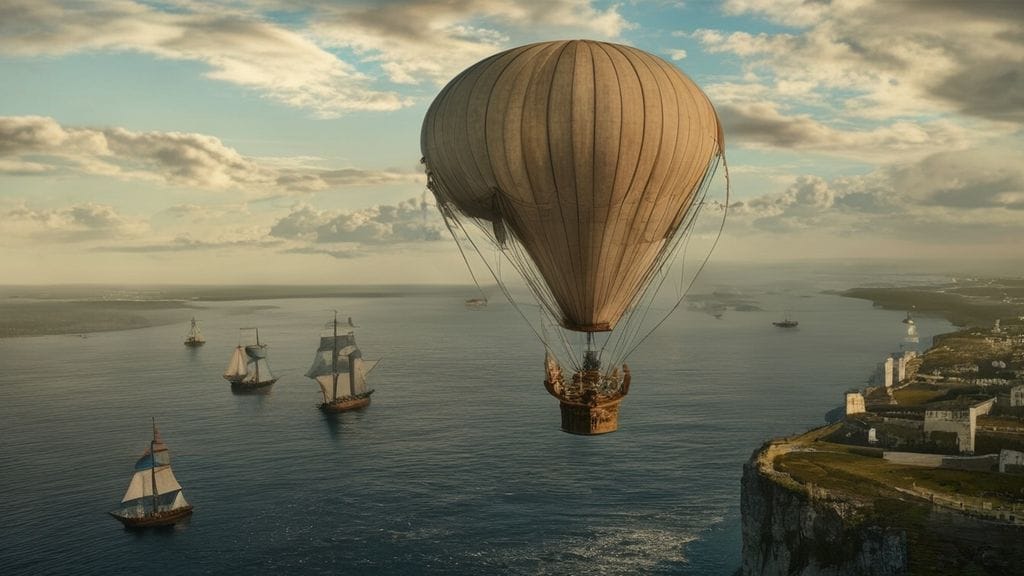
The Channel beneath them was both threat and theater. Ships passed far below: merchantmen with billowing sails, tiny fishing vessels, perhaps even a Royal Navy ship on patrol. Some crews were prepared. Word of the planned attempt had traveled, and captains had been instructed to render assistance should a balloon be seen drifting downward. Others must have stared in stunned confusion, rubbing their eyes and wondering if some strange cloud or monstrous bird was flying overhead. One can easily imagine a sailor, hardened by storms, taking off his cap and crossing himself at the sight.
At first, the balloon held its altitude well. The instruments reported manageable changes; the wind remained steady. Yet even in this early phase, the men in the gondola understood that victory was not guaranteed. Hydrogen, unlike hot air, cools as it ascends, contracting and causing a gentle descent unless compensated by ballast. Every handful of sand thrown overboard bought a little more height but reduced their margin for later. The Channel was not half crossed, and already they were drawing from reserves that might be vital near land.
Still, there were moments of near‑religious awe. Jeffries looked back and saw the French coast shrinking into a pale strip; ahead, the English shore was not yet in sight. He realized that, for a time, they were in a world that belonged entirely to neither nation. “Between the jurisdictions of two crowns,” he might have thought, “we sail in the dominion of the air alone.” In that image, the first aerial crossing of the English Channel becomes more than a geographical achievement; it becomes a fleeting political allegory, a suggestion that high above borders there might exist another space—vulnerable, undefined, and filled with possibility.
Over the Grey Water: The Channel from Above
As the flight progressed, the novelty of ascent gave way to the sober business of survival. The Channel lay beneath like a breathing thing, its surface mottled with patches of darker and lighter grey as currents moved beneath the skin of the water. The wind freshened, occasionally rocking the gondola with a side‑to‑side motion that reminded the aeronauts of how entirely they depended on the quiet buoyancy of gas above their heads. Without warning, the balloon could rise sharply if struck by a warmer current of air, or sink if its hydrogen cooled more quickly than expected.
Jeffries’ notebooks preserve a disciplined calm. He measured the temperature at different heights, watched his barometer’s mercury slide up or down, and attempted to sample the air at various altitudes in glass flasks. Later scientists would look back on this moment as among the first serious attempts to treat the atmosphere as a layered, analyzable environment rather than an undifferentiated void. The first aerial crossing of the English Channel thus contributed not only to geography but to meteorology, offering data from zones of the sky that had never before been measured directly.
Blanchard, meanwhile, tested his steering devices. He worked the oars, pulling against the air with rhythmic strokes that must have looked impressive from below. From the gondola, however, any effect was minimal. The balloon’s immense inertia compared to the thin resistance of the air rendered such efforts almost symbolic. Still, for sponsors and onlookers, the idea that man might one day steer balloons as precisely as ships was intoxicating. In this, Blanchard was less a charlatan than a visionary hoping reality would, eventually, catch up to his claims.
As the hours ticked by, problems began to accumulate. The balloon, which had never been perfectly inflated, showed signs of gradual loss of lift. Perhaps the hydrogen was escaping through microscopic leaks in the fabric or around the neck where the envelope was tied. Perhaps the cold was contracting the gas more than expected. Whatever the cause, the gondola began to sink slowly but unmistakably toward the sea. At first, the descent was gentle, easily checked by throwing overboard a bit of ballast. But sand, once gone, could not be reclaimed.
It is at this stage in the story that the Channel’s reputation as a treacherous, fickle barrier reasserted itself. For centuries, fleets had battled not only each other but the currents and shifting weather in this narrow corridor. Now the same forces threatened these two men in their fragile shell of wicker and silk. The water grew closer; waves became more distinct; whitecaps showed their teeth. The English coast remained stubbornly hidden in haze. Their dream risked becoming a nightmare: to see both shores and touch neither.
Yet in the gondola, the men did not panic. They argued. Jeffries recorded that Blanchard, worried by the balloon’s stubborn descent, proposed throwing over unnecessary weight, which meant, inevitably, Jeffries’ carefully chosen instruments and even some of their clothing. The scientific ambitions of the voyage—those painstaking measurements, those preserved samples—suddenly collided with the brutal arithmetic of survival. In the balance hung not only the success of the first aerial crossing of the English Channel, but their very lives.
Crisis in Mid‑Air: Throwing Everything Overboard
The descent, at first incremental, became alarming. The sea that had seemed an abstract grey texture was now detailed and menacing. Individual waves could be seen rearing up; the white foam of breaking crests appeared and vanished in sickening rhythm. The balloon, its envelope wrinkling and sagging, labored upward with ever less vigor each time Blanchard dumped ballast. Soon, most of the sand was gone. The gondola continued, inexorably, to sink toward the unforgiving water.
At this point, crisis demanded measures that bordered on the absurd. Anything that weighed more than it strictly had to now became suspect. Jeffries, with a heavy heart, began to heave his instruments overboard, one by one. Barometers and thermometers, the very symbols of the flight’s scientific purpose, splashed into the Channel. Paper notes, carefully prepared questions, spare glass vessels: all followed. The sea, indifferent, swallowed this little archive of Enlightenment empiricism without a ripple of remorse.
When that proved insufficient, they turned on their provisions. Food, wine, spare clothing, and even ballast barrels themselves were sacrificed. The gondola lightened with every jettisoned object, but the balloon still sagged, its lift slowly eroding. They removed and threw overboard even some of the oars and the much‑touted “steering fan.” The very devices Blanchard had flourished to claim mastery over the air now became deadweight to be discarded. For a moment, the balloon responded, climbing to a safer altitude, but the reprieve was brief.
As the Channel once more reached hungrily upward, the two men faced an appalling truth: there was little left to discard except themselves. In a macabre moment that would later be retold with varying degrees of embellishment, Blanchard and Jeffries stripped off articles of clothing to reduce weight. Coats, boots, and other garments fell toward the water, fluttering like broken birds. One can imagine the humiliation of standing half‑clad in the biting cold, shivering, staring down at the sea below, and realizing that even one’s dignity must be spurned in the effort to stay aloft.
Eyewitness accounts and Jeffries’ own narrative suggest that the gondola came perilously close to the water’s surface. Some later illustrations exaggerate, showing the basket’s floor awash with spray. Whether or not they actually touched the water, the psychological effect was the same: death was no longer a distant possibility but a presence just meters below. “We seemed,” Jeffries wrote, “poised between two elements, uncertain to which we should resign ourselves.” It was here that the first aerial crossing of the English Channel brushed against catastrophe, and where the fragile partnership between the aeronaut and the scientist found its most extreme test.
Then, almost miraculously, the crisis eased. Having cast off nearly every removable object, and possibly aided by a subtle change in temperature or wind, the balloon began to rise more decisively. The waves receded; the horizon lifted. Ahead, like a ghost forming out of fog, the English coast at last appeared: low, greenish‑brown, and edged with white. The men in the gondola, chilled, half‑naked, and depleted, could now exchange grim smiles. They were not safe—landings in balloons are often more dangerous than ascents—but they had, in the rawest sense, survived the sea.
Landfall in England: Crash, Survival, Triumph
As the English shore grew clearer, emotion in the gondola swung violently between elation and renewed anxiety. They had not fallen into the Channel, but where and how they would land was still unknown. No landing field had been prepared; no reception party waited with ropes. The balloon, now light but unstable, approached the cliffs and fields under an irregular wind that might, at any moment, blow them back out to sea or dash them against a hillside.
They crossed the coastline somewhere near Dover and drifted inland. Below, villagers and farmers stared upward, pointing at the strange apparition gliding over their fields. Horses spooked; dogs barked furiously. The balloon, its envelope showing visible strain from the ordeal, began again to sink, this time toward solid but uneven ground. Blanchard shouted for people below to seize the drag rope once it touched the earth and pull hard to arrest the gondola’s motion. The concept of balloon landings was still unfamiliar; those on the ground hesitated, unsure if this fantastic object was safe to touch.
Finally, the balloon descended into a field near the village of Woodnesborough, not far from Dover. The landing was rough. The gondola struck the ground, bounced, and was dragged along, scattering frightened onlookers. Jeffries and Blanchard clung to the sides, battered and bruised but alive. With the help of locals, the balloon was eventually subdued, its gas slowly released, its once‑proud envelope collapsing into a heap of fabric on the damp earth.
What followed was a rapid transformation from emergency to celebration. Word raced through the countryside: the balloon from France had arrived, bearing two men who had literally fallen from the sky. Messengers galloped toward Dover and up the coast; within hours, news reached London that the first aerial crossing of the English Channel had been achieved. In the centuries‑old contest between the two nations, a new sort of race had been run, and on this occasion, the victors were joint representatives: one French, one American‑English.
In Dover, the aeronauts were feted. Local gentlemen offered lodging; toasts were made; dignitaries clamored to hear every detail. They were examined like specimens and celebrated like heroes. Their half‑naked arrival, hastily covered by borrowed coats, only added to the drama of their tale. Newspapers soon carried engraved images of a nearly naked Blanchard and Jeffries casting their possessions into the sea. The very extremity of their mid‑air sacrifice heightened the sense that this was an exploit on the edge of sanity and survival.
It is difficult, from the perspective of our era of jetliners, to comprehend the intensity of wonder such a flight awakened. Today, one can cross the Channel in under half an hour, barely aware of the sea below. In 1785, to have done so suspended beneath a balloon, buffeted by the wind, was to rewrite the geography of imagination. The waterway that for centuries had been both barrier and highway was suddenly, startlingly, something that could be stepped over from above. For a time, the site of their landing field became a minor pilgrimage spot, where visitors could stand and gaze upward, trying to imagine the path that had carried two men from one world to another in the span of a morning.
The First Aerial Crossing and the Politics of the Sky
The immediate reaction among political elites in both France and Britain was a mixture of pride, curiosity, and a faint undercurrent of unease. Insomuch as the first aerial crossing of the English Channel had been a Franco‑British collaboration—French aeronaut, Anglo‑American physician, joint flags—it could be spun as evidence that old enemies might share new frontiers. In London, the Royal Society examined Jeffries’ account with interest, treating his measurements as valuable additions to mankind’s understanding of the atmosphere. In Paris, accounts of Blanchard’s role reinforced the narrative of French leadership in aerial navigation.
Yet statesmen and military thinkers could hardly ignore the implications. If a balloon could drift from one shore to another carrying two men and equipment, what might a fleet of such balloons carry? Spies, letters, philosophical pamphlets—or explosives? The idea of aerial bombardment remained more fantasy than plan in the 1780s, but seeds had been planted. During the French Revolutionary Wars, and later in conflicts into the nineteenth century, balloons would indeed be used for reconnaissance. The imaginative leap from looking to attacking from above was short, even if technology lagged behind ambition.
Some in Britain muttered that allowing a French‑led exploit to land triumphantly on English soil was a symbolic vulnerability. Others argued that the Channel’s historic role as “moat defensive to a house” might be compromised if new technologies allowed enemies to leap over fleets and fortifications entirely. In the French press, the crossing was hailed as proof of human progress, a vindication of Enlightenment reason over the gloom of superstition. Voltaire had once written that “men argue, nature acts.” Now, men acted upon nature in unprecedented ways, carving aerial routes through clouds as confidently as they cut canals through land.
There was also diplomacy in symbolism. The flight took place barely two years after the Treaty of Paris (1783) ended the American Revolutionary War, in which France had supported the American colonists against Britain. Jeffries’ presence as a Loyalist doctor—a man loyal to the Crown yet born in rebellious Boston—added complexity. One might read in his successful crossing an ironic, personal reconciliation across the waters that had separated his old home from his new. For both nations, to celebrate this exploit was to assert that science and audacity could bind peoples together across the legacy of recent conflict.
Nevertheless, early schemes emerged to adapt balloon technology to state purposes. Proposals were floated—sometimes literally—for government‑sponsored aerial expeditions, for military observation posts in the sky, and for cross‑Channel courier services using balloons. Most were impractical, hindered by the uncontrollable nature of the wind. But the fact that they were proposed at all indicates how the first aerial crossing of the English Channel had cracked open a door in the minds of strategists and dreamers alike.
Public Wonder, Satire, and Fear: Europe Reacts
If politicians pondered, the public gaped. The news of the crossing spread through newspapers, pamphlets, and conversation, igniting imaginations in drawing rooms and taverns from Edinburgh to Naples. Balloons, already fashionable subjects for songs and satirical prints, now acquired a sharper edge of awe. The French caricaturist Jacques‑Louis David reportedly joked that soon ministers would flee parliamentary debates not through the door but through the roof in their own personal balloons. London’s print shops filled their windows with engravings showing grotesquely huge balloons carrying entire towns, or fragile ones collapsing ignominiously into farmers’ fields.
Alongside the humor ran genuine fear. Not everyone welcomed the prospect of a sky that could be traversed. Rural folk, encountering balloons unexpectedly, often responded with hostility, attacking downed envelopes with pitchforks or knives, imagining them to be monstrous birds or demonic portents. Clergymen, especially in more conservative circles, questioned whether man was trespassing into spaces intended only for God’s creatures. One French preacher warned that “to rise above one’s station, even in a balloon, invites a fall more terrible than any suffered on earth.”
The Channel crossing became a powerful narrative at the intersection of these emotions. In salons, it was recounted as an exhilarating adventure, the triumph of wit and nerve over nature’s indifference. In more cautious homes, it was cited as an example of human hubris barely rewarded by survival. The image of Blanchard and Jeffries half‑naked, flinging their possessions into the sea, lingered as a reminder that progress often demanded absurd sacrifices.
Writers seized the event as metaphor. Some saw in it a symbol of emerging cosmopolitanism: if two men could drift between France and England in a matter of hours, perhaps the old hostilities between nations might be similarly thinned. Others, more pessimistic, viewed it as a sign that war would one day arrive from above, rendering traditional defenses obsolete. According to one contemporary diarist, “we shall have no fortress safe, unless it be roofless.” The first aerial crossing of the English Channel thus became a canvas upon which hopes and nightmares of the future were painted in quick, vivid strokes.
In the midst of this cultural reaction, Blanchard embarked on a tour of England, showing off his balloon and recounting the details of the voyage to paying audiences. Jeffries, more reserved, focused on publishing his scientific report. The divergence in their approaches reflected broader currents in the era: science as public entertainment versus science as sober inquiry. Both, however, contributed to the crossing’s legacy. The spectacle secured memory; the data secured respect.
Science in the Gondola: Data, Instruments, and Illusions
Lost beneath the drama of near‑disaster is the quieter story of what Jeffries hoped to accomplish with his notebooks and instruments. He intended the Channel flight to be a moving laboratory, gathering information about the vertical structure of the atmosphere. His barometric measurements, taken at various heights, offered one of the earliest consistent profiles of pressure changes over water. His thermometric readings, though limited, hinted at temperature gradients aloft. He also aimed to compare the composition of air at different altitudes, capturing samples for later analysis.
In an age when some still believed the atmosphere to be relatively uniform, such work mattered. Understanding how pressure and temperature varied with height had implications for weather prediction, health, and future aerial navigation. In his published account, Jeffries carefully tabulated readings and related them to approximate altitudes, attempting, as best one could from a swaying basket, to impose numerical order on a turbulent sky.
Not all his hopes were realized. The emergency jettisoning of instruments over the Channel erased part of his planned program. Some samples were lost; others may have been contaminated. Yet the attempt itself marked an important transition: balloons were not merely amusement devices but tools for investigating the atmosphere’s physics and chemistry. Later aeronauts, particularly in the nineteenth century, would adopt similar methods, ascending with barographs, thermometers, and even early cameras, slowly turning the once‑mysterious air into a mapped and measured domain.
Blanchard’s claims about steering and navigational control, by contrast, fell closer to illusion than to science. His oars and fan likely had negligible influence on the balloon’s horizontal path, which remained dominated by prevailing winds. The dream of truly navigable balloons would not be seriously approached until the advent of internal combustion engines, which would power the great dirigibles of the late nineteenth and early twentieth centuries. Still, Blanchard’s insistence that control was possible served an important imaginative function. It suggested that man was not condemned to drift aimlessly but could, in time, learn to pilot the aerial seas as confidently as he sailed the oceanic ones.
In this blend of careful measurement and optimistic exaggeration, the first aerial crossing of the English Channel reflects the dual nature of Enlightenment progress. On one hand, it embodied the rigor of empirical science, with instruments calibrated and readings logged. On the other, it carried the romance of invention, in which devices were often promoted as more effective than they truly were, in the hope that future refinements would vindicate present bravado. Both tendencies would shape the subsequent history of flight.
From Balloons to Bombers: A Thin Line of Continuity
Seen from the vantage point of the twenty‑first century, the 1785 Channel crossing looks both quaint and prophetic. The drifting balloon, tossed by winds it cannot command, seems an ancestor more to children’s toys than to the sleek jets streaking overhead. Yet a direct line can be traced from that fragile sphere of hydrogen to the airships and airplanes that would remake warfare, commerce, and daily life in the centuries that followed.
In the short term, balloons found their main practical use in military reconnaissance. During the French Revolutionary Wars, the French army deployed an aerostatic corps, using tethered balloons to observe enemy movements from above. Similar techniques appeared in the American Civil War and the Franco‑Prussian War. The Channel crossing had shown that the airspace between nations was traversable; military balloons demonstrated that the sky above battlefields could be exploited.
The dream of heavier‑than‑air flight—machines that would not merely float but actively fly through beating wings or rotating propellers—remained unrealized throughout the eighteenth and most of the nineteenth centuries. Yet the very idea that humans belonged in the sky, that the atmosphere was not an alien realm but a medium in which one might travel, owed much to early balloon exploits. As historian Charles Gillispie observed, “balloons taught the human eye to think in three dimensions,” preparing minds to accept the possibility of controlled, powered flight.
By the time the Wright brothers lifted off at Kitty Hawk in 1903, aerial crossings of larger seas and oceans had become an attainable dream. In 1909, Louis Blériot would complete the first powered airplane crossing of the English Channel, echoing Blanchard and Jeffries’ route but with an engine thundering before him rather than a wind‑filled envelope above. The Channel, once a near‑fatal barrier to a gas balloon, became a test course for pioneers of mechanized flight.
Then, in the twentieth century, the darker implications that some eighteenth‑century observers had dimly feared came fully into view. Airplanes carried bombs across borders; the Channel itself could be overflown by squadrons of fighters and bombers within minutes. During both World Wars, British and German air forces contested the same strip of sky Blanchard and Jeffries had dawdled across in hours. A medium that had once hosted a single frail gondola now roared with the passage of machines designed not to study or to dazzle but to destroy.
Yet the original crossing still stands as a moment when the sky was mostly promise, not yet saturated with engines and contrails. In that sense, the first aerial crossing of the English Channel marks the pivot point between times when the sea defined Europe’s frontiers and a new age in which the air would bind and threaten continents in equal measure. The continuity from balloon to bomber is indeed thin, and unsettling, but it runs undeniably through that cold January morning.
Lives After the Flight: Glory, Decline, and a Fall from the Sky
Triumph rarely guarantees security, and for neither Blanchard nor Jeffries did the Channel crossing translate into a tranquil afterlife. Blanchard capitalized on his fame, touring widely across Europe and later in America, staging ascents that mixed scientific demonstration with theatrical flair. He crossed rivers, drifted over cities, and performed parachute experiments using animals. Always, however, he remained at the mercy of the same volatile winds that had nearly killed him over the Channel, and of the equally fickle currents of public interest and patronage.
In 1808, more than two decades after his moment of greatest renown, Blanchard ascended in The Hague. Mid‑flight, he suffered what appears to have been a stroke or heart attack, lost control, and fell from a considerable height. Though not killed immediately, he never fully recovered, dying the following year. The man who had once embodied the daring face of aerial exploration thus met an end intimately bound to the element he had helped to pioneer. His widow, Sophie Blanchard, would become an accomplished aeronaut in her own right, only to perish in 1819 when her balloon, illuminated by fireworks, caught fire over Paris—a grim reminder that early flight was a dance with death.
John Jeffries’ post‑flight trajectory was quieter. Having secured a place in the scientific annals with his detailed account of the Channel crossing, he faded somewhat from public view. He continued medical practice and maintained interests in science, but without another exploit of similar magnitude, his name gradually retreated from popular memory even as historians of meteorology preserved it. His Channel report, carefully written and published in London, became a foundational document for later atmospheric studies. In its measured prose, one hears the voice of a man who believed that risk was justified by knowledge.
Jeffries eventually returned to America, where he died in 1819. Unlike Blanchard, he did not die in the sky; his passage back across the Atlantic was presumably by ship, a more traditional though still dangerous route. That he crossed the Channel by balloon and later the Atlantic by boat is fitting. He belonged to a transitional generation: men who had tasted the aerial future but still lived primarily in a world dominated by sails and horses.
The fates of these two men color how we remember the first aerial crossing of the English Channel. Blanchard’s death in consequence of an aerial accident reinforces the romantic, tragic aura that nineteenth‑century writers would later wrap around pioneers of flight. Jeffries’ quieter life underscores that behind every dramatic exploit there is often a more modest story of record‑keeping, analysis, and pondering. Heroes of the air, like heroes of the sea, required both the daring captain and the careful navigator.
Myths, Misunderstandings, and the Memory of 1785
Over time, as with many historical events on the border between spectacle and science, the 1785 crossing accumulated myths. Some popular accounts greatly exaggerated how close the gondola came to the water, depicting waves crashing over its sides in a manner unlikely given the balloon’s basic buoyancy. Others downplayed Jeffries’ role, presenting the exploit as essentially Blanchard’s alone. National biases crept in: French writers emphasized French ingenuity; British ones highlighted the Anglo‑American scientist’s composure under pressure.
There were also enduring misunderstandings about the purpose of the flight. Many later narratives portrayed it as essentially a publicity stunt, a piece of aerial theater designed to line Blanchard’s pockets and dazzle crowds. While it certainly had promotional aspects—Blanchard was no stranger to self‑advertisement—such a view does injustice to the genuine scientific aims, especially on Jeffries’ part. His instruments and careful planning, as well as his meticulous post‑flight report, demonstrate that the first aerial crossing of the English Channel had a substantial research component.
Another distortion concerns control. Some popular illustrations show Blanchard vigorously rowing the air, implying that he “piloted” the balloon across the Channel as a mariner steers a ship. Modern aerodynamic understanding and contemporary testimony make clear that the balloon was almost entirely at the mercy of prevailing winds. To call Blanchard a “pilot” in the modern sense is to project later technology backward. He was, more accurately, a manager of altitude and ballast, a careful negotiator with the invisible currents around him.
Historians have worked to peel back these layers of myth. By comparing Jeffries’ account with Blanchard’s and with newspaper reports, they reconstruct a plausible sequence of events and a realistic assessment of risk. Scholarly works on early ballooning, such as those by aviation historians and science historians alike, make clear that the crossing, while dangerous, was not entirely reckless. As one twentieth‑century historian noted, “the men of 1785 were not Icarus, heedless of limits; they were experimenters, keenly aware that wax and feathers would not do.”
The way the flight is remembered has shifted with time. In the nineteenth century, when balloon ascents were still common entertainment and powered flight had not yet arrived, the crossing served as a benchmark of aerial courage. In the twentieth century, overshadowed by airplanes and rockets, it slid into the background of public consciousness, revived occasionally by anniversaries or local commemorations in Calais, Dover, or Woodnesborough. Today, in an age of drones and satellites, it can seem almost pastoral—a quiet morning’s drift over a narrow sea. That impression is deceptive. For the men in that basket, the Channel remained as unforgiving as ever, and the sky as untested.
Why This Flight Still Matters in the Age of Jets and Drones
What, then, does the first aerial crossing of the English Channel mean to a world in which crossing that same waterway by air has become a trivial commute for low‑cost airlines and private jets? On a purely technical level, the 1785 exploit now appears primitive: no engines, no navigation systems, no weather radar, not even an accurate map of the winds. Yet precisely in that simplicity lies its enduring significance. It was a threshold moment, when humans first demonstrated not merely that they could ascend and drift but that they could connect two nations by air in a deliberate, planned journey.
In a broader sense, the flight represents the courage to move into ungoverned spaces. At the time, the law had little to say about what occurred in the sky. There were no air corridors, no aviation treaties, no customs protocols for aerial arrivals. By launching from Calais and landing near Dover, Blanchard and Jeffries quite literally inserted themselves into a legal terra incognita. Today, as human activity expands into other frontier realms—outer space, the deep sea, even the digital ether—their venture offers a historical echo of the moment when new domains first come under human exploration and, inevitably, regulation.
The crossing also continues to resonate as a symbol of cooperation. At a time when nationalism was rising and revolutions were brewing, two men of different backgrounds and loyalties climbed into the same fragile craft to perform an experiment whose success depended on their mutual trust, however strained. Their shared survival required shared sacrifice: each shed possessions, pride, and even clothing in order to keep both alive. In an era where international collaboration in science is again under political pressure, that image of joint vulnerability in pursuit of knowledge remains powerful.
Finally, the story speaks to the mixed legacy of technological progress. The same imagination that led to the first aerial crossing of the English Channel would, over time, produce miracles of connectivity and horrors of aerial bombardment. To study that cold January morning is to see the seed of both. It reminds us that every expansion of human reach, whether into the sky, cyberspace, or the microscopic world of genetic engineering, carries possibilities for benefit and harm. The balloon over the Channel was, in this sense, a floating question: what will we do with the spaces we have just learned to enter?
In classrooms, museums, and historical essays, returning to Blanchard and Jeffries’ exploit offers a way to talk about risk, ambition, and responsibility. It allows us to imagine, if only for a moment, the feeling of standing shivering in a swaying gondola, watching the sea below draw nearer, and deciding what we are willing to throw away to stay aloft. That image stays with us because, metaphorically, it is one we face again and again as a species, whenever our inventions bring us to the edge of a new frontier.
Conclusion
On 7 January 1785, as a frail balloon left the French coast and drifted out over the grey immensity of the Channel, humanity stepped, however cautiously, into a new relationship with the sky. The first aerial crossing of the English Channel was not a clean, controlled triumph but a messy, perilous improvisation: sand spilling, instruments lost, clothes cast away, lives hanging on the thin skin of a gas‑filled envelope. That mixture of courage and contingency, of careful measurement and desperate improvisation, is what gives the story its enduring power.
In the partnership of Jean‑Pierre Blanchard and John Jeffries we see the familiar tensions of technological revolutions: showmanship and science uneasily sharing a gondola, personal rivalries jostling with shared danger. Their flight reshaped how Europeans imagined distance, borders, and the very idea of travel. It suggested, for the first time in a concrete way, that the divisions of sea and land might be overflown, that nations might one day be linked by regular paths through the atmosphere.
The consequences, as history unfolded, were profound. Balloons gave way to airships, then airplanes, then jets and rockets. The sky became crowded, regulated, and weaponized. Yet beneath the roar of modern engines, the memory of that silent passage—powered only by wind and hydrogen—still whispers. It reminds us of a moment when the sky was new, when every ascent was an experiment, and when the line between death and discovery was as thin as the fabric stretched above two men in a winter dawn.
To revisit the story now is not to indulge in quaint nostalgia but to confront the roots of our modern world. The Channel that Blanchard and Jeffries crossed has been overflown millions of times since, but never again with such uncertainty, nor with such immediate revelation. Their voyage invites us to remember that all our smooth, routine journeys rest upon the courage of those who first trusted the unknown and stepped—or floated—into it.
FAQs
- What was the first aerial crossing of the English Channel?
The first aerial crossing of the English Channel was a balloon flight on 7 January 1785, when French aeronaut Jean‑Pierre Blanchard and American‑born physician John Jeffries flew in a hydrogen balloon from near Calais in France to a field near Dover in England. It was the first time anyone had traveled between the two countries by air. - Who were Jean‑Pierre Blanchard and John Jeffries?
Jean‑Pierre Blanchard was a pioneering French balloonist and showman known for numerous early ascents across Europe, while John Jeffries was a Boston‑born physician and Loyalist who had settled in London. Jeffries funded the flight and conducted scientific measurements during it, while Blanchard piloted and managed the balloon. - How long did the 1785 Channel flight take?
The flight lasted a few hours from liftoff near Calais to landing in Kent, though exact times vary by account. During that period the balloon drifted across the Channel under prevailing winds, periodically rising and falling as ballast was adjusted and as hydrogen gradually lost lift. - Was the flight dangerous?
Yes, extremely. The balloon’s hydrogen envelope was imperfect, and as lift decreased the gondola descended perilously close to the sea. Blanchard and Jeffries were forced to throw overboard ballast, instruments, provisions, and even clothing to stay aloft. A miscalculation or sudden change in wind could easily have drowned them in the cold January waters. - Why was the crossing important for science?
John Jeffries used the flight as an opportunity to collect some of the earliest systematic atmospheric data at different altitudes above the sea, measuring temperature and pressure and attempting to sample air for later analysis. His report to the Royal Society helped establish balloons as tools for meteorological and physical research, not just public entertainment. - Did the flight change politics or warfare?
While it did not immediately transform warfare, the crossing alerted politicians and military thinkers to the strategic possibilities of the sky. Within a few decades, balloons were being used for battlefield reconnaissance. Over the longer term, the idea that national borders could be crossed from above foreshadowed later developments in air power and aerial bombardment. - Where exactly did they land in England?
The balloon landed in a field near the village of Woodnesborough in Kent, not far from Dover. The landing was rough, with the gondola bouncing and being dragged before locals helped secure the balloon and its two shaken but unharmed occupants. - What happened to Blanchard and Jeffries after the flight?
Blanchard continued to make balloon ascents across Europe and in America, but in 1808 he suffered a medical episode during a flight in The Hague, fell from his balloon, and died the following year. Jeffries returned to medical practice and scientific interests, eventually going back to America; he died in 1819, remembered primarily for his role in the Channel crossing and his atmospheric observations. - Could Blanchard really steer the balloon?
No, not in any meaningful modern sense. Although he equipped the gondola with oars and a fan and claimed some steering ability, the balloon’s horizontal motion was almost entirely governed by wind. Blanchard could influence altitude by adjusting ballast, but true controlled steering of balloons would only become possible with the advent of powered airships many decades later. - How does this event relate to later aviation milestones?
The 1785 crossing helped normalize the idea of long‑distance aerial travel and demonstrated that significant bodies of water could be traversed by air. It formed part of the conceptual and practical foundation upon which later pioneers—such as Louis Blériot crossing the Channel by airplane in 1909—built, eventually leading to transoceanic flights and the global aviation networks of today.
External Resource
Internal Link
Other Resources
- Encyclopaedia Britannica – general search for the exact subject
- Google Scholar – academic search for the exact subject
- Internet Archive – digital library search for the exact subject

