Table of Contents
- The Dawn of Human Flight: A Dream Takes Shape
- The Wright Brothers: From Bicycle Makers to Aviation Pioneers
- The World Before Kitty Hawk: Flight Aspirations and Experiments
- Kitty Hawk, December 17, 1903: The Day History Took to the Skies
- The First Flight: Four Seconds That Changed the World
- From Kitty Hawk to the Skies Above: The Wrights’ Vision Expands
- Early Reactions: Skepticism, Wonder, and Controversy
- The Science Behind the Machine: Innovations and Technical Mastery
- The Emotional Landscape: Courage, Doubt, and Triumph
- The Global Impact: How Flight Shaped the Twentieth Century
- The Race for the Skies: Competing Innovators and Nations
- The Legacy of Kitty Hawk: Aviation’s Cultural and Economic Explosion
- Remembering the Flight: Memorials, Museums, and Mythmaking
- Women and Flight: Breaking Barriers in the Decades After
- The First Airplane Flight in Modern Memory and Popular Culture
- The Environmental and Military Transformations Driven by Flight
- Kitty Hawk Today: A Pilgrimage to the Birthplace of Aviation
The Dawn of Human Flight: A Dream Takes Shape
On a cold morning in North Carolina, where the Atlantic breezes swept gently over the sand dunes and whispered secrets only the sea knew, the impossible suddenly became reality. At Kitty Hawk, on December 17, 1903, two brothers—a pair of determined bicycle mechanics from Ohio—launched humanity into a new era. The first airplane flight, lasting a mere twelve seconds and covering just over a hundred feet, was more than a mechanical feat: it was a leap of spirit, a triumph of vision over the weight of gravity and doubt.
This moment, often overshadowed by the passage of time and the giant leaps that followed, remains a glimmering beacon in the narrative of human progress. The wind was biting, the skies overcast, yet nerves and hope soared as Orville Wright sat in the cradle of a machine, a fragile contraption that had no guarantees except the audacity of its makers. As the craft faltered into the air, time itself seemed to hold its breath.
But this was no spontaneous miracle. It was the culmination of years of meticulous observation, painful failure, and relentless perseverance—a story as much about human spirit as about technology.
The Wright Brothers: From Bicycle Makers to Aviation Pioneers
Orville and Wilbur Wright were not born scientists or wealthy inventors. Their workshop, nestled in Dayton, Ohio, was a humble bicycle repair shop where they honed their mechanical skills and developed an eye for detail. Yet, their passion extended far beyond wheels and chains. Inspired by earlier dreamers like Sir George Cayley, Otto Lilienthal, and Octave Chanute, the brothers dedicated themselves to unlocking the mystery of controlled, powered flight.
Unlike many of their contemporaries who pursued grandeur, the Wrights approached the problem systematically. They focused not only on generating lift but on control—how a pilot could steer, balance, and maintain stable flight.
Their approach was methodical: wind tunnels to test wing designs, innovative three-axis control systems, and custom-built lightweight engines. They even manufactured their own propellers, believing existing designs were insufficient. This relentless self-reliance, combined with a healthy dose of skepticism toward prevailing notions, set them apart.
When they announced their intentions to test at Kitty Hawk—a remote, windy site ideal for flight experiments—it was met with a mixture of curiosity and incredulity. Still, the world had no inkling that this pair of bicycle men were on the cusp of rewriting history.
The World Before Kitty Hawk: Flight Aspirations and Experiments
The dream of flight predates recorded history, from the myth of Icarus to Leonardo da Vinci’s sketches of flying machines. But scientific flight eluded humanity for centuries. The nineteenth century saw an explosion of attempts: hot air balloons, gliders, and steam-powered contraptions filled the skies, seeking dominance over earthly bounds.
By the late 1800s, inventors across Europe and America were experimenting with gliders, observing bird flight, and theorizing about propulsion. But a truly powered, sustained, and controlled flight was elusive.
Many inventors claimed partial successes, and skeptics abounded. Newspapers were quick to dismiss the Wright brothers’ claims when they finally flew. The aviation field was still seen as the realm of dreamers, often eccentric and impractical.
Yet, beneath the surface of mockery and doubt, the scientific community recognized the importance of balancing lift, thrust, and control—something that had remained unresolved.
Kitty Hawk, December 17, 1903: The Day History Took to the Skies
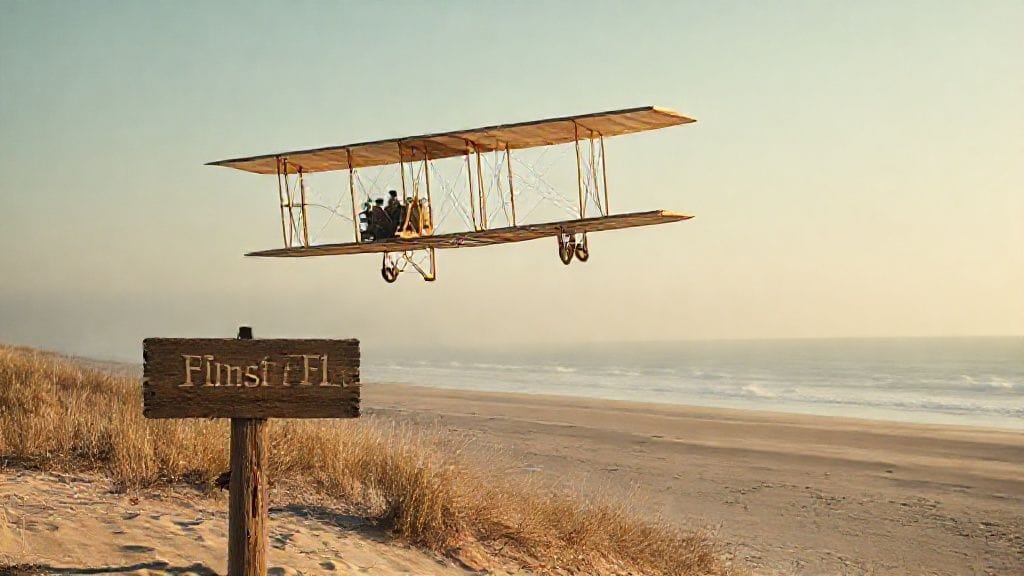
The chilling winds off the Outer Banks of North Carolina were relentless on that December morning. The rugged landscape was chosen for its isolation and steady breeze, perfect conditions for flight trials. At dawn, the Wright Flyer—a fragile assembly of spruce and muslin with a 12-horsepower engine—stood poised for its historic moment.
At 10:35 a.m., with Orville Wright at the controls, the craft was released on a homemade launching rail. The Flyer shook and sputtered as its twin propellers bit into the cold air, and suddenly it lifted—four seconds, 120 feet—into unknown territory.
Wilbur took the reins for the second flight, pushing the machine even further. By the day’s end, they had completed four flights; the longest lasted 59 seconds and stretched 852 feet. Each flight reinforced the reality that sustained, controlled powered flight was possible.
Though modest in duration and distance, these flights ignited a global transformation.
The First Flight: Four Seconds That Changed the World
How could a moment so brief ripple through history with such force? Orville’s four-second flight—deceptively short—was a conclusive demonstration against centuries of impossibility.
They proved beyond reasonable doubt that powered, heavier-than-air flying machines could lift off under their own power, be controlled by a pilot, and sustain flight. It was a scientific and cultural breakthrough, shattering entrenched skepticism.
Yet, the seriousness of their accomplishment was not immediately recognized. With no photographers except a few dubious shots, and no public audience present, much of the world remained unaware until news spread. Still, for the brothers, the flight was a quiet confirmation of years of toil.
As Orville later reflected, “It is possible to fly without motors, but not without knowledge and skill.”
From Kitty Hawk to the Skies Above: The Wrights’ Vision Expands
The flight at Kitty Hawk was a beginning, not an end. The Wright brothers returned to Dayton to refine their designs, build better engines, and develop practical aircraft.
Between 1904 and 1905, their Flyers managed controlled circles, turns, and flights lasting over half an hour. These successes began attracting attention, even from the military and government.
Despite stiff competition, their pioneering patents and technological know-how gave them an edge. Their insistence on manual piloting controls laid the foundation for all future aircraft.
Yet, it took years for the wider public and governments to grasp the potential of powered flight—a potential that would soon redefine warfare, commerce, and human mobility.
Early Reactions: Skepticism, Wonder, and Controversy
When the Wrights first announced their achievement, much of the media and public responded with disbelief. Scientific journals demanded proof, rival inventors scoffed, and the press sometimes labeled them charlatans.
The lack of independent witnesses fueled doubt. Some accused them of exaggeration, while others praised their ingenuity. Yet, the Wrights remained quiet and methodical, refusing grandiose claims.
This mixture of skepticism and awe characterized the early response, but as further flights were documented and witnessed, skepticism gave way to respect.
The Wrights’ struggle for recognition underscores how groundbreaking innovation often meets resistance before acceptance.
The Science Behind the Machine: Innovations and Technical Mastery
At the heart of the first airplane flight lay technical breakthroughs. The Wright brothers developed a lightweight internal combustion engine, which weighed just over 180 pounds but delivered enough power to lift the Flyer.
More revolutionary was their three-axis control system—allowing the pilot to adjust pitch, roll, and yaw—mimicking bird flight dynamics more accurately than any prior attempts.
Their invention of wing-warping technology allowed the plane to balance and turn. Crafting their own propellers based on aerodynamic data gave them efficient thrust.
Combined with the use of spruce wood (chosen for strength-to-weight ratio) and muslin fabric, the Wright Flyer was a masterpiece of aeronautical engineering.
The Emotional Landscape: Courage, Doubt, and Triumph
Behind the mechanics and aerodynamics lived human stories of hope, fear, and resilience. The Wright brothers risked physical injury, professional ridicule, and financial ruin pursuing their dream.
Doubt must have hovered constantly, shadowed by harsh weather and repeated failures. The isolation of Kitty Hawk meant long, lonely days away from family and friends, punctuated only by the crashing disappointment of crashes and stalls.
Yet the emotional payoff—the moment the Flyer stayed aloft—must have been electrifying. Wilbur’s tense face broke into smiles, Orville’s hands trembled. Here was proof that the sky could be touched, conquered.
Their story is a testament to the resilience of will and belief in the face of uncertainty.
The Global Impact: How Flight Shaped the Twentieth Century
The first airplane flight was not merely a local or national achievement—it was an event that urged humanity forward into a new century where distance shrunk, borders blurred, and dreams of connection soared.
Aviation transformed warfare during World War I and II, reshaping strategies and devastating landscapes but also pushing innovation in navigation and communication.
Commercial aviation collapsed isolation, enabling global trade, tourism, and cultural exchange. Emergency medical flights saved lives, and air mail revolutionized communication.
The airplane flight became a symbol of human ingenuity, progress, and the unquenchable desire to rise above limitations.
The Race for the Skies: Competing Innovators and Nations
While the Wright brothers were pioneers, the early 20th century witnessed a global race for supremacy in aviation. France, Germany, Russia, and Britain all pushed their own experiments.
Notable figures such as Alberto Santos-Dumont in Paris and Glenn Curtiss in the USA contributed new technologies and challenged Wright patents.
This competition accelerated exponential advances in engines, aerodynamics, aircraft design, and pilot training. Militaries, governments, and private companies invested heavily.
The fight for flight supremacy had geopolitical undertones, foreshadowing the critical role air power would play in global conflicts.
The Legacy of Kitty Hawk: Aviation’s Cultural and Economic Explosion
The successful first flight planted the seeds for one of the most transformative industries in history. Aviation opened novel economic avenues—from aircraft manufacturing to tourism.
Culturally, it inspired writers, artists, and filmmakers to reimagine human possibilities. It heralded a new era of modernity—where progress was measured by the distance one could travel in hours rather than months.
The Wright brothers became emblematic of determination and innovation, their story taught worldwide as an exemplar of the power of applied science and passion.
Remembering the Flight: Memorials, Museums, and Mythmaking
Today, Kitty Hawk and the Wright Brothers National Memorial attract thousands who pay homage to a modest spot where the impossible was first realized.
Monuments, plaques, and museums preserve their legacy, celebrating not just a mechanical event but a human story of aspiration.
The flight has entered mythic status, inspiring generations to dream beyond the visible horizons.
Women and Flight: Breaking Barriers in the Decades After
While 1903 was dominated by male pioneers, women soon carved their own place in aviation. Figures like Amelia Earhart, Bessie Coleman, and Harriet Quimby challenged social norms and soared to new heights.
Their achievements introduced gender into the narrative of flight’s democratization and widened the symbolic power of aviation as a liberating force.
The First Airplane Flight in Modern Memory and Popular Culture
The first flight continues to be celebrated in films, literature, and education, symbolizing human curiosity and daring.
Reenactments, flight simulators, and commemorations keep the story alive, reminding us that every technological giant starts with a fragile first step.
The Environmental and Military Transformations Driven by Flight
Flight profoundly altered warfare—introducing aerial combat, bombing, and reconnaissance that changed the face of conflicts forever.
Environmentally, it introduced global challenges, as air travel contributed to pollution, yet also offered opportunities for rapid humanitarian response.
Kitty Hawk Today: A Pilgrimage to the Birthplace of Aviation
Visitors to Kitty Hawk tread the sands where the Wright Flyer touched sky, standing close to the very rails that launched a revolution.
The site remains a potent symbol, a quiet monument to a fleeting moment when human ingenuity first lifted us toward the infinite heavens.
Conclusion
The first airplane flight at Kitty Hawk was a brief, fragile dance with destiny—four seconds of airborne defiance that echoed through human history. It was not just a technological breakthrough but the embodiment of perseverance, intellect, and courage. The Wright brothers’ journey from bicycle mechanics to sky pioneers reminds us that great achievements are born of curiosity, patience, and the willingness to lift off despite the weight of impossibility.
Their modest flight did more than conquer gravity; it unlocked a new dimension of human freedom and connection. As jets roar through skies today and rockets strive for stars, the spirit of Kitty Hawk endures—a testament to the power of daring to dream and the relentless pursuit of the sky.
FAQs
1. What was the significance of the first airplane flight?
It marked the first controlled, powered, and sustained heavier-than-air human flight, proving that mechanical flight was possible and opening the door for modern aviation.
2. Why did the Wright brothers choose Kitty Hawk for their experiment?
They sought a remote location with strong, steady winds to assist takeoff and soft sand for safe landings, making Kitty Hawk ideal.
3. How long did the first flight last, and how far did it travel?
The first flight lasted 12 seconds and covered 120 feet.
4. What were the key innovations of the Wright Flyer?
The critical innovations included the three-axis control system (pitch, roll, yaw), lightweight engine, wing-warping technique, and efficient propeller design.
5. How was the Wright brothers’ achievement initially received?
With skepticism and disbelief by many in the press and scientific community, though it later gained widespread recognition.
6. What impact did the first flight have on the 20th century?
It revolutionized transportation, warfare, communication, and global connectivity, influencing nearly every facet of modern life.
7. Did the Wright brothers face competition?
Yes, innovators worldwide raced to develop aviation technology, leading to rapid advancements and legal battles over patents.
8. How is the first airplane flight remembered today?
Through memorials, museums like the Wright Brothers National Memorial, cultural tributes, and ongoing celebrations of human ingenuity.