Table of Contents
- Dawn of a Green Revolution: The Birth of the First Artificial Leaf
- The Urgency of Climate Change: Setting the Stage for Innovation
- The Visionaries Behind the Breakthrough: Daniel Nocera and His Team
- Photosynthesis: Nature’s Masterpiece Understood and Reimagined
- Early Attempts at Artificial Photosynthesis: Trials and Errors
- The 2011 Announcement: A Leap Toward Sustainable Energy
- How the Artificial Leaf Works: A Symphony of Chemistry and Technology
- From Silicon Valley Labs to Global Imagination: Reactions and Reception
- Challenges Beyond Invention: Scaling, Stability, and Efficiency
- The Artificial Leaf in the Context of Renewable Energy Evolution
- Societal Hopes and Environmental Imperatives Intertwined
- The Ripple Effects: Influence on Research and Industry
- Ethical and Political Dimensions of Renewable Energy Technologies
- The Global South’s Perspective: Energy Access and Environmental Justice
- The Artificial Leaf and the Promise of a Carbon-Neutral Future
- Looking Beyond 2011: Advances and Iterations in Artificial Photosynthesis
- The Legacy of the First Artificial Leaf: Inspiring Innovation and Awareness
- Philosophical Reflections: Humanity’s Relationship with Nature and Technology
- Voices from the Field: Scientists, Activists, and Policymakers Weigh In
- Barriers to Adoption and the Path Forward
- Conclusion: A Green Dream Etched in Silicon and Sunlight
- FAQs: Understanding the First Artificial Leaf and Its Impact
- External Resources
- Internal Link
The summer sun bore down relentlessly on the laboratory in Cambridge, Massachusetts, in 2011. Inside, amidst humming instruments and the energy of determination, a quiet revolution was taking shape — a fragile leaf, artificial yet alive with promise, flickered into existence. This was no ordinary feat of science; it was the birth of humanity’s first artificial leaf, a marvel that sought to emulate the fundamental process that fuels all life on Earth — photosynthesis. The air buzzed with anticipation as Daniel Nocera and his team unveiled a device that converted sunlight and water into hydrogen fuel, mimicking nature’s energy alchemy but with a technological twist. It was a moment dense with hope, where human ingenuity brushed against the infinite potential of green energy. But this invention was more than a scientific curiosity; it was an answer whispered by a planet gasping under the weight of fossil fuels and climate crisis.
The first artificial leaf was born in an age desperate for alternatives — decades of environmental warnings, rising carbon dioxide levels, and political deadlocks had pushed scientists and societies alike into a corner. Could humanity replicate the elegance of the leaf, turning sunlight into clean, sustainable fuel? Daniel Nocera dared to try, blending chemistry, physics, and biology into a device no bigger than a credit card but loaded with revolutionary power. His work promised a future where energy could be harvested anywhere, from a sun-drenched backyard to the remotest village, freeing millions from dependence on polluting energy sources. Yet, as with every great innovation, the journey was fraught with scientific puzzles, economic barriers, and the questions of whether this fledgling technology could truly reshape the global energy landscape.
In this article, we embark on a vivid exploration of the first artificial leaf — a story of scientific discovery, human ambition, and the urgent quest for sustainable energy. We will traverse the breakthrough’s origins, the minds that conceived it, the technology behind its operation, and the legacy it left on the world stage. Through this narrative, we witness not only the mechanics of invention but also the emotional, ethical, and global reverberations that continue to ripple decades later.
Dawn of a Green Revolution: The Birth of the First Artificial Leaf
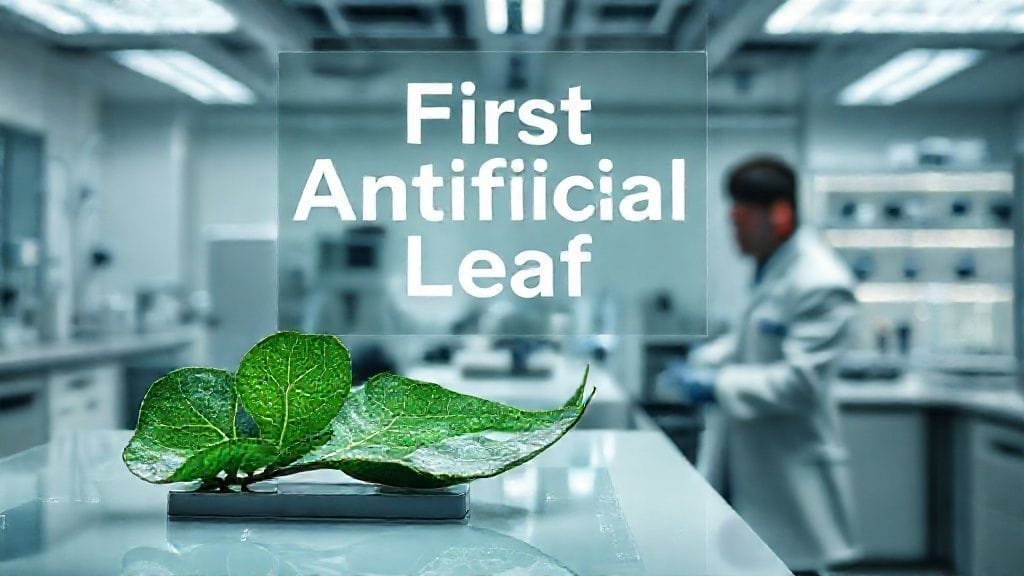
In 2011, the world’s energy dilemma remained critical. Fossil fuels dominated power grids, air pollution stained skies, and climate models warned of escalating catastrophe. Against this backdrop, Daniel Nocera, a professor of energy science and chemistry at Harvard University, unveiled the first artificial leaf. This device was not just a scientific instrument; it was a beacon. Shaped like a tiny wafer, the artificial leaf harnessed sunlight to split water molecules into hydrogen and oxygen — essentially producing fuel from sunlight and water alone.
The unveiling was met with a blend of awe and cautious optimism. Media outlets heralded it as a "game-changer," comparing the breakthrough to the discovery of electricity or the invention of the microchip. Scientists, policymakers, and environmentalists welcomed the prospect of distributed clean energy systems, particularly for off-grid, rural areas where energy poverty was rampant.
The artificial leaf promised a simpler, cheaper, and environmentally safer energy solution. It was small, self-contained, and could theoretically generate an unlimited amount of clean fuel as long as the sun shone. “It’s like giving every leaf on every tree the power to fuel our cars and lights,” Nocera famously said, igniting imaginations worldwide.
The Urgency of Climate Change: Setting the Stage for Innovation
To fully appreciate the significance of the first artificial leaf, one must understand the daunting global backdrop against which it emerged. By the early 21st century, the tightening grip of climate change was undeniable. The Intergovernmental Panel on Climate Change (IPCC) had released scathing reports linking human activity to rising global temperatures, alarming sea-level rise, and intensifying weather extremes.
Fossil fuel dependency was identified as the principal villain, driving up greenhouse gas emissions at an unsustainable pace. Energy production and consumption accounted for nearly 60% of global CO2 emissions, painting a stark portrait of the power sector’s environmental footprint. The urgent need to transition toward renewable energy sources became the clarion call for scientists, activists, and governments alike.
However, solar and wind technologies, though promising, faced challenges — intermittency, high costs, and infrastructure needs limited their universal application. Energy storage and fuel alternatives were rapidly sought after, driving research into innovative solutions that could capture, store, and deploy clean energy with minimal loss.
This was the crucible from which the artificial leaf emerged — a technology designed to surpass the constraints of existing renewable sources by integrating fuel generation with sunlight capture. If successful, it offered a way to store solar energy in chemical bonds — the very essence of solar fuels — providing a continuous, portable energy supply.
The Visionaries Behind the Breakthrough: Daniel Nocera and His Team
Daniel Nocera was no stranger to big ideas. Prior to the first artificial leaf, he had carved out a reputation as a chemist deeply engaged in renewable energy research, blending fundamental science with practical applications. His curiosity circled around an age-old question: could the complex dance of photosynthesis, perfected over billions of years by plants, be translated into human-made systems?
Nocera’s team was multidisciplinary — including chemists, material scientists, and engineers. Their combined expertise was essential to surmount the twin challenges of catalysis — speeding up chemical reactions — and durability. They focused on developing catalytic materials affordable and robust enough for real-world use, steering clear of rare and expensive metals.
Their work culminated in a silicon-based device coated with inexpensive catalysts made from elements like cobalt and nickel. This system could sit submerged in water, exposed to sunlight, splitting water molecules into hydrogen fuel and oxygen without toxins or complex machinery. The elegance of simplicity was their guiding principle.
Photosynthesis: Nature’s Masterpiece Understood and Reimagined
Photosynthesis sits at the heart of Earth’s life support system. Since its emergence billions of years ago, it transformed the planet’s atmosphere and ecosystems by converting sunlight, water, and carbon dioxide into oxygen and glucose — a process that fuels all higher life forms.
Yet, photosynthesis is also marvelously complex and inefficient by human standards. Plants convert only about 1-2% of solar energy into usable chemical energy, and the process involves multiple steps and delicate molecular machinery.
Scientists like Nocera sought to distill this process into a technological facsimile that could be more efficient and tailored to human needs — focusing on splitting water since hydrogen is a clean, high-energy fuel. Artificial photosynthesis thus became a dream of replicating nature’s solar chemistry without its complexity and limitations.
This reimagining also raised philosophical questions: Could humanity harness natural processes without depleting ecosystems? Could technology mimic life to sustain it? The first artificial leaf was the tentative answer to these profound reflections.
Early Attempts at Artificial Photosynthesis: Trials and Errors
Before 2011, the scientific community had been wrestling with artificial photosynthesis for decades. Pioneering research in the 1970s and 80s demonstrated that certain semiconductor materials could absorb sunlight and induce water splitting. However, these systems were often inefficient, unstable, or reliant on noble metals like platinum — scarce and expensive.
Researchers attempted countless catalysts and material combinations, often sabotaged by corrosion, low durability, or toxic byproducts. Hydrogen capture and storage posed their own hurdles. For every small technological advance, new bottlenecks emerged.
Daniel Nocera’s approach was revolutionary not because it invented water splitting but because it made it practical, affordable, and scalable. By focusing on earth-abundant materials and system simplicity, his artificial leaf overcame key obstacles that had held back earlier efforts.
The 2011 Announcement: A Leap Toward Sustainable Energy
On June 8, 2011, Harvard University and the American Chemical Society jointly announced the advent of the first artificial leaf. The world community of energy researchers listened closely as Nocera explained the technology’s potential.
The device was a silicon-based solar cell coated with cobalt and nickel catalysts, capable of producing hydrogen and oxygen from sunlight and water with efficiency and stability never before achieved at this scale and cost.
The announcement was framed not as an endpoint but as a beginning — a first step toward viable, distributed solar fuel generation. Nocera imbued the moment with a vision: energy independence for billions, clean fuel for transportation, and a way to mitigate climate change.
The media coverage was electric. Headlines proclaimed "Artificial Leaf Could Change Energy Forever" and “Scientists Invent Energy-Generating Leaf.” But for the researchers, it also set a challenge: to move from lab success to real-world impact.
How the Artificial Leaf Works: A Symphony of Chemistry and Technology
At its core, the artificial leaf mimics photosynthesis by using sunlight to split water molecules (H₂O) into oxygen (O₂) and hydrogen (H₂). Hydrogen is then collected as a clean fuel.
The device consists of a silicon solar cell that absorbs sunlight and produces an electric current. This current flows to two catalysts: one drives the oxygen evolution reaction (OER), splitting water into oxygen, protons, and electrons; the other drives the hydrogen evolution reaction (HER), recombining electrons and protons to form hydrogen gas.
These catalysts were crucial to the innovation. Prior systems often relied on pricey metals like platinum or ruthenium, but Nocera’s design used abundant metals like cobalt phosphate and nickel, reducing cost and improving feasibility.
The artificial leaf operates by immersing this sandwich-like device in water and exposing it to sunlight — a simple, elegant system that produces fuel continuously, could be portable, and does not rely on complex infrastructure.
From Silicon Valley Labs to Global Imagination: Reactions and Reception
News of the artificial leaf resonated far beyond scientific circles. Environmentalists heralded it as a potential remedy for the planet’s energy addiction. Yet, skepticism also shadowed the celebration, as many questioned its scalability and economic viability.
In developing countries where energy poverty trapped millions in darkness, the prospect of a simple, solar-powered hydrogen generator suggested a future unbound from fossil fuels and power grids. NGOs and humanitarian organizations saw the technology as a hopeful tool for rural electrification.
In corporate America and Silicon Valley, startups and investors eyed the artificial leaf with a mix of excitement and caution. It was a disruptive technology — promising but requiring massive investment and overcoming unknown technical challenges.
The announcement galvanized further research into solar fuels, artificial photosynthesis, and sustainable catalysis, spawning a new wave of projects worldwide.
Challenges Beyond Invention: Scaling, Stability, and Efficiency
Yet, translating laboratory success into a commercial product proved anything but straightforward. The initial artificial leaf was fragile and limited in scale. Real-world conditions such as fluctuating sunlight, water quality, and material degradation posed persistent challenges.
Scientists grappled with improving the catalytic efficiency and durability, seeking to extend device lifespan from hours to years. Manufacturing costs and integration with hydrogen storage and fuel cells were additional obstacles.
Critics argued that competing renewable technologies like solar photovoltaic and batteries were advancing just as rapidly, potentially overshadowing solar fuel devices. The race to practical clean energy solutions was becoming a marathon of incremental innovation rather than instant miracles.
Still, the artificial leaf marked a turning point — proof that artificial photosynthesis could be realized, a platform for ongoing improvement.
The Artificial Leaf in the Context of Renewable Energy Evolution
The first artificial leaf must be understood within the broader energy transition unfolding in the 21st century. Overlapping waves of innovation in solar PV, wind turbines, battery storage, and biofuels configured a mosaic of alternatives to fossil fuels.
However, each technology had limitations revolving around intermittency, storage, or land use. The artificial leaf addressed one keystone problem: direct solar-to-fuel conversion, enabling the storage and transport of solar energy as chemical fuel.
Hydrogen generated by the artificial leaf offered a powerful vector for the decarbonization of hard-to-electrify sectors such as heavy industry, shipping, and aviation. This aligned with long-term climate goals and energy security concerns.
Furthermore, unlike batteries, hydrogen fuel can be stored without degradation, transported over long distances, and used in fuel cells or combustion engines, widening possibilities for energy economy transformation.
Societal Hopes and Environmental Imperatives Intertwined
The first artificial leaf ignited hopes not only for cleaner energy but for a more equitable world. Energy poverty affects nearly a billion people—primarily in sub-Saharan Africa and South Asia—limiting health, education, and economic opportunity.
By providing distributed clean fuel production using only water and sunlight, the artificial leaf symbolized a potential democratization of energy access — empowering remote communities to leapfrog traditional grid infrastructure.
Environmentalists saw in it a bridge toward restoring the planet’s balance, reducing carbon emissions, and protecting ecosystems from mining and drilling scars. The artificial leaf became a symbol of synergy between human innovation and natural processes.
Yet sustainable adoption required navigating socio-political realities, resource distribution, and cultural acceptance — a test of humanity’s capacity to embrace green technology justly.
The Ripple Effects: Influence on Research and Industry
The announcement catalyzed burgeoning fields of “solar fuels” and “artificial photosynthesis” research worldwide. Laboratories accelerated investigations into new catalytic materials, system integration, and solar-to-fuel efficiency.
Industry players ramped up investments in green hydrogen, fuel cells, and catalysis technologies. Governments incorporated solar fuels into renewable energy roadmaps, leveraging the artificial leaf as both model and inspiration.
Moreover, the technological principles inspired spillovers into related areas like photocatalytic water treatment and carbon dioxide reduction to hydrocarbon fuels.
The legacy of the first artificial leaf was thus not confined to one device but ignited a movement blending chemistry, engineering, and environmental science.
Ethical and Political Dimensions of Renewable Energy Technologies
Every energy revolution carries ethical and political weight. The artificial leaf raised questions about resource control, intellectual property rights, and equitable benefit sharing.
Would this technology remain confined to developed nations, deepening global inequalities? How to avoid new forms of energy colonialism? Who controlled the fuels generated, and under what terms?
Furthermore, as clean energy technologies vie to replace fossil fuels, entrenched interests and geopolitical dynamics complicate transitions. The artificial leaf’s promise entailed engagement with these real-world complexities.
Environmental justice activists called for inclusive dialogues to ensure that technologies like the artificial leaf serve marginalized communities and prioritize sustainable livelihoods.
The Global South’s Perspective: Energy Access and Environmental Justice
For many in the Global South, the artificial leaf represented more than a green invention — it was a whisper of hope for energy sovereignty.
Countries burdened by unreliable grids, expensive diesel generators, and environmental degradation eyed solar fuel technologies to power clinics, schools, and water pumps sustainably.
However, high upfront costs, technological unfamiliarity, and policy gaps remained barriers. International collaboration, capacity building, and tailored solutions were imperative to realize the technology’s potential for social upliftment.
The artificial leaf thus became intertwined with global development narratives, linking climate action with poverty alleviation.
The Artificial Leaf and the Promise of a Carbon-Neutral Future
Global efforts to limit warming to 1.5 degrees Celsius hinge on deep decarbonization strategies. The artificial leaf embodies one such tool capable of delivering carbon-neutral fuels.
Green hydrogen generated via artificial photosynthesis could displace fossil fuels in transport, industry, and power sectors. Its clean combustion emits only water vapor, addressing air pollution and climate change simultaneously.
While hurdles remain, the technology’s path aligns with envisioning a circular, regenerative energy economy — drawing upon the sun’s bounty, closing carbon loops, and harmonizing human activity with planetary boundaries.
Looking Beyond 2011: Advances and Iterations in Artificial Photosynthesis
Since the original breakthrough, research has flourished. Variations of the artificial leaf have improved efficiency, stability, and scalability.
New catalysts, novel materials like perovskites, and integration with carbon dioxide reduction open avenues toward producing synthetic fuels like methanol.
Innovations increasingly focus on coupling solar fuel generation with storage and utilization systems, making the technology more practical.
Although no ubiquitous commercial artificial leaf exists yet, the scientific journey inspired by the 2011 milestone continues to fuel hope and action.
The Legacy of the First Artificial Leaf: Inspiring Innovation and Awareness
The artificial leaf’s profound legacy lies in its symbolic and practical influence. It transformed conceptual dreams of solar fuels into tangible reality.
The device has become a touchstone for researchers, educators, and advocates, sparking interest from school children to policymakers.
It exemplifies how human creativity, driven by necessity and reverence for nature, can confront the climate crisis.
Daniel Nocera’s invention stands as both a scientific landmark and a call to action — reminding us that solutions often lie at the intersection of curiosity, courage, and consciousness.
Philosophical Reflections: Humanity’s Relationship with Nature and Technology
The artificial leaf prompts deep reflection on how humans interact with the environment. Can technology replicate natural processes without exploitation? Should we mimic life or preserve nature’s sanctity?
This interplay of imitation and innovation raises ethical questions and invites humility and respect.
Perhaps the artificial leaf is more than hardware; it is a metaphor for coexistence — harnessing nature’s gifts responsibly, through technology inspired by wisdom and stewardship.
Voices from the Field: Scientists, Activists, and Policymakers Weigh In
Scientists hailed the artificial leaf as a watershed moment, a springboard for sustainable energy research.
Activists embraced it cautiously, welcoming its environmental promise but emphasizing social justice and equitable energy access.
Policymakers noted its potential in climate agendas but remarked on the need for sustained funding and infrastructure development.
These dialogic perspectives enrich the narrative, underscoring the multifaceted reality of energy transitions.
Barriers to Adoption and the Path Forward
Significant barriers must be addressed to fully realize artificial leaf technology:
- Enhancing device stability and lifetime
- Reducing production and deployment costs
- Building hydrogen infrastructure
- Overcoming regulatory and market hurdles
- Ensuring equitable access and community engagement
Collaborative efforts between governments, industry, academia, and civil society are essential.
The path forward involves iterative innovation, policy frameworks attuned to sustainability, and inclusive dialogue.
Conclusion
The story of the first artificial leaf is a tale of human ingenuity entwined with the urgency of saving our planet. It embodies a moment when science dared to reimagine the foundations of energy, drawing upon nature’s ancient wisdom to forge a cleaner future. Beyond the silicon wafers and catalysts lies a powerful human narrative — one of hope, ambition, and responsibility. As the world continues to grapple with climate change and energy justice, the artificial leaf stands as a radiant symbol: that with curiosity and courage, we can invent new ways to live in harmony with the Earth, turning sunlight into sustenance not only for plants but for the future of civilization itself.
FAQs
Q1: What is the first artificial leaf and why is it important?
The first artificial leaf is a silicon-based device that mimics natural photosynthesis by splitting water into hydrogen and oxygen using sunlight. It is important because it offers a clean, renewable way to produce hydrogen fuel, potentially transforming energy systems and helping combat climate change.
Q2: Who invented the first artificial leaf and when?
The first artificial leaf was developed by Professor Daniel Nocera and his team at Harvard University and publicly announced in 2011.
Q3: How does the artificial leaf differ from natural photosynthesis?
While it replicates the key reaction of splitting water using sunlight, the artificial leaf uses synthetic materials and catalysts to produce hydrogen fuel, whereas plants produce sugars and oxygen primarily for their own metabolism.
Q4: What challenges does artificial leaf technology face today?
Major challenges include scaling up production, improving stability and efficiency, reducing costs, and creating infrastructure for hydrogen storage and distribution.
Q5: How could the artificial leaf impact developing countries?
It could provide decentralized, clean energy access in remote areas lacking grid infrastructure, improving quality of life and reducing reliance on polluting fuels.
Q6: Has the artificial leaf been commercialized widely?
As of now, it remains largely in the research and pilot stages, with ongoing efforts to commercialize and integrate the technology into energy markets.
Q7: What is the global environmental significance of artificial photosynthesis?
Artificial photosynthesis could deliver a carbon-neutral fuel source, reducing greenhouse gas emissions and aiding efforts to mitigate global warming.
Q8: How does the artificial leaf fit into the broader renewable energy landscape?
It complements other renewables by providing solar-to-chemical fuel conversion and addresses storage and transport challenges faced by solar and wind energy.