Table of Contents
- Introduction
- What Is a Black Hole?
- A Century of Predictions
- The Event Horizon Telescope Collaboration
- How the Image Was Captured
- The Target: M87*
- Technical Breakthroughs and Challenges
- The Historic Image Release
- Public and Scientific Reaction
- What the Image Taught Us
- Implications for Einstein’s Theory
- The Future of Black Hole Imaging
- The People Behind the Achievement
- Conclusion
- External Resource
- Internal Link
1. Introduction
On April 10, 2019, humanity achieved something once thought impossible: we captured the first image of a black hole. It wasn’t just a blurry ring. It was a monument to scientific collaboration, technical brilliance, and our unrelenting curiosity about the universe. For decades, black holes had been predicted mathematically and inferred indirectly, but no one had ever actually seen one. That changed forever thanks to the Event Horizon Telescope (EHT).
2. What Is a Black Hole?
A black hole is a region in space where gravity is so intense that nothing—not even light—can escape from it. Its boundary is known as the event horizon, beyond which all information is lost to the outside universe. The idea may sound like science fiction, but it’s grounded in the general theory of relativity, proposed by Albert Einstein in 1915.
At the center of many galaxies, including our own Milky Way, lies a supermassive black hole, millions to billions of times more massive than our Sun. These objects shape the galaxies around them—and yet remain invisible. Until 2019.
3. A Century of Predictions
The idea of a black hole was first proposed in the 18th century, but it gained serious attention after Einstein’s equations. In 1916, Karl Schwarzschild discovered a solution to Einstein’s field equations that described a black hole’s geometry. However, it wasn’t until the 1970s and 1980s that black holes became widely accepted as real objects in the universe.
Over time, astronomers gathered indirect evidence: stars orbiting invisible objects, intense X-ray emissions from compact sources, and gravitational lensing. But the Holy Grail remained elusive: a direct image.
4. The Event Horizon Telescope Collaboration
The Event Horizon Telescope (EHT) is not a single telescope. It’s a global network of radio observatories, synchronized to function as one Earth-sized virtual telescope. Facilities from Hawaii to Antarctica participated, using a technique called Very Long Baseline Interferometry (VLBI) to combine data.
Coordinating this effort was no easy feat. It required precision timing, perfect weather, and petabytes of data transferred via hard drives on airplanes. But the result? A resolution high enough to capture something no one had ever seen before.
5. How the Image Was Captured
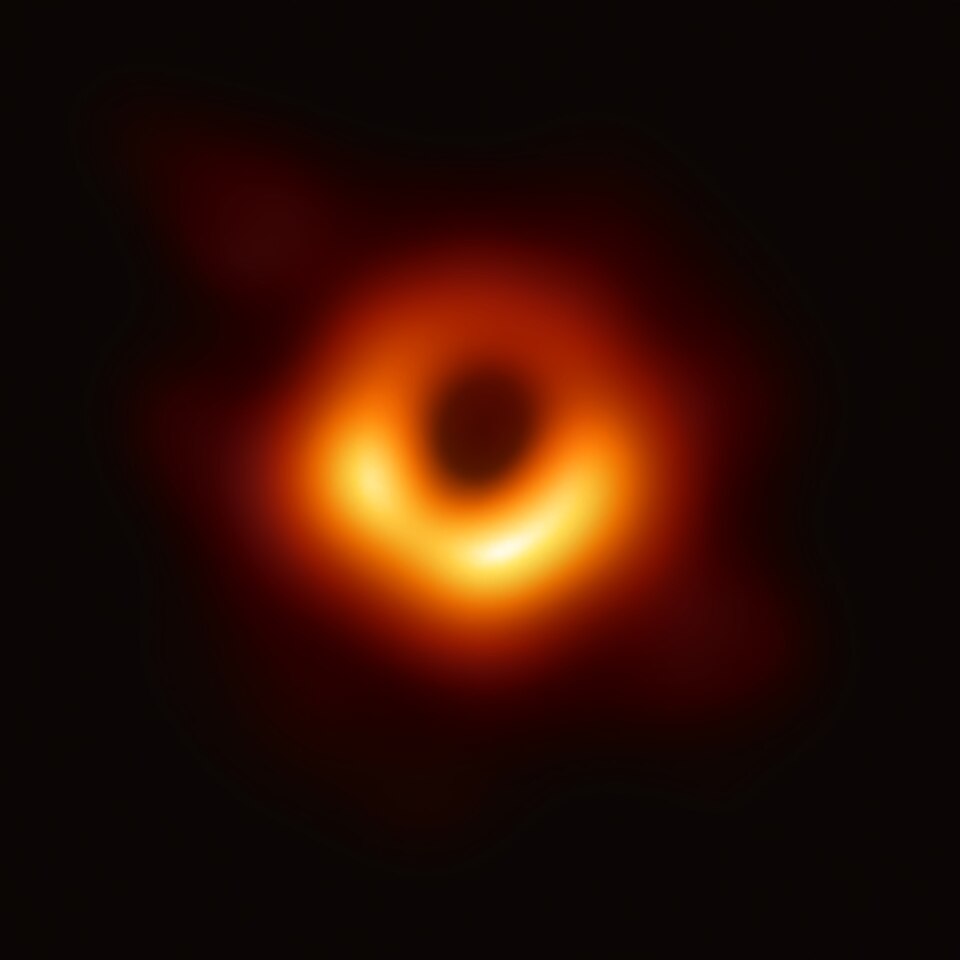
On April 5–14, 2017, the EHT observed a galaxy called Messier 87 (M87) in the Virgo constellation. At its core lies M87* (read: “M87 star”), a supermassive black hole about 6.5 billion times the mass of our Sun.
The image we see isn’t of the black hole itself—remember, black holes emit no light—but of the glowing accretion disk of gas and dust spiraling into it. The bright ring surrounds a dark region known as the shadow of the black hole.
6. The Target: M87*
Why M87*? Despite being 55 million light-years away, M87* is enormous. Its massive size meant its shadow was large enough to image from Earth. The EHT aimed its worldwide eyes at this cosmic monster and patiently gathered data.
The data were then processed by teams on multiple continents, using complex algorithms to reconstruct an image from the scattered signals. This wasn’t like snapping a photo—it was like assembling a puzzle with pieces spread across the globe.
7. Technical Breakthroughs and Challenges
Imaging a black hole wasn’t just difficult—it was insane. Each telescope had to sync to within a fraction of a nanosecond, and weather had to cooperate at all locations. The data were too large to send over the internet, so they were flown to central processing centers.
Dr. Katie Bouman, a computer scientist, became a viral icon when a photo of her reacting to the first image circulated online. Her team’s algorithm helped reconstruct the now-famous image.
8. The Historic Image Release
On April 10, 2019, the EHT collaboration unveiled the image to the world: a glowing orange donut against the void. It immediately became one of the most iconic images in modern science.
It was confirmation—not of fantasy, but of scientific theory brought to life.
9. Public and Scientific Reaction
The image captivated scientists, artists, and everyday people. It was splashed across front pages, featured in memes, and even inspired music and art. It brought relativity, cosmic scale, and collaborative science into mainstream conversation.
More importantly, it was a validation of Einstein’s predictions and a resounding demonstration of human ingenuity.
10. What the Image Taught Us
The image of M87* confirmed many predictions of general relativity, especially about how light bends around extremely massive objects. It allowed scientists to measure the black hole’s size, test gravitational theories, and better understand accretion disk dynamics.
And this is just the beginning.
11. Implications for Einstein’s Theory
Einstein’s theory had withstood another test. The shape, size, and symmetry of the black hole’s shadow aligned almost perfectly with predictions. It was a moment that showed, over a century later, his work still holds firm.
But even Einstein would’ve marveled at the idea that we could one day see the unseeable.
12. The Future of Black Hole Imaging
The EHT is already planning upgrades. Scientists aim to image our own galaxy’s black hole—Sagittarius A*—with more clarity, and possibly even create videos of matter moving around the event horizon.
As telescope arrays improve and algorithms get smarter, we may one day witness real-time dynamics at the edge of spacetime itself.
13. The People Behind the Achievement
This wasn’t the work of one genius—it was the result of over 200 scientists from more than 60 institutions across continents. It included astronomers, engineers, programmers, and theorists. It showcased diversity, collaboration, and global unity in pursuit of a shared goal.
Dr. Sheperd Doeleman, director of the EHT, called it a triumph of team science—and that it surely was.
14. Conclusion
Capturing the first image of a black hole was a landmark achievement for humanity. It represented the culmination of decades of theory, observation, and innovation. On April 10, 2019, we turned our planet into a telescope and aimed it at the impossible.
And the universe responded with a picture we’ll never forget.
15. External Resource
 Wikipedia – First image of a black hole