Table of Contents
- A Revolution in the Lens: The Birth of the First Digital Camera
- December 1975: A Moment Frozen in Time
- The Visionaries Behind the Invention
- Inspirations and Early Computing Landscapes
- The Triumph of Innovation Amidst Skepticism
- Engineering the Impossible: Technical Hurdles and Breakthroughs
- Capturing Reality Digitally: How the Prototype Worked
- The Silent Dawn of a Visual Revolution
- Market Reactions and the Conservatism of the Photo Industry
- The Legacy of Steven Sasson and Kodak Laboratories
- From Clunky Prototype to Ubiquitous Device: The Digital Camera’s Journey
- How the First Digital Camera Transformed Photography Forever
- Echoes Through Time: Digital Imaging Beyond Photography
- The Human Element: Stories of Wonder and Doubt
- Global Impact: Redefining Visual Communication
- Cultural Shift: From Film to Pixels
- Economic Ramifications in the Photography Sector
- The Rise of Digital Media and Social Sharing
- Contemporary Reflections on the 1975 Milestone
- Why December 1975 Still Matters Today
- Conclusion: An Immortal Snapshot of Human Ingenuity
- FAQs About the First Digital Camera
- External Resource
- Internal Link
In the cold December of 1975, an unassuming engineer held what would become one of the most transformative devices of the 20th century—a digital camera, bulky and primitive by today's standards, yet astonishing in its promise. This moment, shrouded in quiet innovation deep within the corridors of Kodak, marked the genesis of a revolution. It was a fragile birth but the dawn of a new era for photography, forever changing how we capture, share, and perceive the world around us.
A Revolution in the Lens: The Birth of the First Digital Camera
Imagine a world where every snapshot required chemical baths and rolls of sensitive film—moments forever lost if the exposure was incorrect or the film spoiled. Photography, one of the most intimate mediums of human expression, was tethered to the tangible and the analog. Until December 1975, when Steven Sasson, an electrical engineer at Eastman Kodak, unveiled a prototype that defied convention: a device that captured an image as digital data, sidestepping film altogether.
This was no mere invention. It was a merger of light and binary code, a synthesis of optics and semiconductors, harnessing the potential of emerging digital technology in a way few had envisioned. The first digital camera did not just freeze an image; it captured a burgeoning future.
December 1975: A Moment Frozen in Time
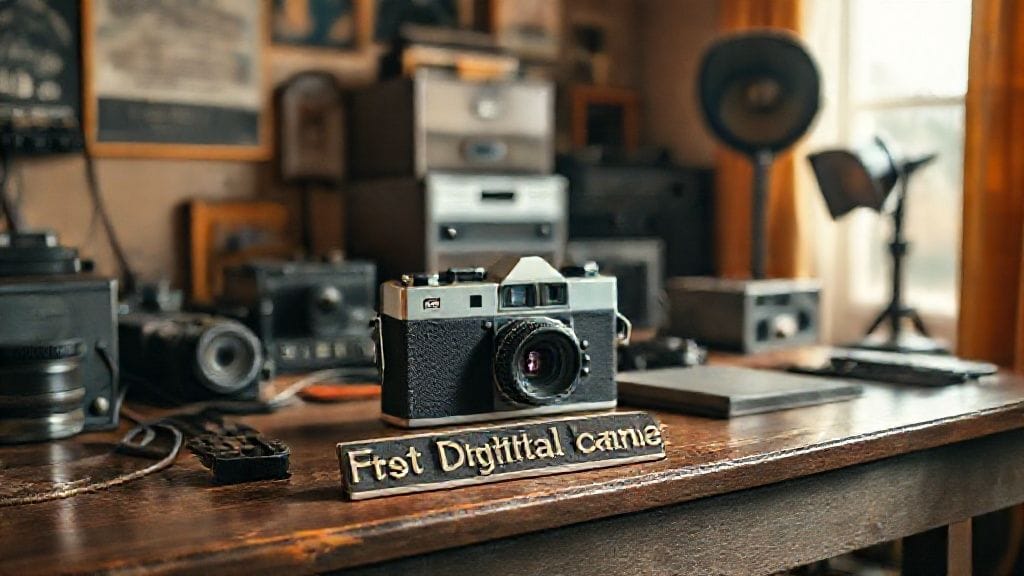
The date was December 7, 1975. Sasson assembled a set of electronic components—the heart of the camera was a charge-coupled device (CCD) image sensor that converted light into electronic signals. These signals were then processed, stored on a cassette tape, and displayed on a television screen. The entire contraption weighed approximately eight pounds and measured roughly the size of a toaster.
The invention was met with polite interest and cautious optimism from Kodak's management. They knew it was promising, but its full potential remained nebulous. After all, the consumer market was deeply rooted in film traditions. Yet, Sasson’s creation was a daring leap forward—a technological marvel quietly humming in the lab.
The Visionaries Behind the Invention
Steven Sasson didn’t act alone. Behind the camera was a fertile ecosystem of visionaries within Kodak and the broader technological community. The concept of digital imaging had been gestating for years, with groundwork laid by scientists exploring semiconductor materials and digital signal processing.
Sasson’s triumph lay in translating theory into practice. His own curiosity and determination sparked the project, supported by meticulous Kodak engineers who understood both photographic science and burgeoning digital technology. Their combined expertise birthed a device that was more than prototype—it was prophecy.
Inspirations and Early Computing Landscapes
The 1970s were a fascinating time to be an engineer or a creator. The microprocessor was fresh on the scene, computers were evolving from room-sized behemoths to-sized desktop curiosities, and the notion of digital data was expanding daily. In this burgeoning digital landscape, the concept of converting analog images into digital information was both inspired and daunting.
Kodak, though rooted in analog photography, was surprisingly prescient. The company anticipated that digital techniques would reshape the future of imaging, though the extent remained unknown. Sasson's project, funded and nurtured in this soup of innovation, was a mindset leap—one that asked: What if the image could live as data?
The Triumph of Innovation Amidst Skepticism
Despite the brilliance, the birth of the first digital camera did not cause an immediate sensation. Kodak’s executives, steeped in film-based business, viewed digital technology primarily as an interesting side project. Some feared it could cannibalize their lucrative film sales. This skepticism slowed the momentum of digital imaging for years, illustrating how even transformative ideas face resistance before acceptance.
Yet, the camera silently continued to evolve in labs and workshops. Sasson’s invention was a seed, one that required time, nurturing, and technological advancement to mature.
Engineering the Impossible: Technical Hurdles and Breakthroughs
Creating a digital camera in 1975 was not simply a matter of assembling parts. The process demanded tackling fundamental challenges: How to store thousands of digital pixels with acceptable fidelity? How to process electronic signals fast enough? And how to convert the hazardous chemical process of developing film into an instantaneous digital snapshot?
Sasson’s device stored images on a digital audio tape—primitive by current standards but revolutionary then. Resolving issues of sensor sensitivity, memory capacity, and digital encoding required innovative problem-solving, which laid foundational principles that endure in modern digital cameras.
Capturing Reality Digitally: How the Prototype Worked
The camera’s sensor captured a 0.01-megapixel black-and-white image, a resolution laughably low today but groundbreaking at the time. Once captured, the data was sent to a digital recorder, and images could be displayed on a nearby TV monitor.
This process—envisioned as science fiction merely a decade earlier—represented an alchemical ritual where photons were translated into electronic pulses, then into binary digits that could be stored and transmitted. It was an early glimpse into a world where images would be instantly viewable and endlessly reproducible.
The Silent Dawn of a Visual Revolution
For all its innovation, the first digital camera’s unveiling passed largely under the radar. The general public remained unaware; Kodak kept the invention internal, cautious of disrupting its own market. Yet, the device set a precedent. It whispered of a future where photography would become instantaneous, accessible, and digital.
This was no fleeting moment but the genesis of a silent visual revolution that would ripple through every facet of personal and professional life.
Market Reactions and the Conservatism of the Photo Industry
Despite the technical breakthrough, the photographic industry exhibited inertia. Kodak and competitors grappled with the realization that their centuries-old business models were about to be upended. Film sales were their lifeblood, and the prospect of digital imaging threatening that revenue stream bred strategic hesitations.
The initial response was tentative research and cautious experimentation rather than wholehearted embrace. It would take years of innovation, market changes, and consumer demand before digital cameras would be democratized.
The Legacy of Steven Sasson and Kodak Laboratories
Steven Sasson’s name may have been unknown to many outside tech circles, but within history’s annals of innovation, he stands tall. Awarded numerous honors later in life, his pioneering spirit and technical genius are a testament to the power of curiosity and perseverance.
Kodak laboratories were the crucible in which this innovation formed—a testament to how corporations can both foster and, paradoxically, stifle transformative creativity.
From Clunky Prototype to Ubiquitous Device: The Digital Camera’s Journey
Following Sasson’s invention, incremental innovations transformed the digital camera from bulky laboratory prototype to consumer-friendly device. The 1980s saw the emergence of basic digital cameras, though early models remained expensive with limited image quality.
By the 1990s, advances in image sensors, storage media, and display technology catalyzed widespread adoption. Eventually, digital cameras were integrated into mobile phones, transforming communication utterly.
How the First Digital Camera Transformed Photography Forever
The shift from analog to digital photography brought profound consequences. No longer was photography confined to professionals or hobbyists equipped with film and darkrooms. Images could be captured, edited, and shared instantly on a global scale.
This democratization altered artistic practices, journalism, and personal memory-keeping. It made every person a storyteller and every moment a potential historical document.
Echoes Through Time: Digital Imaging Beyond Photography
Beyond personal cameras, digital imaging birthed entire industries. Medical imaging, satellite photography, security systems, and social media all owe their existence to early digital imaging breakthroughs.
Even art and culture absorbed digital aesthetics, redefining creativity and communication in the digital age.
The Human Element: Stories of Wonder and Doubt
Behind every technical triumph are human stories—moments of wonder tinged with doubt and frustration. Sasson, in interviews, recalled recounting his invention to skeptics who dismissed it as a novelty. Yet, he persevered, driven by a vision that transcended immediate commercial allure.
Such stories illustrate how innovation often blooms not in applause but in the quiet persistence of belief.
Global Impact: Redefining Visual Communication
Digital photography shifted not only how images were created but how they moved through society. Instant sharing redefined journalism, social movements, and interpersonal relationships.
It also raised new questions of privacy, authenticity, and the value of images in a world flooded with pixels.
Cultural Shift: From Film to Pixels
The transition from film to digital did not merely alter technology; it shifted cultural practices. Family albums became digital galleries, photo studios morphed into online platforms, and memories became data.
This shift prompted reflections on ephemerality, nostalgia, and technology’s role in shaping identity.
Economic Ramifications in the Photography Sector
Digitization revolutionized industry economics. Film production declined sharply; camera manufacturers diversified or disappeared. New markets emerged for digital storage, software, and online platforms.
Kodak itself, paradoxically, struggled to adapt to the digital wave its own engineer had set in motion.
The Rise of Digital Media and Social Sharing
With digital images came platforms designed to share them. The rise of the internet, social networks, and smartphones turned photography into a mass communication tool.
This created new forms of interaction, activism, commerce, and cultural expression grounded in instant imagery.
Contemporary Reflections on the 1975 Milestone
Today, the first digital camera stands as a significant milestone—a testament to vision and tenacity. It reminds us that transformative technologies often emerge from quiet labs and overlooked corners.
Reflecting on this origin fuels appreciation for the everyday miracles of our digital lives.
Why December 1975 Still Matters Today
In a world saturated with digital images, it’s difficult to fathom a time when even a single photograph was a precious chemical artifact. Yet December 1975 shattered that reality. It gifted humanity a new way of seeing and remembering.
This invention not only shaped technology but redefined what it means to hold a moment in hand.
Conclusion
The first digital camera, conceived by Steven Sasson in Kodak’s quiet corridors during December 1975, represents a moment when imagination outpaced expectation. It encapsulates the paradoxes of innovation—how genius can be met with skepticism, and how small inventions can seed revolutions. Digital photography reshaped our collective visual culture, our memories, and our communication. It transformed not merely how we capture images, but how we capture humanity itself, pixel by pixel, forever freezing moments in eternal digital light. Sasson’s invention was not just a machine; it was the herald of a new era where technology and art entwine in every snap.
FAQs About the First Digital Camera
Q1: Who invented the first digital camera and when?
The first digital camera was invented by Steven Sasson, an engineer at Kodak, in December 1975.
Q2: How did the first digital camera work?
It used a charge-coupled device (CCD) sensor to capture black-and-white images, storing the data on a digital cassette tape, and could display the image on a TV screen.
Q3: Why didn’t the invention immediately revolutionize photography?
Kodak’s leadership was wary of disrupting their film-based business while the technology was still bulky, expensive, and low-resolution, leading to slow adoption.
Q4: What impact did the first digital camera have on modern photography?
It laid the foundation for the digital photography revolution, leading to instant image capture, editing, and sharing, fundamentally transforming art, media, and communication.
Q5: How did digital imaging influence fields beyond photography?
It enabled advances in medical imaging, satellite reconnaissance, security technologies, and digital art, expanding the reach of imaging science.
Q6: What challenges did early digital camera engineers face?
Key challenges included limited sensor sensitivity, data storage constraints, and converting analog light signals to digital information.
Q7: How is the legacy of the first digital camera honored today?
Steven Sasson has received numerous awards, and the camera is recognized as a milestone in innovation history, featured in museums and educational materials.
Q8: Did Kodak benefit from inventing the first digital camera?
Ironically, Kodak struggled to capitalize on the invention and eventually filed for bankruptcy partly due to its failure to pivot quickly to digital markets.