Table of Contents
- The Dawn of Vision: A City on the Brink of Change
- Florence in the Late 13th Century: A Hub of Innovation and Renaissance Beginnings
- The Human Struggle with Sight Before Spectacles
- The Birth of a Revolution: The Crafting of the First Eyeglasses
- Who Made the First Eyeglasses? The Mystery Behind the Inventor
- The Workshop where Vision was Transformed
- Materials and Techniques: How Were These Primitive Glasses Made?
- Early Uses: Who Were the First Wearers of Eyeglasses?
- Eyeglasses and the Clergy: A Medieval Marriage of Necessity
- The Spread of Spectacles from Florence to Europe
- Eyeglasses in Medieval Culture: Symbolism and Social Impact
- Scientific and Intellectual Empowerment: A New Lens on Knowledge
- The Economic Implications: The Birth of a New Craft and Industry
- Resistance and Skepticism: Early Criticisms and Misconceptions
- Eyewear and Art: Reflecting the Change in Renaissance Paintings
- The Evolution of Eyeglasses Over the Next Centuries
- The Long Shadow: How the 1286 Invention Influenced Modern Optometry
- Eyeglasses and Human Identity: The Cultural Legacy
- Eyeglasses Today: From a Craft to a Global Industry
- Conclusion: Seeing the World Anew
- FAQs on the First Eyeglasses and Their Historical Significance
- External Resource: Wikipedia Entry on Eyeglasses
- Internal Link: Visit History Sphere → https://historysphere.com/
The Dawn of Vision: A City on the Brink of Change
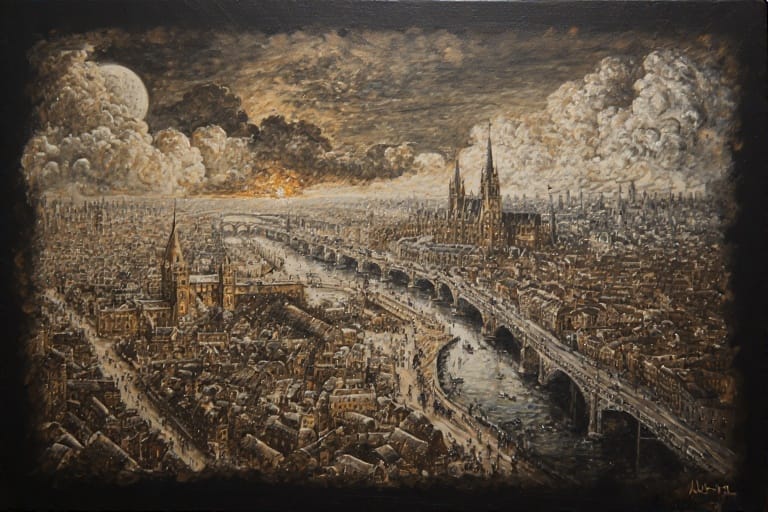
It was a quiet morning in Florence, the spring of 1286. The narrow streets, paved in worn cobblestones and lined with towering, terracotta-tinted buildings, hummed faintly with the voices of merchants, scholars, and artisans. But on this seemingly ordinary day, something extraordinary was about to change the lives of millions. A handful of hands, skilled in the medieval crafts of glass-making and metalwork, were about to fashion an object so simple, yet so transformative, that the very way humanity perceived the world would be forever altered.
Imagine the first pair of spectacles—two tiny pieces of convex glass, carefully cut and mounted in a rudimentary frame, placed before the eyes of a scholar struggling to read the sacred scripts and early scientific writings. With these, blurred words suddenly sharpened, distant outlines filled with clarity, and knowledge became accessible in ways never before possible. This moment did not just mark an invention; it unveiled a new way of seeing life, ushering in an age of deeper insight and greater intellectual possibility.
Florence in the Late 13th Century: A Hub of Innovation and Renaissance Beginnings
Florence during the late 1200s was already stirring intellectually and economically. Though predating what we now call the Renaissance by a century or more, the city's atmosphere was ripe for transformation. It was a bustling trade center, a nexus of wool merchants, bankers, and scholars. The universities of Bologna and Paris were shaping minds, but Florence’s own artisan culture—glassmakers, metalworkers, and scribes—fostered a unique environment where craftsmanship met curiosity.
The city sat on the cusp of a profound upheaval in arts, science, and philosophy. Unlocking clearer vision was not merely metaphorical—it was a practical necessity. Religious institutions and scholars yearned to preserve and study texts; guild members engaged in detailed trade work needed crisper sight; and medical practitioners sought tools to aid their craft. So the crafting of eyeglasses was more than an invention—it was an answer to a collective yearning rooted in the very DNA of Florentine innovation.
The Human Struggle with Sight Before Spectacles
Before the advent of eyeglasses, aging eyes and imperfect vision were curses with few remedies. Medieval people often accepted blurred vision as an inexorable fact of life. Ancient remedies ranged from poultices to mystical incantations, but none delivered lasting clarity. Those with poor eyesight faced isolation—unable to read, write, or engage fully with their environment. For scholars and monks, this was a slow betrayal of intellect as letters blurred and knowledge slipped beyond grasp.
Desperation bred invention, and some had experimented with simple magnifying glasses and polished crystals. Yet, none had devised a way to hold lenses steadily in front of the eyes. The notion of wearable optics seemed a fantasy, a magic trick rather than a practical tool. This is why the miracle of 1286 was such a watershed moment: it turned what had been a dream into tangible reality.
The Birth of a Revolution: The Crafting of the First Eyeglasses
The first eyeglasses were not born in a flash of genius but rather through a confluence of craftsmanship and necessity. Historical records from the period emphasize that these devices emerged almost organically in artisan workshops nestled within Florence’s busy quarters. The process was painstaking—selecting the right glass, grinding and polishing minute lenses, and fashioning frames robust enough to hold them yet light enough to wear.
This innovation was as much about precision as about patience: for the first time, convex lenses were mounted in frames designed to rest on the bridge of the nose, allowing users to correct farsightedness—a condition known in Latin as “presbyopia.” This breakthrough was recorded in a 1306 sermon by Dominican friar Giordano da Pisa who referred to spectacles as a recently invented “gift from God.” It was not just an invention; it was a providence.
Who Made the First Eyeglasses? The Mystery Behind the Inventor
Who exactly crafted the first pair of eyeglasses remains shrouded in mystery and debate. In the mosaic of medieval history, the spotlight does not fall on a single inventor but rather on a collective of artisans whose innovations blended over time. Among the possible candidates is Salvino D’Armate, a Florentine goldsmith whose name surfaces in some of the earliest manuscripts describing the invention. Yet this attribution is debated and lacks conclusive evidence.
What remains clear is the role of the Florentine glassmakers and metalworkers who together refined the lenses and frames. This collaborative spirit typifies the Middle Ages’ artisanal culture—where guilds and workshops were incubators of technical progress, often anonymously unless tied to patronage or ecclesiastical connections.
The Workshop where Vision was Transformed
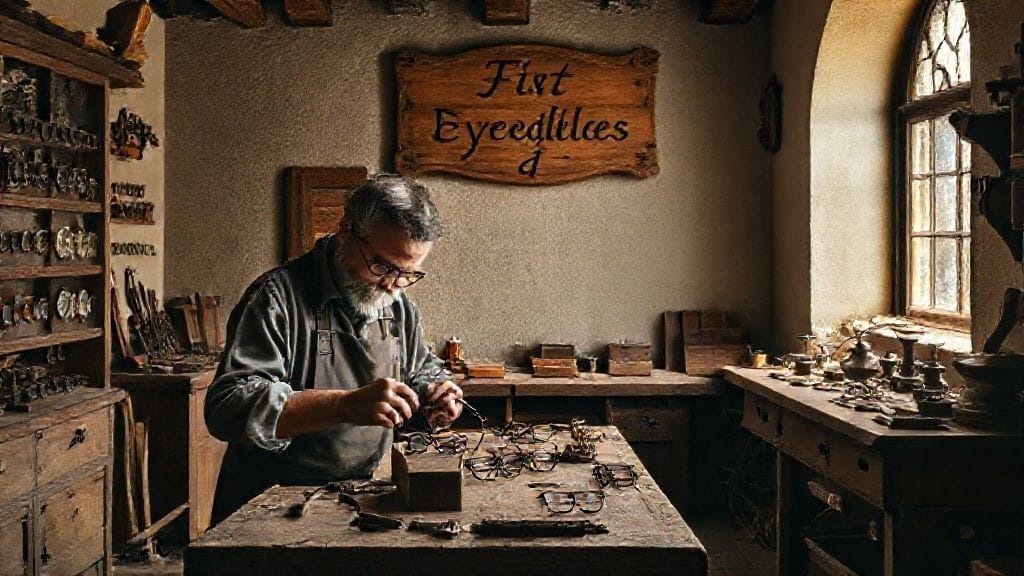
The early spectacle workshops were humble yet sacred spaces. Small wooden benches cluttered with shards of glass, grinding stones, and metal scraps formed the heart of these workshops. Artisans bent intently over their work, whispering prayers or chants through the din of market life outside. The creation of lenses required skilled hands adjusting his lens against coarse grindstones, flame polishing edges, and mounting delicate frames—with each step demanding vigilance and care.
This was craftsmanship in its purest form, where technology was inseparable from art. The tactile intimacy of the work connected the maker to the user in an almost kinesthetic dialogue—a silent wish to restore sight and, by extension, knowledge and understanding.
Materials and Techniques: How Were These Primitive Glasses Made?
The raw materials were ingeniously simple but expertly manipulated. Glass was no stranger to Florentine artisans, who had mastered techniques from the Venetian island of Murano. The lenses were made from clear glass, blown into small spheres then carefully ground into convex shapes using fine abrasives like sand and emery.
Frames typically consisted of iron or copper, bent into rudimentary loops to hold the lenses and provide a nose bridge. The earliest designs lacked side arms, meaning the spectacles rested precariously on the nose—a design that would evolve in the centuries to come. The brilliance lay less in ornate decoration and more in the perfecting of optical clarity and stability.
Early Uses: Who Were the First Wearers of Eyeglasses?
The first wearers were predominantly scholars, clerics, and scribes—those deeply invested in reading and writing. Monks laboring over manuscripts in candlelit scriptoriums found new endurance, their fading eyesight sharpened by the lenses. Likewise, officials tasked with legal documents or financial records depended on this newfound aid.
Eyeglasses quickly became symbols of erudition. Portraiture from the early 14th century shows learned men wearing them with a quiet pride—not just functional aids but badges of wisdom and age. This also sparked a quiet revolution in literacy, enabling longer and more precise study, and enabling the preservation of knowledge as never before.
Eyeglasses and the Clergy: A Medieval Marriage of Necessity
Religion shaped much of medieval life, and the Church played a pivotal role in adopting and disseminating eyeglasses. Clerics who interpreted sacred texts, taught theology, or administered canon law needed keen eyesight even as their vision weakened with age.
Eyeglasses thus transcended mere utility, acquiring spiritual significance as tools that helped serve God’s word more faithfully. Church authorities often endorsed and even encouraged their use, recognizing that preserving intellectual rigor was vital for maintaining clerical authority and fostering education among novices.
The Spread of Spectacles from Florence to Europe
From their workshop origin in Florence, eyeglasses traversed Europe with remarkable speed. By the early 14th century, records show their presence in Parisian universities, English monasteries, and German trade centers. The technology's simplicity helped its diffusion—once the idea was known, local craftsmen in other cities replicated and adapted the design.
Merchants traveling between Italy and northern Europe carried spectacles as commodities, further accelerating accessibility. This spread also coincided with the rise of learned guilds and the nascent universities—organisms hungry for tools that extended human capacities.
Eyeglasses in Medieval Culture: Symbolism and Social Impact
Eyeglasses became powerful cultural symbols. To wear spectacles was to signal wisdom and learning, but also a visible marker of age and vulnerability. In medieval art and literature, characters with spectacles often embodied sagacity or clerical authority. Conversely, satirical depictions sometimes mocked the elderly scholar squinting through thick lenses, underscoring humanity’s frailty.
Socially, they altered perceptions of disability and ability, offering a means to circumvent the limitations of physical impairments. Eyeglasses shaped medieval society’s evolving dialogue about aging, knowledge, and the body.
Scientific and Intellectual Empowerment: A New Lens on Knowledge
This invention fed directly into the flowering of scientific inquiry and humanism that was gaining momentum. Suddenly, texts could be read with renewed vigor, minute details in anatomical drawings discerned, and stars charted more accurately. Eyeglasses catalyzed a cognitive leap, allowing intellectual elites to delve deeper into philosophy, medicine, and natural sciences.
With improved vision, scholars questioned old dogmas and embraced empirical observation, setting the stage for the intellectual upheavals to come centuries later. The lenses framed not only physical sight but the very perspectives of knowledge itself.
The Economic Implications: The Birth of a New Craft and Industry
Eyeglasses also marked the genesis of a new industry. Demand created specialized guilds for eyeglass makers and opticians, and workshops proliferated. Trade in lenses, frames, and related materials became an economic driver in cities famous for glasswork—Venice, Florence, and beyond.
The economic ripple effect extended to merchants, apprentices, and even scribes, marking the spectacle as an early example of a technology that fused craft, commerce, and science—a paradigm mirrored in later industrial revolutions.
Resistance and Skepticism: Early Criticisms and Misconceptions
Yet not all acceptance was immediate. Eyeglasses faced early skepticism and superstition. Some regarded spectacles as unnatural or feared they would strain the eyes. Religious critics occasionally voiced concerns over tampering with God’s creation, likening them to vanity or false wisdom.
Folklore emerged warning of "specter eyes," and some rulers banned public spectacle use, wary of social change. However, practical benefits and growing success stories gradually overcame these attitudes, embedding spectacles into everyday life.
Eyewear and Art: Reflecting the Change in Renaissance Paintings
By the 15th century, eyeglasses appear with greater frequency in art, capturing both their practical and symbolic roles. Renaissance painters like Jan van Eyck and Hans Holbein included spectators in portraits of scholars, diplomats, and nobility, elevating the image of eyeglasses beyond simple tools.
These depictions immortalized the glasses not just as instruments but as icons of intellect and human progress, capturing a pivotal cultural shift that began centuries earlier in Florence.
The Evolution of Eyeglasses Over the Next Centuries
The basic lens-frame concept birthed in 1286 evolved dramatically. By the 17th century, side arms allowed glasses to stay firmly on the face. Optics advanced with the invention of concave lenses to correct nearsightedness. Materials diversified, and innovations like bifocals emerged with Benjamin Franklin centuries later.
Each refinement built upon the original breakthrough, illustrating human ingenuity’s relentless march—from primitive glass circles to today’s sophisticated eyewear tailored for every eye.
The Long Shadow: How the 1286 Invention Influenced Modern Optometry
The crafting of the first eyeglasses cast a long shadow over medical and scientific development. It inspired the systematic study of optics and human vision, leading to modern ophthalmology and optometry.
The very language of vision science—terms like “lens,” “focus,” “magnification”—derive directly from this medieval genesis. Today’s eye care professionals stand on a foundation laid over seven centuries ago in a Florentine workshop.
Eyeglasses and Human Identity: The Cultural Legacy
Beyond functionality, eyeglasses have become integral to cultural identity. They evoke intellect, creativity, aging, and sometimes eccentricity. From Shakespearean scholars to twentieth-century authors and artists, glasses have been worn as badges of honor, tools of the curious mind, and tokens of distinction.
Their invention symbolizes humanity’s refusal to accept limitations and the drive to reshape perception—literally and metaphorically.
Eyeglasses Today: From a Craft to a Global Industry
What began as a humble artisanal invention has grown into a global industry worth tens of billions of dollars annually. Modern glasses combine fashion and technology, addressing myopia, astigmatism, and even serving as augmented reality interfaces.
The journey from that first Florentine pair to today’s frames is a testament to the continuous human quest to improve life through vision—both physical and intellectual.
Conclusion
The first eyeglasses crafted in Florence in 1286 stand as a quiet yet monumental turning point in human history. In a world that had long accepted blurred vision as fate, this invention tore a veil over the eyes of those who wished to see more clearly—not just the letters on a page but the very possibilities of knowledge and understanding.
It was not merely glass and metal combined; it was a new lens on the human condition. A profound symbol of the enlightened spirit—unyielding, curious, and forward-looking. The spectacle’s simplicity belies its power: it is an enduring reminder that sometimes, the smallest changes can reveal the greatest worlds.
FAQs
Q1: Why were eyeglasses invented in Florence around 1286?
Florence was a vibrant center of trade, art, and scholarship with a strong artisan culture. The demand from scholars and clergy for tools to aid reading and study, combined with skilled glassmakers and metalworkers, created the ideal conditions for the invention and crafting of eyeglasses.
Q2: Who is credited with inventing the first eyeglasses?
There is no definitive inventor. The credit generally goes to Florentine artisans collectively, with names like Salvino D’Armate mentioned in some sources, though historians regard this as uncertain.
Q3: What materials were used in the first eyeglasses?
Early lenses were made from clear glass, ground and polished into convex shapes, while frames were crafted from metals like iron or copper. The designs were simple, lacking side arms, and rested on the nose.
Q4: How did eyeglasses impact medieval society?
Eyeglasses extended the capacity for reading and writing among the elderly and visually impaired, particularly scholars and clerics, democratizing knowledge, enabling the preservation and study of texts, and changing perceptions of aging and ability.
Q5: Were eyeglasses immediately accepted?
No, early spectacles faced skepticism and superstition. Some feared their effects or saw them as unnatural. Over time, practical benefits overcame doubts, and glasses became widely accepted tools.
Q6: How did the invention influence scientific progress?
By granting clearer vision, spectacles enabled deeper study of texts, nature, and science, fostering empirical inquiry that fueled the Renaissance and later scientific revolutions.
Q7: How have eyeglasses evolved since 1286?
Glasses evolved with improved materials, new designs like side arms, correction for multiple vision problems, and eventually bifocals and contacts, leading to today’s diverse eyewear industry.
Q8: What is the cultural legacy of eyeglasses?
Eyeglasses symbolize wisdom, intellect, aging, and human innovation. They have become a cultural icon reflected in art, literature, and daily identity.