Table of Contents
- A Distant Shore Imagined: Britain Dreams of a Penal Colony
- From Courtrooms to Convict Hulks: The Human Cargo of Empire
- Planning the First Fleet: Logistics on the Edge of the World
- Setting Sail: The First Fleet Leaves Portsmouth, 1787
- Life at Sea: Fear, Routine, and Hope Below Deck
- Landfalls and Near Disasters: Rio, the Cape, and the Roaring Forties
- January 1788: Botany Bay Disappointment and the Search for a Harbour
- 26 January 1788: Sydney Cove and the Birth of a Penal Colony
- The Eora World Before the British: Country, Kinship, and Sea
- First Encounters: Curiosity, Misunderstanding, and Violence
- Building a Settlement: Hunger, Hard Labour, and Thin Authority
- Women, Families, and Power in the Penal Colony
- Resistance and Survival: Aboriginal Responses to Invasion
- Rum, Whips, and Rations: The Harsh Economy of Early Sydney
- From Camp to Colony: Governance, Rebellion, and Reform
- Myth-Making and Australia Day: Remembering 26 January
- Legacies of the First Fleet: Law, Land, and Injustice
- Conclusion
- FAQs
- External Resource
- Internal Link
Article Summary: This article follows the journey and aftermath of the first fleet penal colony founded at Sydney Cove on 26 January 1788, tracing how a desperate British experiment reshaped a continent and shattered an ancient world. It begins in crowded British courtrooms and fetid prison hulks, where convicts were chosen for exile, then sails with them across the world into the unknown. At Sydney Cove, we witness the fragile beginnings of a penal outpost that relied on harsh discipline, improvisation, and sheer luck to survive. Yet behind the official proclamations lay profound encounters—and conflicts—with the Eora people whose lands were occupied without treaty or consent. The narrative explores daily life, labour, punishment, and the gendered realities of this new society, as well as Aboriginal resistance and resilience. It also examines how the first fleet penal colony became the seed of a broader settler society, shaping laws, land ownership, and national memory. Finally, the article reflects on how 26 January, once a day of imperial triumphalism, has become a site of contested remembrance and calls for justice.
A Distant Shore Imagined: Britain Dreams of a Penal Colony
When British officials first began to speak in earnest of a settlement at the far edge of the world, they did not imagine a city, a nation, or even a community. They imagined a solution. By the 1780s, Britain’s prisons were overflowing and its social order fraying. The American colonies, once a convenient dumping ground for convicts, had slammed their doors shut after the Revolutionary War. The hulks—old, rotting ships moored in the Thames and other rivers—were crammed with men and women in chains, breathing stale air thick with disease. In the midst of this crisis, an extraordinary idea gathered force: send the unwanted thousands to an almost mythical land in the South Pacific and establish a first fleet penal colony so distant that returning would be almost impossible.
For decades, the coast James Cook had charted in 1770 had lived in the imagination of imperial planners as a kind of blank canvas. Cook’s glowing description of Botany Bay as a place of “soil which would produce any kind of grain” lingered in bureaucratic memory, even if it rested on hasty observations. The Admiralty and the Home Office saw more than a new harbour; they saw a pressure valve. If they could plant a self-sustaining penal outpost there, it might relieve the domestic strain, reclaim some prestige lost in America, and project British power deep into the Pacific.
Architects of the plan—among them Lord Sydney, the Home Secretary whose name would be given to the new settlement—used language that was both practical and chilling. Convicts were “transportable property,” anonymous bodies that could be moved far from sight. Yet the documents also reveal a deep anxiety. Could a ragged flotilla of convicts, marines, and officials really carve out a functioning outpost at the end of the earth? Would they starve? Would they mutiny? Would the indigenous peoples—who appeared as vague figures in reports and journals—resist the newcomers’ presence?
The proposal that became the first fleet penal colony was not driven only by cruelty. It was also a symptom of an empire grappling with its limits. There were philanthropic voices who believed exile might offer convicts a chance at moral regeneration, far from the corrupting vices of London’s slums. There were strategic minds who saw a naval station in the Pacific as a way to outflank French ambitions. And there were those for whom the land and its original custodians did not count at all—who wrote of “vacant” or underused territories, erasing tens of thousands of years of Aboriginal occupation with a stroke of the pen.
In 1786, a royal commission approved the plan. Orders were drawn up. A fleet was to be assembled, captained by Arthur Phillip, a naval officer of modest background but considerable experience. He was to sail to Botany Bay, claim it for the Crown, and create an orderly, productive, and self-sufficient community from people whom Britain itself had judged disordered and criminal. It’s astonishing, isn’t it, how confidently a handful of men in London presumed they could reorganize both human lives and an entire continent from across the globe.
From Courtrooms to Convict Hulks: The Human Cargo of Empire
The story of the first fleet penal colony did not begin with the raising of a flag at Sydney Cove. It began in cramped courtrooms, where judges in powdered wigs pronounced sentences that would tear lives apart. Many of the men and women destined for New South Wales had committed petty crimes—stealing a handkerchief, a bolt of cloth, a loaf of bread. Others were guilty of more serious offenses: burglary, highway robbery, forging banknotes. For all of them, the moment the word “transportation” left the judge’s lips, the world they knew collapsed.
Transportation was itself an old punishment, used for decades to ship convicts to North America. But with the loss of the American colonies, thousands remained in Britain. Prison hulks, once temporary measures, became permanent fixtures on rivers and in harbours. Life on these floating prisons was brutal: chains clanked, bodies lay crammed in dank holds, and disease spread with terrifying speed. A clergyman visiting one hulk described the stench as almost unbearable, “a vapour of filth and despair that seems to eat at the lungs.”
The convicts selected for the first fleet penal colony were a cross-section of late eighteenth-century British society’s most marginal people. Many were rural labourers displaced by enclosure and agricultural change; others were urban poor caught in the grinding insecurity of industrializing cities. There were weavers, carpenters, sailors, servants, washerwomen, pickpockets, prostitutes, and a small but significant number of political dissidents and Irish offenders. Some could read and write; many could not. Almost all carried trauma of one kind or another: hunger, violence, abandonment.
Women made up roughly one-fifth of the convict complement. Their presence unsettled officials. On paper, they were to become the moral and domestic backbone of the new settlement, potential wives and mothers for a colonizing population. In reality, many had been driven into sex work by poverty. They faced the dual punishment of a legal system that judged them both criminal and immoral, and a voyage that would expose them to harassment, coercion, and unequal power at every turn.
By the time the convicts were marched in chains through city streets to the embarkation points, crowds had gathered to watch. Some jeered, enjoying the spectacle of humiliation; others wept quietly as sons, daughters, and spouses disappeared into waiting boats. For many families, this was a living death. The distance to New South Wales—fifteen to twenty thousand miles—made any hope of return almost fantastical. Convict letters pleading for news or mercy would be lucky to arrive years later, if at all.
And yet, within the bleakness, there were individuals who clung to the idea that exile might offer a kind of strange opportunity. A young man sentenced for theft might imagine a small plot of land one day. A woman convicted of shoplifting might dream of remaking herself, away from the gossiping neighbours who knew every misstep. The first fleet penal colony was, for them, a cruel gamble: a place that might kill them quickly or, just possibly, give them more than the alleyways and tenements of Britain ever had.
Planning the First Fleet: Logistics on the Edge of the World
Transforming a political idea into eleven ships on the open sea required a feat of organization that bordered on the miraculous. The British government turned to private contractors to supply ships and provisions, a common practice in an age when the state often outsourced its logistics. The vessels ranged from the flagship HMS Sirius and the armed tender Supply to six convict transports and three store ships loaded with everything from seeds to irons.
Arthur Phillip, appointed as commander of the expedition and first Governor of New South Wales, quickly understood the fragility of the plan. Once the fleet left the Cape of Good Hope, there would be no reliable ports to resupply until they reached Botany Bay. If crops failed or stores were lost, the entire enterprise—and every life attached to it—would be at risk. Phillip pored over Cook’s charts, naval instructions, and meteorological observations, aware that any error in timing or navigation could prove disastrous.
Lists were drawn up that tried to anticipate every imaginable need. Tools for felling trees and building houses; nails, saws, and axes; clothing, shoes, and blankets; seeds for wheat, maize, and vegetables; livestock for breeding—sheep, cattle, pigs, and chickens. There were Bibles and prayer books, military uniforms for the marines, and medical supplies to combat scurvy and disease. There were even a few rudimentary scientific instruments, a faint echo of Cook’s more exploratory voyage. Yet for all the detailed planning, some of what was sent revealed a basic misunderstanding of the Australian environment. English seeds and European farming methods would not easily adapt to soil and climate shaped by very different rhythms.
Phillip also had to plan for human discipline. He would command not only sailors, but a detachment of marines responsible for guarding convicts, and a small cadre of civil officers who would form the new administration. Lines of authority were clear on paper: Phillip at the apex, marines answerable to their officers, convicts subject to both military discipline and emerging colonial law. But he knew that at sea, and later in a precarious settlement on unfamiliar shores, those lines might blur under the pressure of hunger, boredom, and fear.
Behind every document and list lay the unanswered question: what of the people already living on the land they intended to occupy? Reports of Aboriginal Australians were fragmentary, filtered through the eyes of brief visitors. Some in London believed they would be few in number and easily “civilized” or displaced. Others hardly mentioned them at all. The planning of the first fleet penal colony, meticulous in its attention to tools and rations, was conspicuously silent about diplomacy, treaties, or consent. The land was treated, in the logic of empire, as available.
Setting Sail: The First Fleet Leaves Portsmouth, 1787
On 13 May 1787, as a pale English sun struggled through the clouds above Portsmouth, the ships of the First Fleet unfurled their sails. Crowds lined the shore, watching the curious armada pull away from familiar docks. Flags snapped in the breeze; orders were shouted; anchors rose from the water dripping with mud. For those on board, the moment brought a strange mix of finality and unreality. The line between “home” and “elsewhere” moved steadily behind them with each churn of the wake.
On the transports, convicts thronged the lower decks, peering up through hatchways at slivers of light. Chains clinked as they were ordered into some semblance of order. Many had never been on a ship before, and the initial lurch of movement triggered nausea and panic. The smell of tar, rope, and seawater mingled with the human odours of fear and confinement. Above deck, marines stood at ready posts, charged with preventing any hint of mutiny during the long voyage ahead.
Governor Phillip’s cabin on the flagship was modest, but it gave him space to spread charts and write instructions. From there he watched the coastline recede, aware that his decisions over the next months would determine the fate not only of the first fleet penal colony, but also of hundreds of people whose names London officials would soon forget. He had been given broad discretionary powers; how he used them would shape the character of the new settlement.
The early days were consumed with adjusting to life at sea. Routines were established: musters, inspections, distribution of rations, brief exercise on deck for the convicts when weather allowed. Phillip insisted on relatively humane treatment compared to earlier transportation voyages. He was determined to arrive with as many convicts alive and capable of work as possible, a practical mercy born of necessity as much as compassion. He ordered better ventilation, enforced cleanliness as far as conditions allowed, and clashed with captains who preferred the old, harsher methods.
Still, no amount of regulation could erase the psychological reality. For most aboard, this was a forced migration beyond imagination. The known world had edges; they were sailing past them. The distance between Europe and the unknown coast of New South Wales loomed as a void in the mind, a blank onto which they projected nightmares or unlikely hopes. Letters written before departure, now sealed and left behind, became the last tangible link to lives that would rapidly fade into memory.
Life at Sea: Fear, Routine, and Hope Below Deck
Weeks at sea blurred into one another. Life on a convict transport was governed by a relentless rhythm of bells, orders, and the creak of wood. At dawn, the lower decks stirred with coughs and whispers. The convicts were mustered, counted, sometimes brought topside in small groups to walk the deck and inhale fresh air. They ate rations of salted meat, ship’s biscuit crawling with weevils, dried peas, and occasionally a spoonful of vinegar to ward off scurvy.
For women convicts, the enforced intimacy of shipboard life brought particular dangers. Officers and sailors, holding nearly absolute power over them, offered favours in exchange for sex or simply took what they wanted. Some women formed relationships that offered a measure of protection; others suffered repeated assaults. Jealousies and alliances emerged in the cramped darkness. Babies were conceived between England and Australia, their lives already bound to the penal colony they had not yet seen.
Disease travelled easily through the fetid air. Scurvy lurked whenever fresh provisions ran low. The ships that carried fewer deaths on the journey did so because surgeons insisted on regular airing and encouraged washing, measures surprisingly enlightened for their time. Still, illness came. Convicts wasted away on their pallets, joints aching, gums bleeding. A burial at sea—body sewn into canvas, weighted, and dropped over the side—was both a solemn ritual and a brutal reminder that the ocean would claim many before they ever glimpsed their destination.
Yet even under such conditions, people found ways to assert their humanity. Some taught others to read, tracing letters on rough boards. There were whispered prayers, snatches of song from homes in Cornwall, London, or Dublin, stories traded to pass the interminable hours. A few convicts, perhaps those with carpentry skills, were occasionally allowed to assist sailors, gaining a measure of trust that might later translate into better work assignments ashore.
Phillip moved among the ships when he could, inspecting conditions, issuing corrections, writing in his journal. He knew that news of his conduct might be used to judge the entire experiment of the first fleet penal colony. At the same time, he could not control everything. A captain with a cruel temperament or a marine sergeant drunk on power could turn a ship into a floating hell. Communication across the fleet depended on weather and visibility; each vessel was a world unto itself.
Time stretched. The coastlines they hugged—Spain, then Africa—receded as quickly as they appeared. The Atlantic swells gave way to the southern oceans. Constellations shifted in the night sky, confusing for those who had never seen the southern stars. Above all, there was waiting: waiting for land, for storms to end, for the strange new country that lived only in rumors and official proclamations. Whatever Britain meant to these drifting exiles, it was no longer home; it was now the place that had cast them off.
Landfalls and Near Disasters: Rio, the Cape, and the Roaring Forties
To sustain such a journey, the First Fleet depended on a series of critical resupply stops. The first major landfall came at Rio de Janeiro. As the ships entered the harbour, its encircling hills and clustered buildings must have seemed almost dreamlike after the monotony of sea and sky. For the convicts, the view was mostly second-hand, caught in fragments as they were allowed brief glimpses or heard sailors’ descriptions.
At Rio, fresh food and water were taken aboard; trade and diplomacy with the Portuguese authorities unfolded in careful negotiations. Fruit, vegetables, and meat brought a temporary reprieve from scurvy. Some officers indulged in local entertainments and luxuries, while Phillip fretted about maintaining discipline and preventing desertion. The settlement at Rio, itself built on exploitation and slavery, offered a sobering mirror to what a new penal outpost might become.
From Rio, the fleet struck out across the South Atlantic towards the Cape of Good Hope, a vital provisioning point. Again, fresh supplies were loaded: grain, livestock, plants. Phillip knew that failure to stock adequately here could doom the first fleet penal colony before it began. He sought seeds and animals suitable for breeding, hoping to transplant a miniature version of English agriculture into an environment he had never seen.
Beyond the Cape, the ships faced the Roaring Forties, the fierce westerly winds that whip around the globe. Here the voyage became truly perilous. Gales slammed into the fleet, waves crashed over decks, rigging groaned and sometimes snapped. Men were washed overboard and lost in seconds. Below, convicts clung to their bunks as the ships pitched and rolled in violent arcs. The shriek of wind in the rigging blurred into a constant roar that made sleep difficult and prayer more urgent.
Navigation demanded nerve and skill. Charts were imperfect; currents unpredictable. Yet these harsh latitudes allowed the fleet to make remarkable time, driven eastward towards the Pacific. Each day that passed without catastrophe was a kind of quiet miracle. As one officer later reflected, “We carried in those wooden shells the fragile beginnings of a people yet unborn.” The phrase may be sentimental, but it captures the underlying fragility: break the shell, and everything within perishes.
January 1788: Botany Bay Disappointment and the Search for a Harbour
After more than eight months at sea, land finally rose on the horizon. In January 1788, one by one, the ships of the First Fleet entered Botany Bay, the very place James Cook had praised years earlier. For convicts and crews alike, the sight of coastline—rugged cliffs, sandy beaches, dark lines of forest—brought a wave of relief. Some convicts wept openly; others stared in cautious silence, trying to imagine what awaited them on this alien shore.
Phillip was not given to sentiment. As soon as he could, he began assessing the site. What he saw filled him with concern. The bay’s anchorage was exposed, the soil near the shore seemed poor and sandy, and fresh water was difficult to find in quantity. The descriptive glow of Cook’s reports faded against the practical demands of feeding and housing hundreds of people. As Phillip moved around the bay in small boats, he also encountered the first Aboriginal people, watching from the shore with a mixture of curiosity and wary distance.
The official instructions were clear: establish the penal settlement at Botany Bay. But Phillip realized that blindly following those instructions could doom the colony. He decided to search for a better harbour to the north, one Cook had sailed past without fully exploring. Taking the Supply and a small party, he left the bulk of the fleet in Botany Bay and struck out along the coast. As they entered the heads of what we now know as Port Jackson, the scene that unfolded took his breath away.
In his journal, Phillip rhapsodized about the harbour he found: deep, sheltered, with arms and coves stretching in every direction, enough to shelter “all the navies of Europe.” In one of those coves—a small, curved inlet with a stream of fresh water—he saw the nucleus of the settlement he had been sent to create. This place, later named Sydney Cove, seemed to promise what Botany Bay could not: security for the ships, reliable water, and land that might, just might, sustain crops.
Returning to Botany Bay, Phillip made his decision. The first fleet penal colony would not be planted at the site Parliament had imagined, but a few miles to the north, where geography offered a fighting chance. As his ships maneuvered between the two harbours, they sighted another European expedition: the French, under Comte de Lapérouse, had also arrived at Botany Bay. For a moment, the fragile British project brushed against the shadow of potential rivalry. But the French, engaged in exploration, did not claim the land. The British moved quietly and quickly to occupy the superior harbour.
26 January 1788: Sydney Cove and the Birth of a Penal Colony
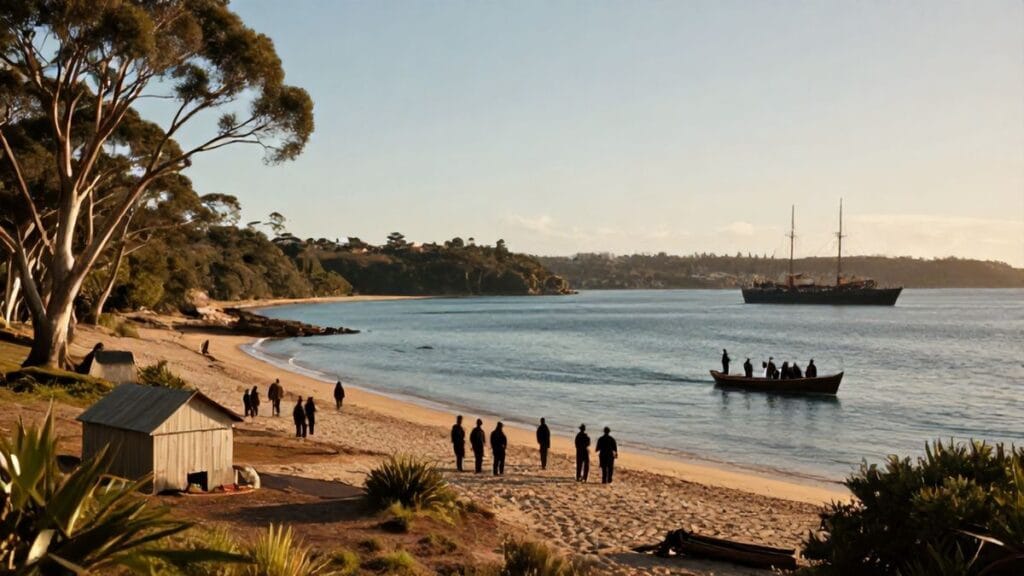
On 26 January 1788, the ships began to drop anchor in the deep waters of Port Jackson, and boats ferried marines and convicts towards the small crescent of sand that would become Sydney Cove. The day was hot, the light hard and unforgiving. Eucalyptus trees, unlike anything in Europe, stood in sparse clumps on the surrounding slopes, their leaves hanging vertically. The sounds of unknown birds cut through the air. For those stepping ashore in chains, the moment felt both monumental and unreal: they were at the end of the world, and the world was watching through the eyes of a handful of officers and chroniclers.
Governor Phillip ordered the British flag raised. Muskets fired in a formal salute, their reports echoing off the rocky headlands. A volley of cheers went up from marines and sailors. To some, it was a scene of triumph: empire extended, a new chapter opened. Yet behind the celebrations lay layers of violence and presumption. No treaty had been signed with the Eora people whose Country this was. No negotiation had taken place. Sovereignty was declared, not granted.
Convicts were soon set to work unloading stores, dragging casks and crates up the shore, pitching tents and rigging makeshift shelters. The first fleet penal colony was less a town than a chaotic camp, its order imposed by shouted commands and the ever-present threat of punishment. The neat rectangles of British planning—streets, lots, farms—existed at this point only in Phillip’s mind and in a few rolled-up plans.
Food was an immediate concern. Rations were carefully accounted for, and Phillip quickly realized that the supplies would not last as long as hoped if the settlement did not become productive. Early attempts at gardening near the cove struggled in soils unlike the rich loam of England. Seeds failed, plantings withered. Hunting and fishing offered some relief, but game was not as abundant near the cove as newcomers had imagined, and Aboriginal expertise in managing and understanding the land remained largely untapped—when it was not actively dismissed.
At night, fires flickered along both sides of the harbour: those of the British camp, and those of Eora people across the water. The two worlds observed one another warily, each seeing strange patterns of light and movement. For convicts lying exhausted in their tents, the cries of unfamiliar animals in the darkness fused with memories of the long voyage and fears of the future. This thin strip of beach and bush was now their prison and their possibility.
The Eora World Before the British: Country, Kinship, and Sea
Long before the first fleet penal colony threw up its tents and raised its flag, the shores of Port Jackson were part of a richly peopled landscape. The Eora, whose name roughly translates to “the people” or “from this place,” had lived here for countless generations. Archaeological evidence suggests that Aboriginal people had occupied the Sydney region for at least 30,000 years, an unimaginable span of time compared to the brief flicker of European presence.
The Eora world was one of deep connection to Country—an English word too weak to convey its full meaning. Country was not just land; it was sea, sky, ancestors, stories, and law intertwined. Clans such as the Gadigal, Cammeraygal, and Wangal moved through their territories according to well-established patterns, guided by seasonal changes in plants, animals, and weather. They fished with skill, using hooks carved from shell and spears tipped with bone or stone; they gathered shellfish, hunted kangaroos and possums, and burned sections of bush in controlled ways to encourage new growth and attract game.
Social life was structured by intricate kinship systems and ceremonial obligations. Elders held knowledge of Dreaming stories that explained how the world came to be and established the proper relationships among people, and between people and place. Songlines—routes inscribed with story, memory, and spiritual significance—crisscrossed the landscape and seascape. To the Eora, Port Jackson was not an empty harbour waiting to be “discovered.” It was a living archive of human and more-than-human relations.
European observers, when they bothered to look beyond their own categories, sometimes glimpsed the sophistication of this world. One officer later wrote, with a hint of surprise, of the Eora’s “dexterity in managing their canoes and harpoons,” noting that they could strike fish at astonishing distances. But such observations were fleeting. The larger imperial narrative cast Aboriginal people as “savages” or “primitives,” justifying dispossession by denying the complexity of their societies.
The arrival of the First Fleet was thus not the beginning of history in this place, but a violent interruption. Disease, displacement, and direct conflict would soon tear through the social fabric of the Eora world. The stories told about 26 January often begin with British footsteps on the sand; to understand the full weight of that day, we must also imagine the Eora feet that had walked those shores for millennia, and the eyes that watched the tall-masted ships with a mixture of wonder, caution, and perhaps foreboding.
First Encounters: Curiosity, Misunderstanding, and Violence
As the new settlement at Sydney Cove took shape, encounters between the British and the Eora people multiplied. At first, they were often tentative and curious. Small groups of Aboriginal men, women, and children watched the activity from a distance, sometimes calling out, sometimes retreating when approached. The British, armed and nervous, interpreted gestures through their own cultural filters, sometimes seeing friendliness where there was warning, or hostility where there was simple refusal.
Governor Phillip believed that forming peaceful relations was both morally desirable and strategically advantageous. He instructed his officers to avoid unnecessary violence and tried to learn a few words of the local language. Gifts were exchanged: metal tools, beads, and cloth from the British, fish and information from the Eora. Yet even the act of gifting was fraught. In Eora culture, obligations created by exchange had different meanings than the one-way generosity the British imagined. Misunderstandings quickly multiplied.
The balance of power in these first months was not as lopsided as later histories sometimes imply. The British were vulnerable: short on food, unfamiliar with the terrain, and dependent on their fragile supply lines. The Eora, deeply rooted in Country and possessing detailed environmental knowledge, could choose when and how to approach. They could aid the newcomers—or ignore them, or harass them. But as more land around the cove was cleared, and as convicts and soldiers began to range farther afield, friction became inevitable.
Theft and retaliation became a tragic pattern. Convicts, driven by hunger or opportunism, stole fishing gear, spears, or even children’s toys left on the shore. Eora warriors responded by spearing isolated convicts, attacking small parties, or taking hatchets and food in turn. Each side read these actions through its own norms of justice and honor. What one side saw as rightful retribution, the other experienced as unprovoked assault.
In one early incident, a British gamekeeper was killed after repeated provocations and violations of Eora hunting grounds. Phillip, under pressure from his officers to demonstrate control, ordered punitive expeditions. These often failed to find their targets, but they sent a clear message: the British would respond to indigenous resistance with organized violence. The first fleet penal colony, in its struggle to assert authority over its own convicts, was already extending that authority outward over land and people it did not understand.
Building a Settlement: Hunger, Hard Labour, and Thin Authority
By the end of 1788, Sydney Cove looked less like a camp and more like a rough-hewn village. Timber huts had begun to replace tents; storehouses rose along the shoreline; paths had been beaten into something like streets. Yet behind this veneer of progress lay grinding hardship. Crops planted in cleared patches of ground either failed or produced meagre yields. Soil eroded quickly under unfamiliar methods of tilling and overgrazing. The possibility that the settlement might starve was not an abstract fear; it loomed daily.
Convicts were divided into work gangs and set tasks from dawn to dusk: felling trees, sawing planks, digging ditches, burning stumps, hauling stones. Those with skills—carpenters, blacksmiths, brickmakers—were in high demand and sometimes earned slightly better rations or more tolerable conditions. Others, branded simply as labourers, felt the full force of a system that saw their bodies as expendable sources of energy to construct the physical shell of the first fleet penal colony.
Punishment was public and severe, designed to maintain discipline in the face of meagre resources and constant temptation to escape or steal. Floggings with the cat-o’-nine-tails tore skin and muscle, administered before assembled convicts as a grim spectacle. Some men received hundreds of lashes over the course of months; backs became ridged with scar tissue. Women, too, were punished, though often in different ways—confinement, reduced rations, or forced labour at the settlement’s dirtiest tasks.
Yet even here, authority was thinner than it appeared. Phillip’s commands sometimes went unheeded; marines resented interference with their internal discipline. Rumours of mutiny flickered periodically, though they rarely grew into open rebellion in these early years. The environment itself undermined control. Forests and bush began only a short walk from the settlement’s edge. Convicts sometimes vanished into them, hoping to live off the land or find a path to some imagined route home. Most returned, half-starved and disoriented, or were brought back by Aboriginal groups who had encountered these desperate wanderers on their Country.
The spectre of hunger shaped everything. Rations were cut; men and women grew gaunt. A failed harvest in 1789 plunged the colony into deeper crisis. Stories circulated of people eating whatever they could find—unfamiliar plants, insects, even, it was whispered, the flesh of those who died. Survival, not progress, became the central preoccupation. The first fleet penal colony, trumpeted in London as a proud assertion of imperial will, survived its early years by the narrowest of margins.
Women, Families, and Power in the Penal Colony
Within the rough architecture of the new settlement, gender shaped experience as powerfully as class or criminal status. Women made up a minority of the convict population, but their presence exerted an influence disproportionate to their numbers. They cooked, washed, mended, and nursed; they traded favours and goods; they navigated a treacherous social terrain in which bodily autonomy was constantly under threat.
Official rhetoric cast female convicts as potential wives and mothers, tools in a demographic project to populate the colony with a British-born generation. Marriages were occasionally arranged or encouraged. A hastily erected church heard vows exchanged between couples who may have met only days earlier, their union more a bureaucratic convenience than a romantic choice. For some women, marriage offered a measure of security—a permanent roof, perhaps slightly better rations. For others, it simply bound them more tightly to men who already exercised informal control over their bodies.
There was also, undeniably, tenderness and genuine affection. Relationships formed on the long voyage sometimes continued ashore. Children were born, their first cries echoing against the rough timber walls of huts instead of the stone lanes of English towns. These children were neither wholly free nor wholly convict; their lives would be marked by the stain of their parents’ sentences and by the freedom of growing up in a society still forming its norms.
Not all women occupied the role of victims or dependents. Some emerged as formidable figures within the early penal economy. By trading in small goods—needles, thread, rum, or food—they carved out pockets of influence. Others worked in domestic service for officers or officials, gaining limited access to information and networks. Their agency was constrained, but not extinguished.
Alongside these European gender dynamics were the experiences of Aboriginal women, whose worlds were profoundly disrupted by the encroaching settlement. They faced violence from both sides: susceptible to abduction, assault, and exploitation by British men, and sometimes caught in the crossfire of inter-clan disputes exacerbated by the newcomers’ presence. Their stories are less well recorded, often only glimpsed in asides in officers’ journals or in Aboriginal oral histories. But they remind us that the first fleet penal colony did not only reorder European lives; it tore through the intimate and social structures of the Eora people as well.
Resistance and Survival: Aboriginal Responses to Invasion
As British tents turned into huts and then into more permanent structures, Aboriginal responses shifted from cautious curiosity to more organized forms of resistance and adaptation. The Eora watched as trees were felled, sacred sites disturbed, and fishing grounds increasingly crowded with European boats. They also watched their own people fall ill from strange diseases that swept through communities with merciless speed—smallpox, measles, and other infections to which they had no prior exposure.
The smallpox epidemic of 1789 was particularly devastating. Contemporary observers described Eora bodies lying along the shores and in the bush, covered in pustules, too weak to fish or gather food. Entire bands were decimated. Historians have long debated how the disease arrived—whether through contaminated clothing, intentional or accidental, or more diffuse contacts—but the effect was indisputable. In a single season, the demographic balance around Sydney Cove tipped dramatically in the newcomers’ favour.
Yet it would be wrong to reduce Aboriginal people to passive victims in this narrative. Resistance took many forms. Warriors launched targeted attacks on isolated work parties, ambushed travellers, and sometimes burned or destroyed property. Knowledge of the terrain allowed them to strike and disappear quickly. The names of some leaders, such as Pemulwuy of the Bidjigal, would later become synonymous with defiance as frontier conflicts spread beyond Sydney’s immediate environs.
Other strategies prioritized survival through engagement. Some Eora individuals and families established relationships with certain British officers or settlers, trading fish, guiding hunting parties, or sharing information about the landscape in exchange for tools and food. Bennelong, perhaps the most famous of these intermediaries, was captured, escaped, and later chose to maintain a complex relationship with Phillip, even travelling to England and back. His story illustrates both the possibilities and the limits of individual diplomacy in the face of systemic dispossession.
As historians such as Henry Reynolds and Inga Clendinnen have argued, the early years around Sydney Cove were marked less by large-scale war than by a series of “small wars,” persistent low-level conflicts and negotiations that chipped away at Aboriginal autonomy. The first fleet penal colony, conceived without meaningful thought to the people already living on the land, produced a frontier defined by asymmetrical power—but not by simple surrender. Aboriginal survival, cultural continuity, and later activism stand as a long-running refusal to accept the finality of 1788.
Rum, Whips, and Rations: The Harsh Economy of Early Sydney
With little coin in circulation and a population constrained by sentences and rank, the economy of early Sydney developed in improvised and frequently brutal ways. The basic currency of the first fleet penal colony was not money, but food, labour, and, increasingly, rum. Rations determined survival; those who controlled their distribution held enormous power. Officers and officials often used extra flour, meat, or spirits as rewards for obedience and tools for co-opting skilled convicts.
Rum—any distilled spirit, usually of dubious quality—became the lingua franca of exchange. It could pay for work, secure favours, purchase goods, and loosen tongues. Marine officers and later members of the New South Wales Corps capitalized on this, importing and hoarding spirits, then selling them at inflated rates. A “rum economy” emerged in which official authority blurred with private profit. Drunkenness, already a concern in British society, took on new dimensions in a place where boredom, trauma, and hard labour made escape—however temporary—deeply tempting.
Corruption seeped into the growing administrative structures. Storekeepers might skim from rations; officers might divert government supplies for personal use. Convicts with access to resources—those working in kitchens, bakeries, or supply depots—sometimes engaged in small-scale theft and clandestine trade. Punishments for such offences were harsh, reinforcing the idea that the state’s property rights outweighed any claim a hungry person might feel to the food in front of them.
At the same time, an informal economy of mutual aid and barter sprang up among convicts themselves. Skills became a kind of currency. A man who could repair shoes, a woman who could sew shirts, a person who could smuggle a bit of tobacco or secure a little extra salt—these individuals wielded influence in the shadows of formal authority. Communities of support, fragile but real, formed around shared origins, shipboard friendships, or simple proximity in the ramshackle huts.
As ships arrived sporadically from Britain with fresh convicts and supplies, the economic balance shifted, but the underlying inequalities remained stark. Those at the top of the system—governors, senior officers, successful merchants—converted their power into land grants and trade monopolies as the colony expanded. Those at the bottom continued to live by their wits, their labour, and their willingness to endure or resist the lash.
From Camp to Colony: Governance, Rebellion, and Reform
In its first years, the settlement at Sydney Cove resembled a fragile military outpost as much as a civil community. The governor’s word carried immense weight, backed by the muskets of the marines and the looming presence of the gallows. But as time passed, and as more convicts completed their sentences or received pardons, the character of the place began to change. The first fleet penal colony, conceived as a dumping ground for Britain’s unwanted, slowly morphed into something more complex: a society with free settlers, emancipated convicts, and a creeping sense of permanence.
Governors after Phillip—such as John Hunter, Philip Gidley King, and William Bligh—faced the challenge of ruling a population in which civil and military interests often clashed. The New South Wales Corps, the military unit replacing the original marines, grew increasingly powerful through its control of the rum trade and land grants. Its officers chafed at gubernatorial attempts to rein them in. Tensions culminated in the so-called Rum Rebellion of 1808, when Bligh, already infamous for an earlier mutiny against him on the Bounty, was arrested by his own officers in a rare coup against a British colonial governor.
This open conflict highlighted a paradox at the heart of the colonial project. The same men sent to enforce discipline and represent imperial authority could become, under certain conditions, its most significant challengers. In New South Wales, power did not flow smoothly downward from London; it was contested on the ground by military elites, entrepreneurial settlers, churchmen, and, increasingly, educated emancipists determined to claim rights commensurate with their status as free subjects.
Reforms came unevenly. Governor Lachlan Macquarie, arriving in 1810, promoted former convicts to positions of responsibility, invested in infrastructure, and began to imagine Sydney as a proper town rather than a mere penal station. He commissioned roads, public buildings, and institutions such as hospitals and schools. Under his rule, the line between “convict colony” and “settler colony” blurred further. But even as he extended opportunity to some, he presided over increasing pressure on Aboriginal lands as the colony pushed westward and northward.
The legal framework also evolved. Courts became more formalized; English common law, transplanted into Australian soil, adapted awkwardly to local circumstances. The principle of terra nullius—the doctrine that the land belonged to no one prior to British claim—was tacitly assumed, denying Aboriginal sovereignty and land rights. It would take almost two centuries, and landmark cases such as Mabo v Queensland (No 2) in 1992, for this legal fiction to be decisively challenged.
Myth-Making and Australia Day: Remembering 26 January
Over time, the date on which the British flag was raised at Sydney Cove—26 January 1788—acquired meanings its participants could not have imagined. In the nineteenth century, as the colonies of New South Wales, Victoria, and others grew wealthier and more self-confident, white settlers began to look back on the arrival of the First Fleet as a foundational moment worthy of commemoration. “First Landing” celebrations, “Anniversary Day,” and later “Foundation Day” events marked the date with dinners, parades, and patriotic speeches.
The first fleet penal colony was reframed in these narratives as the seed of a nation, its brutal origins softened into a tale of bravery, endurance, and pioneering spirit. Convicts became unlikely heroes, reimagined as plucky underdogs who carved a new life from the bush. Governors like Phillip were elevated into near-mythic founders. Aboriginal people appeared, if at all, as minor background figures in a story that celebrated British initiative and colonial success.
In the twentieth century, especially after Federation in 1901, 26 January gradually evolved into what we now know as Australia Day, a national holiday affirming a shared identity. But the process was uneven and contested. Different states celebrated on different days; Indigenous perspectives were largely ignored in mainstream narratives. It was not until the 1938 sesquicentenary—150 years after the First Fleet’s arrival—that a powerful counter-commemoration emerged.
On that day, while official ceremonies lauded the “progress” of the nation, a group of Aboriginal activists gathered in Sydney and declared a Day of Mourning. They denounced the dispossession, violence, and discrimination unleashed by colonization and demanded citizenship rights and legal equality. Their protest marked one of the first nationally coordinated Indigenous political actions in Australia. Since then, many Aboriginal and Torres Strait Islander people have referred to 26 January as Invasion Day or Survival Day, emphasizing loss and endurance rather than celebration.
Today, debates over Australia Day reveal the deep fault lines in how the nation remembers its origins. Opinion pieces, marches, and political speeches reflect opposing views: some Australians see the day as an inclusive celebration that can acknowledge past wrongs while honouring present achievements; others argue that any date tied to the beginning of invasion and dispossession can never be truly unifying. Historians like Kate Grenville and Bruce Pascoe have contributed to this re-examination by foregrounding the violence and complexity of those early years, challenging the comforting myths that once dominated schoolbooks.
Legacies of the First Fleet: Law, Land, and Injustice
The legacies of the first fleet penal colony extend far beyond the wooden stockades and rough huts of 1788. They live on in the legal system, in patterns of land ownership, in social attitudes towards crime and punishment, and in the fraught relationship between settler and Indigenous Australians. The assumption that British law could be transplanted wholesale onto a land already governed by ancient laws set the stage for centuries of conflict and dispossession.
Under the doctrine of terra nullius, Aboriginal people were denied legal recognition of their prior occupation and sovereignty. Land was claimed by the Crown, surveyed, and parceled out as grants or sold. Fences and property titles replaced songlines and customary rights. When Aboriginal people continued to hunt, fish, or move through Country as they had always done, they were increasingly treated as trespassers or criminals on their own land.
The penal origins of the colony also left a deep imprint on Australian institutions. The emphasis on order, surveillance, and punishment—so central to managing the early convict population—echoed in the development of policing, prisons, and social policies. Even after transportation ended in the mid-nineteenth century, the cultural memory of Australia as a “convict colony” influenced both external perceptions and internal identities. For some, it became a source of shame; for others, a badge of rebellious pride.
Most devastatingly, the encounter between the First Fleet and Aboriginal peoples around Sydney presaged a pattern repeated across the continent: disease, armed conflict, legal marginalization, and attempts at cultural erasure. Missions and reserves sought to control Indigenous lives; children were removed from their families in what would later be called the Stolen Generations. As the historian Ann Curthoys has noted, the “penal” aspect of early colonization cannot be neatly separated from the broader project of settler colonialism; both involved the forced movement and containment of people in service of imperial goals.
Yet legacies are not only burdens; they can also be resources for change. The rediscovery and publication of early journals—such as those of Arthur Phillip, Watkin Tench, and others—have allowed later generations to revisit the founding moment with a more critical eye. Legal challenges like the Mabo and Wik cases, as well as truth-telling processes and land rights movements, directly confront the assumptions baked into 1788. Interrogating the myths of the first fleet penal colony, rather than accepting them at face value, is part of a broader effort to build a more honest and just national story.
Conclusion
The establishment of the First Fleet’s penal colony at Sydney Cove on 26 January 1788 was a moment dense with contradiction. It was, on one level, a bureaucratic solution to a metropolitan problem: how to rid Britain of convicts in an age when older outlets had closed. Yet in carrying those men and women halfway around the world, Britain also unleashed a transformation that would reorder a continent and shatter an ancient Aboriginal world. What began as an improvisational camp on a small cove became, through struggle, violence, adaptation, and sheer persistence, the nucleus of a modern nation-state.
For the convicts, the story was deeply personal: a fall from familiarity into exile, years of hard labour and punishment, and for some, an eventual stake in the new society they helped build. For the Eora and other Aboriginal peoples, the story was one of invasion, epidemic, and dispossession, met with resilience and resistance that continues into the present. The first fleet penal colony was not just an institution; it was a collision of radically different understandings of land, law, and belonging.
Looking back from our own time, it is tempting either to condemn the past in simple terms or to romanticize it as a tale of heroic pioneers. Both approaches flatten the complexity of what happened around Sydney Cove in 1788 and the years that followed. The truth lies somewhere more difficult: in the everyday decisions of governors and convicts, warriors and intermediaries, mothers and children—decisions made under pressure, with partial knowledge, but with consequences that rippled outward through generations.
To grapple honestly with this history is not to wallow in guilt or to deny achievement; it is to acknowledge that the foundations of modern Australia rest on both remarkable endurance and profound injustice. The date 26 January will remain contested as long as those twin realities sit uneasily together. Perhaps the most meaningful way to honour the past is not in uncritical celebration, but in listening—to archival voices and oral traditions, to the descendants of both the transported and the dispossessed—and allowing those stories to reshape how we understand ourselves.
FAQs
- What was the First Fleet?
The First Fleet was a group of eleven ships that left England in May 1787 carrying around 1,400 people, including roughly 750 convicts, to establish a British penal colony at Botany Bay, later moved to Sydney Cove, in what became New South Wales. - Why did Britain establish a penal colony in Australia?
Britain faced overcrowded prisons and could no longer send convicts to its former American colonies after the Revolutionary War. Establishing a distant penal settlement in New South Wales provided a way to remove convicts from Britain, reassert imperial prestige, and secure a strategic foothold in the Pacific. - Why was Botany Bay rejected in favour of Sydney Cove?
When Governor Arthur Phillip inspected Botany Bay, he found its anchorage poor, the soil sandy, and fresh water scarce. Exploring further north, he discovered Port Jackson and Sydney Cove, which offered a deep, sheltered harbour and a reliable stream, making it a far better site for settlement. - How did Aboriginal people respond to the arrival of the First Fleet?
Aboriginal responses were varied and changed over time. Initial encounters around Sydney Cove involved curiosity, cautious trade, and occasional hostility. As the colony expanded and resources were taken, resistance grew, including attacks on work parties, while devastating epidemics such as smallpox severely reduced local populations. - What were conditions like for convicts in the early colony?
Conditions were harsh: long hours of physical labour, poor and often dwindling rations, disease, and severe punishments including public floggings. Some skilled convicts could secure better positions, and over time many gained tickets-of-leave or pardons, but the early years were marked by hunger and insecurity. - When did transportation to New South Wales end?
Transportation of convicts to New South Wales officially ended in 1840, though other Australian colonies continued to receive convicts for some years afterward. By then, free immigration and internal population growth were transforming the penal colonies into settler societies. - Why is 26 January controversial as Australia Day?
For many non-Indigenous Australians, 26 January marks the beginning of European settlement and is celebrated as a national day. For many Aboriginal and Torres Strait Islander people, it marks the start of invasion, dispossession, and ongoing injustice, leading them to observe it instead as Invasion Day, Survival Day, or a Day of Mourning. - Did the British sign any treaties with Aboriginal people in 1788?
No. Unlike in some other parts of the British Empire, no treaties were signed with Aboriginal peoples when the First Fleet arrived. British authorities acted on the assumption that the land was effectively unowned (terra nullius), a legal fiction that denied Indigenous sovereignty and land rights. - Who was Governor Arthur Phillip?
Arthur Phillip was a Royal Navy officer appointed to command the First Fleet and serve as the first Governor of New South Wales. He oversaw the establishment of the settlement at Sydney Cove, attempted to maintain relatively humane discipline, and sought—sometimes inconsistently—to establish peaceful relations with Aboriginal people. - How has historical understanding of the First Fleet changed over time?
Earlier histories often celebrated the First Fleet as a heroic founding moment and downplayed its penal nature and impact on Aboriginal peoples. More recent scholarship, using both archival research and Indigenous perspectives, emphasizes the violence, dispossession, and complexity of the encounter, challenging older national myths.
External Resource
Internal Link
Other Resources
- Encyclopaedia Britannica – general search for the exact subject
- Google Scholar – academic search for the exact subject
- Internet Archive – digital library search for the exact subject

