Table of Contents
- A Sweltering Summer in Jamestown: The Dawn of Representative Assembly
- Imperial Ambitions and Colonial Realities: The Context Before 1619
- Arrival and Adversity: Jamestown’s Struggle to Survive
- Seeds of Governance: The First Hints of Self-Rule
- Summoning the Burgesses: The Virginia Company’s Pivotal Decision
- July 30, 1619: Dawn in the Church at Jamestown
- Inside the Assembly: The Defining Debates and Legislation
- Profiles in Leadership: John Pory and the Chosen Burgesses
- Voices From the Colony: Settlers, Strangers, and the Underrepresented
- Day’s End: The Proceedings and Their Immediate Aftermath
- Colonial Ripples: The First House of Burgesses Sparks New Aspirations
- Legal Landscapes: How the First House of Burgesses Shaped Colonial Law
- Women, Servants, and the Silent Majority
- A Transatlantic Echo: English Parliaments and American Experimentation
- Native Voices and Rising Tensions
- Slavery Arrives: Contradictions in Liberty and Law
- Endurance Through Crisis: The Virginia Colony in the Aftermath
- A Model for a Nation: Later Assemblies and Revolutionary Legacies
- Remembrance and Re-evaluation: The Burgesses in American Memory
- Conclusion
- FAQs
- External Resource
- Internal Link
A Sweltering Summer in Jamestown: The Dawn of Representative Assembly
The summer sun in Jamestown was merciless, sultry air clinging to the wooden clapboards of Virginia’s fledging settlement. Yet beneath the cathedral’s humble roof, history was quietly stirring. On July 30, 1619, the first house of burgesses convened, amid the cries of gulls and the anxious anticipation of men burdened with the gravity of their charge. They had been elected—some chosen, some volunteered—to chart new territory in human self-government on soil foreign to them all. Beneath flickering candles and amid August’s wilting heat, a congregation of colonists drafted the earliest echo of representative democracy in the Americas. This convergence, ordinary in its trappings yet extraordinary in its scope, would ripple outward, reframing the boundaries of power, rights, and identity for generations to come.
Imperial Ambitions and Colonial Realities: The Context Before 1619
To truly grasp the significance of the first house of burgesses, one must journey back to the fevered dreams of expansion that gripped 17th-century England. King James I granted the Virginia Company a charter to establish a foothold in the New World—a joint-stock enterprise driven as much by profit as by imperial prestige. The first settlers, so often lionized in later retellings, were ill-prepared for the relentless hardships: famine, disease, and the ever-present uncertainty of life on contested land. By the decade’s close, the reality of Jamestown bore little resemblance to the promises of its founding sponsors. The Company’s directors in London grew anxious, desperate for both stability and the appearance of order. Out of this crucible of ambition and adversity, the notion of a representative assembly was born—a solution both practical and hopeful. The first house of burgesses would not only repair morale but tether the colonists’ loyalty through the shared venture of self-governance.
Arrival and Adversity: Jamestown’s Struggle to Survive
The story of the first house of burgesses is inseparable from the blood-and-sweat saga of survival that defined early Jamestown. The colony, founded in 1607, nearly collapsed several times in its infancy. Only 38 of the original 104 settlers survived the first eight months. By the infamous “Starving Time” of 1609-1610, famine forced desperate choices—a siege from Powhatan Confederacy warriors outside, dysentery and malnutrition within. Fields lay barren. Promises of gold fizzled amid mud and mosquitoes. In this climate of constant peril, the concept of local authority took on new meaning, not as a lofty English ideal but as daily necessity. The need for order and consent grew increasingly urgent as more settlers, indentured servants, and, by 1619, the first enslaved Africans, arrived to stoke hope and uncertainty alike. The formation of the first house of burgesses was thus neither accident nor formality; it was Jamestown’s lifeline, forged in the crucible of existential struggle.
Seeds of Governance: The First Hints of Self-Rule
Yet even as the Virginia Company dictated edicts from London, the seeds of representative government quietly took root. Early colonists, many of whom had learned hard lessons from prior mismanagement, debated and protested company governors’ heavy hand. Whispers of a more responsive system floated among farmsteads and blockhouses. Throughout the 1610s, the Company restructured its colonial administrative model, loosening some of the martial law that had bred resentment. By 1618, the “Great Charter” transformed the colony’s social and legal structure, dividing Virginia into four “incorporations” and introducing provisions for elections. The creation of the first house of burgesses was the logical extension—a pragmatic answer to the demands for local input and control. The Company’s move was motivated in part by necessity, but also by a dawning recognition that communal consent could be an engine of stability, productivity, and loyalty in this distant outpost.
Summoning the Burgesses: The Virginia Company’s Pivotal Decision
In the winter of 1618, the Virginia Company, beleaguered by reports of unrest, sanctioned a form of governance that would alter not only Jamestown but the entire colonial experiment. The formally issued instructions authorized Governor Sir George Yeardley to organize a General Assembly—composed of the appointed Governor, Council, and the elected “burgesses” (freemen landowners) from eleven major settlements. News of the impending assembly raced along the James River’s muddy banks, electrifying discussions in smoky huts and fields alike. For the first time, local planters and artisans were given a voice. Elections were held in hasty councils—no secret ballots, but declarations and acclamations, with each settlement eager to send their strongest speakers. By July’s end, 22 burgesses had been named, each carrying the aspirations and anxieties of their communities to Jamestown’s rough-hewn church. For the first house of burgesses, legitimacy stemmed not only from Company sanction but from the teeming, restless will of the colonists themselves.
July 30, 1619: Dawn in the Church at Jamestown
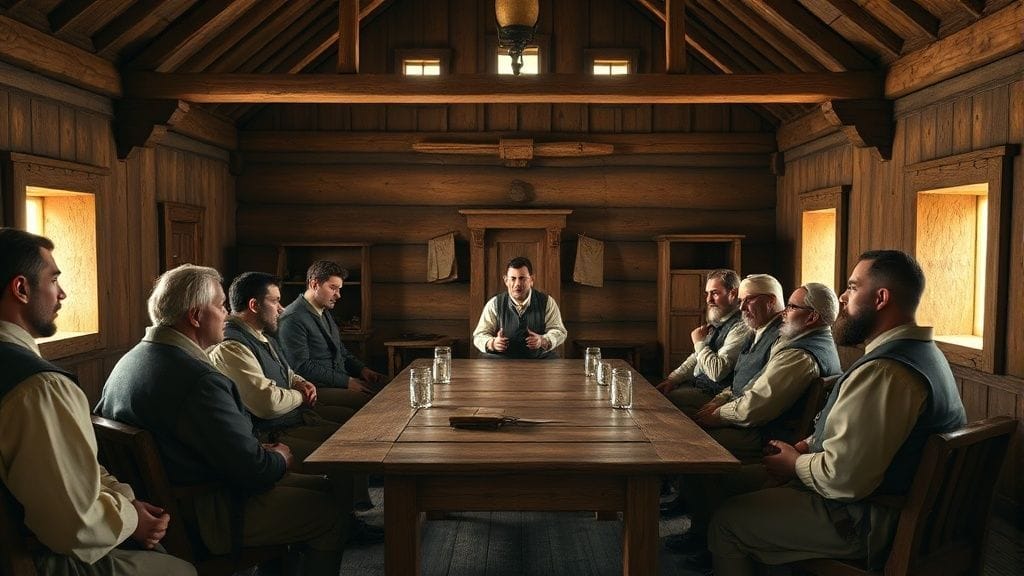
The morning of July 30, 1619, broke humid and bright. In Jamestown’s crude timber church, the assembled burgesses gathered—ordinary men on the threshold of something unprecedented. Worn coats and dirt-caked boots marked these early lawmakers more than any insignia. Governor Yeardley presided with a restrained formality, joined by John Pory, the Assembly’s secretary, who meticulously recorded the proceedings. As the church’s few windows threw shifting bars of sunlight onto the rough-joined benches, voices rose to swear the oath of loyalty and to listen as Yeardley outlined the Assembly’s purpose: to enact “just laws for the happy guiding and governing” of Virginia. It was, for the men present, the first tangible moment of empowerment—a chance to debate, amend, and challenge authority. The first house of burgesses, gathering not in marble halls but amid the smell of split pine and river mud, was a living embodiment of governance in its rawest, most democratic sense.
Inside the Assembly: The Defining Debates and Legislation
What did these first burgesses actually do, once assembled in the modest church? Their agenda was both pragmatic and visionary. The proceedings, which stretched over several sultry days, showcased the realities of survival and the ambitions of self-rule. Debates ranged from the regulation of tobacco prices—a crop that had saved the colony from ruin—to grievances over land tenure, relations with Native peoples, church attendance, gambling, and personal conduct. The Assembly adopted laws governing morality (banning drunkenness, swearing, idleness), as well as laws protecting property and encouraging agricultural innovation. Each gesture, however mundane, was a declaration of principle: that those who lived by the law should have a hand in writing it. The records, painstakingly kept by John Pory, offer a rare window into the anxieties and hopes of these first American legislators. The first house of burgesses was not merely a symbol—it was active governance, the skeleton of a political body that would endure long after its founders’ voices faded.
Profiles in Leadership: John Pory and the Chosen Burgesses
John Pory, the Assembly’s secretary, was a man of learning and curiosity—a Cambridge graduate, traveler, and correspondent whose keen eye for detail would prove invaluable. His records, formal yet attentive to personality, capture both the gravity and rhythm of the Assembly. Among the elected burgesses, notable figures abounded: Captain William Powell, a seasoned survivor of Indian attacks; Samuel Jordan, planter and civic advocate; Thomas Dowse and Captain Nathaniel Powell, each called to balance their daily hazard with the demands of representation. Their backgrounds varied, but most had endured the colony’s jagged uncertainties—from failed harvests to restless relations with local tribes. Together, these men—neither aristocrats nor mere laborers—embodied the tumultuous beginnings of American political culture. It was in their tensions and compromises that the first house of burgesses forged its meaning. Even as disagreements flared and alliances shifted, the assembly’s humanity shone through—voices trembling with conviction and trembling with fatigue, binding the law to the destiny of the community.
Voices From the Colony: Settlers, Strangers, and the Underrepresented
Yet amid the celebration of legislative birth, many voices remained conspicuously absent. Women—wives, mothers, and daughters—did not cast votes. Free and indentured servants, whose labor sustained the economy, could only watch as their fate was decided. And of course, the first enslaved Africans, arriving scarcely three weeks after the Assembly convened, stood at the margins of this fledgling democracy, their status not debated but presumed. Nevertheless, rumors of the first house of burgesses electrified the settlements. Huddled around fires in scattered lean-tos, men and women argued over who had truly been heard. Some congratulated the new openness—others, wary of change, muttered suspicions of creeping chaos. For a fleeting moment, Jamestown vibrated with the thorny energy of self-determination—a public sphere many yearned for, few fully possessed. The contours of inclusion and exclusion drawn by this first assembly would become battlegrounds for centuries to come.
Day’s End: The Proceedings and Their Immediate Aftermath
After nearly a week, the first house of burgesses concluded its initial session, its statutes and appeals bearing Governor Yeardley’s signature and the Company’s cautious blessing. Word spread quickly through the colony—a new order had dawned, at least in principle. The first house of burgesses had survived both the stifling heat and inevitable disputes, leaving behind a written record that was both fragile and monumental. In the immediate aftermath, the Assembly’s rulings began to ripple outward: disputes over stolen corn or drunken brawls now traveled to Jamestown for deliberation; landowners invoked the Assembly’s authority in wrangling with neighbors. The rituals conceived in that modest church—public petition, structured debate, recorded vote—became, slowly and unevenly, the rule by which Virginia’s restless population would seek power, redress, and belonging. The first house of burgesses had proved, at last, that law could arise from the people—however imperfectly defined that “people” might be.
Colonial Ripples: The First House of Burgesses Sparks New Aspirations
The significance of the first house of burgesses was not confined to Jamestown. News of its existence swept across the choppy Atlantic, carried by mariners and Company officials eager to tout their experiment in self-rule. The Assembly’s formation galvanized discussions at home and abroad. Would other colonies follow suit? Could this new world sustain communities grounded in law by consent and not just decree? In Maryland, Massachusetts, and beyond, settlers watched and learned, adapting the lessons—and sometimes the very language—of Virginia’s representative assembly to their own institutions. But with this new structure came new hopes and new fault lines. Colonists debated their right, not simply to govern themselves, but to challenge directives imposed by distant rulers. The establishment of the first house of burgesses ignited aspirations that, over decades, would blossom into movements for autonomy and, ultimately, independence. From these first cautious steps emerged not only a legislative body but a model for political transformation.
Legal Landscapes: How the First House of Burgesses Shaped Colonial Law
In the matter of law, the Assembly’s imprint was both immediate and enduring. The statutes adopted by the first house of burgesses reflected the harsh realities of colonial life: a need for discipline, fairness, and clarity in matters large and small. Laws mandated Sabbath observance, regulated domestic and commercial behavior, and outlined severe penalties for theft or rebellion. The Assembly sanctioned corporal punishment for repeated offenders and created rudimentary guidelines for trade and taxation. These statutes, though born of necessity, established crucial precedents for the rule of law—binding colonists not merely to martial authority but to deliberative judgment. Over the years, as Virginia’s settlements expanded, the legal landscape shaped by these early sessions would provide the scaffolding for broader legal systems. The first house of burgesses became a reference point for subsequent assemblies, and, ultimately, for the documents that would undergird an emerging nation.
Women, Servants, and the Silent Majority
If the first house of burgesses set a precedent for participatory government, it also underscored the persistent exclusion of many. The legal and political architecture of colonial Virginia systematically consigned women, non-landowners, and servants to a voiceless status in matters of law and governance. Under the statutes crafted and ratified by the first house of burgesses, social boundaries hardened, even as political participation expanded for propertied men. For women, the arrival of new English brides in the same year as the Assembly offered a glimmer of agency, yet their legal standing remained subordinate. Servants and enslaved people, whether African or Indigenous, were narrowly defined in law—sometimes as property, more often as labor to be controlled. This stratification would haunt America for centuries, woven so tightly into the first house of burgesses that even its promise of liberty rang hollow to whole swathes of the population. History, after all, is as much the story of those unheard as of those who spoke.
A Transatlantic Echo: English Parliaments and American Experimentation
It is tempting to view the Assembly solely through an American lens, but its genesis lay equally in the evolving English tradition of governance. The first house of burgesses drew consciously on the precedent of English parliamentary rule—a system where free men sent representatives to debate, tax, and legislate. In the eyes of the Virginia Company, the Assembly was no radical rupture but a reassurance: English subjects would reproduce the old country’s hierarchies, formalities, and, crucially, its capacity for accommodation and dissent. Yet the vast distances and unfamiliar conditions of America enforced improvisation. The Assembly experimented, adapted, and—bit by bit—departed from British norms. The result was a distinctively colonial approach to politics, fusing English precedent with New World necessity. The first house of burgesses was both echo and innovation, bridging oceans and centuries, shaping the very contours of Anglophone self-government.
Native Voices and Rising Tensions
While the colonists debated, legislated, and congratulated themselves on their newfound liberties, a parallel and deeply fraught narrative unfolded on the land beyond Jamestown’s precarious palisades. The creation of the first house of burgesses coincided with intensifying dispossession and violence against the region’s Indigenous peoples—the Powhatan Confederacy above all. The Assembly, composed exclusively of English settlers, deliberated Native relations as a matter of policy and profit. But for the tribes whose ancient homelands sprawled along the Chesapeake’s inlets, colonists’ “government” was less a marvel than a menace. Laws passed by the first house of burgesses formalized expansion, justified land claims, and sanctioned force against resistance. In the eyes of Opechancanough—Powhatan leader and later chief architect of the 1622 uprising—the Assembly was a harbinger of unending displacement, an institution not of partnership but of encroachment. The shadow of these unresolved tensions continues to haunt the very idea of American self-government.
Slavery Arrives: Contradictions in Liberty and Law
The year 1619 marks a paradox in American memory—both the glorious birth of representative government through the first house of burgesses, and the grim arrival of the first enslaved Africans in English North America. Bare weeks after the Assembly’s inaugural session, a Dutch ship ferried “twenty and odd” African captives to the Chesapeake shore. Their legal status was at first ambiguous—indentured or enslaved?—but their labor and presence brought a silent contradiction into the heart of colonial law. The records of the first house of burgesses do not mention them; indeed, silence was the first official response. Yet over time, statutes would be crafted that formalized the practice of lifelong racial slavery—making an unspoken hypocrisy central to American law. The same institution that celebrated liberty for some simultaneously sanctioned bondage for others. This foundational contradiction—born in the shadow of the church where the Assembly first gathered—remains one of the most haunting legacies of that July in Jamestown.
Endurance Through Crisis: The Virginia Colony in the Aftermath
The convening of the first house of burgesses gave the colony something it had never known before—a sense of shared stake in the rules that governed daily life. But peace was always transient. The years that followed were marked by recurring crisis: crop failures, new epidemics, and—the greatest tragedy—massive violence between settlers and Native confederacies. In 1622, shock and grief swept Jamestown as coordinated Indigenous attacks left hundreds dead, threatening extinction. The Assembly endured, reconvening with grim determination, passing emergency laws to fortify settlements and punish suspected collaborators. With each crisis, the Assembly’s authority widened, its proceedings sharpening the colonists’ belief that their fate rested less and less on distant monarchs or companies and more and more in their collective, if imperfect, hands. Even as the Virginia Company dissolved and royal governance replaced it, the legacy of the first house of burgesses—its stubborn insistent on agency and deliberation—survived.
A Model for a Nation: Later Assemblies and Revolutionary Legacies
It’s astonishing, isn’t it? That from the cramped, perspiring pews of a wooden church in Jamestown, a precedent was set that would, in time, upend empires. The first house of burgesses’ insistence on elected representation echoed through later colonial assemblies and, a century and a half later, the rebellious halls of Philadelphia. In Massachusetts, Maryland, the Carolinas, legislatures arose, drawing on the very practices—debate, petition, and majority rule—first realized in Virginia. When colonial grievances with British rule flared, it was the language and rituals of the burgesses—the right to be taxed by one’s own representative, to assemble locally, to hold leaders to account—that armed arguments for independence. Patrick Henry, Thomas Jefferson, and George Washington all traced their political lineage to these early assemblies. The first house of burgesses modeled a form of government that would evolve into American republicanism: imperfect, contested, but irrepressibly alive.
Remembrance and Re-evaluation: The Burgesses in American Memory
Centuries later, the image of the first house of burgesses is both hallowed and complicated. Popular myth drapes the event in the colors of triumph—Virginia patriots giving birth to democracy with grace and unity. But more recent reckonings demand a fuller portrait: a gathering brilliant for its vision yet bounded by its exclusions and contradictions. Historical sites and museums in Virginia showcase the claustrophobic church, Pory’s official journal, and the roll call of names. Schoolchildren reenact the first Assembly, speaking in accents not far removed from today’s. Yet beneath the pageantry, deeper questions stir. How much of freedom can coexist with bondage? How many must wait outside before a nation keeps its promise? Every reflection on the first house of burgesses is part celebration, part challenge: a summons to see in these early debates both a remarkable achievement and a beginning, not an end. The story of July 30, 1619, is unfinished—a debate that continues as long as democracy itself.
Conclusion
On the banks of the James River, beneath the warped beams of Jamestown’s church, July 30, 1619, offered the world something genuinely new: settlers claiming, even in rough form, the right to self-legislate. The first house of burgesses was more than a meeting—it was a founding act, a restless declaration that governance must involve the governed. Its legacy is felt not just in the parchment of law, but in the enduring expectation that people have a say in their fate. Yet as we celebrate this institution, we confront also its boundaries—the silences in its record, the voices withheld. From this blend of promise and deficit, the struggle for a truly representative democracy was launched. The first house of burgesses remains, centuries on, a parable for nations: that liberty, to last, must be born from contest, debate, and a continual widening of “we the people.” Its story is one of hope, ambiguity, and the restless drive to make government answer to the governed—a flame first kindled in that sweltering Jamestown summer, still burning, still incomplete.
FAQs
- What was the first house of burgesses?
The first house of burgesses was the inaugural representative assembly in the English colonies of North America, convened in Jamestown, Virginia, on July 30, 1619. It was composed of elected representatives from various settlements and marked the birth of self-governance on colonial soil. - Why did the Virginia Company create the first house of burgesses?
The Virginia Company established the Assembly to stabilize the struggling colony, boost morale, and give settlers a greater stake in local governance, hoping to ensure loyalty and productivity. - Who could vote in the first house of burgesses elections?
Only adult, free, male landowners—primarily of English descent—could vote or stand for election. Women, servants, Indigenous peoples, and enslaved Africans were excluded from participation. - What issues did the first house of burgesses address?
The Assembly passed laws on tobacco regulation, relations with Native Americans, property rights, public behavior, and church attendance, setting critical legal precedents for the developing colony. - How did the first house of burgesses influence American democracy?
By establishing representative self-government, the Assembly provided a model that influenced other colonial legislatures and, generations later, the principles of the United States Constitution. - Did the first house of burgesses address slavery?
No, the Assembly did not directly address the arrival of the first enslaved Africans, though their presence soon altered the colony’s laws and social fabric. - Are there existing records of the Assembly’s proceedings?
Yes, John Pory’s written accounts and transcriptions survive, offering a detailed, if partial, view of the Assembly debates and laws passed.

