Table of Contents
- Introduction
- Before the Laser: The Maser
- The Race to Light Amplification
- Who Was Theodore Maiman?
- The Breakthrough Setup
- The Ruby Laser Explained
- The Historic Moment: May 16, 1960
- Reactions in the Scientific Community
- Understanding Coherent Light
- How the Laser Works
- Early Applications and Misconceptions
- Military and Medical Uses
- Lasers in Everyday Life
- Evolution of Laser Technology
- Nobel Controversy
- Legacy of Maiman’s Laser
- Conclusion
- External Resource
- Internal Link
1. Introduction
On May 16, 1960, in a quiet lab at Hughes Research Laboratories in Malibu, California, Theodore Maiman switched on a device that would emit the first coherent light beam in human history.
The laser—a concept that had lived in theory—was finally real. And it changed the modern world in more ways than anyone could have predicted.
2. Before the Laser: The Maser
The groundwork for the laser began in the 1950s with the invention of the maser (Microwave Amplification by Stimulated Emission of Radiation).
Developed by Charles Townes and Arthur Schawlow, masers could amplify microwave signals using a technique called stimulated emission, originally proposed by Albert Einstein in 1917.
But turning that principle into a light-emitting device required vision, precision, and ingenuity.
3. The Race to Light Amplification
As masers matured, scientists around the globe were working feverishly to extend the concept into the visible spectrum.
Several research teams—from Columbia University to Bell Labs—were working toward the so-called “optical maser.”
Yet it was Theodore Maiman, a relatively unknown physicist at the time, who beat them all to the finish line.
4. Who Was Theodore Maiman?
Born in 1927, Maiman had a background in engineering physics and a Ph.D. in electrical engineering.
He was hired by Hughes Research Labs and given a modest budget to work on maser technology. Many scientists doubted the ruby laser concept he proposed, but Maiman believed it could work.
And he proved them wrong.
5. The Breakthrough Setup
Maiman’s device was deceptively simple:
- A synthetic ruby crystal rod
- A flashlamp (like a camera strobe) coiled around the rod
- A silvered mirror at each end to reflect light internally
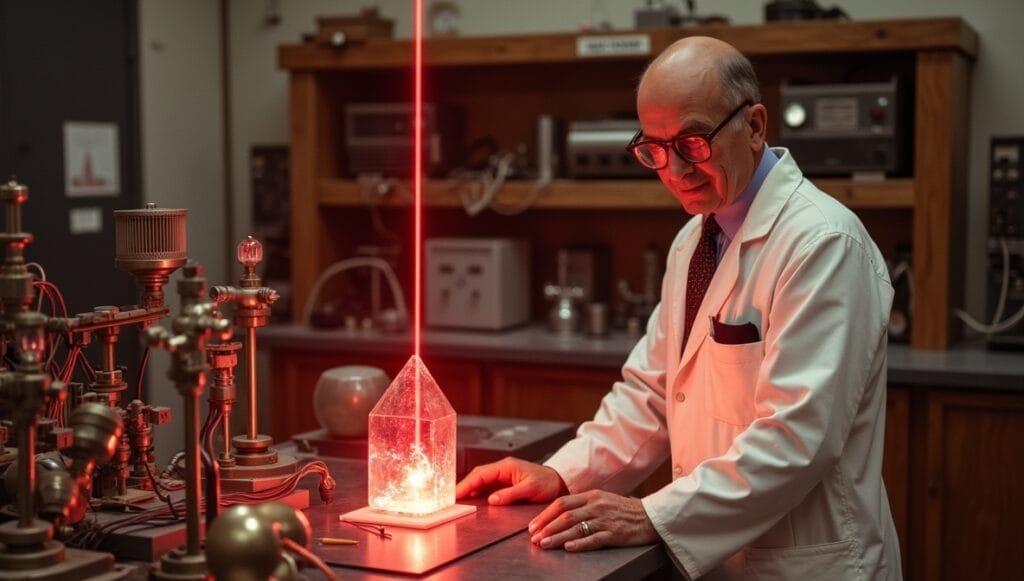
When the flashlamp pulsed, it excited atoms in the ruby rod, producing a short, intense burst of coherent red light.
6. The Ruby Laser Explained
Rubies contain chromium ions, which absorb light and release energy through stimulated emission. With the right setup, this emission is amplified, producing a narrow, intense beam of light at 694 nanometers—deep red.
Unlike regular light, laser light is:
- Coherent: all waves in phase
- Monochromatic: a single wavelength
- Collimated: traveling in a straight, narrow beam
It was like harnessing lightning into a needle-thin ray.
7. The Historic Moment: May 16, 1960
The setup was ready. The switch was flipped. The flashlamp pulsed.
And a brilliant red dot of laser light appeared—sharp, clean, powerful.
Maiman had successfully created the first functioning laser. It lasted just milliseconds, but its implications were monumental.
8. Reactions in the Scientific Community
At first, the response was mixed.
Some physicists dismissed Maiman’s announcement as “just a fancy flashlight.” But those who understood the theory knew this was transformational.
Publications scrambled to catch up. By July 1960, Maiman’s achievement was reported in Nature, and the race to commercial and military laser applications began.
9. Understanding Coherent Light
Coherent light means all the light waves travel in sync, like a perfectly timed marching band.
This quality is what gives lasers their:
- Precision in cutting
- Focus in communication
- Power in surgery and military applications
It’s light, but on another level entirely.
10. How the Laser Works
The basic principles of laser function include:
- Pumping: Excite electrons to higher energy states
- Stimulated Emission: Electrons release photons when they drop energy levels
- Amplification: Photons stimulate more emissions in a cascade
- Optical Resonance: Mirrors reflect the light back and forth
- Output Coupling: Some light escapes as a focused beam
This elegant process produces a tool sharper than any scalpel and faster than any beam of hope.
11. Early Applications and Misconceptions
Early on, people imagined lasers as death rays or science fiction weapons. In reality, their first uses were:
- Precision measuring tools
- Communication links
- Medical diagnostics
Eventually, military and industrial use followed.
12. Military and Medical Uses
By the 1970s, lasers were guiding missiles, performing eye surgeries, and reading barcode scanners.
Today, they’re everywhere:
- Laser eye surgery (LASIK)
- Cancer therapy
- Laser range finders and targeting
- Directed energy research
They’re silent, invisible when infrared, and immensely precise.
13. Lasers in Everyday Life
You might not realize it, but lasers are in your:
- DVD and Blu-ray players
- Fiber optic cables
- Printers and copiers
- 3D scanners
- Even smartphones (LiDAR sensors)
From the operating room to your living room, lasers are everywhere.
14. Evolution of Laser Technology
Since Maiman’s ruby laser, new types have emerged:
- Helium-Neon lasers (scientific)
- Semiconductor lasers (CD/DVD players)
- Carbon dioxide lasers (industrial cutting)
- Fiber lasers (telecoms and surgery)
- Femtosecond lasers (ultrafast imaging)
Each new wave has brought more precision, speed, and applications.
15. Nobel Controversy
Surprisingly, Theodore Maiman never received the Nobel Prize for his work.
Instead, the 1964 prize went to Townes, Schawlow, and Basov for foundational laser theory. Maiman, the experimental pioneer, was left out—one of the Nobel’s most controversial omissions.
He received many other honors later in life, but the Nobel snub still stings in historical hindsight.
16. Legacy of Maiman’s Laser
Maiman’s invention shaped the digital revolution, space exploration, military defense, and entertainment.
His once-ridiculed “optical maser” now drives the internet, maps the oceans, and even helps land spacecraft.
From surgery to symphonies of light at concerts, his vision echoes across modern civilization.
17. Conclusion
On May 16, 1960, the world witnessed the first working laser. A flash of red light not only validated decades of theory but also launched an era of precision and possibility.
In a single, stunning moment, Theodore Maiman changed what light could do—and what we could do with it.
18. External Resource
 Wikipedia – Invention of the Laser