Table of Contents
- The Birth of a New Era: December 2, 1942
- The Visionaries Behind the First Nuclear Reactor
- The Race Against Time: Context of World War II
- Setting the Stage: The Manhattan Project’s Secret Laboratory
- The Science of Splitting the Atom: From Theory to Practice
- The Construction of Chicago Pile-1: An Unprecedented Undertaking
- Fears and Hopes Before the Fateful Day
- The Historic Moment: Achieving the First Self-Sustaining Chain Reaction
- Enrico Fermi’s Leadership and the Moment of Reckoning
- Immediate Reactions: Awe, Relief, and Cautious Optimism
- From Chicago to the World: The Spread of Nuclear Technology
- The Hidden Dangers Behind the Glowing Promise
- How Chicago Pile-1 Changed Warfare and Diplomacy
- The Ethical Dilemmas of Harnessing the Atom
- The Legacy of Chicago Pile-1 in Science and Society
- Remembering December 2, 1942: Memorials and Reflections
- The Reactor’s Role in Post-War Nuclear Development
- Lessons Learned: Safety, Power, and Responsibility
- Popular Culture and the First Nuclear Reactor: Myth and Reality
- The Story’s End? The Ever-Expanding Nuclear Frontier
- Conclusion
- FAQs
- External Resource
- Internal Link
On a cold December afternoon in 1942, beneath the unassuming stands of the University of Chicago’s Stagg Field, a quiet revolution was in motion. Men with nervous hands and steely resolve had gathered, eyes fixed on a strange, towering assembly of graphite blocks and uranium lumps—the nucleus of a dream that until then seemed confined to the realm of theory and science fiction. The air was thick with anticipation, tinged with a potpourri of hope, fear, and awe. Then came the word: the first self-sustaining nuclear chain reaction had started. This was no longer the stuff of fantasy. The first nuclear reactor had come to life, marking humanity’s entry into the Atomic Age.
The Birth of a New Era: December 2, 1942
The historical weight of December 2, 1942, cannot be overstated. With a modest astrophysical buzz and the faintest hiss of coolant gases, Chicago Pile-1 (CP-1) crossed a threshold that would permanently alter the trajectory of human civilization. This slow but monumental achievement planted the seed for the atomic age, a paradoxical epoch offering unparalleled power and existential threat.
The emotion in the room was palpable. It was a fusion of triumph and uncertainty. American physicist Enrico Fermi, who stood at the reactor’s controls, described the moment simply but poignantly: “The pile went critical. The chain reaction started, and that was the beginning.” Behind those words lay years of tireless effort, groundbreaking research, and the shadow of global conflict.
The Visionaries Behind the First Nuclear Reactor
Enrico Fermi was far from the only brain behind CP-1, but his mastery of nuclear physics and pragmatic genius made him the project’s heart and soul. Alongside him were a cadre of brilliant scientists: Leo Szilard, an inveterate thinker haunted by the possible uses of his work; Arthur Compton, a Nobel laureate who coordinated the scientific efforts; and a host of early nuclear pioneers who had quietly chipped away at the mysteries of fission.
Szilard’s earlier conceptualization of a nuclear chain reaction had laid the foundation, but Fermi's experimental skills brought theory into reality. Their collaboration, often marked by debates about ethics and urgency, epitomized the conflicting emotions swirling around this groundbreaking endeavor.
The Race Against Time: Context of World War II
The setting could not have been more urgent. WWII was raging, and intelligence reports suggested that Nazi Germany was pursuing nuclear weapons with alarming vigor. The urgency of developing an atomic bomb before enemy hands could grasp the power of the atom lent a desperate pulse to the Manhattan Project.
The United States, long a cradle of scientific innovation, marshaled its best minds and resources into a tightly classified mission under the leadership of General Leslie Groves. The success of Chicago Pile-1 was a critical step in confirming the feasibility of harnessing nuclear energy—both for power generation and weaponry. The fate of millions arguably hinged on it.
Setting the Stage: The Manhattan Project’s Secret Laboratory
Chicago, unexpected as it sounds, became the clandestine heart of the early reactor experiments. The University of Chicago’s facilities were ideal: a vast urban campus shielded by both institutions and secrecy, capable of housing ambitious scientific undertakings away from prying eyes.
The team transformed the squash court under Stagg Field into a laboratory unlike any before: a place where raw nuclear forces could be tamed. This was a makeshift womb that would give birth to something unprecedented, a symbol of innovation born from urgency.
The Science of Splitting the Atom: From Theory to Practice
Nuclear fission—the splitting of uranium atoms to release vast amounts of energy—was first discovered only a few years prior, in 1938, by Otto Hahn and Fritz Strassmann in Germany, with its interpretation elegantly clarified by Lise Meitner and Otto Frisch.
The chain reaction concept was simple in theory but devilishly complex in practice. Neutrons released by fission would need to trigger further fissions to maintain the reaction. The challenge was to configure sufficient uranium and a moderator to slow neutrons, ensuring the reaction would neither fizzle prematurely nor spiral uncontrollably.
The graphite used in CP-1 had to be exceptionally pure, a requirement that took months of refinement. Every block, every pellet had to be meticulously designed and placed, carefully balancing on the razor’s edge of nuclear possibility.
The Construction of Chicago Pile-1: An Unprecedented Undertaking
CP-1 was not just an experiment; it was a pioneering engineering feat. The reactor was a massive pile of roughly 45,000 graphite blocks, embedded with uranium fuel. Measuring about 25 feet long and 25 feet wide, standing nearly 20 feet tall, it looked more like an elaborate sculpture than a weapon of scientific progress.
The construction was a race against deadlines and technical unknowns. The team worked in shifts, often in near silence, aware of the stakes but buoyed by the shared sense of purpose. Every addition to the pile was scrutinized and documented meticulously, each block a brick in an atomic cathedral.
Fears and Hopes Before the Fateful Day
The personal stakes for the team were immense. Could their experiment explode uncontrollably? Could it fail, wasting invaluable time? The public was oblivious, but the scientists lived with the dual specter of triumph and disaster.
legend tells of physicist Norman Hilberry positioned right next to a control rod, ready to insert it instantly to halt the reaction if it threatened to accelerate beyond control. There were no failsafe shut-off buttons, only human reflex and judgment.
Fermi’s calm demeanor contrasted with the tension, a beacon amidst swirling uncertainty.
The Historic Moment: Achieving the First Self-Sustaining Chain Reaction
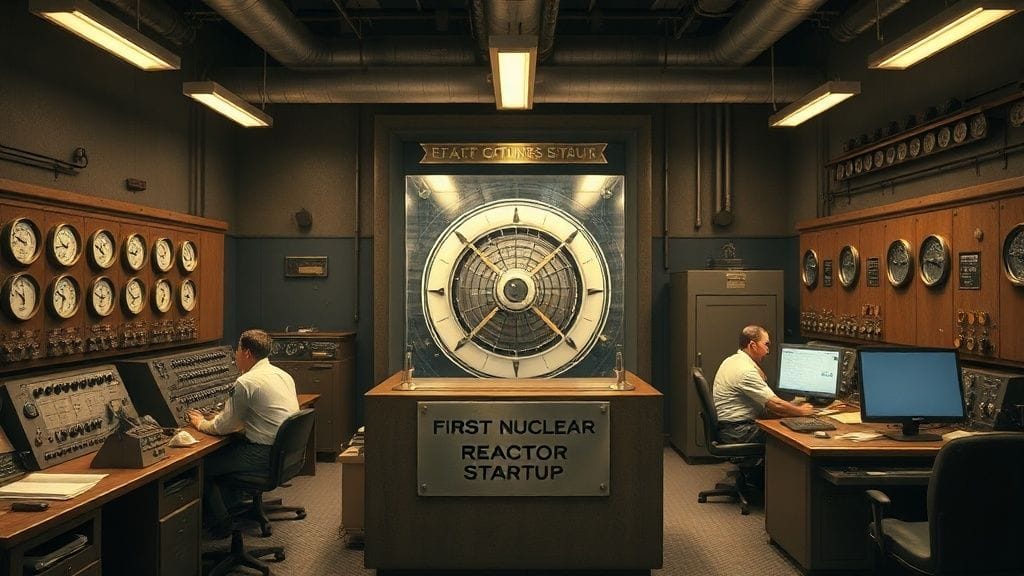
At 3:25 PM on December 2, 1942, the neutron counters recorded a steadily increasing rate, signs of the chain reaction building momentum. Slowly, deliberately, Fermi and his team withdrew control rods, letting the reaction approach criticality.
When the reaction sustained itself, that was a triumph for pure science and human ingenuity. The chain reaction was maintained for 28 minutes, enough to prove the concept, before carefully shutting down.
The room erupted in quiet applause—this was no ordinary celebration but an acknowledgment of having crossed an existential threshold.
Enrico Fermi’s Leadership and the Moment of Reckoning
Fermi’s role was crucial not just technically but emotionally. He had borne the responsibility of shepherding this fragile giant into life. When the reactor went critical, his measured command assured others that they were stepping into a new world.
His words after the event, “I think we have made more progress in the last hour than in all the previous years,” capture the exhilaration and gravity of what they had achieved.
Immediate Reactions: Awe, Relief, and Cautious Optimism
News of the success stayed secret at first. For those involved, it was a moment for careful reflection—success was a beginning, not an end.
The experiment validated the feasibility of nuclear reactors, which could produce immense power or, ominously, trigger bombs of unimaginable force. The world was entering a strange new era, where atoms could be harnessed or destroyed.
From Chicago to the World: The Spread of Nuclear Technology
Chicago Pile-1’s success paved the way for further reactors and eventually nuclear power plants. Its principles informed military applications, leading to the bombs dropped on Hiroshima and Nagasaki less than three years later.
But beyond weapons, it unlocked energy possibilities that continue to influence global power generation.
The Hidden Dangers Behind the Glowing Promise
Despite its promise, the first reactor also opened Pandora’s box. Radiation hazards, waste management, and proliferation risks were soon apparent.
The teams that built CP-1 operated with an innocence of understanding but heavy with the responsibility that future generations would bear the consequences.
How Chicago Pile-1 Changed Warfare and Diplomacy
The atomic bomb reshaped geopolitics. The balance of power shifted, inaugurating the Cold War’s nuclear arms race.
Countries scrambled to catch up or contain the spread of nuclear know-how, making nuclear strategy an enduring cornerstone of international relations.
The Ethical Dilemmas of Harnessing the Atom
The scientists themselves were divided. Szilard and others later advocated control and caution, haunted by the destructive potential of their discoveries.
The story of CP-1 is also one of conscience, the recognition that science does not exist in moral vacuum.
The Legacy of Chicago Pile-1 in Science and Society
CP-1 inspired generations of scientists and engineers. It marked the transition from classical physics to modern nuclear science.
Universities and labs still reflect on its pioneering spirit—a symbol of human potential, tempered by responsibility.
Remembering December 2, 1942: Memorials and Reflections
A plaque now marks the site beneath Stagg Field, hidden away but revered. Annual commemorations and historical retrospectives recall the day when humanity first held the atom’s power in its hands.
The Reactor’s Role in Post-War Nuclear Development
Post-war, nuclear reactors multiplied and diversified, leading to commercial reactors, naval propulsion, and medical isotopes.
Chicago Pile-1 was the seed that blossomed into a vast, complex nuclear ecosystem.
Lessons Learned: Safety, Power, and Responsibility
The early reactor’s story highlights the importance of caution and oversight in nuclear technology—a message increasingly urgent in the present day.
Popular Culture and the First Nuclear Reactor: Myth and Reality
From movies to books, the motif of “splitting the atom” has entered popular culture, often dramatized but rooted deeply in that quiet Chicago laboratory.
The Story’s End? The Ever-Expanding Nuclear Frontier
Though CP-1’s physical form was dismantled quickly, its legacy endures as nuclear science expands into fusion, advanced reactors, and beyond.
Conclusion
Chicago Pile-1 was more than an experiment; it was a turning point. It embodied human curiosity, the drive to understand nature's deepest secrets, and the paradox of creation and destruction entwined. Standing at the precipice of the atomic age, the scientists beneath Stagg Field held power with trembling hands, knowing their work would transform history.
The first nuclear reactor's startup was an act of hope and reckoning—a moment when science stepped from theory to consequence. It reminds us to wield knowledge wisely, balancing ambition with ethics, power with prudence. Above all, it reveals the complexity of progress and the enduring human spirit seeking to illuminate the darkness, even when shadowed by doubt.
FAQs
1. What exactly is Chicago Pile-1?
Chicago Pile-1 was the world’s first artificial nuclear reactor, constructed under the University of Chicago’s Stagg Field. It achieved the first controlled, self-sustaining nuclear chain reaction on December 2, 1942.
2. Who were the key figures behind the first nuclear reactor?
Enrico Fermi led the construction and methodologies; Leo Szilard pioneered the chain reaction concept; Arthur Compton coordinated the project. Many other physicists contributed in design and safety.
3. How did the world learn about the first nuclear reactor?
Because it was a secret Manhattan Project initiative, news was initially classified. Details emerged gradually after the war, becoming public knowledge in the late 1940s.
4. Why was the first nuclear reactor so significant during WWII?
It demonstrated that nuclear energy could be harnessed to create weapons of unprecedented destructive power, thus accelerating the development of the atomic bomb before Axis powers.
5. What were the immediate consequences of this breakthrough?
The successful test spurred the scaling up of nuclear reactors and the eventual manufacturing of atomic bombs used in 1945. It marked a seminal moment in science and military history.
6. How is the site of Chicago Pile-1 remembered today?
There is a historical marker and a small monument at the University of Chicago marking the former reactor’s location, honoring its pivotal role in nuclear history.
7. What ethical debates surrounded the development of nuclear reactors?
Scientists wrestled with the morality of enabling nuclear weapons and the long-term implications for humanity, highlighting a tension between scientific progress and ethical responsibility.
8. Did Chicago Pile-1 lead directly to nuclear power plants?
Yes, it laid the fundamental principles that later reactors expanded upon to produce electricity, medical isotopes, and propulsion.