Table of Contents
- A Dawn Against the Night Sky: The First Radar Detection Flight
- Britain in the 1930s: Unease, Innovation, and the Growing Storm
- The Birth of Radar: Roots in Science and Military Necessity
- The Key Players: Pioneers of Radio Waves and Vision Beyond Sight
- Lull in the Storm: Early Experiments and Frustrations
- The Race Against Time: Rising Threats and Shifting Priorities
- Preparing the Flight: The Crucial Day Before History Was Made
- The 1935 Flight: Eyes in the Sky Without Seeing
- Silent Signals: Interpreting the Unexpected Data
- Euphoria and Skepticism: Military and Scientific Reactions
- Radar’s Role in Shaping British Air Defense Doctrine
- From Mystery to Mechanism: Refinement and Proliferation
- The Larger Picture: Radar and the Approaching War
- Human Stories Behind the Circuits: Faces of the First Detection Flight
- Legacy in the Skies: How 1935 Changed Warfare Forever
- Lessons for the Modern Era: Technology, Intelligence, and Preparedness
- The Radar Flight in Popular Memory and Popular Culture
- Conclusion: A Triumph Beyond the Horizon
- FAQs about the First Radar Detection Flight
- Further Reading and Resources
- Visit History Sphere
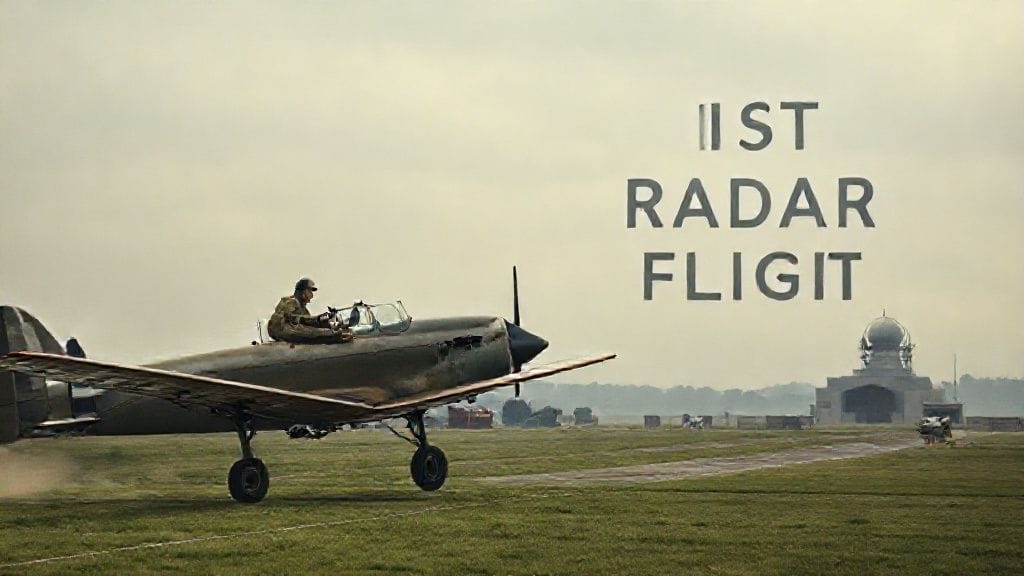
The cool English air of February 1935 was sharp and biting, but it carried with it the crackle of something new — something electric lurking just beyond the horizon. In a quiet corner of the English countryside, under a grey sky streaked with restless clouds, a Bristol Blenheim aircraft roared to life on the runway, carrying within it not just crew but the hopes of a nation tentative on the brink of war. This was the dawn of a radical new way to spy on the skies: the first radar detection flight.
For years, the idea of “seeing” through the darkness of night and thickened weather had been a tantalizing dream. Airplanes were transforming warfare, but vision was limited. How to detect incoming aircraft far beyond human sight and before they reached the coasts had puzzled scientists and military men alike. What happened on that cold morning in 1935 wasn’t just a technical test: it was the birth of a technology that would remake battlefields and raise questions about the very nature of security in a modern world.
Britain in the 1930s: Unease, Innovation, and the Growing Storm
The decade leading to 1935 was charged with a strange mixture of fear and aspiration in Britain. Memories of the Great War’s devastation still haunted the collective psyche while the ominous shadow of militarism in Germany and aviation advances worldwide pressed the British government to innovate fast. The interwar period was a crucible within which the Royal Air Force and scientific minds labored to devise something that could tip the balance from vulnerability to vigilance.
The economic depression brought bitter austerity, yet also paradoxical investments in defense technologies. Intelligence pointed to the growing likelihood of air raids on British cities — a new form of warfare that would exploit air power like never before. Britain’s skies, once a symbol of imperial might, were suddenly exposed as fragile and unclear frontiers.
The Birth of Radar: Roots in Science and Military Necessity
Radar—an acronym for Radio Detection and Ranging—did not emerge fully formed. It was the result of decades of research into radio waves and electromagnetic phenomena. Scientists like Sir Robert Watson-Watt, alongside engineers and pioneers, realized that bouncing radio waves off distant objects could, in theory, reveal unseen aircraft.
The idea was elegant but abstract: send out a radio pulse, wait for the echo, and if the aircraft reflected this signal, their position and even speed could be inferred from the timing and strength of the return wave. But translating these principles into practical detection systems required ingenuity and trial.
The Key Players: Pioneers of Radio Waves and Vision Beyond Sight
At the heart of this effort stood Sir Robert Watson-Watt, often called the father of radar. With background in meteorology and radio engineering, Watson-Watt became an ardent advocate for using radio waves not just for communication, but for defense. Another crucial figure was Arnold Wilkins, a gifted mathematician who first proposed testing the detection idea using aircraft.
Behind these names were countless technicians and RAF officers, all stirred by a shared urgency to prepare Britain for invisible threats. Their collaboration was a fusion of curiosity and patriotism, tempered by the pressures of geopolitical uncertainty.
Lull in the Storm: Early Experiments and Frustrations
Before the decisive flight of 1935, the years were marked by painstaking experimentation. Initial tests involved ground stations trying to pick up reflected radio signals from distant trains or stationary objects. Errors were frequent, signals could be misleading, and equipment bulky.
Many skeptics questioned whether radar could ever move beyond laboratory curiosities to real-world defense tools. Operational challenges — from interference to signal clarity in diverse weather — loomed large. Yet scientists pushed relentlessly, convinced that detection from the air was the next logical step.
The Race Against Time: Rising Threats and Shifting Priorities
By the mid-1930s, German rearmament shattered the fragile peace in Europe. Rapid advances in Luftwaffe capabilities made British defense planners jittery. The looming threat crystallized urgency: radar was no longer optional but vital. Funding and political support began to pour into Britain’s fledgling radar program.
Pressure mounted to produce usable technology. The race to perfect radar was not just a scientific endeavor — it was a race to save Britain’s cities, industries, and lives from the terrifying prospect of aerial bombardments.
Preparing the Flight: The Crucial Day Before History Was Made
The weeks before the first radar detection flight were filled with a tense mixture of hope and nerves. On a February day at Daventry, a site chosen for its relative seclusion and suitable terrain, engineers and airmen coordinated meticulously.
A Blenheim bomber was adapted with radar receivers, operators trained to interpret radio echoes, and ground control stations readied. Every detail mattered; this was the moment theory met practice. The very skies seemed to hold their breath as the aircraft took off.
The 1935 Flight: Eyes in the Sky Without Seeing
The historic flight was unlike any witnessed before. The Blenheim, invisible to naked eyes from ground stations, became a silent hunter and hunted in a play of electromagnetic pulses. As it climbed above the patchwork farms and rolling hills, technicians watched oscilloscope signals dance with the echoes of waves bouncing back from the aircraft’s metal body.
For the first time in history, a flying object was detected not by sight or sound, but by invisible radio pulses reflecting back through the ether. It was a moment of technological revelation — the birth of radar as a practical instrument of defense.
Silent Signals: Interpreting the Unexpected Data
Though the successful detection flight marked an achievement, it was no simple victory lap. Technicians struggled to interpret jittery or weak signals, dealing with noise, reflections from hills and trees, and equipment quirks. Data had to be translated into actionable information rapidly.
These humbling moments underscored the complexity of battlefield radar—precision and clarity mattered immensely. Yet the flight proved the principle was sound, giving the British military an invaluable edge in an uncertain future.
Euphoria and Skepticism: Military and Scientific Reactions
News of the flight stirred excitement but also cautious critique. Military commanders, often conservative by nature, wanted tangible proof radar could be integrated into air defense. Scientists pushed for greater funding and faster innovation, understanding the technology’s promise beyond early trials.
This tension between evidence and optimism echoed across the corridors of power. Yet, it was clear to most that radar was not science fiction, but the new vanguard of warfare.
Radar’s Role in Shaping British Air Defense Doctrine
The first radar flight inaugurated a shift in British defense thinking. Air defense was no longer reliant solely on human observers or sound detection; it was becoming mechanized and scientific. Early radar stations evolved into comprehensive networks—later known as Chain Home—that covered coasts and key industrial areas.
These systems became central to Britain’s preparations for wartime, anticipating enemy bombers with minutes’ warning and revolutionizing command and control.
From Mystery to Mechanism: Refinement and Proliferation
Following 1935, radar technology advanced rapidly. Smaller, more reliable equipment emerged, integrated into radar towers and airfields. Training programs expanded as operators learned to “read” radar screens like navigators of an invisible ocean.
By the outbreak of World War II, radar had graduated from tentative experiment to critical battlefield tool—an invisible shield around British skies.
The Larger Picture: Radar and the Approaching War
The flight’s significance echoed far beyond that single day. As Europe slid into conflict, radar’s early promise became a lifeline during events like the Battle of Britain. It allowed fighter pilots unprecedented early warning and scramble time, saving countless lives.
In hindsight, the first radar detection flight was a quiet precursor to a technological revolution that shaped the fate of nations.
Human Stories Behind the Circuits: Faces of the First Detection Flight
Behind the wires and waves stood men and women driven by courage and conviction. The technical operators, the RAF crew grinders, and the engineers who worked long nights – their stories mirror a culture of invention mixed with resolve to protect a vulnerable island.
One anecdote tells of one radar operator who, struggling with a dubious signal, realized it marked the Blenheim’s return—a confirmation that changed disbelief into hope.
Legacy in the Skies: How 1935 Changed Warfare Forever
Today’s radar systems trace a lineage that begins with that 1935 flight. Modern air traffic control, weather forecasting, even space exploration rely on electromagnetic detection principles that were once radical dreams.
The flight not only changed how wars were fought; it shifted human perspective on sensing and surveillance, heralding an era where invisibility became a disadvantage.
Lessons for the Modern Era: Technology, Intelligence, and Preparedness
Reflecting back, the first radar detection flight holds lessons beyond military history. It shows how technology alone is never enough — integration, training, and political will shape true success.
As global tensions rise anew in the 21st century, the story reminds us that vigilance is both a scientific and human endeavor, needing persistent innovation and adaptation.
The Radar Flight in Popular Memory and Popular Culture
Though overshadowed by later wartime heroism, the 1935 flight has found subtle echoes in culture — from documentaries to novels about secret labs and early warnings of war. Radar as a symbol of unseen vigilance continues to inspire narratives of human ingenuity and defense.
Conclusion: A Triumph Beyond the Horizon
The first radar detection flight in 1935 was more than a milestone of technology—it was a quiet revolution that changed the course of history. In the cold skies over Britain, machines and men touched a new frontier, blending science and courage to forge a shield invisible to the naked eye.
This fusion of innovation and human will reminds us how progress often comes in moments both small and profound, illuminating the dark with flashes of insight and hope. Radar was born that day, not from fantasy, but necessity—a necessity that reshaped warfare and saved lives.
FAQs about the First Radar Detection Flight
Q1: Why was the first radar detection flight in 1935 so important?
A1: It demonstrated for the first time that radar could detect aircraft beyond visual range, proving the technology’s potential for national defense and fundamentally changing air warfare.
Q2: Who was the main inventor behind the British radar system?
A2: Sir Robert Watson-Watt is widely credited as the pioneer who developed and championed the British radar system leading up to the 1935 flight.
Q3: How did the first radar detection flight influence World War II?
A3: It led to the development of the Chain Home radar network, which provided early warning during the Battle of Britain, crucial for the UK’s air defense against German bombers.
Q4: What challenges did the radar pioneers face during early experiments?
A4: They contended with technical difficulties like signal interference, interpreting noisy data, unreliable equipment, and skepticism both scientific and military.
Q5: Was radar technology unique to Britain in the 1930s?
A5: While other countries explored radar concepts, Britain’s rapid development and successful detection flight in 1935 positioned it as a leader in operational radar.
Q6: How did the public and military react to news of radar's potential?
A6: The reaction was mixed – scientists and some military leaders were enthusiastic, while others remained cautious until radar proved effective in real defense scenarios.
Q7: Are there any surviving artifacts or records from the first radar detection flight?
A7: Yes, there are technical documents, oscilloscope readings, and some preserved equipment in museums like the RAF Museum in London.
Q8: How is the first radar detection flight remembered today?
A8: It is recognized as a landmark achievement in military and technological history, setting foundations for modern aviation safety and defense systems.