Table of Contents
- A Dawn Like No Other: The Morning of April 12, 1981
- Behind the Dream: The Vision of a Reusable Spacecraft
- The Space Race Legacy: From Apollo to the Shuttle Era
- Engineering the Future: Challenges of Designing the First Shuttle
- Enter the Crew: The Astronauts Chosen for STS-1
- Liftoff: The Launch of Columbia That Changed Everything
- Moments of Tension: Technical Hurdles in the Early Flight
- Touching Earth Again: The Thrill and Terror of Reentry
- Immediate Reverberations: Celebrations and Criticisms
- The Shuttle’s Technological Innovations and Legacy
- NASA’s Strategic Shift: From Moonshots to Routine Missions
- Political and Economic Stakes: The Shuttle in Cold War Context
- From Military Ambitions to Scientific Endeavors
- Public Fascination and Cultural Impact of the Shuttle
- Tragedy, Triumph, and Transformation: The Shuttle Program’s Enduring Story
- The Global Influence: How the Shuttle Shaped International Spaceflight
- Modern Spaceflight’s Debt to the Shuttle Era
- Reflections from the Crew: Voices from Columbia’s Cockpit
- The Shuttle and the Future of Human Exploration
- Conclusion: The Legacy of the First Reusable Spacecraft
- FAQs: Unpacking the First Shuttle Mission
- External Resource
- Internal Link
1. A Dawn Like No Other: The Morning of April 12, 1981
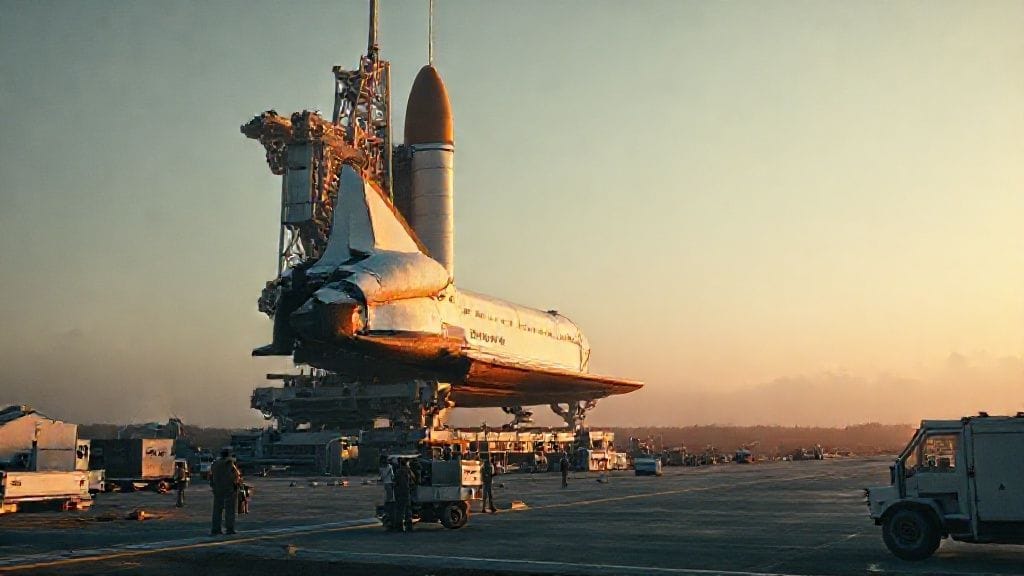
April 12, 1981, began as a chilly, radiant morning at Cape Canaveral, Florida. The early sun cast long shadows over the Kennedy Space Center, illuminating a place forever etched in the dreams of humankind. At 7:00 am, the air buzzed with anticipation as technicians, engineers, journalists, and dignitaries gathered. Their eyes were fixed on the imposing stack of Columbia, the first reusable spacecraft ever built, perched atop the towering launch pad. It was not simply another rocket about to pierce the sky—it was a symbol, a promise of a new era in space exploration.
The Space Shuttle was not only a machine but a leap of faith, a colossal gamble packed into metal and heat-resistant tiles. Its mission, STS-1, would either carve a path to the future or become a somber lesson in the unforgiving theatre of space. As the countdown ticked down, a hushed wonder and palpable tension rippled through the crowd. When engines roared alive and Columbia lifted gently yet powerfully into the dawn, the world held its breath. This was more than a launch—it was the dawn of reusable spaceflight.
2. Behind the Dream: The Vision of a Reusable Spacecraft
The idea of a reusable spacecraft predates Columbia by decades. Visionaries from Konstantin Tsiolkovsky to Wernher von Braun dreamed of vehicles that could make space access more routine and less costly. The 1960s, dominated by the Apollo lunar missions, demonstrated the grandeur and peril of one-shot rockets. NASA realized that to truly inhabit space, they needed a vehicle that could return and fly again—ushering flexibility, frequency, and cost-efficiency.
From the mid-1960s, NASA’s Space Shuttle program emerged as an ambitious effort to reinvent how humans reached orbit. The concept was revolutionary: a winged orbiter capable of landing like a plane, fueled by reusable solid rocket boosters and an external tank designed to be as retrievable as possible. The shuttle was an aircraft, a capsule, and a lab all in one. But beyond technology, this idea spurred dreams of constructing space stations, repairing satellites, and even building interstellar vehicles.
3. The Space Race Legacy: From Apollo to the Shuttle Era
The Shuttle’s birth was inseparable from the Cold War’s turbulent backdrop. The USSR’s Sputnik launch in 1957 kicked off the space race that defined the 1960s and early ’70s. Apollo’s moon landings symbolized American technological supremacy, yet by the ’70s, political will and budgets waned. The United States needed a new vision, something to maintain leadership and justify investment in space exploration amid Vietnam War exhaustion and economic troubles.
The shuttle was that vision—promising to transition from spectacular, infrequent missions to sustainable, practical spaceflight. But this race was different. It stepped away from lunar conquest toward establishing humanity’s permanent presence in orbit. This shift, while innovative, carried immense political stakes and enormous technical risk.
4. Engineering the Future: Challenges of Designing the First Shuttle
Columbia’s engineering was a masterpiece of simultaneous innovation and improvisation. NASA faced problems that defied textbook solutions: How to design heat shields that could withstand 1,650 degrees Celsius during reentry, but could be replaced on the ground efficiently? How to create rocket boosters reusable after surviving 100 tons of thrust firing for two minutes? How to meld airplane-like maneuverability with capsule-style robustness?
Every system—propulsion, avionics, thermal protection—was pushed to its limits. The orbiter’s distinctive black-and-white tiles, a mosaic of over 24,000 pieces, were fragile yet vital. Unbeknownst to the public then, early tests had seen catastrophic failures. The program also wrestled with weight restrictions and cost overruns, forcing cutbacks on payload and crew space.
5. Enter the Crew: The Astronauts Chosen for STS-1
The shuttle’s first astronauts embodied courage and confidence. Commander John Young was a veteran, having walked on the Moon during Apollo 16, bringing an intense professionalism and calm under pressure. Pilot Robert Crippen, younger but equally skilled, completed the duo who would pilot Columbia in unknown skies.
Their training was grueling. They prepared for every conceivable failure—a miracle and nightmare wrapped into one mission. They were the ultimate test pilots, flying a vehicle never before tried in orbit. The weight of history rested on their shoulders; their mission could validate or doom the shuttle program.
6. Liftoff: The Launch of Columbia That Changed Everything
At 12:00 pm EST, the countdown reached zero. Columbia’s main engines thundered to life, and solid rocket boosters roared in unison. The shuttle climbed, shrouded in billowing clouds of steam and flame, moving in graceful ascent against a clear azure sky.
The launch was flawless, an uplifting spectacle witnessed by millions—some live, others on televisions around the globe. It was spaceflight, reborn as accessible rather than extraordinary. Columbia’s climb heralded a new philosophy: space could be a destination repeatedly traveled, not a one-time triumph.
7. Moments of Tension: Technical Hurdles in the Early Flight
Yet the mission was far from smooth. Early telemetry showed worries: damage to thermal tiles during launch threatened reentry safety; engine pressure flags blinked; communication glitches tested ground teams. Young and Crippen’s experience was crucial—they maintained composure while troubleshooting in real time.
These moments underscored the razor-thin margin between success and disaster. “Every second felt like a lifetime,” Crippen would later recall. NASA’s ground control networks worked frenetically, guiding the shuttle through each challenge with tense determination.
8. Touching Earth Again: The Thrill and Terror of Reentry
Reentry was the ultimate test. As Columbia plunged back into Earth’s atmosphere at 25,000 miles per hour, its fragile tile armor would face unimaginable thermal stresses. A single failure could mean catastrophe.
The crew monitored data closely. The shuttle’s heat shield performed impeccably. Columbia glided over California’s Edwards Air Force Base, landing on wheels and bringing the first reusable spacecraft safely back home. The roar of applause and relief was deafening, shared across NASA centers and the world.
9. Immediate Reverberations: Celebrations and Criticisms
News spread rapidly. NASA was hailed for breaking groundbreaking barriers, yet skeptics questioned the shuttle’s cost-effectiveness and safety. Traditionalists doubted the shuttle’s long-term viability given its complexity.
Politicians used the success as a soft power symbol during the Cold War. Public enthusiasm soared, and new contracts for science, defense, and commercial missions flooded NASA’s docket. But behind the scenes, engineers pressed on with improvements—the maiden launch was just the beginning of a long and perilous journey.
10. The Shuttle’s Technological Innovations and Legacy
The shuttle introduced innovations still felt today. Its reusable design influenced spacecraft construction, the assembly of the International Space Station (ISS), and satellite deployment strategies. The orbiter’s partial aircraft abilities brought a new dimension to spaceflight logistics.
Moreover, Columbia showcased the feasibility of frequent missions with substantial cargo, enabling experimental payloads previously unimaginable. Its instrumentation set benchmarks for avionics and human factors engineering.
11. NASA’s Strategic Shift: From Moonshots to Routine Missions
NASA’s mission paradigm evolved drastically. The shuttle was conceived not just as a machine but as a workhorse for space access. Routine flights promised to lower costs and increase experimentation pace.
This shift allowed NASA to focus on Earth observation, life sciences, and materials research, expanding spaceflight’s utility. It marked a gradual transition from heroic conquest narratives to practical exploitation of Earth orbit.
12. Political and Economic Stakes: The Shuttle in Cold War Context
The shuttle was also a geopolitical tool. Amid arms competition and espionage, the U.S. needed a versatile platform to deploy spy satellites and maintain rapid access to orbit.
Economic debates stirred in Congress: the shuttle’s vast upfront cost versus long-term savings. NASA faced constant scrutiny balancing innovation with accountability. The program embodied Cold War tensions and scientific ambition intertwined.
13. From Military Ambitions to Scientific Endeavors
Initially, the shuttle was designed with military objectives in mind—a rapid orbital vehicle to deliver reconnaissance and even weaponry. Over time, it increasingly served international scientific cooperation, including satellite repair, space telescope deployment, and international collaborations on the ISS.
This transition reflected broader political currents toward détente and the recognition that space, while a frontier of competition, also offered shared possibilities.
14. Public Fascination and Cultural Impact of the Shuttle
Columbia’s flight captured imaginations. The shuttle sparked movies, art, education programs, and public discussions about humanity’s place in the cosmos.
Schools followed missions worldwide; children dreamed of astronaut careers. The shuttle’s sleek shape became a cultural icon of the 1980s, a symbol of progress, potential, and adventure.
15. Tragedy, Triumph, and Transformation: The Shuttle Program’s Enduring Story
While the first flight was a triumph, the shuttle program was marred by tragedy—most notably Challenger in 1986 and Columbia in 2003, where disaster struck with devastating human loss.
Yet, each tragedy deeply transformed NASA, leading to reforms that enhanced safety culture and renewed respect for space’s harsh realities. The shuttle became both a monument to human ingenuity and a sobering reminder of its limits.
16. The Global Influence: How the Shuttle Shaped International Spaceflight
The shuttle’s legacy is etched across international space cooperation. Its ability to ferry astronauts from multiple countries fostered partnerships with the European Space Agency, Japan, Russia, and more.
It helped construct the ISS, an unprecedented global endeavor, expanding the shuttle’s reach beyond American ambition to humanity’s shared space home.
17. Modern Spaceflight’s Debt to the Shuttle Era
Today’s new generation of reusable rockets and spacecraft draws heavily on shuttle-era knowledge. Concepts pioneered by Columbia—thermal protection, modular spacecraft, payload versatility—inform SpaceX Falcon 9, Blue Origin’s New Shepard, and NASA’s Artemis program.
The shuttle paved a durable path from exclusive, costly missions to more accessible spaceflight.
18. Reflections from the Crew: Voices from Columbia’s Cockpit
In interviews, John Young recounted the blend of excitement and apprehension. “We were flying a vehicle that had never flown before—a giant leap of faith and preparation.”
Robert Crippen described the mission’s intensity: “Every decision, every gauge mattered. We trusted each other, our training, and our team on the ground.”
Their perspective offers humanity’s heartbeat within gleaming technology.
19. The Shuttle and the Future of Human Exploration
Despite its retirement in 2011, Columbia’s flight remains a beacon. It demonstrated that reusable spacecraft are not fantasy but achievable realities.
The shuttle era laid the groundwork for exploration ambitions—Mars missions, lunar bases, and beyond. The dream of reusable spaceflight is now a cornerstone of humanity’s cosmic future.
Conclusion
The story of the first reusable spacecraft—Columbia’s maiden voyage on April 12, 1981—is more than a chronicle of technology; it is a narrative of hope, risk, and human aspiration. As the shuttle soared into the sky, it carried mankind’s dream of space as a reachable, repeatable frontier. The mission was a testament to ingenuity, teamwork, and relentless courage.
Yet, it also reminded us of the precarious balance between ambition and safety, progress and humility. Columbia’s flight opened a new chapter, one that transformed space exploration from rare exploits into ongoing endeavor. The legacy of the first reusable spacecraft continues to inspire engineers, explorers, and dreamers, propelling humanity toward the stars with each new flight.
FAQs
1. What made Columbia the first reusable spacecraft?
Columbia was designed with a unique thermal protection system and solid rocket boosters that could be recovered and refurbished. Unlike prior capsules, it could land like an airplane and be flown multiple times, marking a fundamental shift in spacecraft design.
2. Why was the space shuttle program developed after Apollo?
Apollo focused on lunar exploration with one-time missions. NASA developed the shuttle to create a reusable, versatile vehicle to lower costs and increase the frequency of orbital flights for scientific, military, and commercial purposes.
3. Who were the astronauts on STS-1 and what was their significance?
Commander John Young and Pilot Robert Crippen were chosen for their extensive flight experience and calm under pressure. Young was a moonwalker, bringing expertise and prestige, while Crippen was a skilled pilot critical for shuttle testing.
4. What were the biggest technical challenges faced during the first shuttle flight?
Managing thermal protection during reentry, verifying engine performance, and ensuring the integrity of delicate heat shield tiles were critical challenges that needed constant monitoring and swift decision-making.
5. How did the shuttle program impact the Cold War space competition?
The shuttle provided the U.S. with a flexible platform for military satellite deployment and rapid space access, strengthening technological leadership and soft power during a tense geopolitical era.
6. How did the atmosphere around space exploration change after the shuttle’s maiden flight?
It shifted from infrequent grand missions to a paradigm of routine, reusable space access, enabling extensive scientific research, cargo delivery, and international collaboration.
7. What is the legacy of the first reusable spacecraft today?
Columbia’s mission laid foundational technologies and philosophies for current and future reusable vehicles, influencing companies and agencies pioneering cheaper, more sustainable space travel.
8. How is the first shuttle mission remembered by those involved?
Astronauts recall it as a blend of fear and elation, pioneering the unknown with meticulous preparation. It remains a deeply human story of trust, skill, and hope.