Table of Contents
- From Highland Valleys to a City of Stone: Setting the Stage for Bogotá
- The Muisca World Before the Conquistadors
- Whispers of Gold and the Spanish March into the Highlands
- Gonzalo Jiménez de Quesada and the Long Road from Santa Marta
- First Encounters: Diplomacy, Fear, and Misunderstanding
- Conquest of Bacatá: The Fall of the Muisca Capitals
- The Day of August 6, 1538: A City Is Proclaimed
- Ceremony on the Savannah: Rituals, Witnesses, and Legal Fictions
- From Bacatá to Bogotá: Names, Symbols, and Erased Memories
- Drafting a New Order: Cabildos, Laws, and the New Kingdom of Granada
- Streets in the Mud: Early Urban Life and Survival at 2,600 Meters
- Faith and Power: Churches, Crosses, and the Battle over Souls
- Muisca Resistance, Adaptation, and the Quiet Wars After Conquest
- Wealth, Tribute, and the Harsh Arithmetic of Empire
- Earthquakes, Famine, and Plague: Fragility of a New Capital
- Bogotá as Nerve Center of the Andes: Roads, Letters, and Laws
- Voices of Dissent: Indigenous Petitions, Priests, and Early Critics
- From Colonial Capital to Cradle of Independence
- Remembering and Forgetting: Myths of the City’s Birth
- Conclusion
- FAQs
- External Resource
- Internal Link
Article Summary: On the cool morning of August 6, 1538, on a high Andean savannah, Spanish conquistadors led by Gonzalo Jiménez de Quesada carried out the legal and symbolic act known to history as the foundation of Bogotá. This article follows the story from the sophisticated Muisca world that existed long before the Spaniards arrived, through the brutal march of conquest, to the moment a new colonial capital was proclaimed at the heart of the New Kingdom of Granada. It explores how the foundation of Bogotá was not just an event but a process—a layering of laws, rituals, and violence that reconfigured power, land, and identity in the central Andes. Through narrative detail, it reconstructs encounters between conquistadors and Muisca leaders, the building of streets and churches, and the emergence of a city that would eventually become Colombia’s capital. Yet behind the familiar heroic myths, it reveals the silenced stories of dispossession, forced labor, and cultural survival. By tracing political ambitions, religious fervor, and human dramas, it shows how the foundation of Bogotá became a pivot in the history of empire in northern South America. In the end, the article reflects on how this city, born of conquest, later helped to undo the very empire that created it, even as its streets still bear the layered traces of that origin.
From Highland Valleys to a City of Stone: Setting the Stage for Bogotá
The story of the foundation of Bogotá begins not with the clang of Spanish armor but with the silence of a high plateau, ringed by mountains and crossed by cold rivers. At more than 2,600 meters above sea level, the Bogotá savannah is a wide, undulating basin cupped within the Eastern Andes of what is now Colombia. Mists drift low over the land in the mornings; the sun, when it pierces through, is bright but not warm. Long before any Spaniard set foot here, this landscape was already humanized—planted, mapped, and filled with sacred places. The foundation of Bogotá would overlay this older world with stone, parchment, and crosses, but it would never entirely erase what came before.
To imagine the valley on the eve of the sixteenth century is to see a dense patchwork of fields and settlements: maize and potatoes, quinoa and beans, tiny raised plots drained by carefully dug canals. Villages lay along ridges and near freshwater lagoons, the homes built of wood and thatch, circular and low to resist the cold. Smoke from hearths rose steadily into the thin air. The people who lived here—the Muisca—knew every curve of the terrain intimately. They had names for hills, streams, and large rocks; they held ceremonies on specific promontories and at dark lagoons where the water seemed bottomless. This was the world into which, in 1537 and 1538, a weary column of Spaniards and their indigenous allies staggered, searching for gold and glory.
When historians speak of the foundation of Bogotá, they often focus on a single date—August 6, 1538—and a single scene: Spanish officers, their scribes, a handful of soldiers, perhaps a priest, gathered on the savannah to erect a crude altar, plant a cross, and declare in the name of the Castilian crown that a city now existed. Yet the meaning of this moment expands far beyond the ritual itself. The foundation of Bogotá formed the political and symbolic core of a new colonial entity, the New Kingdom of Granada, and it is impossible to separate it from the months of violence and negotiation that led up to it, or from the centuries of consequences that followed. From this plateau, roads would eventually radiate out across the Andes, carrying edicts, taxes, and evangelizing friars, as well as news of revolts and dreams of independence.
But in 1538, nothing of this future was guaranteed. The Spaniards who reached the savannah had lost most of their men in jungles and swamps; they were nearly destroyed by hunger and disease. Their victory over the local Muisca rulers was not a given outcome but the result of a cascade of contingency: indigenous rivalries, technological inequalities, the terrifying spread of Old World pathogens. The city they founded was nothing like the capital that would rise centuries later. It was a fragile attempt to anchor imperial authority in unfamiliar soil, a ring of wooden houses and dusty streets laid over the ruins and ritual spaces of Bacatá, the Muisca power center that had once dominated this high basin.
To understand what happened when the banners of Castile were raised over the savannah, we have to move backward—to the Muisca world that predated the Spanish incursion—and then forward again through the march of conquest, the building of the cabildo, and the slow solidification of a colonial city. Only then can we grasp how the foundation of Bogotá transformed not only a landscape but the lives of the people bound to it.
The Muisca World Before the Conquistadors
Before the arrival of Europeans, the region that would become Bogotá was at the heart of one of the most complex societies in northern South America. The Muisca, speakers of a Chibcha language, inhabited the high plateaus of the Eastern Cordillera, stretching from the area around present-day Tunja in the north to the valley of what is now Bogotá in the south. Their territory was not an empire in the Inca sense, but a mosaic of chiefdoms bound together by trade, kinship ties, and religious commonalities. Power was concentrated in at least two major political centers: Hunza (near modern Tunja), ruled by the zaque, and Bacatá, under the authority of the zipa. The future site of Bogotá lay within the dominion of the zipa.
Life in this world revolved around the cycles of agriculture and ritual. The altiplano’s harsh climate demanded careful planning: the Muisca cultivated different crops at slightly different elevations, using a variety of microclimates to cushion against frosts and droughts. They built raised fields and drainage systems, ensuring that their crops would not rot in flooded ground after the heavy rains. Salt was a key resource, extracted from brines and traded widely; so too were cotton textiles, emeralds from mines in the nearby mountains, and beautifully worked gold and tumbaga ornaments. Contrary to later myths that exaggerated their abundance, the Muisca were not drowning in gold, but they deployed it lavishly in religious ceremonies and elite adornment.
Spanish chroniclers, often writing decades after the conquest, were both impressed and puzzled by this society. Juan de Castellanos, in his long poetic chronicle, and later historians such as Lucas Fernández de Piedrahita, attempted to describe Muisca institutions using European categories—kings, nobles, priests—yet much escaped them. Political power was diffuse, rooted in clan networks; succession rules could be complex, sometimes favoring the sister’s son over the ruler’s own son. Priests oversaw temples and sacred lakes, offering tunjos—small gold figures—as votive offerings. In places like Lake Guatavita, they performed rituals so spectacular that they would later fuel the Spanish legend of El Dorado, the gilded man.
Bacatá itself was not a city in the European sense but a core settlement and surrounding cluster of communities, fields, and ceremonial spaces. The zipa’s residence and principal temple were nodes within a broader landscape of power. Roads—really footpaths etched by centuries of movement—linked Bacatá to other Muisca centers. Messengers carried news; traders moved salt, cotton, and metal goods along these routes. By the early sixteenth century, the Muisca had also experienced their own share of upheavals: internal wars between factions, shifting alliances, and perhaps already the distant echoes of epidemics carried overland from earlier Spanish incursions on the Caribbean coast.
This, then, was the world that the foundation of Bogotá would displace. The savannah of Bogotá was already named, ordered, and sacred. Hills that the Spaniards would one day crown with churches—like the one they would call Monserrate—were already charged with meaning. When the Spanish later claimed that they had founded a city on empty land, they erased centuries of Muisca presence from the story. Yet even as they built their colonial institutions, they continued to rely, often unknowingly, on indigenous roads, labor, and knowledge systems. The new city would grow, paradoxically, out of the very world it claimed to supersede.
Whispers of Gold and the Spanish March into the Highlands
The immediate spark for the Spanish intrusion into the Muisca highlands was not a carefully laid imperial plan but rumor, greed, and the restless ambitions of men on a distant Caribbean shore. In the early 1530s, the Spanish crown’s foothold in northern South America was limited mainly to scattered coastal settlements like Santa Marta and Cartagena. Much of the interior remained, from the Europeans’ perspective, unknown—a space into which they projected fantasies of inexhaustible gold. Tales of rich inland kingdoms had long circulated among indigenous groups, moving across trade routes. Spaniards, adept at listening for such rumors and then inflating them, soon wove them into a larger narrative of opportunity.
Among the most tantalizing of these stories was that of a powerful lord who, during an initiation ceremony, would cover himself in gold dust and plunge into a sacred lake while his subjects threw offerings of gold and emeralds into the water. This image—part reality, part myth—would crystallize into the legend of El Dorado. It is astonishing, isn’t it, how a ritual about reciprocity between rulers, people, and sacred forces could be translated, in Spanish minds, into a simple shorthand for a place where gold lay waiting to be taken? For the officials in Santa Marta, desperately seeking wealth to justify their precarious colony, the rumor was irresistible.
By 1535, the governor of Santa Marta, Pedro Fernández de Lugo, authorized an expedition into the interior, granting the command to a lawyer-turned-conquistador named Gonzalo Jiménez de Quesada. The mission’s official purpose was to explore and pacify the lands to the south, in the name of King Charles I. Its unofficial goal, understood by every man who signed on, was to find gold whatever the cost. Jiménez de Quesada assembled several hundred Spaniards, along with thousands of indigenous auxiliaries and enslaved Africans forced to carry supplies, navigate rivers, and bear the brunt of the suffering.
The path ahead was barely charted. The Magdalena River offered a road into the heart of the continent, but it was a hostile route: dense jungles, swarms of insects, sudden floods, and the constant threat of attack from indigenous groups angered by earlier Spanish violence. Disease decimated the ranks; hunger drove the men to desperation. Later chroniclers, including Jiménez de Quesada himself in his Relación, would portray the journey as a near-miraculous feat of endurance, a trial that separated true conquistadors from the weak. Yet these accounts often obscure how much the expedition depended on indigenous guides, coerced porters, and interpreters—people whose names we seldom know, but without whom the march would have failed.
As the column pushed inland, the landscape slowly began to climb. Sweltering jungles gave way to cloud forests, then to the cooler elevations of the cordillera. The path narrowed; mules slipped on muddy slopes; men coughed in the thinning air. Along the way they raided villages, seized food, and left a trail of resentment. But they also heard, again and again, of rich lands higher up, where people wore fine cotton, used gold ornaments, and lived in well-organized settlements. Every rumor of wealth pushed them forward. By the time they reached the approach to the Muisca plateau in 1537, their numbers had shrunk drastically. Those who remained were hardened, desperate, and determined to make their suffering pay.
They would soon emerge onto a landscape that seemed, to their eyes, almost made for a European-style city: a broad, gently sloping plain with ample water, relatively mild temperatures, and dense populations whose labor and tribute could, if subdued, sustain a colonial capital. The foundation of Bogotá was born, in a sense, on that long road—in hunger, violence, and the obsessive pursuit of a golden dream.
Gonzalo Jiménez de Quesada and the Long Road from Santa Marta
To understand the choices made at the foundation of Bogotá, one must look closely at the man who stood at the center of the ceremony: Gonzalo Jiménez de Quesada. Unlike some of his peers, Jiménez de Quesada was not a low-born adventurer. Born around 1509 in Granada, in southern Spain, he trained in law before crossing the Atlantic. This legal background would shape his actions in subtle ways. He was well aware that conquest in the sixteenth-century Spanish world needed to be cloaked in legality. Founding a city, creating a cabildo, writing formal acts—these were not mere administrative details but weapons in the struggle for recognition, titles, and rewards from the crown.
When he left Santa Marta in 1536 or 1537 (chronologies differ slightly), Jiménez de Quesada commanded an expedition that combined military power with legal authority. He carried royal licenses and vague instructions that he would later interpret as broadly as possible. As months passed and the suffering of the march mounted, he likely understood that only a spectacular success—an abundance of gold, a submissive and populous land, and above all, the foundation of a major city—could redeem the losses and secure his reputation. Failure meant returning to the coast impoverished, perhaps disgraced, and certainly contested by rivals.
On the high plateau, he found both opportunity and danger. The Muisca chiefs commanded substantial resources and could mobilize warriors quickly. The Spaniards’ steel weapons, horses, and firearms gave them a sharp edge, but numbers were not entirely in their favor, and they were far from any coastal support. Jiménez de Quesada’s strategy mixed intimidation with negotiation. He sought to present himself as an emissary of a distant but powerful king, offering protection to those who submitted and destruction to those who resisted.
Here his training as a lawyer became particularly useful. Like other conquistadors, he relied on a legal ritual known as the Requerimiento: a document, read aloud in Spanish to bewildered indigenous audiences, that explained—at least formally—the basis of Spanish claims. It demanded that local inhabitants accept the authority of the Pope and the king of Castile, under threat of war, enslavement, and dispossession. The absurdity of reading such a text in a language no one understood was apparent even to some contemporaries, yet in the eyes of the Spanish legal system it provided a thin veneer of legitimacy. The same mentality would later shape the foundation of Bogotá, where the act of writing a founding document and forming a council of settlers marked, at least on paper, the birth of a lawful city.
Jiménez de Quesada was also acutely aware that he was not the only Spanish leader pushing into the interior. Other expeditions, led by men like Sebastián de Belalcázar from Quito and Nikolaus Federmann from the east, were also moving toward the Muisca highlands. The race to occupy and legally claim the most promising lands was intense. In this context, establishing a capital—naming it, drawing its boundaries, creating legal offices—was a way of staking an unambiguous claim before rivals could do the same. The foundation of Bogotá was therefore not only the subjugation of Muisca lands but a maneuver in the competitive chessboard of Spanish colonial expansion.
Years later, Jiménez de Quesada would write accounts justifying his actions and highlighting his role as a loyal servant of the crown. But on August 6, 1538, as he stood on the savannah, he could not know whether the city he founded would endure or crumble. He could only hope that this act—the formal creation of a municipal body in the style of Castilian towns—would give the chaotic and brutal conquest a shape that the monarchy could recognize and reward.
First Encounters: Diplomacy, Fear, and Misunderstanding
The first contacts between the Spaniards and the Muisca were tense, confusing, and sometimes strangely ceremonial. Scouts from both sides watched each other from a distance. The Muisca had heard rumors of these strange men—bearded, pale, riding animals they had never seen before—long before they actually appeared on the plateau. Reports had filtered up from peoples along the lower slopes of the Andes who had suffered the ravages of Spanish forays. Fear and curiosity mingled in equal measure.
Initial meetings often followed a cautious choreography. The Muisca sent envoys carrying food—maize cakes, chicha (a fermented maize drink), and salt—as well as small gold ornaments, more as gestures of diplomacy or attempts to redirect the strangers’ path than as tributes in the European sense. The Spaniards, conditioned to see such offerings as signs of submission, interpreted them as the first fruits of conquest. They demanded more: more gold, more labor, more signs of obedience. Behind the gestures of friendliness, there was calculation on both sides. The Muisca sought to gauge these invaders’ intentions and strength; the Spaniards sought to probe the political fault lines among local rulers.
Misunderstandings were almost inevitable. Simple acts—a Muisca chief withdrawing to consult his council, a Spanish captain mounting his horse to show authority—could be read as signs of treachery or defiance. The Spaniards quickly realized that the Muisca political landscape was fractured; rivalries existed between different caciques and between the northern and southern blocks of the confederation. They exploited these divisions ruthlessly. Reports in later chronicles describe certain chiefs allying, at least temporarily, with the newcomers to weaken their enemies, offering guides or information in hopes of later advantage. If so, they miscalculated the scale of the threat. The Spanish presence, once anchored by a city, would not be a temporary ally but a permanent overlord.
There were also spiritual misunderstandings. Crosses erected by the Spaniards, images of the Virgin, and the theatrical reading of the Requerimiento were meant to mark the land symbolically and to intimidate. Muisca priests and elders, for their part, turned to their own sacred sites and rituals, seeking omens and divine guidance. Some sources mention that eclipses and other unusual sky phenomena during these years were interpreted as warnings or portents. Each side read the world through its own cosmology, even as they were forced to grapple with the physical reality of the other’s power.
Yet not all encounters were immediately violent. There were moments of careful negotiation, of bilingual exchange through hastily recruited interpreters, of shared meals. It is easy to forget, amid the larger narrative of conquest, that individuals on both sides must have experienced powerful emotions: shock at the sight of unfamiliar technologies, fascination with foreign dress and customs, and haunted recognition that their world was changing irrevocably. The foundation of Bogotá would later compress these months of complex human contact into a single story of Spanish triumph. But beneath that neat narrative lay a messier history of fear, hope, bargains, and betrayals.
Conquest of Bacatá: The Fall of the Muisca Capitals
The decisive step that made the foundation of Bogotá possible was the military and political collapse of Bacatá and its ruling structure. The zipa who faced the Spanish incursion, often identified as Tisquesusa, had inherited a fragile position. He commanded warriors and prestige, but his authority, like that of all Muisca leaders, rested on a network of alliances and reciprocal obligations. The arrival of the Spaniards—armed with steel swords, crossbows, and horses, and accompanied by indigenous contingents seeking advantage—threw this balance into chaos.
The exact sequence of battles and skirmishes remains tangled in the sources, but some contours are clear. After probing movements and initial clashes, the Spaniards pressed toward the heartland of Bacatá. The Muisca deployed large numbers of warriors, armed with spears and clubs, reinforced by protective cotton armor. They fought fiercely, making use of the terrain they knew so well. Yet the shock of horses—animals that seemed at first glance to merge man and beast into a single terrifying creature—combined with Spanish tactics and weaponry, produced demoralizing defeats. In one of the key confrontations, the zipa himself is said to have been mortally wounded, either in battle or while fleeing into the surrounding hills.
With the political center decapitated, Spanish forces moved to occupy the main settlement areas. Temples were looted; storehouses were emptied; gold ornaments, carefully crafted by Muisca artisans over generations, were seized and melted down into bars for easier transport and accounting. The invaders demanded information about further sources of wealth, pressing local leaders and priests to reveal the location of sacred artifacts and hidden caches. Each surrendered piece of gold intensified the Spaniards’ conviction that they had indeed stumbled onto a land of riches, even as they overlooked the fact that Muisca society’s wealth was as much in its social organization and ecological knowledge as in its metal.
Yet conquest was not merely the seizure of objects; it was the progressive transformation of authority. Surviving local leaders were pressured to accept baptism and to acknowledge Spanish overlordship. They were drawn, sometimes forcibly, into the encomienda system, in which Spaniards received rights to indigenous tribute and labor in exchange for promises—often weakly fulfilled—to provide protection and Christian instruction. The people of Bacatá, who had once owed their allegiance to the zipa, now found themselves under the fragmented authority of multiple Spanish encomenderos and officials, each with their own demands.
In this moment of disarray, Jiménez de Quesada saw the possibility not only of plunder but of permanent settlement. The savannah’s fertile fields, the density of its population, and its central location made it ideal as a seat of Spanish power. Instead of simply raiding and leaving, he would root himself and his men in the land. To do that, he needed more than military victory; he needed a legal act of foundation that would convert a conquered indigenous capital into a recognized Spanish city.
The Day of August 6, 1538: A City Is Proclaimed
August 6, 1538—the traditional date given for the foundation of Bogotá—dawned, we can imagine, with the thin, bright light characteristic of the Andean highlands. The air was cold; breath hung in front of men’s faces as they gathered on the savannah. Around them, the land still bore the traces of recent violence: Muisca houses abandoned or repurposed, fields worked by hands now tied to new masters, temples stripped of their treasures. Yet amid this uneasy calm, a different kind of performance was about to unfold: not a battle, but a ceremony of words.
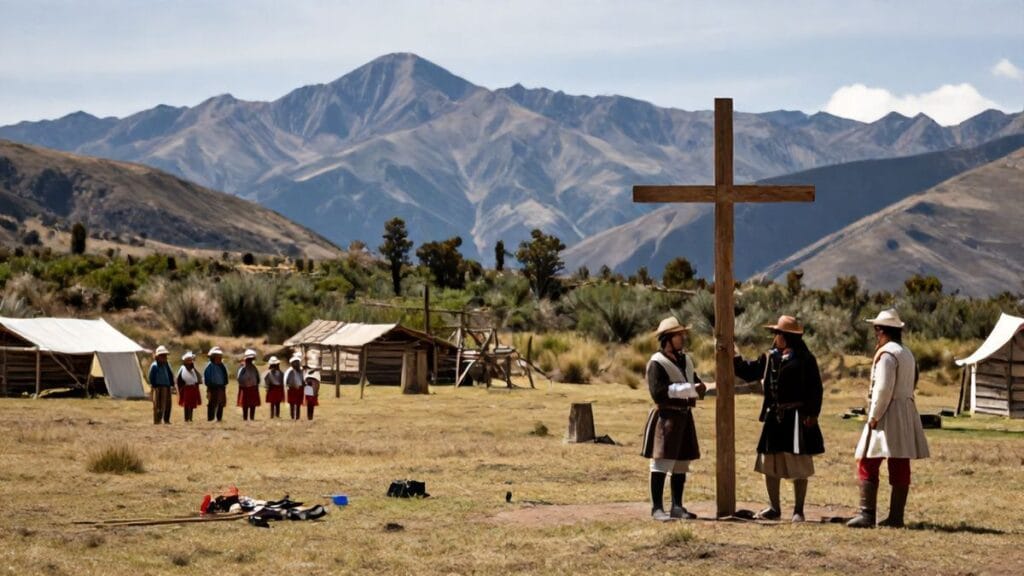
According to later accounts, Jiménez de Quesada assembled his surviving Spaniards, along with indigenous notables pressed into service as witnesses, on a chosen site that would become the heart of the new city. A cross was erected, likely made of local wood hastily cut and bound. An improvised altar might have been set up, draped with cloth and adorned with whatever religious images the expedition still possessed. If a priest was present—and most sources suggest there was—he would have offered a Mass or at least prayers, invoking divine favor on this fragile outpost of Christendom.
The core of the event, however, was secular and legal. A notary, pen in hand, began to write the act of foundation, recording the date, the place, and the names of those present. Jiménez de Quesada declared, in formal language, that a new city was hereby founded in the name of the king of Castile and of God. He announced its name—initially “Nuestra Señora de la Esperanza” or “Santa Fe,” according to some sources, though over time it would be known as Santa Fe de Bogotá. He defined its basic layout, designating a central plaza, lots for public buildings, and parcels for individual settlers. These lines, at first only words on a page and marks on the ground, would later become the rigid grid of streets and blocks that still shapes Bogotá’s historic center.
To give this fledgling city a civic life, he appointed a cabildo—a municipal council—composed of Spanish vecinos (recognized male householders), who would serve as regidores and alcaldes. These men, few in number but ambitious, now held the formal authority to regulate markets, oversee urban order, and represent the city before higher officials. Their names, scribbled in the foundation act, became those of the city’s founders, preserved in colonial memory. The indigenous inhabitants of the region, who vastly outnumbered these newcomers, appeared in the document only as a vague background: tributaries, laborers, subjects.
It is striking how quickly this ceremony, which likely lasted only a few hours, attempted to fix in place a new order. With the reading of a text, the drawing of a few lines, and the naming of offices, a conquered Muisca landscape was recast as Castilian urban space. Of course, on the ground, little changed immediately. The same fields still produced maize and potatoes; the same hills framed the horizon. But in the eyes of the Spanish crown, the foundation of Bogotá signaled that the New Kingdom of Granada now had a capital, a node from which royal authority—and the church’s influence—could expand.
Spanish chroniclers would later elevate this day into a foundational myth, a moment of heroic creation. They did not dwell on the absences: the Muisca leaders killed, the temples destroyed, the voices that did not consent. Yet even within their narratives, one can glimpse the tensions of that morning. The men gathered for the ceremony were exhausted survivors of a brutal campaign, surrounded by a population they had subdued but not fully understood, standing on land still wet from the upheavals of war. The city they proclaimed was as much an aspiration as a reality—an imagined stone future traced onto a valley of earth and memory.
Ceremony on the Savannah: Rituals, Witnesses, and Legal Fictions
Colonial Spanish culture was steeped in ritual, and the foundation of Bogotá drew on that tradition in full. Every gesture on the savannah had a double meaning: it structured human relations in the present and projected a legal fiction into the future. The planting of the cross, for instance, was not merely an act of devotion but a claim of spiritual jurisdiction. By asserting that the land was now under the sign of Christianity, the Spaniards reinforced their argument that those who rejected their rule were not just political opponents but rebels against the true faith.
The notarial record, too, carried enormous weight. In sixteenth-century Spain, cities were engines of law. They had charters, privileges, and recognized rights; they served as intermediaries between the crown and local populations. To inscribe Bacatá’s land as a city—Santa Fe de Bogotá—was to plug it into a preexisting web of legal norms. As historian Jorge Orlando Melo and others have noted, such acts of foundation were often retroactively adjusted or reinterpreted. But what mattered was that a documentary anchor existed. In an empire held together by paper and memory as much as by steel, the parchment written that day on the savannah gave Bogotá a birth certificate.
Indigenous witnesses, who were almost certainly present, would have seen a familiar pattern—ritualized action marking a shift in power—but expressed in alien forms. The Muisca themselves had ceremonies for installing a new zipa or consecrating a sacred site. These involved offerings, processions, and the invocation of ancestral and divine forces. The Spanish ritual echoed this structure, yet replaced Muisca deities with the Christian God and saints, and substituted legal formulas for ancestral myths. It is possible that some Muisca attendees, seeing the cross raised and hearing the mass, interpreted this as another powerful ritual to be respected, even if they did not grasp its full implications.
One of the more poignant aspects of such ceremonies is the way they obscured the asymmetry of understanding. The Spaniards knew exactly what they were doing in legal terms; they had decades of experience in the Americas translating such rituals into royal recognition and personal rewards. The Muisca, though experienced diplomats in their own right, had no reason to believe that a single morning’s performance would permanently transform their land into someone else’s city. For them, the new city might have seemed at first like a fortified encampment, another powerful but perhaps transient presence among many.
Yet the legal fiction created that day hardened over time. The act of foundation would be cited in future disputes over land, jurisdiction, and hierarchy. When other Spanish captains—such as Sebastián de Belalcázar and Nikolaus Federmann—arrived in the highlands, they found that Jiménez de Quesada had already wrapped the savannah in the protective cloak of a legally founded city. The subsequent quarrels among the three leaders, arbitrated in part by written records and royal appointments, hinged on who could claim to have truly founded and organized the region.
In this sense, the foundation of Bogotá was less a spontaneous birth than a carefully staged performance of sovereignty. The rituals on the savannah stitched together faith, law, and force, transforming conquest into an act that the monarchy in faraway Spain could accept, reward, and fold into the growing tapestry of its American empire.
From Bacatá to Bogotá: Names, Symbols, and Erased Memories
Names carry histories, and the shift from Bacatá to Bogotá encapsulates the deeper transformations unleashed by the foundation of Bogotá. The word “Bacatá” referred, in the Muisca language, to a specific political and territorial unit, linked to the authority of the zipa and to a network of sacred and economic sites. When the Spaniards began using “Bogotá,” they were both mishearing and repurposing that indigenous term. The new name, attached to a Spanish-style city—Santa Fe de Bogotá—symbolized the overlay of one system of meaning upon another.
On maps drawn in Europe, “Bogotá” soon appeared as a point, marked by a small sketch of towers or a simple dot with a cross. Its indigenous antecedent, Bacatá, disappeared from most official documents, surviving only in scattered references within chronicles. The land that had been structured by Muisca concepts of sacred space and clan territories was redivided into encomiendas, parishes, and later corregimientos. Hills were renamed for Christian saints; lakes once associated with ancestral rituals became the object of mining and drainage schemes.
Symbolic transformations accompanied this cartographic one. The central plaza of the new city—traced over or near key Muisca ceremonial spaces—became the stage for colonial authority. Here, Spanish officials would ride in processions, royal edicts would be read aloud, and public punishments would be carried out. The cathedral rose where a temple or important Muisca structure likely once stood. Each stone laid in its foundations was, in a sense, a statement that the old world had ended and a new one had begun.
Yet erasure was never total. Many of the early Spanish settlers took Muisca women as partners, whether by force or through negotiated arrangements, leading to generations of mestizo descendants who carried fragments of both worlds. Indigenous communities persisted on the outskirts of the city, cultivating fields and maintaining certain rituals in secret or in syncretic forms. Toponyms in and around Bogotá—Suba, Usaquén, Fontibón—preserved echoes of the Muisca linguistic landscape. Even as official narratives celebrated the Spanish founders, the daily life of the region remained deeply entangled with indigenous practices.
The new name, Bogotá, thus came to stand for a layered identity. It signified a colonial capital in the eyes of the crown, a place from which laws and tributes emanated. For local inhabitants, it was a site of opportunity and oppression, of cross-cultural encounters and forced transformations. Over centuries, as the city grew and the memory of Bacatá receded into legend, efforts to recover the indigenous past would periodically resurface. Nineteenth- and twentieth-century intellectuals, seeking national roots, began to speak again of the Muisca and of Bacatá as the buried antecedent of Bogotá. In doing so, they implicitly acknowledged that the city’s origin story was more complex than the simple heroic tale of a Spanish foundation day.
Drafting a New Order: Cabildos, Laws, and the New Kingdom of Granada
The immediate aftermath of the foundation of Bogotá involved the slow, sometimes chaotic process of turning a conquest camp into an urban polity. The cabildo, or municipal council, created during the founding ceremony, held its early meetings in crude conditions—likely in a hastily constructed building near the central plaza or even in an adapted indigenous structure. Its members deliberated over issues both mundane and momentous: how to distribute the first house lots, where to locate the church, how to regulate markets, and how to allocate indigenous tribute among the conquistadors.
The legal framework for these decisions came from Spanish municipal traditions, adapted to American realities. Town ordinances were drafted, often borrowing language from other recently founded cities. The plaza was declared a space for public gatherings and trade; streets were supposed to follow a grid, with equal-sized blocks—a vision that clashed at first with the organic layout of existing Muisca settlements. Religious space was also planned carefully. The first church structure, modest and built of local materials, marked the city’s spiritual center. Over time, monasteries and convents would join it, bringing with them not just liturgical routines but schools, scriptoria, and hospitals.
At a higher level, the crown and its representatives moved to formalize the larger jurisdiction. The region around Bogotá would be designated the New Kingdom of Granada—a name that linked this Andean land to Granada in Spain, the last Muslim stronghold reconquered by the Catholic Monarchs in 1492. The parallel was not accidental. Just as Granada had symbolized the triumph of Christianity over Islam in Iberia, so too would this new Granada in the Americas represent the extension of Christian monarchy over indigenous “pagans.” Bogotá, as its capital, stood as a monument to this ideological continuity.
Royal governors and, later, presidents of the audiencia (a high court and administrative body) were appointed to reside in Bogotá. Their arrival added another layer of authority to the city’s crowded hierarchy. Tensions between municipal autonomy and royal oversight emerged early. The original conquistadors and settlers, who had risked their lives to seize the land, expected extensive privileges and control over local decisions. Crown officials, however, were charged with curbing their excesses, ensuring that indigenous populations were not completely destroyed, and channeling a steady flow of tribute and gold to Spain.
Within this structure, indigenous communities found themselves forced to maneuver carefully. Some local leaders sought recognition through the Spanish legal system, traveling to Bogotá to present petitions or to confirm their titles as caciques. Others resisted more quietly, bypassing markets, hiding part of their harvest, or maintaining banned rituals away from inquisitive friars. The city thus became not only the nerve center of colonial power but also a place where indigenous voices occasionally spoke back, however constrained, to the apparatus that had been erected over their world.
Streets in the Mud: Early Urban Life and Survival at 2,600 Meters
For all the splash of ceremony and the gravitas of law, the early Bogotá was, in physical terms, a humble and fragile settlement. The savannah, while fertile, turned easily to mud under the frequent rains. Wooden houses with thatched roofs lined the first dirt streets, their walls made from a mix of timber and adobe. Smoke from cooking fires seeped through roofs and doorways. Pigs, chickens, and dogs roamed freely, contributing to a cacophony of sounds and smells that would have been familiar in most colonial towns but especially intense in this confined Andean enclave.
Settlers lived precariously. Food supplies, at least initially, depended heavily on the forced labor and tribute of nearby Muisca communities, who continued to cultivate their fields under new masters. Spanish agriculture—wheat, barley, and European vegetables—was introduced onto the plateau with mixed success. The altitude posed challenges for unfamiliar crops and animals, and adaptation took time. When harvests failed or tribute deliveries were delayed, hunger returned, a grim reminder of the hardships of the expedition that had brought them here.
Social life revolved around a small number of key spaces. The central plaza, still uneven and muddy, hosted markets where indigenous women and men sold maize, potatoes, and crafts. Spanish settlers bartered and bought, often on credit, as coins were scarce. Taverns and pulperías (small shops) appeared, serving wine, chicha, and later aguardiente, becoming hubs of gossip, deals, and disputes. The church—simple but symbolically dominant—marked times not by crops alone but by the Christian calendar: Sundays, saints’ days, and processions punctuated daily routines.
Class and racial hierarchies took shape quickly. At the top were the original conquistadors and early officials, many of whom claimed the best lots near the plaza. Over time, merchants, artisans, and lesser soldiers formed a middling stratum. Indigenous people and enslaved Africans bore the heaviest burdens: building houses, maintaining roads, working in nearby mines, and serving in households. The city’s early days were marked by a constant churn of arrivals and departures, as some Spaniards left for new expeditions or returned to the coast, while others came from nearby regions drawn by the promise of opportunity.
Despite its small size, the city was already a place of dreams and disappointments. For some, Bogotá represented a chance to reinvent themselves far from the rigid class structures of Spain. For others—especially the Muisca and other indigenous groups forced to carry its weight—it embodied loss: of land, of relatives to disease and violence, of cultural autonomy. The foundation of Bogotá may have been sealed in a legal act, but its true consolidation was written in mud, sweat, and the slow accumulation of ordinary days spent surviving the cold Andean air.
Faith and Power: Churches, Crosses, and the Battle over Souls
Religion was not a mere ornament to the colonial order; it was one of its driving engines. From the moment of the foundation of Bogotá, priests and friars claimed a central role in the city’s life. The first parish church, likely dedicated to Our Lady or a prominent saint, doubled as meeting place, school, and court of conscience. Bells, when they could finally be cast and hoisted, marked time as much as the rising and setting of the sun. Confessionals stood as quiet theaters where indigenous and Spanish alike were expected to lay bare their consciences and conform to a new moral code.
Missionary efforts directed at the Muisca and other indigenous communities around Bogotá accelerated in the years following the city’s foundation. Franciscan and Dominican friars established bases in and near the city, learning local languages and compiling vocabularies to aid in catechism. They destroyed idols and burned ceremonial paraphernalia, viewing them as tools of the devil. Temples were torn down or repurposed; sacred groves were cut back. At the same time, missionaries provided some protection to indigenous communities against the worst abuses of encomenderos, denouncing excessive labor demands or overt cruelty.
This dual role—both oppressive and occasionally protective—made the church a complex presence in colonial Bogotá. On one hand, it justified conquest by framing it as a divine mandate to bring salvation to “infidels.” On the other, some clergy became early critics of colonial excess, echoing the arguments of figures like Bartolomé de las Casas, who, in his famous “Brevísima relación,” condemned the brutal treatment of indigenous peoples in the Americas. Although Las Casas himself was more closely associated with the Caribbean and Central America, his critiques resonated across the empire and influenced debates about the treatment of indigenous populations in places like the New Kingdom of Granada.
Within the city, religious life blurred the lines between European and indigenous practices. Festivals in honor of saints often absorbed local rhythms, foods, and even deities, rebranded in Christian clothes. Processions wound through streets that overlay old Muisca paths, carrying images of Christ and the Virgin past fields where older prayers might still be whispered unnoticed. Indigenous converts, coerced or willing, joined confraternities; some rose to positions of minor church authority in their parishes. Over generations, a distinct Andean Catholicism emerged, rooted in Bogotá’s parishes and missions—marked by Baroque devotions, local miracles, and a constant undercurrent of pre-Hispanic memory.
In the city’s symbolic landscape, church towers soon became as prominent as any civic building. From them, one could look out across the savannah and imagine that the cross had indeed conquered the land. But even as religion provided a framework for the new colonial order, it also carried within it the seeds of future challenges. Ideas about justice, Christian charity, and the dignity of all souls, once internalized by indigenous and mestizo populations, could be turned against a system that preached equality before God but practiced stark inequality on earth.
Muisca Resistance, Adaptation, and the Quiet Wars After Conquest
The fall of Bacatá and the foundation of Bogotá did not mark the end of Muisca history. Instead, they opened a long chapter of resistance and adaptation, much of it fought not on open battlefields but in fields, courts, and families. Some Muisca leaders fled the immediate vicinity of the city, regrouping in more distant communities and attempting to preserve older ways of life. Others accepted baptism and nominal submission, using their positions as recognized caciques within the colonial system to shield their people where possible.
Resistance took many forms. There were episodes of open revolt, especially when demands for tribute and labor became unbearable. Groups might refuse to deliver maize or textiles, or they would vanish into the hills when corvée labor teams arrived. Retreat into more remote or marginal lands was a common strategy across the Americas, and the mountainous geography around Bogotá offered many such refuges. Yet retreat had its own costs, cutting communities off from prime agricultural land and trade routes.
Legal resistance, though constrained, also emerged early. Indigenous leaders, sometimes aided by sympathetic friars, traveled to Bogotá to lodge complaints before the cabildo or visiting royal officials. They argued that certain encomenderos were violating the king’s laws limiting labor demands or abusing their people. Such petitions did not always succeed, but they occasionally resulted in sanctions or the reassignment of encomiendas. Each case added to the growing archive of indigenous voices preserved, however imperfectly, in colonial records. Historian Karen Spalding and others have argued that this kind of legal bargaining constituted a form of ongoing, if subtle, resistance to total domination.
Cultural adaptation proceeded alongside these struggles. Many Muisca adopted aspects of Spanish dress, especially in contexts where doing so signaled status or facilitated negotiation. Christian names appeared in baptismal registers, often paired with older indigenous ones that persisted informally. Agricultural practices blended old and new crops; musical traditions fused European instruments with native rhythms. Some Muisca artisans learned European artistic techniques, contributing to the distinctive colonial art of the region, in which saints and angels sometimes bore faint traces of Andean physiognomy and environments.
Yet there was also loss on an immense scale. Epidemics of smallpox, measles, and other Old World diseases tore through the population, often striking hardest at those who lived closest to the new urban center and trade routes. Demographers estimate that within a century of conquest, Muisca populations had fallen dramatically, perhaps by as much as 70–80 percent. Entire lineages disappeared; certain rituals died with their last practitioners. The foundation of Bogotá, while remembered as the birth of a city, was thus also a turning point in a demographic catastrophe whose scars still mark the region’s social fabric.
Wealth, Tribute, and the Harsh Arithmetic of Empire
If the foundation of Bogotá provided a political and symbolic center for the New Kingdom of Granada, its economic logic was driven by a relentless quest for extractable value. The first generation of conquerors expected quick rewards in the form of gold and indigenous tribute. When easily accessible gold proved more limited than rumors had suggested, attention turned to systematic exploitation of local labor and resources.
The encomienda system lay at the heart of this extraction. Spaniards who had participated in the conquest received grants assigning them the tribute of specific indigenous communities. In theory, this was not ownership of land or people but a temporary right to receive labor or goods, accompanied by the obligation to instruct and protect their assigned communities. In practice, encomenderos treated their charges as a largely disposable labor force. Men were conscripted to work not only in local fields but also in distant mines and infrastructure projects, often under brutal conditions. Women and children bore the weight of maintaining households and provisioning the city alongside their own subsistence.
Bogotá’s position on the savannah made it a hub for agricultural surplus. Maize, potatoes, and tubers flowed in from surrounding indigenous communities, while Spanish-introduced wheat and livestock began to transform the landscape. Cattle and sheep grazed on lands that had once supported diverse cropping systems, trampling delicate irrigation channels. Over time, Spanish-style estates—haciendas—emerged, consolidating land into the hands of a relatively small group of colonial elites. Muisca communities, pushed to less favorable plots or forced into tenant arrangements, saw their autonomy shrink further.
Trade connected Bogotá to broader Andean and Caribbean circuits. From the nearby emerald mines, coveted green stones made their way through the city’s markets, destined for Spain and beyond. Silver, though not as abundant here as in Peru or Mexico, still played a role. Bogotanos exported hides, textiles, and some agricultural products, while importing European goods—iron tools, wine, fine cloth, and religious images. Merchants, not just soldiers, became key figures in the city’s growth, weaving together networks of credit and patronage that bound highland producers to coastal exporters and ultimately to Atlantic markets.
For the crown, the New Kingdom of Granada was one piece in a larger imperial puzzle. Officials in Bogotá were required to ensure a steady flow of royal fifths (the quinto real, a 20 percent tax on precious metals) and other levies. Tax records, meticulously kept, reveal the harsh arithmetic of empire: people, land, and resources translated into numbers on a ledger. When revenues fell—due to epidemics, local resistance, or mismanagement—crown officials responded with new regulations and visits of inspection, sometimes punishing local elites for corruption, sometimes squeezing indigenous communities further.
Amid this extractive system, not all wealth was material. Knowledge, too, flowed toward the city. Clerics compiled grammars and catechisms in Muisca; officials gathered information on geography, flora, and fauna to send back to Spain. Bogotá became a place where the empire’s hunger for information intersected with its hunger for gold, each feeding the other. Reports sent from the city helped shape European understandings—often distorted—of the Andean interior, reinforcing the view that places like Bogotá were valuable primarily as sources of tribute and souls to be converted.
Earthquakes, Famine, and Plague: Fragility of a New Capital
The image of a city founded in ceremony and bolstered by law can make Bogotá’s early decades seem more stable than they were. In reality, the new capital was perpetually on the edge of disaster. Nature itself seemed at times to rebel against the intrusive order the Spaniards sought to impose. The highlands are a seismically active region; earthquakes were a recurring threat. Early churches and houses, built with limited knowledge of local tectonics, cracked and collapsed during strong tremors, forcing repeated rebuilding efforts. Each quake was interpreted by many as a divine message, a warning or punishment that had to be answered with processions, penances, and renewed vows.
Climate fluctuations and mismanagement of land contributed to famines. When harvests failed due to drought, frost, or excessive rainfall, the city’s dependence on tribute became painfully evident. Indigenous communities, already strained by labor demands and disease, sometimes could not meet their obligations without risking their own survival. Food shortages sparked unrest and increased mortality, particularly among the most vulnerable: indigenous laborers, enslaved Africans, and poor settlers who lacked reserves. The cabildo records of Bogotá, mirroring those of many colonial cities, tell stories of emergency grain purchases, price controls, and attempts to prevent hoarding—a constant struggle against hunger in a land that, in theory, was rich and fertile.
Disease was an even deadlier and more insidious enemy. Epidemics of smallpox, typhus, measles, and influenza swept through Bogotá and the surrounding countryside with horrifying regularity. The indigenous population, with no prior exposure to these Old World pathogens, suffered the most catastrophic losses. Colonial reports speak, in sober language that barely hints at the human pain involved, of villages left half-empty, of “many Indians dead” and fields untended. Each wave of disease weakened the demographic and cultural base of the region’s original inhabitants, while settlers interpreted these tragedies as proof of divine favor for their cause or as unfortunate but unavoidable collateral damage in the spread of civilization.
Bogotá’s elites sought to shore up the city’s fragility through architecture and institutions. As resources allowed, wooden structures were replaced with more durable stone and brick; churches expanded, cloisters grew more complex, civil buildings acquired imposing facades meant to project stability. Hospitals and charitable institutions, often run by religious orders, attempted to care for the sick and destitute, though with limited resources and medical knowledge that was still deeply tied to humoral theories and religious interpretations of illness.
Despite these efforts, the sense of precariousness remained. Floods occasionally turned streets into rivers; fires, sparked in tightly built neighborhoods, could quickly consume entire blocks. Each calamity left its marks not only on the city’s physical landscape but on its collective psyche. The foundation of Bogotá, once celebrated as a heroic act, was repeatedly tested by forces beyond human control. The city endured, but always under the shadow of potential unmaking.
Bogotá as Nerve Center of the Andes: Roads, Letters, and Laws
As the sixteenth century advanced into the seventeenth, Bogotá grew into its role as an administrative and intellectual center for the highland region. Roads—some built anew, many following older indigenous paths—linked the city to outlying towns, mining areas, and neighboring jurisdictions. Couriers on horseback carried letters, royal orders, and private correspondence across difficult terrain, turning jagged mountains and deep valleys into arteries of communication.
From Bogotá, royal decrees were promulgated and local ordinances drafted. The audiencia, established as the highest court in the New Kingdom of Granada, heard appeals from a vast territory. Its members—oidores, or judges—were educated men steeped in Spanish legal traditions, who tried to apply those frameworks to situations that their books had never envisioned: boundary disputes between encomenderos and indigenous communities, conflicts over water rights in highland valleys, disagreements between religious orders and secular officials. Their decisions, preserved in thick volumes of records, give us glimpses of a society wrestling with the contradictions of empire.
Intellectual life, though limited compared to Mexico City or Lima, took root in Bogotá as well. Colleges founded by religious orders educated young men, primarily of Spanish or creole background, in Latin, theology, and the rudiments of law and philosophy. These institutions would later evolve into universities, making Bogotá a magnet for aspiring lawyers, priests, and bureaucrats from across the region. Libraries, modest at first, collected works from Europe, including chronicles of other conquests and debates about the moral and legal status of indigenous peoples.
It was in such settings that the meaning of the foundation of Bogotá was quietly reinterpreted. For creole elites born in the city, the story of its birth became part of a local identity distinct from peninsular Spaniards. They took pride in their city’s role as capital of the New Kingdom of Granada, in its cabildo’s traditions, and in the memory of conquistador ancestors. Yet they also chafed under restrictions that kept the highest offices and greatest commercial privileges in the hands of those born in Spain. Over time, this tension would sow the seeds of a creole political consciousness that looked back at the foundation not just as a Spanish triumph but as the origin of their own, potentially separate, patria.
The city’s reach extended culturally as well as politically. Liturgical practices, architectural styles, and legal norms radiated outward from Bogotá to smaller towns, creating a shared sense of belonging to a single colonial realm. At the same time, information from peripheral areas—indigenous rebellions, smuggling operations on the coasts, new gold finds—flowed in toward the capital. Bogotá thus stood at the crossroads of local and imperial histories, its archives and memories accumulating the sediment of countless stories that stretched far beyond its streets.
Voices of Dissent: Indigenous Petitions, Priests, and Early Critics
Even as Bogotá entrenched itself as the capital of the New Kingdom of Granada, it was also a focal point for criticism and contestation. Indigenous communities saw the city as both source of oppression and potential avenue for redress. Some traveled hundreds of kilometers to present petitions before the audiencia, describing abuses they suffered at the hands of local officials or settlers. These petitions, dictated in Muisca or other indigenous languages and translated into Spanish, offer rare windows into the perspectives of those on whom the colonial system weighed most heavily.
In one such petition, recorded decades after the foundation of Bogotá, indigenous leaders complained that they were being forced to work in mines far from their homes, leaving their fields untended and their families starving. They invoked not only royal laws that theoretically protected them but also Christian principles of justice and mercy. The very religion that had justified conquest became, in their hands, a language of protest. Some judges listened with sympathy; others dismissed these voices as inconvenient obstacles to economic productivity.
Certain clergy also emerged as critics. Local priests, witnessing firsthand the misery of their indigenous parishioners, sometimes clashed with encomenderos and secular officials. They wrote letters to bishops and even to the king, echoing broader debates in the Spanish world about the morality of conquest and colonization. These tensions mirrored, on a smaller scale, the famous controversies involving figures like Las Casas and Juan Ginés de Sepúlveda, who in the mid-sixteenth century had argued before the Spanish court over whether indigenous peoples possessed rational souls and natural rights.
In Bogotá, as elsewhere, no single consensus emerged. The city’s institutions were built on a contradictory foundation: a proclaimed commitment to Christian universalism and justice coexisted with daily practices of exploitation and racial hierarchy. Over time, these contradictions would become more glaring, especially as a growing population of mestizos and free people of African descent complicated rigid categories of “Spaniard” and “Indian.” Laws attempted to keep people in their assigned boxes; reality kept spilling over the edges.
The city was also the stage for more subtle forms of dissent. Satirical verses circulated, poking fun at officials and priests; informal gatherings in taverns and private homes provided spaces where grievances could be aired. Enslaved and free Africans formed brotherhoods and mutual aid groups that offered solidarity in the face of marginalization. Women, too, navigated the system in ways that occasionally challenged patriarchal norms, using courts to claim inheritance, annul abusive marriages, or defend their honor. Bogotá, born of conquest, gradually became a place where the tools of the conquerors—law, writing, religion—could be turned, however partially, against the structures of domination they had built.
From Colonial Capital to Cradle of Independence
Centuries after that cold morning in 1538, the city founded as Santa Fe de Bogotá would play a key role in another foundational moment: the struggles for independence that swept Spanish America at the turn of the nineteenth century. The logic of these movements would have been unthinkable without the earlier foundation of Bogotá, which had created a political center, a literate creole elite, and a shared sense of regional identity, however layered and contested.
By the late eighteenth century, the Bourbon reforms of the Spanish crown sought to tighten control over colonial economies and administrations. New taxes, trade restrictions, and bureaucratic reshuffling angered both indigenous communities already worn thin by tribute and creole elites who felt increasingly sidelined by peninsular officials. In 1781, the Comunero Revolt—one of the largest popular uprisings in the region’s colonial history—exploded in nearby Socorro and quickly spread toward Bogotá. Peasants, artisans, and even some local elites marched and negotiated, demanding an end to oppressive taxes and greater respect for local autonomy. Though the revolt was ultimately contained, it shook the foundations of colonial rule and demonstrated the mobilizing power of grievances articulated in both traditional and Enlightenment-inflected terms.
In the city itself, intellectual ferment grew. Bogotá’s colleges and salons became spaces where Enlightenment ideas mingled with local concerns. Translations of Rousseau, Montesquieu, and other European thinkers circulated clandestinely; scientific expeditions, like the Royal Botanical Expedition led by José Celestino Mutis, linked the study of nature to emerging notions of national pride. For a new generation of creole thinkers, the history of the city’s founding was no longer just a tale of Spanish glory but a prehistory of their own claims to political agency.
The decisive break came in the early nineteenth century. On July 20, 1810, a conflict over a borrowed flower vase—a pretext carefully staged by a group of creole conspirators—sparked riots and political upheaval in Bogotá. The resulting cabildo abierto (open council meeting) led to the creation of a local governing junta, ostensibly loyal to the deposed Spanish king Ferdinand VII but in practice a step toward autonomy. This moment is often remembered as the starting point of Colombia’s independence process. The city founded to anchor Spanish power in the highlands had become the cradle of its unmaking.
The wars of independence that followed were long and brutal. Bogotá changed hands multiple times, experiencing repression under royalist reconquest and euphoria under patriot victories. When Simón Bolívar entered the city in 1814, and again definitively in 1819 after the Battle of Boyacá, he did so along routes that had been shaped centuries earlier by the foundation of Bogotá and its subsequent growth. The city’s streets, plazas, and institutions—so carefully laid out in imitation of Spanish patterns—were now repurposed to serve a new political imagination: that of a republic.
Yet independence did not erase the legacies of the foundation of Bogotá. The new nation-state inherited colonial patterns of land ownership, racial hierarchy, and centralization. Bogotá remained the capital, its status unchallenged even as federalist and regionalist movements occasionally pushed back. The Muisca and other indigenous descendants around the city continued to fight for recognition and land rights, their grievances often echoing those voiced in the centuries immediately following conquest. The city’s birth, in other words, continued to shape its future long after Spanish flags had been lowered from its government buildings.
Remembering and Forgetting: Myths of the City’s Birth
Over time, the memory of the foundation of Bogotá has been polished, contested, and repurposed to serve different narratives. Nineteenth-century nationalist historians, eager to craft a continuous story from conquest to republic, often portrayed Gonzalo Jiménez de Quesada as a flawed but ultimately civilizing figure, laying the groundwork for what would become the Colombian nation. Monumental statues rose in Bogotá’s plazas; streets and neighborhoods took their names from conquistadors and early officials. School textbooks compressed the complex process of conquest and settlement into a single romanticized episode: a handful of brave Spaniards, guided by faith and courage, founding a city amidst a wild and undeveloped landscape.
This narrative depended on a selective forgetting. It downplayed the sophistication of the Muisca world that predated the Spaniards, the violence and disease that accompanied conquest, and the agency of indigenous and African-descended peoples in shaping the city’s evolution. Bacatá became a footnote, a mere precursor to “real” history. The foundation of Bogotá was framed as a beginning, not as a turning point in a much longer human occupation of the savannah.
In the late twentieth and early twenty-first centuries, this story has increasingly been challenged. Archaeological research around Bogotá has revealed the depth and complexity of pre-Hispanic settlement patterns, making visible the long-term human shaping of the altiplano. Ethnohistorical work has brought to light Muisca perspectives preserved in colonial records, while contemporary Muisca communities, reasserting their identity, have demanded recognition of their continuous presence. Public debates over monuments and place names reflect a broader questioning of whose memory is celebrated in the city’s public spaces.
Newer histories emphasize the layered nature of Bogotá’s foundation. Rather than a single heroic moment, they present it as a process unfolding over years: from the first rumors of El Dorado and the grueling expedition up the Magdalena River to the violent overthrow of Muisca authority and the gradual imposition of Spanish urban forms. They highlight the legal fictions at work in the founding ceremony, the ways in which the written act created a reality that had to be enforced, sometimes brutally, on the ground.
At the same time, these narratives also recognize the creativity and resilience that emerged in Bogotá over the centuries. The city is not only a symbol of conquest but also a stage on which multiple cultures have interacted, clashed, and blended. The descendants of Spaniards, Muisca, African slaves, and later immigrants from many parts of the world have all left their marks. Today, when Bogotá’s residents walk across the Plaza de Bolívar or climb the slopes of Monserrate, they traverse a palimpsest of histories—Muisca, colonial, republican, modern—layered one atop another, none entirely erased.
In revisiting the foundation of Bogotá with critical eyes, contemporary historians and citizens seek not to cancel the city’s origins but to understand them more fully: to see the beauty and brutality, the hopes and the devastations, that converged on that Andean savannah in August 1538, and to ask what responsibilities this knowledge imposes on those who now call the city home.
Conclusion
The foundation of Bogotá on August 6, 1538, was at once an event, a process, and a story that would be told and retold for centuries. On the surface, it appears as a clear-cut moment: a group of conquistadors, led by Gonzalo Jiménez de Quesada, plant a cross, write an act, and declare a city into being on a high Andean plain. But beneath that ceremonial clarity lies a far more intricate reality. The city’s birth was built on the ruins and reconfiguration of Bacatá, a Muisca political and sacred center whose history stretched back long before any Spaniard imagined El Dorado. It emerged from months of grueling marches, violent encounters, fragile alliances, and profound misunderstandings between peoples who saw the world through very different lenses.
From the moment of its foundation, Bogotá functioned as a node where law, faith, and force intersected. The cabildo and audiencia translated the conquest’s rough edges into legal forms; churches and missions translated spiritual conquest into sacraments and sermons. Indigenous communities, initially overwhelmed by disease and dispossession, nonetheless found ways to resist and adapt, using the very tools of the colonial order—petitions, Christian rhetoric, legal arguments—to carve out spaces of survival. Over centuries, the city grew from a muddy outpost into the capital of a colonial kingdom, and later of a republic. Its streets, institutions, and memories shaped and were shaped by the broader currents of empire, reform, rebellion, and independence.
To look back at the foundation of Bogotá today is to confront both the violences that made the city possible and the creative human energies that have sustained it ever since. The Muisca world was devastated but not entirely obliterated; its traces persist in place names, family lineages, agricultural practices, and revived identities. The Spanish colonial framework, imposed with such confidence in 1538, has long since given way to other political forms, yet its legacies endure in land distributions, social hierarchies, and urban layouts. Independence, achieved with the help of Bogotá’s own citizens, did not erase these structures but reworked them in new ideological languages.
By telling the story of the foundation of Bogotá in all its complexity, we move beyond simple celebrations or condemnations. We see instead a moment of radical transformation that entwines tragedy and possibility. The city that stands today—teeming, heterogeneous, full of contradictions—is the product of that transformation and of countless subsequent reinventions. Remembering how Bogotá began, with all the voices included and silenced in that beginning, offers not only a more honest account of the past but also a lens through which to question the present and imagine more just futures on the same misty savannah where a cross was once raised and a city’s name first written into being.
FAQs
- What exactly happened on August 6, 1538, during the foundation of Bogotá?
On that day, Gonzalo Jiménez de Quesada gathered his surviving Spanish soldiers and selected indigenous witnesses on the Bogotá savannah to perform a formal act of foundation. A cross was erected, religious prayers or Mass were likely offered, and a notary drafted the founding document declaring a new city in the name of the Spanish king. Jiménez de Quesada named a cabildo (municipal council), traced a central plaza and basic urban layout, and assigned lots to settlers, transforming the conquered Muisca center of Bacatá into the colonial city of Santa Fe de Bogotá in legal and symbolic terms. - Who were the Muisca, and how did the foundation of Bogotá affect them?
The Muisca were an indigenous people who inhabited the high plateaus of the Eastern Andes, with a sophisticated agricultural, political, and religious system centered on chiefs such as the zipa of Bacatá. The foundation of Bogotá came after the military defeat and political dismantling of their leadership, leading to the imposition of Spanish rule, the encomienda system, and missionary efforts. While many Muisca adapted and resisted in various ways, they suffered devastating population losses from disease and exploitation, and their lands and sacred sites were absorbed into the growing colonial city. - Why was the location of Bogotá chosen as the capital of the New Kingdom of Granada?
The site offered several advantages: it lay on a fertile savannah at a high but habitable altitude, with abundant water and existing agricultural infrastructure created by the Muisca. Its central location in the Eastern Cordillera made it an ideal hub for controlling surrounding valleys, trade routes, and mining regions. For Jiménez de Quesada and the crown, founding a city here allowed them to anchor Spanish authority in a populous, productive region and to create an administrative center—the capital of the New Kingdom of Granada—from which laws, tribute, and missionary activity could be organized. - Did the foundation of Bogotá immediately create a large and prosperous city?
No. In its early years, Bogotá was a small, precarious settlement of wooden houses and muddy streets, dependent on the forced labor and tribute of nearby indigenous communities. Food shortages, harsh climate, and epidemics repeatedly threatened its survival, and its population was modest compared to later periods. It took decades of building, the arrival of new settlers, the establishment of institutions like the audiencia and religious orders, and the integration of the city into regional trade networks before Bogotá became a stable and relatively prosperous colonial capital. - How did the foundation of Bogotá influence later independence movements in Colombia?
By creating a centralized political and administrative hub, the foundation of Bogotá laid the groundwork for a creole elite educated in law, theology, and later Enlightenment ideas. Over centuries, these elites developed a strong local identity tied to the city and its institutions, yet they faced discrimination from officials born in Spain. This tension, compounded by unpopular taxes and reforms, helped fuel discontent that culminated in events like the Comunero Revolt of 1781 and the July 20, 1810 uprising in Bogotá. The city, founded to secure Spanish power, thus became a focal point for the movements that eventually dismantled that power. - Is the pre-Hispanic city of Bacatá completely gone, or are there traces in modern Bogotá?
Bacatá as a political entity was dismantled during the conquest, and many of its main structures were destroyed or repurposed, but traces remain in and around modern Bogotá. Archaeological sites have revealed pre-Hispanic settlements and agricultural systems on the savannah, while place names like Suba, Fontibón, and Usaquén preserve Muisca toponyms. Certain sacred hills and lagoons still occupy important places in the landscape, and contemporary Muisca communities in the region work to revive cultural practices and demand recognition, asserting that Bacatá’s legacy continues beneath and within the modern city. - How do historians today view the foundation of Bogotá compared to older accounts?
Earlier accounts, especially from the nineteenth and early twentieth centuries, tended to romanticize the foundation of Bogotá as a heroic and civilizing act led by Spanish conquistadors. Contemporary historians adopt a more critical and nuanced view, emphasizing the complex Muisca society that preceded Spanish arrival, the violence and demographic collapse that accompanied conquest, and the legal and symbolic fictions involved in the founding ceremony. They also highlight indigenous agency, the role of African-descended peoples, and the long-term consequences of the foundation for social hierarchies, land ownership, and national identity.
External Resource
Internal Link
Other Resources
- Encyclopaedia Britannica – general search for the exact subject
- Google Scholar – academic search for the exact subject
- Internet Archive – digital library search for the exact subject

