Table of Contents
- The Final Days of a Musical Genius
- A Life Woven Into the Fabric of Europe
- The Parisian Scene of 1849: Politics and Art Intersect
- Chopin’s Last Illness: The Lingering Shadow of Tuberculosis
- Friends and Admirers Gather Around the Dying Composer
- The Evening of October 17, 1849: An End Marked by Melancholy
- The Funeral at the Église de la Madeleine: A Nation Mourns
- The Role of George Sand and Other Key Figures
- Chopin’s Legacy Within the Romantic Era
- The Posthumous Mystique: From Obscurity to Immortality
- The Tomb in Père Lachaise Cemetery: A Pilgrimage Site
- Musical Innovations That Influenced Generations
- The Political Undertones of Chopin’s Life and Death
- Chopin’s Death in Letters and Memoirs of Contemporaries
- The Cultural Memory of Chopin: Myth, Legend, and Reality
- The Influence of Chopin’s Polish Identity After His Death
- Paris as a Cradle and Grave of Chopin’s Artistic Spirit
- The Lasting Impact on Piano Music and Romanticism
- How Chopin’s Death Echoed in 19th Century Europe
- Conclusion: The End of an Era and the Birth of a Legend
- FAQs — The Final Notes on Chopin’s Last Day and Legacy
- External Resource
- Internal Link
The Final Days of a Musical Genius
October 17, 1849, Paris—a city bathed in the gray chill of early autumn. The air carried a delicate melancholy, as if the streets themselves sensed the impending loss. Inside a modest apartment on the Rue de la Chaussée-d'Antin, Frédéric Chopin, the frail Polish composer and pianist, lay in his bed, a silhouette against the muted light cascading through the small window. The shadows danced lightly on his gaunt face, the pallor unmistakable against the dim room. Chopin’s breathing was shallow but resolute, his spirit tethered to a world rapidly closing in on him. Those final moments were steeped in quiet dignity, sorrow, and the indelible weight of beauty and genius extinguishing just as the world around him begged for more.
This was the end of a journey marked by passion, exile, and the tragic brilliance of a life ripped too soon from the musical firmament. The death of Frédéric Chopin resonated far beyond the walls of his Parisian apartment, touching the hearts of a Europe in turmoil and forever altering the cultural landscape of the 19th century.
A Life Woven Into the Fabric of Europe
Born in 1810 in Żelazowa Wola, Poland, Chopin’s life was inseparable from the land’s fate. His early years were colored by the Napoleonic upheavals and the Partitions that splintered his homeland. These forces carved deep into the soul of the young pianist, whose music would become a panegyric to his Polish roots—a mournful yet proud ode to a country that seemed to exist only in memory.
At a time when Europe was rocked by revolutions and nationalist aspirations, Chopin’s personal circumstances mirrored the widespread turbulence. The composer left Poland after the November Uprising of 1830, a defining moment that forced him into exile. Paris welcomed him, a city pulsing with intellectual fervor and artistic innovation. There, Chopin cultivated relationships with luminaries like George Sand, Franz Liszt, and Hector Berlioz—figures who saw in him not only a virtuoso but a symbol of the Romantic ideal.
Yet beneath the vibrancy of Parisian society, Chopin’s health faltered. Tuberculosis, a disease that claimed many a 19th-century artist, crept relentlessly into his lungs, slowly dismantling the fragile vessel that carried his prodigious genius.
The Parisian Scene of 1849: Politics and Art Intersect
By 1849, Paris was no stranger to upheaval. The Revolutions of 1848 had shaken France to its core, tearing apart ancient regimes and setting the stage for a new political order. Amidst barricades and debates, artists and intellectuals congregated in salons and cafés, their voices mingling with the echoes of change.
This atmosphere of restlessness created a poignant backdrop for Chopin’s last days. The composer’s music, suffused with nostalgia and personal melancholy, was both a refuge and a lament for the precariousness of beauty in a world tipping on the edge of modernity. Friends like George Sand, who had once been his lover and confidante, remained deeply involved, nurturing his fragile health while grappling with the turbulent tides beyond their intimate sphere.
Chopin’s Last Illness: The Lingering Shadow of Tuberculosis
Tuberculosis was a slow, merciless plague, and Chopin was its unwilling host. Throughout his adult life, frailty shadowed his performances and compositions. His delicate frame and bouts of coughing belied an inner fire that transcended his illness—yet, by 1849, the disease had gained ground.
Medical knowledge was still rudimentary, and treatments limited to palliative care. Chopin’s daily existence became a balance of pain and fading vitality, punctuated by moments of creative clarity. His music, often reflective and intimate in those final years, seems almost prophetic when considering his declining health.
Friends and Admirers Gather Around the Dying Composer
The composer’s final days were attended by a close-knit group of friends and admirers who flocked to his bedside: George Sand, the writer Charles Auguste de Bériot, the pianist Jane Stirling, and others who recognized the urgency of bidding farewell to a luminary.
Their presence brought not only comfort but also an outpouring of grief and respect. Friends read to him, exchanged memories, and often spoke little, as if words could disrupt the fragile boundary between life and death that Chopin navigated. Letters from this period reveal a collective effort to preserve dignity amid suffering, an act of love etched in whispered prayers and quiet tears.
The Evening of October 17, 1849: An End Marked by Melancholy
At around midnight on October 17, surrounded by his closest companions, Frédéric Chopin breathed his last. The room, dim and hushed, seemed to hold its breath. The final chords of a life steeped in music had been struck, yet their reverberations would outlast those fleeting moments by centuries.
His death was not sudden or dramatic—it was a slow extinguishing of a precious flame. The scene evoked a profound tenderness; one can imagine the sadness mingled with relief, the recognition that a man so integral to the soul of Romantic music was finally freed from his physical torment.
The Funeral at the Église de la Madeleine: A Nation Mourns
News of Chopin’s death rippled across Paris and beyond. On October 30, a solemn funeral held at the Église de la Madeleine gathered an assembly that reflected Chopin’s stature.
The church, renowned for its grandeur, was thronged with mourners from all walks of life—fellow musicians like Franz Liszt and Hector Berlioz, Polish émigrés, Parisian society’s elite, and ordinary citizens united in grief. The service was imbued with both Catholic solemnity and nationalist significance, as Chopin’s Polish identity was central to his legacy.
His body was interred in Père Lachaise Cemetery, while his heart—following his own wishes—was placed in a pillar at the Church of the Holy Cross in Warsaw, a poignant symbol of the enduring bond with his homeland.
The Role of George Sand and Other Key Figures
George Sand’s relationship with Chopin was complex, marked by passion, artistic collaboration, and occasional turmoil. In his final days, she remained a figure of steadfast support, balancing public respect with private grief.
Other key figures, like Jane Stirling, displayed selfless devotion—organizing care, liaising with doctors, and preserving Chopin’s musical manuscripts. Such alliances underscored the deeply human network around the composer, blending friendship and artistic stewardship.
Chopin’s Legacy Within the Romantic Era
Chopin’s music exemplified the Romantic spirit: emotional intensity, innovation, and an embrace of individual expression. His nocturnes, mazurkas, and ballades broke formal conventions, weaving folk influences with technical mastery.
His death came at a time when Romanticism was at its height, cementing his place as a figure who transcended national borders, inspiring composers like Liszt, Brahms, and later, Debussy. To many, his life and art were inseparable from the era’s broader cultural resonance.
The Posthumous Mystique: From Obscurity to Immortality
In death, as in life, Chopin became a mythic figure. Stories of his sensitivity, fragility, and profound genius circulated widely, elevating him beyond a mere historical figure to a symbol of artistic purity.
His image as a suffering artist, touched by genius and crushed by fate, resonated deeply in 19th-century society, feeding emerging narratives about the artist’s role in modernity and culture.
The Tomb in Père Lachaise Cemetery: A Pilgrimage Site
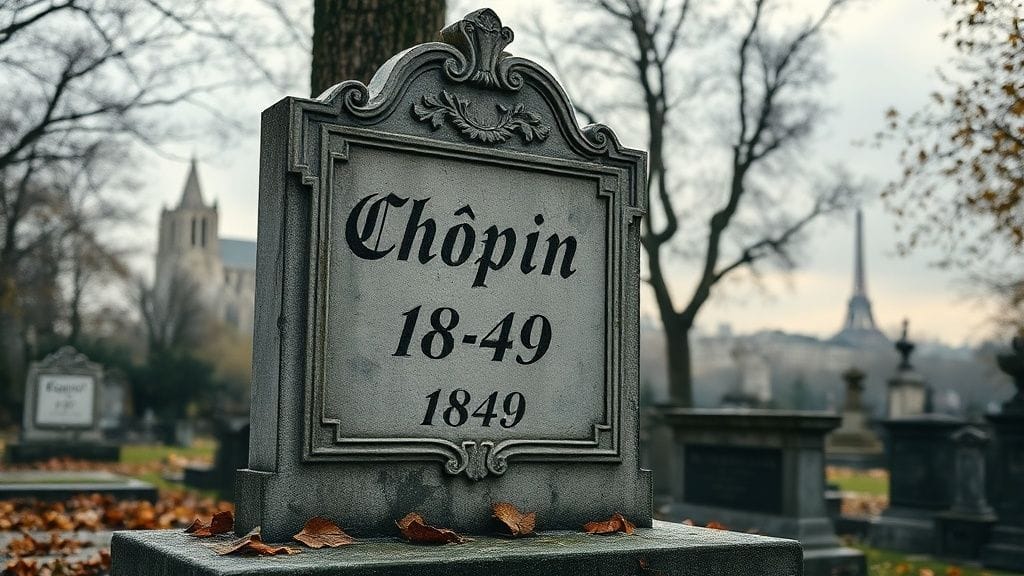
Chopin’s grave in Père Lachaise became a cornerstone of musical pilgrimage. Visitors from around the world come to pay homage, tracing their fingers along the stone that bears not only his name but the quiet echo of a piano’s last notes.
The cemetery itself, resting place of Hugo, Balzac, and Berlioz, is a testament to Paris as a city of memory, where art and mortality intertwine.
Musical Innovations That Influenced Generations
Chopin’s innovations extended beyond technical brilliance. By reshaping the possibilities of the piano, he created a language of unparalleled nuance—turning the instrument into a vehicle for personal confession and national identity.
His influence is visible in the works of subsequent composers, extending into the 20th century, proving that his death marked an end, but also the beginning of an eternal echo.
The Political Undertones of Chopin’s Life and Death
Chopin’s music often carried hidden political messages—a coded lament for Poland’s struggles and a subtle expression of exile’s pain. His death came at a time when nationalism surged across Europe, lending his legacy a charged symbolic role.
Though he never openly took up arms, his art acted as a weapon of cultural resistance, a form of defiance against oppression.
Chopin’s Death in Letters and Memoirs of Contemporaries
Personal letters and memoirs from those who witnessed Chopin’s last days paint a vivid portrait of a man both fragile and fiercely dignified. George Sand’s accounts, as well as those of his students and friends, reveal the emotional texture beneath the public legend.
These documents help us grasp Chopin’s humanity beyond the iconography—the toll of illness, the warmth of friendships, and the quiet courage facing oblivion.
The Cultural Memory of Chopin: Myth, Legend, and Reality
Over time, Chopin’s memory has been curated, mythologized, and contested. The Romantic obsession with genius shaped his posthumous image, but historical scrutiny reveals a more nuanced man—vulnerable yet resolute, private yet engaged with his times.
Balancing legend with reality remains key to understanding his enduring impact.
The Influence of Chopin’s Polish Identity After His Death
The placement of Chopin’s heart in Warsaw’s Church of the Holy Cross symbolizes the unbreakable link between him and Poland. His music burgeoned as a rallying cry for national pride during partitions and later independence movements.
Internationally, Chopin emerged as a cultural ambassador of Poland—a role that continues in the collective consciousness of his countrymen and admirers worldwide.
Paris as a Cradle and Grave of Chopin’s Artistic Spirit
Paris was both a sanctuary and a stage for Chopin’s genius. It nurtured his creativity yet also isolated him from his roots. The city’s intellectual ferment enriched his work, though his death there sealed his fate as an émigré artist, forever caught between worlds.
This duality—belonging everywhere and nowhere—adds complexity to the story of his final days.
The Lasting Impact on Piano Music and Romanticism
Chopin’s deeply personal approach to piano composition expanded the horizon of Romantic music. His emphasis on expressive detail and emotional subtlety altered how pianists and composers perceived the instrument.
The reverberations of his style are still apparent in modern music pedagogy and performance, underscoring a legacy that defies time.
How Chopin’s Death Echoed in 19th Century Europe
In an age of political unrest and cultural rebirth, Chopin’s death became a symbol of lost innocence and enduring hope. The artistic elite, political exile communities, and music lovers who knew him mourned not only a man but an era passing into history.
His music provided solace during upheaval, becoming a soundtrack to European transformation.
Conclusion: The End of an Era and the Birth of a Legend
The death of Frédéric Chopin was not merely the loss of a singular musical genius—it signified the closing of a chapter in European cultural history filled with revolution, romantic idealism, and the search for identity. Yet, from this ending sprang an immortal legacy that continues to inspire, console, and captivate.
Chopin died as he lived: quietly, poetically, with a soul stretched across continents and centuries. His music remains, a timeless testament to the human capacity for profound beauty born of suffering and hope.
FAQs
Q1: What caused the death of Frédéric Chopin?
A1: Chopin died of complications related to tuberculosis, a chronic respiratory illness that plagued him for much of his adult life.
Q2: How did Chopin’s Polish heritage influence his music?
A2: His Polish roots deeply infused his compositions, especially through mazurkas and polonaises, which carried nationalist emotions and folk melodies reflecting his homeland’s struggles.
Q3: Who were the significant figures around Chopin at the time of his death?
A3: Key figures included George Sand, his former lover; Jane Stirling, a devoted pupil; and fellow musicians and friends like Franz Liszt.
Q4: Why was Chopin’s heart placed in Warsaw rather than buried with his body?
A4: Following his wishes, Chopin’s heart was placed in the Church of the Holy Cross in Warsaw as a symbol of his enduring connection to Poland, whose partitioned state he mourned.
Q5: How was Chopin’s death received by the public in Paris and Europe?
A5: His death was met with widespread mourning among artists, émigré communities, and the public, underscoring his stature as both a national and international figure.
Q6: What is the significance of Chopin’s funeral location?
A6: The funeral at Église de la Madeleine, a prestigious church in Paris, highlighted Chopin’s importance in Parisian society and the blending of artistic, religious, and national identities in mourning.
Q7: How did Chopin’s death influence Romantic music and future composers?
A7: Chopin’s demise at the height of Romanticism cemented his role as a pioneer whose innovations influenced generations of composers, reshaping piano music and emotional expression.
Q8: How is Chopin remembered today?
A8: Chopin is celebrated globally as a towering figure in classical music, with his compositions forming a core part of piano repertoire and his life inspiring countless biographies and cultural tributes.