Table of Contents
- The Dawn of September 3, 1939: A City Holds Its Breath
- Europe on the Brink: Tensions Building for a Decade
- The Rise of Totalitarianism and the Shadow of War
- September 1st, 1939: Blitzkrieg Strikes Poland
- The Diplomats’ Dilemma: Allies on Edge
- France’s Decision: From Diplomacy to Declaration
- The Speech Heard Around the World: Daladier’s Address
- Paris Reacts: Citizens Between Fear and Resolve
- Mobilization and Military Preparations: France Girds Itself
- British and French Coordination in the Early Days
- The “Phoney War”: Silence Before the Storm
- The Human Cost Begins: Families Torn and Lives Changed
- Intellectual and Cultural Responses to War in France
- The Political Fallout Within France: Unity and Division
- The Global Ripple Effect: How France’s Declaration Changed the World
- The Legacy of September 3, 1939: Memory in France and Beyond
- Conclusion: Courage in the Face of Uncertainty
- FAQs: Understanding France’s Declaration of War
- External Resource: Dive Deeper into the 1939 Declaration
- Internal Link: Explore More on History Sphere
1. The Dawn of September 3, 1939: A City Holds Its Breath
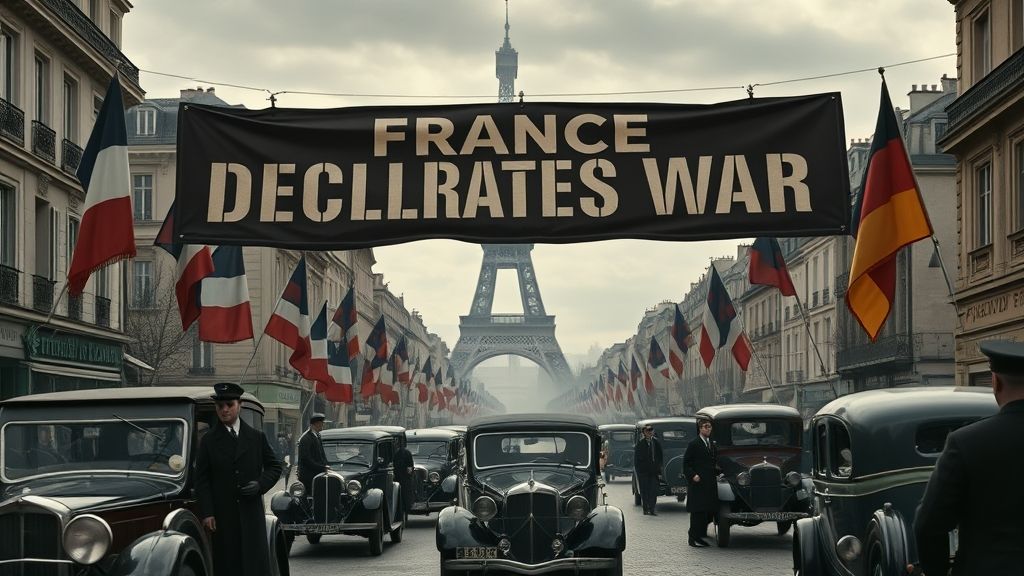
Paris, early morning on September 3, 1939—a city where the scent of fresh coffee mingled uneasily with a rising tension, the morning light filtered through misty skies hanging heavy above the Seine. From the cobblestones of the Latin Quarter to the grand boulevards of the Champs-Élysées, Parisians awoke with a gnawing unease. The news from the East had spread overnight: Nazi Germany had invaded Poland two days earlier, shattering the fragile peace that Europe had clung to for more than a decade. And now, a decision loomed, a fateful weight on the shoulders of French leaders.
At 5 p.m., Édouard Daladier, France’s Prime Minister, would step into the limelight and announce what many feared but hoped to avoid: France was declaring war on Germany. It was a moment etched in history—not a surprise attack or a sudden catastrophe, but a deliberate act of resistance against encroaching darkness. This declaration would mark the beginning of France’s brutal involvement in a conflict that would reshape the world forever.
Yet, beneath the heavy official words lay a complex tapestry of hope, dread, and resolve. To understand why France chose this path, one must peel back the layers of history, diplomacy, and ideology that led to this monumental day.
2. Europe on the Brink: Tensions Building for a Decade
The years that led up to 1939 were marked by a series of unresolved conflicts and mounting anxieties. The Treaty of Versailles, signed in 1919, sought to bring peace to a war-torn Europe but instead sowed seeds of resentment, particularly in Germany. The treaty’s harsh terms placed blame squarely on German shoulders, imposing massive reparations and territorial losses that many Germans perceived as humiliation.
Meanwhile, France emerged victorious but wary, determined to secure its borders against future German aggression. The construction of the Maginot Line—an extensive network of fortifications along the Franco-German border—symbolized this defensive mindset. Across Europe, nationalist fervor and economic instability festered. The Great Depression crippled economies, breeding fertile ground for extremist ideologies.
Into this volatile environment stepped Adolf Hitler and the National Socialist German Workers’ Party, or Nazis. His blend of militaristic ambition, racial ideology, and charismatic oratory electrified many Germans desperate for revival and vengeance. Yet, his aggressive rhetoric and expansionist goals alarmed France and its allies.
3. The Rise of Totalitarianism and the Shadow of War
By the mid-1930s, it was clear that Europe’s balance of power was unraveling. Italy under Mussolini, the Soviet Union under Stalin, and Germany under Hitler each forged totalitarian states that rejected democratic ideals and pursued expansionism. France found itself increasingly isolated and uncertain, struggling with political instability and public divisions.
The policy of appeasement, championed by Britain’s Prime Minister Neville Chamberlain and reluctantly supported by France, aimed to avoid war by conceding certain demands to Hitler. The Munich Agreement of 1938, which sacrificed Czechoslovakia’s Sudetenland to Germany, exemplified this approach.
But appeasement would prove a bitter illusion. It failed to curb Hitler’s ambitions, encouraging him instead. When he openly defied agreements by invading Czechoslovakia outright in March 1939, France and Britain realized the threat was no longer containable by mere diplomacy.
4. September 1st, 1939: Blitzkrieg Strikes Poland
The invasion of Poland was swift and brutal. Germany unleashed its new military doctrine, Blitzkrieg, or “lightning war,” which combined speed, firepower, and surprise to overwhelm defenses. Warsaw was encircled; cities fell rapidly.
France and Britain had guaranteed Poland’s sovereignty but were ill-prepared for immediate intervention. While war was declared only two days later, no significant offensive action occurred at the border with Germany, leading to the uneasy period later called the “Phoney War.”
Germany’s attack on Poland was more than a military gambit; it was a declaration that the fragile post-World War I order was breaking down completely.
5. The Diplomats’ Dilemma: Allies on Edge
The French government’s decision to declare war was neither spontaneous nor unanimous. In the days following August 31st, diplomatic envoys rushed to Paris, strategists debated fiercely, and public opinion pressure mounted. The shadow of World War I loomed large—century-old scars rendered France wary of yet another bloodbath.
Yet abandoning Poland to Germany’s onslaught was untenable, both morally and strategically. France’s alliances demanded honor. Even more, the specter of Nazi domination of Europe posed an existential threat.
The balancing act was delicate: prepare for war without triggering panic, seek support without escalating tensions prematurely, and manage public morale while confronting grim realities.
6. France’s Decision: From Diplomacy to Declaration
On the morning of September 3, Prime Minister Daladier convened his cabinet for one of the most consequential meetings in French history. The evidence was irrefutable, options limited. War had become inevitable.
At 3:30 p.m., the final communiqué was prepared. The French Ambassador in Berlin delivered the ultimatum: Germany must withdraw from Poland within hours—or France would declare war. The hours that followed were tense, the city holding its breath for Germany’s reply.
As the deadline passed without a response, Daladier took to the radio at 5 p.m. to address the nation. His voice, steady but grave, echoed through every home:
“Germany has not heeded the warning of honor. France is at war with Germany.”
The words carried the weight of history, a shattering rupture in the hopes for peace.
7. The Speech Heard Around the World: Daladier’s Address
Daladier’s broadcast was more than an official announcement—it was a call to arms, a solemn moment of collective reckoning. He spoke of the defense of liberty, the need to stand alongside Poland, and the defense of France itself. His tone balanced resolve with the somber acknowledgement of the heavy cost ahead.
Listeners across France sat in silence, some weeping quietly, others gripping hands in solidarity. The war was not yet visible in the streets, but it had arrived in hearts and minds.
“It is no longer a question of throwing diplomatic words into the wind,” Daladier declared. “It is a struggle for the life of our civilization.”
8. Paris Reacts: Citizens Between Fear and Resolve
Throughout Paris, the reaction was multifaceted. Some Parisians rushed home to inform families; others gathered in cafes digesting the news with a cocktail of dread and defiance. Streets thrummed with an enhanced sense of gravity.
Women wept quietly, worried for husbands and sons soon to be conscripted. Elderly men recalled the Great War and feared its specter was returning with a vengeance. Young people, while fearful, also fostered a steely resolve—they understood this was a defense of France’s future.
Still, confusion reigned. How long would this war last? Could France withstand another prolonged conflict? Questions swirled with few answers.
9. Mobilization and Military Preparations: France Girds Itself
France mobilized swiftly yet cautiously. The total standing army swelled with reservists called to duty, and strategic fortifications buzzed with renewed activity. The Maginot Line was manned; air defenses readied; the cavalry dusted off.
Yet logistical challenges loomed. The trauma of trench warfare from two decades prior haunted military planners, who sought to avoid repeating mistakes but struggled to modernize tactics at a swift enough pace.
The government also grappled with civilian defense efforts—rationing was planned, hospitals prepared, and civil defense volunteers trained.
10. British and French Coordination in the Early Days
France’s declaration of war was mirrored by Britain’s own, and the two sought to present a united front to the Axis threat. But coordination proved complicated by geography, politics, and military strategy.
While diplomats pledged cooperation, trench warfare mentalities prevailed, and offensive operations were scarce. The alliance’s early months were defined more by cautious watchfulness than by major battles along the Western Front.
Still, the Franco-British alliance gave hope, a critical psychological buffer in those fraught early days.
11. The “Phoney War”: Silence Before the Storm
The months following September 1939 saw an eerie calm along the Western Front, the so-called “Phoney War” or “Drôle de Guerre.” French soldiers stood in trenches, gas masks at the ready, but the great battles did not come immediately.
For civilians, especially in Paris, the waiting was torturous. The city alternated between moments of normalcy and sudden reminders of war’s presence: blackouts, curfews, news of distant death.
Historians often see this period as a psychological and strategic limbo, where the anticipation of violence shadowed daily life.
12. The Human Cost Begins: Families Torn and Lives Changed
Behind official communiqués and strategic decisions were countless human dramas. Families faced separation; children sent to countryside safer zones; uncertainty permeated every farewell at railway stations.
The initial enthusiasm for the war effort gave way to anxiety and grief as casualty lists began to grow. Soldiers in training worried about weeks or months ahead, while those at home grappled with the void left by loved ones.
Some Parisians volunteered for auxiliary services; others found themselves pulled into resistance or espionage later in the war’s grim arc.
13. Intellectual and Cultural Responses to War in France
The onset of war stirred reflections among writers, artists, and intellectuals. Some rallied for patriotic solidarity, publishing manifestos calling for unity against fascism. Others mourned the tragedy of another looming conflict and warned of the dangers of nationalism.
The arts bore witness, from wartime poems evoking the fragility of peace to cautious cinema productions maintaining morale. Parisian cafes continued to buzz with debate, even as shadows deepened.
This cultural turmoil foreshadowed the complex identity crisis France would face during the war and after.
14. The Political Fallout Within France: Unity and Division
While Daladier’s government pushed for solidarity, French politics remained fractious. Left-wing parties, communists, socialists, and conservatives grappled with how best to respond. Some advocated immediate, aggressive military action; others feared for civil liberties under wartime pressures.
The Popular Front coalition, a dominant force earlier in the decade, had fractured. Daladier’s frail “national unity” government faced challenges keeping dissent in check without suppressing democratic debate.
These internal tensions added a volatile element to France's wartime efforts.
15. The Global Ripple Effect: How France’s Declaration Changed the World
France’s declaration of war was not an isolated act; it marked a pivotal moment in global history. It signaled to nations worldwide that the fragile peace was shattered and that the conflict had reached a truly international scale.
Countries in Europe, Asia, Africa, and the Americas watched anxiously. Colonies under French control experienced new vulnerabilities; alliances shifted; the global economy braced for upheaval.
In the United States, isolationists faced mounting pressure as propaganda and news spread the reality of a world at war. The French commitment underscored the stakes of the conflict—liberty versus tyranny, democracy versus dictatorship.
16. The Legacy of September 3, 1939: Memory in France and Beyond
Today, September 3 is remembered solemnly as France’s entry into the Second World War. Memorials, museums, and literature commemorate the brave decisions and sacrifices made at this juncture.
Yet the memory is complex—a mixture of pride in standing up against aggression and sorrow for the immense losses ahead. The days following the declaration led to years of occupation, resistance, and eventual liberation, narratives deeply intertwined with this moment.
Moreover, this date serves as a somber reminder of the costs of appeasement and the consequences when diplomacy fails.
Conclusion
September 3, 1939, was a day when the ideals and fears of an entire nation converged into a decisive act. France’s declaration of war against Germany was more than a political statement—it was a profound affirmation of defiance in the face of overwhelming darkness.
As Paris held its breath and millions prepared for the unknown struggles ahead, the world tilted irrevocably toward one of history’s most devastating conflicts. Yet, amid the uncertainty, there was courage—a steadfast refusal to surrender liberty.
This moment is a testament to the complexity of choice in wartime: between the longing for peace and the necessity of resistance. It reminds us that history is shaped not only by grand strategies and leaders but by the heartbeat of countless lives caught in the tide of events.
FAQs
Q1: Why did France declare war on Germany in 1939?
France declared war after Germany invaded Poland on September 1, 1939. Bound by treaties and seeing Nazi aggression as a threat to European stability, France chose to uphold its commitment to Poland and resist further expansion.
Q2: How did the French public react to the declaration?
The reaction was mixed—fear, sadness, and resolve intertwined. Parisian citizens braced for war, mourning the possible loss of loved ones, but many accepted the necessity of standing against German aggression.
Q3: What was the role of Édouard Daladier during this time?
Daladier, as Prime Minister, was central in the decision to declare war. His speech on September 3 was a defining moment, articulating France's reasons and rallying the nation.
Q4: How did France’s declaration affect its military strategy in the early war months?
France mobilized rapidly but adopted a defensive strategy focused on the Maginot Line. The initial months saw little offensive action, leading to the “Phoney War” period.
Q5: Did France enter the war alone?
No. Britain declared war alongside France, forming part of the Allied coalition against Germany.
Q6: What long-term consequences did this declaration have?
It led France into a devastating conflict that resulted in occupation, resistance, liberation, and profound changes in European and global order.
Q7: How is September 3 remembered in France today?
Often commemorated in memorials and history, it symbolizes courage, sacrifice, and the tragic costs of war.
Q8: Were there attempts to avoid war before this declaration?
Yes, through appeasement policies and diplomacy, but growing Nazi aggression rendered peace efforts ineffective.