Table of Contents
- Whispers of Steel in the City of Kings
- From Trujillo to the Indies: Origins of a Conquistador
- Broken Empires: The Fall of the Inca World
- Ambition Unleashed: Power Struggles in the New Castilian Realm
- The Almagristas’ Wrath and the Seeds of Rebellion
- June 26, 1541: The Morning Before the Blade
- Assassins at the Palace: The Attack on Pizarro
- The Final Stand: Blood on the Floors of Lima
- In the Immediate Aftermath: A City in Shock
- Echoes in Spain: Crown, Court, and the News of Murder
- Native Eyes on a Spanish Tragedy
- The Birth of the Viceroyalty: Order from Assassination
- Myths, Memories, and the Legend of Pizarro’s Death
- Violence as Politics: Assassination in Early Colonial Rule
- Lima’s Silent Witness: Places that Remember the Killing
- Historians, Chronicles, and the Debate over Responsibility
- Legacy of a Murder: Peru, Empire, and the Shadow of Conquest
- Conclusion
- FAQs
- External Resource
- Internal Link
Article Summary: On June 26, 1541, in the newly founded city of Lima, the man who had broken the Inca Empire, Francisco Pizarro, fell beneath the blades of his own compatriots. This article explores the tangled path that led to the francisco pizarro assassination, tracing his rise from obscure swineherd in Extremadura to governor of one of the richest lands in the Spanish Empire. It unpacks the bitter rivalry with Diego de Almagro, the resentments over wealth and titles, and the fragile politics of a colony held together by violence and greed. Moving through the tense hours of that winter Sunday in Lima, we follow the conspirators into Pizarro’s palace and reconstruct his final, desperate stand. Beyond the killing itself, the narrative examines how the francisco pizarro assassination reshaped colonial governance, hastened the establishment of the Viceroyalty of Peru, and reverberated through both Spanish and Indigenous societies. We also consider how chroniclers, from Pedro Cieza de León to later historians, have interpreted the motives and meaning of his death. In doing so, the article shows how a single assassination became a pivot point, turning the brutal improvisation of conquest into a more structured, imperial rule. Finally, it reflects on how Lima’s streets, churches, and myths still carry the ghost of that afternoon when an empire-maker died by the sword.
Whispers of Steel in the City of Kings
The winter sun over Lima, the self-proclaimed Ciudad de los Reyes—the City of Kings—was thin and deceptive on June 26, 1541. It gilded the half-finished adobe walls and the sharp angles of recently built churches, but it did little to warm the tension that had settled over the city like an invisible cloak. Francisco Pizarro, governor of New Castile and conqueror of the Inca Empire, had reasons to feel triumphant. He lived in a spacious palace near the plaza, surrounded by the echo of his own legend. Yet beyond those whitewashed walls, men with old grievances and sharper memories nursed hatred as they quietly moved toward his door.
This was not a foreign invasion, nor a desperate uprising by the Indigenous Andean populations he had subdued. It was Spaniard against Spaniard, brothers in language and faith, divided by ambition and betrayal. The francisco pizarro assassination was not a sudden, inexplicable act of madness; it was the final chord in a symphony of rivalries that had been playing since the first Spanish boots stepped onto the soil of the Inca realm. Lima that day was a city in its infancy—dusty streets, hurried constructions, the constant sound of hammers and prayers. Yet under the daily noise pulsed a quieter, deadly music: whispered names, secret oaths, the resolute clinking of swords being sharpened.
Inside his palace, Pizarro was an aging warrior, yet still formidable—stout, hardened by years of campaigns in the Caribbean, Panama, and the Andes. He was approaching seventy, an extraordinary age for a conquistador, and carried scars not just on his skin but in his memory: battles won, peoples subdued, allies turned enemies. Stories say he was marking another Sunday with a small gathering, the calm routine of a man who believed his enemies contained or broken. He had, after all, prevailed over the great Atahualpa, crushed Inca resistance, defeated his former partner Diego de Almagro, and distributed lands and riches with a victor’s hand.
But this was only the beginning of the end. In the houses of discontented captains, in the taverns where wine loosened tongues, another story was told: that of promises betrayed, of fortunes denied, of a governor who hoarded power and gold. These men, calling themselves the Almagristas after their fallen leader, had convinced themselves that the only path to justice led through blood. As the morning advanced toward noon, they gathered, armed and armored, making the fatal decision to storm the heart of Pizarro’s power. The city of kings was about to host a king’s murder—though this king wore no crown, only the hard-won authority of conquest.
To understand why blades would soon flash in the governor’s hall, one must step back from that tense Sunday in Lima and follow Pizarro’s life from its humble beginnings in Spain to its violent conclusion in Peru. Only then does the francisco pizarro assassination reveal itself not as an isolated event, but as the inevitable outcome of a system built upon conquest, greed, and fragile loyalties.
From Trujillo to the Indies: Origins of a Conquistador
The story begins far from Peru, in the sunburned fields around Trujillo in Extremadura, western Spain. Francisco Pizarro was born there in the late 1470s—probably 1478 or 1476, historians still debate the precise date—to an illegitimate place in the household of Gonzalo Pizarro, a minor noble and veteran soldier. His mother, Francisca González, was of humbler stock, and the boy’s earliest memories, we can imagine, were not of marble halls but of worn paths, rough work, and the cold acknowledgment that he stood on the margins of society.
Extremadura was a hard land that produced hard men. From here would come several of the most famous conquistadors: Hernán Cortés, who toppled the Mexica Empire; the Pizarro brothers; and other lesser-known but equally ruthless adventurers. In such a region, where opportunities for social advancement were scarce, the news that there were new lands across the ocean—lands filled with gold, rumors said—fell like sparks on dry grass. For a young man like Francisco, poorly educated, illiterate into adulthood if not for life, but strong, stubborn, and ambitious, the Americas were not a distant curiosity. They were an escape hatch.
By the turn of the sixteenth century, he had crossed the Atlantic. In the Caribbean, Pizarro learned the brutal grammar of conquest: expeditions that ravaged Indigenous communities, fragile colonies like those on Hispaniola and later Panama, schemes for wealth that often collapsed into hunger and disappointment. He served under Nicolás de Ovando and later Balboa, the man who first sighted the “South Sea,” the Pacific. In Panama, Pizarro began to emerge from the anonymity of the many aspiring conquistadors, becoming known as a seasoned fighter, a man who could endure hardship and command respect among rough men.
It is astonishing, isn’t it, that from such precarious beginnings he would one day hold sway over the lands of Tawantinsuyu, the sprawling Inca Empire that stretched from present-day Colombia to Chile? But his path there was neither straight nor certain. Years of failed ventures, rumors of rich kingdoms to the south, and difficult partnerships—particularly with Diego de Almagro and the priest Hernando de Luque—slowly shaped his destiny. Their company, sanctioned in stages by the Spanish Crown, set its sights on what the Spaniards called Peru, a name still nebulous, hardly understood, but thick with promises of gold and silver.
As the small bands inched down the Pacific coast, facing storms, hunger, and sometimes hostile Indigenous groups, Pizarro’s stubbornness became his defining trait. When others wanted to turn back, he refused, famously drawing a line on the sands of Gallo Island and inviting those who wished for “riches and honors” to cross it and continue with him. Enough men crossed to keep the dream alive. It is in gestures like this that the roots of future conflicts can already be seen: a leader who demanded loyalty through daring and promise, whose charisma masked a colder calculus of reward and exclusion that would later prove fatal.
By the time Pizarro gained the formal title of governor of “New Castile” from Charles V in 1529, he was no longer the obscure Extremaduran bastard. He was a man entrusted with the conquest and administration of a vast, still-hypothetical empire. Papers signed in Seville and Toledo would eventually translate into the thunder of hooves in Andean valleys, the fall of emperors, and, a dozen years later, the violent scene in his Lima palace where the francisco pizarro assassination would unfold.
Broken Empires: The Fall of the Inca World
To understand the full weight of Pizarro’s eventual death, one must consider what he destroyed to make his own power possible. When his small force finally penetrated deep into the Andean heartland in the early 1530s, they encountered an empire already fractured by war. The Inca world, known as Tawantinsuyu—“the land of the four quarters”—was a marvel of political organization and monumental architecture, supported by a sophisticated system of roads, storehouses, and reciprocal obligations. Yet by the time Pizarro arrived, a devastating civil war between two royal brothers, Atahualpa and Huáscar, had left the empire bleeding.
Pizarro’s seizure of Atahualpa at Cajamarca in November 1532 has been recounted countless times. With fewer than two hundred Spaniards, he trapped and captured the Inca ruler during what was outwardly a peaceful meeting. The Spaniards’ horses, steel weapons, and firearms—unknown in the Andes—gave them a terrifying advantage, but cunning was just as important as technology. The audacity of capturing a ruler in the heart of his domain shocked the Andean world and opened a political vacuum Pizarro eagerly exploited.
Atahualpa’s subsequent offer to fill a room with gold and two with silver in exchange for his freedom created one of the most infamous episodes in early colonial history. The rooms were filled—at least to Spanish eyes—with extraordinary wealth. Yet once the ransom was paid, the Spaniards executed Atahualpa in 1533, a decision many chroniclers later debated. Some, like the later chronicler Pedro Cieza de León, suggested that greed, fear of an Inca resurgence, and internal divisions among the Spaniards all played their part. In murdering the Inca sovereign, they secured immediate control but also unleashed a long, bitter resistance that would never fully end.
With Atahualpa dead, Pizarro and his brothers marched into Cuzco, the sacred capital, in 1533. They installed puppet rulers, shifted alliances among local lords, and began the process of transforming Tawantinsuyu into a patchwork of encomiendas—grants of Indigenous labor and tribute to Spanish conquistadors. This was conquest as improvisation: every step required new deals, new betrayals, and constant violence. Pizarro might have been the nominal leader, but he depended on a fractious band of fellow conquerors, each convinced he deserved more land, more gold, more recognition.
The fall of the Inca world was not the clean, decisive victory that earlier European readers might have imagined. It was messy, contested, and prolonged. New rebellions flared. Inca nobles like Manco Inca first cooperated with the Spaniards, then turned against them, besieging Cuzco in 1536 in a ferocious attempt to drive them out. Pizarro himself was in Lima by then, the city he had founded in 1535 as his new coastal capital, but his brothers and allies struggled desperately to hold out. The resistance ultimately failed, but it signaled that Spanish rule rested on a knife’s edge.
The irony is unmistakable: the same instability that allowed Pizarro to conquer Tawantinsuyu—divided elites, contested successions, rapidly shifting alliances—would also undermine his own rule. Just as Atahualpa and Huáscar had torn their empire apart in civil war, Pizarro and his old companion Diego de Almagro soon turned from partners to bitter rivals. The empire-builder would, in the end, be undone not by the remnants of the Inca elite, but by the very Spanish system of reward and jealousy he had helped foster—a chain of events culminating in the francisco pizarro assassination.
Ambition Unleashed: Power Struggles in the New Castilian Realm
In the first years after the conquest of Cuzco, Spain’s new Andean dominions were divided more by personal claims than by neat imperial lines. The Capitulation of Toledo, which granted Pizarro his authority, named him Governor and Captain General of New Castile, but Diego de Almagro, who had invested heavily in the early expeditions, also sought recognition and reward. The Crown, tens of thousands of kilometers away and dependent on fragmentary reports, responded with ambiguity. It granted Almagro the governorship of a territory to the south, “New Toledo,” whose northern boundary was poorly defined. This vagueness, perhaps bureaucratic oversight, became a loaded weapon.
From the beginning, Pizarro and Almagro represented two poles of power among the conquerors. Pizarro, despite his own illegitimate birth, projected the authority of a governor and preferred to anchor his rule in new institutions: cities, councils, the Church. Almagro, charismatic and popular among many rank-and-file soldiers, was the champion of those who felt shortchanged by Lima’s growing elite. He led expeditions southward, seeking his promised lands and wealth in what would later be Chile, only to find resistance, hardship, and far fewer riches than expected.
When Almagro returned north, disillusioned, he looked not to unexplored frontiers but to Cuzco, the old Inca capital now thick with spoils and influence. Claiming that Cuzco fell within his jurisdiction of New Toledo, he seized the city in 1537 and captured Pizarro’s brother Hernando. War between the two factions—Pizarristas and Almagristas—broke out in earnest. It was the first civil war among Spaniards in Peru, a foretaste of the deeper conflicts that would eventually claim Pizarro’s life.
The Battle of Las Salinas in April 1538 near Cuzco ended in a decisive victory for Pizarro’s forces. Diego de Almagro, once partner and friend, was captured, tried, and executed—strangled and then beheaded. According to several chroniclers, including the Inca nobleman and writer Garcilaso de la Vega in his “Comentarios Reales,” the execution of Almagro shocked many Spaniards who had served under him and saw in his death an act of cold political calculation by Pizarro and his brothers. Whether or not Pizarro could have spared him is still debated, but the perception among many was clear: this was not simply justice; it was elimination.
It is here that the chain leading directly to the francisco pizarro assassination begins to tighten. By killing Almagro, Pizarro unleashed a wave of vengeful determination among Almagro’s followers, particularly those who believed that their leader had been promised Cuzco and then robbed by legal maneuvering and force. These men, stripped of leadership but not of rage, would coalesce around Diego de Almagro “el Mozo,” the illegitimate son of the executed commander. Though young and lacking his father’s military stature, he became a living banner for their cause. Pizarro, ensconced in Lima, might have felt secure in his triumph, but he had planted the seeds of his own doom.
The Almagristas’ Wrath and the Seeds of Rebellion
After Las Salinas, the political map of Spanish Peru seemed to favor Pizarro completely. He stood unchallenged in Lima, sanctioned by royal documents, associated with the victory over the Inca and now the defeat of his Spanish rival. But power in the early colonial Andes was brittle. Many conquistadors who had risked their lives felt sorely underrewarded. They saw Pizarro and his kin amassing estates, Indigenous labor, and political offices, while lesser captains scraped for encomiendas in poorer or more dangerous regions.
Almagro’s former followers, the Almagristas, were the most embittered. They did not simply lose a leader; they lost a narrative of justice in which the Crown’s promises would be honored. Some of them had followed Almagro on the grueling campaign to Chile, suffering hardships that later chroniclers described with grim detail: hunger so severe that horses were eaten, bitter cold, and fierce resistance from Indigenous groups. Their reward upon returning was to see Lima and Cuzco flourishing under Pizarro’s hand, while they carried scars and little else.
These men clustered around Almagro’s young son, Diego “el Mozo.” It is important to remember that many conquistadors were themselves men of broken social ranks—bastards, second sons, minor nobles with big dreams. Diego de Almagro the Younger, also illegitimate, mirrored Pizarro’s own origin story, but without the compensating mantle of victory. To the Almagristas, he embodied a cause: the restoration of their honor and the punishment of what they viewed as Pizarro’s treachery.
As the months passed, grievances hardened into conspiracy. Secret meetings were held in Lima and in other settlements. The conspirators carefully surveyed their options. They doubted that distant royal justice would ever reverse Pizarro’s dominance, and they knew that open rebellion in the countryside might simply result in their isolated elimination. Instead, they resolved on a single, decisive act: to kill Pizarro at the heart of his power and then seize control of Lima itself.
The francisco pizarro assassination, then, was born not from a random plot hatched overnight but from a long-brewing sense of collective betrayal. The conspirators framed their plan not as common murder, but as a kind of rough, frontier justice, a redress of wrongs. It is here that the violent political culture of the early Spanish empire comes into focus. With few stable institutions and often contradictory royal orders, might frequently made right. Pizarro himself had risen through daring, manipulation, and ruthless decisions. Now men who had learned in his shadow decided to apply those same lessons against him.
In Lima’s narrow streets, rumors swirled. Some must have reached Pizarro’s ears. Warnings, veiled or explicit, were said to have been delivered. Yet he remained, by most accounts, either dismissive or overconfident. He believed that his authority, his reputation as conqueror of the Incas, and his network of allies—including powerful brothers—would shield him. He underestimated the lethal combination of desperation and ideology that now drove the Almagristas toward his door.
June 26, 1541: The Morning Before the Blade
Sunday, June 26, 1541, dawned like many winter days in Lima: cool, with a pale light softening the edges of the newly built city. It was a day of worship, rest, and social visits among the Spanish colonists. In the central plaza, people moved in and out of the church, lingered in conversation, and watched the shifting interplay of status that defined the colonial hierarchy—governor, officials, priests, merchants, soldiers, Indigenous intermediaries.
Inside his palace near the main square, Francisco Pizarro followed his own Sunday routine. Contemporary accounts say he planned a meal with a few companions, including some of his most trusted men. The governor, now an older man hardened by decades of warfare, likely felt that the worst of his struggles were behind him. He had defeated the Inca resistance, founded Lima as the new capital, and beaten Diego de Almagro in both the battlefield and the courtroom of royal approval.
Still, there were indications of unrest. The conspirators had not hidden all their intentions with perfect care. Some friends and allies had reportedly warned Pizarro that Almagro’s followers might attempt something drastic. One story claims that a friar came to him to speak of rumors of a plot. Others suggested that letters or messages carried hints of brewing trouble. Whether through fatigue, arrogance, or a cold calculation that his enemies would not dare attack him so openly, Pizarro did not take the precautions that hindsight makes seem obvious.
On the other side of the city, in a house where they had gathered, the Almagristas donned armor and prepared their weapons. They were not a vast army; estimates vary, but many historians place their number at around twenty men directly involved in the attack, supported by a broader circle of sympathizers. Yet they were determined and experienced in combat. Among them, Diego de Almagro the Younger stood as their symbolic leader, though some older captains likely steered the tactical decisions.
They chose this Sunday precisely because they expected reduced defenses. The governor’s residence would not be on high military alert during a religious day. Many soldiers would be at mass or engaged in personal business. The conspirators, armed with swords, daggers, and possibly shields, intended to strike swiftly, overwhelm the guard, and kill Pizarro before the city could react. Then, they planned to proclaim Almagro’s son as governor or at least to seize control in his name, appealing to the discontented among the Spanish population.
As midday approached, the lines of fate drew closer. Inside the palace, servants moved about, preparing the meal. Pizarro reportedly spoke with his guests, perhaps confident, perhaps distracted, unaware that within the hour he would be fighting for his life almost alone. Beyond the thick walls, the conspirators were already on the move, advancing through Lima’s streets, turning a morning of worship into the prelude to a political murder that would echo across two continents.
Assassins at the Palace: The Attack on Pizarro
The conspirators approached Pizarro’s palace with grim purpose. Contemporary chronicles, though differing in some details, agree on the broad strokes: a band of armed Almagristas moved through Lima, shouting slogans that cast their planned killing as justice for Diego de Almagro’s death. Some accounts have them crying, “¡Viva el Rey! ¡Muera el tirano!”—“Long live the King! Death to the tyrant!” This phrase, if accurate, is telling; it positions their rebellion not against the Spanish Crown, but against a governor they portrayed as a usurper of royal authority.
When they reached the governor’s residence, they found the outer guards fewer and more relaxed than they might have been on a weekday of political activity. The Sunday calm worked to their advantage. They rushed the entrance, weapons drawn, taking the defenders by surprise. In the chaos of the first assault, some of Pizarro’s men were killed or driven back. The noise—shouts, clashing steel, cries of pain—ripped through the quiet day and echoed off the adobe walls of surrounding buildings.
Inside, Pizarro understood quickly that this was no minor disturbance. Either a servant or a panicked guard must have burst into the room to warn him: the Almagristas were inside the palace. What followed has been told and retold, woven into legend as much as fact. He was allegedly eating or preparing to eat with a handful of guests. One of them, Francisco de Chaves, went to investigate the commotion, perhaps to parley with the attackers. As he reached the staircase that led down, the conspirators cut him down mercilessly, his body tumbling back—a mortal warning that no negotiation would spare those within.
At that moment, the francisco pizarro assassination shifted from a distant possibility to an immediate, personal battle. The governor, an old soldier, did not attempt to flee. Instead, he ordered the doors barricaded and armed himself. Some narratives describe him putting on a cuirass or at least grabbing a sword and buckler. His companions, however, were not all made of such stern material. Terrified by the ferocity of the attack, several tried to escape through windows or side exits, abandoning him in his hour of greatest need.
One of the most poignant and often repeated details is that Pizarro, seeing some of his guests trying to scale the walls to flee, shouted that they were “cowards” and called upon them to stay and fight. But fear had already broken their resolve. Only a small handful remained by his side when the attackers breached the final barriers and surged into the room. Among those said to have stayed were a few loyal servants and possibly some younger, less experienced warriors. Yet against the seasoned Almagristas, hunger for revenge sharpened their blades.
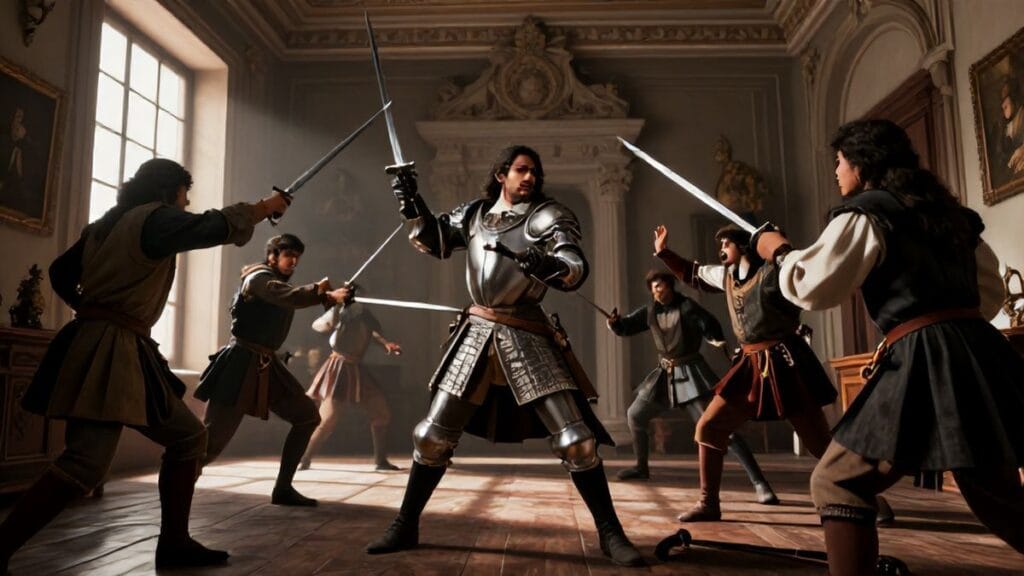
The conspirators poured into the governor’s chamber. Dust rose from the floor; the air filled with the metallic reek of steel and the first spurts of blood. In the struggle that followed, Pizarro’s long life of combat training did not desert him. He parried blows, lunged at attackers, and is said to have killed at least two of his assailants, wounding others. For a brief, fierce moment, the aging conqueror of the Inca stood as he had so many times before: outnumbered but unyielding, the center of a deadly storm.
The Final Stand: Blood on the Floors of Lima
But no personal valor could alter the basic arithmetic of that room. Pizarro was surrounded, his allies few, his enemies many and driven by rage. The fight turned into a brutal melee. Blades flashed and scraped; boots thudded on the packed-earth floor. One conspirator managed to lunge past Pizarro’s guard and wound him. Another followed, and soon the governor, though still fighting, was bleeding from multiple cuts.
Chroniclers provide various dramatized details, but certain images recur. One is that Pizarro, struck by a deep wound, fell to his knees, his sword slipping from fingers suddenly slick with blood. Another is that, as the fatal blow came—some say a thrust to the throat or the chest—he reached out and traced a cross on the floor with his own blood, murmuring the name of Christ or asking for God’s mercy. Whether this gesture actually occurred or was embroidered later by pious storytellers, it has become a central symbol in the narrative of the francisco pizarro assassination: the ruthless conqueror dying like a penitent sinner on the ground of the city he had founded.
His killers, their work completed, did not linger sentimentally. Pizarro’s body lay amid the blood and shattered furniture, the room still echoing with the last cries of the struggle. The conspirators stepped back, breathing hard, their armor smeared with gore, but their focus already shifting to the next step: political control. Some ran out into the palace corridors, shouting that the tyrant was dead, that justice for Almagro had been done. Others secured the building, searching for documents, for potential pockets of resistance, for symbols of authority they could now claim.
Outside, the city reacted with a mix of shock, confusion, and calculation. Residents heard the tumult, saw armed men at the palace, and realized something extraordinary had happened. Some panicked; others stayed behind shuttered windows, unwilling to risk choosing the wrong side too early. The conspirators sought to impose a swift new order, proclaiming Diego de Almagro the Younger as their chosen leader, hoping that those who resented Pizarro’s dominance would rally to their cause.
Yet behind the celebrations of the Almagristas lay a fatal miscalculation. Killing Pizarro removed a powerful figure, but it did not eliminate his broader network of allies or the Spanish Crown’s interest in stabilizing a territory rich in silver and gold. Even as Pizarro’s blood dried on the floor, other forces were moving—both in Lima and far beyond—that would soon swallow the conspirators in a tide of royal retribution. The governor’s corpse could be buried, but the empire he had helped fashion would not die with him. Instead, it would adapt, hardening into a more bureaucratic and centralized form under viceroys directly appointed by the Crown.
In that room, however, on the afternoon of June 26, 1541, such futures were still unknown. There was only the heavy silence that follows violence, the muffled steps of those who dared approach the body, and the lingering shock that the once-invincible conqueror of the Inca lay lifeless, killed not by foreign enemies but by the hands of fellow Spaniards driven by vengeance.
In the Immediate Aftermath: A City in Shock
The hours following the killing were chaotic and tense. Lima was a small city, but it housed enormous ambitions. News of Pizarro’s death traveled rapidly from mouth to mouth, moving along the dusty streets, into taverns and homes, around the church cloisters. The reaction was not uniform. Some wept or frowned in stunned disbelief, having believed the governor nearly untouchable. Others, perhaps secretly resentful of his authority, felt a grim satisfaction—though few would have expressed it openly until the political outcome was clearer.
The conspirators attempted to seize control with the speed their plan required. They occupied key buildings, took up positions in the plaza, and declared their loyalty to the Crown while denouncing Pizarro as a tyrant who had overstepped his authority. Diego de Almagro the Younger, barely more than a figurehead, was pushed forward as their candidate to replace the murdered governor. But things did not immediately fall into their hands. Fear of royal retribution ran deep among the Spanish elite, and many hesitated to join a movement born of assassination.
It is here that we see how limited the conspirators’ broader support actually was. They had planned the killing carefully, but they had not secured a consensus among the colonists or the royal officials. Key figures, including some of Pizarro’s surviving supporters, began to organize resistance or at least to maneuver cautiously, waiting for signals from higher authorities. The municipal council—the cabildo—faced the delicate task of dealing with armed men who claimed to have acted in the king’s name, while also fearing that future royal investigations might hold them accountable for any perceived collaboration.
Pizarro’s body, initially left where it had fallen, was eventually recovered. Accounts diverge on the exact sequence, but it seems that some religious figures ensured that he received Christian rites, however hurried. The man who had once ordered the death of an Inca emperor was now himself prepared for burial, his remains a grim reminder that conquest offered no exemption from mortality. In an early colonial society obsessed with honor and reputation, how Pizarro died and how he was buried both became part of heated conversations that would echo for decades.
The francisco pizarro assassination thus plunged Lima into a strange dual state: outwardly controlled by armed Almagristas, inwardly simmering with anxiety and intrigue. Everyone knew that this event could not remain a local affair. Sooner or later, news would sail across the ocean to Spain, to royal eyes not known for leniency when confronted with rebellion among their colonial subjects. The conspirators’ victory in the governor’s palace was real but fragile—an island of power in a vast sea whose currents were set in distant Valladolid or Madrid.
Echoes in Spain: Crown, Court, and the News of Murder
While swords clashed in Lima, the Spanish monarchy in Europe remained, for a time, ignorant. Communication between Peru and Spain could take many months, even more than a year, depending on ship routes, storms, and political priorities. Yet when the news of Pizarro’s assassination finally reached the royal court, it must have struck like thunder. The man who had brought down one of the greatest empires in the New World, who had delivered staggering quantities of precious metals to the Crown, was dead—murdered by fellow subjects.
Charles V (Carlos I of Spain), already burdened with wars in Europe and the complex governance of a sprawling empire, now faced a stark reminder that the conquistador model of colonization—based on personal initiative, private armies, and negotiated authority—had severe limits. If such powerful governors could be killed by disgruntled factions, then royal control was dangerously thin. The francisco pizarro assassination therefore accelerated a process already underway: the shift from conquest to formal colonial administration under royal appointees known as viceroys.
Court officials and royal councils debated how to respond. On one level, the matter was clear: rebellion and assassination of a royal governor could not go unpunished. The perpetrators, once identified, would have to be hunted down and made examples of. On another level, the Crown had to consider the broader context. Many conquistadors in Peru complained of unpaid promises and harsh conditions. A response perceived as too one-sided might ignite further unrest. The king’s advisors, drawing on reports from judges, bishops, and other officials, crafted a policy that blended punishment with institutional reform.
Royal decrees began to reshape the governance of Peru. New officials were appointed, inquiries ordered. The aim was not merely to avenge one man, but to prevent the recurrence of such destabilizing violence. Still, for many at court, Pizarro’s death also carried a sense of rough poetic justice. His career had been marked by alliances of convenience and brutal decisions, from the capture of Atahualpa to the execution of Diego de Almagro. While his murder was officially condemned, some may have privately seen in it the logical consequence of a world ruled by the sword.
In letters and reports, Spanish bureaucrats began to speak of the need to restrain the power of individual conquerors, to subject them more thoroughly to direct royal oversight. The creation of the Viceroyalty of Peru, formalized shortly after these events, cannot be understood without reference to this crisis. Lima’s bloody Sunday convinced many that the empire in the Indies needed not just daring adventurers, but also cold administrators who would answer directly to the king and enforce a consistent rule of law—however unevenly that law might be applied in practice.
Native Eyes on a Spanish Tragedy
While Spanish chroniclers and royal officials focused on political ramifications, Indigenous peoples across the Andes watched these events through different lenses. For them, Pizarro was not merely a governor; he was the visible face of a catastrophic transformation. Under his leadership and that of his brothers, their lands had been seized, their labor conscripted, their temples desecrated, their rulers executed or reduced to puppet figures. The collapse of the Inca state and the imposition of Spanish encomiendas led to demographic and social shocks whose depth is hard to overstate.
What did they think when they heard that the great conqueror had been killed by his own? There are fewer direct Indigenous-written testimonies from this exact moment, but later narratives and oral traditions—some preserved in works such as Garcilaso de la Vega’s chronicles—suggest a mixture of interpretations. Some may have seen the francisco pizarro assassination as divine retribution, a sign that the Spaniards, like the Incas before them, were vulnerable to internal strife and the justice of higher powers. Others, more pragmatically, may have viewed it as yet another shift in overlords, unlikely to change their daily burdens.
In the highland communities, where resistance had flared repeatedly, Spanish power did not vanish with Pizarro. Other governors, captains, and encomenderos continued to extract tribute and labor. But news of Spanish-on-Spanish violence could provide opportunities. A distracted colonial elite was sometimes easier to resist or negotiate with. In some regions, Indigenous leaders might have taken advantage of the confusion to reaffirm local authority, delay payments, or subtly sabotage Spanish demands.
It is crucial to recognize that for Indigenous Andeans, the assassination did not bring an end to suffering nor a return to the old order. The Inca imperial system was already shattered beyond repair. Instead, Pizarro’s death marked a transition within the colonial regime—from a chaotic, personalized conquest led by a small group of captains to a more standardized and bureaucratic domination. For the people at the bottom of this hierarchy, the faces at the top changed, but the structure of exploitation remained, even as some protections and regulations—such as those later codified in the New Laws of 1542—were debated in far-off Spain.
Yet memory works differently from administrative reality. In Andean lore, the fall of Pizarro sometimes merged with other tales of Spanish misfortune, contributing to a broader story in which oppressive rulers inevitably faced their own downfall. The man who had ordered the death of Atahualpa, the Inca ruler strangled despite his ransom, was himself cut down in a sudden act of betrayal. This narrative symmetry held a moral power that official decrees could never fully erase.
The Birth of the Viceroyalty: Order from Assassination
Out of the bloodshed in Lima and the confusion that followed emerged one of the most consequential institutional changes in the history of Spanish America: the establishment of the Viceroyalty of Peru. While the Crown had already been considering stronger oversight for its South American territories, the francisco pizarro assassination underscored the urgency of moving from a conquest-phase governance model to a stable, hierarchical colonial administration.
In 1542, only a year after Pizarro’s death, Charles V created the Viceroyalty of Peru, appointing Blasco Núñez Vela as its first viceroy. This new office was designed to centralize authority under a single representative of the king, with broad powers over civil, military, and judicial matters. Lima, the city that Pizarro had founded and in which he had died, became the capital of this enormous jurisdiction, covering most of Spanish South America at the time.
The creation of a viceroyalty did not instantly pacify the region. On the contrary, the first viceroy’s attempts to enforce the New Laws of 1542, which sought to limit the hereditary nature of encomiendas and curb abuses against Indigenous communities, provoked fierce resistance among the conquistador class. Yet the symbolic shift was profound. No longer would a single conquistador, however successful, be allowed to morph into a quasi-independent prince. The Crown asserted that the age of chartered adventurers was over; the age of imperial bureaucracy had begun.
In this sense, Pizarro’s death marked both an end and a beginning. He was one of the last great conquistadors whose personal initiative and charisma shaped the birth of a colonial state. After him, the men who governed Peru answered more directly to royal councils, carried detailed instructions, and operated within a legal framework—however often bent or ignored—that claimed to prioritize order over individual ambition. The murder in Lima was thus both symptom and catalyst: it revealed the dangers of leaving vast powers in private hands and accelerated the Crown’s resolve to institutionalize its rule.
For later historians, this transition has often been framed as the passage from the “age of conquest” to the “age of empire.” In that framing, the scene of Pizarro lying dead on his palace floor becomes more than a personal tragedy; it is an emblem of historical transformation. One world—volatile, opportunistic, driven by individual greed and heroics—is eclipsed by another, more rigid but also more durable, in which law codes, councils, and bureaucrats weave the web of colonial domination. The echoes of that shift would resonate for centuries in Peru and beyond.
Myths, Memories, and the Legend of Pizarro’s Death
As with many dramatic deaths of famous figures, the killing of Francisco Pizarro quickly moved from bare fact into the realm of legend. Each chronicler, each generation of historians, and even local storytellers in Lima added layers to the narrative, polishing some details, forgetting others, and embedding the event in broader moral lessons. The francisco pizarro assassination thus became not just a datum in colonial records, but a story told with an eye toward meaning.
One persistent legend is the already mentioned image of Pizarro drawing a cross with his own blood on the floor as he lay dying. Some accounts state that he traced the sign while murmuring “Jesús” or “Señor,” a final appeal for divine forgiveness. The gesture, whether historically accurate or not, offers a neat moral arc: the ruthless conquistador meets his end with a display of Christian piety, as if attempting to wash away a life of questionable deeds with a single symbolic act. It is a scene well suited to sermons and moralizing tales.
Another recurring trope is the idea that the conspirators, after killing Pizarro, immediately regretted the sacrilege of having killed such a major royal official, sensing doom descending upon them. Some chronicles describe moments of hesitation or even attempts to portray themselves as reluctant instruments of justice. Others emphasize their brutality—stabbing the fallen governor multiple times, shouting curses, ransacking his residence. The variation reveals as much about the storytellers’ agendas as about the actual events.
Later centuries layered patriotic and nationalist interpretations onto the story. In some Peruvian narratives, Pizarro appears as the architect of colonial oppression, and his death is framed as a kind of cosmic balance, even though his killers were not Indigenous rebels but fellow conquistadors. In others, particularly those influenced by Spanish imperial nostalgia, he is a tragic hero betrayed by envious subordinates, a symbol of the dangers that lurk in human ambition.
Modern historians have tried to peel back these layers, returning to primary sources such as letters, legal testimonies, and early chronicles. Scholars like Raúl Porras Barrenechea and John Hemming, building on earlier works, have sought to reconstruct the context of his assassination with greater nuance, highlighting how economic interests, legal ambiguities, and personal rivalries all fed into the crisis. The scene in the palace becomes less a morality play and more a complex political drama in which no actor has clean hands.
Yet even the most rigorous academic analysis cannot entirely banish myth. People remember stories more readily than footnotes. In Lima today, guides still speak of the blood on the palace floor, of the cross traced by a dying hand, of the shout that Pizarro supposedly uttered when he saw his guests fleeing: a curse against cowards and a call to die fighting. These details breathe life into the bare bones of dates and names, ensuring that the francisco pizarro assassination endures not merely as a line in a history book, but as a vivid, almost cinematic episode in the city’s collective memory.
Violence as Politics: Assassination in Early Colonial Rule
The murder of Pizarro did not occur in a vacuum; it was part of a broader pattern in which political authority in the early Spanish Americas was frequently contested by force. Assassination, rebellion, and coups were not rare aberrations but recurring features of a system where written laws had to be enforced across oceans by men who carried swords more comfortably than quills.
From the Caribbean to Mexico to Peru, conquistadors and colonial officials clashed over jurisdiction, spoils, and honor. In some cases, royal representatives sent to investigate abuses found themselves targeted by those they sought to discipline. Civil wars between rival factions, as in the conflict between Pizarro and Almagro, reflected both the wealth at stake and the weak presence of stable institutions. In such a world, the line between lawful authority and naked power was often blurred.
The francisco pizarro assassination thus appears less like an extraordinary deviation and more like the logical outcome of a political culture that valorized martial prowess and personal autonomy. When disputes arose, negotiation was only one option; armed confrontation was always lurking in the background. A governor who wielded too much power could become a rival to be eliminated, just as a recalcitrant Indigenous leader could be labeled a rebel and crushed.
At the same time, assassination carried risks. It violated the monarchic principle that authority flowed from the king and his appointed representatives. By killing a governor, conspirators risked being branded traitors, their grievances dismissed as cover for criminal ambition. The Almagristas hoped to frame their deed as the removal of a tyrant in the king’s name, but the Crown ultimately treated them as rebels, hunting them down and executing Diego de Almagro the Younger after a brief period of contested control.
The Spanish monarchy learned from these episodes. Over time, it developed mechanisms to reduce the likelihood that individual colonial officials could amass Pizarro-like power: rotating appointments, residencia trials at the end of a tenure, overlapping jurisdictions, and a more robust network of appeal channels. None of this eliminated violence, but it made high-profile assassinations less central to the political process. The frontier logic of “kill or be killed” gradually gave way to bureaucratic infighting and legal battles fought in the halls of audiencias and councils.
Still, the image of men in armor storming a palace in Lima, cutting down the empire-builder they once followed, casts a long shadow. It reminds us that early colonial rule was not the smooth imposition of European order onto passive lands, but a rough, contested process in which even the most powerful could fall overnight to a determined group of conspirators. In that sense, Pizarro’s death is emblematic of the fragility of all early colonial regimes, wherever they arose.
Lima’s Silent Witness: Places that Remember the Killing
Walk today through the historic center of Lima, and the ghosts of June 26, 1541, are never far away. The modern city, with its traffic, noise, and layered architecture, hides but does not erase the colonial grid that Pizarro himself helped design. Near the Plaza Mayor stands the Government Palace of Peru, the seat of executive power. It occupies, broadly speaking, the same site where Pizarro’s original palace rose—where he lived, ruled, and died.
Although the original building has long since vanished, replaced by later constructions and renovations, the location binds past and present. Standing there, one can imagine the scene: the narrow streets, the lower, simpler houses, the dusty plaza where mounted Spaniards and Indigenous porters mingled. Somewhere behind the modern facades, on ground that has been built over and reworked many times, the old governor fell beneath his attackers’ swords. The soil beneath Lima carries that memory, however invisible to the naked eye.
Nearby, the Cathedral of Lima and the Archbishop’s Palace dominate the square. Within the cathedral, a tomb traditionally associated with Pizarro has been a point of interest for visitors and historians alike. For many years, a glass coffin displayed a body believed to be his, until forensic studies in the twentieth century revealed that the remains were misidentified; the true bones, smaller fragments hidden in an ossuary, were subsequently reclaimed and reinterred with greater care. This strange afterlife—even his skeleton caught up in confusion and myth—adds another layer to the story of the francisco pizarro assassination.
Local tours and plaques sometimes mention the assassination explicitly, folding it into Lima’s broader narrative as the “City of Kings” and the heart of Spanish power in South America. Schoolchildren learn of Pizarro’s role not only as conqueror and founder, but also as victim of internal colonial conflict. His presence is felt in street names, statues, and commemorative sites, even as modern Peru wrestles with how to interpret the legacy of conquest in light of Indigenous dispossession and enduring inequalities.
The cityscape, then, serves as a kind of living archive. Even as buildings rise and fall, the alignment of streets, the relative positions of palace and cathedral, of plaza and government, keep alive the basic geography of that day in 1541. For those who pause to look beyond the surface, Lima offers not just a setting, but a witness—a mute reminder of the afternoon when power changed hands through the thrust of blades rather than the stroke of a pen.
Historians, Chronicles, and the Debate over Responsibility
The task of making sense of the francisco pizarro assassination has occupied historians, chroniclers, and writers for centuries. Immediately after the event, Spanish officials gathered testimonies from witnesses and participants as part of legal inquiries. These depositions, along with letters written by contemporaries, provided raw material for the first narratives. Chroniclers such as Pedro Cieza de León, who traveled extensively in Peru in the 1540s and 1550s, offered accounts that mixed observation with hearsay, already colored by political loyalties and personal judgments.
Later, the mestizo chronicler Garcilaso de la Vega, born in Cuzco to a Spanish father and an Inca noble mother, brought a unique perspective. Writing decades after the conquest, he wove together Spanish documents and Indigenous oral traditions, often striving to reconcile the two. In his works, Pizarro appears as both a disruptive force and a figure caught in the larger currents of history. Garcilaso did not excuse the conquistador’s actions, but he placed them within a broader tragic narrative of empire and loss.
Modern scholarship, drawing on these earlier sources and on archival research in Spain and Latin America, has pushed the analysis further. One key debate concerns responsibility: To what extent was Pizarro himself to blame for the hatred that led to his death? Some historians argue that his refusal to adequately reward Almagro’s followers, combined with his approval of Diego de Almagro’s execution, made the assassination all but inevitable. Others point to structural factors—the Crown’s ambiguous grants, the competitive nature of conquest, the sheer difficulty of balancing competing claims in a rapidly changing environment—as constraints that made conflict unavoidable.
Another line of inquiry examines the social background of the conspirators. Were they primarily marginalized captains seeking redress, or did they also include elite figures who saw an opportunity to realign power in Lima? Archival work has revealed a mix of profiles—men of different regional origins in Spain, varied degrees of wealth, and differing personal histories with Pizarro. This diversity complicates any neat narrative in which a single motive—greed, revenge, or justice—explains everything.
Citations within the historiography underscore the complexity. For instance, in “The Conquest of the Incas,” John Hemming emphasizes how years of unfulfilled promises, compounded by the ruthless suppression of rivals, fostered a climate in which assassination seemed a viable political option (Hemming, 1970). Similarly, Raúl Porras Barrenechea’s studies of Peruvian chronicles highlight the interpretive work performed by early writers who sought to either legitimize or morally condemn the killing, reflecting their own positions within colonial society.
Through all this debate, one conclusion stands out: the assassination cannot be reduced to the villainy of a few or the martyrdom of one. It was the result of a volatile system that rewarded conquest but struggled to manage its aftermath, a system in which men like Pizarro both benefited from and ultimately fell victim to the very logic of violence they helped institutionalize.
Legacy of a Murder: Peru, Empire, and the Shadow of Conquest
What, then, is the enduring legacy of that winter afternoon in Lima when blades flashed and a governor fell? The immediate consequences were clear enough: a temporary power vacuum, swift royal backlash, the eventual execution of Diego de Almagro the Younger, and the establishment of the Viceroyalty of Peru. But the deeper legacy lies in how the francisco pizarro assassination illuminated the contradictions of the colonial enterprise and shaped subsequent perceptions of conquest and authority.
For Peru, Pizarro’s death became part of a founding narrative. The nation that would later emerge from the colonial framework inherited not only cities and institutions, but also stories—about heroism, cruelty, betrayal, and resistance. Pizarro occupies an ambiguous place in this narrative. He is, on one hand, the “founder of Lima” and the bringer of European institutions; on the other, the destroyer of the Inca Empire and a symbol of the violence that underpinned colonial rule. His assassination encapsulates that ambiguity: a powerful colonizer, himself colonized by greed and fear, undone by those he had wronged.
Within the broader Spanish Empire, his fate served as a cautionary tale. Conquistadors continued to operate in various regions, but their window of near-sovereign freedom narrowed. The Crown’s determination to assert direct control was reinforced, leading to administrative reforms, legal codifications, and a more systematic exploitation of colonial resources. Ironically, the death of a figure associated with disorderly conquest contributed to the imposition of a more organized and, in some ways, more efficient colonial order.
On a human level, the story of Pizarro’s life and death raises enduring questions about ambition, loyalty, and the cost of empire. Here was a man who rose from illegitimacy and poverty to extraordinary power, who toppled a mighty empire and reshaped a continent. Yet he did so through methods—deception, ruthless warfare, political elimination—that sowed the seeds of his own destruction. The same qualities that enabled his rise—bravery, cunning, implacability—also alienated allies and nurtured enemies who bided their time until they could strike.
Today, as historians and the public reassess the legacies of conquest worldwide, the francisco pizarro assassination invites reflection on how violence begets violence, and how the architecture of domination can crumble from within even as it imposes suffering without. Monuments to Pizarro have been removed or relocated in some places; school curricula have shifted to highlight Indigenous perspectives. Yet his story, and particularly his dramatic end, remains a core element in understanding how the modern Andean world was forged in conflict.
In the end, perhaps the most haunting aspect of June 26, 1541, is not the gore or the betrayals, but the realization that for many of those involved—the governor, the conspirators, the onlookers—this outcome must have felt both shocking and strangely predictable. In a world ruled by the sword, no one could ever be truly safe, not even the man who once believed himself master of an empire.
Conclusion
Viewed from a distance of nearly five centuries, the assassination of Francisco Pizarro in Lima on June 26, 1541, appears less as an isolated act of treachery than as the culmination of a long trajectory of conquest, rivalry, and structural instability. From his humble origins in Extremadura to his meteoric rise as conqueror of the Inca Empire, Pizarro embodied both the possibilities and the brutalities of the early modern Spanish expansion. The same forces that propelled him—personal ambition, reliance on private armies, a distant and ambiguous royal authority—also laid the groundwork for the plot that would end his life.
The francisco pizarro assassination exposed the deep fissures within the Spanish colonial elite: resentments over unequal distribution of wealth, outrage at the execution of Diego de Almagro, and a shared culture in which political disputes frequently escalated into armed conflict. By killing Pizarro, the Almagristas hoped to reset the balance of power in Peru, but their violence instead hastened the Crown’s decision to curtail the autonomy of conquistadors through the creation of the Viceroyalty of Peru. In this way, the assassination marked a watershed moment, closing the age of improvisational conquest and ushering in a more formal, bureaucratic imperial regime.
For Indigenous peoples, Pizarro’s death did not bring liberation, yet it resonated as a sign that the conquerors were not invincible and that empires—Inca or Spanish—could fracture from within. For later generations, the scene of the old governor fighting in his palace, abandoned by many of his companions, has served as a powerful symbol. It invites moral interpretations of justice and retribution, as well as sober recognition of how cycles of violence perpetuate themselves within systems built on coercion.
Ultimately, the story of Pizarro’s assassination forces us to confront uncomfortable truths about the foundations of colonial societies: that they were forged in blood, maintained through force, and haunted by the ever-present possibility that those who ruled by the sword might someday die by it. In the dust of that Lima afternoon, a single man fell, but an entire mode of governance was called into question, reshaping the history of Peru and the Spanish Empire for centuries to come.
FAQs
- Who was Francisco Pizarro?
Francisco Pizarro was a Spanish conquistador from Extremadura who led the conquest of the Inca Empire in the 1530s. Rising from humble and illegitimate origins, he became governor of New Castile, founded Lima in 1535, and played a decisive role in the capture and execution of the Inca ruler Atahualpa. - When and where did the assassination of Francisco Pizarro occur?
Pizarro was assassinated on June 26, 1541, in his palace in Lima, then part of the Viceroyalty’s precursor polity in the Spanish-controlled Andean territories. The city, newly founded a few years earlier, served as his administrative capital and would soon become the seat of the Viceroyalty of Peru. - Who killed Francisco Pizarro, and why?
He was killed by a group of conspirators known as Almagristas, followers of the late conquistador Diego de Almagro. Their motives centered on revenge for Almagro’s execution after the Battle of Las Salinas in 1538 and on anger over what they saw as Pizarro’s monopolization of power, wealth, and royal favor in Peru. - How did the assassination of Pizarro unfold?
On a Sunday, the conspirators stormed Pizarro’s palace in Lima, taking advantage of reduced guards and the governor’s relaxed routine. They forced their way through the defenses, killed some of his companions, and eventually confronted Pizarro in his private quarters, where he fought back fiercely before being overwhelmed and killed in a close-quarters melee. - What immediate impact did Pizarro’s death have on Lima and Peru?
The assassination plunged Lima into confusion and fear. The conspirators attempted to seize control and promote Diego de Almagro the Younger as leader, but their support base was limited. Royal authorities and rival factions quickly mobilized, leading to a period of instability that ultimately ended with the suppression of the Almagristas and the strengthening of direct royal control. - How did the Spanish Crown respond to Pizarro’s assassination?
The Crown condemned the killing as rebellion and ordered investigations and reprisals against the conspirators. More broadly, it accelerated plans to create the Viceroyalty of Peru in 1542, appoint a viceroy, and implement reforms such as the New Laws, signaling a shift from conquest by private adventurers to centralized, bureaucratic colonial rule. - Did Pizarro’s assassination improve conditions for Indigenous peoples?
In the short term, it did not significantly improve Indigenous conditions; exploitation under the encomienda system continued, and Spanish power remained entrenched. However, the subsequent royal reforms, partly motivated by instability such as Pizarro’s death, introduced legal protections on paper, though these were only partially enforced and often resisted by colonial elites. - What legends surround Pizarro’s death?
One of the most famous legends is that Pizarro, mortally wounded, drew a cross on the floor with his own blood while invoking Christ before dying. Though its historical accuracy is uncertain, this story has endured in chronicles and popular memory, symbolizing a dramatic, almost theatrical end to his violent career. - Where is Francisco Pizarro buried today?
Pizarro’s remains are housed in the Cathedral of Lima. For many years, a misidentified body was displayed as his, but twentieth-century forensic analysis revealed the error. Subsequent investigations uncovered bones believed to be his actual remains, which are now preserved and commemorated within the cathedral complex. - Why is the assassination of Francisco Pizarro historically significant?
The assassination is significant because it exposed the deep fractures within the conquistador elite, highlighted the dangers of personalist rule in distant colonies, and directly influenced the Spanish Crown’s decision to establish the Viceroyalty of Peru. It also stands as a stark example of how the violence that fueled conquest could ultimately turn inward and consume its own architects.
External Resource
Internal Link
Other Resources
- Encyclopaedia Britannica – general search for the exact subject
- Google Scholar – academic search for the exact subject
- Internet Archive – digital library search for the exact subject