Table of Contents
- Awakening of a Nation: The Dawn of the Frankfurt Parliament
- The Tumultuous Mid-19th Century: Europe on the Brink
- Cracks in the German Confederation: Seeds of Change
- The Call for Unity amidst Fragmentation
- May 18, 1848: The Historic Gathering at St. Paul's Church
- Faces of Reform: The Delegates and Their Visions
- The Architecture of Democracy: Crafting a Constitution
- Voices Raised: Debates, Disputes, and Dreams
- A New Germany Imagined: From Kleindeutsch to Grossdeutsch
- The Role of King Frederick William IV: Hopes and Rejections
- The Struggle Between Monarchs and Revolutionaries
- Outside the Chamber: The Pulse of the Streets and Provinces
- The Parliament’s Limitations: Political Realities and Tactical Errors
- The Fall of the Frankfurt Parliament: Retreat and Defeat
- Legacy Beyond Failure: Seeds of German Unification
- The Frankfurt Parliament’s Influence on Modern Democracy
- Cultural Reverberations: Literature, Art, and Memory
- The Lessons Left Behind: Freedom, Fragmentation, and Future
- Conclusion: The Eternal Strive for German Unity
- FAQs: The Frankfurt Parliament Unveiled
- External Resource: Further Reading
- Internal Link: Visit History Sphere
Awakening of a Nation: The Dawn of the Frankfurt Parliament
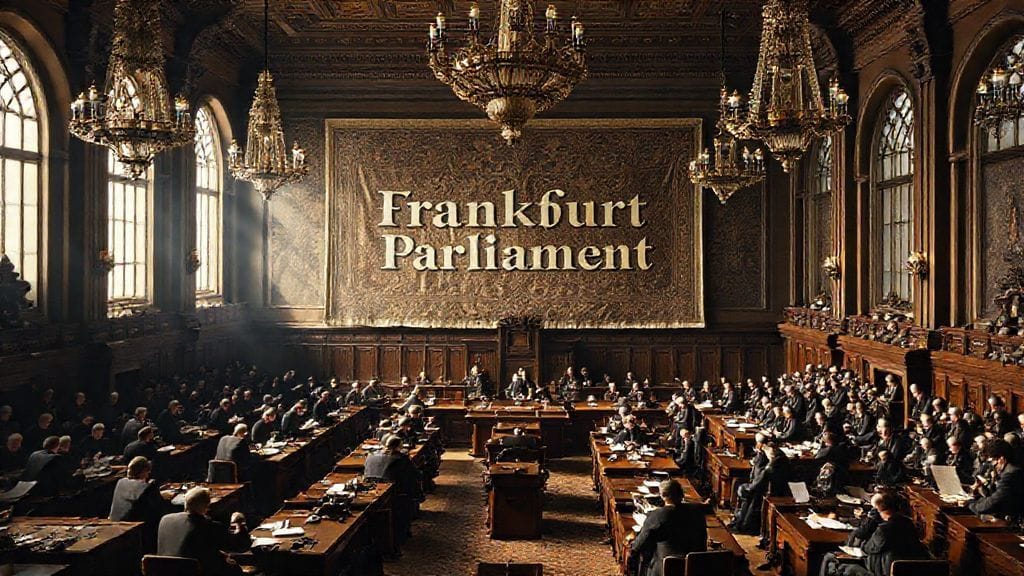
The morning of May 18, 1848, in Frankfurt am Main was thick with anticipation and the scent of change. Within the vaulted halls of St. Paul’s Church, nearly 500 delegates gathered, their eyes burning with the promises of a new era. The wooden benches creaked under the weight of history as voices began to echo across the chamber—voices that dared to envision a Germany reborn, unified, and free.
This was no ordinary assembly. It was the first freely elected parliament representing a pan-German state, an emblematic moment born of upheaval and courage. The Frankfurt Parliament—sometimes called the Frankfurt National Assembly—was the live heartbeat of a revolutionary wave sweeping across Europe; an expression of collective hope and national identity after centuries of division.
But this gathering was as fragile as it was glorious. Its fate, like that of the nation it sought to forge, hung precariously between revolution and reaction, promise and peril. The dream of a united Germany was gathering momentum—but would it endure the storm?
The Tumultuous Mid-19th Century: Europe on the Brink
The mid-1800s were a tinderbox of social unrest, liberal aspirations, and nationalist fervor. Europe simmered with the aftershocks of the Napoleonic era and the slow but surging currents of industrialization and political awakening. Across its landscapes, ancient empires wrestled with the rise of the middle class and the demands for constitutional governance.
The year 1848, dubbed the “Springtime of Nations,” saw revolutions erupt from Paris to Vienna. The old order—rigid monarchies and aristocratic privileges—was shaking. Democratic ideals, national self-determination, and social reform permeated the air. The German states, meanwhile, were particularly combustible: a patchwork of kingdoms, duchies, principalities, and free cities, bound loosely under the German Confederation.
These disparate entities jostled for power, identity, and survival amid these sweeping transformations. The people’s growing discontent was fueled by food shortages, economic hardship, and political repression—a volatile mix demanding action.
Cracks in the German Confederation: Seeds of Change
The German Confederation, established in 1815 by the Congress of Vienna, was a patchwork alliance rather than a unified state. Its existence masked the growing consciousness among Germans that their fragmented nature was a barrier to prosperity and sovereignty.
Liberal and nationalist groups spread their ideals through pamphlets, salons, and secret societies. The press pulsed with calls for rights, elections, and a constitution. But the Confederation’s ruling princes remained wary, favoring stability over change. This tension cracked open in early 1848, when riots and protests unsettled major cities like Berlin and Vienna.
The revolutionary wave forced monarchs to concede reforms—including promises of constitutional assemblies. It was in this climate that the idea of a national parliament took root: a forum to give Germany a voice, a constitution, and perhaps, unity.
The Call for Unity amidst Fragmentation
The fragmentation of Germany was not just political. It was linguistic, cultural, and economic. Railroads and industrial hubs were scattered, and within each kingdom or principality, loyalties often outweighed nationalist sentiments.
Still, a common yearning emerged—a desire to create a sovereign nation-state that could rival the powers of France, Austria, and Prussia. Advocates of unity were divided on the details: should Austria be included? Should this new Germany be a monarchy, republic, or constitutional state?
The Frankfurt Parliament’s convocation was the culmination of these currents—a beacon for those who dreamed a German nation beyond parochial disputes and dynastic squabbles.
May 18, 1848: The Historic Gathering at St. Paul's Church
On that May day, the delegates assembled in the former Protestant church—a symbolic choice highlighting the assembly’s role as a spiritual and national sanctuary. Journalists crowded the galleries; crowds gathered outside, eager for news.
Inside, the Chamber’s austere wooden benches filled with an array of men: university professors, lawyers, journalists, bureaucrats, and nobles alike. Their diversity was astonishing, yet all shared a common purpose: to wrestle with the question of German unity and freedom.
The assembly was inaugurated with hymns and speeches that ignited passions. The atmosphere blended solemn responsibility with revolutionary zeal. As one delegate later recalled, “Here were the voices of a people, rising from centuries of silence, daring to shape their destiny.”
Faces of Reform: The Delegates and Their Visions
The delegates were a complex mosaic of ideologies and backgrounds. Conservatives who sought to preserve monarchy but limit absolutism sat alongside liberals advocating constitutional monarchy or even republics. Radicals pushed for social reforms and broader suffrage.
Some were young and fiery, inspired by the French Revolution; others were seasoned politicians seeking moderate but pragmatic change. Among the most influential figures were Heinrich von Gagern, a gifted orator who became the parliament’s president, and Robert Blum, a passionate democrat who later paid with his life for his convictions.
Their ideological clashes would shape every debate, reflecting the fundamental questions about Germany’s identity and future.
The Architecture of Democracy: Crafting a Constitution
From the outset, the Frankfurt Parliament sought to draft a constitution—a legal foundation binding diverse states into a cohesive political body. They envisioned a parliamentary monarchy, with a constitution guaranteeing civil liberties, equality before the law, freedom of the press, and parliamentary oversight of the executive.
The challenge was formidably complex. Delegates debated representation, federal structures, and the balance of power between crown and people. Drafting committees labored tirelessly, producing proposals that drew from Enlightenment thought and existing constitutional models.
It was as much about creating a political framework as about forging a collective identity—a Germany united not by bloodline alone but by shared laws and ideals.
Voices Raised: Debates, Disputes, and Dreams
The chamber resounded with passionate discussions. Heated debates over the inclusion of Austria, the extent of suffrage, religious freedoms, and protections for minorities would become defining features of the assembly.
At times, disagreements threatened to paralyze progress, reflecting unsettled tensions between reform and revolution, between pragmatism and idealism. Moments of consensus were celebrated; moments of division threatened to unravel the fragile unity.
One iconic moment was the debate over whether to include the Austrian Habsburg lands—a question that underscored the era’s competing visions: a “Lesser Germany” dominated by Prussia or a “Greater Germany” including Austria.
A New Germany Imagined: From Kleindeutsch to Grossdeutsch
The “German question,” as it came to be known, centered on the shape of the future nation. The Kleindeutsch solution envisaged unification under Prussian leadership, excluding Austrian territories due to their multiethnic composition. The Grossdeutsch advocates wanted a broader empire including Austria.
This debate was emblematic of deeper cleavages—between conservatives and liberals, between powerful states jockeying for dominance, and across ethnic and religious lines. Ultimately, the Kleindeutsch vision gained momentum, but not before deepening rifts labeling the assembly falls short of consensus.
The Role of King Frederick William IV: Hopes and Rejections
The parliament’s boldest step was to offer the imperial crown to King Frederick William IV of Prussia. It was a symbolic invitation: a constitutionally limited monarchy meant to bind Germany’s disparate parts.
At first, the king appeared cautious, attending diplomatic discussions but withholding commitment. His rejection—rooted in his belief that the crown should come from German princes, not “from the gutter”—was a devastating blow.
This refusal crystallized structural obstacles to the revolution’s success. It underscored lingering aristocratic resistance and the limits of liberal progressivism against entrenched monarchical power.
The Struggle Between Monarchs and Revolutionaries
Behind the parliamentary debates, monarchies mobilized reactionary forces to regain control. The old guard feared loss of privileges and national disintegration.
Incidents of violence, suppression of uprisings, and the formation of paramilitary units across German states illustrated the precariousness of the revolutionary project. While the parliament sought compromise and legality, the tide was shifting toward reaction.
The revolutionaries faced a paradox: lacking an armed force to enforce their mandates and dependent on reluctant princes, their authority was ultimately fragile.
Outside the Chamber: The Pulse of the Streets and Provinces
While the parliament sat in Frankfurt, the German populace was deeply divided. Some cities and regions eagerly embraced the revolutionary agenda, while others recoiled or remained indifferent.
Newspapers, political clubs, public lectures, and demonstrations animated civil society, but also exposed tensions—between urban and rural, between classes, and among religious groups.
The parliament’s connection to the people was real but uneven, complicating its legitimacy and effectiveness.
The Parliament’s Limitations: Political Realities and Tactical Errors
Despite its historic significance, the Frankfurt Parliament struggled with fundamental challenges: lack of enforcement power, absence of military support, and internal divisions.
Its members sometimes appeared out of touch with popular demands or unwilling to confront hard political realities. The idealism that fueled its vision also bred inflexibility and indecision.
Furthermore, foreign powers and dominant German monarchies viewed the parliament as a threat, coordinating to undermine it. The combination of internal discord and external hostility made survival increasingly difficult.
The Fall of the Frankfurt Parliament: Retreat and Defeat
By 1849, the fragile assembly began to unravel. The rejection of its constitution by key German states, coupled with military suppression of associated uprisings, marked the end of the parliamentary experiment.
Delegates were forced to flee or were arrested; the parliament dissolved amid political repression. The dream of German unification under a liberal constitution was temporarily shattered.
Yet this defeat was not the end—it was a somber lesson etched into the nation’s political consciousness.
Legacy Beyond Failure: Seeds of German Unification
Though a short-lived failure, the Frankfurt Parliament planted vital seeds. It was the first substantive attempt to unite Germany through democratic deliberation and constitutionalism.
Its debates, documents, and ideals influenced later movements and thinkers. By exposing the difficulties of unification, it paved the way for more pragmatic, state-driven approaches, culminating in the German Empire’s creation in 1871.
Moreover, it popularized ideas of national identity and parliamentary governance that persisted through decades.
The Frankfurt Parliament’s Influence on Modern Democracy
The assembly’s emphasis on rights, freedoms, and constitutionalism became foundational in German political culture. Concepts debated and adopted influenced both the Weimar Republic and the post-World War II Federal Republic of Germany.
In a broader sense, the parliament exemplified the challenges and hopes of early democracy: balancing diverse interests, navigating power struggles, and articulating national identity.
Cultural Reverberations: Literature, Art, and Memory
The events surrounding the Frankfurt Parliament inspired writers, poets, and artists. It entered German collective memory as a tragic but heroic struggle for freedom and unity.
Films, novels, and public commemorations have revisited the assembly’s story, preserving its lessons and emotional resonance. It remains a symbol of aspiration and the complexities of nation-building.
The Lessons Left Behind: Freedom, Fragmentation, and Future
The Frankfurt Parliament’s fate teaches us that nationhood and democracy are not simply won—they are arduously crafted through compromise, patience, and courage.
In a world still grappling with division and populism, its story is a reminder of ideals pursued even amidst failure. The balance between authority and liberty, unity and diversity, remains a living debate.
Conclusion: The Eternal Strive for German Unity
The Frankfurt Parliament was more than a historical footnote—it was a pivotal moment when Germany dared to dream itself whole. Though its efforts faltered, the impulse for national unity and democratic governance did not fade.
The echoes of 1848 remind us that history moves through setbacks as much as triumphs. The parliament’s chambers may have emptied, but the voice of a unified and free Germany was forever raised.
This striving continues today, a testimony to the enduring human quest for dignity, identity, and belonging.
FAQs: The Frankfurt Parliament Unveiled
Q1: What was the primary goal of the Frankfurt Parliament?
A: Its main goal was to create a unified German nation-state with a constitution that guaranteed democratic rights and freedoms.
Q2: Why was the Frankfurt Parliament convened in 1848?
A: It was convened amidst widespread revolutionary movements demanding political reform and national unity across the German Confederation.
Q3: Who were the key figures in the Frankfurt Parliament?
A: Prominent delegates included Heinrich von Gagern, Robert Blum, and several liberal and radical leaders representing a spectrum of German society.
Q4: What was the “German question” debated at the parliament?
A: It referred to whether the future Germany would include Austria (Grossdeutsch) or exclude it in favor of Prussian leadership (Kleindeutsch).
Q5: Why did King Frederick William IV reject the imperial crown?
A: He refused what he considered a crown “from the gutter,” unwilling to accept legitimacy from a popular assembly rather than other monarchs.
Q6: What led to the failure of the Frankfurt Parliament?
A: A mix of internal divisions, lack of enforcement power, and opposition from monarchs and conservative forces caused its collapse.
Q7: How did the Frankfurt Parliament influence later German history?
A: It laid groundwork for future constitutionalism, nationalism, and ultimately contributed ideas to the eventual unification of Germany in 1871.
Q8: Is the Frankfurt Parliament remembered positively in Germany today?
A: Generally, it is seen as a noble but tragic effort towards democracy and unity, symbolizing both hope and the complexities of nation-building.