Table of Contents
- Dawn of a New Era: The Frankish Push into Aquitaine
- The Gaul of the Late 5th Century: A Landscape in Turmoil
- The Legacy of Roman Withdrawal and the Stage for Conflict
- Clovis I: Rise of the Frankish King and His Vision
- Aquitaine and Poitiers in the 490s: Between Survival and Submission
- Tribes, Romans, and Aspirations: The Complex Mosaic of Gaul
- The Frankish Army on the Move: Strategies and Tactics
- The Clashes that Shaped History: Skirmishes Across Aquitaine
- The Battle for Poitiers: A Defining Moment in the Frankish Expansion
- The Role of Local Lords and Roman Aristocracy
- Faith and Power: The Conversion of Clovis and its Political Weight
- The Cultural Exchange Between Franks and Aquitanians
- The Aftermath in Aquitaine: Reorganization and Resistance
- The Transformation of Gaul: From Roman Province to Frankish Heartland
- Legacy of the Conquest: Foundations for Medieval Europe
- Conclusion: The End of an Era, The Dawn of Another
- FAQs: Understanding the Frankish Advance into Aquitaine
- External Resource
- Internal Link
Dawn of a New Era: The Frankish Push into Aquitaine
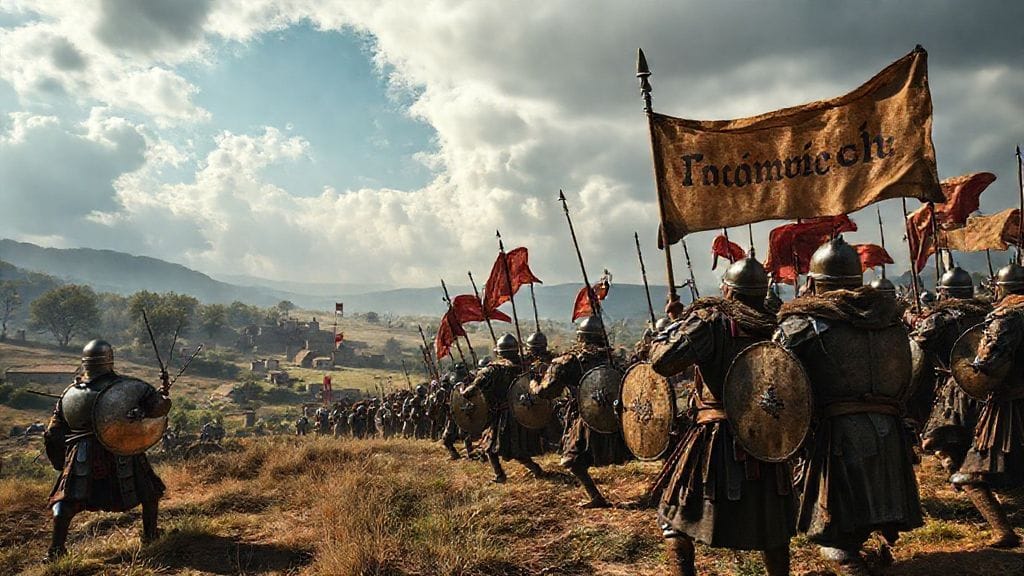
The air was thick with anticipation on the rolling plains surrounding Poitiers in the waning years of the 5th century. The once lush Gallo-Roman settlements now bore the scars of decades of conflict and neglect, yet they remained coveted jewels coveted by emerging powers. From the misty forests to the riverbanks, whispers circled—an unstoppable force, the Franks, were moving further south, narrowing their grip on the fractured remnants of Roman Gaul. It was a moment pregnant with tension and possibility, where the old world was daily fading, and a new order was about to be forged in blood and iron.
The Frankish advance into Aquitaine and the Poitiers region during the 490s was more than a mere military campaign; it was the tidal wave that reshaped the political, cultural, and religious landscape of Western Europe. This was the dawn of what would later be known as medieval France, an era marked by the mingling of Roman legacy, Germanic warrior ethos, and the nascent Christian order that Clovis I, the Frankish king, championed with unprecedented zeal.
The Gaul of the Late 5th Century: A Landscape in Turmoil
To understand the gravity of the Frankish advance, one must first picture Gaul in the late 5th century—a land fragmented and fragile. The once-mighty Roman Empire had withdrawn its legions and administrative grip decades before, leaving behind a patchwork of Romanized cities, barbarian kingdoms, and restless local powers. The Western Roman Empire officially fell in 476 AD, barely a decade before the Frankish campaigns that rocked Aquitaine.
Gaul was split between various Germanic kingdoms—Visigoths held sway in the southwest, notably in Aquitaine; Burgundians ruled the southeast; and the Franks, under the ambitious Clovis, dominated the north and northeast. Yet none felt utterly secure. Each ruler eyed the territory of neighbors with hunger, each region as much a city-state as a kingdom, ruled by warlords, bishops, and the still-present Roman aristocracy clinging to past prestige.
The Legacy of Roman Withdrawal and the Stage for Conflict
The Roman withdrawal did not only leave military voids, but financial, administrative, and social ruptures that fractured local communities deeply. Aquitaine, for instance, was a region where Roman customs lingered but were increasingly overshadowed by Visigothic law and Germanic traditions. Urban centers such as Poitiers retained traces of Roman grandeur—baths, forums, amphitheaters—yet daily life had become a blend of survival and negotiation.
This power vacuum bred instability but also opportunity. For ambitious leaders like Clovis, it represented a chance to unify and redefine Gaul, not as a province of an empire that had crumbled, but as a kingdom with its own destiny.
Clovis I: Rise of the Frankish King and His Vision
Clovis, the son of Childeric I, was more than a tribal chief wielding a sword. He was a visionary ruler, hungry for expansion and consolidation. Ascending to power likely in the mid-480s, he quickly realized that military might alone wouldn’t grant him dominion; religious unity and political legitimacy were equally crucial.
His choice to convert to Catholic Christianity — diverging from the Arian Christianity practiced by many Germanic tribes — was a masterstroke that earned him the powerful support of the Gallo-Roman Catholic aristocracy and the Church. This alliance would prove decisive as he pushed his armies into Aquitaine, an area deeply split between lingering Roman loyalties and Visigothic influence.
Aquitaine and Poitiers in the 490s: Between Survival and Submission
The region of Aquitaine during the 490s was at a crossroads. The Visigothic kingdom had dominated much of the south, but internal pressures and the growing Frankish threat challenged its hold. Cities like Poitiers became pivotal nodes—defensive bastions, trade centers, and symbolic prizes for any force seeking hegemony over southwestern Gaul.
Inhabitants faced daunting choices as armies approached. Collaboration, resistance, flight—none options guaranteed safety. Clergy and landowners played crucial roles, negotiating with new powers while preserving fragile communities. Meanwhile, common folk endured the chaos often invisibly, their everyday struggles etched in annals only faintly recorded.
Tribes, Romans, and Aspirations: The Complex Mosaic of Gaul
Gaul was no monolith. Besides Franks and Visigoths, Burgundians, Alemanni, and remnants of Roman citizens shared the land, each group with distinct legal traditions, languages, and customs. This diversity complicated conquests and governance. Conquerors had to grapple with local laws—a delicate blend of Roman law and Germanic customs—while attempting to impose unity.
Yet this diversity also enriched the cultural tapestry emerging, laying groundwork for medieval identities that would blend these influences over centuries.
The Frankish Army on the Move: Strategies and Tactics
Clovis’ military success owed much to his strategic acumen. Frankish forces were small but tactically flexible, utilizing mounted troops, infantry formations, and exploiting weaknesses in enemy lines. Unlike the Roman legions before them, the Franks combined barbarian ferocity with growing experience in siegecraft and city assault.
Logistically, their campaigns were swift, designed to surprise and overwhelm. The conquest of Aquitaine was marked not by prolonged sieges but by rapid strikes that broke resistance before it could consolidate.
The Clashes that Shaped History: Skirmishes Across Aquitaine
The campaign through Aquitaine was punctuated by numerous battles and sieges, many small but cumulatively decisive. The terrain presented challenges—forests, rivers, and fortified towns made the advance a slow grind.
Though details are fragmented, accounts indicate that Frankish forces met fierce resistance from Visigoths and local militias. Poitiers, in particular, was a focal point, as holding the city meant controlling central Aquitaine. The skillful capture or submission of such strongholds demonstrated Clovis’ growing mastery and his ability to meld warfare with diplomacy.
The Battle for Poitiers: A Defining Moment in the Frankish Expansion
Though often overshadowed by the later Battle of Tours in 732, the fighting around Poitiers in the 490s was itself a defining moment in establishing Frankish dominance in Aquitaine. The city, with its strategic location, was a linchpin that allowed Clovis to stretch influence further south and solidify control.
Its capture or submission disrupted Visigothic plans and heralded the erosion of their power in the region. This battle is a prelude but an essential chapter to understanding the longer narrative of the Frankish consolidation of power.
The Role of Local Lords and Roman Aristocracy
In this turbulent period, many local Gallo-Roman aristocrats faced a dilemma: oppose the Franks and risk annihilation or negotiate and accommodate a new power. Often, collaboration proved pragmatic.
Clovis shrewdly co-opted local elites, offering positions, recognition, and protection of privileges. The Church, too, became an ally. Bishops wielded influence far beyond religious affairs and were instrumental in stabilizing regions newly under Frankish sway.
Faith and Power: The Conversion of Clovis and Its Political Weight
Clovis’ conversion was more than a personal spiritual journey — it redefined Frankish identity and politics. Baptized perhaps around 496 AD, his embrace of Catholic Christianity distinguished him from other Germanic rulers who adhered mostly to Arianism.
This shift aligned Clovis with the powerful institution of the Catholic Church, boosting his legitimacy in the eyes of conquered Roman populations and foreign rulers alike. The conversion enabled him to claim a sacred mandate, making the conquest of Gaul not just a political ambition but a divine mission.
The Cultural Exchange Between Franks and Aquitanians
The Frankish advance did not lead to a wiping away of local culture. Instead, it initiated a slow, complex cultural exchange. Roman urban manners, language (Latin evolving into early Romance dialects), legal traditions, and Christian practices mixed with Germanic tribal customs.
The fusion laid early foundations for medieval European civilization, from feudalism to law codes and religious institutions.
The Aftermath in Aquitaine: Reorganization and Resistance
Although the Frankish conquest advanced decisively, pockets of resistance and unrest persisted. The transformation of Aquitaine was not a single event but a process spanning decades.
The Frankish kings instituted new administrative structures, appointed loyal counts and bishops, and sought to integrate Aquitaine’s economy into their growing realm. Yet they had to handle revolts, local disputes, and the ever-present threat of Visigothic retaliation.
The Transformation of Gaul: From Roman Province to Frankish Heartland
The conquests of the 490s marked a critical juncture in the transition from antiquity to the Middle Ages. Gaul ceased to be a Roman province and gradually emerged as the Frankish kingdom’s heartland.
This metamorphosis entailed changes across society: from defense and economy to culture and faith. The old Roman roads bore Frankish warriors; churches once dedicated to Roman gods became Christian sanctuaries; Latin morphed into French.
Legacy of the Conquest: Foundations for Medieval Europe
The Frankish conquest of Aquitaine paved the way for the Carolingian dynasty and the eventual unification of much of Western Europe under Charlemagne. The blend of Roman order, Germanic vigor, and Christian faith that began with Clovis’ campaigns defined European identity for centuries.
Poitiers and Aquitaine would remain poignant symbols of this transformation—a testament to resilience, adaptation, and the forging of a new era.
Conclusion
The Frankish advance into Aquitaine and the Poitiers region during the 490s transcends the mere narrative of warfare and territorial expansion. It represents a profound chapter in the birth of medieval Europe—a crucible where fading Roman legacies blended with emerging new powers and ideas. This campaign, propelled by the ambitions of Clovis and fueled by shifting political and religious tides, rewrote the map of Gaul and forever altered its culture and society.
As we contemplate the stones of Poitiers, the forests of Aquitaine, and the echoes of battle cries long silenced, what emerges is a story not just of conquest, but of human determination to redefine identity amidst chaos. The 490s were not simply years of conflict; they were the womb of a civilization still shaping our world today.
FAQs
1. Why was the Frankish advance into Aquitaine significant in the 490s?
The advance marked a decisive shift in power from the Visigoths to the Franks, facilitating the unification of much of Gaul under Frankish rule and laying the foundations for medieval France.
2. Who was Clovis and why was his role crucial?
Clovis was the Frankish king who led the expansion. His strategic military campaigns, combined with his conversion to Catholic Christianity, helped him gain both territorial control and political legitimacy.
3. What was the state of Gaul before the Frankish conquest?
Gaul was fragmented among various Germanic kingdoms and remnants of Roman administration, with complex interplays between local lords, Roman aristocracy, and invading groups.
4. How did religion influence the Frankish conquest?
Clovis’ conversion to Catholicism aligned him with the powerful Gallo-Roman Church, which provided political support and helped unify diverse populations under a single religious and cultural identity.
5. What was the fate of Aquitaine and Poitiers after the conquest?
Aquitaine and Poitiers were gradually integrated into the Frankish kingdom, with new administrative structures established, though resistance persisted in some areas.
6. How did this conquest influence future European history?
It helped establish the Frankish kingdom as a dominant power, eventually paving the way for the Carolingian Empire and medieval Europe’s political and cultural landscape.
7. Were there cultural changes after the conquest?
Yes, the Frankish rule initiated a cultural fusion between Roman traditions and Germanic customs, crucial in shaping medieval European civilization.
8. What sources do historians rely on to study this period?
Primary sources include Gregory of Tours’ History of the Franks, archaeological evidence, and various ecclesiastical records, though accounts remain fragmentary.

