Table of Contents
- A Spring Morning in Rome: The Day the Empire Came to the City
- The Long Twilight of an Empire Before Frederick
- A Reluctant Ruler: Frederick’s Path from Graz to Imperial Ambition
- Italy in Turmoil: Popes, Princes, and the Lure of Imperial Crowns
- The Journey South: Frederick’s Procession Toward Rome
- A Marriage, a Crown, and a Bargain: Frederick and Eleanor of Portugal
- The Eve of Power: Rome Awaits Its Last Imperial Coronation
- March 30, 1452: Frederick III Crowned Holy Roman Emperor
- Ritual, Symbol, and Sword: Inside the Coronation Ceremony
- Behind the Splendor: Politics Between Emperor and Pope
- A Fragile Empire: German Princes, Italian Cities, and Imperial Limits
- Frederick the “Arch-Sleepyhead”: Character, Caution, and Reputation
- From Rome Back to the Frontiers: War, Diplomacy, and Ottoman Shadows
- The Habsburg Design: How a Crown Built a Dynasty
- Echoes After Rome: The Last Medieval Emperor in a Changing World
- Memory and Myth: How Historians See Frederick’s Coronation Today
- Conclusion
- FAQs
- External Resource
- Internal Link
Article Summary: On March 30, 1452, in a Rome still haunted by ruins and rivalries, Frederick III crowned Holy Roman Emperor stepped into a role that was as symbolic as it was precarious. This article traces the winding path that brought him from the provincial courts of Inner Austria to the greatest ceremony of Latin Christendom, when Frederick III crowned Holy Roman Emperor before a watching world in St. Peter’s. It explores the fraught politics behind the journey, the marriage alliance with Eleanor of Portugal that underpinned his power, and the tense partnership with Pope Nicholas V that made the coronation possible. We move through the ceremony itself—its oaths, relics, swords, and crowns—unfolding its meanings for contemporaries who feared Ottoman expansion and yearned for Christian unity. Yet behind the pageantry, Frederick III crowned Holy Roman Emperor also marked a turning point: the fading of universal imperial dreams in an age of powerful kingdoms and rising city-states. The narrative follows the emperor back north, into conflicts with German princes, uneasy truces, and slow but deliberate dynastic planning. Finally, we examine how later generations have debated his legacy, asking whether the day Frederick III crowned Holy Roman Emperor in Rome was a last echo of the medieval world or the quiet opening act of the Habsburg centuries to come.
A Spring Morning in Rome: The Day the Empire Came to the City
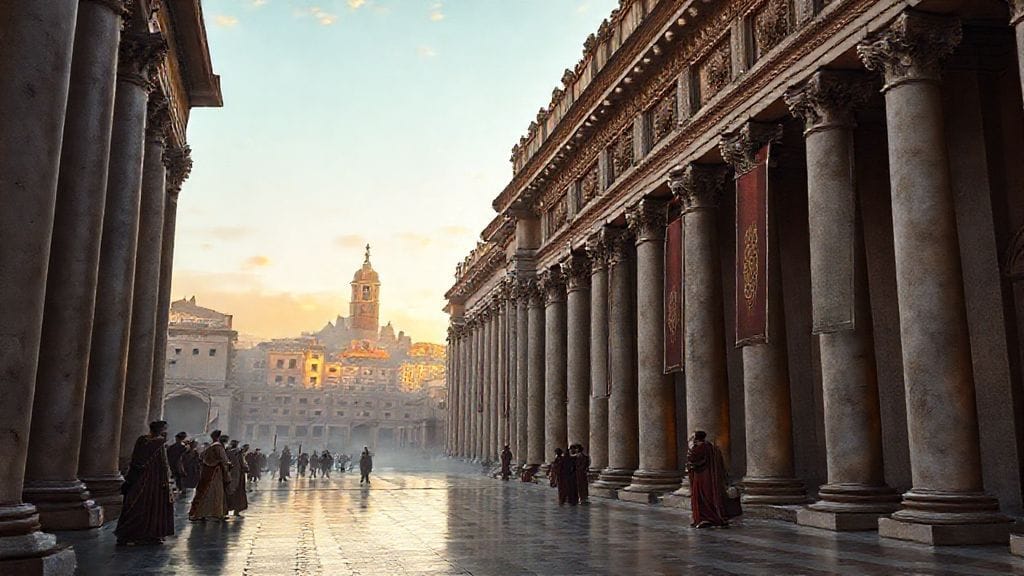
The bells of Rome began to toll long before dawn on March 30, 1452. Their iron tongues rang over broken forums and half-ruined palaces, over narrow streets where pilgrims, merchants, and beggars had slept in uneasy clusters. Rome was used to spectacle, to processions and holy days, but that morning felt different. The city, once the heart of an empire, was about to witness the crowning of another—Frederick III, a man from the distant Alpine lands, would be made Holy Roman Emperor in a rite that many in the crowd suspected they might never see again.
The Tiber rolled sullenly under the early light as the procession assembled. Standard-bearers lifted banners bearing imperial eagles and papal keys. German knights, stiff in their foreign armor, fumbled with reins and harness, their breath steaming in the chill, while Italian onlookers whispered about their accents and their awkwardness. Above them, on the seven hills, crumbling antique walls and medieval towers looked down like silent witnesses to an old story being retold one last time.
At the center of this spectacle rode Frederick of Habsburg, King of the Romans, soon to be crowned emperor. He was not a flamboyant ruler. Contemporary observers described him as reserved, even taciturn, a man more inclined to wait than to charge. Yet here, surrounded by cardinals, bishops, nobles, and envoys, he represented something staggering: the living claim to be Roman Emperor, heir—however distantly—to Caesar, Constantine, and Charlemagne. The simple phrase “Frederick III crowned Holy Roman Emperor” would, by nightfall, be fact rather than expectation, a line in future chronicles and a symbol heavy with meaning for a Europe in crisis.
The air smelled of incense and sweat, of dust stirred up by hundreds of hooves and boots. Around the procession, people jostled for a view. Some hoped to glimpse their new empress, Eleanor of Portugal, whose recent marriage to Frederick had brought tales of exotic courts and Atlantic winds into Roman taverns. Others were driven less by curiosity than by unease. The Ottomans were pressing hard against the Balkan frontiers; Constantinople was but months away from its final siege. To many, the coronation was not just a ritual of honor but a desperate prayer that Christendom might yet find a leader capable of holding its enemies at bay.
And yet, even as trumpets blared and the procession moved toward St. Peter’s, a more skeptical murmur ran through the crowd. What did it mean, in 1452, to claim the title of Holy Roman Emperor? Was this grand pageant a renewal of old power—or an echo of a world that no longer existed? Those questions would hang in the air long after the oil had dried on Frederick’s forehead and the heavy crown had been lifted from the altar to his head.
The Long Twilight of an Empire Before Frederick
To understand why this coronation mattered, we must step back into the unsettled centuries that preceded it. The Holy Roman Empire was never a simple state. It was an idea stitched into a patchwork of lands, languages, and laws—a claim to universal authority over Latin Christendom that few emperors could truly enforce. By the time Frederick III approached Rome, the empire had already endured centuries of conflict with popes, princes, and cities that chipped away at its reach.
In the high Middle Ages, emperors like Frederick I Barbarossa and Frederick II Hohenstaufen had descended into Italy with vast armies, determined to impose their sovereignty over rebellious communes and a jealous papacy. Their campaigns shook the peninsula from Lombardy to Sicily, pitting “imperial” and “papal” factions against each other in endless civil strife. Yet for all their might, these emperors never fully tamed Italy—and their efforts left a legacy of mistrust, fear, and devastation. After the fall of the Hohenstaufen line in the 13th century, the very notion of a strong, centralized empire began to wane.
The fourteenth century did the empire few favors. While kings like Charles IV of Luxembourg managed to keep the title alive, they did so by compromise and careful avoidance of Italian entanglements. Charles’s famous Golden Bull of 1356 codified the rights of the prince-electors who chose the King of the Romans, the emperor-to-be. It was a practical solution to a long-running problem of disputed elections, but it also entrenched the power of local rulers, making it even harder for any single monarch to dominate the empire. The crown, increasingly, was something bargained over and shared, rather than a weapon to command.
By the early 15th century, the empire’s influence in Italy had eroded so deeply that some Italian states spoke of it almost in the past tense. City-republics like Florence and Venice, princely courts like Milan under the Visconti and later the Sforza, moved with a confidence that barely acknowledged imperial oversight. The popes themselves, fresh from the humiliation of the Avignon Papacy and the Great Western Schism, were uneasily rebuilding their temporal authority in central Italy. The empire might still be invoked in charters and ceremonies, but its presence on the ground south of the Alps was thin.
Against this backdrop, the idea that Frederick would journey to Rome to be crowned in person took on an almost archaic flavor. Many of his predecessors had been content—or forced—to rule without papal coronation; some had never set foot in Rome at all. As historian Peter H. Wilson notes in his study of the empire, for late medieval rulers “the Roman coronation was becoming optional rather than essential,” a fading ritual rather than a necessary sacrament. Yet Frederick was about to defy this trend, insisting on reviving the old journey, the old oaths, the old theater of power.
Why? The answer lay partly in his own uncertain position at home—and partly in the shifting tides far beyond his frontiers.
A Reluctant Ruler: Frederick’s Path from Graz to Imperial Ambition
Frederick was born in 1415 in Innsbruck, but he grew up in the Habsburg world of Inner Austria—lands like Styria, Carinthia, and Carniola, straddling the Alps and the northeastern Adriatic hinterland. This was not the glittering heart of Europe but a frontier region, a place where German, Slovene, Croatian, and Italian tongues mingled in markets and border disputes. The Habsburg family itself was, at this point, a rising but far from unassailable dynasty, split into several branches and often quarrelsome.
Frederick’s youth was marked by family tension and the complexity of shared inheritance. When he was still a young man, he became guardian of his cousin Ladislaus the Posthumous, the underage heir to extensive Habsburg possessions including Austria proper and claims in Hungary and Bohemia. This guardianship would shape much of his early career: it brought opportunities but also constant friction with nobles and neighboring powers eager to manipulate or dispossess the boy-king. Frederick learned early the value of patience, of delaying decisions until his opponents had exhausted themselves.
He was not, in temperament, the typical medieval warlord. Eyewitnesses and later chroniclers describe him as reserved, sometimes painfully slow to act, inclined to outwait crises rather than smash through them. One famous nickname, bestowed by frustrated contemporaries, called him the “Erzschlafmütze”—the “Arch-Sleepyhead.” Yet behind that slowness, others sensed calculation. Frederick might miss chances for bold moves, but he also avoided many of the ruinous wars that had destroyed stronger-looking rulers before him.
In 1440, following the death of Emperor-elect Albert II, the prince-electors gathered to choose a new King of the Romans. They needed a candidate who was legitimate, but not overpowering; steady, but not threatening. Frederick fit perfectly. As guardian of Ladislaus and head of a key Habsburg line, he was important enough to command respect, but his reputation for caution reassured the princes that he would not try to bulldoze their privileges. They elected him king, giving him the right—if he could secure papal cooperation—to be crowned emperor someday.
Yet kingship did not instantly transform Frederick’s fortunes. His authority in Germany was contested; the princes acted with near-sovereign freedom, minting coins, waging wars, and forming leagues. The imperial cities jealously guarded their rights. South and east of his hereditary lands, Ottomans pushed into Hungary and the Balkans, threatening to tear away Christian frontier zones that the Habsburgs hoped to influence. Frederick’s own resources, modest compared to those of the great territorial princes, forced him to govern by negotiation and delay rather than raw force.
In this uncertain environment, the ancient prestige of the imperial crown had a renewed appeal. If Frederick could secure coronation as emperor in Rome, under the blessing of a pope widely seen as a restorer of order and culture, he might stiffen his standing both abroad and at home. Frederick III crowned Holy Roman Emperor would not automatically give him more soldiers or silver—yet the title could buttress his claims, dignify his diplomacy, and boost his slowly unfolding dynastic strategy. For that, however, he needed to look beyond the Alps and toward the Tiber.
Italy in Turmoil: Popes, Princes, and the Lure of Imperial Crowns
Italy in the mid-15th century was a tapestry of rivalries and experiments in power. The long agony of the Avignon Papacy and the Great Western Schism had split Christendom’s spiritual leadership into competing obediences. Councils in Pisa, Constance, and Basel tried to tame the popes, offering a vision of shared church governance. Out of this tempest emerged Nicholas V (Tommaso Parentucelli), who became pope in 1447. Learned, bookish, and politically shrewd, Nicholas sought to heal the wounds of schism, stabilize the Papal States, and transform Rome into a new center of humanist culture.
Yet Nicholas was also operating in a country that had grown used to improvising in the absence of strong, consistent imperial involvement. In northern and central Italy, wealthy communes had given way to “signori”—lords such as the Sforza in Milan, the Este in Ferrara, and the Medici in Florence, who combined urban politics with princely ambition. Venice, a maritime giant, balanced its trade between East and West and eyed the Ottoman advance with both fear and opportunity. The kingdom of Naples changed hands among dynasties and foreign claimants in a tangle of bargains that baffled even seasoned observers.
Into this world stepped Frederick, still only King of the Romans but determined to complete the old imperial rite. For Nicholas V, his arrival offered both promise and risk. On one hand, a solemn coronation could underscore papal supremacy over all Christian princes, sending a signal that the pope—not any council—conferred the highest authority on earth. On the other, inviting a German ruler into the heart of Italy risked stirring old memories of imperial interference and threatening the delicate balance Nicholas was trying to maintain with regional powers.
The Ottomans added urgency. Their recent victories in the Balkans and their looming threat to Constantinople terrified humanists and churchmen alike, who saw in the possible fall of the Eastern Roman (Byzantine) Empire a catastrophe for Christendom as a whole. A crowned emperor might serve as a rallying figure for a new crusade, or at least as a symbolic defender of the faith. Rumors and plans for leagues against the Turks floated through Italian courts, often more rhetorical than real.
So when envoys began to shuttle between Frederick and the papal curia, discussing terms for a coronation in Rome, the negotiation was about far more than pageantry. It was about who would stand as the visible head of a fractured Christian world, about whether imperial and papal claims could be harmonized—or at least staged for mutual benefit. Rome was preparing not only to crown a man, but to test whether the ancient architecture of empire still meant anything in a world tilting toward modernity.
The Journey South: Frederick’s Procession Toward Rome
In an age before railways and asphalt roads, a royal progress was itself a kind of theater, unfurling slowly across landscapes and parading power from town to town. Frederick’s journey to Italy was no exception. Leaving his central European heartlands, he turned south through Alpine passes that had seen emperors and armies come and go for centuries, their memory lingering in the shrines and wayside chapels that dotted the slopes.
The retinue he gathered was impressive but not overwhelming. Unlike the great imperial invasions of the 12th and 13th centuries, Frederick did not come with an army intent on enforcing his will. Instead, he moved with a courtly entourage: nobles from his German and Austrian lands, ecclesiastical dignitaries, legal advisors, household officials, and the usual flurry of servants, grooms, cooks, and scribes who made aristocratic mobility possible. Their presence signaled honor; their relatively modest numbers signaled caution.
As he descended into northern Italy, Frederick moved through territories that were, at least in theory, still part of the empire: the old Regnum Italiae, the Kingdom of Italy claimed by the German kings since the days of Otto I. Local lords and city councils, however, received him more as a visiting sovereign among many rather than as a true overlord. They staged elaborate welcomes—triumphal arches, processions of guilds, Latin orations from humanist scholars—but much of it had the flavor of polite theater rather than submission. Their loyalties lay with their own interests, their own alliances, and with the fragile peace known as the Italian League.
Nonetheless, these stops mattered. They offered Frederick chances to negotiate with Italian powers, to affirm traditional rights, to strengthen his hand in disputes that might arise later. Chroniclers recount banquets in candlelit halls, tournaments organized in his honor, and pious visits to churches thick with relics. At each halt, letters were sent ahead to Rome, updating the pope’s court on his progress, while reports flowed back to German lands, assuring allies and rivals alike that the journey was proceeding without incident.
For the common people who watched the cavalcade pass, the sight was both familiar and strange. Foreign armor, strange dialects, the black imperial eagle on gold—it all spoke of distant lands and stories. Old men might murmur about Barbarossa’s time, when imperial hosts had thundered down the same roads with far darker intent. Younger citizens, shaped by the rhythms of city republics and princely courts, saw instead another player in the perpetual Italian game, a piece that perhaps could be used—or avoided.
As Frederick approached central Italy, the atmosphere thickened. The Papal States, nominally under direct papal rule, were dotted with baronial families and semi-autonomous towns who did not love the idea of a foreign king marching through their lands. Yet Nicholas V and his cardinals worked tirelessly to prevent trouble, issuing commands, guaranteeing safe passage, and arranging ceremonial receptions. The journey itself, in its smoothness, was already a quiet victory for the pope’s project of restoring order—and for Frederick’s strategy of avoiding any hint of conquest.
A Marriage, a Crown, and a Bargain: Frederick and Eleanor of Portugal
While the road to Rome carried Frederick closer to his coronation, another thread of his story had been woven far out in the Atlantic world: his marriage to Eleanor of Portugal. This union, agreed upon before the journey but solemnized as part of the Italian episode, was crucial to his broader plans. Eleanor was the daughter of King Edward of Portugal, a realm then increasingly defined by its maritime ventures along the African coast and into the Atlantic islands. Her dowry was substantial; her lineage impeccable.
The negotiations that led to the match reveal Frederick’s combination of caution and long vision. He did not seek a bride from among the German princely houses, where marital alliances could easily entangle him in internal rivalries. Instead, he looked west, to a kingdom that was distant enough not to threaten his base, yet rich enough to bolster his standing. The dowry funds would help stabilize his finances; the connection to a successful, outward-looking monarchy would lend prestige.
Eleanor herself was no mere cipher. Contemporary accounts portray her as pious and dignified, educated in the traditions of one of Europe’s more sophisticated courts. Traveling by sea and then overland to meet her groom, she arrived in Italy like a figure from a different world, carrying stories of Lisbon’s harbors and the strange new routes opening along Africa’s shores. When she and Frederick met, their personal rapport was, as in most dynastic marriages, secondary to the political circumstances—but sources indicate mutual respect and a degree of companionship that surprised some observers.
Their marriage was celebrated with the kind of spectacle that Italian courts excelled in producing: costumed pageants, symbolic triumphs, allegorical tableaux extolling love, faith, and imperial virtue. But beneath the surface glitter lay a cold practicality. If Frederick III crowned Holy Roman Emperor in Rome, he would not do so as a solitary figure. He would have by his side an empress whose dowry helped fund his policies and whose kinship extended the web of Habsburg influence across Europe.
The link between his marriage and his coronation was not accidental. In many ways, they were two sides of the same strategy. The imperial crown gave the Habsburgs an unmatched symbolic platform; the marriage provided material support and new diplomatic avenues. The Rome of Nicholas V—scholarly, artistic, anxious about Ottoman threats, proud of its ancient mantle—offered the perfect stage to fuse these strands into one narrative: a pious emperor and empress, united under God and the pope, ready to defend and guide Christendom.
It is astonishing, isn’t it, how often history’s great turns hinge on the quiet signing of marriage contracts, on dowry agreements, on the calculated exchange of brides and titles? Frederick understood this perfectly. The Rome he approached was not just the city of Peter and Paul; it was the ideal theater in which to announce to Europe that a new Habsburg epoch was beginning.
The Eve of Power: Rome Awaits Its Last Imperial Coronation
By the time Frederick and Eleanor neared Rome, the city had been preparing for weeks. Nicholas V, determined to show the world that the papacy had recovered from its long exile and schism, ordered restorations and decorations across key ceremonial routes. Painters and artisans were commissioned to build triumphal arches and frescoed panels evoking imperial and biblical themes. Humanist scholars debated which ancient texts best captured the spirit of the coronation to come, reaching for Livy, Virgil, and Eusebius to anchor the event in both pagan and Christian pasts.
Rome itself was still, in many respects, a ruin. The population had shrunk drastically from its ancient size. Many classical buildings lay broken, their stones cannibalized for newer, less graceful constructions. Goats grazed among fallen columns; narrow, twisting streets wound around the remnants of forums and temples. Yet Nicholas had begun the long process of turning the city into a showcase for Renaissance art and architecture. Under his watch, the Vatican Library was expanded, churches were repaired, and new building campaigns initiated. The arrival of a king seeking the imperial crown offered a chance to present this program to a global audience.
On the eve of the coronation, the city was thick with expectation. Foreign envoys filled the inns and palaces. Merchants hawked commemorative broadsheets and crude images of the imperial eagle. Pilgrims hoping for indulgences mixed with scholars discussing Greek manuscripts and the latest news from Constantinople. Every conversation, however, eventually circled back to the same questions: What promises would Frederick make? What oaths would he swear to the pope? Would this ceremony herald a new age of Christian unity, or prove merely an elaborate illusion?
That night, Frederick withdrew into preparatory rites appropriate to a king about to claim an even higher sacramental status. Confessions were heard; masses were celebrated; relics were venerated. The future emperor had to present himself as both a secular ruler and a humble Christian, receiving his authority not only from electoral law but from the grace of God channeled through the Church. The careful choreography of the following day had been laid out in liturgical books and ceremonial handbooks, but like all human enterprises, it remained vulnerable to chance—an illness, a riot, a sudden diplomatic crisis. None of these came. Dawn approached quietly, and with it, the hour of coronation.
March 30, 1452: Frederick III Crowned Holy Roman Emperor
The morning of March 30 broke pale and cool over Rome as Frederick’s procession formed once more. At its heart rode the king, flanked by his retinue and preceded by clerics bearing crosses and banners. Bells pealed across the city as they moved toward the old Basilica of St. Peter, then a medieval complex that would, decades later, give way to the Renaissance structure we know today. The square before the church filled with bodies, a restless sea of curiosity and devotion.
Inside, the basilica was prepared for the solemnity. Candles flickered in hanging chandeliers; incense thickened the air. Relics of apostles and saints, long central to Rome’s spiritual authority, were displayed in gleaming reliquaries. At the high altar, ministers moved with ritual precision, laying out the imperial insignia: sword, scepter, orb, and crown—symbols whose meanings had been constructed over centuries of theological and political reflection.
Frederick entered not as emperor but as King of the Romans, the title he had carried since his election by the prince-electors. Now he approached the pope—Nicholas V, robed in pontifical finery—ready to enact a ceremony that fused Frankish, Roman, and Christian traditions. He would swear to defend the Church, to maintain peace and justice, to uphold the rights of the pope and the faithful. In return, he would receive an anointing and a crown that declared him, in theory, the secular head of Christendom.
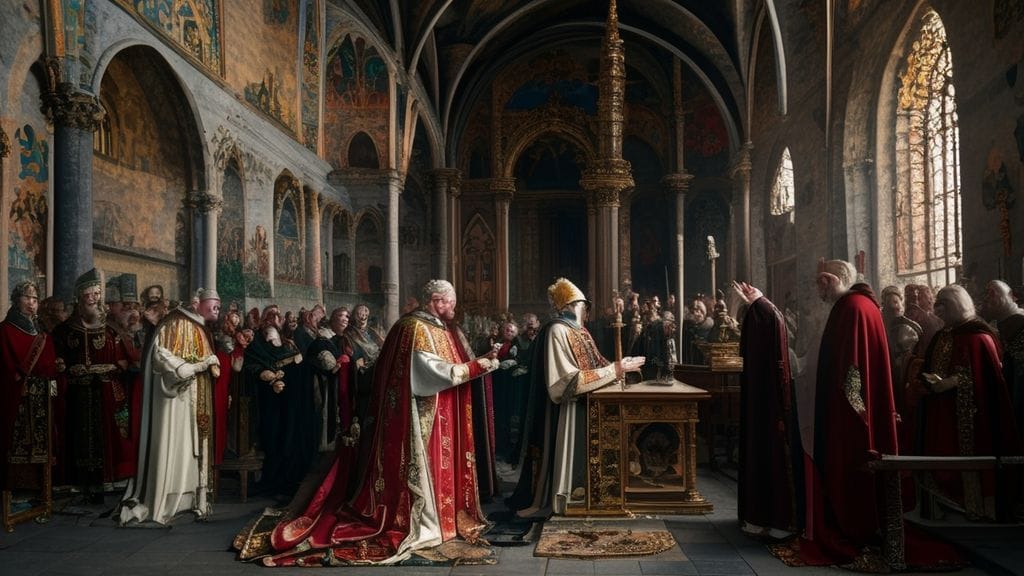
Accounts of the liturgy vary in detail, but its core elements are clear. After profession of faith and oaths, Frederick was anointed with holy oil, marked as a ruler chosen and blessed by God. He received the sword, sign of his duty to defend the weak and uphold law; the scepter and orb, symbols of governance and the Christian world; and finally, the imperial crown itself, placed upon his head by the pope. At that moment, the phrase that had so long been anticipated became real: Frederick III crowned Holy Roman Emperor. Trumpets sounded; the congregation burst into acclamations. The union of altar and throne, of mitre and crown, was visible for all to see.
Somewhere in the thick of this sound and incense, among murmured Latin prayers and the rustle of silk and armor, stood Eleanor, now empress, her own coronation intertwined with her husband’s ascent. For her, as for Frederick, this day was both personal and deeply political: the confirmation of a bond that would shape Habsburg history for generations.
Outside the basilica, the news spread rapidly. Scribes hurried to record the event in official charters and letters. Envoys drafted reports for their home rulers, detailing the pomp, the gestures, the words spoken. Chroniclers framed the moment in glowing language, imagining it as a turning point. “On this day,” wrote one observer, “the Lord God confirmed His Church by giving it a defender and helper in the person of the most serene Frederick.” Such phrases carried hope, but also a kind of desperation. Europe needed saviors; whether Frederick could fill that role remained uncertain.
But this was only the beginning. The ceremony had succeeded; the title was his. Now he would have to live with what it meant—and with what it could no longer promise.
Ritual, Symbol, and Sword: Inside the Coronation Ceremony
The coronation of a Holy Roman Emperor was never merely a legal formality. It was a carefully layered drama designed to communicate, to those present and to those who would read about it later, a specific vision of power. In Frederick’s case, that vision had to reconcile an increasingly fragmented political reality with the older ideal of a single Christian empire under God.
The ritual began with humility. Frederick, though already a king, approached the pope as a servant of the Church, prostrating himself, kissing the papal feet, swearing to be the Church’s “advocate and protector.” This act was more than courtesy; it was an acknowledgment that his title depended on papal recognition. Medieval theorists had long debated the balance between papal and imperial power, but here, in this basilica, the choreography spoke loudly: the emperor received his authority through the pope’s hands.
Then came anointing. With holy oil, Nicholas V marked Frederick’s body, setting him apart as a sacred ruler. Anointing tied him symbolically to Old Testament kings like David and Solomon, chosen by God’s prophets. In a world where sacraments defined the deepest realities, this was no simple gesture. It signaled that the emperor’s justice, if rightly exercised, was part of divine order, not mere human will.
Next, the regalia were bestowed. Each carried its own message. The sword, which Frederick would later wear in ceremonies, was not just a weapon but a liturgical tool, lifted and lowered at key moments, symbolizing his duty to defend the Church and punish wrongdoers. The scepter represented governance, the duty to guide his subjects. The orb, often surmounted by a cross, embodied his lordship over a Christian world, with Christ symbolically reigning over all.
Finally, the crown itself—heavy, golden, set with precious stones—found its place upon his head. Some contemporaries believed in a quasi-mystical transformation at that moment: the man Frederick fading as the person of the Emperor emerged, inheriting a lineage stretching back to Charlemagne and beyond. The liturgical chants swelled; prayers proclaimed him “Emperor of the Romans, forever august.” The phrase “Frederick III crowned Holy Roman Emperor” was not just a political description but a theological claim about the nature of authority in the world God had made.
It is important, though, to recognize how differently these symbols resonated with different audiences. For Nicholas V and his curia, the ceremony emphasized papal primacy and the Church’s role in shaping secular power. For German princes reading the reports, it underscored Frederick’s rank among them but did little to change their entrenched privileges. For Italian city-states, it was another grand show from which practical consequences might be limited—unless Frederick chose to interfere in their affairs, which he largely did not.
Yet the ceremony’s long-term significance lay not solely in its immediate political effects, but in its place in a longer story. With this coronation, Frederick became the last Holy Roman Emperor ever to be crowned in Rome by a pope. His successors would take the imperial title by virtue of election alone, crowned in German cities, independent of papal ritual. In hindsight, the day of his coronation appears as the last full performance of an older script, a final flourish before a new, more secular and territorial Europe took shape.
Behind the Splendor: Politics Between Emperor and Pope
While the crowds marveled and the liturgy unfolded, the real work of power lay in quieter spaces: council chambers, private chapels, and the rooms where Frederick and Nicholas V—or, more often, their top advisors—negotiated what this alliance would mean in practice.
Nicholas V entered the arrangement with several objectives. He wanted to reinforce papal supremacy after the challenges posed by the conciliar movement, which had tried to subject the pope to the will of church councils. Crowning an emperor in Rome was a potent way to demonstrate that the papal office still stood at the head of Christendom’s hierarchy. He also hoped to enlist Frederick’s support, at least symbolically, in future efforts against the Ottomans and to secure recognition of papal territories and rights within the empire.
Frederick, for his part, needed papal legitimacy to elevate his kingship into full imperial dignity. He also sought confirmation of his rights over contested regions and support in his complicated guardianship over Ladislaus and the associated Habsburg claims. Some territorial and legal disputes were quietly bundled into the broader coronation negotiations, with papal bulls and charters later confirming arrangements agreed in principle in Rome.
Yet both men were constrained. Nicholas could not afford to alienate the Italian powers by granting Frederick too much latitude in the peninsula. Frederick could not promise resources he did not possess for distant crusades or papal wars. Much of their diplomacy thus revolved around language—carefully worded vows, general commitments, and honorifics that allowed each to claim success without making impossible promises.
One of the most telling aspects of their interaction is what did not happen. There was no grand joint crusade launched from Rome, no sweeping imperial intervention in Italy. Instead, after the coronation, Frederick prepared to return to his German and Austrian heartlands, leaving Nicholas to manage the internal politics of Italy and the gathering storm from the East. The alliance was, in effect, a mutual endorsement more than a program of shared action.
Still, that endorsement mattered. When Frederick III crowned Holy Roman Emperor returned north with papal blessing, he carried with him a renewed aura of legitimacy that helped in later disputes. Nicholas, for his part, could boast of having presided over the coronation of a pious emperor, projecting an image of restored harmony between altar and throne at a time when critics of papal worldliness were not silent.
Behind the splendor, then, we see compromise. Both emperor and pope turned to ceremony to compensate for the limits of their real power. The coronation did not change everything—but it helped each man navigate a dangerous world with a bit more authority.
A Fragile Empire: German Princes, Italian Cities, and Imperial Limits
Once the last echoes of the coronation faded in St. Peter’s, Frederick’s real work resumed in the form of letters, diets, and local negotiations. The empire he now headed was far from a monolithic realm. It was a mosaic of duchies, bishoprics, free cities, counties, and knightly territories, each guarding its privileges with ferocious jealousy.
The Golden Bull of 1356 had defined how the King of the Romans was chosen and had solidified the powers of the seven prince-electors: three ecclesiastical (the archbishops of Mainz, Trier, and Cologne) and four secular (the kings of Bohemia, the count palatine of the Rhine, the duke of Saxony, and the margrave of Brandenburg). These princes were not mere courtiers. They were major players with their own foreign policies, warfare, and ambitions. Frederick could not simply command them; he had to bargain, cajole, and occasionally withstand them.
Within the empire, leagues and alliances formed—some in support of imperial authority, others against strong neighbors or even against the emperor himself. Imperial cities, from Nuremberg to Frankfurt, acted as semi-republican entities, vigorously defending their right to self-governance and trade. Local feuds, judicial disputes, and conflicts over tolls or succession regularly flared up, each requiring imperial mediation or, at the very least, imperial recognition.
In this context, Frederick’s newly acquired status as emperor functioned as a kind of constitutional keystone. It gave weight to his role as ultimate judge in imperial courts and as arbiter in princely disputes. “Frederick III crowned Holy Roman Emperor” sounded impressive on seals and in documents, and that impression mattered in a legalistic political culture where procedure and authority were endlessly cited.
Yet his practical ability to coerce remained limited. He had no standing army under direct imperial control. Revenues from his own hereditary lands, while not negligible, were modest compared to the combined wealth of the leading princes. When he tried to assert his will too strongly, opposition could quickly coalesce. Many of his successes, as historians have observed, came not from conquering problems but from outlasting them, waiting for adversaries to die, lines to fail, or alliances to shift in his favor.
Italy, meanwhile, remained a realm of more imagined than real imperial authority. Frederick’s coronation in Rome did not magically restore the old Regnum Italiae to his effective control. He left behind a peninsula where princes and city-states continued to maneuver largely independent of his will. Even the kingdom of Naples, technically a papal fief, operated according to its own dynastic drama, with the crown passing among Aragonese and local rulers in ways the emperor could do little to shape.
Thus the paradox at the heart of his reign: never had the symbolic elevation of the imperial title been more vivid than when Frederick received it at the hands of the pope in Rome; yet rarely had its practical scope been more constrained. The empire was fragile, but not yet falling—it persisted, in part, because men like Frederick learned to live with its limits.
Frederick the “Arch-Sleepyhead”: Character, Caution, and Reputation
Rulers are often remembered less for what they build than for how they act in crises. In Frederick’s case, contemporaries and later historians have frequently fixated on his slowness, his reluctance to act quickly or decisively. The mocking epithet “Arch-Sleepyhead of the Holy Roman Empire” captures both exasperation and a grudging recognition of his method.
His caution was not mere laziness. Raised amid the complex politics of the Habsburg domains, Frederick learned early that hasty decisions could shatter fragile compromises. As guardian of Ladislaus the Posthumous, he had to balance competing noble factions, foreign claimants, and the boy’s own rights. When he became King of the Romans, that balancing act extended across a far broader stage.
Critics charged that his delays allowed enemies to entrench themselves, that his failure to launch bold campaigns against external threats, especially the Ottomans, represented a dereliction of duty. Supporters, or at least more sympathetic observers, countered that the empire lacked the cohesive structure needed for such action and that Frederick’s patience prevented reckless adventures that might have broken it apart. The truth likely lies somewhere between these poles.
His personality seems to have been steady, somewhat introverted, with a dry intelligence. He cultivated a small circle of trusted advisors and tended to keep his own counsel, revealing his intentions late, if at all. This secrecy could unnerve allies and enemies alike. In an age when rulers were expected to lead from the front, to dazzle with charisma, Frederick’s reticence struck many as a weakness.
Yet if we measure his reign not by flashes of glory but by long-term outcomes, a different picture emerges. Frederick III crowned Holy Roman Emperor in 1452 and remained emperor until his death in 1493—a remarkably long tenure of over four decades. During that time, the Habsburg dynasty’s position improved steadily. Through marriages, legal maneuvers, and persistence, Frederick and his son Maximilian laid the groundwork for the Habsburgs’ later dominance in Central Europe and beyond.
One contemporary chronicler, writing with more nuance than the “Sleepyhead” jibe, remarked that Frederick “let time be his ally, for he knew that all things, in their season, are given or taken by God.” It is a revealing line. Frederick’s governing philosophy, such as it was, rested on an almost theological patience. The coronation in Rome did not transform that temperament; rather, it gave a solemn, sacral confirmation to a man who already believed that endurance itself could be a kind of power.
From Rome Back to the Frontiers: War, Diplomacy, and Ottoman Shadows
Frederick’s departure from Rome marked a shift from ritual to survival. As he made his way back across the Alps, news from the East grew ever darker. Only a little more than a year after his coronation, in May 1453, Constantinople would fall to Sultan Mehmed II, sending shockwaves through Christian Europe. It is tempting to imagine that those who had watched Frederick III crowned Holy Roman Emperor in St. Peter’s connected that earlier ceremony to the later catastrophe, asking whether the newly anointed emperor might somehow stem the tide. If so, they were disappointed.
The Holy Roman Empire, in its fragmented state, lacked the unity needed to mount a major crusade. While crusading rhetoric remained powerful in sermons and proclamations, practical support was thin. Princes guarded their resources; cities prioritized trade; the Papal States faced their own vulnerabilities. Frederick, cautious by nature and constrained by circumstance, did not become the crusading emperor some had hoped the coronation would herald.
Instead, his energy was directed mostly toward closer theaters. He faced conflicts within the empire, disputes over succession, and the ever-present challenge of integrating and defending Habsburg territories along the Hungarian and Slovenian frontiers, where Ottoman raiders and local magnates alike posed threats. Diplomacy occupied much of his time—treaties with neighboring kings, arrangements with powerful noble families, and efforts to keep internal strife from spilling into larger wars.
In some cases, his strategy of delay and endurance paid off handsomely. When Ladislaus the Posthumous died young and without issue, Habsburg claims to various lands could be strengthened. By patiently asserting rights, forging marriages, and using his imperial authority to legitimize settlements, Frederick expanded the family’s reach, even when battlefield victories were scarce.
On a broader scale, his reign overlapped with pivotal changes in Europe: the consolidation of royal power in France and England, the rise of the Spanish kingdoms under Ferdinand and Isabella, and the first voyages pushing beyond Europe’s coasts. These monarchies increasingly drew their strength from centralized administration, tax systems, and—crucially—territorial cohesion. The empire, by contrast, clung to its multi-centered structure. The image of Frederick III crowned Holy Roman Emperor in the heart of Rome may have looked impressive, but it masked an institution drifting away from the cutting edge of state-building.
Yet we should be careful not to mistake relative slowness for irrelevance. The empire remained a key arena for European politics. Its cities and territories contributed to trade, culture, and diplomacy. Its legal frameworks influenced how disputes were resolved. And Frederick, sitting at the top of this loose hierarchy, was far from a mere ornament. He worked constantly to ensure that, even as the Ottomans advanced and western monarchies rose, the empire and the Habsburgs would endure.
The Habsburg Design: How a Crown Built a Dynasty
If there is one realm in which Frederick’s coronation in Rome proved truly transformative, it is dynastic strategy. By making the Habsburgs the imperial house almost without interruption from his reign onward, Frederick set his family on a path that would reshape Europe.
The title “Holy Roman Emperor” did not automatically pass from father to son; it remained an elective dignity. Yet association with the imperial office conferred a kind of dynastic prestige that could sway electors and impress foreign courts. Frederick understood this and worked tirelessly to place his descendants in positions from which election would be likely, if not guaranteed.
The marriage to Eleanor of Portugal was part of this scheme, bringing not only money but also foreign ties that widened Habsburg horizons. Later, Frederick’s son Maximilian would marry Mary of Burgundy, gaining access to the wealthy Burgundian inheritance and, eventually, through subsequent generations, to Spain and much of the New World. None of this was foreordained in 1452, but the imperial coronation helped create the conditions in which such leaps became possible.
Frederick’s heraldic motto—“A.E.I.O.U.”—has puzzled and fascinated historians. He inscribed these letters on buildings, documents, and personal objects. One widely accepted reading is “Austriae est imperare orbi universo” (“It is Austria’s destiny to rule the whole world”). Another proposes “Alles Erdreich ist Österreich untertan” (“All the earth is subject to Austria”). While some scholars caution that Frederick may have enjoyed the motto’s ambiguity, its imperial overtones are unmistakable. It encapsulates a vision in which the Habsburg lands, anchored in Austria, are destined for universal, or at least far-reaching, rule.
In this light, the image of Frederick III crowned Holy Roman Emperor takes on a new dimension. The coronation was not just a personal triumph but a visual proclamation of the Habsburg mission. The emperor kneeling before the pope, rising with sword and crown, appeared to be assuming a role that transcended his own finite life. The office, conjoined with his family’s tenacity, could become a lever to move dynastic fortunes ever upward.
And so it did. Over the next century, Habsburgs would hold not only the imperial title but also crowns in Spain, Hungary, Bohemia, and more. Their domains would stretch from the Americas to the Philippines. While many factors contributed to this astonishing expansion—marriages, wars, accidents of succession—the quiet, steady consolidation under Frederick laid essential groundwork. His reign provides a case study in how a seemingly cautious, even plodding, ruler can leave a revolutionary legacy.
Echoes After Rome: The Last Medieval Emperor in a Changing World
Frederick’s long life spanned a turning point in European history, and his coronation in Rome stands as a symbolic marker in that transition. Born into a late-medieval world of feudal bonds, religious unity (at least outwardly), and localized economies, he died in 1493, on the threshold of the Reformation and the full flowering of Renaissance culture and Atlantic exploration.
Consider what changed between 1452 and 1493. The fall of Constantinople shattered one of Christendom’s great bulwarks and sent Greek scholars—and with them, ancient texts—streaming into Italian cities, fueling humanist learning. Gutenberg and his contemporaries developed printing with movable type, making books and pamphlets far more widely available and gradually transforming how ideas spread. Voyages along Africa’s coast and across the Atlantic hinted at new worlds and new routes to wealth and power, decentering the Mediterranean.
Politically, the consolidation of monarchies in France, England, and Spain began to eclipse the diffuse, negotiated structure of the empire. New forms of taxation, standing armies, and bureaucratic governance emerged. In this landscape, the old ideal of a single universal Christian empire ruled by a German emperor and crowned in Rome seemed increasingly archaic. It is striking that after Frederick, no emperor would again travel to Rome for coronation; the ritual was tacitly abandoned, replaced by German coronations that required no papal hands.
In that sense, Frederick III crowned Holy Roman Emperor appears like the last fully medieval performance of Roman empire in the West. The rite was layered in sacral symbolism, deeply embedded in a hierarchical vision of church and state. It assumed, at least rhetorically, a unity of Christendom that the coming decades would test to breaking point. Within fifty years of his death, Martin Luther would challenge the papacy, princes would convert to Protestantism, and religious wars would tear apart the old order.
Yet the story is not one of simple rupture. Many institutions and habits persisted. Imperial diets continued to meet; imperial law continued to function. The empire itself survived until 1806. And Frederick’s legacy, embodied in the Habsburgs’ enduring role, tied the medieval coronation to the very modern politics of dynastic competition and balance of power. The Renaissance and the Reformation did not erase the memory of that day in 1452; they reinterpreted it.
To some later observers, Frederick appeared as a man slightly out of his time, more at home in the slower rhythms of older politics than in the bolder strokes of the age of discovery and confessional conflict. But that very conservatism helped carry certain medieval ideals—of negotiated authority, of legal order, of multiethnic empires—into the early modern era. His Rome coronation, in this reading, was both an ending and a bridge.
Memory and Myth: How Historians See Frederick’s Coronation Today
Modern historians have returned repeatedly to the moment when Frederick III crowned Holy Roman Emperor in Rome, seeing in it a fruitful case study of continuity and change. Was it, as some older narratives claimed, a hollow spectacle, the last gasp of a dying medieval dream? Or did it, as more recent scholarship suggests, form part of a longer, adaptive story of imperial identity?
Scholars such as Peter H. Wilson and Heinz Angermeier have emphasized the resilience of the imperial idea, arguing that the empire functioned not as a failed state but as a different kind of polity, one based on collaboration and legal frameworks rather than centralized force. From this angle, the coronation appears as a powerful affirmation of a certain constitutional order—an order that would persist, albeit in modified form, for centuries.
Others, focusing on the Italian and papal context, see the event primarily as a victory for Nicholas V’s vision of the papacy. By orchestrating the ceremony, Nicholas signaled to Europe that the pope remained the spiritual architect of political legitimacy. Yet the fact that no later emperor sought Roman coronation suggests that this victory was at best partial, and perhaps even Pyrrhic. Papal power, too, would face grave challenges in the century after Frederick’s death.
There is also the question of Frederick’s personal agency. Was he simply swept along by tradition, or did he actively choose to revive the Roman coronation as a conscious political strategy? The evidence of his broader behavior—his careful marriage choices, his slow but steady accumulation of titles and lands—supports the latter view. While not a flamboyant visionary, he seems to have recognized the long-term advantages of fusing the Habsburg brand with the highest office in Christendom.
In one of the more evocative assessments, a 20th-century historian described Frederick as “a hinge between ages,” a man whose life touched the high medieval world of knights and crusades and the early modern world of printing presses and oceanic empires. The coronation in Rome is, perhaps, the most theatrical expression of that hinge status. Standing beneath St. Peter’s vaults, crowned in the old style, he embodied an ideal that was already, in some respects, slipping away, even as he laid foundations for an entirely different imperial future.
Today, visitors to Rome can still walk the spaces he traversed, though transformed by later centuries. St. Peter’s has been rebuilt; baroque facades overlay medieval streets. Yet the idea that a German king once came here to be made “Roman Emperor” has not vanished. It lingers in guidebook paragraphs, in scholarly footnotes, in the faded but persistent memory of an empire that claimed to be holy, Roman, and yet very much its own peculiar, enduring creation.
Conclusion
On that March day in 1452, when solemn chants rose in St. Peter’s and a crown touched Frederick’s brow, few could have guessed how historians would later parse the scene. To contemporaries, the meaning seemed clearer: God and His Church had set over Christendom a defender, a ruler charged with justice and peace. “Frederick III crowned Holy Roman Emperor”—the phrase echoed in charters, chronicles, and prayers, carrying both hope and a faint tremor of fear in a troubled age.
Yet the decades that followed revealed the limits of that office and, at the same time, its unexpected strengths. Frederick did not become a crusading hero or a unifier of lands. Instead, through patience, calculation, and dogged endurance, he turned the prestige of his coronation into a platform for Habsburg advancement. The empire he led may have seemed weak compared to emerging centralized monarchies, but its institutions and symbols, renewed in Rome, persisted and evolved.
In the end, his coronation stands as a paradoxical milestone: the last full medieval Roman coronation of an emperor and the quiet inauguration of a new age of Habsburg hegemony. It marked both the waning of universal imperial dreams and the birth of a dynastic project that would dominate European politics for centuries. Rome lent Frederick its ancient aura; Frederick carried that aura back across the Alps and into a future the men in St. Peter’s could not have imagined.
Looking back, we see that the real power of that day did not lie in the weight of the crown alone, nor in the splendor of the ritual, but in the way it connected past, present, and future. It tethered an old imperial myth to the emerging realities of a Europe on the brink of modernity—and in doing so, ensured that the empire, however altered, would remain part of the continent’s story long after the candles of that coronation Mass had burned out.
FAQs
- Why was Frederick III’s coronation in Rome historically significant?
It was the last time a Holy Roman Emperor was crowned in Rome by a pope, marking the end of a centuries-old tradition that linked imperial authority directly to papal ritual. After Frederick, emperors took the title through election and German coronations alone, signaling a shift toward more territorial and less universal conceptions of power. - Did Frederick III gain real power from being crowned Holy Roman Emperor?
The coronation greatly enhanced his prestige and legal authority, but it did not suddenly give him a strong centralized state. The empire remained a loose federation of princes, cities, and church territories. Frederick had to rely on diplomacy, legal structures, and patience rather than direct coercion to exercise influence. - How did Frederick’s marriage to Eleanor of Portugal relate to his coronation?
The marriage and coronation were closely connected parts of his broader strategy. Eleanor’s substantial dowry helped fund his policies, and the alliance with Portugal boosted his standing among European courts. Together, the marriage and the Roman coronation strengthened the Habsburgs’ dynastic position. - Did Frederick III lead a crusade against the Ottoman Empire after his coronation?
No major, sustained crusade originated from Frederick despite the hopes surrounding his coronation. While he supported anti-Ottoman efforts rhetorically and engaged in frontier defense, the fragmented nature of the empire and limited resources prevented him from organizing a large, unified crusading campaign. - Why is Frederick sometimes called the “Arch-Sleepyhead” of the empire?
Contemporaries frustrated with his slow decision-making coined this derisive nickname. Frederick often delayed action, preferring to wait out crises rather than confront them head-on. Over time, however, this patience allowed him to outlast many opponents and steadily improve Habsburg fortunes. - How did Frederick’s coronation affect the Habsburg dynasty’s future?
By firmly associating the Habsburgs with the imperial title, the coronation elevated their status across Europe and made future elections of Habsburg emperors more likely. Combined with astute marriages and territorial acquisitions, it helped set the stage for the vast Habsburg monarchy of the 16th century. - Was the Holy Roman Empire already in decline when Frederick was crowned?
It was not so much in simple “decline” as evolving into a different kind of polity. Its universal ambitions were fading, especially in Italy, but its legal and institutional structures remained resilient. Frederick’s reign illustrates this shift from a conquering empire to a negotiated, law-based federation. - Why did no later emperor seek coronation in Rome?
Travel to Rome was dangerous, expensive, and politically complicated, especially as Italian states and the papacy pursued their own agendas. Over time, the practical benefits of Roman coronation no longer justified the risks, and the imperial title came to rest primarily on election and German rites.
External Resource
Internal Link
Other Resources
- Encyclopaedia Britannica – general search for the exact subject
- Google Scholar – academic search for the exact subject
- Internet Archive – digital library search for the exact subject