Table of Contents
- Twilight over Nara: Setting the Stage for Upheaval
- Heirs of Power: The Fujiwara Clan and the Making of Nakamaro
- Sacred Thrones: Empress Kōken, Emperor Junnin, and the Struggle for Legitimacy
- The Monk and the Minister: Dōkyō’s Rise and Nakamaro’s Growing Fear
- Under the Lantern Light: Conspiracies in the Heijō‑kyō Palace
- Mobilizing the Realm: Orders, Armies, and the First Moves of Rebellion
- March to Omi: Flight from Nara and the Illusion of Control
- Storm on Lake Biwa: Battles, Betrayals, and the Collapse of Nakamaro’s Forces
- Night of Reckoning: Captures, Executions, and the Fall of a Statesman
- After the Flames: Empress Shōtoku, Dōkyō, and the Re‑Forging of Authority
- Courtly Whispers: How Chroniclers Framed the Fujiwara no Nakamaro Rebellion
- Lives in the Crossfire: Soldiers, Monks, and Commoners in 764
- Religion and Rule: What Dōkyō’s Ascent Revealed about Nara Buddhism
- Echoes in the Capital: From Heijō‑kyō to Heian‑kyō and the Fear of Usurpation
- Family, Memory, and Silence: The Fate of Nakamaro’s Line
- From Rebellion to Principle: Dynastic Stability and the “Emperor Above All”
- On the Page of History: Scholarly Debates and New Perspectives
- Lessons from 764: Power, Loyalty, and the Fragility of Political Order
- Conclusion
- FAQs
- External Resource
- Internal Link
Article Summary: In the autumn of 764, Japan’s Nara court was torn apart by a dramatic confrontation remembered as the fujiwara no nakamaro rebellion, a clash not only of armies but of visions for the future of the throne. This article traces the rise of Fujiwara no Nakamaro from gifted aristocrat to the most powerful minister in the realm, and follows his fatal decision to challenge his sovereign. We explore the complex triangle between Empress Kōken (later Empress Shōtoku), the charismatic monk Dōkyō, and Nakamaro himself, whose fear of losing influence pushed him toward open revolt. Through cinematic narrative grounded in historical sources, we move from secret councils by lamplight to hurried marches, broken alliances, and final defeat on the shores of Lake Biwa. Along the way, the article examines how religion, politics, and personal ambition intertwined in the Nara period and how the rebellion reshaped imperial policy. The fujiwara no nakamaro rebellion left scars not only on the court elite but on soldiers, monks, and commoners dragged into a conflict they did not choose. Its legacy echoed into later centuries, hardening Japanese ideas about who may rule and how close religious figures may come to the center of state power. Ultimately, this study reveals how a short, failed uprising could nonetheless transform a dynasty’s understanding of loyalty, legitimacy, and the fragile balance of power at the heart of empire.
Twilight over Nara: Setting the Stage for Upheaval
The year 764 in Japan did not begin as a year of rebellion. The capital of Heijō‑kyō—what we now call Nara—still gleamed with the tidy geometry of its imperial avenues, modeled on the great Tang cities of the continent. Its tiled roofs shone after the summer rains, and behind vermilion gates, courtiers in layered robes rehearsed the same intricate rituals their fathers and grandfathers had known. Yet as autumn approached, the calm of the Nara plains was deceptive. At the center of the court, the bonds that held ruler and subjects together were fraying, quietly at first, then with a speed that astonished even those who lived through it.
To understand the fujiwara no nakamaro rebellion that would split the court and send soldiers marching through smoke‑choked valleys, one must first see the invisible tensions rising in these polished corridors. The Nara period (710–794) was a time of ambitious state‑building. Laws were copied from China, the population was registered and taxed, and a fixed capital—Heijō‑kyō—was laid out with an engineer’s precision. But behind this façade of order, power flowed through families, alliances, and whispered promises. The Fujiwara clan, in particular, had mastered the art of ruling from behind a bamboo screen. By marrying their daughters into the imperial line and dominating the highest offices, they had become the quiet architects of imperial governance.
Among these aristocrats, one figure began to stand out: Fujiwara no Nakamaro. To his admirers, he was brilliant, decisive, and utterly devoted to the imperial institution as he understood it. To his enemies, he was ambitious to the point of danger. By the mid‑eighth century, he held multiple titles and commanded the machinery of government with a firm hand. Yet, in a twist that feels destined in retrospect, the very system that had elevated him also produced rivals and unpredictable alliances, especially between the throne and the Buddhist clergy.
At court, the presence of powerful monks was nothing new. Buddhism, imported centuries earlier, had become both a spiritual guide and a political tool. Temples were patrons of land and labor; influential clerics were courted like senior ministers. But when a single monk, Dōkyō, began to attract the special favor of Empress Kōken, observers felt something different stirring. Rumors rustled through the palace that the empress, widowed and without an heir of her own body, trusted Dōkyō more than her ministers or even her designated successor, Emperor Junnin. What if, people whispered, the boundaries between throne and monastery dissolved entirely?
This was the atmosphere—thick with suspicion, fear, and competing loyalties—in which the fujiwara no nakamaro rebellion would ignite. The political map of the realm was deceptively neat, but lines of authority overlapped. Provincial governors owed their positions to court patrons; military commanders kept one eye on the edicts from Nara and another on the ambitions of men like Nakamaro. Provincial soldiers, recruited from distant regions, would soon find themselves marching not to drive out foreign enemies or quell bandits, but to decide whose vision of imperial Japan would prevail.
It is astonishing, isn’t it, that such structural conflicts can remain invisible until a single moment of crisis brings them all into focus? In 764, that moment was approaching. The actors were already in place: the empress resigned but still alive and watching, the reigning emperor uneasily seated on the throne, the monk whose influence raised old anxieties about religious usurpation, and the minister whose pride and fear would push him past the brink.
Heirs of Power: The Fujiwara Clan and the Making of Nakamaro
Fujiwara no Nakamaro did not rise from nowhere. He was born into one of the most powerful lineages of early Japan, a grandson of Fujiwara no Fuhito, the architect of much of the Nara state’s institutional framework. The Fujiwara name was almost a second crown, a guarantee of influence, but it also came with expectations. From childhood, Nakamaro moved through a world of poetry recitations, classical Chinese texts, and courtly etiquette, absorbing not only the language of power but its rhythms and dangers.
The Fujiwara strategy for dominance was subtle and effective. By marrying their daughters into the imperial line, they positioned themselves as maternal relatives to emperors and empresses, occupying a role that was both intimate and politically decisive. They rarely sat on the throne themselves, but they ensured that whoever did would be surrounded by their kin and clients. Fujiwara no Nakamaro’s career must be read through this lens: he was less an independent strongman than the latest, brightest extension of a family strategy that had been honed over generations.
Nakamaro’s early career showed an unusual speed of advancement. He gained important posts in the bureaucracy and, more importantly, the trust of then‑Empress Kōken. At court, he was known for his decisiveness in administration; chroniclers of the Shoku Nihongi, one of our main sources for the period, describe him as a man of firm will and unyielding purpose. This was precisely the sort of personality that could stabilize a fragile state—or, under different circumstances, tear it apart.
By the 750s, Nakamaro held key offices in both civil and military administration. He was in a position to direct taxes, appoint provincial governors, and influence the selection of officials across the realm. He also cultivated a reputation as a defender of the imperial order against perceived threats, particularly those from within the court itself. When Empress Kōken abdicated in favor of Emperor Junnin, a relative whom Nakamaro strongly supported, he seemed to stand at the apex of his power.
But power at court was never static. The same networks that sustained Nakamaro could also entangle him. Other Fujiwara lines watched his rise with unease, sensing that one branch of the family was beginning to overshadow the others. Non‑Fujiwara aristocrats, long accustomed to jockeying for position, saw their space narrowing. And within the imperial house, the relationship between the retired Empress Kōken and her former protégé grew more complex. She was still alive, still revered, and still capable of influence—especially as she deepened her connection with the Buddhist monk Dōkyō.
Nakamaro’s mind, as we must imagine it, was a paradoxical place: informed by genuine concern for the institutional integrity of the throne and yet driven by a fierce desire to maintain his own pre‑eminence. When historians call the uprising the fujiwara no nakamaro rebellion, they place his name at the center. But in his own understanding, he was likely not rebelling against the throne as an institution. He saw himself as defending a legitimate order—represented by Emperor Junnin and the bureaucratic structures he commanded—against distortions brought by courtly factions and a rising cleric who, in Nakamaro’s eyes, threatened to blur the lines between spiritual guidance and political rule.
There is a tragic logic here. The very talents that enabled Nakamaro to climb—the ability to read shifting allegiances, to act decisively, to imagine himself as indispensable to the state—made him uniquely vulnerable when he judged that his position, and perhaps the throne itself, were in danger. When such a man concludes that the normal channels of persuasion and counsel are no longer effective, the path to open confrontation becomes thinkable.
Sacred Thrones: Empress Kōken, Emperor Junnin, and the Struggle for Legitimacy
The drama of 764 unfolded not around an empty throne, but around an unusually complicated arrangement of imperial authority. Empress Kōken, who had reigned from 749 to 758, abdicated but did not vanish into obscurity. Unlike emperors of later centuries who retired into cloistered seclusion, she remained an imposing figure in the political landscape, her presence a reminder that sovereignty in Nara Japan could be layered and ambiguous.
Her successor, Emperor Junnin, was elevated with the clear support of Fujiwara no Nakamaro. Junnin’s claim to the throne, while acceptable, was not the strongest possible in terms of strict bloodline orthodoxy. His legitimacy depended heavily on the endorsement of Kōken and the administrative apparatus dominated by Nakamaro. The arrangement worked as long as these three nodes—retired empress, reigning emperor, and chief minister—remained in rough alignment.
Yet behind the celebrations of Junnin’s accession, unease persisted. Kōken was not merely a retired sovereign; she was a woman with her own network of supporters, and she still commanded respect among key officials and religious leaders. The Nara court, accustomed to balancing the interests of competing clans and temples, now had to navigate an unprecedented triangle of power: a retired empress, a reigning emperor, and a pre‑eminent minister.
In this delicate configuration, the entry of a new, charismatic figure could only destabilize the balance. That figure was Dōkyō, a monk whose reputation for spiritual power and healing had drawn Kōken’s attention. Their relationship—whatever its personal dimension may or may not have been—was certainly political. As Kōken turned increasingly to Dōkyō for advice, a new axis emerged in the court: a partnership of retired empress and monk, offering an alternative center of influence to that of Emperor Junnin and Fujiwara no Nakamaro.
The question of legitimacy shifted subtly. Was authority clearest in the reigning emperor, installed according to formal rites and supported by the leading minister? Or did it radiate from the retired empress, whose original ascendancy had been sanctioned by heaven and whose health, some believed, had been miraculously preserved by Dōkyō’s intervention? These were not merely abstract debates for court philosophers; they were felt acutely in the ceremonies, petitions, and daily interactions of the capital.
The chroniclers of the time, including those who compiled the Shoku Nihongi under later emperors, tended to portray Kōken’s renewed assertiveness and Dōkyō’s influence as dangerous deviations. Yet such judgment reflects the outcome of the fujiwara no nakamaro rebellion, not its inevitability. In 764, it was still unclear whether Kōken’s return to direct power would be seen as a restoration of rightful rule or a usurpation of the order that Nakamaro believed he represented.
For Nakamaro, this ambiguity was intolerable. He had built his authority around Emperor Junnin as the symbol of legitimate succession and the guarantor of his own position. The more Kōken reclaimed active power, the more Junnin appeared marginal—a figure who might soon be stripped of his title, leaving Nakamaro exposed. As the retired empress and her monk‑advisor strengthened their bond, the minister could feel the ground shifting beneath his feet.
Thus legitimacy in 764 was not a settled fact but a contested terrain. Each player—Kōken, Junnin, Nakamaro, and Dōkyō—could plausibly claim to act in the name of the rightful order of things. The tragedy was that only one configuration could ultimately endure, and the means by which the decision would be reached were turning from courtly persuasion to armed force.
The Monk and the Minister: Dōkyō’s Rise and Nakamaro’s Growing Fear
Dōkyō’s ascent is one of the most evocative stories of the Nara period, and it lies at the heart of the fujiwara no nakamaro rebellion. He was not born into any great lineage; his early years remain indistinct in the record. What we do know is that he emerged from the monastic world at a moment when Buddhism had become deeply entangled with the state. Temples were repositories of learning and wealth, and monks often acted as diplomatic intermediaries with the continent.
Dōkyō first rose to prominence after Empress Kōken, suffering from illness or affliction, sought his religious aid. According to later accounts, his rituals and prayers brought her comfort and possibly a remarkable recovery. Whether this was coincidence, spiritual efficacy, or narrative embellishment, it marked a turning point. Kōken’s trust in Dōkyō deepened, and he became not simply a healer but a counselor. Over time, she drew him into the inner circle of decision‑making, blurring the boundary between spiritual adviser and political actor.
For Nakamaro, this development struck at the core of how he believed the state should function. In his view, monks, however pious or learned, should remain outside the center of political power. Temples could be patrons of culture, partners in public rituals, and recipients of royal patronage—but they should not steer the ship of state. Dōkyō’s growing influence threatened to invert this hierarchy. The minister watched as edicts and appointments began to reflect the wishes of the retired empress and her monk more than those of his own faction or the reigning emperor.
Nakamaro’s private conversations, as we imagine them, must have been laced with anxiety. Trusted allies might have reassured him that Dōkyō’s influence was limited, that no monk could truly displace a Fujiwara minister. Others may have warned him that he was underestimating the danger. In those candlelit gatherings after evening audiences, as the autumn of 764 approached, the outlines of drastic action would have appeared sharper with each passing week.
Yet we must be careful not to reduce the conflict to a simple dichotomy of secular minister versus intrusive monk. Dōkyō’s own motives were surely complex. He may have believed that the spiritual renewal of the realm required a closer integration of Buddhist precepts into governance. Kōken, for her part, might have seen in Dōkyō a partner who, unlike hereditary ministers, owed his rise entirely to her favor and who would not easily turn against her. Their alliance was born in a world where the sacred and the political were already entwined, and they simply took this logic further than most.
What pushed Nakamaro from wary opposition to active plotting was the growing possibility that Dōkyō and his patrons would remake the very structure of rule. If a monk could become the de facto ruler behind a female sovereign, what would prevent him—or his successors—from claiming a more overt role, perhaps even a title approaching that of an emperor? Later, a famous oracle episode would claim that Dōkyō sought confirmation that a monk could ascend the throne itself, an event used in subsequent centuries to condemn his ambitions. Whether or not this specific episode unfolded as later told, the fear was already alive in 764: that the balance between throne, aristocracy, and clergy was approaching a perilous tipping point.
Thus, Nakamaro’s growing fear was not purely personal. It reflected deeper anxieties in the Nara court about the fragile equilibrium that maintained imperial Japan. But once fear began to dictate his choices, reasoned opposition gave way to secret plans and, ultimately, open rebellion.
Under the Lantern Light: Conspiracies in the Heijō‑kyō Palace
We will never know the exact words spoken in the private meetings where Fujiwara no Nakamaro finally chose the path of revolt. The official chronicles compress these tense weeks into a series of formal entries: appointments, removals, rumors of unrest. But if we imagine the setting—lanterns flickering in the cool night, guards posted discreetly outside sliding doors, servants sent away on invented errands—we can begin to feel the charged atmosphere in which the plot took shape.
Nakamaro’s plan hinged on three critical elements: control of the emperor, command over troops, and mastery of communication. First, he needed Emperor Junnin firmly in his camp, not merely as a passive symbol but as the legitimizing face of any military action. It appears that he succeeded; Junnin was persuaded—or felt compelled—to align himself with Nakamaro’s interpretation of events. The retired Empress Kōken and her circle, from this perspective, were not guardians of the realm but usurpers influencing affairs from behind the scenes.
Second, Nakamaro had to secure military strength. Unlike later samurai eras, the eighth‑century Japanese state theoretically monopolized armed force. Provincial soldiers and guards were raised under imperial authority, and local commanders owed their loyalty to the court. But in practice, ministers like Nakamaro could heavily influence which troops were called up and where they were stationed. Using his positions, he arranged for forces from certain eastern provinces—regions where his relatives and clients held governorships—to be at his disposal.
The third element was information. In a world without telegraphs or rapid messengers, control of edicts and seals, of who could speak in the emperor’s name, was power itself. Nakamaro and his faction prepared documents framing their actions as defensive: they were, according to their own narrative, protecting the emperor and the proper order against a faction surrounding the retired empress and the monk Dōkyō. If they moved quickly enough, they could present their opponents as rebels, even as they themselves took the first decisive military steps.
Yet behind the calculated strategies there was hesitation. Some allies must have advised caution, arguing that Kōken’s moral authority remained too great to challenge, that provincial governors might waver once the first swords were drawn. The risk was enormous: failure would mean not only Nakamaro’s death but the ruin of his entire branch of the Fujiwara family. Still, the momentum of events pushed him forward. The more Dōkyō’s influence grew, the more likely it seemed that, if he did nothing, he would be marginalized or destroyed anyway.
In the weeks leading up to the outbreak of open hostilities, the court lived in an eerie dual reality. By day, the usual rituals proceeded—the reading of petitions, the offering of incense at temple ceremonies, the review of tax registers from distant provinces. By night, letters were smuggled out of the city, horses quietly requisitioned, and maps unrolled in guarded rooms. Those who sensed the rising tension but lacked clear knowledge of the plans must have gone to sleep each night with a knot in their stomach, wondering which side they would be forced to choose if matters came to a head.
The fujiwara no nakamaro rebellion was thus not a sudden explosion but the culmination of weeks, even months, of gathering storm. When the first open moves were made—when Nakamaro attempted to spirit the emperor out of the capital and mobilize his provincial forces—the palace’s quiet conspiracies erupted into full view.
Mobilizing the Realm: Orders, Armies, and the First Moves of Rebellion
The decisive break came when Fujiwara no Nakamaro moved to take Emperor Junnin out of Heijō‑kyō and into territory he believed he could control. This was not simply a flight; it was a bid to transfer the center of legitimacy away from the retired empress and her monk and into a region where edicts in the emperor’s name would be harder to contest. If Nakamaro could gather troops around Junnin and issue proclamations denouncing his enemies as traitors, the battle for perception might still be his to win.
As the small imperial entourage slipped out of the capital, messengers sped along the roads toward key eastern provinces. Governors, many of them tied to Nakamaro by kinship or patronage, received hurried instructions: raise troops, secure mountain passes, and prepare to march. Somewhere in these communications, the language must have framed the conflict as one of loyalty to the reigning emperor against those who would subvert him with the help of a monk. This was crucial, for in official ideology, rebellion against the emperor was the gravest sin—whereas resistance undertaken in his name could be cast as an act of ultimate loyalty.
Yet events in Nara did not freeze while Nakamaro made his move. Retired Empress Kōken, far from being paralyzed, responded with remarkable speed. As soon as it became clear that Nakamaro had removed the emperor from her immediate reach and was calling provincial forces to his side, she mobilized the resources still under her control. Capital guards, loyal ministers, and temples with their own men‑at‑arms were brought into action. Edicts were issued declaring Nakamaro and his supporters rebels, turning his attempt to define the narrative back upon him.
The sudden need to raise armies exposed the underlying fragility of the Nara state. Officially, all soldiers fought for the throne; practically, their loyalties were filtered through local ties and patronage. In some provinces, governors responded eagerly to Nakamaro’s call, seeing in him the continuation of an order they understood. In others, hesitation or hostility prevailed. Distance, delays, and doubt meant that the forces Nakamaro had counted on did not cohere into the decisive, overwhelming army he had imagined.
Meanwhile, Kōken’s camp took full advantage of the capital’s symbolic weight. Temples performed public rituals for the subjugation of rebels, reinforcing the idea that the gods and buddhas favored the retired empress’s cause. Dōkyō, cast by his enemies as the source of disorder, now stood at the heart of the counter‑move, presiding over invocations for victory. Swords and sutras, banners and blessings, were all pressed into the service of a single goal: to ensure that the fujiwara no nakamaro rebellion would be remembered as an act of unambiguous treason, not a loyalist stand gone awry.
As the two sides mobilized, a grim inevitability settled over the realm. Letters and oaths were no longer enough; the question of who truly embodied imperial authority would be settled by the clash of armed men. Nakamaro, already committed, could no longer turn back without confessing his own guilt. Those who had thrown in their lot with him must have sensed the narrowing of options. If they won, they would rewrite the story; if they lost, no explanation would save them.
March to Omi: Flight from Nara and the Illusion of Control
Nakamaro’s chosen refuge was the region of Ōmi, centered around the vast waters of Lake Biwa northeast of Nara. It was a strategic choice: Ōmi lay along crucial routes between the capital and the eastern provinces, and its terrain—with its hills, passes, and lake—offered defensive advantages. If he could secure Ōmi and its approaches, Nakamaro could hope to link up with reinforcements from the east, then turn back toward Nara with a formidable army at his back.
The journey itself, however, revealed the precariousness of his position. The imperial cortege, once surrounded by measured ceremony, was now hurried and exposed. Emperor Junnin, the nominal center of all loyalty, traveled under the effective control of a minister whose decisions risked plunging the realm into civil war. For the emperor’s servants and attendants, the dissonance must have been acute: were they participating in a lawful relocation of the sovereign, or in the kidnapping of the realm’s symbol of legitimacy?
As Nakamaro’s group moved toward Ōmi, they encountered not the smooth convergence of allies but a landscape of uncertainty. Some local leaders pledged support; others temporized, waiting to see which side would gain the upper hand. Supplies, the lifeblood of any military endeavor, could not be guaranteed. Every day that passed without the arrival of large, cohesive reinforcements ate away at the confidence of Nakamaro’s circle.
Still, for a brief, flickering moment, it must have seemed to Nakamaro that he held the center. He had the emperor physically by his side, the eastern provinces nominally under his command, and a defensible region in which to regroup. In his own mind, he was not in rebellion against the throne; he was the sword arm of its preservation, striking preemptively against a retired empress who, by reasserting herself and elevating a monk, had crossed the line into unacceptable interference.
But this illusion of control could not endure without decisive victories. From Nara, Kōken’s forces moved swiftly, cutting off routes, persuading or coercing local elites to reject Nakamaro’s overtures. The geography that had seemed to favor him—passes to defend, distances to delay pursuit—was turned against him as loyalist troops used intimate knowledge of the terrain to box him in. Lake Biwa, whose broad expanse might have offered an avenue for supply or retreat, instead became the backdrop to encirclement.
In the villages and fields through which the two factions maneuvered, common people watched the passage of armored men with mingled fear and resignation. Most had no voice in the court intrigues that had brought war to their doorsteps. Yet they would pay the price in requisitioned rice, trampled crops, and the risk of being dragged into service. The fujiwara no nakamaro rebellion, though born in palace corridors, now unfolded across the land, inscribing its consequences into the lives of those far from the capital’s debates.
Storm on Lake Biwa: Battles, Betrayals, and the Collapse of Nakamaro’s Forces
The climax of the conflict came near the shores and passes around Lake Biwa, where Nakamaro’s forces and those of the retired empress finally collided. The chronicles provide only spare details of maneuvers and numbers, but we can reconstruct the essentials: Nakamaro’s army, smaller than he had hoped and under increasing logistical strain, faced a loyalist force better coordinated and buoyed by the clear backing of the central institutions in Nara.
In battle, the advantage lay not simply with numbers but with cohesion and morale. Nakamaro’s men fought under a banner of contested legitimacy; many must have wondered how the gods and buddhas viewed their cause. The opposing side, by contrast, could draw on the powerful assurance that they fought on behalf of the retired empress, whose prestige and rituals at the capital declared Heaven’s favor. “When the realm is in disorder, Heaven reveals its will,” a later commentator would note, suggesting that the swift unraveling of Nakamaro’s power proved the righteousness of his enemies’ cause.
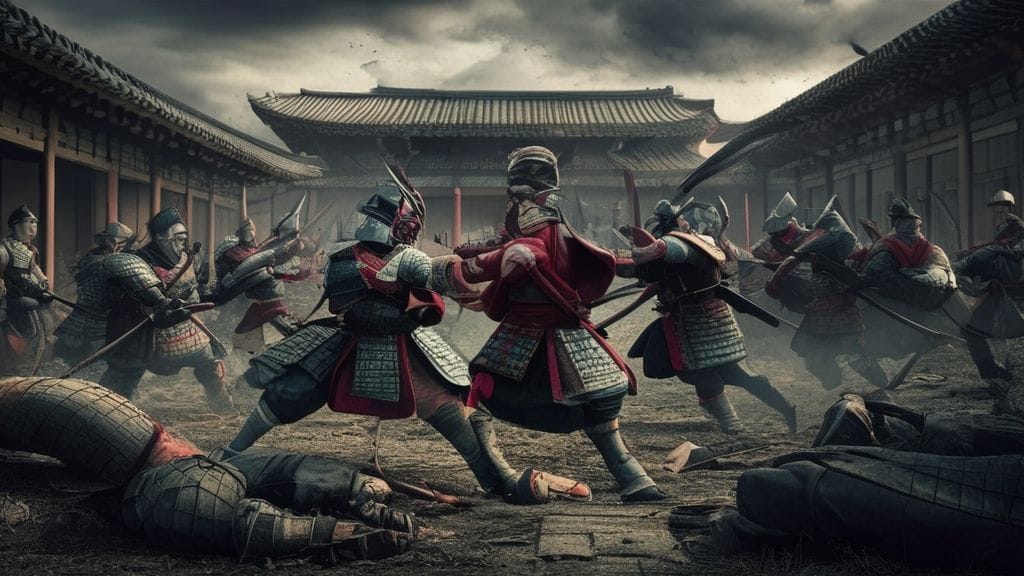
The fighting itself was likely fierce but short. Eighth‑century Japanese warfare did not yet feature the large, long‑drawn campaigns of later samurai eras, but it could be sudden and brutal. Arrows and spears, swords and simple armor, clashed in the wooded passes and along the lakeshore. As reports of defections and defeats reached Nakamaro’s inner circle, panic must have set in. Some allies, weighing their chances of survival, switched sides outright or slipped away under cover of confusion.
Betrayal, in such moments, is as much a symptom as a cause. It revealed that Nakamaro’s claim to embody the true order of things had not taken deep root beyond his closest followers. The web of patronage and obligation that had seemed so solid in the capital proved fragile under the shock of open conflict. Provincial commanders, even those initially inclined to support him, could read the shifting winds—and they increasingly saw that Kōken’s camp, not Nakamaro’s, would shape the story told about 764.
By the time Nakamaro’s position fully collapsed, there was no more talk of strategic withdrawal or regrouping. It became a matter of escape and survival for him and his immediate family. Men who had once stood confidently in the great halls of Heijō‑kyō now found themselves fugitives along the margins of fields and forests, hunted by forces that only weeks before had bowed to them. In this reversal, the starkness of political fortune was laid bare: power in Nara Japan could vanish almost overnight, leaving the former wielder of authority with nothing but the clothes on his back and the fear in his chest.
Thus, on the banks and passes around Lake Biwa, the fujiwara no nakamaro rebellion met its military end. The larger story, however, would continue in the aftermath—through executions, proclamations, and the reweaving of political narratives that would define how generations to come understood what had just happened.
Night of Reckoning: Captures, Executions, and the Fall of a Statesman
After the collapse of his forces, Fujiwara no Nakamaro’s final days were marked by desperate flight and inevitable capture. Accounts suggest that he and his sons tried to escape, perhaps hoping to reach remaining allies or to disappear into the countryside. But with the mechanisms of the state turned against them, their chances were slim. The same system of officials, messengers, and local informants that had once recognized Nakamaro’s authority now worked to hunt him down.
When he was finally captured, the moment must have been heavy with symbolism. Here was the man who had once dominated the court, now bound and brought low before the power he had challenged. The state, in such situations, stages a kind of theater: the condemned is made an example, a warning inscribed not only in blood but in memory. Nakamaro, his sons, and many of his close supporters were executed, their bodies offered up as the price of defiance.
Emperor Junnin, whose presence had been central to Nakamaro’s claim of legitimacy, did not escape unscathed. Stripped of his title, he was reduced to a subordinate status and ultimately killed. His fate underscored a grim reality: in the struggle between retired empress and minister, the reigning emperor had been more pawn than player. When the side he was associated with lost, his person became too dangerous to leave alive. His very existence could serve, in future, as a rallying point for new challengers.
The method and setting of these punishments were carefully chosen. Executions were not random acts of vengeance but calibrated displays, meant to restore a moral universe that the rebellion had thrown into question. Public proclamations framed Nakamaro and his companions as traitors, men who had abused imperial favor and turned arms against their rightful sovereign. By condemning not only the deeds but the characters of the rebels, the regime sought to foreclose any sympathetic reinterpretation of their motives.
Yet the human element resists such neat categorization. Those who died with Nakamaro were fathers, sons, brothers, and retainers. Some had followed him out of genuine conviction; others had been bound by duty or family loyalty. Their widows and children, suddenly stripped of honor and protection, faced an uncertain future. The fall of one man at the apex of power radiated down the social ladder, leaving ripples of suffering in households that had little say in his fateful choices.
In this night of reckoning, the fujiwara no nakamaro rebellion ended as many political uprisings do: with the eradication of its leaders and the silencing of their version of events. But memory could not be so easily controlled. Even as official chroniclers inscribed the court’s perspective into the record, the story of Nakamaro—the brilliant minister undone by fear and ambition—continued to haunt the imagination of later generations.
After the Flames: Empress Shōtoku, Dōkyō, and the Re‑Forging of Authority
With Nakamaro dead and his faction broken, the victors moved quickly to consolidate their triumph. Retired Empress Kōken resumed the throne, now under the name Empress Shōtoku, a deliberate signal that her new reign (764–770) would be understood as a restoration of rightful rule rather than a mere continuation of her earlier tenure. The political landscape shifted immediately. Offices once held by Nakamaro’s allies were redistributed; those who had proved their loyalty in the crisis were rewarded.
Dōkyō, whose influence had been at the heart of Nakamaro’s fears, now reached the zenith of his power. He received high secular titles, effectively placing him at the top of the official hierarchy. In an unprecedented move, he was granted the title of “Hōō” (Dharma King), blurring the lines between religious and temporal authority to an extent that alarmed many observers. For a brief moment, it seemed conceivable that the realm might accept an order in which a monk, sanctioned by an empress, would wield near‑imperial power.
Yet even in victory, the seeds of limitation were present. Many at court, while grateful for Shōtoku’s decisive suppression of the rebellion, viewed Dōkyō’s ascent with unease. The idea that a non‑imperial, non‑aristocratic figure could stand so close to the pinnacle of authority clashed with deep cultural expectations. Shōtoku herself, though committed to Dōkyō, had to navigate the delicate balance between drawing on his support and reassuring a wary aristocracy.
It was in this tense aftermath that one of the most famous episodes associated with Dōkyō unfolded: the oracle from the Usa Hachiman shrine in Kyushu. According to later sources, Dōkyō sought divine confirmation that he could ascend to the throne, or at least receive an unprecedented elevation of his status. An official sent to the shrine returned with a devastating response: the deity declared that “the imperial line is already fixed; it does not lie in a subject to become emperor.” This story, whether polished or partly constructed by later chroniclers, captured the essential lesson that the political elite drew from the crisis.
When Shōtoku died in 770, Dōkyō’s power collapsed almost overnight. Stripped of his titles and sent away from the capital, he became a cautionary figure rather than a founding father of a new order. The very speed of his fall underscored how thin the ice beneath him had been, even during his period of apparent invincibility. The aristocracy, chastened by the turmoil of the fujiwara no nakamaro rebellion yet determined to prevent any repeat, resolved to reinforce the principle that the throne must remain firmly in the hands of the imperial line—and that no monk or minister, however favored, could overstep that boundary.
Thus, the years after 764 were not simply about the punishment of rebels but the re‑forging of authority. Empress Shōtoku’s reign and Dōkyō’s rise and fall became a crucible in which new, more rigid notions of imperial sovereignty and the proper role of religious figures were hammered into shape. The trauma of rebellion had convinced many that the state could not survive another such test if the lines between ruler, aristocrat, and monk remained so dangerously blurred.
Courtly Whispers: How Chroniclers Framed the Fujiwara no Nakamaro Rebellion
History, as we know it, is not the raw memory of events but the product of those who wrote them down. The primary source for the fujiwara no nakamaro rebellion is the Shoku Nihongi, an official court chronicle completed in the early ninth century. Its compilers worked under emperors who had every reason to legitimize the post‑764 order and to warn against future attempts to disrupt it. As a result, Nakamaro appears in its pages through a particular lens: at first a capable minister, later a man whose growing arrogance and lawlessness justified his downfall.
In this narrative, Dōkyō is cast as a dangerous interloper, exploiting Empress Shōtoku’s trust to reach beyond his proper station. Nakamaro’s rebellion, then, becomes a tragic yet ultimately necessary episode that exposes both the perils of excessive clerical influence and the consequences of overweening ministerial ambition. The imperial institution emerges as the eternal, if sometimes obscured, center of rightful order; all others are evaluated in terms of how well they serve or betray it.
But within the chronicle’s formal entries, hints of more complex realities glimmer. We catch glimpses of debates at court, of officials torn between competing loyalties, of edicts that had to be reissued or clarified in the rush of events. A modern historian reading these texts—many of which have been translated and analyzed in detail—must learn to hear the silences as well as the words. What is not said about Nakamaro’s motives? How are Kōken’s actions selectively praised or criticized? Which voices are entirely absent?
Later medieval and early modern writers would return to the story with their own agendas. For some, Nakamaro became a cautionary tale about hubris, a man who forgot the proper limits of service. For others, he was a tragic figure, caught between loyalty to a vision of imperial rule and the political currents he could no longer control. Dōkyō, likewise, appeared alternately as a villainous usurper and a symbol of the dangers of mixing monastic virtue with worldly power.
Citations from the period, such as the oft‑quoted line that “Heaven’s will is made known through the prosperity of the righteous and the ruin of the wicked,” were used to frame the rebellion as a moral parable. Yet it is precisely such moralization that modern scholarship has begun to question. As recent studies remind us, events like the fujiwara no nakamaro rebellion were not scripted allegories but the messy outcomes of structural tensions, personal relationships, and contingent decisions.
Thus, to read the history of 764 is to listen to a chorus of courtly whispers, each shaped by its own time. Our task today is not to silence them with a single authoritative interpretation but to recognize how each retelling reflects both the trauma of the original crisis and the differing needs of those who inherited its legacy.
Lives in the Crossfire: Soldiers, Monks, and Commoners in 764
Political narratives tend to orbit around emperors, ministers, and eminent monks, but the fujiwara no nakamaro rebellion touched many more lives than those recorded in the chronicles. The soldiers who marched for Nakamaro or for Empress Shōtoku were drawn from the provinces: farmers’ sons conscripted under the ritsuryō system, minor local elites seeking advancement, professional guards transferred from the capital companies. They did not write their own histories, yet their presence made history possible.
For a conscript from a far‑flung district, the call to arms in 764 might have arrived suddenly—an order from the provincial headquarters, a summons to assemble with spear and provisions. The reasons given would be framed in terms of loyalty to the emperor and the punishment of rebels. Few would have had any clear understanding of the intricate court rivalries that had set the conflict in motion. What they did understand was the immediate disruption: fields left untended, families anxious for news, the risk of wounds or death far from home.
Monks, too, found themselves drawn into the crisis. Beyond the figure of Dōkyō, countless lesser clerics participated in rituals for victory, protection, and the pacification of the realm. Temples aligned with one faction or the other risked their fortunes on the outcome. Some may have provided logistical support, food, or even armed retainers; others tried to maintain neutrality, focusing on prayer and internal discipline. When the dust settled, temples associated with the losing side could face confiscations or loss of patronage, altering the religious map of entire regions.
Commoners in the path of the armies suffered in ways that rarely enter the official record. As troops marched, they consumed local resources. Requisitions, whether nominally compensated or not, strained the fragile economies of villages. Skirmishes could spill over into populated areas, and rumors of approaching forces prompted families to hide valuables or even flee temporarily into the hills. In such times, the abstract question of who was the rightful guardian of the imperial order mattered less than the concrete reality of who controlled the roads and demanded their labor or food.
Women’s experiences, in particular, are almost entirely silent in our textual sources, yet they were central to the social fabric being torn and rewoven. Noblewomen in the capital saw their fates tied to the success or downfall of male relatives; some lost husbands or sons to execution or exile. Provincial women bore the burden of managing households in the absence of conscripted men, negotiating with officials, and enduring the uncertainties of war. The rebellion’s immediate human cost, therefore, extended far beyond the headline names.
When we speak of the fujiwara no nakamaro rebellion, it is tempting to measure its importance solely in terms of high politics and its role in shaping imperial ideology. But if we widen the lens, we see that it was also a moment when the ordinary people of eighth‑century Japan were pressed, however briefly, into the front lines of a struggle that would redefine their rulers—and, indirectly, their own lives for generations to come.
Religion and Rule: What Dōkyō’s Ascent Revealed about Nara Buddhism
The crisis of 764 cannot be separated from the broader story of Buddhism’s rise in Nara Japan. By the mid‑eighth century, the religion had moved far beyond its initial introduction as an exotic import. Great temples like Tōdai‑ji stood as monumental statements of state‑sponsored piety. The casting of the Great Buddha, completed earlier in the century, had itself been a national project, meant to stabilize the realm through divine favor. Monks attended court ceremonies; sutras were copied and chanted for the protection of the state.
Dōkyō’s prominence, then, did not arise in a vacuum. He stepped into a world where the court had already embraced Buddhism as a crucial pillar of its legitimacy. The innovation—or the transgression, depending on one’s perspective—lay in the degree to which he personalized that relationship, positioning himself not just as a representative of the wider sangha, the monastic community, but as an individual spiritual partner to the sovereign.
The aftermath of the fujiwara no nakamaro rebellion made clear that this experiment had gone too far for the comfort of many elites. While temples remained powerful, the notion that a single monk could overshadow ministers and even entertain the idea of imperial status provoked a strong reaction. After Dōkyō’s fall, policies were put in place to limit the political role of monks and nuns, restricting their access to certain offices and reaffirming that while the state would patronize Buddhism, it would not be governed by it.
This recalibration had long‑term consequences. It contributed to a distinct Japanese model in which religious institutions were richly endowed and socially influential but structurally separated from the direct exercise of sovereign authority. The memory of Dōkyō—amplified by his association with the rebellion—became a reference point whenever the balance threatened to tilt again. “Let no monk mimic Dōkyō,” later admonitions essentially said, “and let no court forget the dangers of placing spiritual charisma above lawful succession.”
Yet the relationship remained symbiotic. The court needed Buddhism’s rituals, its role in legitimizing rule and explaining disasters as karmic warnings. Temples needed the court’s patronage, lands, and protection. The events of 764 did not shatter this partnership; they merely hardened the dividing lines within it. The same sutras that were once chanted for Nakamaro’s success were now recited to sanctify his suppression, and the same clerical networks that had nurtured Dōkyō continued to train monks who would advise emperors—if at a safer distance.
In this light, the fujiwara no nakamaro rebellion appears as a moment of clarification. It exposed the tensions inherent in Nara’s Buddhist state, forcing rulers and monks alike to recognize that the fusion of religious charisma and political power has limits that, once crossed, invite violent correction.
Echoes in the Capital: From Heijō‑kyō to Heian‑kyō and the Fear of Usurpation
The shadow of 764 did not disappear with the burial of its protagonists. In the decades that followed, the court increasingly looked for ways to reduce the risks of palace intrigue and military confrontation in the Nara basin itself. One of the most momentous decisions in Japanese history—the relocation of the capital from Nara to Heian‑kyō (Kyoto) in 794—was influenced in part by the cumulative experience of political unrest, including the fujiwara no nakamaro rebellion and Dōkyō’s overreach.
Heian‑kyō was laid out with similar Chinese‑inspired geometry but in a different environment, both physically and politically. The move allowed the court to leave behind some of the dense web of temple–palace interconnections that had characterized Nara. Major religious institutions would still exist in and around the new capital, but care was taken to ensure that no single temple complex could dominate the city’s spiritual and political landscape in the way the great Nara temples had done.
The memory of attempted usurpation—whether by a minister like Nakamaro or a monk like Dōkyō—also shaped evolving doctrines of rule. Over time, a clearer consensus emerged: the imperial line was sacrosanct, and its continuity was the highest political good. Ministers could be powerful, even overshadowing weak emperors; cloistered emperors and retired sovereigns would themselves become key players. But the idea that someone outside the imperial bloodline could plausibly claim the throne or wield military power in his own name remained anathema in theory, even as practice sometimes skirted close to this boundary.
The Fujiwara clan, interestingly, learned its own lessons. Later Fujiwara leaders preferred methods that did not require open confrontation: they married into the imperial line, acted as regents for child emperors, and used their familial position to control access rather than armies. The violent failure of their kinsman Nakamaro became, implicitly, a case study in what not to do. Influence was to be exercised obliquely, through kinship and ritual, not through overt military revolt.
In this sense, the echoes of the 764 crisis resonated in the very fabric of Heian politics and culture. The Heian period’s famed aesthetic of refined detachment, of power hidden behind screens and layered robes, rested on a foundation partially shaped by a determination to avoid the crude spectacle of ministers and monks openly vying for the throne. Under the elegant surfaces of Heian literature, the lessons of Nara’s blood‑stained autumn remained alive.
Family, Memory, and Silence: The Fate of Nakamaro’s Line
For the immediate family of Fujiwara no Nakamaro, the rebellion’s consequences were stark and personal. His sons who had joined him in arms were executed; other relatives may have faced exile, dispossession, or forced retirement from public life. The Fujiwara name itself, however, was too large and diversified to be extinguished by the fall of one branch. Other Fujiwara lines distanced themselves from Nakamaro’s actions, emphasizing their loyalty to Empress Shōtoku and her successors.
Within households connected to Nakamaro by blood or marriage, a more private reckoning unfolded. Family shrines had to decide whether and how to honor the memory of a man officially branded a traitor. Mothers and widows navigated the dangerous terrain of mourning a loved one whose death the state had celebrated as just punishment. Children grew up under the shadow of a name that could not be spoken too loudly in certain contexts.
In aristocratic society, where lineage and memory were everything, such silences could be as eloquent as any public monument. A poem that alluded obliquely to “autumn storms that uproot even the tallest trees” might, for those in the know, evoke the fall of Nakamaro without naming him. Genealogies could minimize or omit his presence, smoothing over the jagged edge of rebellion in favor of a more palatable continuity.
Over generations, this family‑level negotiation with the past intersected with broader cultural trends. As the Fujiwara regained and maintained their dominance in the Heian court, they had little interest in celebrating a forebear whose methods had so conspicuously failed. At the same time, the sheer drama of the fujiwara no nakamaro rebellion made it hard to erase entirely. Stories persisted in oral tradition, in local legends, in the haunted reputation of places associated with his final stand.
Thus, Nakamaro’s line did not vanish; it was absorbed, rebranded, and selectively forgotten. The man himself became less an ancestor to be proudly claimed than a cautionary figure at the margins of the family’s official narrative. In this, his fate mirrors that of many failed power‑seekers across history: too important to ignore, too dangerous to celebrate.
From Rebellion to Principle: Dynastic Stability and the “Emperor Above All”
Out of the smoke and confusion of 764 emerged a clearer, harder principle that would guide Japanese political thought for centuries: that the imperial line, however mediated by ministers, regents, or retired sovereigns, must remain above challenge from non‑imperial figures. The fujiwara no nakamaro rebellion and Dōkyō’s attendant rise and fall together formed a twin warning—against ministerial overreach backed by arms and against clerical overreach backed by spiritual charisma.
This principle did not mean that emperors always ruled directly, or even effectively. In later eras, warriors like the Taira and Minamoto, then the Ashikaga and Tokugawa, would dominate the country while nominally recognizing the emperor’s ultimate sovereignty. Yet the separation between de facto military rulers and the sacred authority of the emperor remained conceptually intact. The samurai shogunate could wage war and govern the provinces, but it rarely attempted to displace the emperor as the symbolic source of legitimacy.
We can see the distant influence of 764 in this arrangement. The trauma of a court torn between a retired empress, a reigning emperor, a dominant minister, and an ambitious monk ingrained a deep wariness of any attempt to fuse military or religious authority with the throne itself. Even when the imperial house was politically weak, its symbolic inviolability endured. It is no coincidence that later challengers to the prevailing order often claimed to act in the emperor’s name rather than in explicit opposition to him.
Another principle that gained strength was the careful management of retired rulers. Empress Shōtoku’s assertive return to power and her partnership with Dōkyō highlighted the potential for conflict when retired sovereigns retained too much independent influence. Over time, complex rituals and institutions grew up to structure the relationship between reigning and retired emperors, seeking to avoid the kind of open contest that had contributed to the crisis of 764.
Thus, from the narrow corridor of one rebellion emerged broad avenues of constitutional thinking. The Japanese polity did not adopt a written constitution in the modern sense until much later, but it had a long‑gestating body of unwritten rules and precedents. In that evolving code, the events of 764 served as a pivotal case: a negative example that clarified what must not be allowed if the dynasty were to survive repeated cycles of factional struggle.
On the Page of History: Scholarly Debates and New Perspectives
Modern historians have returned to the fujiwara no nakamaro rebellion with fresh questions and tools. Rather than accepting the official chronicles at face value, they have cross‑examined them with archaeological findings, comparative political theory, and a more critical reading of language and omission. Was Nakamaro primarily a villainous usurper, as the Shoku Nihongi implies, or a conservative reformer driven to extremes by fear of radical change? Was Dōkyō a power‑hungry monk or a sincere advocate for a closer union of spiritual and temporal authority?
One line of scholarship emphasizes structural factors: the inherent instability of a system that relied on powerful aristocratic families to staff the state while denying them formal avenues to match their informal influence. By this reading, the rebellion was almost inevitable once a minister like Nakamaro reached a critical mass of power and then felt threatened by the rise of a rival center of influence—embodied, in this case, by Dōkyō and Empress Shōtoku. The real “cause” of the rebellion was less individual character than systemic design.
Another perspective focuses on gender and the unusual prominence of an empress in this story. Kōken/Shōtoku’s reign and restoration forced courtiers to confront the question of how a female sovereign should relate to male advisers, both secular and religious. Some scholars argue that the backlash against Dōkyō and the subsequent reluctance to enthrone female emperors for many centuries were intertwined, reflecting anxiety about the perceived vulnerability of women on the throne to manipulation—an anxiety that says more about male fears than about historical reality.
Religious historians, meanwhile, have examined the rebellion as a key episode in the evolving relationship between the Japanese state and Buddhism. For them, 764 marks not a simple rejection of clerical involvement in politics but a recalibration. The state continued to rely heavily on Buddhist rituals and institutions; what changed was the acceptable degree of direct monastic influence on appointments and succession. From this angle, Dōkyō is less a monstrous anomaly than an experiment whose dramatic failure set new parameters.
Recent work has also tried to recover, as far as possible, the experiences of those outside the highest ranks. By studying land registers, temple records, and regional histories, scholars trace how the upheaval of 764 affected taxation, land tenure, and local governance. They find that, in some areas, the crisis accelerated shifts in landholding patterns or temple patronage, subtly reshaping the countryside long after the last rebel had fallen.
There is no single, definitive interpretation that resolves all these debates. Instead, the continued scholarly interest in the fujiwara no nakamaro rebellion underscores its richness as a case study—a lens through which to examine the formation of Japanese statehood, the intersection of religion and politics, and the enduring questions of how societies remember and interpret internal conflict.
Lessons from 764: Power, Loyalty, and the Fragility of Political Order
Looking back across more than twelve centuries, the events of 764 still speak with unsettling clarity about the nature of political power. Fujiwara no Nakamaro’s rise and fall illustrate how quickly a seemingly stable order can unravel when key actors lose trust in the system’s ability to protect their interests. Once Nakamaro concluded that his position—and perhaps the very model of imperial rule he cherished—was under existential threat, the temptation to resolve the crisis through force became overpowering.
The rebellion also reveals the double‑edged nature of loyalty. Many of Nakamaro’s followers believed they were acting in the name of the emperor, even as their opponents claimed the same mantle. In a world where legitimacy was bound to a single sacred figure, disputes over who truly represented that figure could not be peacefully arbitrated once communication and trust broke down. The tragic result was that Emperor Junnin, the supposed focus of all loyalty, became a victim of the very conflict waged ostensibly on his behalf.
Another lesson lies in the limits of charisma, secular or sacred. Dōkyō’s meteoric ascent showed how a gifted individual, favored by a powerful patron, could momentarily reshape the political landscape. But his equally rapid fall underscored that without a sustainable institutional base, personal influence is fragile. Monks, ministers, and even retired sovereigns could, for a time, bend the system; they could not, in the end, escape its gravitational pull.
Finally, the fujiwara no nakamaro rebellion teaches us about the long half‑life of political trauma. The choices made in the aftermath—strengthening the principle of imperial uniqueness, circumscribing monastic power, refining the role of retired rulers—were all responses to the fears laid bare in 764. Those responses helped stabilize the dynasty but also fixed certain hierarchies and exclusions in place, shaping Japanese political culture for centuries.
When we read the story now, it is tempting to see the outcome as inevitable: of course Nakamaro would fail, of course Dōkyō would fall, of course the imperial line would endure. Yet for those who lived through that autumn, nothing was guaranteed. It was a time when rumors outran facts, when decisions had to be made on incomplete information, when ordinary people bore the costs of choices taken far above their heads. In recognizing that uncertainty, we come closer to understanding the rebellion not as a predetermined chapter in a grand narrative, but as a contingent, human drama whose echoes still resonate in the way Japan remembers its past.
Conclusion
The story of Fujiwara no Nakamaro’s Rebellion in 764 is at once tightly bound to its own era and surprisingly universal. In the glittering yet precarious world of Nara’s Heijō‑kyō, a gifted minister rose on the currents of family strategy and imperial favor, only to be swept under by the very forces he had helped to unleash. His desperate attempt to secure his position—by seizing the person of the emperor, mobilizing provincial armies, and framing his actions as a defense of legitimate rule—ended in disaster on the shores of Lake Biwa. The rebellion’s suppression, and the brutal reckoning that followed, allowed Empress Shōtoku and the monk Dōkyō to reshape the court temporarily, but their victory, too, carried the seeds of its undoing.
In the long view, the fujiwara no nakamaro rebellion served less to transform Japan immediately than to clarify what could and could not be tolerated in its political order. It sharpened the doctrine of imperial uniqueness, set new limits on the direct involvement of monks in government, and offered the Fujiwara and other aristocrats a vivid example of the dangers of open revolt. It also imprinted on the collective imagination a cautionary tale about the volatility of power: how swiftly fortunes can reverse, how thin the line is between defender and traitor, and how deeply the consequences of elite struggles cut into the lives of ordinary people.
To revisit 764 today is to be reminded that political stability is never a given. It must be constantly renegotiated among competing actors, all of whom believe—or claim to believe—that they are acting for the good of the realm. The fragile balance between throne, nobility, and religious authority that characterized Nara Japan may seem distant from modern forms of government, yet the underlying dynamics of fear, ambition, loyalty, and belief remain hauntingly familiar. In that sense, the autumn rebellion of Fujiwara no Nakamaro is not just a chapter in Japanese history; it is a mirror held up to the perennial human struggle over who should rule, by what right, and at what cost.
FAQs
- What was the Fujiwara no Nakamaro Rebellion?
The Fujiwara no Nakamaro Rebellion was a short but consequential civil conflict in 764 Japan, led by the powerful minister Fujiwara no Nakamaro against forces loyal to retired Empress Kōken (who returned to the throne as Empress Shōtoku). It centered on a struggle over who truly embodied imperial authority and how much influence the monk Dōkyō should wield at court. - Why did Fujiwara no Nakamaro rebel?
Nakamaro rebelled because he feared the growing influence of retired Empress Kōken and the monk Dōkyō, whom he believed threatened both his own position and the established order of imperial rule. Convinced that normal political channels could no longer protect him or the model of governance he supported, he attempted to seize control of the emperor and mobilize provincial forces in what he portrayed as a defense of legitimate authority. - Who were the main figures involved in the rebellion?
The central figures were Fujiwara no Nakamaro, the leading minister; retired Empress Kōken, who later reigned again as Empress Shōtoku; Emperor Junnin, whose person both sides claimed to represent; and the Buddhist monk Dōkyō, whose close relationship with Kōken made him a lightning rod for aristocratic fears about clerical power. - How did the rebellion unfold militarily?
The rebellion began when Nakamaro removed Emperor Junnin from the capital and attempted to rally provincial troops, especially from eastern regions, while moving toward Ōmi near Lake Biwa. Loyalist forces rallied around retired Empress Kōken in Nara, quickly organized a counteroffensive, and defeated Nakamaro’s smaller, less coherent army in a series of engagements around Lake Biwa. Nakamaro’s support collapsed, and he was captured and executed. - What happened to Emperor Junnin?
Emperor Junnin, who had been installed with Nakamaro’s strong backing, was captured after the rebellion failed. Stripped of his title and reduced to a subordinate status, he was ultimately killed. His fate highlighted how a reigning emperor could become a pawn in factional struggles and suffer the consequences when his associated faction lost. - What role did the monk Dōkyō play?
Dōkyō was a Buddhist monk who gained Empress Kōken’s trust after reportedly healing her and providing spiritual counsel. His influence grew to the point where he received high secular titles and stood at the pinnacle of the official hierarchy. His prominence fueled aristocratic fears that a monk might overstep traditional bounds and even aspire to the throne, making him central to the political tensions that framed the rebellion. - How did the rebellion affect the relationship between the state and Buddhism?
The rebellion and Dōkyō’s subsequent rise and fall led to a recalibration of the state–Buddhism relationship. While the court continued to patronize Buddhist institutions and rely on their rituals, it moved to limit the political role of individual monks, reinforcing the idea that religious figures should not directly control succession or high secular offices. - What were the long‑term political consequences of the rebellion?
Long‑term consequences included a stronger emphasis on the inviolability of the imperial line, stricter informal limits on monastic political influence, and a preference among powerful families like the Fujiwara for exerting control through kinship and regency rather than open rebellion. The memory of 764 also contributed to later decisions, such as the move of the capital to Heian‑kyō in 794, aimed at reducing certain kinds of political risk. - How do historians today view Fujiwara no Nakamaro?
Modern historians view Nakamaro with more nuance than the official chronicles, which depict him largely as a traitor. Many see him as a powerful but ultimately conservative figure who believed he was defending a particular model of imperial governance. His rebellion is interpreted as the product of structural tensions in the Nara state as much as of personal ambition or moral failing. - Why is the Fujiwara no Nakamaro Rebellion still important to study?
The rebellion remains important because it illuminates key issues in early Japanese state formation: the balance between throne and aristocracy, the political role of Buddhism, and the ways in which internal crises can lead to enduring constitutional principles. Studying it helps us understand how Japan’s political culture developed and how societies more generally respond to the threat of usurpation and civil conflict.
External Resource
Internal Link
Other Resources
- Encyclopaedia Britannica – general search for the exact subject
- Google Scholar – academic search for the exact subject
- Internet Archive – digital library search for the exact subject

