Table of Contents
- The Dawn of a New Vision: Venice, August 1609
- The Man Behind the Lens: Galileo Galilei’s Journey
- The Birth of the Telescope: From Dutch Optics to Italian Genius
- Venice: A City Ready for Innovation and Intrigue
- Galileo’s Arrival and His Secret Instrument
- The First Public Demonstration: Awe and Skepticism
- The Scientific Context of the Early 17th Century
- How the Telescope Transformed Astronomy Forever
- The Moons of Jupiter: A Revelation Beyond Imagination
- The Clash with Aristotelian Cosmology and the Church
- The Role of Venetian Patrons and the Grand Duke of Tuscany
- The Spread of the Telescope Across Europe
- The Personal Risks Galileo Took to Share His Discovery
- The Immediate Impact on Naval and Military Surveillance
- Galileo’s Continuing Observations and Writings after Venice
- The Public’s Fascination and the Birth of Modern Science Communication
- Long-Term Scientific and Philosophical Consequences
- Galileo’s Telescope and the Birth of the Scientific Revolution
- Venice as the Stage for a Historic Turning Point
- Echoes in Modern Astronomy and Technology
- Conclusion: The Telescope That Changed Humanity’s View of the Cosmos
- FAQs
- External Resource
- Internal Link
1. The Dawn of a New Vision: Venice, August 1609
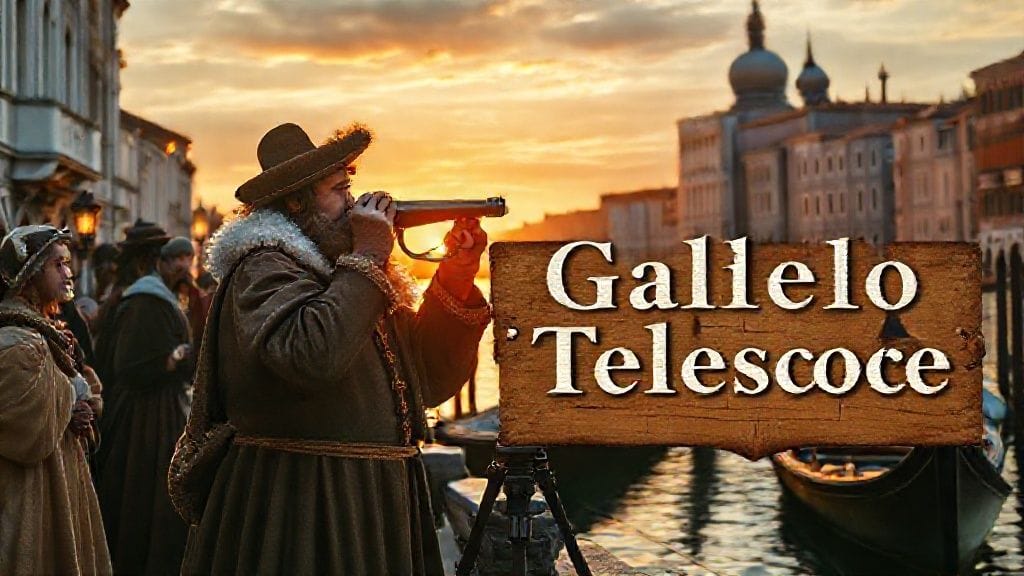
It was an August day like no other in the winding canals of Venice, where shimmering waters reflected an azure sky bristling with possibility. The heavy scent of salt and spice mingled with the clamor of merchants and gondoliers, but amid this familiar chaos, something extraordinary was unfolding. In a narrow Venetian square, a small crowd had gathered, eyes turned towards a peculiar tube held steady by a man whose quiet intensity suggested he was about to redefine the universe itself.
Galileo Galilei, scientist, mathematician, and dreamer, stood poised to unveil a device so groundbreaking that it would shatter centuries of cosmic assumptions. The telescope—a newly refined marvel—would not simply magnify distant objects; it would extend humanity’s gaze beyond the earthly veil, tearing open the heavens to reveal a cosmos far stranger and more wondrous than anyone dared imagine.
On August 21, 1609, in Venice’s heart, Galileo demonstrated his telescope for the first time—a humble instrument that would bring down stars, rearrange the pillars of knowledge, and ignite a scientific revolution.
2. The Man Behind the Lens: Galileo Galilei’s Journey
Galileo wasn’t born a universal genius manifest overnight. His life was a testament to perseverance, curiosity, and stubborn courage. Raised in Pisa and later settled in Padua, his early passion for mathematics and physics faced initial failures and skepticism from more traditional scholars. Yet Galileo’s restless mind refused to turn away from the mysteries of the universe.
By 1609, at 45 years old, he had carved out a modest but important career at the University of Padua. It was here that whispers reached him about the Dutch invention of a “spyglass,” a crude and unrefined tool designed to magnify distant objects. Galileo saw in that fleeting concept a chance to rewrite the book of nature.
3. The Birth of the Telescope: From Dutch Optics to Italian Genius
The telescope’s origins are humble and somewhat contested, tracing back to modest Dutch spectacle-makers. Their invention—a simple tube with lenses—offered a blurry glimpse of far-off shapes. But it was Galileo who, driven by intellectual obsession, improved the instrument’s optics dramatically. His lenses were ground meticulously, enabling sharp clarity and magnification up to 30 times, far surpassing contemporary devices.
This was not mere craftsmanship; it was a spark of innovation fueled by rigorous scientific insight, transforming a rudimentary “wonder” into a powerful tool for discovery.
4. Venice: A City Ready for Innovation and Intrigue
Venice in the early 17th century was more than a marvel of engineering and trade—it was a bustling epicenter of Renaissance thought, art, and politics. The city-state's maritime dominance demanded keen observation and intelligence, making it fertile ground for innovations like Galileo’s telescope, which promised practical military and naval applications alongside intellectual breakthroughs.
Venetian nobles, merchants, and scholars listened eagerly as rumors of Galileo’s work reached their palaces and academies. The stage was set for his public unveiling.
5. Galileo’s Arrival and His Secret Instrument
Carrying his telescopes hidden in simple wooden boxes, Galileo arrived in Venice, a city alive with excitement. For weeks, he prepared in secret, choosing the right place and moment to reveal his invention to the public and potential patrons.
His telescope was deceptively simple—a slender brass tube, no longer than a man’s arm—but what it showed was otherworldly. Gazing through it, viewers saw ships miles away on the lagoon, clearly distinguishable men atop masts, and the craggy terrain of distant fortresses. The impact on Venetian sailors and aristocrats was immediate.
6. The First Public Demonstration: Awe and Skepticism
The demonstration took place on a Venetian balcony overlooking the bustling Grand Canal. Curious Venetians lined the edges, from dockworkers to noblemen. One by one, they peered through the telescope, murmuring in disbelief as their familiar cityscape transformed into a detailed, magnified world.
Yet for every gasp of awe, there was a shadow of skepticism. Some dismissed the instrument as a trick, an elaborate illusion. How could a mere lens challenge the established truths taught by Aristotle and Ptolemy for centuries?
7. The Scientific Context of the Early 17th Century
To grasp the full magnitude of Galileo’s demonstration, one must remember the scientific context. Europe was still dominated by the geocentric model—the Earth at the universe’s center, stationary and eternal. The heavens were seen as perfect and unchanging, a realm of divine order.
But cracks were appearing in this worldview. Copernicus had proposed a heliocentric system decades before, but lacked observational proof. Astronomy was on the cusp of transformation, ready to be propelled forward by instruments such as Galileo’s telescope.
8. How the Telescope Transformed Astronomy Forever
Galileo’s telescope did more than magnify; it revealed. With it, he observed mountains and craters on the moon, disproving its supposed perfect smoothness. He counted countless stars invisible to the naked eye. The Milky Way was unraveled as a dense cluster of stars.
Most importantly, he discovered four moons orbiting Jupiter, directly contradicting the dogma that all celestial bodies circled Earth. This was revolutionary—not just a new view of the sky, but a new cosmic geography.
9. The Moons of Jupiter: A Revelation Beyond Imagination
When Galileo first saw the four “Medicean Stars” dancing around Jupiter, he knew he had uncovered something extraordinary. This finding was critical evidence supporting Copernican heliocentrism, as it proved not all cosmic objects revolved around Earth.
Publicly announcing the moons symbolized Galileo’s defiant stride into uncharted scientific territory. His dedication to observation over doctrine would ignite admiration and fierce opposition alike.
10. The Clash with Aristotelian Cosmology and the Church
Galileo’s discoveries threatened centuries of Aristotelian philosophy deeply embedded in Church doctrine. The notion of an imperfect moon and orbiting satellites challenged the Church's scriptural interpretation of the cosmos.
Though Galileo initially enjoyed some papal favor, his findings stirred discomfort among theologians and conservative scholars. This clash escalated into one of history’s most dramatic conflicts between science and religious authority.
11. The Role of Venetian Patrons and the Grand Duke of Tuscany
Galileo’s Venetian demonstration was as much political theater as scientific display. His patrons, including the Doge of Venice and the Grand Duke Ferdinand of Tuscany, saw value in the telescope beyond intellectual curiosity.
Venice eyed enhanced naval superiority while the Medici family embraced Galileo’s innovations as a symbol of renaissance brilliance. Patronage would prove critical in sustaining his work amid growing controversies.
12. The Spread of the Telescope Across Europe
News of Galileo’s telescope spread swiftly from Venice to Paris, London, and beyond. Within months, other scientists and navigators were crafting their versions, sparking a pan-European wave of observational astronomy.
This rapid dissemination marked the telescope not only as a scientific milestone but as a catalyst for a broader Intellectual Renaissance.
13. The Personal Risks Galileo Took to Share His Discovery
Galileo’s public demonstration was a bold move. The scientific establishment and religious authorities could—and ultimately would—resist his findings. His willingness to endure scrutiny, ridicule, and eventual trial demonstrated his profound belief in truth and inquiry.
Behind his confident façade lay a man conscious of the historical stakes at hand, knowing his telescopes might rival his own safety and legacy.
14. The Immediate Impact on Naval and Military Surveillance
On a practical level, the telescope revolutionized maritime operations. Venetian commanders used Galileo’s invention to observe enemy ships from afar, track movements on the lagoon, and better navigate treacherous waters.
Thus, an object of pure curiosity quickly became an instrument of power, revealing how technology could reshape politics and war.
15. Galileo’s Continuing Observations and Writings after Venice
Following his Venetian success, Galileo continued his observations, meticulously recording phases of Venus, sunspots, and the rugged lunar surface. His works, such as Sidereus Nuncius (Starry Messenger), disseminated these revelations, stirring a global debate that would change astronomy forever.
Each discovery built on the last, weaving an ever more compelling argument for a universe in flux, not fixed and eternal.
16. The Public’s Fascination and the Birth of Modern Science Communication
Galileo’s demonstrations captivated not only scientists and nobles but the general public. For the first time, complex astronomical phenomena became accessible to ordinary citizens, fueling curiosity and wonder.
This marked a new era where scientific ideas began circulating beyond cloistered academies—an early step toward modern science communication.
17. Long-Term Scientific and Philosophical Consequences
Galileo’s telescope did not merely change astronomy but challenged humanity’s place in the cosmos and the nature of knowledge itself. It ushered in empirical observation as the foundation of science, inspiring thinkers from Newton to Kepler.
Philosophically, it blurred the boundaries between science, metaphysics, and theology, highlighting tension but also eventual synthesis.
18. Galileo’s Telescope and the Birth of the Scientific Revolution
Viewed through the lens of history, the Venetian demonstration presaged the Scientific Revolution. It symbolized the shift from dogma to observation, from deference to inquiry, embodying a new scientific method grounded in evidence.
This moment stands as one of history’s greatest instances where a tool fundamentally altered humanity’s worldview.
19. Venice as the Stage for a Historic Turning Point
That Venetian summer day, under bright skies and watery streets, the city hosted more than a spectacle—it became the crucible where Renaissance humanism met emerging science. Venice's unique blend of culture, power, and curiosity made it the perfect stage for Galileo’s audacity.
The city's canals still whisper tales of those transformative hours.
20. Echoes in Modern Astronomy and Technology
Galileo’s telescope paved the way to modern astronomy—from Hubble’s space observatory to today’s James Webb Telescope. The simple brass tube in Venice is the ancestor of all instruments that continue to expand our cosmic horizons.
Its legacy lives on in GPS satellites, deep space probes, and the human desire to explore.
21. Conclusion: The Telescope That Changed Humanity’s View of the Cosmos
On August 21, 1609, Galileo did more than demonstrate a new device—he illuminated a path out of darkness and dogma into an age of discovery. With a slender glass tube, he expanded mankind’s vision to the infinite, transforming not just the sky above but the very essence of knowledge and belief.
In a bustling Venetian square, a quiet revolution began—one still spinning onward through the stars.
Conclusion
Galileo’s demonstration of the telescope in Venice was a defining moment in human history, where science stormed the gates of ancient wisdom and opened the heavens for all eyes to see. It was a bold act of vision and courage, forever changing our understanding of the universe and ourselves. Beyond optics and magnification, it was about daring to look farther, to question long-held truths, and to embrace the awe of discovery. Today, as we peer through modern telescopes and gaze deeper into space, the spirit of that August day in Venice endures—a testament to the power of curiosity and the unquenchable human desire to know.
FAQs
Q1: Why was Galileo’s telescope demonstration in Venice so important?
It marked the first public unveiling of an improved telescope that revealed unprecedented celestial observations, dramatically challenging established cosmic beliefs.
Q2: What did Galileo discover with his telescope?
He pointed out mountains on the Moon, countless stars in the Milky Way, phases of Venus, and four moons orbiting Jupiter—each discovery undermining geocentric dogma.
Q3: How did the Church initially react to Galileo’s findings?
Initially intrigued but increasingly hostile, especially when discoveries conflicted with scripture interpreted in a geocentric framework, eventually leading to Galileo’s trial decades later.
Q4: What role did Venice play in Galileo’s scientific career?
Venice was a center of innovation where Galileo demonstrated his telescope, gained patrons, and showed the practical as well as intellectual value of his invention.
Q5: How did the telescope change naval warfare?
It allowed early detection of ships, better navigation, and surveillance, giving maritime powers like Venice a strategic advantage.
Q6: How quickly did the telescope spread across Europe after Galileo’s demonstration?
Within months, copies and improvements of the telescope reached other capitals, accelerating scientific discoveries continent-wide.
Q7: What was the broader impact of Galileo’s telescope on science?
It helped shift science from reliance on philosophy and dogma to empirical observation and experimentation, laying the foundation of modern science.
Q8: Is the telescope Galileo used in Venice preserved today?
No original telescopes from Galileo survive, but many reproductions and historic descriptions preserve its design and legacy.