Table of Contents
- A Winter Wedding in Ravenna: Setting the Stage in 417
- From Imperial Princess to Captive: Galla Placidia Before the Marriage
- Constantius the General: A Soldier’s Path to the Imperial Purple
- The Western Empire in Crisis: Thrones, Usurpers, and Barbarians
- Designing a Political Union: Why the galla placidia constantius iii marriage Was Decided
- Ravenna, Swamps, and Ceremony: The City That Hosted an Imperial Marriage
- The Wedding Day: Ritual, Spectacle, and Silent Calculations
- A Difficult Intimacy: Personal Dynamics Behind a Political Alliance
- Children of Compromise: Justa Grata Honoria and Valentinian III
- An Emperor for a Year: Constantius III and the Limits of Power
- Widow, Regent, and Mother: Galla Placidia After Constantius
- Faith, Factions, and Theodosius’s Legacy in the Marriage
- Ravenna’s Courtly World: Daily Life Around the Imperial Couple
- Echoes Across the Empire: Eastern Reactions and Diplomatic Ripples
- Memory, Legend, and Historians: How the Marriage Was Remembered
- From Ravenna to the Fall of Rome: Long Shadows of a Short Union
- Conclusion
- FAQs
- External Resource
- Internal Link
Article Summary: In the early days of 417, amid the mists and marshes of Ravenna, the marriage of Galla Placidia and Constantius III sealed a fragile bargain meant to save a crumbling Western Roman Empire. This article traces the tangled lives that led to the galla placidia constantius iii marriage, from captivity among Goths to campaigns in Gaul, and from imperial intrigues to the quiet terror of political necessity. It explores how this union blended personal reluctance with ruthless strategy, creating an alliance that reshaped the Western court, defined a regency, and set the course for the reign of Valentinian III. Through narrative scenes, analysis, and the testimony of ancient writers, we enter the palaces, council chambers, and churches of Ravenna to see how power, faith, and family collided. The story follows Galla Placidia’s journey from princess to hostage, bride, empress, and widow, and examines how Constantius rose from professional soldier to co-emperor—only to die within a year of reaching the purple. It also tracks the wider political stakes: barbarian federates, usurpers in Gaul, bishops and eunuchs at court, and wary observers in Constantinople. Above all, it shows how the galla placidia constantius iii marriage, far from being a mere footnote, sat at the crossroads of Roman decline and transformation, its human drama echoing long after the empire in the West was gone.
A Winter Wedding in Ravenna: Setting the Stage in 417
On the first day of the year 417, when winter fog wrapped Ravenna in a damp, shifting veil, an imperial bride walked through corridors of mosaics and shadow toward a future she had not chosen. The galla placidia constantius iii marriage was more than a family event; it was a calculated maneuver in a game that had come to define the late Roman world—survival through marriage, alliance through blood. In Ravenna’s palaces, candlelight trembled on golden tesserae, the air heavy with incense from nearby churches and salt from the Adriatic marshes. Outside, soldiers in cloaks watched the canals that crisscrossed the city, their breath visible in the cold, while bureaucrats hurried between ministries, clutching wax tablets and muttering about new edicts. Inside, the focus of the empire narrowed to one woman and one man whose joining might steady, or shatter, the Western Empire.
Galla Placidia, daughter of Theodosius the Great, sister of the reigning emperor Honorius, and once the captive bride of a Gothic king, now stood ready to marry a man she had long resisted: Flavius Constantius, the hard, stocky general whose campaigns had defended her brother’s throne. The ceremony in Ravenna sealed a bargain. Honorius could not rule alone; Constantius could not claim the purple without dynastic legitimacy; the empire could not weather the storms of usurpation and barbarian settlement without a stabilizing figure at court. And so, in the chill of 417, the galla placidia constantius iii marriage became the hinge on which Western politics would turn for the next generation.
Yet behind the celebrations, the Empire’s situation was precarious. Only seven years had passed since Alaric’s Goths had sacked Rome itself, shattering an aura of invincibility that had lasted for centuries. Britain had effectively slipped from Roman control, Gaul was fractured by competing claimants, and Spain lay contested between imperial forces and barbarian groups seeking their own kingdoms. Ravenna, nestled deep in its marshes, was at once refuge and prison for the court. In the great hall where Galla Placidia and Constantius would exchange vows, courtiers whispered not only about their union, but about the crumbling world beyond the city’s walls.
It is astonishing, isn’t it, that an event so intimate—two people joining their lives—could be so deeply entangled with the survival of an empire? Yet such was the nature of imperial life in late antiquity. The galla placidia constantius iii marriage, in that sense, was not only a personal turning point but a lens focused on a civilization in transition. To understand its significance, we must step backward, tracing the paths that brought bride and groom to this moment: her childhood in a glittering Constantinopolitan court, her years as a hostage among Goths, his rise from obscure officer to magister militum, supreme commander of the Western armies. Only then does the quiet drama of that winter day in Ravenna fully come into view.
From Imperial Princess to Captive: Galla Placidia Before the Marriage
Galla Placidia was born into a world of ceremony and danger, a daughter of emperor Theodosius I and his second wife, Galla, herself of imperial blood. As a child in Constantinople, she would have known the thunder of acclamations in the Hippodrome, the shimmer of silks in palace processions, and the severe piety of a court that increasingly pledged itself to Nicene Christianity. Her father had reunited the empire through will and war, defeating Gothic rebels at the Frigidus River in 394 at a cost so terrible that some Christian observers later wondered if God had punished Rome for its own brutality.
Widowed young, Galla Placidia moved westward, growing up under the shadow of her half-brother Honorius and the strong-willed general Stilicho, who effectively ruled the Western Empire. She was no ordinary princess; even as a girl she was betrothed in the shadow of diplomacy, a living pledge of Theodosian unity. Yet the same power that surrounded her also made her a prize for every faction that sought leverage over the imperial house. Her life would be defined by men who saw in her a gateway to legitimacy, a means of binding soldiers, bishops, and barbarian chiefs to a single political project.
When Alaric’s Goths marched on Italy and finally descended upon Rome itself in 410, Galla Placidia’s life changed forever. She was in the city when the Visigoths breached the gates, and amid the fires and plunder she was seized as a captive, carried away from the dying majesty of the Eternal City into the moving court of a Gothic king. Contemporary observers like Orosius and later Jordanes preserve fragments of these years: the imperial princess traveling under guard, moving from encampment to encampment, a living hostage whose fate might sway negotiations. For four years she moved with the Goths, first under Alaric and then under his successor Ataulf.
Out of this captivity came her first marriage, a union no less political than the later galla placidia constantius iii marriage. Around 414, in the city of Narbonne in Gaul, Galla Placidia married Ataulf, the Gothic king. The ceremony, according to the historian Orosius, mixed Roman and Gothic elements: a Roman bride, a Gothic groom, senatorial guests, and gifts taken from the spoils of Rome itself. Ataulf reportedly declared that he had once dreamed of destroying the Roman Empire and replacing it with a Gothic one, but had since come to believe that he must instead restore Rome in alliance with the Goths. Through Galla Placidia, he sought legitimacy; through Ataulf, she found a precarious protection amid a hostile world.
Their time together was brief and marked by hardship. They lost a son, named Theodosius in honor of Galla Placidia’s father, shortly after birth. The child, symbol of a hoped-for Romano-Gothic synthesis, was laid in a tiny grave in Barcelona, and with him, perhaps, a fragile vision of shared kingship. When Ataulf was assassinated in 415, Galla Placidia fell once more into the hands of shifting Gothic factions, and finally, by a hard-bargained agreement, was returned to the Western imperial court. She came back to Ravenna not as a sheltered princess, but as a woman who had walked the camps of enemies, buried a child far from home, and learned that imperial blood offered no immunity from suffering.
This history of captivity and reluctant alliance haunted every step that led to the galla placidia constantius iii marriage. Those who pressed her toward Constantius knew she had once resisted becoming another man’s political token. She understood, perhaps more keenly than any of them, that a marriage could simultaneously bind and imprison, dignify and diminish. And yet, returning to a court where her brother drifted in indecision and the empire itself tottered, she also recognized that without a new bond, she remained a pawn, vulnerable to the next crisis.
Constantius the General: A Soldier’s Path to the Imperial Purple
Compared with Galla Placidia’s luminous lineage, Flavius Constantius began in comparative obscurity. Little is known of his early life; he emerges from the shadows of history as a skilled soldier, a man whose talent on the battlefield and in the barracks carried him steadily upward. By the early fifth century, he had become one of the principal commanders in the Western army, a trusted lieutenant under Stilicho and later an indispensable defender of Honorius’s shaky throne.
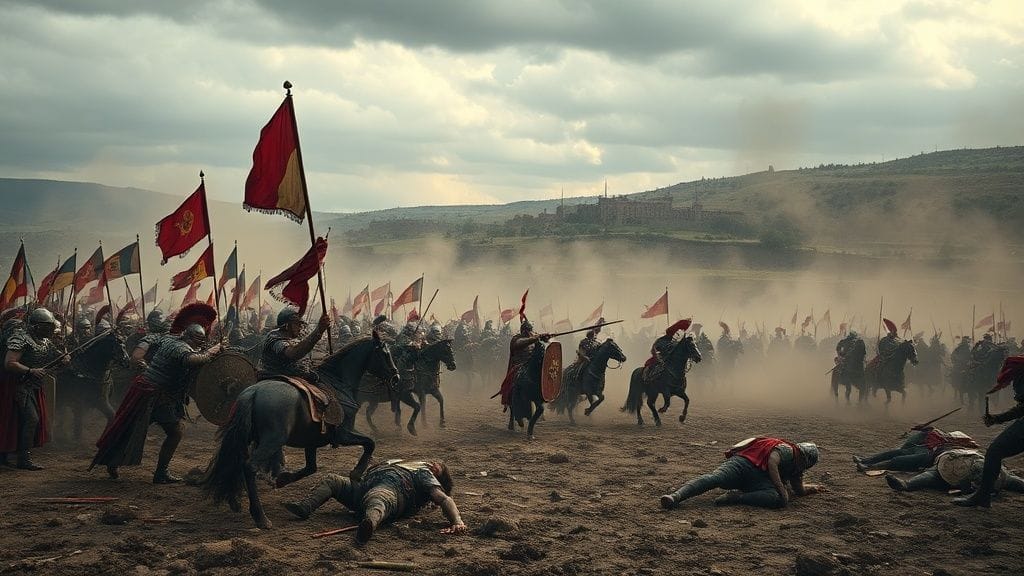
Constantius’s reputation was forged in hard campaigns. When Britain slipped from effective imperial control and a succession of usurpers rose in Gaul—Marcus, Gratian, then Constantine III—Constantius was among those sent to contain the crisis. In 411, he played a leading role in the defeat of Constantine III, whose bid for the purple had threatened to pull the Western provinces apart. Later, Constantius turned his energies against Jovinus, another Gallic usurper, and against the very Goths with whom Galla Placidia had once wandered. This was no simple frontier warfare, but a brutal civil conflict in which the loyalties of soldiers could turn with the promise of donatives and titles.
As he rose, Constantius developed a reputation for stubbornness, discipline, and a shrewd sense of timing. Zosimus and later chroniclers depict him as a man of middling physical appearance, even ungainly—short, stocky, with a neck that seemed almost to sink into his torso—but of immense will. He lacked the charm and aristocratic sheen of earlier strongmen like Stilicho; what he possessed instead was persistence and the support of key officers loyal to his person. By 411 he was magister utriusque militiae, master of both infantry and cavalry, a position that made him, in effect, the empire’s military backbone.
Yet Constantius also knew the limits of a soldier’s power in a world where legitimacy was rooted in blood and ceremony. A general could compel obedience from his troops; he could not, by arms alone, assure that bishops, senators, and bureaucrats would accept his commands as binding law. To move from general to emperor, or at least to something close to it, he needed the dynasty. He needed Theodosian blood—and in Ravenna, that blood flowed now most clearly through Galla Placidia.
Thus, long before the galla placidia constantius iii marriage was solemnized, Constantius lent his voice to those advocating the union. Some accounts suggest that he himself pressed for it, seeing in Galla not only a woman of extraordinary resilience but the key to the throne he had defended for others. Whether affection played any role is difficult to say; the sources are largely silent on personal feeling. But in the cold arithmetic of strategy, the match offered him what years of hard campaigning had not: a path into the imperial family itself.
The Western Empire in Crisis: Thrones, Usurpers, and Barbarians
To grasp the full stakes of the galla placidia constantius iii marriage, we must situate it in the wider collapse of Western Roman authority. The early fifth century was an age of fragmentation. In 406, a coalition of Vandals, Alans, and Suebi had crossed the frozen Rhine, pouring into Gaul and then Spain. Provinces that had once sent taxes, grain, and recruits to the legions now seethed with violence and competing law codes. In Britain, Roman troops proclaimed their own emperors, and by the time Honorius famously told the Britons to look to their own defense, imperial control there had largely vanished.
At the same time, the central court in Ravenna was wracked by its own instability. Honorius, who ascended the throne as a child, never displayed the strategic brilliance of his father Theodosius. He depended heavily on strong ministers—first Stilicho, then a series of powerful generals, eunuchs, and courtiers who vied to control access to the emperor. Each fall from favor sent tremors through the empire: Stilicho’s execution in 408, spurred by palace intrigue and xenophobic fears about his half-Vandal origins, precipitated some of the very disasters it had been meant to prevent, including the Gothic sack of Rome.
The lines between “Roman” and “barbarian” blurred. Gothic federates served in Roman armies even as other Gothic groups raided Italian towns. Vandals might ally with one Roman faction against another, only to carve out their own kingdom when the winds shifted. In Gaul, Gallo-Roman aristocrats tried to navigate between loyalty to Ravenna, accommodation with barbarian rulers, and the threat of local usurpers. Law codes, currency reforms, church councils—all bore the marks of improvisation amid crisis.
Within this maelstrom, dynastic marriages became vital tools of statecraft. An emperor’s sister, daughter, or widow was not merely a family member but a hinge between worlds. Marrying Galla Placidia to Ataulf had been one such experiment, a desperate attempt to turn Gothic power into an asset. After that experiment faltered, the Western court needed a new strategy. The galla placidia constantius iii marriage represented a different approach: instead of binding the dynasty to an external Gothic king, it would bind it to the very general who commanded the Western army. Barbarian forces would still be managed through treaties and subsidies, but the core of authority would, it was hoped, rest firmly in Roman hands.
Ravenna itself symbolized this new reality. Once a minor port, it had become the Western capital under Honorius, its marshy surroundings offering natural defenses against both seaborne and land attacks. The city’s canals and causeways shaped daily life: barges carrying grain and timber, narrow bridges guarded by soldiers, courtyards where water glimmered beside mosaicked floors. From this watery refuge, the court issued laws for distant provinces it could barely control. The marriage taking place there in 417 was an attempt to weld together military power, imperial prestige, and the stubborn hope that Rome’s western half could still be governed as a coherent whole.
Designing a Political Union: Why the galla placidia constantius iii marriage Was Decided
The decision to arrange the galla placidia constantius iii marriage emerged from a convergence of needs and fears. For Honorius, facing a world in which his personal authority was widely questioned, marrying his sister to his chief general offered a way out of isolating dependence on ever-shifting ministers. Constantius, once brother-in-law to the emperor, would find it harder to turn against him; at the same time, his enhanced status might placate the army, which looked to him for leadership. The dynasty would be reinforced, and the succession clarified through any children born of the union.
For Constantius, the logic was equally compelling. His position, though powerful, was precarious. Generals who grew too strong often met bloody ends—Stilicho’s fate lingered as a warning. By joining the imperial house, Constantius hoped to convert military clout into something more enduring: a share, if not outright control, of the imperial title. Indeed, within a few years, this expectation would be realized when he was raised to the rank of Augustus. Without Galla Placidia, such elevation would have been unthinkable. With her, it became a plausible next step in the unfolding script of late Roman politics.
And what of Galla herself? Sources like the chronicler Hydatius and the later historian Procopius suggest that she resisted the match, and modern historians generally agree that the marriage was not of her choosing. She had been given once already, unwillingly, to a political husband—Ataulf—only to see that precarious partnership end in blood and exile. Now, back in Ravenna, she may have dreamed of a quieter life, perhaps of religious patronage or a role as honored imperial aunt at court. Instead, she was again called upon to serve as the bridge between competing forces.
Yet even in resistance, there may have been calculation. Galla Placidia understood that remaining unmarried left her vulnerable. An unmarried princess of her stature could be offered at any moment to the highest bidder, including once more to barbarian kings. By agreeing—however reluctantly—to the galla placidia constantius iii marriage, she secured a measure of safety within the Roman fold. It tethered her fate to that of the army’s leading figure, but also gave her a powerful claim in her own right as future mother of emperors.
Behind the scenes, bishops, eunuchs, and high officials weighed in. The powerful patrician and praetorian prefects, mindful of stability, favored anything that might curb the cycle of usurpations. Church leaders recognized that Constantius, though a soldier, stood within the Nicene Christian consensus that now defined imperial orthodoxy. Some may have quietly preferred him to new alliances with Arian-leaning Gothic groups. The marriage thus aligned spiritual and secular interests, presenting itself as a providential solution to a man-made crisis.
As the negotiations took shape, the date—January 1, 417—was chosen with symbolic care. In Roman tradition, the Kalends of January marked renewal: the start of the consular year, the moment for vows of loyalty, for gifts, for public declarations. To begin the year with a marriage was to declare that a new chapter in the empire’s story had opened. The galla placidia constantius iii marriage would stand not only as a personal union but as a kind of political New Year’s resolution: a determination, however fragile, to hold the West together.
Ravenna, Swamps, and Ceremony: The City That Hosted an Imperial Marriage
The staging of the wedding in Ravenna mattered as much as the marriage itself. To modern eyes, Ravenna’s marsh-laced landscape might seem an odd setting for imperial grandeur, but to late Romans it was both sanctuary and symbol. From a distance, the city appeared low and elusive, a lattice of causeways, waterways, and low buildings, its walls mirrored in still, brackish pools. Approaching it by sea, one passed through lagoons where reeds shivered under winter winds and flocks of waterfowl scattered at the sound of oars.
Within, however, Ravenna sheltered a dense courtly world. Palaces boasted mosaics that caught the light in thousands of tiny reflections: golden halos encircling saints, deep blues evoking Mediterranean skies, imperial portraits with solemn, unblinking gazes. Some of the churches and halls that survive today, such as those later associated with Galla Placidia herself, give us a sense of this atmosphere: small but intense spaces, where ceilings glittered with stars and processional figures seemed to float across jeweled walls.
On the morning of the galla placidia constantius iii marriage, this world would have come fully alive. Soldiers lined the approaches to the palace, shields polished, spears upright. City officials ordered extra barges to ferry guests, envoys, and supplies along the canals. Senators from Italy and perhaps from distant Gaul donned heavy cloaks against the cold, their richly dyed tunics glimpsed beneath layers of wool. Attendants spread rushes or carpets along the palace corridors, muffling the sound of footsteps.
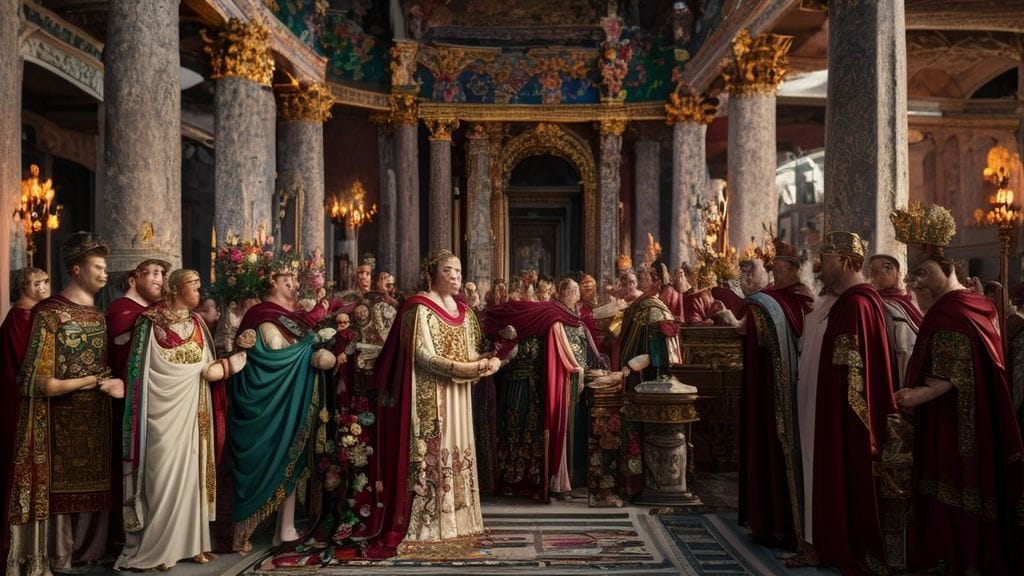
The ceremony likely followed the broad outlines of late Roman aristocratic marriage adapted to imperial scale. Galla, veiled, would have been escorted from her quarters to the reception hall, preceded by attendants carrying torches, even in daylight, as a sign of festivity. Constantius, in military dress or court regalia, awaited her before a gathering of dignitaries. There, vows were spoken, not in the modern romantic sense but as a solemn contract between families and powers. Rings or other tokens might be exchanged; documents were certainly drawn up and witnessed.
Christianity, by this time firmly established as the state religion, infused the proceedings. A bishop—perhaps the bishop of Ravenna himself—would have blessed the union, invoking divine favor. Prayers might mention the recent ordeals of the empire and the hope that, through this marriage, God would grant peace. Yet behind the pious words, the air was thick with calculation. Courtiers gauged Constantius’s demeanor, watched Galla Placidia’s expression, wondered how this new axis of power would reshape the factions at court.
After the formalities, a banquet followed, as was customary. Tables groaned under dishes of fish from local waters, game from inland estates, bread from African and Italian grain. Wine from the Adriatic coast flowed freely, though the more cautious officials sipped sparingly, conscious that loose tongues could end careers. Toasts honored the couple, the emperor, and the empire. Musicians played; perhaps a recitation of panegyric verses praised the union as a renewal of Roman fortunes. But this was only the beginning. The real significance of the galla placidia constantius iii marriage would be felt not in that single day of ritual, but in the years of uneasy partnership and shared rule that followed.
The Wedding Day: Ritual, Spectacle, and Silent Calculations
In imagining the wedding day itself, we must balance the sparseness of surviving descriptions with what we know of late Roman ceremony. No chronicler gives a minute-by-minute account, but scattered references and the nature of imperial protocol allow us to reconstruct its emotional texture. For Galla Placidia, stepping once more into the role of bride must have conjured memories of Narbonne: another hall, another crowd, another alliance sealed over her objections. This time, however, there was no exile, no foreign king surrounded by Gothic warriors; instead, she faced a fellow Roman, hard-eyed yet familiar, whose soldiers patrolled the very city in which she had grown up as an exile-returned.
Constantius, for his part, entered the hall not as a young man but as a seasoned campaigner whose hair may already have been touched with gray. He knew the rituals; he had watched other imperial weddings as an outsider, one more officer in the crowd. Now he was the focus, standing beneath banners stitched with imperial monograms. The knowledge that this day might set him on a path to the purple must have weighed heavily, even as he exchanged formal gestures of affection with the woman beside him. One can imagine his internal resolve: this was the culmination of years of maneuvering, a chance he could not afford to mishandle.
Among the guests, reactions were mixed. Some senators, weary of instability, welcomed the match as a consolidation of power. Others, jealous of Constantius’s sudden elevation from mere general to imperial kin, grumbled softly over their cups. Courtiers who had prospered under previous factions gauged how closely to align themselves with the new couple. The bishop presiding over blessings saw in the marriage an echo of divine providence, the union of sword and scepter under the sign of Christ. Scribes recorded the event in official annals, compressing all the drama into a few spare lines: “In the consulship of so-and-so, Galla Placidia was joined to Constantius.”
Outside, the populace of Ravenna enjoyed what they could of the celebration. Distributions of bread, oil, or coin, traditional at such events, may have cheered the streets. Children chased one another along the canals, mocking the stiff formality of palace processions. For them, the galla placidia constantius iii marriage signified free food and spectacle more than distant questions of imperial succession. Yet even their laughter formed part of the day’s texture, a reminder that beneath the layers of crisis and calculation, life in the late empire still pulsed with ordinary joys and concerns.
As evening fell, torches flickered in the corridors, casting long shadows on walls where processional saints watched with unchanging eyes. The couple withdrew from the public gaze to begin the private portion of their union—another layer of symbolic consummation, another duty laid upon them. Behind closed doors, whatever words passed between Galla Placidia and Constantius are lost to history. Did he speak with the blunt directness of a soldier, promising protection? Did she answer with cool formality, or with the weary pragmatism of one who had seen too much to believe in the permanence of any alliance? We cannot know. But we do know that from this night onward, their lives and their fates were inextricably entwined.
A Difficult Intimacy: Personal Dynamics Behind a Political Alliance
After the celebrations faded, the realities of married life began. Unlike many imperial couples, Galla Placidia and Constantius did not start from a position of mutual affection. Several ancient writers hint that she disliked, perhaps even loathed, her new husband at first. Modern historians, reading between the lines, have suggested that she may have seen in him a symbol of the apparatus that had condemned Stilicho, that had failed to defend Rome, that had bargained her life away among Goths and then again in Ravenna. For her, the galla placidia constantius iii marriage was a capitulation to necessity, not the fulfillment of desire.
Constantius, by contrast, likely viewed Galla with a mixture of respect and calculated pragmatism. He could not ignore her exceptional pedigree: daughter of Theodosius, sister of Honorius, aunt—eventually mother—to emperors. He also knew her reputation for intelligence and strong will, traits she would later display openly during her regency. In private, their conversations may have ranged from bitter recollections of past betrayals to cautious discussion of what could still be salvaged from the empire’s fading greatness.
There is no record of open conflict between them during their years together, but the absence of evidence is not evidence of ease. We know that Galla Placidia would later come to rely heavily on the memory of Constantius when arguing for her own authority as regent, invoking him as an emperor and partner who had shared her vision for the West. Whether this reflected a genuine softening of feeling or a posthumous political strategy is difficult to determine. Relationships in the late Roman imperial house were rarely uncomplicated; affection and ambition wove together in patterns invisible to outsiders.
One can imagine moments of uneasy intimacy in the palaces of Ravenna: the two of them walking beneath frescoed ceilings, discussing letters from the Eastern court, dispatches from Gaul, reports of new barbarian incursions. At times, perhaps, shared concern over the empire’s survival bridged the distance between them. The births of their children—first Justa Grata Honoria, then Valentinian—must also have altered the emotional landscape. To hold a child is to glimpse a future, however uncertain. In that sense, the galla placidia constantius iii marriage created not only a political alliance, but a small, fragile world of familial bonds amid the surrounding darkness.
Yet behind every domestic moment loomed public expectation. Galla Placidia remained a symbol as much as a wife; Constantius remained a commander as much as a husband. The palace walls could not entirely protect them from the din of drills in distant barracks, the rattle of messenger hoofbeats arriving with fresh crises. Their love—or their lack of it—mattered less to their contemporaries than the fact that together they embodied a compromise meant to keep the Western Empire functioning, at least for a little while longer.
Children of Compromise: Justa Grata Honoria and Valentinian III
The most enduring consequences of the galla placidia constantius iii marriage were not immediate political gains but the children who sprang from the union. Their daughter, Justa Grata Honoria, was likely born around 417 or 418, not long after the wedding. Their son, the future emperor Valentinian III, appears in the sources in 419, a small child whose existence would reshape the line of succession. In a court obsessed with dynastic continuity, these births were more than private joy—they were strategic triumphs.
For Galla Placidia, motherhood brought both fulfillment and new burdens. She had already known the pain of losing a child with Ataulf; now, in the safer—though still precarious—environment of Ravenna, she cradled futures that extended beyond herself. Valentinian, in particular, became the focus of intense attention. As the only male heir in the Theodosian line within the West, he united the blood of Theodosius with the military prestige of Constantius. He was, in effect, the living answer to the question haunting the court: what comes after Honorius?
The presence of these children also altered the balance of power. Constantius, now father to potential emperors, gained leverage in his dealings with Honorius and with the Eastern court in Constantinople, where another branch of the Theodosian family reigned. Negotiations over titles, military commands, and territories now had to reckon with the possibility that Valentinian might one day sit on the throne, perhaps even over a reunified empire. In this sense, every smile, every illness, every early word spoken by the toddler carried political weight.
Honoria, though at first less central to succession politics, would later rebel dramatically against the constraints of her role, famously appealing to Attila the Hun decades later in an act of desperate defiance. But even in infancy, she too represented a resource to be managed: another possible marriage partner, another potential link between factions. In the women of the imperial house, the empire stored its last, best bargaining chips.
The family scenes that flicker at the edge of our sources—the imperial children watching processions from balconies, running in palace courtyards under the watchful eyes of nurses and eunuchs—remind us that the galla placidia constantius iii marriage, for all its cold political logic, also generated ordinary human moments. Galla Placidia teaching her daughter prayers, Constantius lifting his son to show him the troops drawn up in review—such images, though speculative, are grounded in the rhythms of court life. They hint at a tenderness that history books, focused on borders and battles, rarely pause to consider.
An Emperor for a Year: Constantius III and the Limits of Power
The political gamble embedded in the galla placidia constantius iii marriage paid a visible dividend in 421, when Constantius was finally elevated to the rank of Augustus—co-emperor of the West—alongside Honorius. After years of serving as the empire’s indispensable general, he had at last reached the pinnacle he had long pursued. Coins were struck bearing his image, laws issued in his name. For a brief moment, the man once known primarily as a tough, unglamorous soldier stood as equal, at least in theory, to the imperial brother whose throne he had defended.
This elevation was as much a recognition of reality as a reward. Constantius already controlled the Western military; his marriage to Galla Placidia tied him to the dynasty; his children offered a clear line of succession. To deny him the purple indefinitely would have courted the very kind of rebellion that had plagued the previous two decades. By granting the title, Honorius hoped to stabilize his regime, ensuring continuity and perhaps even securing Constantius’s goodwill in moments of crisis.
Yet the glory was short-lived. Constantius III, as he is known to us, reigned for no more than seven months. In September 421 he died suddenly, likely from illness, leaving behind a widow, two young children, and a court abruptly deprived of its chief source of military discipline. His death laid bare the fragility of the political architecture built around the galla placidia constantius iii marriage. The man who had been meant to shield the dynasty from chaos was gone, and the question once more arose: who would control the empire’s armies?
In Ravenna, Galla Placidia’s grief mingled with shock and fear. She had not wanted this husband, perhaps, but she had come to rely on his presence as a buffer between herself and the more predatory factions of the court. The loss of Constantius forced her into a new role: that of imperial widow and guardian of a future emperor who was, as yet, only a child. She now carried on her shoulders the weight of both maternal and political responsibility, in a world where widows and orphans often found themselves surrounded by wolves.
The Eastern court in Constantinople, meanwhile, reacted cautiously to Constantius’s elevation and death. The Eastern emperor Theodosius II had never fully accepted his Western counterpart’s unilateral decision to raise Constantius to the rank of Augustus, a slight that would complicate subsequent negotiations over Valentinian’s status. In this tension, we see again how the galla placidia constantius iii marriage reverberated beyond Ravenna, shaping not only internal Western dynamics but the delicate dance between the empire’s two halves.
Widow, Regent, and Mother: Galla Placidia After Constantius
With Constantius gone, Galla Placidia stood at a crossroads. She could have receded into a life of pious widowhood, as many imperial widows had done before, retreating to church patronage and the quiet exercise of influence from the margins. Instead, she gradually emerged as one of the most consequential political figures of the mid-fifth century. The galla placidia constantius iii marriage had not only bound her to power; it had taught her how to inhabit it.
Her first challenge was survival at court. Relations with her brother Honorius deteriorated, culminating in a dramatic break that drove her and her children into exile in Constantinople around 423. There, at the Eastern court, she sought refuge and leverage, appealing to Theodosius II to recognize her son Valentinian’s rights. Honorius died that same year, and a usurper, Johannes, seized power in the West. The stage was set for yet another civil conflict, but this time Galla Placidia was no passive bystander.
In Constantinople, she convinced Theodosius II to back her claim on behalf of Valentinian. Eastern troops, commanded by the general Ardaburius and his son Aspar, were dispatched to depose Johannes and install Galla’s young son as Western emperor. In 425, the plan succeeded. Johannes was captured and executed; Valentinian III, still a child, was proclaimed Augustus in the West, with Galla Placidia as his regent. The daughter of Theodosius, the widow of Constantius III, now governed the Western Empire in her son’s name.
As regent, Galla navigated a treacherous landscape of generals, bishops, and provincial elites. She alternated between cooperation and conflict with powerful military figures like Aëtius, the “last of the Romans,” whose own career would span negotiations with Huns and battles against them. She engaged in diplomatic balancing acts with the Eastern court, barbarian kings, and papal authority in Rome. Throughout, she wielded the legitimacy granted her by birth and by the now mythologized memory of her marriage to Constantius. When critics challenged her authority, she could invoke not only her father and brother but also her late husband, the last man formally recognized (at least in the West) as co-emperor alongside Honorius.
Her patronage left visible marks on Ravenna itself. The famed mausoleum known today as the Mausoleum of Galla Placidia—though likely not her actual tomb—bears her name and reflects the intertwining of politics and piety in her later life. Its mosaics, glittering with stars and saints, express a Christian vision of order amid chaos, of divine shepherds guiding flocks through darkness. Whether or not she directly commissioned these works, they speak to the spiritual and aesthetic world she inhabited: one in which imperial power justified itself increasingly through Christian imagery and rhetoric.
In the end, Galla Placidia outlived the man to whom she had been unwillingly bound and shaped the empire more profoundly as his widow than she had as his bride. Yet none of this would have been possible without the foundation laid by the galla placidia constantius iii marriage. That union had produced Valentinian, provided her with a platform of aut hority, and taught her how to survive amid the shifting alliances of Ravenna and Constantinople. From captive to bride, from widow to regent, her life traced the arc of a world in transformation.
Faith, Factions, and Theodosius’s Legacy in the Marriage
Religion was not merely a backdrop to the galla placidia constantius iii marriage; it was one of its structuring forces. Theodosius I, Galla’s father, had famously declared Nicene Christianity the official religion of the empire, suppressed pagan public rites, and convened church councils to define orthodoxy. His children, raised in a world where bishop and emperor walked hand in hand, inherited not only his throne but his theological commitments. By the early fifth century, any imperial marriage took place under the silent gaze of bishops and monks who evaluated its implications for the faith as well as for the state.
Constantius, though a career soldier, appears in the sources as a man of conventional piety, aligned with the Nicene mainstream. This distinguished him from some of the Gothic leaders, whose adherence to Arian Christianity—an alternative understanding of Christ’s nature condemned at Nicaea—made them both religiously and politically suspect to Roman churchmen. Marrying Galla Placidia to Ataulf had posed theological challenges that marrying her to Constantius did not. In this sense, the later wedding in Ravenna could be presented by sympathetic writers as a return to proper order: an orthodox princess united with an orthodox soldier, under the auspices of an orthodox emperor.
Yet religious unity did not erase factionalism. Bishops in Italy, Gaul, and Africa each had their own priorities, shaped by local conflicts and personalities. Ravenna’s court, populated by eunuchs, secretaries, and palace clergy, simmered with doctrinal debates and personal rivalries. Galla herself, known in later tradition for her church building and patronage, likely saw in her marriage not only a political necessity but a spiritual trial. The tension between duty to family, duty to empire, and duty to God formed a constant undercurrent in her decisions.
Citations from writers like Augustine, though not directly referring to her marriage, illuminate the mental world she inhabited. In one of his letters, Augustine warns a noblewoman that “earthly greatness is nothing if it does not serve the eternal city of God,” a sentiment that must have echoed in the hearts of those watching the empire’s visible structures crack. To what extent did Galla Placidia, walking the line between palace and church, agree with such assessments? Her later career suggests she saw no contradiction between wielding imperial power and promoting Christian orthodoxy; indeed, she may have viewed the former as a means to the latter.
The galla placidia constantius iii marriage thus lay at the intersection of multiple legacies: Theodosius’s dream of a Christian empire, the increasingly clerical language of imperial legitimacy, and the personal pieties of a woman who had seen both pagan and Christian cities burn. When modern historians, such as Peter Brown, speak of late antiquity as an age in which “the Roman world found a new soul,” they evoke the same world in which Galla and Constantius made their calculations, balancing the salvation of souls against the survival of borders.
Ravenna’s Courtly World: Daily Life Around the Imperial Couple
Beyond crises and councils, the galla placidia constantius iii marriage unfolded amid the textures of daily life in Ravenna’s court. The palace complex functioned like a small city, populated by slaves, guards, scribes, cooks, artisans, and a rotating cast of officials. At dawn, the sound of trumpets or horns would rouse soldiers to drill in courtyards, while clerks gathered in offices lined with document chests to begin the day’s correspondence. Messengers arrived from provinces with satchels of reports: news of tax shortfalls in Spain, of vandal raids in Mauretania, of minor rebellions put down—or not—in Pannonia.
Galla Placidia’s mornings might begin with prayer in a palace chapel, surrounded by flickering oil lamps and the low chanting of clergy. She would then receive petitions: bishops seeking imperial support in local disputes, widows pleading for justice in property cases, provincial envoys hoping to secure tax remissions or military aid. Her reputation for seriousness and resolve made her a formidable presence. Constantius, meanwhile, convened councils of war, reviewed troop dispositions, and debated strategies for dealing with both internal and external threats.
Meals brought a different rhythm. At the imperial table, seating arrangements signaled favor or disfavor; the place assigned to a senator or general could launch or end a career. Galla and Constantius presided together, their children sometimes present, absorbing the language and gestures of power before they could fully understand them. Between courses—a fish from the Po delta, perhaps, followed by roasted fowl or stewed vegetables—conversations turned from military matters to theology, from provincial gossip to the never-ending question of how to govern with dwindling resources.
Afternoons might see the couple attending to ceremonial duties: receiving foreign envoys, blessing the construction of a church, reviewing a new legal code drafted by jurists. The laws issued in these years, preserved in the Theodosian Code, reveal a world grappling with everything from inheritance disputes to the status of barbarian settlers. Each decree, stamped with imperial authority, bore the invisible imprint of conversations held in chambers where Galla and Constantius weighed risks and benefits, ideals and constraints.
Evenings brought a relative quiet. Musicians performed; poets might recite verses praising the emperor and his house. Galla Placidia, whose education prepared her for such entertainments, listened with the ear of one who knew the distance between flattery and reality. Outside, in the darker quarters of Ravenna, ordinary citizens went about their lives: craftsmen repairing tools, mothers soothing children, sailors preparing for dawn departures. For them, news of the galla placidia constantius iii marriage had long ago receded into the background noise of imperial pronouncements. Yet the decisions made by the couple and their advisors continued to shape the taxes they paid, the security they enjoyed, and the prospects their children faced.
Echoes Across the Empire: Eastern Reactions and Diplomatic Ripples
The Roman Empire of the early fifth century was nominally one, but in practice two: Eastern and Western courts, each with its own emperor, bureaucracy, and priorities, bound together by a shared Theodosian dynasty and a fragile sense of common purpose. From Constantinople, the galla placidia constantius iii marriage looked both reassuring and unsettling. Reassuring, because it seemed to stabilize the West under a competent general tied firmly to the dynasty; unsettling, because it also elevated a man whom the East had not chosen and whose ambitions might, one day, extend toward their own sphere.
News of the wedding likely traveled quickly. Envoys in Ravenna wrote dispatches, messengers crossed the Adriatic, and within weeks or months courtiers in the Great Palace of Constantinople discussed the implications. Theodosius II, still young and under the influence of his sister Pulcheria and other advisors, had to consider what Constantius’s marriage to Galla meant for the balance of power. Would the new couple press for greater autonomy in dealing with barbarian groups? Would they attempt to assert precedence over the East on the grounds of seniority or descent?
Diplomatic correspondence from the period, though only selectively preserved, hints at a cautious dance. The East recognized Galla Placidia’s status as imperial princess and later as regent for Valentinian; it was more ambivalent about Constantius’s claim to equal imperial dignity. When he was proclaimed Augustus in 421, Constantinople withheld recognition, a slight that must have stung both him and Galla. The marriage had given him the platform from which to demand that recognition; the refusal underscored the limits of even such a powerful union.
At the same time, the Eastern court depended on some measure of Western stability to manage its own challenges: Sassanian Persia on the eastern frontier, internal theological controversies, and the ever-present threat of new barbarian movements along the Danube. Galla’s presence in Constantinople during her exile, and later negotiations over Valentinian’s status, kept channels of communication open. In these talks, the memory and meaning of the galla placidia constantius iii marriage constantly hovered in the background, shaping perceptions of her legitimacy and the strength of her claims.
The ripples extended beyond courts to provincial elites. In North Africa, where Augustine wrote his final works under the looming shadow of the Vandal advance, news of imperial arrangements filtered slowly but steadily. Bishops and landowners speculated on how the marriage and Constantius’s elevation would affect military support and tax policy. In Gaul and Spain, where barbarian kingdoms were already taking shape, the union was yet another sign that Ravenna still tried to project coherence, even as its grip slipped. Thus the wedding in Ravenna, though an intimate event, echoed from the Bosporus to the Pillars of Hercules, a reminder that in late antiquity, families and frontiers were woven together.
Memory, Legend, and Historians: How the Marriage Was Remembered
In the centuries that followed, the galla placidia constantius iii marriage receded from public memory, overshadowed by more dramatic events: the sack of Rome in 410, the Vandal capture of Carthage in 439, Attila’s campaigns, and finally the deposition of Romulus Augustulus in 476. Yet for those who study late antiquity, the union retains a peculiar fascination as a microcosm of the era’s complexities. Ancient historians mentioned it briefly, often more interested in the political consequences than the personal drama. Later chroniclers, like the sixth-century writer Procopius, folded Galla Placidia into broader narratives about the decline of the West.
Modern scholarship has slowly restored depth to the picture. Works by historians of late antiquity—drawing on law codes, letters, archaeological evidence, and comparative analysis—have explored how marriages like this one functioned as instruments of governance. The image of Galla as a tragic figure, carried by Goths, forced into alliances, yet ultimately asserting herself as regent, has attracted particular attention. Constantius, though less romanticized, has been reevaluated as an effective, if unglamorous, stabilizer at a time when stability was in short supply.
Some popular accounts have woven semi-legendary elements into the story, embellishing Galla’s years among the Goths or her alleged hatred of Constantius. While such tales can be engaging, they risk obscuring the more interesting historical reality: that individuals like Galla and Constantius operated within tight constraints, making choices that were often less about passion than about the least catastrophic available option. As the historian J. B. Bury once observed in another context, “In the winter of the world, men took what warmth they could from arrangements that would have seemed bitter in an earlier age” (a paraphrase that captures the spirit if not the exact words).
Archaeology adds another layer to the marriage’s afterlife. Buildings associated with Galla Placidia in Ravenna, above all the so-called mausoleum with its starry dome, have become tourist landmarks and symbols of the city’s late antique glory. Visitors stand beneath the mosaicked sky and read plaques bearing her name, often unaware that the structure may not, in fact, be her tomb, and that the man she married in 417 lies in more obscure repose. The stones remember her more than him, yet the two cannot be fully separated. The very existence of these monuments owes something to the authority she wielded as the widow of Constantius III, as well as to her birthright.
In academic debates about the “fall of Rome,” the galla placidia constantius iii marriage surfaces as a case study in adaptation. Was it a last, doomed attempt to preserve an imperial system already beyond saving? Or was it an early gesture toward the kind of hybrid rulership—mixing military charisma, dynastic legitimacy, and Christian ideology—that would characterize medieval kingship? Opinions differ, but all agree that in the story of Rome’s transformation, this union is more than a footnote. It is a window into how people in that era tried, with the tools at hand, to navigate a world coming apart.
From Ravenna to the Fall of Rome: Long Shadows of a Short Union
Looking back from the vantage point of the late fifth century, the marriage that began in Ravenna on a cold day in 417 casts a long, intricate shadow. Valentinian III, the child of the galla placidia constantius iii marriage, would reign as Western emperor from 425 to 455, his thirty-year rule one of the longest in the empire’s troubled final phase. During his minority, Galla Placidia’s regency provided a measure of continuity, even as provinces slipped away and new powers rose on former Roman soil. Under Valentinian’s name, treaties were signed with Vandals and Visigoths; campaigns were launched and lost; the Huns were both courted and fought.
Yet the structural weaknesses that the marriage had been meant to address—overreliance on strong generals, fragmentation of authority, dependence on barbarian federates—persisted, sometimes in sharpened form. Galla’s tensions with Aëtius, himself a figure of remarkable military talent, repeated the old pattern of imperial reliance on a single commander, followed by fear of his influence. Eventually, in 454, Valentinian had Aëtius assassinated, only to be killed himself the following year. The line born of Galla and Constantius thus ended in blood, like so many others in Rome’s history.
After Valentinian’s death, a rapid succession of short-lived emperors took the stage: Petronius Maximus, Avitus, Majorian, Libius Severus, Anthemius, Olybrius, and others, each attempting in different ways to hold together an empire now reduced largely to Italy and thin slivers of Gaul. The Vandals seized and held North Africa, the empire’s breadbasket; the Visigoths entrenched themselves in southwestern Gaul and Spain; the Burgundians, Suebi, and others carved out realms of their own. The Western imperial title itself would be extinguished in 476, when Odoacer deposed Romulus Augustulus, sending the regalia to Constantinople.
In this long unwinding, the choices made in Ravenna decades earlier reveal their paradoxical nature. The galla placidia constantius iii marriage stabilized the Western court at a critical moment, providing a clear line of succession and a partnership between dynasty and army. Without it, the empire might well have fractured more quickly. Yet the very logic that made the marriage necessary—the need to bind military power to imperial blood through personal union—also underscored the system’s fragility. As long as security depended on such marriages, on the fortunes of individual couples and their heirs, the empire remained vulnerable to sudden deaths, assassinations, and the unpredictable course of human lives.
At the same time, the union contributed to the emergence of a new political culture that would outlast the empire itself. The blending of martial authority, hereditary right, and Christian legitimation visible in the galla placidia constantius iii marriage foreshadows the medieval pattern of kingship, in which royal marriages, church blessings, and warrior elites together defined sovereignty. In that sense, the story of Galla Placidia and Constantius III is not only about endings, but about beginnings—about how the ancient world, in its final centuries, gave birth to something different, but not entirely new.
And so, when we picture that winter day in Ravenna, we might imagine not only the glitter of mosaics and the murmur of vows, but the unseen threads stretching outward from the couple: threads leading to African bishops, Gallic aristocrats, Gothic kings, Eastern courtiers, and, ultimately, to the historians and travelers who still walk beneath the starry ceilings of late antique churches. Their marriage, forged in necessity and lived in complexity, remains one of the human stories through which we can still feel, across fifteen centuries, the pulse of a world in transition.
Conclusion
The marriage of Galla Placidia and Constantius III in Ravenna on January 1, 417, was at once an intensely personal event and a calculated act of imperial strategy. Born of crisis, it sought to fuse dynastic legitimacy with military authority, binding a weary princess marked by captivity to a hardened general who had fought to hold the Western Empire together. From this union came children whose lives would carry forward Rome’s embattled legacy, above all Valentinian III, under whose reign the West staggered on for three more turbulent decades. The galla placidia constantius iii marriage did not cure the empire’s ills: usurpations continued, provinces were lost, and barbarian kingdoms rose where Roman governors had once presided. Yet it bought time, imposed a fragile order, and created the conditions under which Galla herself could later rule as regent and patron of a distinctly Christian imperial culture.
In tracing the arc from that winter wedding through Constantius’s brief emperorship, Galla’s widowhood and regency, and the eventual collapse of Western imperial institutions, we see the limits of human agency in the face of structural decline—but also the tangible impact of individual choices. Galla Placidia’s journey from imperial child to Gothic captive, from reluctant bride to determined widow and regent, encapsulates the contradictions of late antiquity: opulence and insecurity, faith and realpolitik, continuity and transformation. The story of her marriage to Constantius III reminds us that the “fall of Rome” was not a single event but a lived experience, negotiated day by day in ceremonies, treaties, and family decisions. Through their uneasy alliance, Galla and Constantius helped shape the twilight of the Western Empire and, in so doing, lit faint, enduring beacons that would guide the emerging medieval world.
FAQs
- Who was Galla Placidia?
Galla Placidia was a daughter of Emperor Theodosius I and sister of Emperor Honorius, born into the Theodosian dynasty in the late fourth century. Captured during the Gothic sack of Rome in 410, she spent years as a hostage and later wife of the Visigothic king Ataulf before returning to the Roman court. Her later marriage to Constantius III and her regency for her son Valentinian III made her one of the most influential figures in the late Western Roman Empire. - Why was the marriage between Galla Placidia and Constantius III arranged?
The marriage was primarily a political arrangement designed to stabilize the Western Empire. Constantius, as the leading general, needed dynastic legitimacy, while Honorius needed Constantius’s continued loyalty and the support of the army. By marrying Galla Placidia, Theodosian princess and imperial sister, Constantius became part of the ruling house, and any children from the union would offer a clear line of succession. - Did Galla Placidia want to marry Constantius III?
Ancient sources suggest that Galla Placidia initially resisted the marriage and may have disliked Constantius personally. Having already been used as a political pawn in her marriage to the Gothic king Ataulf, she likely viewed another arranged union with reluctance. Over time, however, she seems to have accepted and even leveraged the marriage, especially after his death, when she invoked his status to legitimize her regency. - What children were born from the galla placidia constantius iii marriage?
The couple had at least two children: Justa Grata Honoria and Valentinian III. Honoria later became notorious for appealing to Attila the Hun for help against an arranged marriage, while Valentinian III was elevated to the Western imperial throne as a child and reigned from 425 to 455. Their births were crucial in securing the Theodosian succession in the West. - How long did Constantius III rule as emperor?
Constantius III was elevated to the rank of Augustus, co-emperor of the West alongside Honorius, in 421. His reign was extremely brief—lasting only about seven months—before he died, likely of illness, in the same year. Despite this short official reign, his influence as magister militum and imperial consort had shaped Western politics for years before his elevation. - What role did Galla Placidia play after Constantius III’s death?
After Constantius’s death, Galla Placidia eventually became regent for their son Valentinian III. Exiled briefly to Constantinople following a break with her brother Honorius, she returned to the West with Eastern military support, overthrew the usurper Johannes, and installed Valentinian as emperor. During his minority, she effectively ruled the Western Empire, balancing powerful generals, church leaders, and provincial elites. - How did this marriage affect the relationship between the Eastern and Western Empires?
The marriage tightened dynastic links but also created tensions. While Constantinople recognized Galla Placidia’s status and later supported her son’s claim, it initially refused to acknowledge Constantius’s elevation as co-emperor. This highlighted underlying rivalries between the courts, even as they remained bound by shared Theodosian ancestry and common external threats. - Was the marriage successful in stabilizing the Western Roman Empire?
The marriage provided temporary stabilization by aligning military power with imperial blood and clarifying the line of succession through Valentinian III. However, it could not resolve deeper structural problems such as overreliance on strong generals, fiscal strain, and the rise of independent barbarian kingdoms. It delayed, but did not prevent, the eventual disintegration of Western imperial authority. - Where did the marriage take place, and why was Ravenna important?
The marriage took place in Ravenna, the Western imperial capital since the early fifth century. Ravenna’s marshy surroundings made it defensible against both land and sea attacks, turning it into a secure but somewhat insular seat of government. The city’s palaces and churches, adorned with rich mosaics, formed the backdrop for the ceremony and for much of Galla Placidia’s later political life. - How do historians today view the galla placidia constantius iii marriage?
Historians see the marriage as a key example of how late Roman elites used dynastic unions to manage crisis. It is viewed neither as a romantic story nor as a mere footnote, but as a revealing moment when personal fates, military necessity, and imperial ideology converged. The union is often discussed in studies of late antiquity as part of the broader transition from classical imperial rule to the hybrid political cultures of the early Middle Ages.
External Resource
Internal Link
Other Resources
- Encyclopaedia Britannica – general search for the exact subject
- Google Scholar – academic search for the exact subject
- Internet Archive – digital library search for the exact subject