Table of Contents
- The Restless Giant Awakens: Gaua’s Fiery Prelude
- Vanuatu’s Volcanic Heart: Setting the Scene
- Geological Origins: The Birth of Mount Gharat
- Pre-Eruption Warning Signs: Nature’s Ominous Whispers
- The First Explosive Roar: September 2009 Ignition
- Flames and Ashes: The Intensity Builds Over Months
- Villages on Edge: The Human Face of the Crisis
- Emergency Responses: Local and International Aid
- The Role of the Volcanologists: Science Under Pressure
- Environmental Impact: Alterations of Land and Sea
- Cultural Resilience: Myths and Memories Among the Communities
- The Social Displacement: Refugees of Fire and Smoke
- Economic Shocks: Agriculture and Fisheries in Peril
- Media Coverage: The World Watches a Volcanic Drama
- The Eruption’s Finale: Early 2010’s Diminishing Fury
- Aftermath: Healing a Landscape—and a People
- Scientific Insights: Lessons from Gaua’s Fury
- Global Significance: Volcanoes as Climate Catalysts
- Commemorations and Folklore: The Eruption in Local Storytelling
- Resilience and Reconstruction: Vanuatu’s Steadfast Spirit
- Remembering Gaua: Cultural and Historical Legacy
The Restless Giant Awakens: Gaua’s Fiery Prelude
It began quietly, almost imperceptibly, beneath the dense canopy of Vanuatu’s lush tropical forests. Beneath the waves of the Pacific Ocean, the earth began to hum a low, malignant tune—a subtle rumbling set to crescendo over the coming months. The island of Gaua, crowned by the imposing volcano Mount Gharat, had long been a sleeping titan, a place where fire and earth danced in uneasy but ancient harmony. Then, in late 2009, that sleep turned restless.
Smoke seeped from the crater lips, thin at first, a whisper of the fury concealed beneath. The local Ni-Vanuatu people, inheritors of generations of volcanic lore, sensed something was changing, whispering warnings passed down by their ancestors. And soon, the earth spoke louder—it trembled, it roared, it exploded. Ash darkened skies, rivers choked with pumice, and the warm breath of molten rock reshaped an island’s destiny.
This was no ordinary eruption; it was a moment when nature reminded humanity of its raw power and fragile existence. The Gaua eruption of 2009–2010 was a chapter of fire and resilience in the Pacific saga—a saga that demands to be told in full.
Vanuatu’s Volcanic Heart: Setting the Scene
To understand the significance of Gaua’s eruption, one must first grasp the nature of Vanuatu itself. Situated in the Pacific Ring of Fire, this archipelago is a world shaped by tectonic violence. Dozens of islands born from undersea volcanic activity pepper the ocean, their formation ongoing, a constant act of fiery creation and destruction.
Gaua Island, part of the Banks Islands group, lies roughly 60 kilometers north of Espiritu Santo, Vanuatu’s largest island. Its dramatic topography is dominated by Mount Gharat, a roughly 797-meter high stratovolcano, crowned by Lake Letas, the largest crater lake in the South Pacific. This lake-filled caldera itself is a testament to countless previous eruptions and a natural reservoir of volatile energies.
For the islanders, volcanic activity is part of daily life, but that does not make it any less terrifying. The land nourishes them, but it also reminds them incessantly of the precarious pact between humans and nature.
Geological Origins: The Birth of Mount Gharat
Mount Gharat is not a recent creation. It owes its existence to the relentless collisions along the convergence zone between the Australian and Pacific tectonic plates. This collision generates magma that pushes through the crust, creating volcanoes like Gharat.
Over tens of thousands of years, stratovolcanoes such as Mount Gharat form through successive layers of lava and ash. But these geological giants can also summon catastrophic eruptions that can reshape entire landscapes in moments.
Gaua’s geology is complex: beneath the lush vegetation lies a simmering caldera lake, a reservoir for highly pressurized magmatic gases. This setup makes future eruptions not only powerful but unpredictable, with potential for both explosive and effusive activity.
Pre-Eruption Warning Signs: Nature’s Ominous Whispers
In the months leading to September 2009, scientists monitoring Gaua detected telltale signs: ground tremors intensified, sulphur dioxide emissions surged, and small phreatic explosions—or steam-driven blasts—began to punctuate the volcano’s restless rumblings.
Locally, the islanders noted peculiar changes—atypical animal behavior, unusual fog and steam from the crater, and faint yet persistent quakes shaking their homes. Village elders recalled old prophecies and oral histories. The spirit world was stirring.
For volcanologists, these signals were unmistakable, a warning that the volcano was preparing to reassert itself. Yet predicting the timing and scale remained fraught with uncertainty.
The First Explosive Roar: September 2009 Ignition
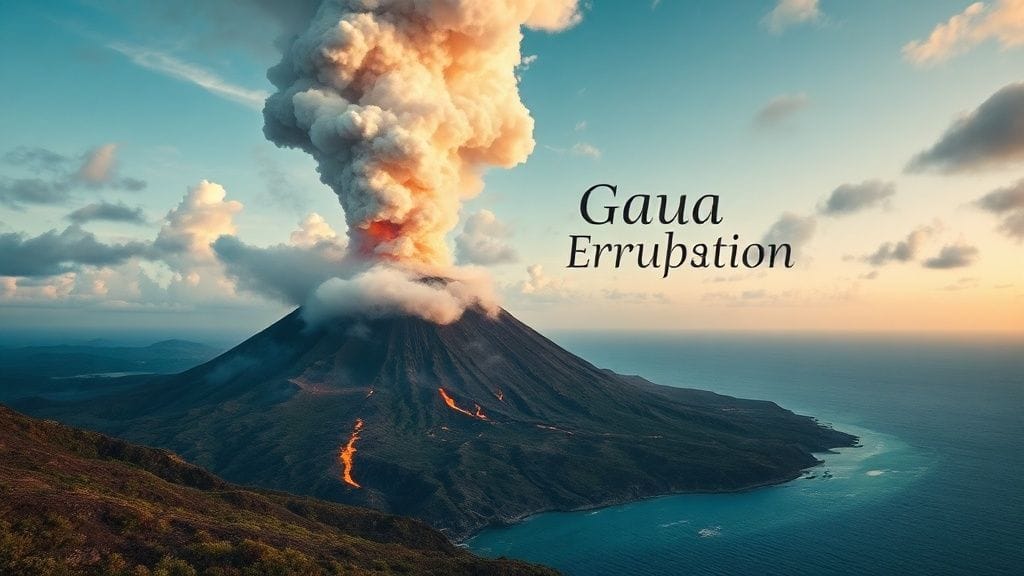
Then came the day when Mother Earth’s sleepy giant erupted in earnest. On a humid September morning, the calm shattered with a thunderous explosion that sent a towering column of dark ash and volcanic gases into the sky. The ground shook violently, thick plumes darkened the heavens, blocking sunlight, plunging the island into an eerie twilight.
Pyroclastic flows—deadly avalanches of hot gas and rock—descended along the volcano’s flanks. Ashfall blanketed the island’s villages and farmlands. For several days, intermittent explosions continued, varying in intensity, keeping the island in tense suspense.
This initial blast marked the eruption’s violent commencement but was only a prelude to the unfolding months of eruptive activity.
Flames and Ashes: The Intensity Builds Over Months
Through the following months, Gaua’s eruption oscillated unpredictably between violent blasts and quieter effusive phases, releasing lava and volcanic gases. Ash clouds from recurrent eruptions disrupted air traffic across the South Pacific, and the smoke plume reached altitudes high enough to impact regional weather.
Volcanic ash, with its fine abrasive particles, buried crops, crushed roofs under its weight, and polluted water sources across the island. Rivers became laden with sediment, and Lake Letas churned, altering aquatic life.
The sustained eruption tested the limits of local emergency services and global scientific vigilance alike.
Villages on Edge: The Human Face of the Crisis
While the geological spectacle unfolded, the island’s inhabitants bore the immediate brunt of catastrophe. Villages situated downwind faced heavy ashfall disrupting daily life—schooling halted, health issues surged with respiratory illnesses, and anxiety rose.
People evacuated, sometimes multiple times, as new warnings demanded sudden relocations. Traditional homes, crafted from local timber and leaf, were ill-suited to withstand months of volcanic assault.
Yet amid fear, the communities displayed remarkable resilience, turning to one another for support, drawing strength from ancestral traditions.
Emergency Responses: Local and International Aid
The eruption demanded swift action. Vanuatu’s government mobilized disaster response teams, evacuation centers were established, and aid distributions organized. Regional partners, including New Zealand and Australia, extended logistical and humanitarian support.
Monitoring equipment was upgraded, aerial surveys conducted, and local media kept the populace informed. International volcanological institutions coordinated with local experts to ensure preparedness and safety.
This collaboration highlighted the interconnectedness—and vulnerability—of remote island communities in the face of natural disasters.
The Role of the Volcanologists: Science Under Pressure
Scientists worked tirelessly to decode the volcano’s behavior. Seismographs, gas analyzers, and satellite imagery fed continuous streams of data. Deciphering patterns amidst chaotic signals was challenging.
Dr. Thierry Pelletier, a French volcanologist involved on site, later recalled: “Each eruption pulse was like reading a complex story in an unknown language. Our role was to interpret the signs fast enough to save lives.”
Their efforts underscored the vital human dimension behind volcanic monitoring—an interplay of knowledge, intuition, and urgent communication.
Environmental Impact: Alterations of Land and Sea
Beyond the immediate human tragedy, nature itself transformed. Fires ignited by lava flows consumed forests, altering habitats and forcing species migration. The lake’s water chemistry shifted dangerously, threatening aquatic ecosystems.
Marine life along the coast also felt the impact, as acidic ash and sediment runoff disrupted coral reefs and fish populations. Yet over time, new ecological niches began to emerge among the volcanic rubble—a quiet testament to life’s tenacity.
Cultural Resilience: Myths and Memories Among the Communities
Volcanic eruptions are not mere physical events for the Ni-Vanuatu—they are woven into their cultural fabric. The eruption of Gaua rekindled ancient myths, stories in which fire spirits, ancestral deities, and the land itself engage in perpetual struggle.
Elders gathered to recount tales of past eruptions and frame the current calamity within a spiritual cycle of destruction and renewal. This cultural lens helped communities process trauma and find meaning amid upheaval.
The Social Displacement: Refugees of Fire and Smoke
Displacement shattered routines and fractured social networks. Families bivouacked in makeshift shelters, cut off from farmlands and customary hunting grounds.
The psychological toll—stress, uncertainty, fear—was profound. Health services strove to provide not just physical aid but also emotional support, recognizing the invisible scars volcanoes leave on human souls.
Economic Shocks: Agriculture and Fisheries in Peril
Vanuatu’s economy, heavily reliant on subsistence farming and fishing, suffered a severe blow. Crops like taro, yams, and bananas were buried or contaminated. Fishing zones were affected by ash runoff and changed water quality.
Recovery demanded both ingenuity and external assistance—a long and arduous path from devastation to sustainability.
Media Coverage: The World Watches a Volcanic Drama
Coverage ranged from local radio broadcasts to international news channels. Photographers captured dramatic ash columns, and scientists featured in documentaries explaining the volcano’s behavior.
Yet Vanuatu’s remote isolation limited global attention—many beyond the Pacific remained unaware of the human stories behind the smoke and ash.
The Eruption’s Finale: Early 2010’s Diminishing Fury
By early 2010, the volcano’s activity gradually waned. Ash emissions thinned, pyroclastic flows ceased, and smoke dissipated. Residents cautiously returned to their rebuilt homes.
Analysis later showed the eruption had lasted approximately six months—an eruption moderate in scale but intense in socio-cultural and environmental impact.
Aftermath: Healing a Landscape—and a People
Months of rebuilding followed. Forests slowly regenerated; waters cleared; crops replanted. But scars remained visible on the land—and in the memories of those who survived.
Local government and international agencies worked together on resilient infrastructure development, disaster education, and economic diversification.
Scientific Insights: Lessons from Gaua’s Fury
The Gaua eruption contributed valuable data on caldera lake volcanoes and eruption forecasting. It underscored the complexity of phreatomagmatic events—where water interaction intensifies explosions—and the need for continuous monitoring.
It also inspired novel approaches combining indigenous knowledge and modern science for hazard preparedness.
Global Significance: Volcanoes as Climate Catalysts
Volcanic eruptions, even relatively moderate ones like Gaua’s, can influence regional climates through particulate emissions. Understanding these events feeds into broader discussions about atmospheric chemistry, weather patterns, and climate change.
In an era of increasing environmental fragility, Gaua stands as a reminder of Earth’s dynamic systems and humanity’s place within.
Commemorations and Folklore: The Eruption in Local Storytelling
Today, anniversaries of the eruption are marked with ceremonies blending Christian and traditional rituals, honoring both the living and the spirit world.
Stories of survival circulate, inspiring younger generations to respect and prepare for nature’s caprices.
Resilience and Reconstruction: Vanuatu’s Steadfast Spirit
The eruption tested Vanuatu’s resilience and revealed the power of community solidarity. Innovations in architecture, disaster response, and ecological management emerged.
In the wake of flames and ash, hope rooted itself deeply—rebuilding not just structures, but social bonds.
Remembering Gaua: Cultural and Historical Legacy
Gaua’s eruption remains etched in the region’s collective memory—a potent symbol of the interdependence between humans and their volatile environment.
It stands as a testament to survival, scientific endeavor, and the enduring dialogue between ancient wisdom and modern knowledge.
Conclusion
The 2009–2010 eruption of Mount Gharat on Gaua Island was more than a geological event. It was a dramatic story woven from the threads of nature’s indomitable power and humanity’s resilient spirit. The eruption tore through the landscape, disrupted lives, and challenged scientific understanding—all while reaffirming the profound bond between people and the land they inhabit.
In those months of smoke and fire, the Ni-Vanuatu people faced fear and loss but rose with courage, drawing strength both from tradition and innovation. Science raced against time to decode a living enigma, attempting to translate the language of the earth’s fiery heart. The world glimpsed the raw drama of the Ring of Fire—where creation and destruction coexist perpetually.
Ultimately, Gaua’s story is one of regeneration. Ash-encrusted fields gave way to new life; displaced communities found ways to heal; myths and memories transformed trauma into collective identity. It reminds us that the earth’s tremors, though unsettling, carry lessons of humility and hope.
To witness Gaua’s eruption is to understand a fundamental truth of human existence—the dance with nature’s forces is perpetual, and survival depends on respect, knowledge, and the courage to rebuild time and time again.
FAQs
Q1: What caused the Gaua eruption in 2009?
The eruption was triggered by the movement of magma beneath Mount Gharat, driven by tectonic activity in the Pacific Ring of Fire. Pressure built beneath the volcano’s crater lake until explosive release occurred.
Q2: How long did the eruption last?
The primary eruptive phase occurred from September 2009 through early 2010, lasting approximately six months.
Q3: What were the main dangers to local populations?
Threats included ashfall causing respiratory issues, destruction of homes and crops, pyroclastic flows, and displacement due to unsafe conditions.
Q4: How did scientists monitor the eruption?
Volcanologists used a combination of seismic monitoring, gas emission analysis, aerial surveillance, and satellite imagery to track activity and forecast risks.
Q5: What were the environmental effects of the eruption?
The eruption devastated forests, altered the chemistry of crater lake waters, polluted rivers, and impacted marine ecosystems through ash runoff.
Q6: How did the eruption affect the local economy?
Agriculture and fisheries—a lifeline for many residents—were heavily damaged, leading to food insecurity and economic hardship.
Q7: In what ways did the local culture influence the response to the eruption?
Traditional knowledge, oral histories, and spiritual beliefs helped communities interpret the event and foster resilience.
Q8: What lessons does the Gaua eruption provide for global volcanic hazard preparedness?
It highlights the importance of continuous monitoring, integrating indigenous knowledge, prompt communication, and international collaboration in managing volcanic crises.

