Table of Contents
- The Dawn of a New Era: Geneva, Summer 1954
- The Aftermath of Dien Bien Phu: France’s Defeat and the World’s Watchful Eyes
- Indochina in Turmoil: The Colonial Legacy and the Seeds of Conflict
- Key Players Gathering: Diplomats, Generals, and Revolutionaries at Geneva
- From War to Negotiation: The Road to the Geneva Conference
- The Stakes at Geneva: Ideologies, Geopolitics, and Regional Hopes
- The Opening Days: Tensions and Talks Under Swiss Skies
- Chairman Mao’s Influence and the Role of China in the Talks
- The Vietnamese Front: Ho Chi Minh’s Calculated Gambit
- The French Position: Holding onto a Fragmenting Empire
- The United States’ Ambiguous Role and the Shadow of the Cold War
- The Provisional Division of Vietnam: Drawing the Line at the 17th Parallel
- Laos and Cambodia: Their Place in the Indochinese Puzzle
- The Geneva Accords Text: Key Provisions and Their Ambiguities
- The Ceasefire: The Immediate End to Fighting or a Temporary Pause?
- Withdrawal and Repatriation: The Movement of Troops and Populations
- Refugees and Displacement: Stories of Separation and Hope
- The Failed Elections Clause: A Pact without Guarantees
- Reception and Reaction: Around Indochina, Europe, and the United States
- The Geneva Accords’ Legacy: Seeds of Future Conflict in Vietnam
- The Cold War Perspective: Global Power Struggles and the Indochinese Chessboard
- Cultural Resonance: How Geneva 1954 Echoed in Literature and Memory
- Beyond the Accord: From Geneva to the Vietnam War
- Reflections on Diplomacy: Lessons and Missed Opportunities
- The Geneva Accord Today: Understanding the Long Shadow Over Southeast Asia
The Dawn of a New Era: Geneva, Summer 1954
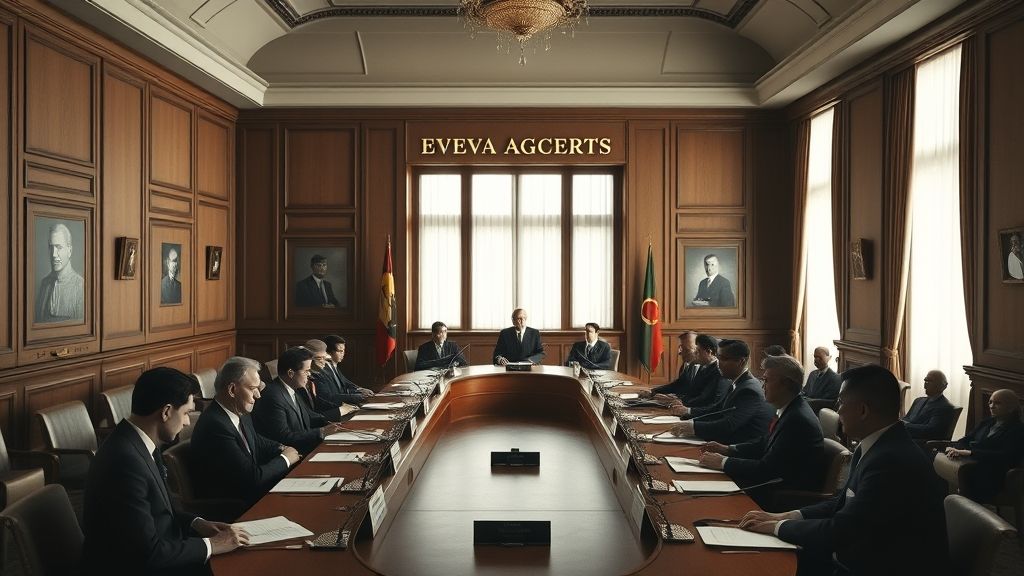
On a humid July day in 1954, the serene city of Geneva found itself at the heart of a world on edge. Delegates from warring nations, weary generals, fervent revolutionaries, and anxious diplomats gathered beneath the elegant chandeliers and stately facades not to celebrate, but to negotiate the fragile cessation of a brutal conflict. The air was thick with exhaustion and hope — hope for peace, but shadowed by uncertainty. The Geneva Accords, signed on July 21, 1954, promised to redraw not only maps but the very destinies of millions in Indochina. Yet, from the outset, the arrangement was a delicate ceasefire rather than a conclusive remedy; a complicated web of compromise born from the brutal lessons of war.
The Aftermath of Dien Bien Phu: France’s Defeat and the World’s Watchful Eyes
Just weeks prior, the French garrison at Dien Bien Phu had capitulated after seventy-seven days of siege and relentless Vietnamese artillery bombardment. That defeat was seismic — a bitter confirmation that the once-mighty French colonial empire was crumbling under the will of an indomitable nationalist surge. The world watched, riveted, as the Indochinese nationalist forces led by General Võ Nguyên Giáp turned the tide decisively against European imperialism. The collapse at Dien Bien Phu shattered French confidence and forced the international community to reckon with the reality of a conflict that no longer seemed containable by violence alone.
Indochina in Turmoil: The Colonial Legacy and the Seeds of Conflict
The roots of the Geneva Accords dig deep into the tangled history of French colonialism in Southeast Asia. Indochina—comprising Vietnam, Laos, and Cambodia—had been a prized possession since the late nineteenth century. Yet, beneath the surface of colonial administration simmered discontent, nationalism, and increasingly organized resistance. The Japanese occupation during World War II had destabilized the region further, and in the immediate postwar years, Viet Minh guerrillas under Ho Chi Minh ignited a fierce struggle for independence. The First Indochina War, raging since 1946, was the backdrop against which the peace talks unfolded — a brutal contest between colonial powers and revolutionary movements shaped by Cold War dynamics.
Key Players Gathering: Diplomats, Generals, and Revolutionaries at Geneva
The Geneva Conference attracted a cast of towering personalities and diverse representatives: from the hard-nosed French delegation struggling to preserve influence, to Ho Chi Minh and his Viet Minh comrades asserting Vietnamese sovereignty; alongside Britain, the Soviet Union, the People’s Republic of China, and the newly independent nations of Indochina. Despite the diversity of interests and antagonisms, all were bound by the common urgency to halt the bloodshed. The Swiss authorities played a quiet but influential role, providing a neutral venue for some of the most challenging Cold War-era negotiations.
From War to Negotiation: The Road to the Geneva Conference
The journey to Geneva had been arduous. Years of brutal combat had drained resources and morale on all sides. Both France and the Viet Minh understood that prolonged conflict would only exacerbate losses. International pressure, especially from the United States and the Soviet bloc, heightened the stakes, transforming a regional war into a proxy theater of global tensions. The conference was conceived as a last-ditch diplomatic effort to broker peace, though deep mistrust and divergent objectives complicated the proceedings.
The Stakes at Geneva: Ideologies, Geopolitics, and Regional Hopes
The Geneva Conference was no mere regional dialogue; it was a microcosm of Cold War rivalries. Western powers feared the spread of communism in Southeast Asia, while the communist bloc sought to support national liberation movements without provoking direct superpower confrontation. For Indochinese leaders, the conference represented a chance to assert autonomy and shape their countries’ futures. The diplomatic dance unfolded amid these competing imperatives, illustrating the complexity of peace-making in a polarized world.
The Opening Days: Tensions and Talks Under Swiss Skies
Negotiations began under a cloud of suspicion. Initial talks were marred by conflicting demands and the sheer difficulty of reconciling irreconcilable visions. The French pressed for a framework that would protect remaining colonial interests; the Viet Minh demanded complete independence and the withdrawal of foreign forces. The Soviet and Chinese delegations balanced support for the Viet Minh with pragmatic concerns about regional stability. Behind closed doors, intense discussions ensued, with moments of both civility and stark confrontation.
Chairman Mao’s Influence and the Role of China in the Talks
China, freshly unified under communist rule, emerged as a key player at Geneva. Chairman Mao Zedong’s intervention was cautious yet pivotal. Beijing sought to support the Vietnamese revolutionaries but was wary of triggering wider conflict with the West. Mao’s nuanced diplomatic posture reflected a desire to consolidate communist gains in Asia without overextending China's resources or antagonizing superpowers. This balancing act influenced the conference’s outcomes, particularly regarding the division of Vietnam and the stipulations on neutrality for Laos and Cambodia.
The Vietnamese Front: Ho Chi Minh’s Calculated Gambit
Ho Chi Minh proved a skilled negotiator and symbol of nationalist aspirations. Though militarily victorious, he faced the challenge of transforming battlefield gains into political legitimacy. Ho’s acceptance of the temporary division of Vietnam at the 17th parallel was a pragmatic concession, designed to buy time and international recognition. Behind this compromise lay a vision: eventual reunification under communist leadership, contingent on the promised elections that the Accords called for but that would later become a source of bitter contention.
The French Position: Holding onto a Fragmenting Empire
On the opposite side, the French delegation fought to salvage diminishing authority. After years of draining conflict and rising domestic opposition back home, France was increasingly unable or unwilling to maintain its Indochinese empire. Yet, negotiators sought guarantees for French nationals and settlers, and a semblance of influence through alliances in Laos and Cambodia. The humiliating military defeat at Dien Bien Phu weakened France’s bargaining power but toughened their resolve to secure at least an honorable exit.
The United States’ Ambiguous Role and the Shadow of the Cold War
Though the United States did not sign the Accords, it played a critical role behind the scenes. Washington was intent on preventing communist expansion but was reluctant to become directly involved in what was initially framed as a colonial conflict. American policymakers endorsed French efforts initially yet grew wary of Paris’s waning control. The failure of the Accords to guarantee elections or prevent the split of Vietnam laid the groundwork for deeper U.S. engagement that would culminate in the Vietnam War.
The Provisional Division of Vietnam: Drawing the Line at the 17th Parallel
Perhaps the most enduring and contentious outcome of the Geneva Accords was the temporary division of Vietnam along the 17th parallel. This demarcation, established not by a natural boundary but by negotiation, created a North Vietnam led by Ho Chi Minh’s communist government and a South Vietnam under a non-communist regime. Intended as an interim measure pending national elections within two years, this geopolitical fracture would become a fault line that shaped the region’s destiny for decades.
Laos and Cambodia: Their Place in the Indochinese Puzzle
Laos and Cambodia, often overshadowed in narratives focused on Vietnam, gained formal recognition of independence during the Geneva talks, with guarantees of their neutrality. These smaller nations faced complex internal dynamics but were granted a delicate international status. Their inclusion in the accords underscored the intertwined fates of the Indochinese countries and foreshadowed future upheavals as Cold War rivalries extended into their borders.
The Geneva Accords Text: Key Provisions and Their Ambiguities
The text of the Geneva Accords reflected the compromises and contradictions of the conference. It called for ceasefire agreements, troop withdrawals, the prohibition of foreign military bases, and promises of elections in Vietnam. However, many clauses were deliberately vague or unenforceable, leaving ample room for divergent interpretations. These ambiguities would haunt the region, fueling tensions and undermining the prospect of durable peace.
The Ceasefire: The Immediate End to Fighting or a Temporary Pause?
The ceasefire agreement was a welcome halt to open warfare, but for many, it felt more like a fragile truce than a lasting peace. Front lines solidified, but insurgent and counterinsurgent activities did not cease entirely. The lack of mechanisms to enforce compliance or to monitor elections meant that the Accords’ spirit was vulnerable to unraveling under political and military pressure.
Withdrawal and Repatriation: The Movement of Troops and Populations
One of the most human aspects of the Accords was the massive movement of troops and civilians. French forces withdrew progressively northwards, while Viet Minh forces consolidated their control in the north. More than a million Vietnamese, many Catholics and anti-communists, migrated from North to South Vietnam, often through perilous journeys. These population shifts created immense personal and social upheaval, splitting families and communities along ideological lines.
Refugees and Displacement: Stories of Separation and Hope
The refugee flow out of Northern Vietnam embodied both tragedy and hope. Families uprooted themselves fleeing potential persecution or seeking political freedom, while others faced the trauma of forced abandonment of their homes. These narratives of displacement reveal the intimate human cost behind the high politics of Geneva—a cost that would resonate through generations.
The Failed Elections Clause: A Pact without Guarantees
Arguably the most controversial aspect of the Geneva Accords was the provision calling for free general elections in July 1956 to reunify Vietnam. These elections were never held. The U.S.-backed government in the South refused to participate, fearing a Ho Chi Minh victory. This breach laid bare the limits of the diplomatic agreement, transforming what was meant to be a temporary division into a permanent schism, and setting the stage for a new, far deadlier phase of conflict.
Reception and Reaction: Around Indochina, Europe, and the United States
Reactions to the Geneva Accords were as varied as the signatories. In Indochina, reactions ranged from cautious optimism to resigned skepticism. Many Vietnamese saw the Accords as a victory tempered by concessions. In France, the treaty deepened political divisions and accelerated decolonization. The United States publicly supported the terms but secretly prepared to bolster anti-communist regimes. Globally, the accords were hailed as a diplomatic achievement but recognized as a fragile compromise.
The Geneva Accords’ Legacy: Seeds of Future Conflict in Vietnam
The Accords represented both an end and a beginning. They ended French colonial war but planted seeds for the Vietnam War that would engulf the region for two more decades. By failing to create enforceable guarantees of peace and political unity, the Accords created conditions for escalating strife between North and South Vietnam, eventually drawing in superpower confrontation and unparalleled human tragedy.
The Cold War Perspective: Global Power Struggles and the Indochinese Chessboard
Viewed through the Cold War lens, the Geneva Accords were a chess move in a grand game. Neither the West nor the communist bloc achieved a decisive victory, and both saw the accords as a temporary measure. Indochina became an arena where ideological conflicts played out with profound local consequences. Geneva exemplified the cold diplomacy of a divided world, where compromise was often a cover for continued rivalry.
Cultural Resonance: How Geneva 1954 Echoed in Literature and Memory
Beyond politics, the Geneva Accords seeped into cultural consciousness. Writers, journalists, and artists grappled with the human stories behind the headlines—displacement, identity, and the fractured dreams of nationhood. The 1954 events entered global memory as a symbol of decolonization’s tumult and the limits of international diplomacy.
Beyond the Accord: From Geneva to the Vietnam War
Despite its intentions, the Geneva Accords did not prevent further violence. By the late 1950s, guerrilla warfare intensified in South Vietnam, and American involvement escalated. Geneva was both a hopeful pause and a prelude to a much larger conflagration — one whose scars and lessons continue to challenge historians and policymakers alike.
Reflections on Diplomacy: Lessons and Missed Opportunities
In hindsight, the Geneva Conference reveals the paradoxes of Cold War diplomacy: the desire for peace constrained by ideological inflexibility, misunderstandings, and competing national goals. It was a juncture rich in possibility yet hamstrung by realpolitik. Understanding these dynamics offers valuable insights into both the nature of conflict resolution and its perennial challenges.
The Geneva Accord Today: Understanding the Long Shadow Over Southeast Asia
More than half a century later, the Geneva Accords remain a touchstone for Southeast Asian history and international relations. They evoke the complexities of decolonization, the persistent burdens of division, and the ongoing struggle for sovereignty and stability. To study Geneva 1954 is to confront the intertwined legacies of empire, ideology, and human resilience.
Conclusion
The Geneva Accords of 1954 stand as a monumental yet ambiguous waypoint in the turbulent history of Indochina and the Cold War. Marked by hopes of peace and fraught with compromises, they ended a brutal colonial war but failed to create lasting stability. The temporary division of Vietnam and the unfulfilled promises of elections became the fault lines of future conflict — a tragic irony born from well-meaning but flawed diplomacy.
Yet, amid the struggle and disappointment, the Accords also bore witness to an epochal shift: the waning of European colonial empires, the awakening of nationalist aspirations, and the reshaping of global power dynamics. Through the stories of soldiers, diplomats, refugees, and civilians, the Geneva Conference reminds us that history is not merely the chronicle of events, but the complex tapestry of human courage and fragility.
To reflect on Geneva 1954 today is to understand that peace is not simply the absence of war, but a continuous, demanding process — requiring vision, trust, and the persistent commitment of all those it seeks to serve.
FAQs
1. What were the primary causes leading to the Geneva Accords on Indochina?
The Geneva Accords resulted mainly from the prolonged First Indochina War, colonial resistance against French rule, and the decisive Viet Minh victory at Dien Bien Phu in 1954. The broader context of Cold War tensions and international pressure also compelled the parties to seek diplomatic resolution.
2. Who were the key figures involved in the Geneva Conference?
Prominent figures included Ho Chi Minh representing the Viet Minh, French Prime Minister Pierre Mendès France’s delegation, Soviet diplomat Andrei Gromyko, Chinese Premier Zhou Enlai, and representatives from Laos and Cambodia. The United States was involved indirectly, not as a signatory but as a key spectator and influencer.
3. Why was Vietnam temporarily divided at the 17th parallel?
Vietnam was divided to create a ceasefire line separating communist-controlled North Vietnam from non-communist South Vietnam, intended as a temporary measure pending nationwide elections that were never held.
4. What were the main provisions of the Geneva Accords?
Ceasefire agreements, troop withdrawals of foreign forces, recognition of independence for Laos and Cambodia, prohibition of foreign military bases, and the promise of general elections in Vietnam within two years were central provisions.
5. Why did the Geneva Accords fail to bring lasting peace?
Ambiguous clauses, lack of enforcement mechanisms, refusal of the South Vietnamese government to hold elections, and escalating Cold War tensions undermined the Accords. This led to renewed conflict and eventually the Vietnam War.
6. How did the Geneva Accords influence Cold War geopolitics?
The Accords exemplified Cold War diplomacy — balancing power without direct conflict. They were a strategic pause in ideological rivalry but set the stage for deeper American involvement and global polarization.
7. What impact did the Accords have on the populations of Indochina?
Massive displacements, refugee crises, and social upheaval ensued, with millions uprooted from their homes, many migrating southward to escape political persecution or align with new regimes.
8. Are the Geneva Accords still relevant today?
Yes, as a historical lesson on decolonization, Cold War diplomacy, and conflict resolution, the Geneva Accords continue to inform contemporary understanding of Southeast Asia’s geopolitical landscape.