Table of Contents
- The Quiet Prelude: Geneva in the Roaring Twenties
- The Shadow of the Great War: Memories That Haunt
- Rising Fears and the Chemical Menace
- The League of Nations and the Quest for Peace
- Early Attempts to Regulate Chemical Weapons
- The Diplomatic Storm: Negotiating the Geneva Protocol
- A Conclave of Nations: The Assembly in June 1925
- Signing the Geneva Protocol: A Historic Moment of Hope
- The Words on Paper: Understanding the Protocol’s Provisions
- Immediate Global Reactions: Celebrations and Skepticism
- The Protocol’s Fragility: Exemptions and Loopholes
- Chemical Warfare in Later Conflicts: A Bitter Reality
- The Influence on International Law and Warfare
- Human Stories: Victims and Survivors in the Aftermath
- The Legacy of the Geneva Protocol in the 20th Century
- Reflections on Modern Chemical Weapons Treaties
- From Geneva 1925 to Today: Continuity and Change
- The Cultural Imprint: Literature, Art, and Memory
- Challenges to Enforcement: Political and Ethical Dilemmas
- The Geneva Protocol in Contemporary Discourse
- Conclusion: The Enduring Quest to Banish Chemical War
- FAQs: Clarifying the Geneva Protocol and Its Impact
- External Resource
- Internal Link
In the early summer of 1925, the city of Geneva stood as a somber stage for one of the twentieth century’s most earnest endeavors: the signing of the Geneva Protocol. This was no mere diplomatic formality, but an urgent, collective response to the unspeakable horrors unleashed barely a decade earlier on the battlefields of World War I. As the world still recoiled from the sight of creeping waves of lethal gas, bitter memories fueled a desperate hope: to ban the use of chemical and biological weapons in all future wars.
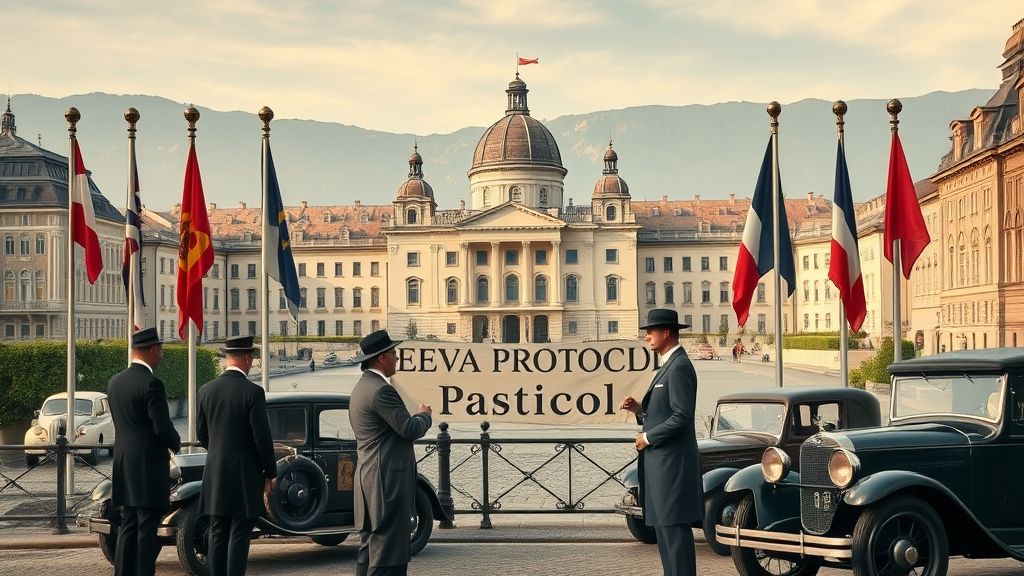
The atmosphere that day was thick with a mix of solemnity and cautious optimism. Delegates from around the globe gathered in the ornate building of the League of Nations, their faces etched with experiences both personal and political. The air beyond the windows of the Palais des Nations was filled with the whisper of history in the making—though few truly grasped then how fragile and imperfect this treaty would turn out to be.
Yet this moment was far from sudden. It was the culmination of years of mounting dread, scientific anxieties, political inertia, and moral awakenings. The Geneva Protocol was not simply about banning gas and bacteria: it was a reflection of humanity’s desperate yearning to impose reason upon the chaos of war. It was an emblematic act that, despite its future flaws and failures, marked an enduring commitment to international law and the protection of human dignity.
The Quiet Prelude: Geneva in the Roaring Twenties
The world of 1925 was paradoxical. On one hand, cities buzzed with jazz rhythms, technological marvels like the automobile and radio reshaped daily life, and optimism seemed oncerebounding from the ashes of war. On the other, the scars left by the First World War—and its gruesome chemical innovations—were slow to heal. Geneva, nestled among the serene waters of Lake Geneva and shadowed by the Alps, had become a symbol of international diplomacy as the home of the League of Nations.
The city’s tranquil streets belied the weighty discussions inside its diplomatic halls. It was here that nations wrestled with the unprecedented challenge of restraining future bloodshed. The memory of mustard gas and phosgene—noxious, invisible enemies lingering over trenches—was etched indelibly into public consciousness. For many, Geneva was the last hope.
The Shadow of the Great War: Memories That Haunt
World War I had shattered the old notions of warfare. No longer confined to bayonets and cannonballs, the conflict introduced industrial-scale slaughter facilitated by machine guns, artillery barrages, and critically, chemical agents. The first large-scale deployment of poisonous gases—chlorine at Ypres in 1915—had ushered in a terrifying new reality.
Soldiers spoke hauntingly of the choking, burning sensation that overtook them, of comrades who died agonizingly after mere minutes in the toxic mists. Civilians too were not spared, as wind shifts carried gas clouds beyond battlefields. The collective trauma resonated deeply. Many were determined that such horror would never be repeated.
Rising Fears and the Chemical Menace
In the aftermath, scientists and strategists warned that future wars might escalate the use of chemical and biological arms. The rapid advancements in chemistry, microbiology, and industrial manufacturing meant that developing more potent agents was a tangible possibility. This dark prospect spurred many to advocate for treaties to pre-empt the use of such weapons.
Public opinion, too, galvanized around this cause. Newspapers recounted the episodes of gas attacks with horror; humanitarian organizations pressed governments for action. Yet, while the fear was widespread, political will was often tentative—war-making nations calculated benefits and risks, reluctant to relinquish a potentially decisive tactical edge.
The League of Nations and the Quest for Peace
Founded in 1920, the League of Nations was a bold experiment in international governance. Its principal mission was to prevent another global conflict through collective security and dialogue. The League’s early years were marked by struggles to enforce peace, address territorial disputes, and codify humanitarian standards.
The question of chemical weapons became an urgent priority on the League’s agenda. It was clear that preventing future gas attacks was both a moral imperative and a pragmatic necessity. Several League bodies studied disarmament efforts, and proposals for an international ban surfaced regularly—though agreement was slow and difficult.
Early Attempts to Regulate Chemical Weapons
Before the Geneva Protocol, there had been some tentative steps towards prohibiting chemical arms. The Hague Conventions of 1899 and 1907 contained provisions aimed against “poison or poisoned weapons,” but these were vague and unenforced, insufficient to stem the tide of gas warfare later.
After the Great War, nations attempted bilateral agreements and drafts, but a binding multilateral treaty remained elusive. Disagreements about verification, exceptions, and retaliation hindered progress. Some feared that outright bans would be meaningless if not all powers complied, or that countries might conceal production while appearing to conform.
The Diplomatic Storm: Negotiating the Geneva Protocol
Negotiations leading to the Geneva Protocol in 1925 were intense and fraught with mistrust. Major powers such as Britain, France, Germany, Japan, and the United States (which never ratified the Protocol) approached the talks with conflicting priorities.
The Soviet Union insisted on stricter clauses, recalling its experiences during the Civil War, while smaller states were caught between the demands of power politics and humanitarian concerns. The specter of future conflict—already simmering as ideological and imperial tensions rose—pushed delegates toward compromise yet caution.
A Conclave of Nations: The Assembly in June 1925
On June 17, 1925, representatives from over 50 nations gathered in Geneva. The Assembly of the League of Nations convened against a backdrop of unease: the Balkans remained volatile, nationalist movements surged, and the memory of recent bloodshed hung heavy.
Amid hushed anticipation, the Protocol was presented. Its text forbade the “use in war of asphyxiating, poisonous or other gases, and of all analogous liquids, materials or devices” along with “bacteriological methods of warfare.” For many, this represented an unprecedented step—a solemn pact to contain mankind’s capacity for self-destruction.
Signing the Geneva Protocol: A Historic Moment of Hope
The act of signing was laden with symbolism. Delegates affixed their signatures under the gaze of military officers and observers, hopeful but sober. It was a testament not only to legal progress but to the shared horror of past suffering. Yet, observers noted the ironic absence of some powers and the ambiguous wording that left room for interpretation.
Still, large headlines across newspapers hailed the event as a milestone. Editorials reflected a yearning for peace and reason, even if tempered by wartime cynicism.
The Words on Paper: Understanding the Protocol’s Provisions
While concise, the Protocol’s text was impactful. It prohibited the use, but notably not the production or stockpiling, of chemical and biological weapons. Additionally, it did not prohibit the threat of their use or their use against non-signatories. These loopholes would have significant implications.
The treaty obligated signatories to abstain from employing such weapons in warfare but lacked enforcement mechanisms. It relied heavily on mutual trust and international pressure—an experiment in norms rather than a strict legal code.
Immediate Global Reactions: Celebrations and Skepticism
Reactions were mixed. Peace advocates and many governments celebrated the Protocol’s promise to prevent chemical carnage. The public, scarred by war stories, largely welcomed it.
Conversely, some military leaders criticized it as idealistic or naive, doubting that future conflicts would respect the ban. The absence of key states such as the United States and the Soviet Union stoked fears about its practical efficacy. The chemical industry itself reacted cautiously, aware that restrictions could hamper a growing sector.
The Protocol’s Fragility: Exemptions and Loopholes
In practice, the Geneva Protocol proved fragile. It did not stop nations from developing or stockpiling chemical arms, nor from threatening their use as deterrence. Certain countries reserved rights to respond in kind if attacked.
Moreover, the Protocol did not ban the use of chemical weapons in retaliation nor did it extend protections to internal conflicts or colonial wars. These gaps allowed its spirit to be compromised repeatedly in the coming decades.
Chemical Warfare in Later Conflicts: A Bitter Reality
Despite the Protocol, chemical weapons re-emerged in conflicts throughout the 20th century. Most notoriously, during the Second Italo-Ethiopian War in 1935–1936, Italy deployed mustard gas with devastating impact. During World War II, fears of chemical warfare were high, but limited actual use on battlefields.
The Cold War further complicated matters, as both NATO and the Warsaw Pact amassed huge chemical stockpiles. The Geneva Protocol’s lack of enforcement mechanisms became painfully evident.
The Influence on International Law and Warfare
Nevertheless, the Protocol laid the groundwork for future treaties. It established chemical and biological weapons as legitimate objects of international prohibition, influencing the 1972 Biological Weapons Convention and the 1993 Chemical Weapons Convention—both much stronger and more comprehensive.
Its normative force created a baseline expectation that such weapons are abhorrent, shaping military doctrine and public attitudes.
Human Stories: Victims and Survivors in the Aftermath
Behind legal texts were human faces. Soldiers blinded or burned by gas, civilians choking from airborne toxins—these testimonies fueled campaigns for prohibition. Memoirs and reports from mustard gas survivors provided visceral reminders of war’s inhumanity, imbuing treaties with an emotional urgency.
Humanitarian organizations, like the Red Cross, used such narratives to press for implementation and awareness, anchoring international law in lived experience.
The Legacy of the Geneva Protocol in the 20th Century
Over the decades, the Protocol endured as a symbol—often imperfect but always pivotal—in the long struggle against chemical warfare. It was a legal cornerstone, a moral beacon, and a rallying point for activists and diplomats.
Its influence ebbed and flowed with the tides of global politics, but its core message remained relevant: some weapons are so cruel and indiscriminate that their use undermines the very concept of civilized warfare.
Reflections on Modern Chemical Weapons Treaties
Modern agreements build upon the 1925 legacy, with stricter verification protocols and broader prohibitions. The Chemical Weapons Convention, entering force in 1997, established an unprecedented system of inspections and destruction mandates, transforming ideals into enforceable practice.
Yet challenges persist—rogue states, terrorist groups, and scientific advances continue to threaten this fragile domain.
From Geneva 1925 to Today: Continuity and Change
Tracing the journey from the Geneva Protocol’s hopeful signing to contemporary realities reveals a complex interplay of progress and setbacks. It highlights how international law adapts with geopolitical shifts and evolving technologies, yet remains anchored by foundational principles formed nearly a century ago.
This legacy is a testament to the enduring human effort to restrain our worst impulses.
The Cultural Imprint: Literature, Art, and Memory
The Protocol—and the horrors it sought to ban—have permeated culture. Literature, film, and art have evoked the surreal terror of chemical warfare, ensuring that memories of suffering remain alive. Poetry and novels from the interwar period forward often grapple with the trauma, reflecting society’s unresolved tensions.
Museums and memorials also preserve this heritage, reminding future generations of the price of peace.
Challenges to Enforcement: Political and Ethical Dilemmas
Even now, enforcing bans on chemical weapons is riddled with complexity. Verification is difficult; the dual-use nature of chemicals complicates detection; political interests often impede sanctioning violators.
Ethical debates persist around deterrence, retaliation, and humanitarian intervention, echoing the dilemmas faced by Geneva’s delegates in 1925.
The Geneva Protocol in Contemporary Discourse
Today, the Protocol surfaces in discussions around outbreaks of chemical attacks in Syria and elsewhere. It serves as both a legal reference and a moral compass, invoked by diplomats and activists alike.
While overshadowed by later treaties, it remains a foundational milestone in the ongoing battle to humanize warfare.
Conclusion
The signing of the Geneva Protocol on June 17, 1925, was a moment of profound hope etched amidst the tremors of a recovering world. It represented a collective vow—imperfect yet sincere—to shield humanity from the ghastly specter of chemical and biological warfare. Though marred by gaps and later violations, this treaty cast a long shadow over the 20th century and shaped the evolving fabric of international law.
Beyond legal jargon, the Protocol captures an essential truth: progress in human affairs is seldom linear, but always propelled by the courage to confront horrors and aspire to a better, more humane future. Its story is a poignant reminder of the price of peace and the enduring responsibility borne by nations to protect life and dignity even in times of conflict.
The Geneva Protocol remains a testament to the power of conscience, diplomacy, and the relentless pursuit of a world where weapons of mass suffering have no place.
FAQs
1. What prompted the creation of the Geneva Protocol in 1925?
Terrified by the unprecedented use of chemical weapons in World War I and fearing their escalation, the international community sought to prohibit such weapons to avoid repeating the horrors.
2. Which weapons did the Protocol seek to ban?
It banned the use of asphyxiating, poisonous gases and bacteriological methods of warfare—essentially chemical and biological weapons.
3. Did all major nations sign the Protocol immediately?
No. While many signed, key powers like the United States initially refused to ratify it, and others reserved rights to retaliate, limiting its universal effectiveness.
4. Was the Protocol successful in preventing the use of chemical weapons?
The Protocol had limited success. Chemical weapons were used in subsequent conflicts despite the ban, due in large part to loopholes and lack of enforcement mechanisms.
5. How did the Geneva Protocol influence later treaties?
It laid foundational legal and moral precedents that influenced stronger treaties like the 1972 Biological Weapons Convention and the 1993 Chemical Weapons Convention.
6. What are the main limitations of the Geneva Protocol?
It did not ban production or stockpiling of such weapons, lacked verification or enforcement procedures, and allowed for retaliation, which weakened its ultimate efficacy.
7. How is the Protocol regarded today?
Though overshadowed by later treaties, it remains a key landmark in international arms control history and continues to underpin modern discourse on chemical weapons prohibition.
8. Can the Protocol be seen as a turning point in humanitarian law?
Yes, it marks an early and significant international attempt to humanize warfare by restricting weapons causing indiscriminate suffering.