Table of Contents
- Introduction
- The Birth of Temüjin
- Tribal Mongolia in the 12th Century
- Family Tragedies and Survival
- Early Leadership and Alliances
- Becoming Genghis Khan
- Uniting the Mongol Tribes
- Military Genius and Innovations
- Campaigns of Conquest
- Impact on Asia and Europe
- Legacy and Death
- Historical Myths and Reality
- Genghis Khan’s Descendants
- Conclusion
- External Resource
- Internal Link
1. Introduction
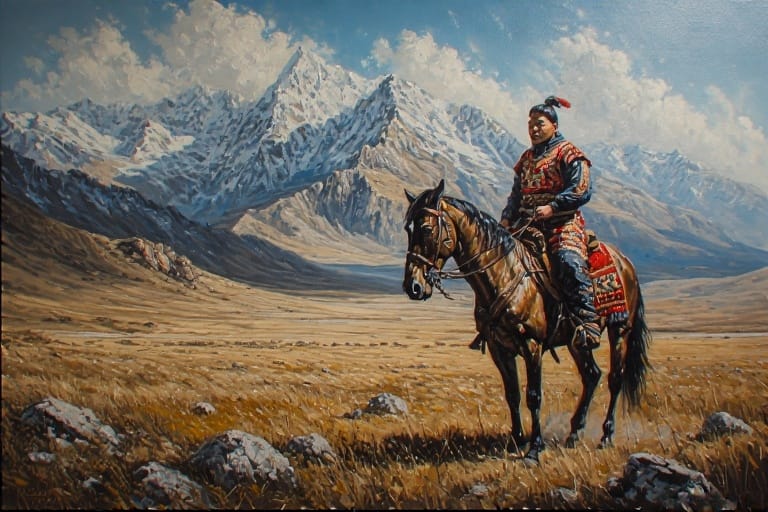
Genghis Khan—born Temüjin in 1162, near the Khentii Mountains in Mongolia—was not predestined for greatness. Yet, through cunning strategy, charisma, and sheer determination, he forged the Mongol Empire, which at its peak stretched from the Pacific Ocean to the heart of Europe. His legacy is both revered and reviled, but his impact on history is undeniable.
2. The Birth of Temüjin
Temüjin was born into the Boran tribe, part of the Mongol confederation. His exact birthdate is uncertain, but May 31, 1162, is often cited symbolically. His father, Yesügei, was a tribal chief who named his son after a Tatar chieftain he had just defeated in battle.
From the beginning, Temüjin’s life was marked by violence and shifting tribal loyalties—elements that would later define his leadership.
3. Tribal Mongolia in the 12th Century
At the time of Temüjin’s birth, Mongolia was divided into dozens of rival tribes, constantly feuding over land, resources, and honor. Loyalties were fickle, and survival depended on one’s strength and alliances. Central authority was almost nonexistent, and warlords ruled their domains with brute force.
In this chaotic world, the idea of unification seemed impossible—until Temüjin.
4. Family Tragedies and Survival
When Temüjin was around nine, his father was poisoned by the Tatars, leaving the family vulnerable. The tribe abandoned his mother Hoelun and her children, forcing them to fend for themselves in the harsh steppes.
Temüjin learned hardship early—hunting rodents for food, defending his family from rivals, and even being imprisoned by enemies. These formative years taught him resilience, cunning, and the importance of loyalty.
5. Early Leadership and Alliances
Temüjin’s first significant alliance was with Toghrul, the khan of the Kerait tribe, and later with his blood brother Jamukha. These alliances would both aid and challenge him as power dynamics shifted. Jamukha eventually turned against Temüjin, and their rivalry became a defining story of Mongol politics.
Despite setbacks, Temüjin showed an uncanny ability to adapt, build support, and use both marriage and merit to consolidate power.
6. Becoming Genghis Khan
In 1206, after years of warfare, victories, and diplomacy, a council of Mongol tribes (a kurultai) declared Temüjin as Genghis Khan, meaning “universal ruler.” This moment marked the birth of the Mongol Empire.
He had accomplished what no one before him had: uniting the Mongol tribes under one leader. From here, he would look outward.
7. Uniting the Mongol Tribes
Genghis Khan reorganized Mongol society into military units rather than tribes, effectively ending tribal divisions. He implemented a meritocratic system, promoting warriors based on loyalty and skill, not noble birth.
He also introduced a law code—the Yassa—to maintain discipline and order across his growing domain. It emphasized honor, loyalty, and harsh punishment for betrayal.
8. Military Genius and Innovations
The Mongol military under Genghis Khan was a well-oiled machine. They used composite bows, horseback archery, feigned retreats, and psychological warfare to crush enemies. They also utilized messenger relay stations for swift communication across vast distances.
Their adaptability—adopting siege weapons from the Chinese and engineers from conquered cities—made them nearly unstoppable.
9. Campaigns of Conquest
Genghis Khan’s conquests began with northern China, targeting the Xia and Jin dynasties, then moved west toward Central Asia, including the Khwarezmian Empire. His campaign against Khwarezm was brutal and methodical, prompted by the execution of Mongol envoys.
He conquered cities like Samarkand, Bukhara, and laid waste to empires that had once seemed untouchable. His methods were ruthless, but often spared those who surrendered early or offered tribute.
10. Impact on Asia and Europe
The Mongol conquests devastated populations, but also opened up the Silk Road, enabling trade, cultural exchange, and communication between East and West. Technologies, ideas, and even diseases (like the plague) spread more rapidly under Mongol control.
Many later rulers, including Tamerlane, the Mughals, and even Napoleon, studied Genghis Khan’s campaigns as models of strategic brilliance.
11. Legacy and Death
Genghis Khan died in 1227, likely from injuries sustained in a fall from a horse, though legends suggest more dramatic causes. His burial site remains unknown, adding to the mystique. His empire was divided among his sons, who continued his expansion—most notably Kublai Khan, who founded the Yuan Dynasty in China.
Genghis Khan’s legacy in Mongolia is that of a national hero, and his image appears on currency, statues, and schools. In the West, he is often remembered for his brutality, yet historians increasingly recognize his diplomatic skill, administrative innovation, and cultural impact.
12. Historical Myths and Reality
Popular culture often portrays Genghis Khan as a bloodthirsty barbarian. While it’s true his campaigns were often marked by extreme violence, he also implemented laws to protect religious freedom, supported trade, and respected scholars.
He created a postal system, encouraged multicultural governance, and even recruited administrators from Persia, China, and beyond.
13. Genghis Khan’s Descendants
His descendants, known as the Golden Lineage, ruled over parts of Asia for centuries. The Ilkhanate, Chagatai Khanate, Golden Horde, and Yuan Dynasty were all offshoots of his empire.
Modern genetic studies suggest that millions of men across Eurasia share a Y-chromosome lineage tracing back to Genghis Khan—a testament to his reach and legacy.
14. Conclusion
Genghis Khan’s rise from an orphaned outcast in the Khentii Mountains to master of the known world is a story unmatched in history. He changed the political, economic, and cultural map of Eurasia and left behind a legacy that still shapes global history.
From terror to tolerance, destruction to connection, his reign exemplifies the duality of power—and reminds us that sometimes, history’s greatest figures are also its most complex.