Table of Contents
- A City Silenced: The Dawn of Occupation
- Europe on the Brink: The Backdrop to March 1939
- The Czechoslovak Crisis: Between Betrayal and Defiance
- The Munich Agreement’s Shadow: Seeds of Submission
- Hitler’s Strategic Advance: The Road to Prague
- March 15, 1939: The Day Prague Stood Still
- The Wehrmacht’s Silent March: From Liberty to Chains
- President Beneš’s Resignation: A Nation Leaderless
- The Establishment of the Protectorate of Bohemia and Moravia
- Daily Life under Nazi Rule: Fear’s Invisible Grip
- The Resistance Flickers: Courage in the Face of Oppression
- The Cultural Cleansing: Suppression of Czech Identity
- The Nazi Administration: Orders, Laws, and Oppression
- The Impact on Jewish Citizens: The Beginning of a Darker Chapter
- International Reactions: Ambivalence and Inertia
- Economic Transformation under Occupation
- The Role of the German Minority in Prague
- Underground Networks: The Lifeline of Hope
- Prague’s Intellectual Scene Silenced but Unbroken
- Wartime Prague: From Occupation to Liberation
- Aftermath and Memory: The Long Shadow of 1939
- Legacy of Occupation: Lessons for Europe and the World
- Conclusion: The Resilience of a City and Its People
- FAQs: Understanding the German Occupation of Prague
- External Resource
- Internal Link
1. A City Silenced: The Dawn of Occupation
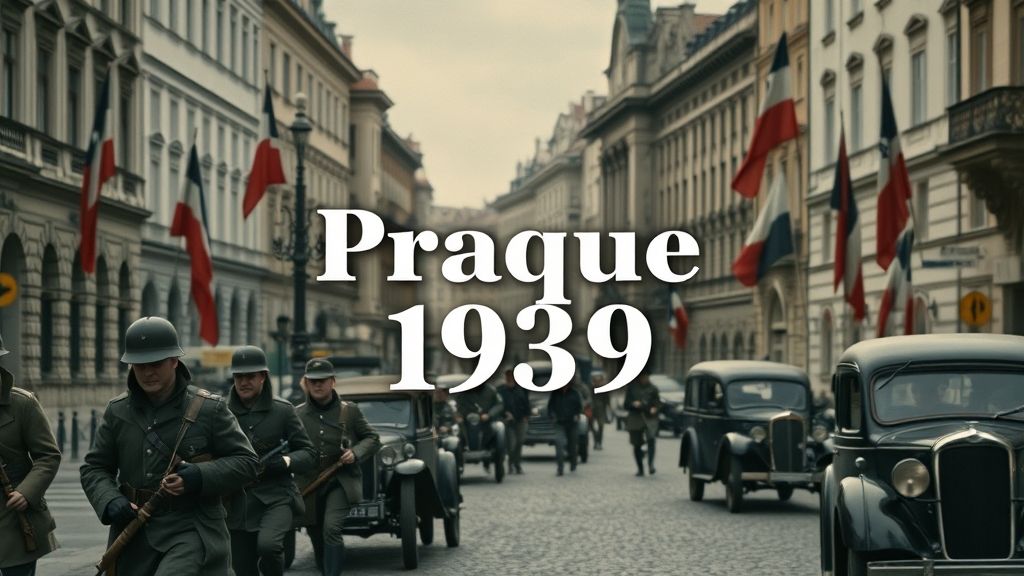
On March 15, 1939, under an ominous sky awash with whispers of war and betrayal, Prague, the storied capital of Czechoslovakia, awoke to a reality it had hoped to avoid. The cobbled streets, once echoing with the laughter of college students and the clatter of horse-drawn carriages, now held a heavy silence. German tanks rumbled without resistance through Wenceslas Square. Soldiers in iron-gray uniforms marched briskly past narrow alleys, their shadows swallowing centuries of freedom and culture. The draped banners bore the stark swastika; a symbol not just of occupation, but of an ideological tempest that threatened to dismantle not only a nation but the very essence of its identity.
This was no spontaneous invasion; it was the climax of forces, both seen and unseen, converging upon Prague’s ancient heart. The German occupation of Prague was not merely a military maneuver—it was the usurpation of hope, the smothering of a vibrant democracy, and a grim prelude to one of history's darkest chapters.
2. Europe on the Brink: The Backdrop to March 1939
To understand the gravity of March 15, 1939, one must journey beyond Prague’s borders and into the volatile atmosphere of late 1930s Europe. The Treaty of Versailles, signed barely two decades prior, had redrawn maps and sewn ethno-national tensions. Among the new states birthed from the Austro-Hungarian Empire was Czechoslovakia—a mosaic of Czechs, Slovaks, Germans, Hungarians, and Jews, often united only by their shared apprehension in a volatile continent.
Meanwhile, Adolf Hitler’s rise in Germany was reshaping European politics with ruthless ambition. His vision of a Greater Germany demanded the unification of all ethnic Germans under the Reich, placing the Sudetenland, with its German-speaking majority, as a primary target. His rhetoric was fiery, his methods brutal. Czechoslovakia, a flourishing democracy with a modern industrial base, became a glaring obstacle to his nationalist dreams.
Yet, the Western powers—Britain, France—were reluctant to confront him directly. Appeasement reigned supreme, hoping to quench fascist ambitions with concessions. In this uneasy environment, the stage was set for Prague’s fall.
3. The Czechoslovak Crisis: Between Betrayal and Defiance
The crisis in Czechoslovakia did not emerge overnight. For months, ethnic Germans in the Sudetenland agitated for autonomy, emboldened by Nazi propaganda and covert support. Domestic political fractures deepened, as President Edvard Beneš and his government advocated resistance amidst growing external pressure.
Yet the betrayal that many Czechs came to resent was not only from foreign powers but from their own Western allies. The Munich Agreement of September 1938—often hailed as a diplomatic triumph to avoid war—ceded the Sudetenland to Germany without Czechoslovak consent. The agreement shattered trust, bleeding the nation’s defenses and morale.
4. The Munich Agreement’s Shadow: Seeds of Submission
Though hailed in Britain as “peace for our time,” the Munich Agreement was, paradoxically, a death knell for Czechoslovakia’s sovereignty. Stripped of strategic borderlands on a silver platter, the government found itself vulnerable and isolated. President Beneš resigned in October 1938 for the first time but would return, grappling with the crumbling state.
Czechoslovakia was left leaderless internationally and exposed militarily. Meanwhile, Hitler’s confidence soared. He regarded the agreement not as an end but the beginning of his territorial expansion. For Prague’s citizens, it meant a painful wait under the looming shadow of an inevitable German suzerainty.
5. Hitler’s Strategic Advance: The Road to Prague
Winter of 1938-1939 was a period of calculated moves. While cheering crowds greeted German troops in the annexed Sudetenland, Prague prepared—though in vain—to defend its remaining territories. The government hoped for allied intervention that never arrived.
By March 1939, Hitler’s intentions were clear: he demanded full occupation of Bohemia and Moravia, territories constituting the Czech heartland, effectively reducing the independent state to a puppet regime. On March 14, he confronted the Czechoslovak representatives, delivering an ultimatum—accept German “protection” or face invasion.
The clock ticked with terrifying certainty.
6. March 15, 1939: The Day Prague Stood Still
As dawn broke on this fateful day, an eerie calm hung over the city. Shops were shuttered, schools emptied, and anxious families clutched radios, tracking rumors that thickened like the morning fog. At precisely 9 a.m., German forces crossed into Prague without firing a shot.
The original dream of independence was crushed not by violence but overwhelming political and military pressure. A Czech radio announcer’s voice, trembling yet dignified, broadcast President Beneš’s resignation. The gavel of sovereignty was to fall; the Protectorate of Bohemia and Moravia was born.
The streets filled with a mix of muted despair and furtive resolve. Some Czech citizens eyed the newcomers with distrust, others with reluctant resignation, but all knew one thing: life in Prague was irrevocably changed.
7. The Wehrmacht’s Silent March: From Liberty to Chains
Unlike many brutal occupations elsewhere, the German army imposed control with surgical precision. The Wehrmacht was not merely a conquering force; it was an arm of political domination. German military police swiftly dismantled Czech institutions and arrested outspoken opposition.
However, beneath this cold and efficient takeover simmered an undercurrent of fear and defiance. Residents spoke in whispers of clandestine meetings, hidden newspapers, and plans to resist. Yet the power imbalance was stark—freedom was not even a memory but a fragile ember awaiting spark.
8. President Beneš’s Resignation: A Nation Leaderless
Edvard Beneš, who had championed Czechoslovak independence since its inception, faced an impossible choice. His resignation symbolized the impotence of diplomatic resistance against totalitarian aggression. In his farewell message, he called on Czechs to endure with dignity, a last plea to preserve national spirit amid subjugation.
Beneš would later lead the government-in-exile, continuing the fight from afar, but for those in Prague, his departure marked the loss of the last unifying figure of pre-occupation sovereignty.
9. The Establishment of the Protectorate of Bohemia and Moravia
The German occupation was formalized not as a direct annexation but as a “protectorate,” designed to cloak domination in a veneer of legality. Reinhard Heydrich and Konstantin von Neurath were appointed as high-ranking Nazi administrators, implementing draconian policies designed to Germanize and control.
Czech political institutions were reduced to puppets, freedoms curtailed, and propaganda infused every corner of public life. The Protectorate became a microcosm of Nazi racial and political policies—oppressive, destructive, yet paradoxically stirring resistance.
10. Daily Life under Nazi Rule: Fear’s Invisible Grip
For ordinary Prague residents, the occupation permeated every facet of life. Curfews restricted night walks; banning of Czech language in official spaces diminished cultural expression. Food shortages and economic control bred hardship.
Neighbors grew suspicious, aware that informants could lurk anywhere. Public gatherings were monitored, and fear of arrest was constant. Yet within homes and hidden cafés, stories were told, songs hummed, and quiet acts of rebellion persisted—life endured beneath the iron fist.
11. The Resistance Flickers: Courage in the Face of Oppression
Despite ruthless suppression, the human spirit clings to hope. From the outset, underground resistance networks sprang up. Intellectuals, students, and former soldiers banded together to disseminate anti-Nazi literature, sabotage German operations, and prepare for future liberation.
Though often brutally crushed, these movements embodied Prague’s refusal to be extinguished. Acts of defiance, however small, carved pathways of dignity and resilience in a city gripped by fear.
12. The Cultural Cleansing: Suppression of Czech Identity
The Nazis understood that domination extended beyond military might—it was cultural annihilation. Czech universities were shuttered or closely monitored; museums and theaters controlled; Czech artists censored or exiled.
Monuments were defaced, new Germanic symbols raised. The occupation sought to erase centuries of Czech heritage, replacing it with an artificial narrative of German supremacy. Yet Prague’s intellectuals kept smuggling culture in exile, planting seeds for future rebirth.
13. The Nazi Administration: Orders, Laws, and Oppression
The bureaucratic machinery of the Protectorate became an instrument of terror. New laws criminalized political dissent, curtailed press freedom, and ordered mass arrests. Reinhard Heydrich's arrival marked an escalation; he imposed a reign of terror designed to crush resistance utterly.
Show trials, arbitrary executions, and mass deportations became harrowing tools. The Sicherheitsdienst (SD) and Gestapo infiltrated every aspect of life, embedding paranoia deep into social fabric.
14. The Impact on Jewish Citizens: The Beginning of a Darker Chapter
The German occupation heralded catastrophic change for Prague’s Jewish community. Initial discriminatory laws segregated Jews socially and economically. Synagogues were desecrated; Jewish businesses confiscated.
The horrors escalated rapidly, with mass deportations beginning shortly after occupation, part of the broader machinery of the Holocaust that would soon engulf Europe. Prague’s Jews found themselves trapped in a nightmare of persecution unparalleled in history.
15. International Reactions: Ambivalence and Inertia
The world watched Prague’s fall with a mixture of horror and helplessness. Britain and France, bound by appeasement policies, offered no substantial aid. The Soviet Union condemned the move rhetorically but remained cautious.
The United States expressed concern but avoided intervention. The occupation revealed the impotence of international diplomacy and foreshadowed the larger conflagration soon to engulf the globe.
16. Economic Transformation under Occupation
The Protectorate’s industrial resources were swiftly commandeered to support the German war machine. Prague’s factories transitioned from producing consumer goods to armaments. Labor was tightly controlled, and many Czech workers were forced into harsh conditions.
Economic hardships deepened, wealth was drained, and the local economy became a cog in Nazi Germany’s militaristic apparatus.
17. The Role of the German Minority in Prague
The sizeable German minority in Prague played complex roles during occupation—some collaborated openly, benefiting from Nazi favor, others navigated a dangerous middle ground. The community’s presence was both a tool and a catalyst in the process of Germanization.
This internal division added layers of social tension and mistrust within the already fractured urban landscape.
18. Underground Networks: The Lifeline of Hope
Resistance was never monolithic—various groups, from communists to religious dissidents, formed cells. They risked everything to pass information to allies, smuggle people out, and sabotage Nazi efforts.
The courage of couriers, the dedication of clandestine printers, and the ingenuity of underground leaders kept alive the dream of freedom against overwhelming odds.
19. Prague’s Intellectual Scene Silenced but Unbroken
University closures, censorship, and arrests targeted Prague’s intellectual elite. Yet, despite isolation, many continued to write, teach secretly, and maintain correspondence with exiled leaders.
This intellectual resistance ensured that Czech national identity and cultural memory persisted beyond the occupation’s physical confines.
20. Wartime Prague: From Occupation to Liberation
As World War II advanced, Prague’s strategic importance grew. Allied bombings targeted industrial zones, while the Czech resistance intensified sabotage efforts.
In May 1945, Soviet and Czech partisans liberated Prague in a jubilant uprising that marked the end of Nazi occupation. The city, battered but unbowed, began the slow process of healing.
21. Aftermath and Memory: The Long Shadow of 1939
The occupation left scars—families torn apart, cultural treasures lost, and a population deeply traumatized. Post-war justice sought to rebuild but was complicated by Cold War realities.
Memory of occupation became central to Czech identity, commemorated annually amidst a nuanced reckoning with collaboration, resistance, and survival.
22. Legacy of Occupation: Lessons for Europe and the World
Prague’s occupation remains a testament to the perils of appeasement, the resilience of national identity, and the human capacity for endurance under tyranny.
It serves as a sobering chapter in world history, reminding us that vigilance against authoritarianism is essential and that cultural survival is a form of resistance.
23. Conclusion: The Resilience of a City and Its People
The German occupation of Prague in 1939 was not merely an episode of military conquest—it was a profound rupture in Central European history. Yet through the fog of repression, the ember of Prague’s spirit refused to die.
This story is one of shadows and light, despair and hope, oppression and undying resistance. It teaches us that even when freedom is suffocated, the human soul finds ways to endure, to remember, and ultimately, to triumph.
FAQs: Understanding the German Occupation of Prague
Q1: What triggered the German occupation of Prague in March 1939?
The occupation followed the Munich Agreement and Hitler’s ultimatum to Czechoslovakia demanding full control of Bohemia and Moravia after the Sudetenland was ceded, exploiting political weakness and international appeasement.
Q2: How did the Munich Agreement affect Czechoslovakia’s fate?
It effectively betrayed Czechoslovakia by ceding the vital Sudetenland to Germany, weakening its defenses and sovereignty, paving the way for full occupation.
Q3: Who was Edvard Beneš and what role did he play?
Beneš was Czechoslovakia’s president who resigned during the occupation’s onset, symbolizing the nation’s political collapse but later led the government-in-exile opposing Nazi rule.
Q4: What was daily life like for Prague’s citizens under occupation?
Life was marked by fear, curfews, censorship, economic hardship, and surveillance but also quiet acts of resistance and cultural preservation.
Q5: How did the occupation affect Prague’s Jewish community?
It initiated severe persecution, discriminatory laws, and deportations that foreshadowed the Holocaust’s horrors.
Q6: Were there any active resistance movements in Prague?
Yes, numerous clandestine groups formed to sabotage Nazi operations, spread information, and maintain hope despite brutal crackdowns.
Q7: What was the international response to the occupation?
Largely passive; Western powers focused on appeasement and avoided direct intervention, while other states issued condemnations without action.
Q8: How is the German occupation remembered in Prague today?
Through memorials, education, and annual commemorations emphasizing resistance, sacrifice, and the importance of vigilance against oppression.