Table of Contents
- Rome Awaits the Victor: Dawn of the Triumph of Germanicus
- From Julio-Claudian Heir to Frontier Commander: The Making of Germanicus
- Echoes of Teutoburg: The Wound That Demanded Vengeance
- Across the Rhine: The Campaigns That Forged the Germanic Victories
- Blood, Fire, and Forests: The Battles That Led to the Triumph
- Recovering the Lost Eagles: Symbols, Skulls, and Sacred Ground
- The Long Road Home: From the Rhine Camps to the Gates of Rome
- Stagecraft of Power: Planning the Triumph in the Heart of the Empire
- A City Transformed: Rome on the Eve of Germanicus’ Triumph
- The Procession Begins: Drums, Trumpets, and Germanic Spoils
- Spectacle and Sorrow: Prisoners, Standards, and the Memory of Teutoburg
- The Man in the Chariot: Germanicus Between Glory and Fate
- Tiberius in the Shadows: Politics Behind the Celebrations
- The People’s Hero: How Rome Fell in Love with Germanicus
- The Limits of Victory: Why Germania Was Never Truly Conquered
- After the Laurel Wreaths: Exile, Suspicion, and Germanicus’ Mysterious Death
- Agrippina, Caligula, and the Legacy of a Fallen Conqueror
- Memory, Myth, and Manipulation: How Historians Remember Germanicus
- Conclusion
- FAQs
- External Resource
- Internal Link
Article Summary: On 26 May in the year 17 CE, Rome erupted into celebration as Germanicus Julius Caesar rode in triumph for his Germanic victories, a spectacle that promised to heal the trauma of Teutoburg and restore Roman honor. This article follows the full arc of that moment: from the rise of Germanicus within the Julio-Claudian dynasty, through the brutal campaigns across the Rhine, to the carefully staged magnificence of his triumphal procession. Along the way, it explores how the germanicus triumph germanic victories served both as a genuine outpouring of popular devotion and as a calculated instrument of imperial politics under Emperor Tiberius. Yet behind the golden chariot and laurel wreath lay a more complex reality—Germania remained unconquered, and the seeds of court jealousy and intrigue had already been sown. We trace the aftershocks of this victory through Germanicus’ mysterious death, the grief of Agrippina, and the rise of their son Caligula. The article also examines how ancient authors like Tacitus and Suetonius crafted the memory of the germanicus triumph germanic victories into a powerful legend of lost promise. Ultimately, this was not only a celebration of past campaigns but a turning point in Rome’s frontier policy and in the tragic story of a beloved heir whose glory may have cost him his life.
Rome Awaits the Victor: Dawn of the Triumph of Germanicus
At first light on the 26th of May, in the year 17 CE, a murmur rolled across the city of Rome like distant thunder. Before the sun had fully climbed over the Palatine, citizens pressed into every available space along the Sacred Way, crowding balconies, temple steps, and rooftop edges. The air smelled of crushed laurel leaves and dust, mingling with the pungent smoke of incense curling upward from household shrines. This day would mark the germanicus triumph germanic victories, a celebration that promised to bind old wounds and proclaim to the world that Rome had avenged the humiliation of Teutoburg.
Today, the city itself had become a stage. Fresh garlands hung from the façades of marble temples; purple and gold banners fluttered above the Forum. Statues along the route had been polished until they gleamed in the early light, each god and hero silently bearing witness to the living man about to join their company in the pantheon of Roman glory. Children perched on their fathers’ shoulders, straining to see past the throng. Old veterans, their faces furrowed and arms scarred, clutched faded military decorations pinned to worn tunics, determined to honor the commander who had brought back the standards once thought lost forever in the wilds of Germania.
Somewhere behind the Palatine, Germanicus Julius Caesar prepared in near-ritual silence, dressing not as a mortal general but as a figure halfway to divinity. He was to ride in a chariot through the heart of a city that loved him almost as much as it had once loved Julius Caesar himself. Yet, as drums and trumpets began to echo through the streets, the triumph was not just about spectacle. It was a political act, a grand theater of power and memory. In the background, Emperor Tiberius watched and waited, balancing pride in a loyal adoptive son against the gnawing fear that the germanicus triumph germanic victories might elevate the young prince above the emperor himself.
For the Roman people, however, such calculations mattered little. They remembered stories of soldiers ambushed in dripping forests, of three legions annihilated, of standards carried away by barbarians who vanished into the mist. Now, after years of anxiety, a different story would be told. The procession about to wind its way from the Campus Martius to the Capitoline Hill would present to Rome a reimagined past: not of failure, but of revenge, not of loss, but of recovered honor. It’s astonishing, isn’t it, how a single day’s pageantry could attempt to rewrite the emotional history of an empire?
From Julio-Claudian Heir to Frontier Commander: The Making of Germanicus
To understand why this triumph resonated so deeply, one must first understand the man at its center. Germanicus Julius Caesar was not just any general. Born in 15 BCE, he was the son of Drusus the Elder, beloved younger brother of Tiberius, and Antonia Minor, daughter of Mark Antony and Octavia, sister of Augustus. His blood carried within it both Julian and Claudian lines, the tangled strands of Roman civil war and reconciliation. From his infancy, whispers followed him: “This one,” they said, “was born to rule.”
His earliest memories would have been of palaces and corridors steeped in power, of statesmen and generals conversing in hushed tones, of the old princeps Augustus walking carefully through gardens shadowed by looming marble. Yet alongside this gilded upbringing came something more austere. His father Drusus had died campaigning in Germania, thrown from a horse and succumbing to his injuries far from the comforts of Rome. The story of that death, told and retold within the family, shaped Germanicus’ imagination: the frontier was not just a place of duty; it was his father’s unfinished business.
As he grew, the young prince displayed a rare combination of charm and severity. Well educated in rhetoric, philosophy, and law, he also embraced the life of the soldier. Tacitus, writing decades later, would describe him as “a man of remarkable physical beauty, unmatched courage, and a courtesy that never seemed rehearsed.” It was this blend—princely manners and battlefield grit—that made him so beloved by both the Senate and the legions. When Augustus looked to the future, he saw in Germanicus not only an heir to the imperial name, but an instrument to prove that Rome’s greatness did not end with him.
The path to that role was shaped by adoption. In the carefully scripted dynastic arrangements of Augustus, Tiberius was adopted as son and successor, and in turn, Tiberius adopted Germanicus. This double act was meant to stabilize the succession, weaving the younger man firmly into the Julio-Claudian fabric. It also made the germanicus triumph germanic victories, years later, more than military commemoration—it became an implicit display of the dynasty’s continuity and vigor. To cheer for Germanicus was, in theory, to cheer for Tiberius as well. But human hearts are rarely so neatly controlled.
From his earliest commands, Germanicus showed a willingness to march at the head of his troops, to share their hardships, to call soldiers by name. In an empire where imperial relatives could have lived like cloistered idols, he instead wore dust and sweat as badges of honor. This earned him a loyalty that, in the delicate balance of Roman politics, was both precious and dangerous. When the time came to confront the ghosts of Teutoburg, there was no one the Senate would have more gladly entrusted with the task, and no one Tiberius could refuse without appearing weak.
Echoes of Teutoburg: The Wound That Demanded Vengeance
Eight years before Germanicus’ triumph, in 9 CE, Rome had suffered one of the most devastating blows in its long military history. Deep in the damp forests beyond the Rhine, three legions under Publius Quinctilius Varus had been lured into an ambush by their supposed ally, the Cheruscan noble Arminius. Over several days of relentless rain and guerrilla assault, the disciplined formation of Rome disintegrated into a nightmare of panic and slaughter. Few survived. The standards—those sacred eagles of the XVII, XVIII, and XIX legions—were seized as trophies by tribes who had once bowed to Roman authority.
The psychological impact in Rome was profound. Ancient sources tell of Emperor Augustus wandering the halls of his palace, tearing at his clothes and crying out, “Varus, give me back my legions!” Whether or not the quote is literal, the story captures something true. Teutoburg was more than a battlefield loss; it was a shattering of Rome’s self-image as invincible. The northern frontier, once imagined as a gateway to further conquests, now loomed as a dangerous, nebulous threat.
In the years immediately following, Tiberius, then still a prince, had led cautious operations in Germania but refrained from any dramatic expansion. When he became emperor in 14 CE, he faced a dilemma. The call for vengeance was loud—especially among senators and old soldiers—but every step across the Rhine threatened to drag Rome into a quagmire of endless forest warfare. Tiberius was inclined toward consolidation, toward limiting risk. Many in Rome, however, longed for a more decisive answer to the humiliation. That answer arrived in the person of Germanicus.
By sending his adoptive son to command the Rhine armies, Tiberius seemed to be offering Rome what it desired: a heroic campaign to avenge Teutoburg and reclaim the lost eagles. Yet the choice was double-edged. Any success would reflect gloriously on the dynasty but might also make Germanicus too popular, too admired, too indispensable. The stage was set for a complex drama in which military necessity, family honor, and personal ambitions converged.
The wound of Teutoburg demanded narrative healing as much as territorial redress. Stories of massacred legionaries and desecrated standards haunted not only the Senate but the ordinary people of Rome, who had seen recruitment notices and farewell marches as their sons departed for the northern frontiers. When word reached the capital that Germanicus had begun a series of bold campaigns across the Rhine, hopes rose that the shame could be transformed into a new tale of heroism. The germanicus triumph germanic victories would eventually present that tale in its most polished, ceremonial form, but out on the frontier, nothing was polished—only mud, blood, and the haunted silence of ancient woods.
Across the Rhine: The Campaigns That Forged the Germanic Victories
Germanicus assumed command in a turbulent moment. In 14 CE, as news of Augustus’ death rippled across the empire, mutinies broke out among the Rhine legions. Soldiers, uncertain of their future under Tiberius, seized the chance to demand shorter service, better pay, and relief from harsh conditions. When Germanicus arrived, he did so not as a distant prince but as a mediator and fellow soldier. He stepped into camps that seethed with anger, facing men who had dragged their commanders from tents and threatened them with drawn swords.
According to Tacitus, Germanicus resolved the crisis through a remarkable mixture of sternness and empathy. He addressed the troops directly, acknowledging their grievances but refusing to tolerate sedition. In a carefully staged act, he even presented his own infant son—little Gaius, nicknamed Caligula because of the tiny soldier’s boots he wore—to the mutinous soldiers, inviting them to see in his child their shared future. It worked. The legions, ashamed and moved, renewed their oaths of loyalty. The bond between Germanicus and his men, already strong, was fused in crisis.
With discipline restored, Germanicus turned to the unfinished business of Teutoburg. Over the next several campaigning seasons—15, 16, and into early 17 CE—he led repeated incursions into Germania, pushing beyond the Rhine, crossing wide rivers using hastily built fleets, and marching through territories where the names of Arminius and Varus still hung heavy in the air. These operations were not mere raids. They were carefully organized campaigns aimed at punishing hostile tribes, destabilizing the coalition that had formed under Arminius, and recovering the lost eagles that had become symbols of Rome’s wounded dignity.
The terrain itself was an enemy. Thick forests, swampy lowlands, and unpredictable weather rendered many traditional Roman tactics difficult. Germanicus adapted. He used scouts intimately familiar with local paths, coordinated land and river movements, and sometimes launched surprise attacks with smaller, highly mobile contingents. The germanicus triumph germanic victories celebrated in Rome would later present these campaigns as a smooth arc of inevitable success, but on the ground, every victory was uncertain, every advance fragile.
What made these operations different from earlier Roman ventures into Germania was not only Germanicus’ tactical skill but his personal investment. He was chasing not only Arminius but the specter of his father Drusus, who had died in these lands, and the shadow of Augustus’ anguished cry for his lost legions. Each step into the forests was a step into family history as much as into enemy territory. The soldiers felt it too. Their commander did not seem a distant aristocrat chasing glory but a man carrying on a sacred duty.
Blood, Fire, and Forests: The Battles That Led to the Triumph
The germanic victories that Rome would later celebrate in procession were carved out of some of the harshest fighting the frontier had seen. In 15 CE, Germanicus launched a massive campaign against the tribes aligned with Arminius. Among the most significant clashes was the Battle of Idistaviso, fought on a plain near the Weser River, where Roman forces finally met Arminius’ confederation in pitched battle.
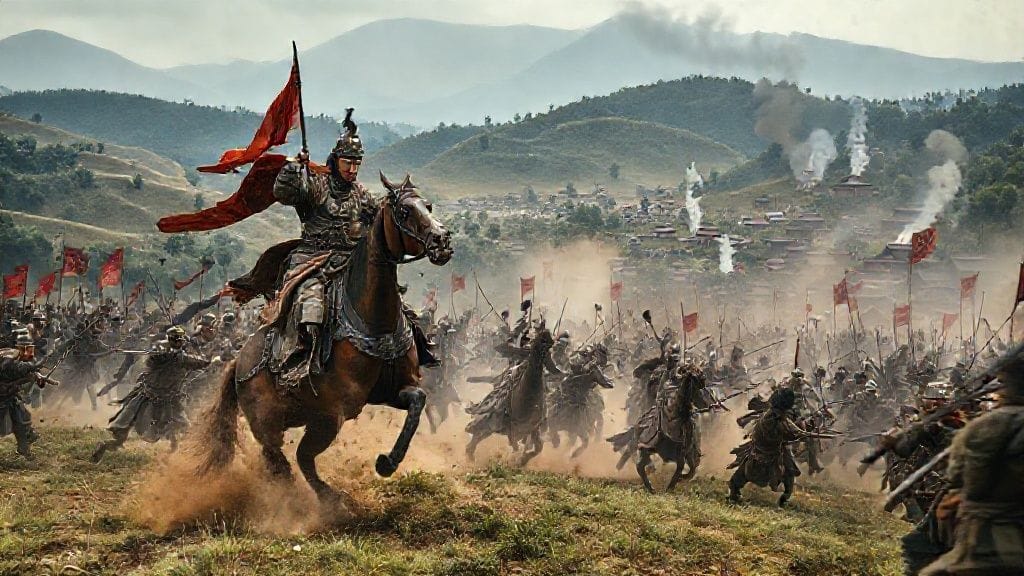
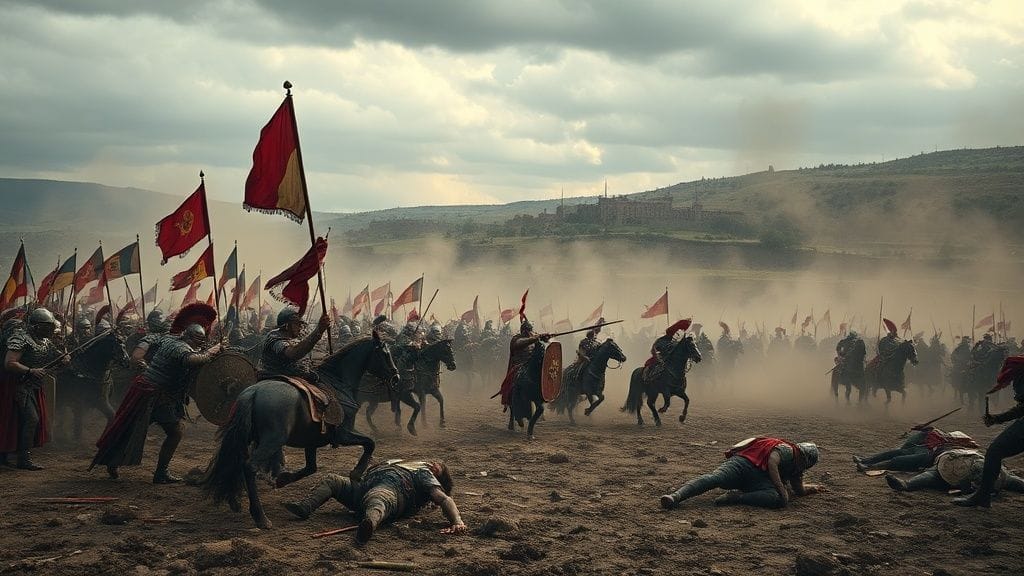
Descriptions of the battle, preserved by Tacitus, paint a scene of tightly ordered Roman lines advancing against a wild, shouting mass of German warriors. Javelins flew, shields slammed, and the clash of iron on iron echoed under a clouded sky. Germanicus, riding along the front, is said to have urged his men forward with promises not only of pay and plunder but of redemption—for themselves, for Rome, and for the ghosts of Teutoburg. The legions responded with ferocity. In the end, the Germanic forces broke, fleeing toward the forests and the river, harried by Roman cavalry.
Another fierce engagement followed at the so-called Angrivarian Wall, an earthwork fortification raised by local tribes. Once again, Germanicus coordinated infantry, auxiliaries, and cavalry in a way that exploited Roman discipline against the looser formations of the German warriors. Victories like these did not annihilate Arminius or fully pacify the region, but they inflicted serious losses and broke the aura of invincibility that had surrounded the Germanic coalition since Varus’ disaster.
One must imagine the faces Germanicus saw at night around the campfires after these battles: men exhausted, armor dented, tunics stained, yet exultant. They had fought, and they had won, not in some distant desert or on sunbaked plains, but in the very forests where three legions had once been swallowed whole. These were the triumph’s true foundations—the smell of wet leather, the ache of battered limbs, the eerie silence that descends after a battlefield is emptied of the living.
Germanicus himself did not emerge unscathed. He watched comrades fall, heard the last cries of standard-bearers fighting to the death to protect their eagles, and personally inspected the corpses of enemy chieftains who had sworn to cleanse their lands of Roman presence. Yet with each campaign season, his reputation among the troops and back in Rome grew. Letters and dispatches, read aloud in the Senate and posted on walls in the Forum, carried stories of rivers crossed, towns burned, and enemy coalitions shattered. The phrase germanicus triumph germanic victories had not yet been pronounced, but the imagination of Rome was already preparing for it.
Recovering the Lost Eagles: Symbols, Skulls, and Sacred Ground
Among the most emotionally charged achievements of Germanicus’ campaigns was the recovery of the legionary standards lost at Teutoburg. These eagles were more than metal emblems; they embodied the honor, spirit, and continuity of the legions. To lose one was a disgrace; to lose three in a single catastrophe was trauma on an imperial scale.
In a series of operations and negotiations, Germanicus managed to retrieve at least one, and ultimately more, of these standards from the tribes who had kept them as powerful talismans. The details of each recovery are murky—some were seized by force, others surrendered as part of agreements with tribes eager to avoid further devastation. What mattered to Rome was that the eagles were coming home. Imagine a soldier who had enlisted after Teutoburg, marching behind a standard once lost in that disaster, now raised high again over the marshes of the north. It would have felt like walking inside a resurrected myth.
Perhaps even more haunting was Germanicus’ visit to the actual site of the Varian disaster. Guided by survivors and locals, he walked through the remnants of hastily dug ditches and over the scattered bones of men and horses. The skulls of Roman soldiers were said to still hang nailed to trees, a tribal offering that turned the forest into a macabre shrine. Germanicus ordered these remains gathered and buried in a mass grave with what honors could be offered so many years later.
Tacitus records that some criticized this as un-Roman, claiming that Germanicus had lowered himself to mourn the dead like a common soldier rather than maintaining the aloof dignity expected of a prince. But for the men who watched him stand bareheaded before those graves, the act spoke volumes. He was not merely avenging the dead; he was acknowledging them. In that moment, the distance between commander and legionnaire narrowed to almost nothing.
When, years later, the standards and relics from these campaigns were paraded through Rome during the germanicus triumph germanic victories, the crowd did not see mere ornaments. They saw proof that the unthinkable had been confronted. Forests where Roman voices had been silenced by spear and arrow had now echoed with victory shouts. The eagles themselves—regilded, polished, held aloft by surviving veterans or chosen standard-bearers—were like ghosts returned from exile, glinting ominously in the Italian sun.
The Long Road Home: From the Rhine Camps to the Gates of Rome
As Germanicus’ campaigns reached their climax around 16 CE, Tiberius began to reconsider the wisdom of sustained large-scale operations beyond the Rhine. The emperor, ever cautious, feared that Germania might become a bottomless pit consuming men and money. He also, as ancient gossip insisted, feared something more subtle: the growing stature of Germanicus. Victories in distant provinces were one thing; a triumph celebrated in Rome, in front of a populace that adored him, was another.
In a move that would later fuel speculation about jealousy and mistrust, Tiberius ordered Germanicus to end the major campaigns and return. The official reasoning was pragmatic: the frontier had been stabilized, the enemy punished, and the honor of Rome restored. Perhaps that was true. Yet to Germanicus, whose temperament leaned toward action, the recall might have felt abrupt, even premature. Arminius still lived. Germania remained, in large part, unconquered. The Rhine would continue to be a hard frontier, not a line behind which Rome could rest easy.
Nevertheless, Germanicus obeyed. He organized the withdrawal of troops, oversaw the securing of forts, and began the long journey back toward Italy. The march home was not triumphant in the theatrical sense—that would come later—but it was emotionally charged. Soldiers carried with them not only spoils and memories but scars both visible and hidden. They had crossed rivers where comrades had drowned, camped under trees that still held the echoes of midnight alarms. Now they would return to a city that, for many, existed only in story and rumor, a gleaming capital far removed from the mud of the frontier.
News of their approach traveled ahead of them, borne by messengers and merchants. In the Senate, debates began over the scale and nature of the honors to be offered. Tiberius, careful to maintain an image of generosity, proposed that Germanicus should receive a triumph proportionate to his achievements. The Senate, relieved and enthusiastic, agreed readily. Some even whispered that the day of his triumph might be a rehearsal for a future day, when he would enter the city not as a victorious general but as emperor.
Germanicus himself seems to have accepted the honors with a mixture of pride and unease. Triumphs were rare, reserved for those who had brought substantial gains to the empire. He had won battles, crushed coalitions, and recovered standards—but he had not transformed Germania into a secure province. Yet behind him stood a trail of burned enemy strongholds and shattered alliances. In the calculus of Roman politics, that was enough. The germanicus triumph germanic victories would declare to the world that the Teutoburg humiliation was over, whether or not the forests across the Rhine truly accepted Roman rule.
Stagecraft of Power: Planning the Triumph in the Heart of the Empire
Months before the date itself—17-05-26 by our reckoning—the logistical machinery of the triumph began to turn. Triumphs were not improvised celebrations; they were meticulously choreographed pageants involving priests, senators, soldiers, artisans, and the urban prefecture. Routes had to be mapped, streets cleared, scaffolding built for spectators, and temples prepared for ritual offerings.
In workshops across the city, sculptors and painters labored over the visual centerpiece of the spectacle: the triumphal paintings and models that would depict the germanic victories. These were the ancient equivalents of battlefield documentaries, large panels showing river crossings, sieges, and dramatic charges. Carpenters assembled wooden facsimiles of Germanic forts and villages, some to be rolled slowly through the streets, others to be adorned with captured weapons and armor.
Artists worked from descriptions provided by officers and soldiers who had returned ahead of the main force. They listened to accounts of thick marshes, sprawling oak forests, and harsh northern weather, then transformed those stories into scenes intelligible to the Roman eye. The Germania that appeared in the triumph was therefore both real and mythologized—a wild, gloomy land tamed, at least temporarily, by Roman steel.
Meanwhile, officials at the Temple of Jupiter Optimus Maximus on the Capitoline prepared for the sacred climax of the day, when Germanicus would offer sacrifices and dedicate spoils. Ritual details were rehearsed: the order of hymns, the sequence of animal offerings, the positioning of priests and augurs. A triumph was as much a religious event as a military one, a grand thank-you to the gods for allowing Rome to prevail once again over chaos at the edges of the world.
In the imperial palace, Tiberius oversaw these preparations with an air of distant propriety. He would attend, of course, and offer public praise, yet there was an undercurrent of tension. The more splendid the triumph, the brighter Germanicus would shine. Still, Tiberius could not afford to appear resentful. The stability of his regime depended on the perception that he rewarded merit and honored those who served Rome well—especially his own adoptive son. Thus, the city became a theater not only for celebrating germanicus triumph germanic victories but for displaying the unity and continuity of the Julio-Claudian house.
A City Transformed: Rome on the Eve of Germanicus’ Triumph
As the appointed day drew near, Rome itself seemed to pulse with growing anticipation. Taverns buzzed with rumors about the trophies that would be shown. Street poets recited verses praising Germanicus as “the thunderbolt of the north” or “the avenger of Varus.” In the markets of the Forum, vendors hawked laurel wreaths, miniature bronze eagles, and crude figurines of Germanic warriors in chains—curios that allowed ordinary citizens to feel part of the drama.
Public buildings along the triumphal route were draped with hangings of vivid color. Magistrates issued edicts directing citizens to keep the streets clear enough for the procession to pass, while also encouraging them to attend in great numbers. The atmosphere was festive but not without apprehension; triumph days could be chaotic, with crowds surging forward, tempers flaring, and pickpockets taking advantage of distraction. The urban cohorts were placed on alert, ready to intervene if enthusiasm tipped into disorder.
At home, families prepared as if for a religious holiday. Housewives laid out offerings for household gods, asking for protection over sons who served—or would one day serve—under commanders like Germanicus. Old men rehearsed stories they planned to tell younger relatives as the procession passed: tales of earlier triumphs, of Pompey’s parades of eastern kings, of Julius Caesar’s return from Gaul. Each generation measured its own era against those legends. Now they would have, in the germanicus triumph germanic victories, a living memory to add to the chain.
For the veterans who had marched with Germanicus in Germania, the city felt both familiar and alien. After months or years in crude wooden forts and muddy encampments, its marble gleam and bustling avenues could seem almost unreal. Some took quiet walks at dawn through the Forum, touching the bases of statues, reacquainting themselves with the capital they had sworn to defend. Others gathered in groups, reliving particular nights on campaign—a surprise attack, a desperate stand, a moment when Germanicus himself had appeared out of the darkness, rallying them with a few well-chosen words.
The night before the triumph, Rome did not sleep easily. Somewhere, priests watched the flight of birds and the patterns of lightning, seeking omens. In countless homes, people lay awake, listening to the distant murmur of workers making last-minute adjustments along the route. Tomorrow would not just be a spectacle but a verdict on years of effort and sacrifice. Had the Teutoburg wound really been healed? Would the spirits of the dead at last be at peace? The answers, for many, would be written in the faces of the marching soldiers and in the bearing of the man in the triumphal chariot.
The Procession Begins: Drums, Trumpets, and Germanic Spoils
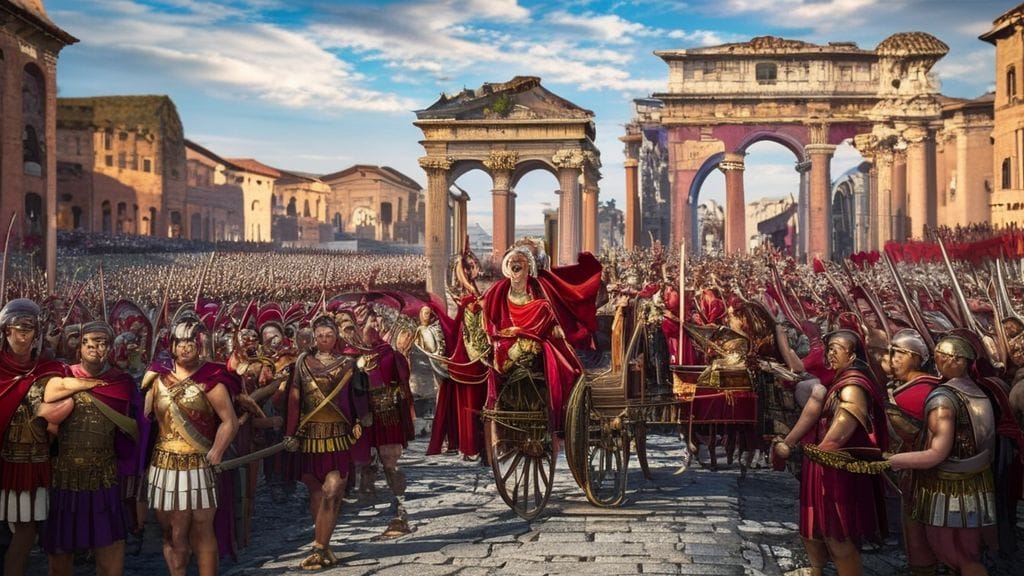
At last, morning broke over the Fields of Mars, where the procession assembled in solemn order. First came the magistrates and lictors bearing fasces, their bundles of rods and axes glinting. Then priests in white robes, crowned with laurel, leading sacrificial animals decorated with ribbons and garlands. The air trembled with the first blasts of trumpets—long, curved instruments whose sharp notes cut through the city’s usual hum.
Behind them moved the visual narrative of war: carts and platforms piled high with Germanic spoils. There were captured weapons—long spears, broad blades, heavy shields painted with swirling patterns—and suits of armor taken from fallen chieftains. Model villages and forts rolled by, wooden miniatures that depicted Germanic settlements, some half-burned, others broken open to reveal victorious Roman soldiers swarming inside. Painted panels towering over the crowd showed dramatic scenes: Germanicus crossing a storm-tossed river; legionaries hacking through dense undergrowth; standards lifted high over a shattered enemy line.
Exotic animals from the northern forests, perhaps bears and elk, were led or caged, wide-eyed and confused by the noise and heat. Their presence added to the impression that Rome had not merely defeated human foes but mastered an alien, threatening world. Children gasped and pointed; elders nodded, as if to say that the ends of the earth themselves had bent to Roman destiny.
As the procession advanced along the Sacred Way, incense smoke thickened, and the crowd’s cheers grew louder. “Germanicus! Germanicus!” Voices merged into a roaring wave. Some shouted blessings upon his wife Agrippina and their children, others called curses down on Arminius and all those who dared defy Rome. The phrase germanicus triumph germanic victories, though not yet fossilized as a slogan, passed from mouth to mouth in excited paraphrase: “Germanicus avenged the legions! Germanicus broke the Germans!”
The order of the march had been designed with psychological precision. Spoils and images came first, building anticipation, followed by the most shocking and intimate element of all: the prisoners.
Spectacle and Sorrow: Prisoners, Standards, and the Memory of Teutoburg
When the prisoners appeared, a hush fell over parts of the crowd, as curiosity wrestled with pity and contempt. Chieftains and warriors from Germanic tribes, once proud rulers in their forest strongholds, now walked in chains, some bound at the neck, others with hands shackled before them. Their hair, often long and wild by Roman standards, had been left uncut, their clothing only partially stripped, so that their foreignness stood out clearly. Here, the enemy had a face.
Arminius himself was not among them; he would never grace a Roman triumph. But relatives and allies of his, men who had sworn to drive Rome forever from their lands, now trudged along the paving stones of the Eternal City, enduring the jeers and stares of thousands. Some met the crowd’s gaze with unbroken defiance, others with dull resignation. A few, overwhelmed, glared upward at the towering temples and basilicas, as if trying to comprehend the sheer scale of the power that had crushed them.
Behind the prisoners came the most sacred and emotionally charged objects of all: the recovered legionary standards. Carried by chosen veterans, the eagles of the legions lost at Teutoburg floated above the throng, their metal wings flashing in the sunlight. At their sight, the crowd erupted into a roar unlike any other that day. Men wept openly. Women raised their children high, urging them to look and remember. The humiliation of the past seemed, if only for a moment, to dissolve into this new, jubilant memory.
Somewhere in that mass of onlookers, older veterans of Varus’ legions might have stood, spared or escaped by chance years earlier, now seeing the standards they had once sworn to defend unto death. What thoughts passed through their minds? Relief? Guilt? Bitterness at having missed the chance to march behind them again? The triumph did not erase their suffering, but it offered a kind of narrative closure—an ending that transformed personal loss into collective pride.
And then, at last, came the chariot, rolling slowly into view, framed by the gleam of gold and the rhythmic beat of drums. Germanicus had arrived.
The Man in the Chariot: Germanicus Between Glory and Fate
Germanicus stood in his chariot wearing the triumphator’s traditional garb: a purple and gold toga picta, richly embroidered with imagery of victory, and a laurel wreath upon his head. His face, handsome and open, turned from side to side as he acknowledged the cheers of the crowd. Behind him, a slave reportedly held a golden crown above his head and whispered the ritual warning: “Remember you are mortal.” Whether that phrase was actually used in Germanicus’ day, the sentiment certainly hung over the scene.
Beside or behind the chariot stood his young children and his wife Agrippina the Elder, their presence both humanizing and symbolic. Here was not merely a general, but a father and husband, a living node in the dynastic web that bound Rome’s present to its future. The people, who had grown wary of distant, aloof rulers, saw in Germanicus a figure who smiled, who grieved, who bled—a man who seemed to bridge the gulf between palace and street.
As the chariot rolled forward, an extraordinary wave of emotion followed it. Some in the crowd shouted prayers that Germanicus would one day rule as emperor. Others simply chanted his name in long, rhythmic cries. Ancient authors later claimed that the love of the people for Germanicus was so intense that Tiberius could not help but regard it with suspicion. The germanicus triumph germanic victories, splendid as it was for the dynasty, also served as a public opinion poll that left no doubt about where popular affection lay.
Germanicus himself must have felt a whirl of conflicting sensations. Pride in his soldiers, grief for those who had not lived to see this day, satisfaction at having carried out his duty, and perhaps even a shadow of unease. He knew that his campaigns, though glorious, had not turned Germania into another Gaul. He knew, too, that his fame had swelled to proportions that could be as dangerous in the palace as any ambush in a foreign forest. The city’s acclamations were both a laurel wreath and a subtle crown of thorns.
Yet in that moment, as the wheels of the chariot turned upon the stone and his eyes met those of his soldiers marching behind him, he allowed himself to be what the day demanded: the embodiment of Rome’s revenge and renewal. The germanicus triumph germanic victories had taken on a life of its own, and he was its living center.
Tiberius in the Shadows: Politics Behind the Celebrations
High above the route, on balconies and in reserved seating near the Capitoline Hill, senators and imperial family members watched with more measured expressions. Among them, Tiberius sat in his ceremonial place, cloaked in the dignity of emperorship yet, according to later writers, inwardly restless. The man below—cheered, adored, exalted—was his adoptive son and designated successor. He was also his most potent rival in the court of public opinion.
Tiberius had never enjoyed the spontaneous affection that Germanicus seemed to attract effortlessly. Reserved, cautious, and often suspicious, he inspired respect and fear more easily than love. As Germanicus’ victories were reported in Rome, they had been greeted not only with relief but with an almost messianic enthusiasm. The triumph crystallized that mood into a single, overwhelming image: the young conqueror passing through a storm of adulation under the watchful eyes of the gods.
Ancient historians, particularly Tacitus, do not hesitate to suggest that this spectacle darkened Tiberius’ thoughts. Whether that is entirely fair is still debated among modern scholars, who note that Tacitus wrote with the hindsight of later events and a clear dislike for Tiberius’ reign. Yet even if we discount some exaggeration, it is difficult to imagine the emperor watching the germanicus triumph germanic victories without feeling at least a twinge of anxiety. The line between celebrated heir and potential threat could be perilously thin in the Roman world.
Publicly, Tiberius played his part. He praised Germanicus in the Senate, lauded his achievements, and posed with him at key moments of the ceremonies. But the political subtext did not escape contemporary observers. Many senators, who had chafed under Augustus’ tight control, saw in Germanicus a possible return to a more open, collaborative style of rule. Others recognized that such hopes could easily be crushed if suspicion took root in the imperial heart.
Thus, the triumph was not merely the conclusion of a military campaign but the opening act of a political tragedy. The very success of the germanicus triumph germanic victories amplified the pressures and tensions surrounding Germanicus’ future. The laurel wreath on his brow might, in the end, prove to be a wreath laid on the altar of fate.
The People’s Hero: How Rome Fell in Love with Germanicus
For the ordinary inhabitants of Rome, Germanicus became something rare: a member of the imperial family they could truly claim as their own. His triumph cemented this bond. They had watched him grow from promising youth to seasoned commander, heard rumors of his fairness to provincials, his respect for the Senate, and his devotion to his troops. Now they saw him, glorified yet still recognizably human, wave and bow and smile as he passed through their midst.
In the weeks and months after the triumph, stories spread rapidly. Some claimed Germanicus had spared villages that submitted without resistance, refusing to indulge in needless slaughter. Others told of his sharing the hardships of winter campaigns, sleeping under rough tents instead of in specially built headquarters. Whether all such tales were strictly accurate mattered less than the image they reinforced: Germanicus was the good prince, the mirror of virtues that Romans still associated with the Republic even as they lived under empire.
Poets praised him in verse, comparing him to Alexander the Great or to Aeneas, the pious founder-hero of Rome. In private conversations, comparisons to Julius Caesar also surfaced—dangerous, evocative, impossible to ignore. Where Tiberius seemed remote, Germanicus seemed accessible. Where the emperor hesitated, the younger man seemed bold. The germanicus triumph germanic victories thus became, in memory, not just a celebration of frontier warfare but a moment when Rome glimpsed an alternate political future.
Yet behind the adulation lay complex social dynamics. The urban poor, living in crowded tenements, saw in Germanicus’ generosity and popularity a hope that he would continue the grain doles and public entertainments that made their lives bearable. The equestrian and senatorial elites, though more cautious, recognized that aligning themselves with him could bring future patronage. Even provincial delegations in Rome reported back to their cities that Germanicus treated them with unusual courtesy, speaking with them at length rather than merely acknowledging them in passing.
This convergence of affections and expectations was enormously powerful—and potentially volatile. The more Germanicus came to embody the people’s hopes, the more threatening his existence became to any ruler who feared competition. The triumph, with its glitter and chanting crowds, fixed those hopes in the clearest possible form, preserving them in the city’s collective memory like a bright fresco painted over a wall of darker, older anxieties.
The Limits of Victory: Why Germania Was Never Truly Conquered
Triumphs, by design, tell stories of completion. They present wars as arcs with clear beginnings and endings: enemy defies Rome, Rome retaliates, Rome prevails, peace restored. Yet history is rarely so neatly bound. The germanicus triumph germanic victories suggested that Germania had been decisively brought to heel, that Teutoburg’s stain had been cleansed once and for all. In reality, Germanicus’ campaigns had achieved much but left many questions unresolved.
The geographic and cultural realities of Germania stubbornly resisted Roman models of conquest. Unlike Gaul, with its urban centers and loosely centralized tribal structures, Germania beyond the Rhine was a patchwork of clans and confederations, constantly shifting and regrouping. Its dense forests and wetlands made large-scale Roman operations difficult, and its warriors could melt quickly into terrain that confounded even the best Roman scouts.
Germanicus had inflicted serious damage on the tribal coalitions, killed or captured key leaders, and demonstrated that Rome could, when it chose, project overwhelming force across the Rhine. But he had not established permanent, secure control over vast territories. Nor had he destroyed the capacity of Germanic groups to regroup and strike again if provoked. Tiberius seems to have recognized this, choosing after Germanicus’ recall to favor a policy of defense and diplomacy rather than further major offensives.
This decision prompted debate both then and now. Some ancient voices, like the biographer Suetonius, suggested that Tiberius was motivated partly by fear of Germanicus’ rising fame. Modern historians, examining the logistical difficulties and limited economic rewards of conquering Germania, tend to see more pragmatic reasoning at work. It was one thing to avenge a humiliation; it was another to commit Rome to a potentially endless and costly struggle.
Thus, in a sense, the triumph told only half the story. On that dazzling day in Rome, few wanted to contemplate the long-term unsuitability of Germania as a Roman province. They wanted catharsis, not strategic analysis. The germanicus triumph germanic victories offered exactly that—a narrative in which Rome had been wounded but then risen again, splendid and unassailable. The messy realities of frontier management would remain for others to grapple with long after the laurel wreaths had withered.
After the Laurel Wreaths: Exile, Suspicion, and Germanicus’ Mysterious Death
In the wake of the triumph, Germanicus’ career did not, as many might have expected, lead him steadily toward supreme power in Rome. Instead, his path curved away from the capital. In 17 CE, he was assigned to the eastern provinces with broad authority to settle disputes, reorganize client kingdoms, and manage delicate relations with Parthia. On paper, this was a prestigious command. In practice, some saw in it a subtle exile, a way of keeping the popular prince far from the city where his adoring crowds had once chanted his name.
In the East, Germanicus continued to display diplomatic skill and charisma. He dealt with Armenia, visited the ancient cities of the Greek world, and even toured Egypt—without, it must be said, securing the explicit permission of Tiberius, which some took as a sign of overconfidence or miscalculation. His journey down the Nile, marveling at monuments older than Rome itself, reads almost like a farewell tour in retrospect, a last chance for this restless, curious man to see the grandeur of the wider Mediterranean.
But shadows followed him. In Antioch, in 19 CE, Germanicus fell suddenly ill. As his condition worsened, rumors of poison began to circulate. Suspicion quickly focused on Gnaeus Calpurnius Piso, the governor of Syria, who had clashed with Germanicus and allegedly acted with the tacit support of Tiberius’ powerful confidante—and mother—Livia. Whether these accusations were well founded remains a matter of debate. Ancient accounts, colored by sympathy for Germanicus and hostility toward Tiberius, lean heavily toward the theory of deliberate murder.
What is certain is that Germanicus died far from the city that had once hailed him as its avenger. On his deathbed, he is said to have urged his friends and family to seek justice but not revenge, framing his own fate as part of a larger, inscrutable design. Agrippina, shattered by grief yet fiercely determined, carried his ashes back to Rome in a heartbreaking procession that mirrored, in a dark inversion, the glory of his triumph. Crowds again lined the streets, but this time their cheers were replaced by wails.
The germanicus triumph germanic victories, once a symbol of renewed hope, now took on a tragic sheen in memory. Had that very day of adulation hastened his end by inflaming jealousy at court? Would Tiberius have feared him less if Rome had not so clearly craved him as a future ruler? No definitive answers exist, but the tension between triumph and death became one of the central dramas of the early empire, retold and reshaped by generations of historians, playwrights, and political commentators.
Agrippina, Caligula, and the Legacy of a Fallen Conqueror
Germanicus’ death did not extinguish his influence. Instead, it shifted the focus of his legacy onto those who survived him—most notably his wife Agrippina the Elder and their children. Agrippina, granddaughter of Augustus and a woman of formidable will, refused to let her husband’s memory fade into a convenient haze. She publicly clashed with Tiberius, accusing his circle, if not the emperor himself, of complicity in Germanicus’ demise. Her determination to honor and defend her husband’s reputation turned her into both a symbol of virtue and a lightning rod for imperial suspicion.
Among their children was Gaius, better known by his nickname Caligula, “little soldier’s boot,” earned when, as a toddler, he toddled through Germanicus’ Rhine camps wearing miniature legionary gear. During the triumph, he had been just a child, perhaps lifted into the chariot or carried along the route, absorbing without understanding the sheer scale of his father’s acclaim. For the soldiers, he was a living reminder of Germanicus in miniature, a link between the dead hero and the uncertain future.
Years later, when Caligula ascended the throne after Tiberius’ death, he did so largely on the power of his father’s name. The Senate and people, weary of Tiberius’ dour rule, embraced the son of Germanicus as if he were a reincarnation of the fallen prince. In those early days, Caligula openly invoked his father, staging ceremonies and games in his honor, parading images that recalled the germanicus triumph germanic victories. The aura of that long-ago procession still clung to the family, shaping expectations in dangerous ways.
Tragically, Caligula’s reign would descend into cruelty and excess, poisoning the memory of the line in ways Germanicus could never have foreseen. Yet even then, ancient writers were careful to distinguish between father and son. Germanicus remained, in their eyes, the unfulfilled promise, the ideal that had never been permitted to blossom fully. Agrippina’s later descendants, including Nero, would likewise trade on his legend, presenting themselves as heirs not only to Augustus but to the noble victim who had once paraded through Rome as the conqueror of Germania.
Thus, the triumph’s significance outlived the man who rode in it. It became a family myth, a touchstone of legitimacy, invoked whenever a new generation of Julio-Claudians sought to remind Rome of what might have been. The laurel wreath, preserved in stories and images, adorned not only Germanicus but those who claimed him as their blood.
Memory, Myth, and Manipulation: How Historians Remember Germanicus
The story of Germanicus and his triumph reaches us through the pens of ancient historians, chief among them Tacitus, Suetonius, and Cassius Dio. Each wrote with his own agenda, biases, and sources, transforming the raw events into narratives that have shaped our understanding ever since. Tacitus, in particular, crafted Germanicus as a tragic hero, standing in luminous contrast to the increasingly sinister figure of Tiberius. In his Annals, the germanicus triumph germanic victories becomes a pivot point, a moment of dazzling promise before the onset of imperial decay.
Modern scholars have approached these accounts with both fascination and skepticism. They ask: how much of Germanicus’ image is history, and how much is literary construction? Was he truly as universally beloved as Tacitus implies, or have disappointed hopes amplified his virtues in retrospect? Was Tiberius’ recall of Germanicus from Germania driven primarily by jealousy, or by genuine strategic prudence? The sources, colored by senatorial resentment and the moralizing tendencies of later writers, do not always allow clear answers.
What we can say is that the triumph itself functioned as an inflection point in Roman memory. It encapsulated themes that resonated deeply with Roman identity: vengeance for betrayal, the recovery of sacred symbols, the tension between frontier expansion and imperial restraint, the precarious balance between military glory and political stability. Later emperors, from Claudius to Trajan, would confront similar dilemmas on other frontiers, but none with quite the same tragic poignancy.
Historians also note how the triumphal imagery shaped Rome’s mental map of Germania. The paraded spoils, the painted battle scenes, and the chained prisoners fixed in the Roman imagination a vision of the north as a grim, savage region that could be punished but not easily tamed. This contributed to a long-term strategic orientation in which the Rhine and Danube became accepted as natural limits of Roman power in the west, a choice that would shape European history for centuries.
In a sense, every retelling of the germanicus triumph germanic victories is an act of selection and emphasis—choosing which aspects to spotlight: the heroism, the politics, the limitations, the pathos. Our own age, with its skepticism of grand narratives, tends to dwell on the ambiguities and the costs. Yet even stripped of myth, the image of Germanicus riding through Rome on that May day in 17 CE retains a stubborn power. It is the image of an empire trying to convince itself that it could still control its destiny, even as forces beyond any single man’s grasp gathered in the shadows.
Conclusion
On the surface, the triumph of Germanicus on 26 May 17 CE was everything a Roman could wish for: a brilliant procession celebrating decisive victories, a beloved commander hailed by a jubilant populace, sacred standards restored, and a narrative of humiliation transformed into one of vindication. The germanicus triumph germanic victories offered Rome a moment of collective catharsis, allowing the city to believe, if only for a day, that the trauma of Teutoburg had been not only avenged but somehow morally reversed. Yet behind the drums and banners lay more complicated truths. Germania remained unconquered in any lasting sense, and the strategic decision to halt large-scale expansion beyond the Rhine would mark a permanent turn in Roman frontier policy.
On a human level, the triumph stands at the midpoint of a tragedy. It elevated Germanicus to almost unbearable heights of expectation, sharpening the contrast between what he symbolized and what the imperial system could safely tolerate. Within two years, he was dead in a distant province, his ashes returning to Rome in a funeral procession that eerily echoed, and inverted, the glory of his triumphal chariot. His wife Agrippina’s defiance, his son Caligula’s troubled reign, and the later invocations of his name by descendants like Nero all testify to the enduring power of his legend. Historians, from Tacitus to modern scholars, have wrestled with this legend, probing the historical man behind the myth while recognizing that the myth itself—shaped in no small part by that day’s pageantry—became a political force in its own right.
In the end, Germanicus’ triumph encapsulates the paradox at the heart of Roman imperialism: the need to project absolute confidence and control in public ritual, even when the realities of geography, culture, and politics rendered such control tenuous at best. Rome paraded its victory over Germania through streets lined with marble, but far beyond the Alps, the forests still whispered with languages and loyalties it would never fully command. The memory of the germanicus triumph germanic victories thus endures as a lens through which we can view not only one man’s rise and fall but an empire’s struggle to reconcile its dreams of limitless expansion with the stubborn limits imposed by the world—and by its own internal fears.
FAQs
- When did Germanicus celebrate his triumph for the Germanic victories?
Germanicus celebrated his triumph for the Germanic victories in Rome on 26 May 17 CE, following several years of campaigns across the Rhine that avenged the disaster of Teutoburg and recovered lost legionary standards. - What was the main purpose of the germanicus triumph germanic victories?
The triumph served multiple purposes: it honored Germanicus’ military successes, symbolically healed the trauma of the Varian disaster, showcased the restored legionary eagles, and reinforced the legitimacy and prestige of the Julio-Claudian dynasty in the eyes of the Roman people. - Did Germanicus completely conquer Germania for Rome?
No. While Germanicus won important battles, shattered tribal coalitions, and carried out devastating punitive expeditions, he did not fully pacify or annex Germania beyond the Rhine. Strategic and logistical constraints, along with Tiberius’ caution, led Rome to accept the Rhine as a practical frontier rather than pushing for permanent conquest. - Why did Emperor Tiberius recall Germanicus from Germania?
Officially, Tiberius recalled Germanicus because he believed the objectives had been met: the enemy punished and Roman honor restored. Ancient sources like Tacitus, however, suggest that jealousy of Germanicus’ growing popularity and concern about his political influence may also have played a role. - How did Germanicus die, and was he murdered?
Germanicus died in Antioch in 19 CE after a sudden illness. Many contemporaries believed he had been poisoned, possibly at the instigation of the Syrian governor Piso and with support from figures close to Tiberius. Proof was never conclusive, and modern historians remain divided, weighing the plausibility of foul play against the frequency of natural deaths from disease in the ancient world. - What happened to Germanicus’ family after his death?
His widow, Agrippina the Elder, returned to Rome with his ashes and became a vocal critic of Tiberius’ regime, eventually suffering exile and death. Their son Gaius, known as Caligula, later became emperor, initially benefiting from his father’s revered memory before his own rule descended into tyranny. - Which ancient sources describe the triumph of Germanicus?
The triumph and its surrounding events are primarily described by Tacitus in his Annals, with additional references in Suetonius’ Lives of the Caesars and Cassius Dio’s Roman History. These sources are rich but biased, requiring careful interpretation by modern historians. - Why is Germanicus often portrayed as a tragic hero?
Germanicus combined noble birth, military talent, personal charm, and apparent devotion to traditional Roman values. His early death, likely amid political suspicion, allowed writers like Tacitus to cast him as the ideal prince who never had the chance to rule, contrasting his promise with the perceived moral decline under Tiberius. - Did the triumph change Roman policy toward Germania?
The triumph did not by itself change policy, but it coincided with a shift from aggressive expansion to strategic defense along the Rhine. The political satisfaction and symbolic closure it provided may have made it easier for Rome to accept a more limited, defensive stance instead of pursuing further risky conquests. - How did the Roman people react to Germanicus’ triumph?
Contemporary accounts describe an outpouring of enthusiasm and affection. Crowds filled the streets, cheered his name, and saw in him both a military savior and a moral exemplar. This reaction significantly increased his popularity, contributing to the later perception that Tiberius saw him as a dangerous rival.
External Resource
Internal Link
Other Resources
- Encyclopaedia Britannica – general search for the exact subject
- Google Scholar – academic search for the exact subject
- Internet Archive – digital library search for the exact subject