Table of Contents
- Dawn Over the Gold Coast: A Nation on the Brink
- The Shadows of Colonial Rule: Ghana Before Independence
- Kwame Nkrumah: The Voice of a People
- The Rise of Political Movements: CPP and the Quest for Freedom
- The Winds of Change Across Africa
- Negotiating Freedom: The Road to Self-Governance
- March 6, 1957: The Day Ghana Awoke Free
- Accra’s Streets in Celebration: The Heartbeat of a New Nation
- The Symbolism of Independence: Flags, Speeches, and Hopes
- Challenges at Dawn: From Colony to Nationhood
- International Reactions: Ghana on the World Stage
- The Legacy of Nkrumah’s Vision
- Social and Economic Realities after Independence
- The Pan-African Dream: Ghana as a Beacon
- Lessons from Ghana’s Birth: Reflections on Decolonization
- The Road Ahead: Political and Cultural Evolution
- Ghanaian Identity and National Pride
- Education and Cultural Renaissance Post-Independence
- The Role of Women in Ghana’s Liberation
- Economic Struggles and Development Ambitions
- Ghana and the Cold War: Navigating Global Tensions
- Remembering 1957: Commemoration and Memory in Modern Ghana
- Conclusion: The Enduring Flame of Ghanaian Independence
- FAQs: Understanding Ghana’s Independence
- External Resource
- Internal Link
Dawn Over the Gold Coast: A Nation on the Brink
The early morning sun spilled its golden light over Accra, illuminating the wide streets brimming with voices and hopes alike. It was March 6, 1957—a day unlike any before it in the history of the Gold Coast. The air was thick with anticipation, charged with the energy of a people who had long endured the heavy yoke of colonialism. This was the dawn of Ghana’s independence, Africa’s first sub-Saharan nation to emerge free from European rule. The moment was electric and raw, filled with pride, joy, and the shadows of uncertainty.
For decades, the land known as the Gold Coast had been a symbol of colonial exploitation—its wealth extracted, its people marginalized. Yet on this day, as Kwame Nkrumah stepped forward to proclaim Ghana a sovereign state, the tides of history had truly turned. In that breathless instant, the rhythmic drumbeats of the Ghanaian people echoed centuries of struggle, resilience, and dreams yet fulfilled.
The Shadows of Colonial Rule: Ghana Before Independence
To fully grasp the significance of March 6, 1957, one must travel back into the layered past of the Gold Coast, a jewel among Britain’s colonies. Since the 19th century, the British had exerted control over the region, drawn by its abundant natural resources—gold, cocoa, and timber. The colonial government imposed systems that prioritized extraction over welfare, molding local governance into a tool for imperial ambitions.
Local societies, rich in culture and political sophistication, were often sidelined or co-opted. Chiefs and traditional leaders found themselves torn between collaboration with the British and allegiance to their people, cultivating a brewing dissatisfaction. Meanwhile, a growing class of educated Ghanaians, inspired by global notions of nationalism and self-determination, began to push back against the imposed order. This growing opposition coalesced in voices that called not only for reform but for full independence.
Kwame Nkrumah: The Voice of a People
At the heart of Ghana’s independence stood Kwame Nkrumah, an extraordinary figure whose charisma and vision would galvanize a nation. Educated abroad, steeped in the ideology of Pan-Africanism and anti-colonialism, Nkrumah returned to the Gold Coast with a burning desire to dismantle the colonial system and build a new Ghana grounded in unity and self-reliance.
Nkrumah’s political rise was meteoric. He preached a message that resonated across ethnic and social divides—Ghana must govern itself. His formation of the Convention People’s Party (CPP) in 1949 represented not just another political entity but a mass movement committed to “self-government now.” His rhetoric was fiery; his determination absolute. By 1951, his party had won elections, signaling a new dawn—but the ultimate prize, complete independence, was still distant.
The Rise of Political Movements: CPP and the Quest for Freedom
The Gold Coast’s journey toward independence was shaped by a complex tapestry of political organizations, labor unions, and mass movements. The CPP stood apart for its ability to mobilize the ordinary citizen, utilizing rallies, strikes, and effective communication to spread its message.
Opposition came from various quarters—the Traditionalist groups who feared disruption of existing hierarchies, rival parties wary of rapid change, and the British colonial administration itself, skeptical of hastening independence. Yet, the CPP’s persistence was unyielding. Its demand for “Positive Action,” including civil disobedience and strikes, put pressure on the colonial authorities that became increasingly untenable.
The Winds of Change Across Africa
The momentum in the Gold Coast was part of a wider continental awakening. Post-World War II Africa was simmering with anti-colonial sentiment. Countries like Algeria, Kenya, and South Africa were experiencing their struggles against European rule, and the wave of decolonization was unstoppable.
International opinion, too, was shifting. The United Nations promoted self-determination, and the Cold War rivalry forced Western powers to reconsider their colonies' futures lest they fall under communist influence. Ghana’s independence would become emblematic, inspiring hope in oppressed peoples across the continent.
Negotiating Freedom: The Road to Self-Governance
Despite the revolutionary fervor among the populace, the path to independence was also navigated through tense negotiations. The British government, wary but pragmatic, engaged with Ghanaian leaders. Between 1954 and 1956, constitutional conferences took place, redefining Ghana’s political landscape.
Nkrumah negotiated shrewdly, leveraging his party’s popular support and the shifting global climate. The British conceded internal self-government in 1954, but full sovereignty remained elusive until 1957. Each step forward was hard-won, reflecting the delicate balance between local demands and imperial control.
March 6, 1957: The Day Ghana Awoke Free
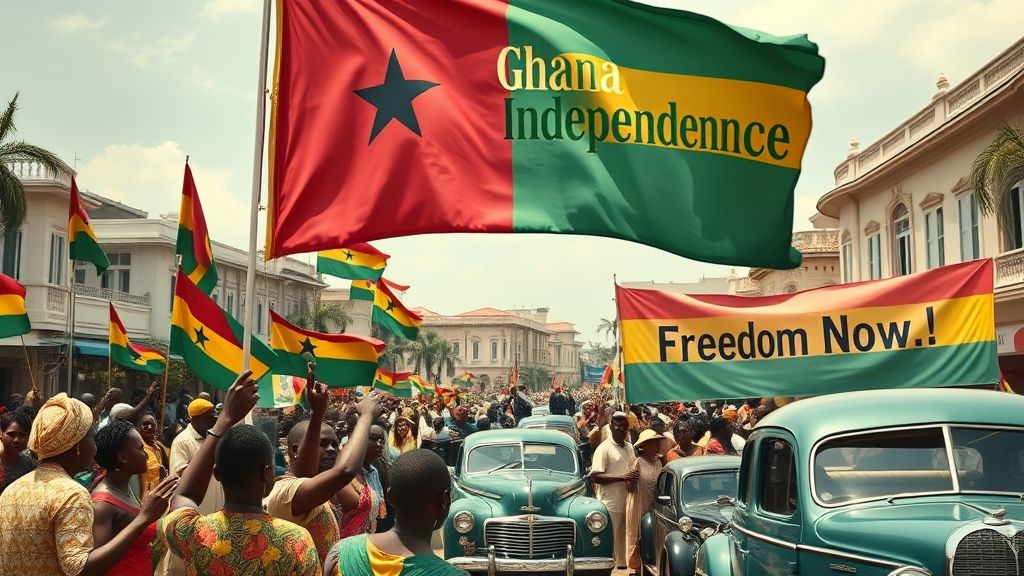
The historic morning of March 6 arrived with a ceremony at the Accra Castle, attended by thousands and broadcast across the Gold Coast. Dignitaries from Britain were present, including the Duke of Gloucester, representing the British Crown. Against a backdrop of raised flags and resounding drumbeats, Kwame Nkrumah declared Ghana free.
His speech was both poetic and pragmatic, encapsulating centuries of struggle and the weights of future responsibility: “At long last, the battle has ended! And thus Ghana, your beloved country, is free forever!” The crowd erupted in jubilation—tears of joy mingling with cries of freedom as the Union Jack was lowered and the new Ghanaian flag raised.
Accra’s Streets in Celebration: The Heartbeat of a New Nation
From Accra to Kumasi, towns and villages exploded in celebration, flags fluttered from rooftops, and the streets vibrated with song and dance. The air was filled with new hope and the intoxicating scent of possibility.
For many ordinary Ghanaians—farmers, traders, students—the moment was surreal. Freedom had been a distant dream; now it lay at their feet. Yet, beneath the surface, the enormity of the task ahead was clear: nation-building would be arduous.
The Symbolism of Independence: Flags, Speeches, and Hopes
Independence was not just a legal status; it was a profound cultural and psychological transformation. The flags, the attire, the public performances drew on Ghana’s rich heritage, symbolizing unity amidst diversity. The anthem, the adoption of national symbols, and the constitution embodied ambitions of equality, justice, and progress.
Nkrumah’s oration painted a vision that transcended Ghana’s borders, linking the nation’s fate to that of all Africa. Independence was a step toward a pan-African identity, a beacon for all colonized peoples yearning for freedom.
Challenges at Dawn: From Colony to Nationhood
However breathless the celebrations, the newborn nation faced immediate challenges. Colonial legacies had left economic dependency, underdeveloped infrastructure, and social inequalities.
Ghana’s politics were fragile, balancing traditional authorities, ethnic groups, and socialist ideals. Economic development required strategies beyond slogans. Education, health, and industrialization loomed as critical priorities. Additionally, the global Cold War dynamics pressured Ghana’s foreign policy.
International Reactions: Ghana on the World Stage
Ghana’s independence reverberated worldwide. Western powers viewed it cautiously, while the Soviet bloc saw opportunity in the burgeoning African liberation movement. Newly independent Ghana joined international organizations to assert its sovereignty and pursuit of development.
African leaders hailed Ghana’s success as a model. Kwame Nkrumah himself became a prominent figure on the global stage, advocating unity and self-determination across Africa and the Global South.
The Legacy of Nkrumah’s Vision
Nkrumah’s dream did not end with independence. He envisaged an industrialized, educated, and united Africa. His policies of infrastructure development, education expansion, and Pan-African solidarity sought to realize these ambitions.
Though his rule faced criticism and eventual overthrow, his imprint on Ghana and African nationalism remains profound. The independence of Ghana sowed seeds for the continent’s decolonization and self-realization.
Social and Economic Realities after Independence
The promise of independence confronted entrenched difficulties. Ghana struggled with balancing traditional structures and modern governance. Economically, reliance on cocoa exports made the country vulnerable. Programs to diversify the economy met mixed success amid global market shifts.
Poverty, urban migration, and social tensions complicated efforts to build an inclusive nation. Yet, resilience and optimism endured.
The Pan-African Dream: Ghana as a Beacon
Ghana’s emergence energized Pan-African movements. Nkrumah’s leadership inspired the creation of the Organization of African Unity in 1963 and numerous liberation movements.
Ghana became a refuge for political exiles and a laboratory for African socialism. The country’s independence was a clarion call for continental solidarity and emancipation.
Lessons from Ghana’s Birth: Reflections on Decolonization
Ghana’s story offers insights into the complexities of decolonization: the interplay of grassroots activism, charismatic leadership, international dynamics, and cultural identity.
It underscores that independence, while a monumental achievement, is the start of an arduous journey toward true sovereignty and development.
The Road Ahead: Political and Cultural Evolution
Since 1957, Ghana has traversed coups, democratic transitions, economic reforms, and cultural revival. The spirit of 1957 remains a touchstone for national identity and governance.
Ghana today stands as a stable democracy with a vibrant culture, recalling its independence as a pivotal moment that transformed a people—and a continent.
Ghanaian Identity and National Pride
Independence cultivated a renewed pride in Ghanaian heritage, languages, and arts. This reawakening challenged colonial narratives and celebrated indigenous traditions.
National holidays, literature, music, and festivals commemorate the enduring spirit of liberation and unity.
Education and Cultural Renaissance Post-Independence
Education became a cornerstone of Nkrumah’s policies, aimed at empowering citizens and fostering national cohesion. Institutions were built, and curricula adapted to reflect Ghanaian realities.
Cultural initiatives flourished, seeking to harmonize modernity with ancestral wisdom.
The Role of Women in Ghana’s Liberation
Though often underrepresented in mainstream histories, Ghanaian women played crucial roles as activists, organizers, and intellectuals in the independence movement.
Post-independence, the quest for gender equality gained momentum, shaping Ghana’s social transformation.
Economic Struggles and Development Ambitions
Despite progress, economic challenges persisted. The volatility of commodity prices and infrastructural deficits complicated growth.
Development plans emphasized industrialization and diversification, with mixed outcomes.
Ghana and the Cold War: Navigating Global Tensions
Ghana navigated treacherous geopolitical waters after independence. Nkrumah’s non-aligned stance sought to avoid domination by either superpower while leveraging international assistance.
This balancing act shaped Ghana’s foreign policies and internal politics.
Remembering 1957: Commemoration and Memory in Modern Ghana
Today, March 6 is celebrated annually as Independence Day, a national holiday filled with pomp and reflection.
Monuments, museums, and public education ensure that the legacy of 1957 remains vivid in collective memory.
Conclusion
Ghana’s independence on that luminous day in March 1957 was more than the birth of a new state—it was a manifesto of human dignity and hope. Against centuries of colonial subjugation, a people dared to claim their future in their own hands. The struggles, aspirations, and triumphs surrounding Ghana’s emergence as a sovereign nation echo far beyond its borders, inspiring generations and reminding us that freedom, though arduous to attain, transforms the soul of a people.
The story of Ghana’s independence is a tapestry woven with courage, vision, and resilience. It teaches us that freedom is not merely the absence of chains, but the continuous crafting of a just, inclusive, and hopeful society. Ghana’s journey remains a beacon, a testament to the power of collective will and the enduring flame of liberty.
FAQs
Q1: What were the main factors that led to Ghana’s independence?
A: Ghana’s independence stemmed from a combination of educated political leadership, grassroots movements like the CPP, economic exploitation under colonialism, and the shifting global attitudes after World War II favoring decolonization.
Q2: Who was Kwame Nkrumah, and why is he significant?
A: Kwame Nkrumah was Ghana’s first prime minister and later president. A visionary and charismatic leader, he championed Pan-Africanism and led the country to independence through political mobilization and negotiations.
Q3: How did Ghana’s independence affect other African countries?
A: Ghana’s successful independence was a catalyst for decolonization across Africa, inspiring liberation movements and providing a model of political organization and Pan-African solidarity.
Q4: What were some challenges Ghana faced immediately after independence?
A: Economic dependency on export commodities, political instability, infrastructural deficits, and social divisions posed significant challenges to nation-building.
Q5: How did the international community respond to Ghana’s independence?
A: Responses were mixed—Western powers were cautious yet cooperative, while socialist countries saw opportunities for influence. Ghana quickly entered the international arena, advocating non-alignment.
Q6: In what ways is Ghana’s independence commemorated today?
A: March 6 is celebrated as Independence Day with parades, speeches, cultural displays, and national reflection on Ghana’s journey and identity.
Q7: What role did women play in Ghana’s independence movement?
A: Women were active participants—organizing protests, educating communities, and supporting political mobilization, though their contributions are often understated in mainstream histories.
Q8: How did Nkrumah’s vision shape Ghana’s early development policies?
A: Nkrumah emphasized industrialization, education, and Pan-African unity, influencing infrastructural projects, social reforms, and Ghana’s foreign policy direction.