Table of Contents
- The Fiery Fall of Florence’s Preacher: The Night Before the Execution
- The Rise of Girolamo Savonarola: From Dominican Friar to Florence’s Voice
- Italy in Turmoil: Political and Religious Tensions of Late 15th Century Florence
- The Visionary Who Challenged the Papacy and Tyranny
- The Bonfire of the Vanities: Flames of Morality and Madness
- The Enemies Within: Political Foes and Ecclesiastical Opposition
- The Trial: A Theatre of Accusations and Public Spectacle
- The Night of May 23, 1498: Execution in the Piazza della Signoria
- The Aftermath in Florence: A City Shaken and Silenced
- Savonarola’s Legacy: Prophet, Martyr, or Heretic?
- The Broader Context: Renaissance, Reform, and the Seeds of the Reformation
- The Personal Dimension: Savage Piety and Fragile Humanity
- Artistic Memory: How Savonarola Inspired Painters and Writers
- Reflections from Contemporaries: From Machiavelli to Villari
- Modern Reinterpretations: Savonarola in Historical Scholarship and Popular Culture
- Conclusion: The End of a Prophet and the Echoes of a Voice
- FAQs: Understanding the Life and Death of Savonarola
- External Resource
- Internal Link
Florence. A city bathed in golden sunlight, its cobblestone streets thrumming with the rhythm of life, commerce, and art. But on the night of May 23, 1498, an ominous gloom blanketed the celebrated Piazza della Signoria. The crowd, thick with anticipation and dread, gathered to witness the execution of a man whose name had become synonymous with fiery sermons and unyielding moral crusades: Girolamo Savonarola. As the flames licked the pyre, consuming both body and decree, Florence’s painting of hope, sin, and divine justice was forever altered. Yet, this was not merely the extinguishing of a man’s life — it was the dramatic spectacle of power, faith, and rebellion colliding in the heart of the Renaissance.
The Rise of Girolamo Savonarola: From Dominican Friar to Florence’s Voice
Born in 1452 in Ferrara, Girolamo Savonarola entered the Dominican order, initially blending into the cloistered anonymity of monastic life. But his passions were anything but quiet. Gifted with a sharp intellect and an unrelenting spirit, Savonarola’s fiery oratory quickly turned heads. By the late 1480s, Florence, under the powerful Medici family, was a canvas of artistic splendor yet riddled with corruption and political intrigue. It was this atmosphere that rafted Savonarola into the limelight — a charismatic preacher who spoke of divine judgment, moral decay, and urgent repentance, convicting the conscience of Florence’s citizens like never before.
Italy in Turmoil: Political and Religious Tensions of Late 15th Century Florence
The Italy of Savonarola's Florence was a patchwork of competing city-states, papal influence, and foreign powers thirsting for dominance. The Medici family’s rule was both a patronage of the arts and a political tightrope, balancing oligarchic control and popular goodwill. But by the 1490s, the political landscape had changed dramatically. The French invasion of Italy in 1494 saw the Medici expelled, leaving a power vacuum that fostered hope for republican renewal but also unleashed factional strife. Within this frayed political fabric, Savonarola’s voice gained gravity — a prophet warning of divine retribution if Florence failed to reform.
The Visionary Who Challenged the Papacy and Tyranny
Savonarola's sermons did not just condemn personal sin; they struck at the heart of institutional corruption. His incendiary calls for a "new Jerusalem" challenged both the secular liberties of Florence’s rulers and the papal court’s extravagances. The preacher’s mix of apocalyptic visions and impassioned reformist zeal ultimately set him on a collision course with Pope Alexander VI, infamous for nepotism and licentiousness. Such confrontations transcended mere rhetoric; they were battles for the soul of Christendom itself.
The Bonfire of the Vanities: Flames of Morality and Madness
One cannot speak of Savonarola without vivid imagery of the Bonfire of the Vanities, the spectacle where books, cosmetics, artworks, and other ‘sinful’ vanities were cast into flames. The event was a physical manifestation of Savonarola’s campaign against excess and moral laxity — and, simultaneously, a public theatre of religious fervor that electrified yet unsettled the populace. For some, these burning piles declared a purging of sin and a hopeful ascendance to spiritual purity. For others, it signaled the suffocating grip of fanaticism and cultural repression.
The Enemies Within: Political Foes and Ecclesiastical Opposition
Savonarola’s ascent inevitably fostered powerful enemies. The resurgent Medici, displaced nobility, and merchants anxious about his anti-luxury campaigns saw in him a threat to Florence’s delicate balance and prosperity. More insidiously, his persistent criticism of the Vatican provoked a papal response: initial attempts at negotiation shifted toward condemnation. Support within Florence cooled as famine, plague, and political chaos compounded discontent. Friend turned foe, and loyalty frayed as fear and ambition intersected.
The Trial: A Theatre of Accusations and Public Spectacle
By early 1498, Savonarola was arrested and brought to trial on charges of heresy, sedition, and insulting the pope. The proceedings were emblematic of Renaissance justice — a mixture of legal theater, political calculation, and religious dogma. Witnesses testified, evidence was marshaled, and Savonarola’s own defiance became both his shield and, paradoxically, his condemnation. The trial unfolded before an ambivalent crowd hungry for justice yet afraid of the consequences of dissent.
The Night of May 23, 1498: Execution in the Piazza della Signoria
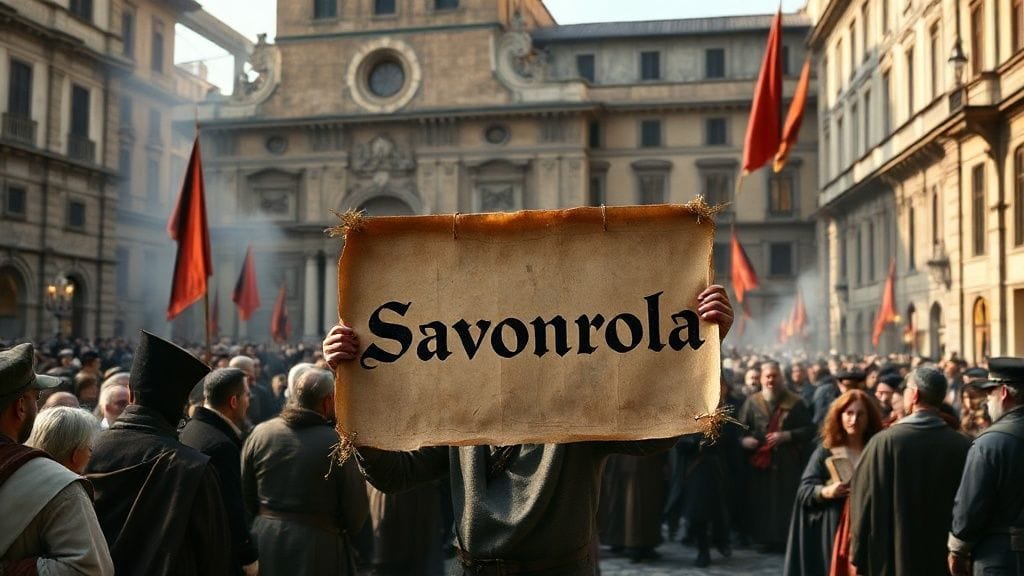
The culmination was merciless and gripping. On a cold spring evening, Savonarola was dragged to the same piazza where once he had thundered against evil, now to face death. Bound to a wooden stake and draped in white shrouds, his last words danced between prayer and prophecy. The executioners lit the pyre, and with the hiss of burning flesh and the flares of smoke, the city watched its mercurial prophet consumed. His ashes scattered not just to the wind, but into the collective memory of Florence — a burning question between sanctity and heresy.
The Aftermath in Florence: A City Shaken and Silenced
Savonarola’s death did not silence the turmoil. His followers mourned and decried injustice; opponents breathed a fragile sigh of relief. Yet Florence was left scarred — a city grappling with spiritual vacancy and political fragmentation. The Medici would eventually return, but the shadow of Savonarola’s sermons haunted artistic works, civic thought, and religious debates for decades. The extravagance and humanism of the Renaissance bore an indelible imprint of his austere yet passionate vision.
Savonarola’s Legacy: Prophet, Martyr, or Heretic?
History has struggled to pin Savonarola into neat categories. Some see him as a visionary reformer, illuminating sins concealed by gilded facades. Others cast him as a fanatic whose zeal extinguished pluralism and led to repression. His prophetic voice is echoed in later reformers’ critiques of Church corruption. His martyrdom questions what it means to speak truth to power, and whether moral absolutism is a strength or a peril.
The Broader Context: Renaissance, Reform, and the Seeds of the Reformation
Savonarola’s story is a prelude to seismic shifts in European religious life. Decades before Martin Luther’s theses, Florence saw the turbulent intersection of faith, politics, and culture. The preacher’s calls for church reform reverberated beyond Italy’s borders, hinting at the coming Reformation and the fracturing of Christendom. His demise underscored the risks inherent in challenging established religious authority amid changing societal tides.
The Personal Dimension: Savage Piety and Fragile Humanity
Behind the austere robes and incendiary rhetoric lay a deeply complex man — prone to intense asceticism, yet also beset by moments of doubt and frailty. Contemporary accounts describe a man who walked the edge between divine inspiration and human frailty, whose charisma drew thousands yet alienated others. In examining his letters and sermons, the turbulent inner world emerges: a soul tormented by the weight of the mission imposed by God, a figure of passion and paradox.
Artistic Memory: How Savonarola Inspired Painters and Writers
Savonarola’s impact transcended politics and theology — it seeped into culture. Artists grappled with his legacy, depicting his death and persona with ambivalence. From renaissance paintings showing the bonfires to later literary dramatizations, his figure became a symbol of divine wrath, prophetic hope, or tragic downfall. His influence can be traced in works ranging from Botticelli’s rumored association with his circle to modern theatrical renditions. Art became a vessel for the unresolved tensions stirred by Savonarola’s life and death.
Reflections from Contemporaries: From Machiavelli to Villari
Niccolò Machiavelli, who lived through Savonarola’s era, offered nuanced perspectives, contemplating the preacher’s political and moral complex. Later historians like Pasquale Villari revived interest in Savonarola in the 19th century, reinterpreting him through the lens of nationalism and reform. These reflections reveal how Savonarola’s story serves as a prism through which to understand power, faith, and resistance. The contentious dialogue between praise and criticism continues to animate scholarly debate.
Modern Reinterpretations: Savonarola in Historical Scholarship and Popular Culture
Today, Savonarola fascinates historians and the public alike. His figure embodies the paradoxes of the Renaissance — progress and repression, reform and fanaticism. Modern scholarship has nuanced the simplistic heretic/saint dichotomy, situating him within broader currents of religious, political, and cultural upheaval. Cinema, novels, and even video games have reimagined his legacy, attesting to the enduring human fascination with the man who dared to challenge powers far beyond Florence’s walls.
Conclusion
As flames consumed Girolamo Savonarola on that fateful May evening in 1498, Florence watched more than the death of one man — it witnessed the violent clash of ideals, fears, and passions that defined an era. His life was a storm of zeal and doubt, conviction and conflict, a mirror reflecting the contradictions of a city at the crossroads of history. The echoes of his voice argue timeless questions: What is the price of speaking truth to power? How far should one go in the name of faith and justice? Centuries later, his story resonates, reminding us that history is not merely the record of events, but the shared soul of humanity wrestling with its own conscience.
FAQs
Q1: Who was Girolamo Savonarola?
A Dominican friar from Ferrara, Savonarola became a radical preacher in Florence advocating for religious reform and moral purity during the late 15th century.
Q2: What led to Savonarola’s rise in Florence?
The political upheaval following the Medici’s expulsion, combined with widespread corruption and religious anxiety, created fertile ground for his prophetic and reformist messages.
Q3: Why was Savonarola executed?
He was charged with heresy, sedition, and insulting the pope, following clashes with political and ecclesiastical authorities who felt threatened by his incendiary reforms.
Q4: What was the Bonfire of the Vanities and why is it significant?
A public burning of books, artworks, cosmetics, and luxury goods, it symbolized Savonarola’s campaign against moral decay but also illustrated the extremes of his austere vision.
Q5: How did Florence change after his death?
The city fell into political chaos and spiritual uncertainty, eventually seeing the return of the Medici, but Savonarola’s legacy influenced ongoing debates about faith and power.
Q6: How do historians view Savonarola today?
As a complex figure — neither solely a martyr nor a fanatic — whose life illuminates tensions between religious idealism and political realities in Renaissance Italy.
Q7: What impact did Savonarola have on the wider Reformation movement?
Though predating Protestant reforms, his emphasis on church corruption and calls for moral renewal foreshadowed many Reformation themes.
Q8: Are there any artistic or literary works inspired by Savonarola?
Yes, from Renaissance paintings possibly linked to his followers, to modern historical novels and plays, his life continues to inspire creative expression.