Table of Contents
- The Final Curtain: January 27, 1901, Milan
- A Life Composed in Grandeur: Giuseppe Verdi’s Early Years
- The Rise of a Musical Titan: Verdi's Path to Immortality
- Italy on the Brink: Political Turmoil and Nationalism in Verdi’s Time
- The Man Behind the Legend: Personality, Beliefs, and Private Life
- Milan—The Heartbeat of Italian Opera and Verdi’s Chosen Stage
- The Last Days: Verdi’s Health and the Gathering Storm
- The Silent Farewell: The Moment of Passing
- Public Mourning: Milan Reacts to the Death of a Maestro
- National Reverence: How Italy Grieved Verdi’s Loss
- Verdi’s Legacy: The Continuation of an Italian Epic
- The Political Symbolism of Verdi’s Passing
- Remembering the Maestro: Funerary Rites and Memorials
- Verdi’s Influence on 20th Century Music and Culture
- Echoes Through Time: How Verdi’s Death Shaped Modern Italy
- The Composer’s Final Notes: Reflections on Mortality and Art
- From Milan to the World: Global Repercussions of Verdi’s Death
- The Historic Burial Place: Verdi’s Resting Place in Milan
- The Composer as National Icon: Myth and Reality
- Art and Politics: Verdi’s Life as Italy’s Soundtrack
- Conclusion: The Immortal Voice of Giuseppe Verdi
- FAQs: The Final Questions About Verdi’s Death and Legacy
- External Resource
- Internal Link
The Final Curtain: January 27, 1901, Milan
The air in Milan was heavy that January day—an austere cloud of winter fog and collective grief. The city that had long crowned itself as Italy’s opera capital found itself silenced, the streets strangely subdued as news spread that the towering figure of nineteenth-century music, Giuseppe Verdi, had passed away. Not a mere composer, but a symbol of Italy’s very soul, Verdi had breathed life into a nation’s hopes and heartbreaks through melodies that swelled with passion and patriotism. On January 27, 1901, as the golden light dwindled over the Alps, a light in Milan’s cultural firmament was extinguished—one whose echoes would resonate far beyond the opera houses and concert halls of Italy.
A Life Composed in Grandeur: Giuseppe Verdi’s Early Years
Born in 1813 in the humble village of Le Roncole, near Busseto, in the Duchy of Parma, Giuseppe Verdi entered a world brimming with challenges and opportunity. From the very beginning, his life was marked by an indomitable spirit and a prodigious gift. Surrounded by modest surroundings, the young Verdi’s genius was nurtured by relentless study and a fierce determination. His early musical education, though often fraught with obstacles, was the first movement in the symphony of a life destined for greatness.
Verdi’s humble beginnings would forever shape his empathy for the common people, a theme that would ripple through his future operas with an authenticity that resonated deeply with audiences across Italy’s fragmented states.
The Rise of a Musical Titan: Verdi's Path to Immortality
The opera stage would become Verdi’s battlefield and canvas. With his first major success, Nabucco (1842), renowned for the potent chorus "Va, pensiero," Verdi tapped into the veins of Italian nationalism and collective identity. His music was more than artistry—it was an anthem, a call for unity at a time when Italy was fragmented by foreign rule and internal conflict.
Each subsequent opera, from Rigoletto to Il Trovatore and La Traviata, revealed a composer maturing in emotional depth and political relevance. Verdi’s mastery of melody and drama didn’t just entertain; it inspired. His works punctuated the Risorgimento, the movement towards Italian unification, becoming intertwined with the country’s quest for liberation and pride.
Italy on the Brink: Political Turmoil and Nationalism in Verdi’s Time
Verdi’s life spanned decades of seismic political upheaval. The Italian peninsula was a patchwork of duchies, kingdoms, and foreign dominions—each with its own interests and rulers. The push for a unified Italy, driven by a surge of nationalist fervor, was a cause few could articulate as powerfully as Verdi through his operas.
“Viva VERDI” became a secret slogan, its acronym standing for Vittorio Emanuele Re D’Italia (Victor Emmanuel King of Italy), linking the composer’s genius directly to the political cause. Verdi’s music became a clandestine rallying cry in cafés and piazzas, fanning the flames of patriotism with songs that transcended mere notes.
The Man Behind the Legend: Personality, Beliefs, and Private Life
Despite his public stature, Verdi was a man of complex contradictions. Known for his fiery temperament, deep patriotism, and unshakable devotion to his craft, he was also deeply private, even melancholic. His personal life was marked by tragedy—the loss of his wife and children left scars that imbued his music with shades of sorrow and resilience.
Friends described Verdi as both irascible and tender, a man who could command stages and salons alike, yet yearned for simple moments away from the spotlight. His letters and personal reflections reveal a philosopher of melody, wrestling with mortality, art, and the burden of fame.
Milan—The Heartbeat of Italian Opera and Verdi’s Chosen Stage
Milan was no accident as the place where Verdi spent his final years. The city’s Teatro alla Scala was the pulsing heart of Italian opera—the epicenter where Verdi’s masterpieces regularly premiered and where his genius was immortalized in standing ovations.
The city’s political climate, intellectual circles, and cultural institutions made Milan the natural home for a composer who was both an artist and a nationalist symbol. Milan embraced Verdi not just as a citizen, but as a key architect of Italy’s cultural identity.
The Last Days: Verdi’s Health and the Gathering Storm
As the dawn of the twentieth century approached, Verdi’s health began to decline. The strong man who had once conducted with commanding vigor was now frail, battling ailments that signaled the closing act of a storied life. Surrounded by a close circle of family and friends, Verdi endured these final days cloaked in quiet dignity.
Yet even in deterioration, his mind wandered upon his musical legacy and the Italy that had embraced him so fully. There was a serene acceptance, a readiness to bow out after a lifetime devoted to elevating collective human emotion.
The Silent Farewell: The Moment of Passing
On the 27th of January, 1901, Giuseppe Verdi passed away in Milan, closing a chapter that had reshaped Italian culture forever. The world lost not just a composer, but a voice that had spoken to struggles, dreams, and identity with unparalleled eloquence. The moment itself was simple—a man drawing his last breath—but its echoes were anything but.
Public Mourning: Milan Reacts to the Death of a Maestro
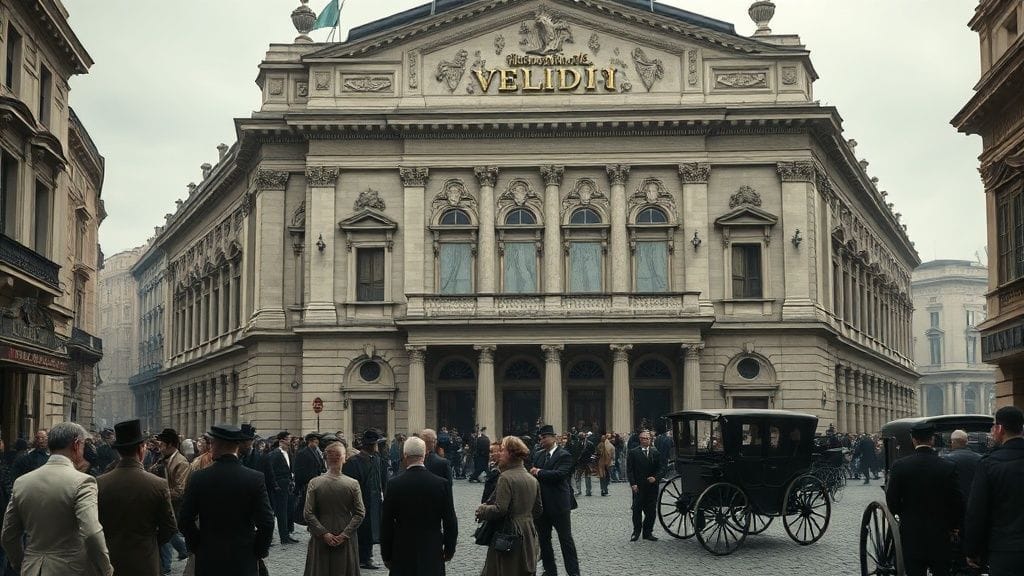
The death sent ripples through Milan’s streets and squares. Newspapers halted their regular editions to dedicate front pages to Verdi’s memory. Theatres dimmed their lights, and citizens donned black in respect. While the city and, indeed, the nation, grieved collectively, the mourning carried a deep intimacy—as if losing a beloved family member.
A spontaneous outpouring of sorrow took over Milanese life, with thousands visiting Verdi’s home and the nearby theatres to pay tribute to a maestro whose music had become part of their own stories.
National Reverence: How Italy Grieved Verdi’s Loss
Verdi’s death was not a local event—it was a national tragedy. Across Italy, bells tolled and flags flew at half-mast. In Rome and Naples, Turin and Venice, people gathered to commemorate a giant whose life had been entwined with the country’s emergence from division to unity.
Political leaders, artists, musicians, and ordinary citizens contributed to the chorus of remembrance. Verdi was celebrated as a unifier, a cultural hero whose memory transcended class and politics.
Verdi’s Legacy: The Continuation of an Italian Epic
The end of the composer’s life was only the beginning of his mythic journey through history. Verdi’s works continued to be performed and reinterpreted, influencing generations of musicians and listeners worldwide. His operas became staples of the repertoire, embodying universal themes of love, power, sacrifice, and freedom.
Institutions in Milan and beyond established museums, archives, and festivals in Verdi’s honor, immortalizing not only his music but the spirit of an era that Italy identified with.
The Political Symbolism of Verdi’s Passing
Verdi’s death came at a delicate moment in Italian politics. The newly united Italy was still grappling with regional disparities and political tensions. His passing was seen symbolically as the close of an epoch—the Risorgimento generation itself now departing.
Politicians invoked his memory to inspire unity, while debates raged about how to preserve the cultural and political legacy that Verdi’s life epitomized. The composer remained (and remains) a potent emblem of Italian nationalism and identity.
Remembering the Maestro: Funerary Rites and Memorials
The funeral procession was a grand spectacle of respect and veneration. Processions winding through Milan’s streets carried the composer’s coffin, witnessed by throngs of mourning citizens. Ceremonies combined solemnity with celebration, blending religious rites with musical homage.
Subsequent memorials, statues, and dedications around Italy paid homage to Verdi’s enduring presence—not only as an artist but as a symbol of Italy itself.
Verdi’s Influence on 20th Century Music and Culture
Verdi’s death echoed beyond opera houses into the very fabric of 20th-century music and culture. Composers like Puccini, Rossini, and later generations looked to his dramatic intensity and melodic richness as benchmarks of excellence.
His works infiltrated popular culture, inspiring filmmakers, poets, and political activists. The voice of Verdi became synonymous with the passion and complexity of Italian — and indeed, universal — human experience.
Echoes Through Time: How Verdi’s Death Shaped Modern Italy
Verdi had bridged the old world and the new, and his passing marked a cultural watershed for Italy. The values embedded in his compositions—hope, unity, struggle—continued to fuel Italian artistic and political movements well into the modern era. Today, Verdi lives not only in scores but in the collective memory of a nation always in search of harmony.
The Composer’s Final Notes: Reflections on Mortality and Art
In his final years, Verdi reportedly reflected on the transitory nature of human life versus the permanence of art. While the body fades, the music endures—an immortal echo carrying the composer’s voice across time.
This profound meditation on mortality gave new poignancy to Verdi’s works, transforming them into timeless monuments of human passion and aspiration.
From Milan to the World: Global Repercussions of Verdi’s Death
While rooted in Italian soil, Verdi’s fame was global. His death prompted tributes worldwide: in Paris, London, New York, and beyond. Musicologists and historians hailed the end of a master whose influence transcended borders.
International opera houses staged commemorations and retrospectives, reminding the world of the profound humanistic messages embedded in Verdi’s oeuvre.
The Historic Burial Place: Verdi’s Resting Place in Milan
Verdi was laid to rest in the Casa di Riposo per Musicisti, a retirement home for musicians he had founded. His tomb in Milan remains a pilgrimage site for admirers, standing as a testament not only to his personal generosity but to his lifelong dedication to nurturing musical talent.
The Composer as National Icon: Myth and Reality
Verdi’s image in national mythology often conceals the nuances of his private self—the man behind the heroic composer. Yet, it is precisely this interplay of legend and reality that fuels fascination with Verdi’s life and death. A deeply human figure, immortalized in myth, his story continues to captivate.
Art and Politics: Verdi’s Life as Italy’s Soundtrack
Verdi’s music was never merely entertainment; it was a political act, a soundtrack to Italy’s rebirth. His death closed the chapter on a pioneer who understood the power of art to move nations and shape ideology. This intertwined legacy endures as a beacon of culture and activism.
Conclusion
Giuseppe Verdi’s death on that cold January day in Milan was more than the passing of an extraordinary composer—it was the farewell of a man who had given voice to the hopes, sorrows, and dreams of an entire nation. His music, steeped in passion and rebellion, became the anthem of a people longing for unity and respect. As Italy mourned its maestro, it also inherited a legacy—a timeless soundscape of human emotion and national identity that continues to resonate in theatres and hearts around the world.
The final note of Verdi’s life did not fade into silence; it transformed into a lasting symphony of culture, politics, and art. The maestro’s immortal voice, born from the small village of Le Roncole and concluding in Milan’s grandeur, remains an eternal testament to the power of music to reflect and shape humanity itself.
FAQs
Q1: What were the main causes leading to Verdi's death in 1901?
A1: Verdi died after a period of declining health due to natural causes associated with age. He was 87 years old, and though specifics about his medical condition are sparse, his death was peaceful, following a lifetime of physical and emotional hardship.
Q2: How did Milan specifically react to Verdi's death?
A2: Milan, as Verdi’s cultural home, reacted with profound mourning. Theatres dimmed their lights, newspapers dedicated special editions, and masses of people took to the streets to honor the maestro’s memory through public ceremonies and personal tributes.
Q3: In what ways was Verdi's death significant for Italian nationalism?
A3: Verdi’s death symbolized the end of a foundational era in Italian nationalism—the Risorgimento. His music had been a rallying cry for unity, and his passing marked the closing of the generation that had forged modern Italy, amplifying his place as a national icon.
Q4: What was Verdi’s relationship with Milan throughout his life?
A4: Milan was central to Verdi’s career and legacy. The city housed La Scala, where many of his operas premiered, and it served as his final residence. Milan embraced Verdi as a native son and cultural patriot, making the city a key stage for his life’s drama.
Q5: How has Verdi’s death influenced music and culture after 1901?
A5: Verdi’s death sparked a wave of commemorations and solidified his position as a foundation of operatic and classical music heritage. His stylistic innovations and dramatic sensibilities deeply influenced 20th-century composers and remain a benchmark in the operatic canon.
Q6: Where is Verdi buried, and why is that place significant?
A6: Verdi is interred at the Casa di Riposo per Musicisti in Milan, a retirement home for musicians he founded. This place is symbolic of his lifelong commitment to supporting music and musicians beyond his own career.
Q7: Did Verdi receive any state honors at his death?
A7: Yes, numerous state and cultural institutions honored Verdi posthumously, including official commemorations, monuments, and public ceremonies reflecting his status as a national treasure.
Q8: How is Verdi remembered in modern Italy today?
A8: Verdi is revered as a cultural titan and a symbol of Italian heritage. His operas are regularly performed, and his life and works remain integral to Italy’s national identity, taught in schools and celebrated in cities from Milan to Busseto.