Table of Contents
- Rome on the Edge: The World of the Year 32
- The Making of a Consul: Lineage of Gnaeus Domitius Ahenobarbus
- Lucius Arruntius Camillus Scribonianus: The Quieter Partner in Power
- Tiberius in Seclusion: An Emperor Governing from Afar
- The Shadow of Sejanus and the Politics of Fear
- The Consular Elections of 32: Ceremony under Suspicion
- “Gnaeus Domitius Ahenobarbus Consul”: Prestige, Ancestry, and Ambition
- Ruling from the Curia: Daily Life of the Consuls
- Senate Debates, Treason Trials, and the Paralysis of Fear
- The People of Rome: Rumors, Spectacles, and Silent Anxiety
- Families, Marriages, and Dynastic Calculations
- Across the Empire: Provinces under the Consuls’ Gaze
- Religion, Omens, and the Gods of an Uneasy Year
- The Legacy in Blood: From Ahenobarbus to Nero
- From Consular Dignity to Civil War: Scribonianus and the Future
- How Historians Remember 32: Tacitus, Suetonius, and Beyond
- Conclusion
- FAQs
- External Resource
- Internal Link
Article Summary: In the year 32 CE, while Emperor Tiberius ruled the Roman Empire from distant Capri, the consuls in Rome—Gnaeus Domitius Ahenobarbus and Lucius Arruntius Camillus Scribonianus—stood at the visible apex of civic power in a city suffused with fear and suspicion. This article explores how the title gnaeus domitius ahenobarbus consul signified not only public honor but also entanglement in the volatile politics of the Julio-Claudian regime. Through vivid reconstruction of daily routines in the Senate, the atmosphere of treason trials, and the murmurs of the urban crowd, we follow the consuls across a tense political landscape. We trace the aristocratic lineages that placed them in office, showing how Ahenobarbus’s bloodline led eventually to Nero, and how Scribonianus’s career prefigured later rebellion. We situate their consulship within the broader context of Tiberius’s isolation, the recent fall of Sejanus, and the spreading culture of denunciation. The narrative weaves between high politics and ordinary lives, between the official dignity of office and the quiet dread that permeated Rome. In doing so, it shows how one seemingly ordinary consular year became a hinge in the story of imperial autocracy and dynastic fate. The article finally considers how ancient historians crafted their portraits of 32 CE, and what that reveals about memory, power, and survival in early Imperial Rome.
Rome on the Edge: The World of the Year 32
The year 32 opened in Rome not with triumphant fanfare, but with a nervous shiver. From the rooftops of the Subura to the colonnades of the Forum, the city wore a strange mask—outwardly calm, inwardly afraid. It was an empire at its territorial height, yet its political heart trembled. The Emperor Tiberius, once a stern but visible figure in the capital, was far away on the rocky island of Capri, shrouded in rumor and recrimination. In his absence, familiar forms still moved—the Senate met, magistrates were elected, laws were passed—but these forms were hollowed out by suspicion.
At the center of those forms stood two men: Gnaeus Domitius Ahenobarbus and Lucius Arruntius Camillus Scribonianus, the pair of consuls for 32 CE. On calendars inscribed in stone, their names fixed the year itself. On official documents, decrees, and treaties, they were the temporal markers, the label that said: this happened when Gnaeus Domitius Ahenobarbus and Lucius Arruntius Camillus Scribonianus were consuls. For Romans, time was not numbered but named, and that year belonged to them. To say “gnaeus domitius ahenobarbus consul” was to anchor oneself in a world of privilege, lineage, and concealed risk.
Yet behind the solemnity of their titles and the austere white of their togas, the political landscape was jagged. Only a few years earlier, in 31, the powerful Praetorian Prefect Lucius Aelius Sejanus, once Tiberius’s trusted right hand, had been suddenly destroyed—arrested in the Senate, dragged away, and executed. His statues were torn down, his memory cursed, his allies hunted. The shock of that reversal still reverberated through the corridors of power when Ahenobarbus and Scribonianus entered office. Conspiracies had been unearthed, or at least alleged; more would almost certainly be invented. No one could be sure where the next denunciation would fall.
Rome seemed stable, yet every surface hinted at hidden fractures. Grain ships continued to arrive at Ostia; fountains still ran in the forums; traders hawked goods from Syria and Gaul. Gladiatorial schools trained their fighters, priests tended the fires of Vesta, and builders laid new bricks in the endless project of remaking the city. The daily rhythm of life did not stop. But in the Senate House, the mood was very different: words were weighed like gold, glances measured, friendships quietly reassessed. The year 32 was, in so many ways, an exercise in controlled panic.
As the new consuls took up their office on the Kalends of January, the people watched them process toward the Capitol. The lictors walked ahead, fasces on their shoulders, a visible reminder of the power to command and punish. But it is astonishing, isn’t it, how those same symbols could conceal a kind of helplessness? For beneath the republican costume lay imperial reality. The consuls might preside over the Senate and give their names to the year, but all truly decisive authority radiated from Capri, where Tiberius brooded over reports and letters from Rome. The consuls walked a tightrope between tradition and subordination, display and dependency.
This was the stage on which the words “gnaeus domitius ahenobarbus consul” gained their full meaning. It was not merely a title, not only a step in the cursus honorum. It was an inscription written over a year of trials—both legal and moral; a badge that revealed the resilience of aristocratic ambition and the fragility of public courage. To understand that year, we must first understand the men who wore the office, the paths that brought them there, and the heavy shadow cast over them by an emperor who ruled from a distance yet intruded into every thought.
The Making of a Consul: Lineage of Gnaeus Domitius Ahenobarbus
The family of Gnaeus Domitius Ahenobarbus was one of those Roman lineages that seemed woven from legend and steel. The name itself—Ahenobarbus, “bronze-beard” or “red-beard”—reached back into myth. According to tradition, a forefather had been greeted by the gods on a battlefield, his black beard miraculously turning fiery red as a sign of divine favor. Later generations carried the name as a kind of hereditary omen, flaunting it in politics, in war, and in the Senate.
By the early first century CE, the Domitii Ahenobarbi had become deeply entangled with the ruling Julio-Claudian house. Gnaeus’s father, Lucius Domitius Ahenobarbus, had already been consul in the chaotic year 16 BCE and triumphed as a naval commander. The family’s wealth derived from extensive estates, especially in Italy, and its prestige from a long record of high office. Yet in Rome, pedigree was never enough; it had to be constantly reaffirmed through service—and through visibility.
This was where the title “gnaeus domitius ahenobarbus consul” would later resonate. It marked the reassertion of a family that had sometimes stood at the edge of power and sometimes in its very center. Years before he donned the consular toga, Gnaeus had navigated the familiar rungs of the cursus honorum: likely beginning with junior magistracies, perhaps having served as quaestor, then as praetor. Each of these offices offered a chance to display gravitas: managing public finances, presiding over courts, or governing a province. Each was also an opportunity to misstep in an age when imperial favor could shift without warning.
But the most critical aspect of Ahenobarbus’s rise was his proximity to the imperial family. He had married Agrippina the Younger, great-granddaughter of Augustus, daughter of Germanicus, a woman who embodied the tensions of dynastic politics. Their union was more than personal; it was a calculated bond between ancient nobility and reigning dynasty. From this marriage would be born Lucius Domitius Ahenobarbus—the future emperor Nero. In that sense, every decision made by Gnaeus in 32, every stance he took in the Senate, was cast in a longer shadow than he could possibly have imagined.
To his contemporaries, however, he was not yet the father of Nero; he was a senator of stern bearing, with the sharp-edged dignity typical of his house. Ancient writers like Suetonius later paint him as harsh, arrogant, even cruel in private life, yet such traits were not disqualifying in Roman elite culture. On the contrary, a certain severity could be read as moral firmness, a readiness to enforce discipline—qualities admired in public office. The honor of “gnaeus domitius ahenobarbus consul” thus fused public expectation with private temperament; he was expected to embody both the antiquated republican ideal and the new reality of imperial service.
In a Rome still haunted by the memory of the late Republic, the Domitii stood as living reminders of the old order. His ancestors had marched with consular armies, debated with Cicero’s generation, and seen the Republic collapse into civil war. Now their descendant occupied the highest magistracy in an empire that maintained those same republican institutions as careful fictions. Ahenobarbus’s very presence in the consul’s chair was a performance: a reenactment of past freedom, staged in a political theater whose script was written by the emperor.
Yet this was only the beginning of the story. To grasp what it meant to be gnaeus domitius ahenobarbus consul, we must place him alongside his colleague, a man of different background but equal rank, sharing responsibility in that anxious year.
Lucius Arruntius Camillus Scribonianus: The Quieter Partner in Power
Lucius Arruntius Camillus Scribonianus was, in some ways, the inverse of his colleague. Where Ahenobarbus was marked by the glamor of an ancient, widely-known name, Scribonianus embodied a quieter, more composite heritage. His very name hints at multiple familial strands: “Arruntius” linking him to a respected senatorial house; “Camillus” evoking the old patrician Furius Camillus line; “Scribonianus” pointing toward adoption or maternal descent from the Scribonii. In the intricate web of Roman aristocracy, identity was often layered, a mosaic built of marriages, adoptions, and ancestral claims.
Though less prominent in later literary tradition than his colleague, Scribonianus was no minor figure. He had earned enough prestige to reach the consulship under Tiberius—a feat impossible without a solid record and at least tacit imperial approval. We can safely infer, based on patterns of the period, that he had held previous magistracies and likely governed either a minor province or at least commanded military forces in some capacity. In a system that prized experience in both civil and military roles, he would have needed to demonstrate competence and loyalty alike.
His temperament remains partly obscured by the silence of our sources. Yet silence in ancient history is rarely accidental; it often mirrors the deliberate self-effacement required for survival under the early emperors. Where a more flamboyant or controversial figure might draw comment from historians like Tacitus, a careful, cautious senator could leave only a faint trace. And in a year like 32, caution could be the highest political art. Scribonianus’s presence beside Ahenobarbus at the apex of civic life suggests a man adept at balancing outward obedience to imperial directives with the internal expectations of the Senate aristocracy.
In later decades, another Lucius Arruntius Camillus Scribonianus—likely his son or close kinsman—would become infamous for launching a rebellion in Dalmatia against the emperor Claudius in 42 CE. That uprising, swiftly crushed, shows that in this family lineage there smoldered at least a potential for defiance against imperial control. When we look back, the consul of 32 seems like an early node in that story, a man whose experience in an era of fear and denunciation would shape the political atmosphere in which his successors acted.
But in that year, he was primarily a partner: sharing the fasces, alternating the chair in the Senate, lending his name alongside “gnaeus domitius ahenobarbus consul” to official acts. In public processions, their lictors marched paired; in decrees, their names were carved or inked together. The consulate was always a dual office, a reminder of republican ideals of collegiality and constraint. Two men, each with the power to veto the other, each theoretically an equal. Yet under an absentee emperor and the never-absent memory of Sejanus, that ideal of mutual independence had grown thin.
Still, to many eyes in Rome, Scribonianus would have personified a promise of stability. His very lack of dramatic notoriety might have been reassuring: here was a man who would not rock the ship of state, who would steer the familiar course of routine business. Beneath the surface, however, the waters were more turbulent than anyone dared admit aloud.
Tiberius in Seclusion: An Emperor Governing from Afar
When Gnaeus Domitius Ahenobarbus and Lucius Arruntius Camillus Scribonianus began their consular year, the man who truly commanded the empire was absent. Tiberius Caesar, the second emperor of Rome, resided thousands of steps away on Capri, a rugged island in the Bay of Naples. From there, he oversaw an empire of tens of millions of subjects. The physical distance was small in geographical terms; in psychological and political terms, it was an abyss.
Tiberius’s withdrawal from Rome had begun years earlier, but its effects had grown more pronounced by 32. The emperor, increasingly disillusioned with the intrigues of the capital and perhaps haunted by his own family tragedies, preferred the company of a small, controlled circle. Reports speak of astrologers, informers, and a carefully curated retinue. From Capri, he dispatched letters—cold, precise, and sometimes deadly. Tacitus, our most somber chronicler of this era, remarks that under Tiberius “the forms of the ancient constitution were retained, but the reality of power had moved elsewhere” (cf. Tacitus, Annals).
This long-distance rule shaped the daily lives of the consuls. Every major decision carried out in the Senate risked later scrutiny by an emperor who was not present to be persuaded or mollified in person. A delicate fiction had to be maintained: the Senate deliberated “freely,” yet always with one ear inclined toward Capri, listening for the unspoken will of the absent princeps. The consuls, as presidents of the Senate, became interpreters of silence.
The assassination of Sejanus in 31 had been orchestrated through such correspondence. A carefully crafted letter from Tiberius had been read aloud in the Senate, its gloomily ambiguous tone turning suddenly to accusation. The great Praetorian Prefect, who had once seemed destined to succeed Tiberius, was arrested before the expectant eyes of the senators. By 32, the echo of that event still reverberated. Every time a letter from Capri was announced, hearts pounded. Would it contain praise? Instruction? Or a death sentence?
In this environment, the formal dignity of “gnaeus domitius ahenobarbus consul” acquired a paradoxical meaning. Traditionally, the consulship had confided immense independence to its holder—especially in times when the Senate truly ruled. Under Tiberius’s remote yet pervasive control, however, the office became largely ceremonial in public but crucially sensitive in private. Ahenobarbus and Scribonianus had to manage the Senate’s proceedings in such a way that imperial policy was advanced without seeming to be coerced, while also shielding themselves from the accusation of either servility or defiance.
From Capri, Tiberius watched. Information flowed to him through a network of officials and informers: provincial governors, military commanders, members of the Praetorian Guard, and private agents. The consuls, depending on how they were perceived, could be presented to him as loyal facilitators, as dangerous independents, or as timid functionaries. In a world where reputation could kill, perception was everything.
Yet, behind the celebrations that still marked the opening of their term—the sacrifices, the Senate meeting on the first day of the year, the rituals on the Capitol—there lay an unspoken understanding: whoever wore the consular insignia did so under the gaze of a distant, inscrutable ruler. The year 32, therefore, was not just “the time of gnaeus domitius ahenobarbus consul”; it was one of the clearest demonstrations of how much the consulship had changed in the age of emperors.
The Shadow of Sejanus and the Politics of Fear
To walk through the Forum in 32 was to move through a landscape recently re-edited by power. Where once stood gilded statues of Lucius Aelius Sejanus—on pedestals, in colonnades, at crossroads—there were now empty bases, hastily chiseled inscriptions, or newly rededicated monuments. Official memory had been violently rearranged. The man who had seemed almost a co-ruler with Tiberius was now an official non-person, condemned by the Senate, his name cursed and erased.
But erasure on marble could not so easily wipe away the imprint of fear he had left on human minds. Under Sejanus’s ascendancy, Rome had seen an expansion of the maiestas (treason) trials. The charge was elastic, capable of stretching to cover almost any act perceived as disrespectful to the emperor or the state. Words spoken in private, gestures interpreted unkindly, mere association with the wrong people—any of these might be twisted into treason. When Sejanus fell, the machinery he had helped engineer did not disappear. It simply changed hands.
For the consuls of 32, this meant presiding over a Senate haunted by ghosts—not only the memory of Sejanus himself, but the specter of future accusations. To speak, to vote, even to remain silent could be dangerous. Did too much praise of Tiberius sound like flattery in the style of Sejanus? Did too little praise suggest hidden disloyalty? Every senator had to navigate between these extremes, often choosing the safest of all options: conspicuous conformity.
The phrase “gnaeus domitius ahenobarbus consul” appears in surviving documents as a marker of the year, but behind that neutral formula lay countless fraught sessions of the Senate House. Some senators had lost relatives to the purges; others had gained property and prestige from the fall of Sejanus’s faction. Old alliances had dissolved overnight. New alliances were not openly declared, only guessed at. In such an atmosphere, the consuls’ role as moderators of debate became psychologically exhausting.
Tacitus, again, is our most eloquent witness to this climate. Describing earlier years under Tiberius, he writes of “grim silence, and muted complaint” and of senators whose “faces guarded their thoughts, and their thoughts guarded their lives.” In 32, that defensive habit had hardened into second nature. Behind every vote, every senatorial decree, each acquittal or condemnation, the fear of imperial reaction loomed.
The consuls had to manage treason trials or at least oversee the procedural landscape in which they occurred. That did not necessarily make them villains; more often, it made them reluctant functionaries of a judicial system designed to instill terror. Some judgments might have been genuinely believed, others extracted by dread or opportunism. For someone like Ahenobarbus, known for a certain hardness of character, the line between stern justice and ruthless compliance may have been thin. For Scribonianus, whose later family history suggests a capacity for resistance, these years of enforced conformity may have planted seeds of discontent that would bear fruit in the next generation.
Yet, amidst all this, Rome continued to live: contracts were signed, marriages celebrated, temples repaired. The paradox is jarring. The year of gnaeus domitius ahenobarbus consul was one of simultaneous normality and terror, a city going about its business under a sky thick with unspoken dread.
The Consular Elections of 32: Ceremony under Suspicion
Long before the first day of January, the year of any consul began in the Forum—at the elections. In the Republic, the consuls had been elected by the popular assemblies, the comitia centuriata, meeting in the Field of Mars. By the time of Tiberius, the forms of this process remained, but the reality had changed. The emperor nominated candidates, often informally; the Senate confirmed them; the people played a largely ceremonial role. Yet the process still mattered, not only for law but for spectacle.
In the late months of 31, as Rome reeled from the fall of Sejanus, the names of Gnaeus Domitius Ahenobarbus and Lucius Arruntius Camillus Scribonianus would have been circulated. They were not unexpected outsiders; both had the standard qualifications, the expected rank. But in a city that now saw conspiracies everywhere, even something as traditional as a consular list could raise murmurs. Were these men chosen for their loyalty to Tiberius? Their distance from Sejanus? Their balance of prestige and pliability?
The assemblies met under the watchful eyes of magistrates and soldiers. Citizens cast their votes—or appeared to. The outcome, virtually assured in advance, was announced with solemn ritual. Heralds proclaimed the names, scribes recorded them; the crowd murmured polite applause. In that moment, the words “gnaeus domitius ahenobarbus consul” leapt from private expectation into public fact.
It is important to remember that Romans, even under emperors, cherished the continuity of their institutions. Those who gathered to witness or participate in the election could still recall stories of contest and rivalry in the days before Augustus, when consular campaigns were fierce, expensive, and dangerous. Now, while true competition had faded, the outward choreography persisted. People still spoke of “standing for the consulship,” of “winning” or “losing” it, even when the real battlefield had moved into the emperor’s private council.
But this was only the beginning of the consuls’ year. Once elected, they entered a liminal period before formally taking office. During this time, they prepared their staffs, consulted with allies, visited temples, and perhaps most importantly, tried to read the political weather. How far would Tiberius involve himself in Rome’s daily business from Capri? Would more purges follow, or would the emperor be satisfied with the blood already spilled in 31? No one could be sure, and the consuls least of all.
On the eve of their inauguration, as they contemplated the white-bordered toga of office laid out in their homes, both men stood on the threshold of a year that promised honor and threatened danger. In official inscriptions, their names together would define 32 for all subsequent generations. In private, they could only guess at what that year might do to them personally.
“Gnaeus Domitius Ahenobarbus Consul”: Prestige, Ancestry, and Ambition
There was a certain magic in hearing one’s name pronounced in the formal formula of Roman timekeeping. “In the consulship of Gnaeus Domitius Ahenobarbus and Lucius Arruntius Camillus Scribonianus…” So would begin decrees, treaties, even private legal documents. The phrase “gnaeus domitius ahenobarbus consul” thus echoed in courts, councils, and marketplaces. It was, for twelve months, inseparable from the concept of the present.
For Ahenobarbus himself, this must have stirred a complex pride. He bore a name heavy with expectations. His ancestry carried tales of stern republican virtue, of military exploits and senatorial authority. His marriage into the imperial family added another layer: he was not only an aristocrat but also a link in the chain that connected Augustus to future generations. Ambition was almost a family duty. To reach the consulship was to fulfill an obligation. Yet in the age of emperors, the full freedom of that ambition was tightly caged.
The irony was sharp. In the late Republic, a man of Ahenobarbus’s lineage might have aspired to lead armies independently, to vie openly for supremacy, even to challenge rivals on the battlefield. Now, such aspirations were muted, channeled into more subtle avenues—court influence, senatorial prestige, marriages, patronage networks. The consulship, once a launching pad for greater personal power, had become more of a destination, a ceremonial peak that one ascended with imperial permission and descended with careful gratitude.
Still, within these limits, ambition did not die. It simply adapted. Each appearance of the phrase “gnaeus domitius ahenobarbus consul” on a public inscription or official document reinforced the status of his house, gave weight to his patronage, and shaped the memories of those who came after. Roman politics was a long game: reputations accrued over decades, and the glory of one generation nourished the claims of the next. When his son Nero later asserted his right to rule, the fact that he was the son of a consul—of this consul—would count in the calculus of legitimacy.
Ancient sources hint that Ahenobarbus was not beloved. Suetonius, peering back from the age of the Flavian emperors, speaks of his cruelty and arrogance, telling stories of how he reportedly ran over a boy with his chariot rather than slow his horses, or forced men to fight wild animals in mock hunts. Whether these stories are wholly true, exaggerated, or shaped by hostility toward Nero’s lineage is impossible to say with certainty. What matters for our story is how such a character fit into the role of consul in the year 32.
It is easy to imagine his stern figure presiding in the Senate, voice controlled but commanding, the red-bearded ancestor’s mythic ferocity translated into judicial austerity. In a year when any misstep could be fatal, a certain icy detachment might even be seen as prudence. Yet one wonders: did the harshness ascribed to him intensify the cold atmosphere of fear? Or was it merely one more shard in an already jagged landscape?
In any case, the formula “gnaeus domitius ahenobarbus consul” was much more than a line on a calendar. It fused prestige and anxiety, ambition and limitation, family legacy and imperial oversight. Within that single formula, Rome’s complex transition from republic to principate was written in miniature.
Ruling from the Curia: Daily Life of the Consuls
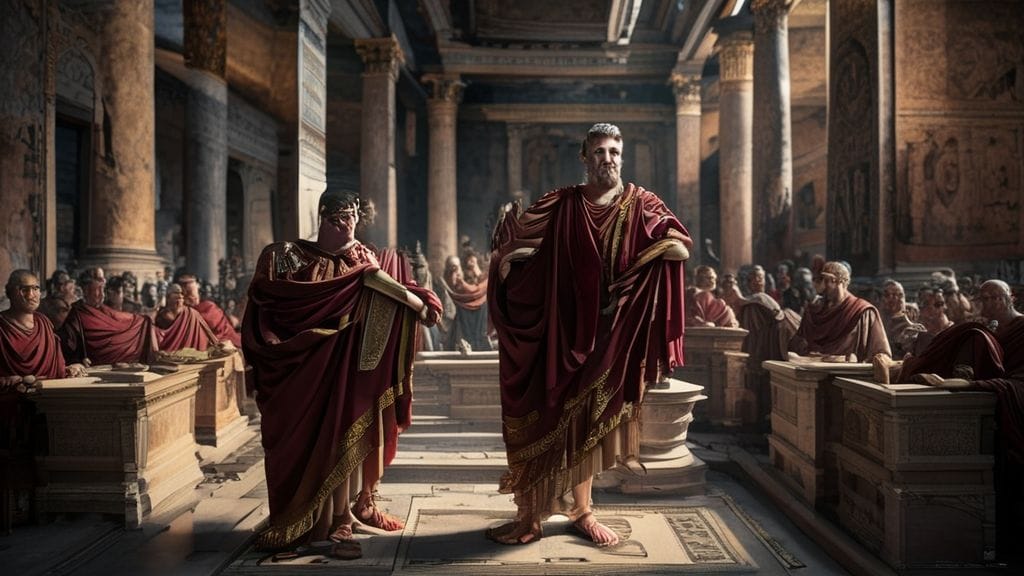
On most mornings of 32, as the sun climbed over the Palatine and lit the columns of the Forum, the consuls began their ritualized workday. Their lictors assembled before their homes, the bundle of rods and axe—the fasces—resting on their shoulders. Attendants and clients gathered at the door, waiting to join the procession. When Gnaeus Domitius Ahenobarbus emerged in his broad-striped senatorial toga, the scene would have been familiar to generations: the hum of greetings, the shuffle of sandals, the thud of rods as the lictors cleared a path through crowds.
The consul’s destination was often the Curia Julia, the Senate House built under Julius Caesar and completed by Augustus. There, he would ascend the low steps, mount the central dais, and take his seat in the curule chair. On alternate months, that honor belonged to Scribonianus. The rotation was a visible reminder that, whatever the reality of imperial dominance, the old idea of shared magistracy still lived on in form.
The agenda of the Senate varied: debates on provincial administration, finance, public works, religious matters, and, increasingly, treason cases. The consuls called on speakers, maintained order, and framed proposals. They also announced letters from Tiberius, having them read aloud to the assembly. Each such letter turned the session into a kind of theater: senators leaning forward, searching the lines for hints of favor or disfavor, measuring the emperor’s mood from afar.
Outside the Senate, the consuls had judicial responsibilities, especially in high-profile cases. They might preside over trials, appoint special commissions, or oversee appeals. Their decisions could shape careers, families, and fortunes. In a city where status was everything, the consuls’ rulings could make or unmake reputations overnight. Yet they themselves lived under the constant judgment of the man on Capri and the revolving gaze of their peers.
On festival days, their role shifted from administrators to public exemplars. They presided over religious ceremonies, offered sacrifices at major temples, and sometimes sponsored games. The sight of “gnaeus domitius ahenobarbus consul” leading a procession up the Capitoline Hill, flanked by priests and followed by the Senate, would have reassured many ordinary Romans: whatever rumors spread about Capri, the gods were still honored, the rituals observed. Continuity of ritual masked discontinuity of power.
In private, the consuls dealt with petitions. Ambitious young men sought their endorsement for lower offices. Provincial delegations begged for favorable consideration in tax burdens or local disputes. Friends and relatives pressed for help in court cases or financial troubles. Patronage flowed through their homes like water through aqueducts—sometimes clear, sometimes muddied by self-interest. To be seen entering or leaving a consul’s house could itself be a political statement.
Yet even the most confident figure had to tread lightly. A recommendation too strongly expressed might seem an attempt to sway imperial judgment. A refusal, if poorly worded, could create an enemy. The daily life of a consul in 32 was less about grand heroic gestures than about the meticulous management of words, favors, and appearances.
Senate Debates, Treason Trials, and the Paralysis of Fear
The heart of Roman public life still beat in the Curia, but it was a heart racing with anxiety. Under the watchful eyes of Ahenobarbus or Scribonianus, the senators filed in, each taking his seat according to rank: consulars at the front, praetorians and lesser magistrates behind. The marble walls echoed with the rustle of togas and the low murmur of greetings. Yet beneath the surface courtesies lay calculation. Who had been seen recently with whom? Who was whispering? Who avoided meeting whose gaze?
When a treason case came before the house, the tension thickened. An accuser—sometimes a personal enemy, sometimes a professional informer—would lay out the alleged offense: a careless remark about Tiberius, a supposed astrological prediction of the emperor’s death, an ill-considered inscription, even a failure to adequately honor imperial images. The accused might plead, deny, or remain silent. His friends sat rigidly, torn between loyalty and self-preservation.
The consul presiding had to maintain procedure. He called on speakers in turn, ensured that legal formalities were observed, and eventually organized the vote. But in such cases, law was only half the story. The other half was fear. Senators knew that an acquittal against the emperor’s unspoken wishes could be fatal. They also knew that a too-zealous conviction might later be judged excessive if imperial winds shifted. Tacitus offers chilling accounts of such debates: “Some, in their eagerness to win favor, went beyond the cruelty of the times; others, out of fear, followed them.”
In this environment, the role of “gnaeus domitius ahenobarbus consul” was acutely sensitive. His own vote, his tone when summarizing arguments, his decision about when to call for the division of the house—all sent signals. Did he incline toward severity, thereby demonstrating his loyalty but perhaps increasing the Senate’s servility? Or did he sometimes temper accusations, risking suspicion of softness? Our sources do not provide a transcript, but the structure of the system makes clear how constrained he would have felt.
The psychological impact on the Senate was profound. Speech became a minefield. Once a place of robust debate, the Curia in 32 was a chamber of strategic silence and carefully calibrated praise. Proposals in honor of Tiberius—new statues, new vows for his health, new festivals—were advanced and approved not only out of genuine reverence but out of the need to perform unanimity. Any hint of dissent could be magnified into disloyalty.
Still, some business proceeded without immediate danger: discussions of provincial roads, grain supply, or local disputes. In such matters, senators could display technical expertise and even frank disagreement. But the specter of maiestas hovered just beyond the perimeter of every conversation, ready to break in. The year 32 thus crystallized a pattern that would mark much of early imperial history: a formally functioning Senate operating under the invisible but constant pressure of autocracy.
The People of Rome: Rumors, Spectacles, and Silent Anxiety
While the Senate wrestled with its nightmares in the Curia, the Roman populace navigated a different but related world of fear and fascination. In the crowded insulae of the city’s poorer districts, people told stories—half fact, half rumor—about what was happening on Capri. Some swore that Tiberius spent his days in philosophical contemplation, reading Greek tragedies and discussing astrology with scholars. Others whispered of darker pursuits: cruel entertainments, secret executions, unspeakable pleasures. The truth, veiled by distance and propaganda, remained elusive.
For ordinary Romans, the names of the consuls—Gnaeus Domitius Ahenobarbus and Lucius Arruntius Camillus Scribonianus—were not abstractions. They appeared on public notices, on the headings of court documents, on the dating clauses of contracts. They were announced in official proclamations and repeated by heralds at festivals. To the baker selling loaves near the Circus Maximus, the formula “in the consulship of Gnaeus Domitius Ahenobarbus and Lucius Arruntius Camillus Scribonianus” simply meant: this is now. Yet even he might feel the chill of political change when a neighbor vanished after an accusation, or when rumors spread that another noble had been condemned.
The city’s entertainment life continued, though even the arena could become a stage for politics. Games sponsored by the consuls or other magistrates served as safety valves for popular discontent and as showcases of elite generosity. Gladiatorial combats, chariot races, staged hunts—all offered a space where people could shout, cheer, and forget for a moment the invisible strings of power that bound their lives. But sometimes, the crowd’s mood turned. A poorly timed spectacle, a mismanaged distribution of grain, or a rumor of senatorial corruption could incite booing or even unrest.
The consuls paid attention. No prudent magistrate ignored the voice of the Roman crowd. Letters to Tiberius might downplay tension, but reports from informers ensured that imperial ears heard the street’s whispers sooner or later. Ahenobarbus and Scribonianus, as the year’s leading magistrates, were responsible in part for maintaining public order and ensuring the urban plebs did not erupt into riot. Their choices about how to respond to minor disturbances—pardon, punishment, or simple inattention—could set the tone for their entire term.
In the markets, gossip merchants flourished. Who had been seen leaving whose house at dusk? Which senator had stopped speaking in the Curia? What new letter had arrived from Capri? Each piece of hearsay was polished by repetition. In a city where open criticism of the emperor was dangerous, jokes, allegories, and coded stories did the work of dissent. A witty lampoon scratched on a wall might speak more truth in a few lines than a dozen senatorial speeches.
Yet, for all the unease, there was resilience. Families celebrated births, mourned deaths, arranged marriages. Tradesmen apprenticed their sons, midwives eased labor pains, schoolmasters drilled children in Greek and Latin. The year marked by “gnaeus domitius ahenobarbus consul” thus contained multitudes: fear at the top, survival in the middle, and stubborn everyday life at the bottom.
Families, Marriages, and Dynastic Calculations
Among Rome’s elite, family strategy was politics by other means. In 32, behind the public scenes of Senate and Forum, aristocratic houses negotiated marriages, reconciled feuds, and crafted alliances designed to last generations. For a man like Gnaeus Domitius Ahenobarbus, already married into the imperial family, these calculations took on an especially intense character.
His wife, Agrippina the Younger, carried within her veins the complex legacy of Augustus’s dynasty: the idealized memory of Germanicus, her father; the troubled story of her mother, Agrippina the Elder; and the fading echo of Augustan moral ideals. This marriage was not only a union of two individuals but a fusion of myth and power. Their child, the young Lucius Domitius Ahenobarbus, would later become Nero, an emperor whose reign would shock even a world accustomed to cruelty and magnificence. In retrospect, the consular year of his father appears as a prelude to that later drama.
Other families watched closely. An alliance with the Domitii Ahenobarbi, especially now that “gnaeus domitius ahenobarbus consul” was on every official’s lips, could be a route to influence. At dinner parties on the Palatine, in garden peristyles lit by oil lamps, senators and their wives discussed suitable matches: daughters to be married off, sons seeking promising brides. Ahnobarbus’s connections to the ruling house made him both desirable and dangerous as a partner in such plans.
Scribonianus’s family pursued its own calculations. Bearing the names Arruntius and Camillus, he straddled different strands of aristocratic identity. Marriages into or out of his house would have been weighed with care: proximity to imperial favor on the one hand, the need for a margin of independence on the other. The later rebellion of his kinsman in 42 suggests that this family did not see its fate as wholly bound to the fortunes of the Julio-Claudians. But in 32, such potential defiance lay hidden beneath polite negotiations and celebratory banquets.
Women, often omitted from the formal record, played crucial roles in these strategies. Mothers lobbied for their children’s interests, wives relayed confidences from one circle to another, sisters acted as go-betweens in reconciliation attempts. Agrippina herself, still relatively young in 32, would later demonstrate how potent a politically engaged Roman woman could be—first as the wife of the emperor Claudius, then as the mother and manipulator of Nero. The household of “gnaeus domitius ahenobarbus consul” thus became a crucible in which the future of the dynasty was slowly, invisibly forged.
In such a world, affection and calculation coexisted uneasily. A father might genuinely love his daughter, yet arrange her marriage with an eye primarily to political capital. A son might feel genuine admiration for a bride, yet know that her dowry and family connections were the real prize. Under the veneer of domestic tranquility, the same ruthless logic that governed imperial succession shaped the everyday choices of Rome’s ruling class.
Across the Empire: Provinces under the Consuls’ Gaze
From their vantage point in Rome, Ahenobarbus and Scribonianus presided over an empire that stretched from the Atlantic to the Euphrates, from the forests of Germania to the deserts of Egypt. Yet their direct authority beyond Italy was limited. Provincial governors held the day-to-day power, especially in military zones; the emperor himself maintained special control over key regions. Still, the consuls’ year framed the careers of these distant officials. Reports were dated by their names; decisions taken in Syria or Hispania were recorded as having occurred “in the consulship of Gnaeus Domitius Ahenobarbus and Lucius Arruntius Camillus Scribonianus.”
Letters flowed constantly between Rome and the provinces. A governor facing unrest on a frontier, a proconsul dealing with corruption in local tax farming, a military commander requesting reinforcements—all wrote dispatches that might, in time, be read aloud in the Senate. The consuls, as presiding magistrates, controlled when and how such communications were introduced. Their attitude toward provincial complaints could subtly influence outcomes. Did they treat petitions from cities in Asia Minor with sympathetic patience or bored indifference? Did they press for inquiries into abuse by Roman officials or quietly file the complaints away?
Economic currents also ran through their term. The flow of grain from Egypt and North Africa, the movement of tax revenue from the wealthy eastern provinces, the dispatch of soldiers from frontier legions—all were part of the empire’s vast circulatory system. If a major crisis erupted—a famine, a rebellion, a barbarian incursion—the consuls would be involved in drafting senatorial responses, recommending honors or punishments, and communicating with the emperor. Even routine matters, such as confirming a city’s right to hold certain festivals or to erect a new temple to Rome and Augustus, passed through the Senate’s hands.
In this way, the formula “gnaeus domitius ahenobarbus consul” became a faint but pervasive presence at the edges of the known world. A city council in Gaul, reading out a decree, repeated that Roman phrase in a Gallic accent. A Greek-speaking scribe in Asia Minor might render it into Greek characters, anchoring local decisions in the temporal framework of Roman power. The consulship thus served as a kind of imperial clock, ticking in the background of provincial life.
Of course, most provincial subjects cared little who the consuls in Rome were. What mattered to them were their immediate rulers: the governor, the procurator, the local magistrates. Yet the consular year still structured the documents that regulated their lives. Contracts, manumissions, civic honors—all bore the stamp of Roman time. The reach of Ahenobarbus and Scribonianus was, in that sense, more archival than practical, but it was real. History, as it would later be written and read, would remember 32 not as “a distant year under Tiberius” but as “the year when Gnaeus Domitius Ahenobarbus and Lucius Arruntius Camillus Scribonianus were consuls.”
Religion, Omens, and the Gods of an Uneasy Year
Amid political tension and whispered accusations, Romans turned as they always had to the gods for reassurance—or at least for signs. The year 32 saw the regular cycle of festivals and sacrifices: the Lupercalia, the Parilia, the rites on the Capitoline. The consuls, as chief magistrates, played prominent roles in many of these ceremonies. Wearing laurel crowns, accompanied by priests and attendants, they led processions to temples, poured libations on altars, and offered prayers for the safety of the emperor and the empire.
Religion and politics were deeply entwined. To serve as “gnaeus domitius ahenobarbus consul” was not simply to handle legal and administrative tasks; it was to stand before the divine on behalf of the Roman people. A failed sacrifice, a bad omen, or an accidental error in ritual could be seized upon as a sign of divine displeasure. In anxious times, such signs were watched more closely than ever.
The appearance of comets, earthquakes, unexplained portents—these were endlessly discussed. Astrologers, though officially frowned upon when they probed too directly into imperial fate, found a thriving market among both the elite and the commoners. Ahenobarbus, with his family’s mythic connection to divine favor, might have felt particular pressure to present a pious public face. Any hint of impiety could be devastating in a city where even the emperor’s misfortunes were sometimes read as punishment for moral failings.
Temples to the imperial cult played a delicate role. Tiberius himself had been reluctant to accept excessive divine honors while alive, yet local communities across the empire often pressed for the right to build shrines and altars to “Rome and Augustus” and to the imperial family. The Senate, under the guidance of the consuls, sometimes had to arbitrate such requests. Approving too many cult sites might seem like flattery; approving too few might appear to slight local enthusiasm or undercut imperial prestige.
In private, many senators hedged their bets. They honored the traditional gods—Jupiter, Juno, Minerva, Mars—but also consulted foreign cults, eastern mysteries, and personal talismans. The more unpredictable politics seemed, the more attractive it became to seek stability in patterns of stars, in oracles, in sacrificial entrails. The year of “gnaeus domitius ahenobarbus consul” was thus not only a political epoch but a spiritual one, marked by an intensification of the eternal Roman impulse to read meaning into the workings of fate.
Still, religion could be as much a tool as a refuge. Public vows for the health and safety of Tiberius, organized under the consuls’ oversight, bound the community together in a performance of loyalty. To be seen participating eagerly in these rites was prudent; to be seen hesitating could be dangerous. In an age of suspicion, even one’s manner of prayer might be judged.
The Legacy in Blood: From Ahenobarbus to Nero
When history looks back at the year 32, it cannot avoid seeing it through the lens of what came later. The phrase “gnaeus domitius ahenobarbus consul” may have sounded routine to contemporaries, just another iteration of aristocratic success. But to later generations, especially after Nero’s reign, it acquired a darker resonance. This was the man whose blood, mingled with that of the Julio-Claudians, would produce one of Rome’s most infamous rulers.
Nero’s birth in 37, a few years after his father’s consulship, tied the turbulence of Tiberius’s later years to the extravagance and cruelty of the mid-first century. Ancient authors like Suetonius and Tacitus, writing under later emperors, liked to trace the roots of Nero’s character back into his lineage. Ahenobarbus’s reported vices—his brutality, arrogance, and self-indulgence—became part of this genealogical indictment. Whether fairly or not, the father’s consular dignity did little to shield the son from moral censure.
Yet the connection runs deeper than mere character assassination. Ahenobarbus’s consulship represented the integration of an old republican house into the heart of imperial power. By marrying Agrippina, by holding high office under Tiberius, by navigating—however precariously—the new order, he helped cement the fusion of dynastic monarchy with senatorial aristocracy. Nero, when he ascended the throne in 54, stood as the living embodiment of that fusion: emperor by both blood and office, product of both Julio-Claudian myth and republican memory.
The consequences for Rome were profound. Nero’s reign would see further expansions of imperial spectacle, dramatic experiments in artistic self-presentation, and explosive political conflicts culminating in civil war. One cannot blame these later developments solely on the consul of 32, of course, but one can see in that year a key node in the long chain of events leading to them. The consulate of Ahenobarbus gave his house renewed prestige, reinforced its alliances, and placed it firmly within the narrative of imperial succession.
It is tempting to imagine the young Nero, years later, hearing stories of his father’s time as consul: the formal processions, the Senate debates, the letters from Capri. Did he feel pride, envy, or indifference? Did he see in that role an ideal of public service to emulate—or merely a stepping stone to the more absolute power he himself would wield? The sources are silent on these intimate questions, but the structural link between 32 and Nero’s later reign is undeniable.
Thus, the seemingly bureaucratic phrase “gnaeus domitius ahenobarbus consul” becomes, in hindsight, a hinge in Roman history. On one side stands the anxious, controlled autocracy of Tiberius; on the other, the theatrical, often chaotic despotism of Nero. Between them lies a generation shaped by the lessons—and scars—of the year 32.
From Consular Dignity to Civil War: Scribonianus and the Future
The legacy of Scribonianus, though less dramatically famous than that of his colleague, has its own powerful resonance. Around a decade after the consulship of 32, a man of his house, Lucius Arruntius Camillus Scribonianus, governed Dalmatia under the emperor Claudius. In 42 CE, that governor raised the standard of revolt, attempting to pull his legions into opposition against the new emperor.
The rebellion failed quickly. The troops hesitated; loyalty to Claudius—or fear of the consequences of treason—prevailed. Scribonianus, facing defeat, took his own life. Tacitus and other historians report the episode as a brief but significant flare of resistance, a sign that not all senatorial houses were content to submit quietly to imperial domination. That such a figure bore the same composite name as the consul of 32 suggests a familial continuity of ambition and of unease with the new order.
Looking back, one can see the consular year of 32 as part of the prehistory of that revolt. Scribonianus’s experience in a Senate paralyzed by fear, administering justice shadowed by imperial suspicion, must have shaped his and his relatives’ understanding of what life under the Julio-Claudians meant. The lesson may have been twofold: first, that the Senate, for all its forms, lacked the capacity to check an emperor’s will; second, that real change would require risk—perhaps even arms.
Of course, the older Scribonianus of 32 did not himself rebel. He accepted and fulfilled the role of consul, threading the difficult path between loyalty and self-respect as best he could. But the later uprising by his namesake shows how fragile that balance remained. The dignity of the consulship, once a symbol of republican sovereignty, had gradually been repurposed as a badge of subordination. Some could live with that transformation; others could not.
In this light, the pairing of “gnaeus domitius ahenobarbus consul” and “Lucius Arruntius Camillus Scribonianus consul” in 32 acquires symbolic weight. One line would help produce an emperor who embraced and exaggerated the new autocracy; the other would produce a governor who briefly tried to resist it. The year they shared in office stands, therefore, at the crossroads of accommodation and revolt, a moment when the future paths of empire were still, just barely, unsettled.
How Historians Remember 32: Tacitus, Suetonius, and Beyond
Our knowledge of the year 32 rests largely on the work of later historians, especially Tacitus and Suetonius. Writing decades after the events, under different emperors, they approached the reign of Tiberius with a mixture of fascination and moral outrage. For Tacitus, the later years of Tiberius’s rule, including the consular year of Ahenobarbus and Scribonianus, exemplified the corruption of freedom under autocracy. In the Annals, he paints a picture of a Senate cowed by fear, of a city haunted by informers, of an emperor ruling from the shadows. The names of the consuls appear, as always, as chronological markers, but the tone surrounding them is one of lament.
Suetonius, in his Lives of the Caesars, focuses more on personalities and scandal. His account of Tiberius on Capri is filled with salacious detail, much of it likely exaggerated or at least unbalanced. Yet even Suetonius’s gossip-laden narrative reveals the central role of consuls as reference points in imperial chronologies. When he dates events in Tiberius’s and Nero’s lives, he often uses formulas anchored on consular pairs. The phrase “gnaeus domitius ahenobarbus consul” thus becomes, in these pages, a neutral label carrying the weight of highly colored stories.
Modern historians read these sources with caution. They recognize biases: Tacitus’s senatorial perspective, Suetonius’s appetite for anecdote, both authors’ tendency to interpret earlier reigns in light of later crises. Nonetheless, their works remain invaluable. Without them, the consular year of 32 would be little more than a line in a fasti (official calendar of magistrates), a lifeless entry. Through their narratives, the context comes alive: the terror after Sejanus, the absentee emperor, the growing pathology of the treason courts.
Epigraphic and documentary evidence fills in some gaps. Inscriptions from Italy and the provinces record the names of Ahenobarbus and Scribonianus as date markers. Legal texts transmitted through later jurists occasionally preserve clauses that originated in this year. Together, these scattered pieces corroborate the framework within which the historians work, even as they remind us how partial our view remains.
In recent scholarship, the year 32 is often discussed as part of broader studies of Tiberius’s reign, the development of the principate, and the social psychology of political fear. The figure of “gnaeus domitius ahenobarbus consul” appears in monographs about Nero’s ancestry, while Scribonianus surfaces in discussions of senatorial opposition under Claudius. Specialized articles parse the dynamics of treason trials, the role of Capri in imperial self-presentation, and the transformation of the consulship from republican engine of power to imperial ornament and instrument.
And yet, even with all this learning, a large part of 32 remains unknowable. We can reconstruct frameworks, infer motives, imagine atmospheres, but we cannot hear the exact sound of Ahenobarbus’s voice in the Curia or see the flicker of Scribonianus’s expression when a dangerous letter from Capri was read aloud. History leaves us with shadows on stone and words on parchment, from which we must coax a picture of living men navigating a lethal landscape.
Conclusion
The year 32, fixed forever in Roman memory by the names of its consuls—Gnaeus Domitius Ahenobarbus and Lucius Arruntius Camillus Scribonianus—was a turning point disguised as continuity. On the surface, little seemed revolutionary: the Senate met, laws were passed, festivals celebrated. The traditional offices functioned; the same religious rites were observed. Yet beneath that veneer, the nature of power had shifted decisively. The emperor ruled from a distance, his will transmitted through letters and fear. The Senate, once the heart of republican decision-making, had become a stage upon which loyalty was performed and anxiety concealed.
Within this fragile structure, the formula “gnaeus domitius ahenobarbus consul” acquires its full resonance. It names a man whose lineage tied old republican nobility to the emergent dynastic monarchy, whose marriage and offspring would shape the empire’s fate, and whose character, as later portrayed, mirrored the harshness of his times. Alongside him, Scribonianus represented another strand of aristocratic adaptation, one that would, in the next generation, test the limits of imperial tolerance through open rebellion.
The world of 32 was, above all, a world learning to live with permanent autocracy. The institutions of the past remained, but their spirit had changed. The consulship still conferred honor, but its power was circumscribed by the invisible presence of the emperor. Public courage shrank; private fears multiplied. Yet life went on: people traded, married, worshipped, joked, and hoped. The empire’s vast machinery continued to turn, even as some of its gears ground against each other under the strain of mistrust.
By tracing the story of this single consular year, we glimpse the broader arc of Roman history in the first century: from the austere domination of Tiberius, through the theatrical tyranny of Nero, to the eventual explosions of civil war. The names inscribed at the top of decrees—“gnaeus domitius ahenobarbus consul,” “Lucius Arruntius Camillus Scribonianus consul”—are no longer mere chronological labels. They are windows into a world where ancestral honor, dynastic ambition, and the everyday struggle for survival converged in the shadow of an emperor’s distant gaze.
FAQs
- Who were the consuls of Rome in the year 32 CE?
In 32 CE, the Roman consuls were Gnaeus Domitius Ahenobarbus and Lucius Arruntius Camillus Scribonianus. Their names served as the official way to date the year in Roman documents, decrees, and inscriptions. - What does the phrase “gnaeus domitius ahenobarbus consul” signify?
It is the formal designation of Gnaeus Domitius Ahenobarbus as consul for the year 32 CE. Romans named years after the serving consuls, so this formula appears in legal texts, inscriptions, and historical narratives to anchor events in time. - How powerful were the consuls under Emperor Tiberius?
Formally, consuls retained many traditional republican powers: presiding over the Senate, overseeing certain courts, and leading key religious rites. In practice, however, their authority was subordinate to the emperor’s will, especially when Tiberius ruled remotely from Capri and used fear and treason trials to shape political life. - What was the political climate in Rome during the consulate of Ahenobarbus and Scribonianus?
The climate was tense and fearful. The recent downfall and execution of the Praetorian Prefect Sejanus had unleashed waves of treason prosecutions, and the Senate operated under the constant threat of denunciation. Tiberius’s absence from Rome and his rule by correspondence intensified uncertainty and suspicion. - How was Gnaeus Domitius Ahenobarbus related to Emperor Nero?
Gnaeus Domitius Ahenobarbus was Nero’s father. Through his marriage to Agrippina the Younger, a great-granddaughter of Augustus, he connected the old aristocratic Ahenobarbus line to the Julio-Claudian dynasty. Their son, Lucius Domitius Ahenobarbus, would later become the emperor Nero. - Did Lucius Arruntius Camillus Scribonianus or his family oppose the emperors?
The consul of 32 himself did not rebel, but a relative bearing the same name, governing Dalmatia under Emperor Claudius, launched a revolt in 42 CE. The uprising failed, and Scribonianus took his own life, but the event shows that elements within his family were willing to challenge imperial authority. - How do we know about events in the year 32?
Our main literary sources are Tacitus’s Annals and Suetonius’s Lives of the Caesars, which provide narratives of Tiberius’s reign and later Julio-Claudian history. Inscriptions and legal documents, which frequently use the consuls’ names for dating, corroborate the chronological framework and some specific events. - What role did religion play during this consular year?
Religion remained central to public life. The consuls led major sacrifices and festivals, supervised vows for the emperor’s safety, and helped manage requests for imperial cult honors in the provinces. In a period of political anxiety, omens, oracles, and astrological predictions took on heightened significance for both elites and commoners. - Was the consulship still important under the early emperors?
Yes, but in a transformed way. The consulship no longer offered a path to independent supreme power as it had in the Republic. Instead, it became a prestigious office within an imperial system, conferring honor, visibility, and influence, but always under the overarching authority of the emperor. - Why is the year 32 considered historically significant?
While no single spectacular event defines it, 32 illustrates the consolidation of imperial autocracy under Tiberius, the enduring yet hollowed-out forms of republican institutions, and the dynastic positioning of families like the Domitii Ahenobarbi and Arruntii. It stands at a crossroads between the fearful stability of Tiberius’s later years and the more explosive crises that would come under later emperors such as Nero.
External Resource
Internal Link
Other Resources
- Encyclopaedia Britannica – general search for the exact subject
- Google Scholar – academic search for the exact subject
- Internet Archive – digital library search for the exact subject