Table of Contents
- The Dawn of a New Era: Godfrey’s Ascension in Jerusalem
- The Siege that Shaped History: Prelude to the Crusader Kingdom
- From Warrior to Ruler: Godfrey’s Path to Advocatus Sancti Sepulchri
- Jerusalem at the Crossroads: A City in Turmoil and Transition
- The Symbolism of the Title: Understanding Advocatus Sancti Sepulchri
- The Role of Godfrey in the Early Crusader Kingdom
- Building the Foundations: Security and Governance in Jerusalem
- Challenges from Within: Rivalries and Political Struggles
- Godfrey’s Relationship with the Latin Patriarch and the Church
- The Everyday Life under Godfrey’s Rule: Soldiers, Nobles, and Citizens
- Diplomacy and Defense: Threats from the Muslim Neighboring States
- Religious Zeal and its Political Implications in Jerusalem
- The Legacy of Godfrey’s Rule: Bridging East and West
- Death and Succession: The End of an Era
- Historical Interpretations: Godfrey’s Myth and Reality
- The Significance of 1099 in the Crusader Chronicles
- Memory and Mythmaking: Godfrey’s Place in Christian and Muslim Narratives
- Conclusion: The Lasting Echo of a Crusader King’s Rule
- FAQs: Unraveling the Mysteries of Godfrey’s Reign
- External Resource
- Internal Link
1. The Dawn of a New Era: Godfrey’s Ascension in Jerusalem
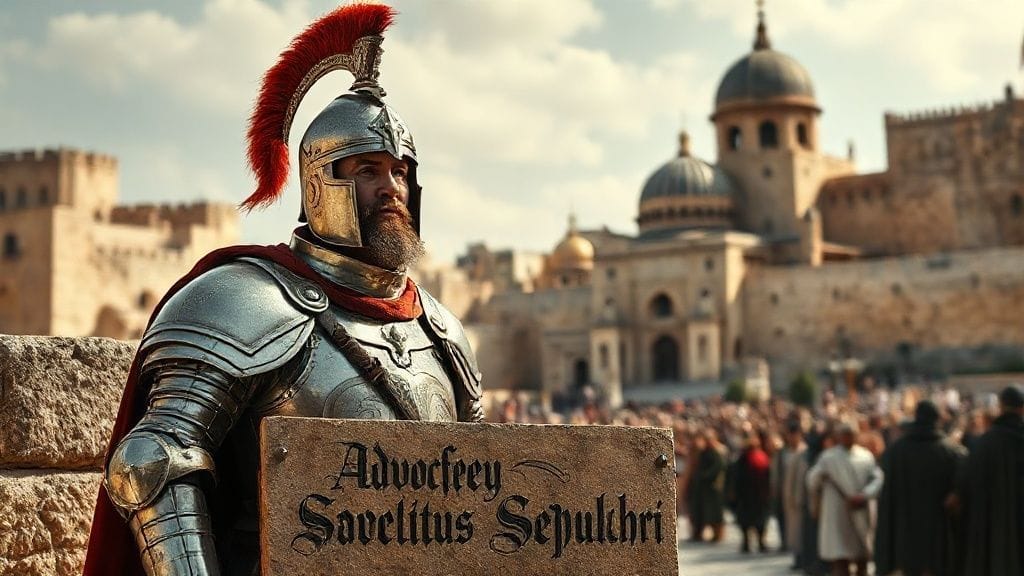
In the sweltering heat of July 1099, as the walls of Jerusalem still bore the scars of the brutal siege that had just ended, a man stood before a city steeped in millennia of sacred history and recent violence. Godfrey of Bouillon, a knight whose name was already whispered across Europe, was about to assume a role unparalleled in its spiritual and political complexity: Advocatus Sancti Sepulchri, the Defender of the Holy Sepulchre.
The atmosphere was taut with anticipation and reverence. Jerusalem had been wrested from Muslim control by a ragtag army of Western Christians, a feat deemed miraculous by contemporaries. Yet, there was no time for celebration, no evident crown to be presented, no pomp befitting kingship. Godfrey declined the title of “king,” opting instead for the title that emphasized guardianship rather than sovereignty over a city considered the spiritual heart of Christendom—and indeed, of the world.
As the sun set over the domes and minarets, city streets echoed with a mix of triumph and uncertainty. It was here, in that precious and perilous moment, that Godfrey stepped forward—not merely as a warrior, but as a custodian of a fragile conquest that would become the foundation of the Kingdom of Jerusalem.
2. The Siege that Shaped History: Prelude to the Crusader Kingdom
The capture of Jerusalem did not occur in isolation. It was the culmination of a grueling, nearly two-month siege that tested the mettle and faith of the Crusader armies. Since their departure from Europe in 1096, the crusaders had marched thousands of miles, through harsh climates and hostile lands, driven by a potent combination of religious fervor and promises of glory.
Jerusalem, governed by the Fatimid caliphate for brief periods and earlier by the Seljuk Turks, had remained a city of intense conflict and strategic value. Its religious significance for Christians, Muslims, and Jews alike elevated it beyond the realm of political conquest into something more sacred—a prize symbolizing divine favor and holy legitimacy.
The siege was marked by hardship: scant food supplies, brutal clashes, and constant sabotage attempts. When the walls finally fell, the Crusaders saw not only victory but the fulfillment of a divine mission. It was against this backdrop that Godfrey emerged, recognized not only for his valor but his noble lineage and perceived piety.
3. From Warrior to Ruler: Godfrey’s Path to Advocatus Sancti Sepulchri
Before his arrival in Jerusalem, Godfrey of Bouillon was already a figure of notable stature in Europe’s feudal tapestry. Born into a noble family in the region that is now Belgium, Godfrey was steeped in chivalric ideals and Christian values. His participation in the First Crusade was motivated by deeply held religious convictions as well as political ambitions.
The choice to grant him the title "Advocatus Sancti Sepulchri" rather than “King of Jerusalem” was emblematic of both the precariousness of the Crusader position and Godfrey’s own sense of humility. The title carried an air of protector rather than monarch, wisely acknowledging Jerusalem’s sacred nature and the hopes placed upon its governance.
Godfrey’s reluctance to crown himself king can also be viewed as a mirror to the tensions within the Crusader ranks, as well as between secular and ecclesiastical powers. His acceptance of the title bridged these divides, setting a precedent for the governance of the nascent Kingdom of Jerusalem.
4. Jerusalem at the Crossroads: A City in Turmoil and Transition
Jerusalem in 1099 was not merely a prize; it was a city caught between eras and cultures. Its population was diverse and fractured, including Muslims, Jews, Eastern Christians, and now an influx of Western crusaders who had brought new languages, customs, and ideologies.
The city’s urban landscape bore the marks of centuries—Roman ruins mingling with Muslim architecture, Christian shrines overshadowed by Islamic minarets. The conquest disrupted a delicate coexistence, and the arrival of Godfrey’s rule introduced new challenges in governance, religious tolerance, and security.
This complex fabric required more than mere military dominance; it demanded a leader capable of navigating cultural fault lines without alienating the city’s multifarious inhabitants. The first months of Godfrey’s leadership would prove to be a trial of his political acumen as well as his spiritual leadership.
5. The Symbolism of the Title: Understanding Advocatus Sancti Sepulchri
The title "Advocatus Sancti Sepulchri," or Defender of the Holy Sepulchre, was more than an honorific—it was a statement about the nature of power in Jerusalem. By refusing the crown, Godfrey distanced himself from conventional kingship notions and instead embraced a role that conferred protector status over the holiest Christian site on Earth.
This approach was both political and deeply symbolic. Godfrey’s title underscored that Jerusalem was a city under the guardianship of Christ, not merely a kingdom to be ruled by mortal kings. It echoed an idea prevalent in medieval Christendom: that temporal power was subordinate to divine authority.
Historians have often debated this point, with some seeing Godfrey’s choice as a pious gesture, while others interpret it as political pragmatism to avoid provoking rival claims or ecclesiastical disapproval.
6. The Role of Godfrey in the Early Crusader Kingdom
Godfrey’s governance can best be understood in the crucible of his time—a fragile moment where military conquest demanded immediate consolidation and the establishment of political legitimacy.
One of his crucial roles was to organize defenses against inevitable counter-attacks by Muslim forces. He began structuring a militia from the diverse crusader forces and managing the city’s fortifications. Equally important was his effort to establish rudimentary administration and judicial structures informed by Western legal traditions, which were alien yet necessary in the Levant.
Godfrey also assumed a symbolic role of uniting various factions within the crusader camp. His noble standing and reputation gave him substantial authority, but tensions between knights, clergy, and settlers were a constant challenge.
7. Building the Foundations: Security and Governance in Jerusalem
The newly constructed Kingdom of Jerusalem was born from violence but had to survive through stability. Godfrey’s immediate priority was to secure the city from external threats. The Crusader leadership was well aware that Muslim powers, particularly under the Fatimid caliphate and the Seljuk Turks, would seek to retake the city.
To that effect, Godfrey commenced building defenses — reinforcing the city walls, organizing patrols, and positioning troops strategically. He also laid the groundwork for a feudal system that would govern land distribution and military obligations, allowing the crusader settlers to settle and cultivate the land.
The administration was heavily militarized, but leaders quickly realized that sustainable governance required infrastructure, taxation, and diplomacy. Godfrey’s balancing act was to hold the conquered city together while preparing for long-term stability.
8. Challenges from Within: Rivalries and Political Struggles
Godfrey’s reign was not without internal strife. The coalition that had taken Jerusalem comprised princes, knights, soldiers, pilgrims, and clerics, many with competing ambitions. The rivalry between Godfrey and other major crusader leaders—such as Raymond of Toulouse and Bohemond of Taranto—was evident, with disputes over territorial control and political precedence.
Moreover, the relationship with the Latin Patriarch of Jerusalem, a powerful ecclesiastical figure, was complex. The Church sought to assert spiritual authority over the city, often clashing with Godfrey’s secular ambitions.
These tensions threatened to fracture the fragile unity essential for the survival of the Crusader state. Yet, Godfrey’s diplomacy and personal stature helped maintain a measure of cohesion during his brief tenure.
9. Godfrey’s Relationship with the Latin Patriarch and the Church
The Latin Patriarch of Jerusalem held immense influence, both spiritual and political. The position was pivotal in legitimizing the Crusader conquest as a holy mission and providing moral authority to the new regime.
Godfrey’s interactions with the Patriarch were characterized by mutual dependence but occasional friction. The religious leader expected deference in spiritual matters, while Godfrey sought to retain control over military and civil governance.
The balance was delicate. Godfrey’s refusal of the royal crown also reflected sensitivity to the Church’s claims that Jerusalem’s ultimate sovereignty belonged to Christ and His representatives—the clergy. This uneasy partnership shaped the early institutional structure of the kingdom.
10. The Everyday Life under Godfrey’s Rule: Soldiers, Nobles, and Citizens
Life in Jerusalem during Godfrey’s rule was one of contrasts: hope mingled with hardship, religious festivity with the trauma of recent conflict. The influx of Crusaders introduced new customs, languages, and beliefs, reshaping the city’s social fabric.
The soldiers, many hardened warriors from across Europe, were both the protectors and the ruling elite. Nobles established themselves on lands seized from Muslims, creating a feudal society transplanted from Europe. Meanwhile, the local populations—Muslims and Jews—faced subjugation, displacement, and in some cases, violence.
Church services and pilgrimages resumed, restoring some normalcy and reinforcing the city’s Christian identity. However, the challenges of rebuilding homes, marketplaces, and places of worship amid a still-tenuous peace remained monumental.
11. Diplomacy and Defense: Threats from Muslim Neighboring States
Godfrey’s rule was defined by an unending awareness of the external threats looming on Jerusalem’s borders. Muslim polities in the Levant, particularly the Fatimids in Cairo and the Seljuk Turks in Syria, viewed the Crusader presence as an affront.
Despite the euphoria of conquest, Godfrey’s early reign required constant vigilance. Raids and skirmishes were frequent, and alliances with local powers were tentative at best. The Crusader leaders sought both military readiness and diplomatic outreach, hoping to buy time and build defensive depth.
Godfrey’s leadership during this precarious period established a military culture that would characterize the Kingdom of Jerusalem for decades to come: a civilization perpetually on guard, aware that their tenuous victory was far from secure.
12. Religious Zeal and its Political Implications in Jerusalem
Godfrey embodied the fusion of martial zeal and devout piety typical of the Crusader ethos. His refusal to be crowned king was as much an act of reverence as it was political calculation, reflecting a belief in divine dictum.
The religiosity of the crusaders was not only personal but also deeply political. The conquest was justified as the fulfillment of God’s will, and administration sought to mirror Christian ideals. Religious orders gained prominence, and the Church exercised considerable influence on laws and customs.
This interweaving of faith and politics cemented Jerusalem’s identity as more than a city; it became a symbol of salvational history and Christian dominion in the East, a beacon for pilgrims and warriors alike.
13. The Legacy of Godfrey’s Rule: Bridging East and West
Though Godfrey’s rule was brief—he died in 1100, roughly a year after his assumption of power—his impact was profound. He laid the foundational structures that enabled the Crusader Kingdom of Jerusalem to survive subsequent decades of warfare.
Godfrey’s leadership forged a bridge between the Western European chivalric world and the complex realities of the Levant. He managed to temper the expectations of a conquering army with the realities of ruling a diverse, sacred city.
His legacy influenced the monarchy that would follow and became enshrined in legend: the humble protector rather than the conquering king, a figure both practical and idealized.
14. Death and Succession: The End of an Era
Godfrey’s death in July 1100 shocked the nascent kingdom. His passing left a power vacuum that would soon be filled by his brother Baldwin of Boulogne, who crowned himself King of Jerusalem, decisively adopting the royal title Godfrey had refused.
This transition marked a turning point: the Kingdom of Jerusalem shifted from a protectorate ethos to a full-fledged monarchy. Baldwin’s reign expanded the Crusader state’s influence, but without the subtlety and moderation that characterized Godfrey’s leadership.
Godfrey’s death closed the first and most fragile chapter of Crusader Jerusalem, casting a long shadow over what followed.
15. Historical Interpretations: Godfrey’s Myth and Reality
For centuries, Godfrey of Bouillon was lionized in Christian Europe, immortalized in chronicles, art, and legend. He became the archetypal Crusader, a paragon of chivalry and piety, often depicted as Jerusalem’s “noble defender.”
Yet modern historians have peeled back layers of mythology to reveal a more nuanced figure: a complex leader striving to balance spiritual ideals with brutal realpolitik. He was neither saint nor mere warrior but a man navigating unprecedented circumstances.
His refusal of kingship has been variously interpreted as humility, strategic acumen, or religious conviction—each aspect reflecting the multilayered legacy Godfrey left behind.
16. The Significance of 1099 in the Crusader Chronicles
The year 1099 stands as a watershed in medieval history. It marked the culmination of the First Crusade’s perilous journey and the establishment of a Western Christian foothold in the Levant that would last nearly two centuries.
Godfrey’s ascent in that year represents the foundation of a new political and religious order, one that would shape interactions between Europe and the Middle East profoundly.
Beyond military conquest, 1099 symbolized the intersection of faith, power, and cultural exchange. It heralded an era where Jerusalem became a nexus of conflict, cooperation, and enduring legend.
17. Memory and Mythmaking: Godfrey’s Place in Christian and Muslim Narratives
The legacy of Godfrey’s rule echoes not only in Christian historiography but also in Muslim and Jewish memories. For Christians, Godfrey is a hero and martyr, a foundational figure of the Crusader ideal.
In contrast, Muslim narratives often remember 1099 as a catastrophe, an era of loss and resistance. Godfrey’s reign is viewed through the lens of invasion and occupation, shaping centuries of hostility and eventual calls for reconquest.
The complex narratives surrounding this figure highlight how history is always intertwined with memory, identity, and struggle.
18. Conclusion: The Lasting Echo of a Crusader King’s Rule
Godfrey of Bouillon’s stewardship over Jerusalem as Advocatus Sancti Sepulchri was not merely a momentary political episode; it was the genesis of a layered, contested, and profound chapter in world history.
His ascension symbolizes the clash and fusion of cultures, the tension between worldly power and spiritual authority, and the enduring human quest for meaning amid turmoil.
Though his tenure was short, the imprint of his leadership reverberates in history and memory alike—a testament to courage, conviction, and the complex legacy of conquest.
FAQs
Q1: Why did Godfrey refuse to be crowned King of Jerusalem?
A1: Godfrey’s refusal was rooted in both religious humility and political sensitivity. He believed that no mortal should wear a crown over the city where Christ suffered and that accepting a royal title might offend the Church or the city’s sacred character.
Q2: What were Godfrey’s main challenges in ruling Jerusalem?
A2: He faced internal rivalries among the Crusader nobility, diverse city populations including Muslims and Jews, ongoing military threats from neighboring Muslim states, and the need to establish new political and religious institutions.
Q3: How did Godfrey’s title “Advocatus Sancti Sepulchri” define his role?
A3: The title designated him as a protector and guardian of the Holy Sepulchre, emphasizing stewardship over direct kingship and highlighting the city’s spiritual significance above temporal rule.
Q4: What was the relationship between Godfrey and the Latin Patriarch?
A4: While they shared a common Christian mission, tensions existed over authority; Godfrey held civil and military power, whereas the Patriarch wielded spiritual leadership, requiring negotiation and mutual respect.
Q5: How did Godfrey’s rule affect the local populations of Jerusalem?
A5: The conquest led to displacement and hardship for many Muslims and Jews, while Crusader settlers imposed European customs and governance, fundamentally altering the city’s demographic and cultural makeup.
Q6: What happened after Godfrey’s death in 1100?
A6: His brother Baldwin succeeded him, taking the royal title of King of Jerusalem, which shifted the kingdom towards a more conventional monarchy and expanded its territorial control.
Q7: Why is 1099 considered pivotal in the history of the Crusades?
A7: The capture of Jerusalem in 1099 marked the climax of the First Crusade, establishing a Western Christian foothold in the Holy Land that defined Christian-Muslim relations for centuries.
Q8: How do modern historians view Godfrey’s legacy?
A8: They see him as a complex figure balancing piety, pragmatism, and leadership under extraordinary circumstances, whose mythic image often masks the nuanced realities of his rule.
External Resource
For a detailed historical overview, visit Godfrey of Bouillon – Wikipedia.
Internal Link
🏠 Visit History Sphere → https://historysphere.com/

