Table of Contents
- The Final Days of a Crusader King
- The Legacy of Godfrey of Bouillon in the Levant
- The Siege of Jerusalem: Triumph and Tragedy
- The Last Moments: July 1100 Unfolded
- Jerusalem at the Dawn of Godfrey's Death
- The Political Landscape of the Kingdom of Jerusalem
- Pilgrims and Warriors: The Human Fabric of the Crusader State
- The Religious Significance of Godfrey's Reign
- Death and Myth: The Circumstances Surrounding Godfrey’s Passing
- The Burial Controversy: Sacred Ground and Political Symbolism
- Succession Crisis: The Question of Jerusalem’s Crown
- The Role of Baldwin of Boulogne in the Aftermath
- The Fragile Stability of the Latin Kingdom
- The Muslim Response to the Death of Godfrey
- The Cultural Memory of Godfrey in Western Christendom
- The Impact on Crusading Ideals and European Perceptions
- Jerusalem’s Iconography: From Godfrey to Modern Imagination
- Archaeological Insights and Historical Records
- Godfrey’s Death within the Greater Crusades Narrative
- The Levant: A Crossroads of Faith and Power
- The Emotional Resonance of Godfrey’s Passing Through Time
- Conclusion: The End of an Era and the Birth of a Kingdom
- FAQs on Godfrey of Bouillon’s Death and Its Impact
- External Resource: Wikipedia Link
- Internal Link: Visit History Sphere
The Final Days of a Crusader King
The sweltering heat of the Levant in the summer of 1100 clung to the stones of Jerusalem as Godfrey of Bouillon, the indomitable crusader knight-turned-ruler, faced his inexorable end. The city, captured with fire and faith less than three years prior, buzzed with the exhaustions of war but also with the fragile hope of peace. From the battlements, the golden-domed city stretched like a promise—vulnerable yet eternal. Yet inside the modest chambers of a plain Jerusalem house, the first ruler of the nascent Kingdom of Jerusalem grappled with a terrible malady. Fever ravaged his body; pain gnawed at his spirit. The leader who had carved a path through blood and betrayal now stared death in the eye, aware that the fate of the fragile Christian foothold in the Holy Land would shift with his last breaths.
The Legacy of Godfrey of Bouillon in the Levant
Godfrey’s rise from a noble knight to “Advocate of the Holy Sepulchre” was marked by valor and continent-shaking ambitions. As one of the principal leaders of the First Crusade, his military prowess and steadfast piety earned him the respect of fellow crusaders and local populations alike. His refusal to wear a crown in the sacred city of Christ—claiming he would not don a kingly crown where Christ had worn a crown of thorns—transcended political symbolism. It embedded Godfrey’s legacy in a confluence of humility and steadfast authority, a beacon around which the crusader states would strive to coalesce.
But as his health dwindled, the fragile political and social edifice he helped construct was poised on the edge of uncertainty.
The Siege of Jerusalem: Triumph and Tragedy
The conquest of Jerusalem in July of 1099 remains one of the most harrowing and decisive moments of the Crusades. Godfrey of Bouillon stood at the forefront of the final assault, a figure both heroic and pragmatic, leading his hardened warriors through battered gates and narrow, winding streets soaked with blood. The victory was a pyrrhic one; sacred spaces were desecrated, and thousands perished in the rampage that followed.
Yet it was this triumph that elevated Godfrey, not to a king, but to a protector of the Holy Sepulchre, a mantle heavy with spiritual responsibility.
Still, the victory unleashed a torrent of political and military challenges that would preoccupy his brief reign—issues that warred alongside his failing body in his final days.
The Last Moments: July 1100 Unfolded
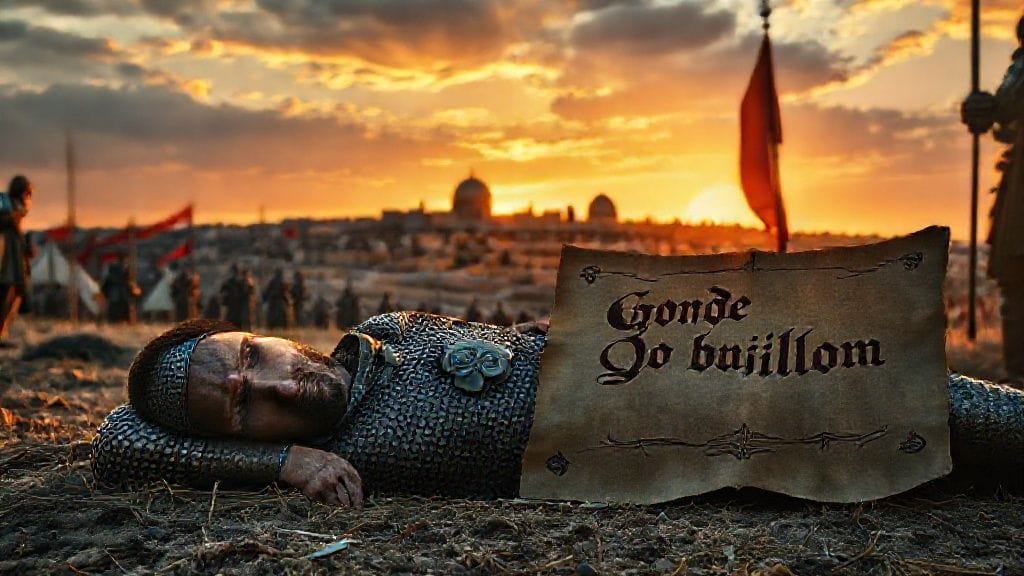
It was on the 18th of July, 1100, barely a year after his enthronement in Jerusalem, that Godfrey of Bouillon succumbed to a fever, likely stemming from battle wounds and the harsh conditions endured during continuous military campaigns. The man who had crossed deserts, rivers, and mountains with an unwavering sense of purpose now faced the quiet expanse of mortality.
Chroniclers describe his deathbed not as a scene of silence but of reverence. Fellow crusaders, clergy, and common folk gathered, mourning the passing of a leader who had become a symbol of divine justice and earthly resolve. Among them, Baldwin of Boulogne, his brother and eventual successor, stood witness to the closing of an epoch.
Jerusalem at the Dawn of Godfrey's Death
Jerusalem in 1100 was an amalgam of the old and new, the sacred and the profane. The Christian conquerors imposed their rule over a city steeped in centuries of Islamic, Jewish, and Christian history. The fortifications were still tenuous, the administrative systems embryonic. The city’s population was a volatile blend: native Christians, Muslim inhabitants, Jewish communities, and the influx of crusaders seeking salvation and spoils alike.
Godfrey’s governance had to balance military defense with intricate diplomacy, fragile alliances with local leaders, and the logistical nightmare of sustaining a foreign army far from home. His illness threw these delicate dynamics into crisis.
The Political Landscape of the Kingdom of Jerusalem
Godfrey’s death did not merely mark the passing of a man; it ushered in an acute political challenge. The Latin Kingdom’s legitimacy relied heavily on his personal stature. Unlike a hereditary monarchy, the crusader states’ leadership often derived from martial merit and religious symbolism more than bloodlines.
Godfrey’s refusal of the royal crown left ambiguous the exact nature of the kingdom’s governance, sowing seeds of contestation that his successors would have to navigate. His demise invited not only internal contest but also emboldened external foes hungry to reclaim lost ground.
Pilgrims and Warriors: The Human Fabric of the Crusader State
Behind the grand narratives of conquest and politics lay the lives of thousands—warriors worn by campaigns, pilgrims drawn by piety, merchants seeking fortunes, and local inhabitants adapting to new rulers. The kingdom was less a monolith and more a patchwork of experiences, fears, and hopes.
Godfrey’s death echoed through this social fabric, stirring anxiety and mourning. For many, he embodied the ideal of the crusader knight, a paragon blending divine mission and martial skill, a living link to Europe’s shared mythos.
The Religious Significance of Godfrey's Reign
Godfrey’s reign was underpinned by profound religious symbolism. His title, “Advocate of the Holy Sepulchre,” emphasized stewardship rather than kingship in a city deemed the earthly seat of Christ’s passion and resurrection.
His death was not merely political loss but a spiritual event, marking a moment when the divine mission and harsh realities intersected tragically. The church played a central role in commemorating Godfrey, intertwining his narrative with sacred history and myth.
Death and Myth: The Circumstances Surrounding Godfrey’s Passing
As often happens with towering historical figures, Godfrey’s death was cloaked in legend and conflicting reports. Some chroniclers suggest he died from complications of battle wounds and fever, while others hint at the toll of relentless campaigns and the psychological burdens of leadership.
His body was said to exude an unearthly fragrance—a sign of sanctity—yet the precise fate of his remains became a subject of dispute and intrigue, reflecting the weight his person carried beyond death.
The Burial Controversy: Sacred Ground and Political Symbolism
Where to lay Godfrey’s body became a contentious issue charged with political and religious meaning. Some accounts hold that he was buried in the Church of the Holy Sepulchre, the heart of Jerusalem’s Christian heritage. Others suggest his grave was concealed or relocated amid ongoing conflicts.
This burial dilemma symbolized a broader struggle over Jerusalem’s sacred geography and the authority the crusader rulers claimed over the city’s holy sites.
Succession Crisis: The Question of Jerusalem’s Crown
Godfrey’s passing precipitated a pivotal succession moment. His brother, Baldwin, already established in Edessa, was invited to ascend as the first King of Jerusalem, a title Godfrey had notably avoided. Baldwin’s acceptance is often seen as the formal establishment of hereditary monarchy in the Latin East.
This transition was crucial in stabilizing the kingdom temporarily but set the stage for future dynastic struggles, shifting the crusader states from charismatic leadership to feudal monarchy.
The Role of Baldwin of Boulogne in the Aftermath
Baldwin’s swift arrival and coronation as King Baldwin I marked an important chapter. Known for his political savvy and military acumen, Baldwin faced the daunting task of consolidating the kingdom amid threats both external and internal.
His reign would build upon Godfrey’s legacy but also redefine the Latin Kingdom’s identity, moving it into a more entrenched monarchical structure with expanded territorial ambitions.
The Fragile Stability of the Latin Kingdom
Despite the symbolic continuity in leadership, the kingdom remained acutely vulnerable. Muslim forces under leaders like Saladin were already regrouping, and internal divisions among the Crusaders and local populations threatened to unravel the fragile alliance that had captured Jerusalem.
Godfrey’s death laid bare the precariousness of the Latin states, a reality that would resonate through the subsequent century of conflict.
The Muslim Response to the Death of Godfrey
The Muslim world, from Damascus to Cairo, viewed Jerusalem’s occupation as an affront, and the death of Godfrey was interpreted both as a moment of opportunity and warning. While some Muslim rulers sought to exploit potential chaos, others began consolidating power in anticipation of future engagements.
The event thus contributed to a complex web of ongoing resistance and pragmatism that defined Muslim-Crusader relations for decades.
The Cultural Memory of Godfrey in Western Christendom
Back in Europe, Godfrey’s image became that of a saintly warrior, a model crusader knight etched into Christian imagination and literature. Chronicles, troubadour tales, and later medieval romances elevated his story into legend, one blending fact and piety.
His death was mourned widely and evoked questions about divine favor and the costs of holy war, shaping European attitudes toward the Crusades.
The Impact on Crusading Ideals and European Perceptions
Godfrey’s life and death crystallized essential themes of the Crusading movement: faith, sacrifice, and the tension between worldly power and spiritual humility. His reluctance to adopt the title of “king” underscored a unique blend of religious devotion and political pragmatism.
The circumstances of his death invited reflections on the mortal limits even of great crusaders, a somber counterpoint to the martial zeal driving the movement.
Jerusalem’s Iconography: From Godfrey to Modern Imagination
Visual representations of Godfrey, from medieval illuminations to modern historical paintings, have contributed to the city’s mythic status. His figure often stands as a symbol of righteous conquest and holy struggle, a motif repeated in art, literature, and popular culture.
This iconography shapes collective memory, weaving Godfrey indelibly into the fabric of Jerusalem’s contested identity.
Archaeological Insights and Historical Records
Recent archaeological work in Jerusalem and surrounding areas offers glimpses into the era of Godfrey’s rule, illuminating the fortifications, everyday life, and religious practices of the early crusader kingdom. Combined with meticulous scrutiny of chronicles, letters, and charters, historians reconstruct the context for his death and its immediate effects.
These findings enrich our understanding, transforming legend into tangible history.
Godfrey’s Death within the Greater Crusades Narrative
Godfrey’s mortality signaled the end of the First Crusade’s initial fervor and the beginning of a protracted struggle for survival and legitimacy in the Holy Land. His death stands as a marker between the chaotic conquest and the nascent institutionalization of Crusader rule.
Understanding his passing helps illuminate the broader trajectory of crusading history into the 12th century and beyond.
The Levant: A Crossroads of Faith and Power
The region Godfrey sought to govern was a medieval cauldron where religions, empires, and peoples intersected. His death occurred not in isolation but amid the relentless tension of competing claims over sacred geography and political dominion.
This rich and troubled backdrop magnifies the significance of his life and passing.
The Emotional Resonance of Godfrey’s Passing Through Time
The death of Godfrey of Bouillon echoes beyond the chronicles and historical analysis—its emotional weight reverberates through centuries as a moment of loss, transition, and reflection on human ambition converging with divine will.
For many, his passing symbolizes the cost of war waged in the name of faith, a poignant human story amid the grandeur of history.
Conclusion
Godfrey of Bouillon’s death on that summer day in 1100 was far more than the demise of a knight-king; it was the closing of a chapter that melded sacred aspiration, brutal warfare, and the fragile creation of a Christian kingdom in an ancient, contested city. His passing underscored the transience of individual glory against the relentless tides of history.
Yet, from this endpoint emerged a new beginning—Baldwin’s coronation, the entrenchment of a feudal kingdom, and a legacy that would resonate through religious, cultural, and political landscapes of Europe and the Levant alike.
Godfrey’s life and death invite us to consider the complexities of leadership amid faith and conflict, the pain of mortal fragility, and the enduring human yearning for meaning in the face of mortality.
FAQs on Godfrey of Bouillon’s Death and Its Impact
Q1: What caused the death of Godfrey of Bouillon?
A1: Historical sources suggest Godfrey died from a combination of fever and complications likely linked to wounds sustained during previous battles, combined with the physical toll of continuous military campaigning in harsh conditions.
Q2: Why didn’t Godfrey accept the title of King of Jerusalem?
A2: Godfrey believed it was inappropriate to wear a royal crown in the city where Christ had suffered with a crown of thorns. Hence, he opted for the title "Advocate of the Holy Sepulchre" to emphasize his protector role rather than kingship.
Q3: What was the immediate political consequence of Godfrey’s death?
A3: His death led to a succession crisis that was resolved when his brother Baldwin was invited to Jerusalem to take the title of King, formalizing the monarchy and stabilizing the Latin Kingdom temporarily.
Q4: How did Godfrey’s death affect relations with Muslim neighbors?
A4: It was seen as a moment of vulnerability and opportunity. Muslim leaders began to regroup and strategize to reclaim territory, marking it as a turning point for ongoing resistance against the Crusader presence.
Q5: Where was Godfrey buried, and why is this significant?
A5: Though accounts vary, it is believed Godfrey was buried in the Church of the Holy Sepulchre. This burial site symbolized his sacred role but also touched political and religious sensitivities about legitimizing Crusader rule.
Q6: How is Godfrey remembered in European history and culture?
A6: Godfrey remains a symbol of chivalry, piety, and the complex interplay between religious zeal and political power, immortalized in chronicles, legends, and artistic depictions that continue to shape Western perceptions of the Crusades.
Q7: Did Godfrey’s death end the First Crusade?
A7: While Godfrey’s death marked the end of the initial conquering phase, it did not end the Crusading efforts, which continued for decades with ongoing military, political, and religious ventures across the Levant.
Q8: What role did Baldwin of Boulogne play after Godfrey’s death?
A8: Baldwin took the crown as Jerusalem’s first king, shifted policies towards establishing hereditary monarchy, and worked to consolidate and expand the Latin Kingdom, shaping the Crusader states for years to come.