Table of Contents
- The Dawning of a New Imperial Order: Europe on the Eve of 1356
- The Holy Roman Empire: Fragmented Thrones and Perilous Power
- Emperor Charles IV: The Man Behind the Golden Bull
- The Journey to Nuremberg and Metz: Setting the Stage for Reform
- The Golden Bull of 1356: A Codex of Power and Ceremony
- Defining the Prince-Electors: Lords of the Imperial Crown
- Electoral Procedure: The Rituals that Shaped Empire
- Balancing Tradition and Innovation: Law Meets Politics
- The Role of the Golden Bull in Stabilizing the Empire
- Reactions and Resistance: Champions and Critics
- The Bull’s Impact on Nobility and Local Powers
- Consequences for Imperial Authority: Strengthened or Shattered?
- Economic Ripples: Trade, Territory, and Power Dynamics
- The Long Shadow of the Golden Bull: From 14th Century to Modern Legacy
- Anecdotes and Voices: Chronicles from the Heart of Nuremberg and Metz
- The Golden Bull in the Broader Context of Medieval Europe
- Cultural and Legal Heritage: The Bull’s Imprint on Later Constitutions
- Lessons from 1356: Governance, Electorate, and Identity
- Historiographical Debates: Interpreting the Bull through Time
- The Golden Bull’s Role in Shaping the Holy Roman Empire’s Fate
- Conclusion: Echoes of Authority in the Golden Bull’s Light
- FAQs
- External Resource
- Internal Link
The clinking of armor and the murmurs of courtiers echoed through the ancient halls of Nuremberg and Metz, cities pulsing with political intrigue and solemn ritual. It was 1356, and Europe held its breath as the Holy Roman Empire sought to codify its fragile heart—its system for choosing emperors. A document, resolute and majestic, was about to be unveiled: the Golden Bull. This decree would forever alter the rhythms of power, embedding legal certainty into a realm ruled by shifting alliances, contested claims, and the ceaseless ambitions of princes.
The Dawning of a New Imperial Order: Europe on the Eve of 1356
The mid-14th century was a Europe ever in flux, suspended between medieval tradition and the cusp of Renaissance change. Kingdoms vast and small jostled for dominance, while the Holy Roman Empire—a vast, sprawling entity combining German principalities, Italian duchies, and Bohemian lands—labored under an increasingly tenuous grasp of imperial cohesion. The Emperor boiled down his authority not merely to conquest, but to the carefully balanced voices of select powerful electors, a mechanism rooted less in written law and more in custom and political expedience.
The continent wrestled with feudal complexities: warlords seeking legitimacy, church authorities vying for spiritual supremacy, and towns emerging as new centers of commerce and influence. Within this whirlwind, the need for clear rules to govern the election of the Emperor became urgent. Uncertainty bred conflict, and conflict threatened the already fragile unity of the Empire.
The Holy Roman Empire: Fragmented Thrones and Perilous Power
From the reign of Charlemagne onwards, the Empire had been a patchwork—its Emperor a sort of “first among equals” rather than an absolute monarch. Power was dispersed across duchies, counties, ecclesiastical territories, and independent cities. But by the 14th century, this dispersion bred disarray. There was no straightforward hereditary succession; instead, the Emperor was chosen by a handful of powerful princes, known as the electors.
Yet, who these electors were, how many votes they held, and especially the procedure of election had never been formally fixed. Intrigues, overlaps in claims, and regional ambitions caused repeated unrest. Disputes over legitimacy rippled through the Empire, threatening its coherence and the prestige of the imperial crown itself.
Emperor Charles IV: The Man Behind the Golden Bull
It was under the astute and ambitious Emperor Charles IV that the seeds of reform finally blossomed. Born Wenceslaus, King of Bohemia, Charles was a shrewd politician and a patron of scholarship and law. His vision for the Empire was one of ordered stability, where power was recognized and circumscribed by law rather than brute force.
Charles’s reign witnessed an appreciation of the intricate political fabric of the Empire and a determined effort to preserve imperial dignity amidst incessant factionalism. His self-fashioning as a philosopher-ruler sought a return to the ideal of a legal and moral order, where hereditary privilege was balanced against formal institutions.
The Journey to Nuremberg and Metz: Setting the Stage for Reform
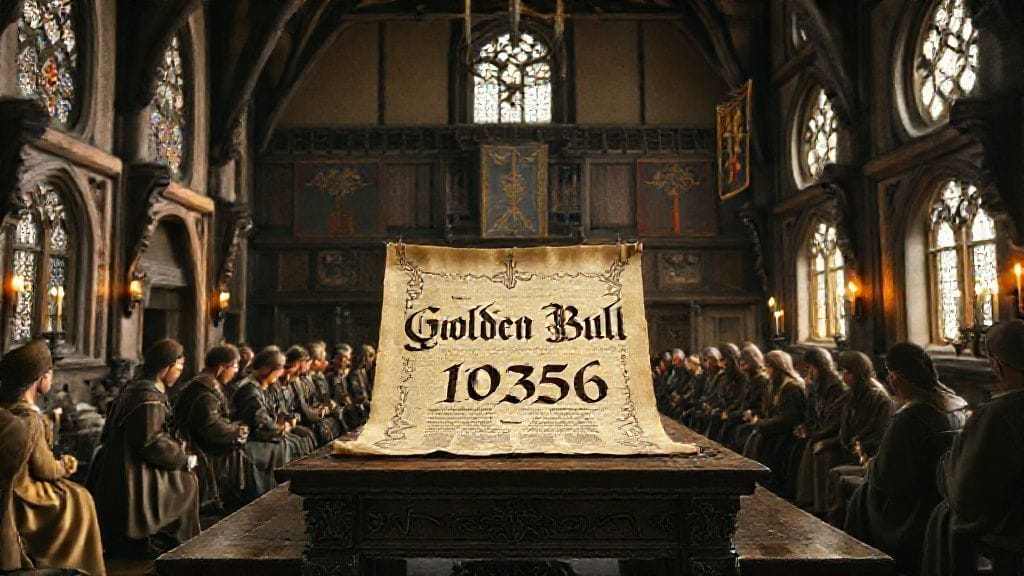
The year 1356 was pivotal. The imperial court gathered for an assembly that would go down in history—the Diet of Nuremberg and subsequently Metz. It was here that Charles IV presented and promulgated the Golden Bull, a document that crystallized centuries of customs, disputes, and conventions into a single, golden-hued legal decree.
Nuremberg and Metz were not arbitrary choices; both cities embodied the spirit of imperial law and culture. They were hubs of commerce, centers of law, and crossroads between East and West. The setting underscored Charles’s intention: to fuse tradition and innovation under the solemn gaze of Europe.
The Golden Bull of 1356: A Codex of Power and Ceremony
At its core, the Golden Bull was a constitutional charter. Its name derived from the golden seal (bulla aurea) affixed to authenticate its authority, but its contents shaped the essence of imperial politics for centuries.
The Bull defined the number of Prince-Electors at seven—three ecclesiastical and four secular rulers—each with privileges and responsibilities clearly set forth. It laid down procedures for the election, residence, coronation, and conduct of these electors, enshrining practices that formalized political power while attempting to curb internal anarchy.
This decree was revolutionary not because it introduced entirely new concepts, but because it inscribed them in permanent law, giving a fragile empire the semblance of order and predictability.
Defining the Prince-Electors: Lords of the Imperial Crown
The seven electors, a mix of spiritual and temporal princes, were the pillars upon which the Empire balanced. The Archbishops of Mainz, Cologne, and Trier represented ecclesiastical power, while the King of Bohemia, the Count Palatine of the Rhine, the Duke of Saxony, and the Margrave of Brandenburg stood as secular giants.
Each elector was granted the right to cast a single, decisive vote in the election of the Emperor. Importantly, the Bull prevented the multiplication of votes or the creation of competing electorates—a move designed to prevent dilution of power and endless disputes.
Moreover, the electors were granted sovereign privileges within their domains, strengthening their authority locally even as they took on a collective imperial function.
Electoral Procedure: The Rituals that Shaped Empire
The Golden Bull was meticulous in detailing how elections were to unfold. From convening the electors at the imperial city of Frankfurt to setting codes of conduct forbidding external interference, it created a ritual of legitimacy.
The elector palatine was named Arch-Steward of the Empire, the Duke of Saxony the Arch-Marshal, and so on, imbuing these roles with elaborate ceremony. The elected King was then required to journey to Aachen—site of Charlemagne’s coronation—to be crowned. Only upon this ritual did the monarch’s authority become “official” within the Empire.
These protocols combined legal precision with theatrical grandeur, strengthening the mystique of imperial authority.
Balancing Tradition and Innovation: Law Meets Politics
The Bull was no mere dry legal text; it was a political masterstroke that balanced the autonomy of princes with the ideal of a united Empire. By institutionalizing the electoral college, Charles IV attempted to reconcile centuries of conflicting claims and unsteady alliances.
Yet it was also a cleverly crafted compromise: while it limited freehold territorial changes of electors, it secured their loyalty through privileges, reverence, and recognition.
It reflected the medieval worldview’s pragmatism: law was as much about preserving power as about justice, and legitimacy flowed from recognized form as much as from deeds.
The Role of the Golden Bull in Stabilizing the Empire
For decades, the Empire had buckled under the weight of fractious contests and competing claims. The Golden Bull offered clarity, setting forth a durable electoral mechanism that curtailed arbitrary election and factional strife.
This codification helped prevent civil wars among princes, ensured succession disputes could be resolved with established procedures, and buttressed imperial authority against encroaching external powers.
In effect, the Bull’s strength lay not in creating a strong centralized monarchy, but in enabling a stable aristocratic order where power was shared and disputed according to rules.
Reactions and Resistance: Champions and Critics
Despite its authoritative tone, the Golden Bull was not universally welcomed. Some smaller nobles and urban entities saw it as cementing the dominance of the electors, threatening their influence.
Opposition also emerged from ambitious nobles excluded from the electoral college, while the papacy viewed the codification warily, concerned it limited church influence over imperial elections.
Nevertheless, many contemporaries hailed it as a triumph of legal order over disorder, a beacon of peace in troubled times. Chroniclers praised Charles IV as a wise and courageous ruler who dared to bring light to the Empire’s darker shadows.
The Bull’s Impact on Nobility and Local Powers
By reinforcing the privileges of the electors, the Golden Bull altered the internal balance of power. Electors became almost sovereign princes, often ruling territories larger than kingdoms elsewhere in Europe.
Smaller nobles saw their estates threatened by the rising autonomy of these princes, and towns likewise struggled to assert their rights.
Yet this hierarchy also allowed for regional identities to flourish within the imperial framework, embedding diversity within unity.
Consequences for Imperial Authority: Strengthened or Shattered?
The Golden Bull’s legacy is paradoxical. On one hand, it strengthened imperial governance by reducing chaos and formalizing succession rules. On the other, by elevating potent regional rulers, it entrenched fragmentation.
The Emperor became more a primus inter pares—a first among equals—rather than an absolute monarch. This constitutional framework shaped the Holy Roman Empire’s character until its dissolution in 1806.
Economic Ripples: Trade, Territory, and Power Dynamics
The stability conferred by the Bull encouraged economic growth in electorates, fostering trade, commerce, and urban development.
Secure succession and fewer disputes allowed investments in infrastructure and fortified towns. Electors leveraged their stature into economic leverage, negotiating privileges such as tolls, market rights, and coinage.
Thus, the Bull’s political codification had tangible impacts on medieval economic life.
The Long Shadow of the Golden Bull: From 14th Century to Modern Legacy
For centuries, the Golden Bull remained a cornerstone of imperial law. Its mechanisms persisted through the Reformation, the Thirty Years’ War, and beyond, shaping the evolving nature of European monarchy and statehood.
Its influence can be traced through legal traditions, political culture, and constitutional practices not only in Germany but across Europe.
Anecdotes and Voices: Chronicles from the Heart of Nuremberg and Metz
Contemporary chronicles reveal colorful scenes: the grandeur of electoral assemblies, the whispered alliances in castle halls, and the tension of rivals waiting in royal chambers.
One tale tells of the Duke of Saxony arriving in a blaze of banners, outshining others, while the Archbishop of Mainz subtly maneuvered behind the scenes. The Golden Bull was not just law, but theater—where destinies were forged in those fleeting, golden moments.
The Golden Bull in the Broader Context of Medieval Europe
The Bull must be understood not in isolation, but as part of a wider European trend towards codified law and constitutional monarchy.
Similar developments in England, France, and elsewhere reflected changing ideas about sovereignty, legality, and governance emerging from feudal complexity.
Cultural and Legal Heritage: The Bull’s Imprint on Later Constitutions
Legal scholars have traced the Bull’s principles into later documents, like the Peace of Westphalia and even modern federalism.
Its emphasis on electoral legitimacy influenced political thought on sovereignty and collective governance, invoking debates still relevant today.
Lessons from 1356: Governance, Electorate, and Identity
The Golden Bull presents a study in governance balancing act: decentralization and central authority, tradition and innovation, power and law.
It reminds us that political stability often demands compromise and that legitimacy arises from shared, accepted rules rather than sheer force.
Historiographical Debates: Interpreting the Bull through Time
Historians have long debated the Bull’s significance. Was it a step toward constitutional monarchy or a conservative charter preserving feudal hierarchy?
Some view Charles IV as a visionary statesman; others see the Bull as cementing aristocratic grip and postponing necessary reforms.
The Golden Bull’s Role in Shaping the Holy Roman Empire’s Fate
Ultimately, the Golden Bull shaped the Empire’s unique character—a fragmented empire held together by law, tradition, and ritual rather than autocracy.
Its legacy is still visible in European history’s layered complexity and the enduring question of how empires maintain coherence.
Conclusion
The Golden Bull of 1356 stands as a monument in the history of governance, a shimmering thread of golden law woven into the vast, complex fabric of the Holy Roman Empire. More than a dry statute, it was a living accord—crafted with care, ambition, and a profound understanding of power’s intricacies.
In codifying who held the right to crown emperors, Charles IV did not merely resolve a political puzzle; he shaped the identity of a realm that, in all its fragmentation and diversity, sought unity through shared ritual and accepted rule. Its echoes resonate through centuries—a timeless testament to the delicate art of balancing sovereignty, privilege, and law.
The Golden Bull reminds us that history’s great moments are as much about the ceremonies and voices in assembly halls as about battles and kings; about crafting laws that breathe life into politics; and about the enduring human quest for order amidst chaos.
FAQs
Q1: What was the primary purpose of the Golden Bull of 1356?
A1: The Golden Bull was designed to formalize and codify the process for electing the Holy Roman Emperor, clarifying the roles and rights of the seven Prince-Electors to prevent disputes and strengthen imperial legitimacy.
Q2: Who were the Prince-Electors named in the Golden Bull?
A2: The Bull affirmed seven electors: three Archbishops (Mainz, Cologne, Trier) and four secular rulers (the King of Bohemia, the Count Palatine of the Rhine, the Duke of Saxony, and the Margrave of Brandenburg).
Q3: How did the Golden Bull affect the power dynamics within the Holy Roman Empire?
A3: It reinforced the authority of the electors, elevating them to near-sovereign princes, which stabilized imperial politics but further decentralized the empire, weakening the emperor’s absolute power.
Q4: Why were the cities of Nuremberg and Metz significant in the promulgation of the Golden Bull?
A4: Both cities were important imperial centers symbolizing legal authority and tradition, providing a fitting stage for promulgating such a pivotal constitutional document.
Q5: Did the Golden Bull resolve all conflicts over imperial succession?
A5: While it reduced many disputes by codifying election procedures, conflicts and rivalries continued, but within a more structured legal framework.
Q6: What is the legacy of the Golden Bull in European legal history?
A6: It influenced constitutional law, the concept of elective monarchy, and federal structures, contributing to debates about sovereignty and governance that reverberate to modern times.
Q7: How long did the Golden Bull’s rules remain influential?
A7: Its provisions shaped imperial governance until the dissolution of the Holy Roman Empire in 1806 and continued to influence European political thought thereafter.
Q8: Was the Golden Bull more a legal document or a political tool?
A8: It was both—a legal codification that also served as a political instrument to balance competing interests among powerful princes and stabilize imperial rule.

