Table of Contents
- The Deadly Roar Beneath the Sea: Introduction to the Grand Banks Tsunami
- The Calm and the Storm: Newfoundland in the 1920s
- Geological Prelude: The Scotia Plate and Oceanic Instabilities
- November 18, 1929: The Day the Earth Trembled
- The Undersea Earthquake: Mechanics of the 7.2 Magnitude Quake
- The Silent Destroyer: Triggering of the Submarine Landslide
- An Ocean in Motion: Birth of a Tsunami in the North Atlantic
- The First Wave Hits: Unfolding Disaster in the Outport Communities
- The Town of Port aux Basques: Trapped Between Land and Sea
- Voices Lost and Found: Eyewitness Accounts of the Tsunami’s Onslaught
- Communications Cut: How the Undersea Cable Helped Detect the Event
- The Extent of the Devastation: Quantifying Loss and Damage
- The Response: Rescue Efforts Amidst Chaos and Isolation
- Scientific Advancements Born from Tragedy: Early Tsunami Research
- Newfoundland’s Recovery: Social and Economic Aftermath
- Global Reverberations: The Tsunami Beyond Canadian Shores
- Memory and Memorial: How Newfoundland Remembers the 1929 Disaster
- Lessons from the Deep: Evolution in Tsunami Warning Systems
- Tsunami Today: Geological Monitoring in the North Atlantic
- The Grand Banks Tsunami in Popular Culture and Research
- Conclusion: A Legacy Etched in Waves and Time
- FAQs about the Grand Banks Tsunami
- External Resource
- Internal Link
The Deadly Roar Beneath the Sea: Introduction to the Grand Banks Tsunami
November 18, 1929, dawned quietly over the rugged coastlines of Newfoundland, Canada. Fishermen prepared their boats, and families tended hearths warmed by the gentle Atlantic breeze. Yet beneath the icy calm, a colossal force was stirring—one that would transform the sea into an instrument of horror within minutes. Without warning, a violent earthquake ruptured the seafloor on the Grand Banks, triggering one of the most powerful tsunamis ever recorded in the North Atlantic. This wave of destruction surged ashore, swallowing coastal villages, shattering lives, and forever altering the collective memory of an entire region. The deafening roar from the depths was not merely a natural catastrophe; it was a reminder of Earth's volatile power, lurking beneath the calmest seas.
The Calm and the Storm: Newfoundland in the 1920s
To understand the full impact of the Grand Banks tsunami, one must glimpse the Newfoundland of the late 1920s. A land shaped by rugged coastlines, isolated fishing communities, and the relentless demands of the Atlantic Ocean, Newfoundland was both blessed and cursed by its geography. The economy depended heavily on cod fishing, a livelihood deeply intertwined with the sea’s rhythms. Communication with the mainland was fragile—transatlantic cables connected the island to the rest of Canada and beyond, but they were still vulnerable to nature’s whims.
Politically, Newfoundland was then a dominion of the British Empire, grappling with economic challenges stemming from trade fluctuations and the aftermath of World War I. Many communities lived in relative isolation, relying on local knowledge and tight-knit social networks for survival. In this fragile balance between man and nature, the ocean was both provider and adversary.
Geological Prelude: The Scotia Plate and Oceanic Instabilities
Beneath the sea as calm as glass that November morning lay a battleground of crustal plates. The Grand Banks region sits near the boundary of the North American and Eurasian plates, with the smaller Scotia Plate making an impression on the geological map. Fault lines and subduction zones crisscross beneath the seabed, constantly shifting in slow, imperceptible dances.
The features of the ocean floor near the Grand Banks are far from tranquil—steep underwater slopes and sediment deposits make it inherently unstable. Over decades, massive sediment layers accumulate, poised precariously against gravity’s pull. When a strong seismic event shakes such regions, vast undersea landslides can occur, displacing enormous volumes of water almost instantaneously.
November 18, 1929: The Day the Earth Trembled
At precisely 5:02 PM local time, the Grand Banks awakened violently. A magnitude 7.2 earthquake ripped through the undersea fault, centered 250 kilometers south of Newfoundland’s Burin Peninsula, a region known for geological restlessness but not recent catastrophes. The shaking was felt faintly on land but more notably under the ocean, where it set in motion a chain reaction no one could have fully predicted.
In the seconds following the quake, the seafloor fractured, unleashing a colossal submarine landslide. An estimated 200 cubic kilometers of sediment cascaded down the ocean slope, traveling at speeds of up to 70 kilometers per hour. This mass movement displaced millions of tons of water, initiating a tsunami that would race across the continental shelf toward a vulnerable and unsuspecting population.
The Undersea Earthquake: Mechanics of the 7.2 Magnitude Quake
The earthquake itself was the primary cause of the disaster but not the sole agent of destruction. It was a thrust fault event—where one block of the Earth’s crust shoved beneath another—occurring deep underwater. The energy released was immense, equivalent to thousands of atom bombs detonating simultaneously, yet concealed beneath the rolling ocean.
Scientists have since studied the seismic waves recorded across far-flung stations to reconstruct the event’s dynamics. Interestingly, the underwater landslide caused additional seismic tremors—often referred to as “tsunami earthquakes”—because the shaking they produced was deceptively weak on land compared to the magnitude of the oceanic disturbance.
The Silent Destroyer: Triggering of the Submarine Landslide
It was the submarine landslide that breathed life into the tsunami. As layers of sand, clay, and sediment collapsed en masse, they acted like a giant scoop, pushing enormous quantities of seawater upward and outward. Unlike typical tsunamis driven by sudden vertical shifts on the ocean floor alone, this event was amplified by the massive volume and rapid speed of debris moving downhill under the sea.
This process made the wave unpredictable and devastatingly powerful. Over the next minutes, wave peaks of up to 13 meters were recorded along parts of the Burin Peninsula—far higher than normal Atlantic swells—making any warning impossible for coastal residents.
An Ocean in Motion: Birth of a Tsunami in the North Atlantic
The North Atlantic is not commonly thought of as a tsunami hotspot, unlike the Pacific Ring of Fire. Yet the Grand Banks event proved otherwise: even cold waters and vast oceanic expanses are vulnerable to sudden, deadly waves.
The tsunami propagated at speeds of 500 to 600 kilometers per hour, racing across the Atlantic before hitting Newfoundland’s shores. The wave’s long wavelength and rapid travel left no time for evacuation or response. It struck like a monstrous beast—sweeping away everything in its path, reshaping coastlines, and drowning communities that moments earlier had been peaceful fishing villages.
The First Wave Hits: Unfolding Disaster in the Outport Communities
The Burin Peninsula bore the brunt of the tsunami’s fury. Small communities like Port aux Basques, Lamaline, and Little Harbour were met not with a gentle tide but with walls of water breaking through homes and fishing stages.
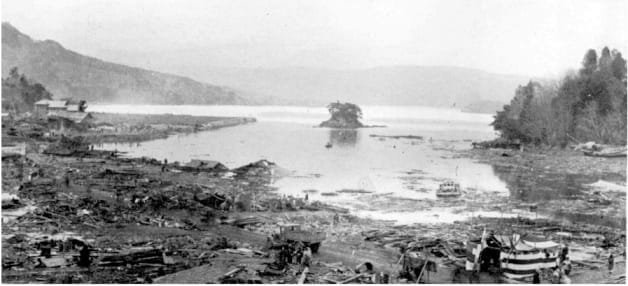
Port aux Basques, a vital port town, witnessed sudden flooding that tore apart docks, boats, and buildings. The residents, many of whom were out fishing or working ashore, were caught off guard. Some survivors later described the wave as a “mountain of water” that swallowed streets and left behind wreckage of ships and shattered lumber.
The human cost was tragic—over 27 people lost their lives, hundreds were injured, and countless homes were obliterated. The tsunami destroyed fishery infrastructure central to the region’s livelihood, further deepening the pain.
The Town of Port aux Basques: Trapped Between Land and Sea
Port aux Basques was more than just a victim; it was a symbol of resilience. The town’s geographical location—edge of the Burin Peninsula and a key point for telegraph and communications cables—made it both vulnerable and strategically important.
In the immediate aftermath, the town was isolated by damaged roads and broken communication lines. Yet its people quickly organized rescue efforts to save survivors from the rising waters and debris. The tsunami destroyed many of the homes and commercial buildings, but the community’s determination ensured the town’s eventual recovery.
Voices Lost and Found: Eyewitness Accounts of the Tsunami’s Onslaught
Recounting the tsunami, survivors' stories mix terror with a surreal sense of disbelief. One fisherman recalled, “It was quiet first, then the sea lifted like a giant hand and slammed down on the shore. I thought the world was ending.”
Another told of cruel irony: "We were used to the ocean’s moods, but nothing like this—no swell or storm could prepare us for that monstrous wave.”
These testimonies humanize the event, crystallizing the moment’s emotional and spiritual trauma. It was a sudden rupture in time—when nature’s fury eclipsed human understanding.
Communications Cut: How the Undersea Cable Helped Detect the Event
Interestingly, the Grand Banks tsunami was first scientifically detected through damage to the Transatlantic Telegraph Cable linking Newfoundland to Europe. The submarine landslide broke the cable twice, cutting telegraph communications.
This interruption alerted engineers and scientists that something extraordinary had occurred. Further analysis of the cable breaks helped researchers pinpoint the tsunami’s location and approximate timing, inaugurating a new reliance on undersea communications as natural disaster sensors.
The Extent of the Devastation: Quantifying Loss and Damage
Though the tsunami struck a relatively small population region, its impact was monumental—27 lives lost, over 1,200 people made homeless, and vast economic damages primarily from destroyed fishing infrastructure.
More than 15 communities suffered waves between 10 and 13 meters. The total force displaced millions of tons of sediment, reshaped the coastline, and left behind debris fields marking the violent encounter between earth and ocean.
The financial toll—hard to quantify then—was substantial, with many families losing their sole source of income, pushing Newfoundland deeper into economic hardship during a period shadowed by the Great Depression.
The Response: Rescue Efforts Amidst Chaos and Isolation
With roads flooded and communication severed, the people of Newfoundland relied on neighborly help, church organizations, and the limited government response to aid victims. Medical supplies came by boat and rail once routes reopened.
Rescue missions combed through debris, searching for survivors and recovering bodies. The tragedy triggered community solidarity: fishermen donated boats, women organized relief kitchens, and local churches hosted displaced families.
This collective effort underscored the profound human spirit that, tragically tested, refused to break.
Scientific Advancements Born from Tragedy: Early Tsunami Research
The Grand Banks tsunami marked a turning point in understanding seismic sea waves—until then, tsunamis were poorly studied outside the Pacific.
Geologists and oceanographers studied sediment deposits, wave heights, and the unprecedented submarine landslide, giving rise to the concept of “tsunami earthquakes,” where undersea slides amplify wave energy.
The event inspired scientific expeditions and the development of better seismic monitoring. It also raised awareness that even distant Atlantic communities were vulnerable to such deadly phenomena, broadening the global scope of tsunami risk evaluation.
Newfoundland’s Recovery: Social and Economic Aftermath
The tsunami's catastrophic effect compounded the struggles faced by Newfoundland’s communities, which were already grappling with poverty and isolation. Many families lost their homes or fishing boats, essential to their survival.
Reconstruction took years, fueled partly by government assistance and private aid, but the scars ran deep—homes rebuilt were often simpler, and entire fishing fleets needed replacement. Psychologically, the event lingered as a shadow over generations, influencing local culture and storytelling.
Economically, the disaster accelerated calls for better infrastructure and emergency preparedness, slowly transforming attitudes toward natural risks.
Global Reverberations: The Tsunami Beyond Canadian Shores
Remarkably, the Grand Banks tsunami was detected as far as Portugal and even on the coasts of Bermuda, where small water level oscillations were recorded hours after the Atlantic wave’s inception.
It was one of the earliest confirmations that tsunamis could cross ocean basins, forcing a reconsideration of early warning and hazard models worldwide. Scientists also noted unusual ocean turbidity, offering new insights into sediment transport and submarine landslide dynamics.
Memory and Memorial: How Newfoundland Remembers the 1929 Disaster
Nearly a century later, the Grand Banks tsunami remains a poignant chapter in Newfoundland’s history. Monuments in disaster-stricken towns commemorate the lives lost. Oral histories preserve the stories, passed down to younger generations as reminders of nature’s unpredictability.
Museums and local archives honor this legacy, educating visitors about geological hazards and the resilience of coastal communities. The event has inspired works of literature and art, embedding its memory within Newfoundland’s cultural tapestry.
Lessons from the Deep: Evolution in Tsunami Warning Systems
The 1929 tragedy underscored the critical need for tsunami detection beyond the Pacific. Over subsequent decades, international cooperation led to improved seismic monitoring networks and ocean buoys.
Modern warning systems now incorporate wave gauges and satellite technology to provide real-time alerts. The Grand Banks event serves as a case study emphasizing that tsunami risk is a global concern requiring vigilance and preparedness, even in regions historically considered safe.
Tsunami Today: Geological Monitoring in the North Atlantic
Today, agencies such as the Geological Survey of Canada and international partners closely monitor the Atlantic seabed. Advances in sonar mapping and underwater seismic stations provide detailed data to assess potential landslide zones.
Although rare, the possibility of future Grand Banks-like events remains. Ongoing research continues to refine models predicting submarine landslides and their possible impacts, aiming to protect the vulnerable coastal communities still dependent on the sea.
The Grand Banks Tsunami in Popular Culture and Research
While less famous than Pacific tsunamis, the 1929 event has inspired documentaries, academic symposia, and regional folklore. It represents a compelling chapter in the history of natural disasters that challenges perceptions of the Atlantic as calm or benign.
Researchers frequently cite the Grand Banks tsunami as a pivotal event in geosciences, blending historical tragedy with scientific discovery. This dual legacy ensures it remains a subject of fascination and respect.
Conclusion: A Legacy Etched in Waves and Time
The Grand Banks tsunami of 1929 was a sudden, devastating reminder that nature’s deepest forces can erupt without warning, reshaping landscapes and lives in minutes. The tragedy illuminated the fragile relationship between coastal communities and the restless Earth beneath them. Yet within the destruction arose stories of resilience, solidarity, and ongoing scientific pursuit—a testament to humanity’s courage in the face of overwhelming odds.
As waves of memory ripple through time, the Grand Banks tsunami remains a compelling narrative of both loss and hope, inspiring vigilance, respect for nature, and a deeper understanding of our planet's powerful mysteries.
FAQs about the Grand Banks Tsunami
Q1: What caused the Grand Banks tsunami of 1929?
A1: The tsunami was caused by a powerful magnitude 7.2 earthquake that triggered a massive submarine landslide on the continental slope of the Grand Banks, displacing huge volumes of water and generating the tsunami.
Q2: Why was the tsunami particularly destructive in Newfoundland?
A2: The tsunami struck coastal communities along the Burin Peninsula, where the steep underwater slopes and proximity to the earthquake epicenter amplified wave heights. Many settlements were unprepared and lacked warning systems.
Q3: How many people died in the tsunami?
A3: Official records report approximately 27 fatalities, with hundreds injured and over a thousand people left homeless.
Q4: How was the tsunami first detected?
A4: Interestingly, the rupture of the Transatlantic Telegraph Cable caused communication outages that alerted scientists to an underwater disaster, helping locate and time the event.
Q5: Did the Grand Banks tsunami impact other regions?
A5: Yes, the tsunami generated measurable waves far beyond Newfoundland, including minor oscillations recorded as far as Portugal and Bermuda.
Q6: What scientific advancements came from this event?
A6: The tsunami spurred early research into submarine landslides, tsunami earthquakes, and expanded tsunami monitoring beyond the Pacific Ocean.
Q7: How does Newfoundland remember the tsunami today?
A7: Through monuments, museum exhibits, oral histories, and community commemorations, the event remains a powerful part of local heritage.
Q8: Could a similar tsunami occur again in the North Atlantic?
A8: While rare, submarine landslides and earthquakes remain possible. Modern monitoring aims to detect and warn populations to mitigate future risks.