Table of Contents
- A Nation’s Destiny Awakes: April 23, 1920, Ankara
- The Ottoman Twilight: Seeds of Revolution
- The Aftermath of Defeat: Istanbul’s Diminishing Sovereignty
- Mustafa Kemal’s Vision: From Battlefield to Parliament
- The Moment of Gathering: Delegates Arrive in Ankara
- The Symbolic Birth of the Republic: First Session of the Grand National Assembly
- The Nationalist Agenda: Laws, Declarations, and Determination
- Istanbul Versus Ankara: Dual Power in a Nation Divided
- International Reactions: Allies, Neighbors, and Intrigues
- Struggles Within: Political Factions and Emerging Leaders
- Mobilizing a People: War of Independence Ignited
- The Cultural Renaissance: National Identity and Language
- The Assembly as a War Council and a Beacon of Hope
- The Treaty of Sèvres and Ankara’s Defiance
- The Role of Women and Minorities in the New Assembly
- Press and Propaganda: Voices from the Assembly
- Economic Challenges: Funding the Struggle for Sovereignty
- Links to Wider Anti-Colonial and National Movements
- The Assembly’s Decisions that Shaped Modern Turkey
- Legacy and Commemoration: National Sovereignty and Children’s Day
- Conclusion: The Grand Assembly as the Heartbeat of a New Republic
- FAQs: Understanding the 1920 Grand National Assembly
- External Resource
- Internal Link
1. A Nation’s Destiny Awakes: April 23, 1920, Ankara
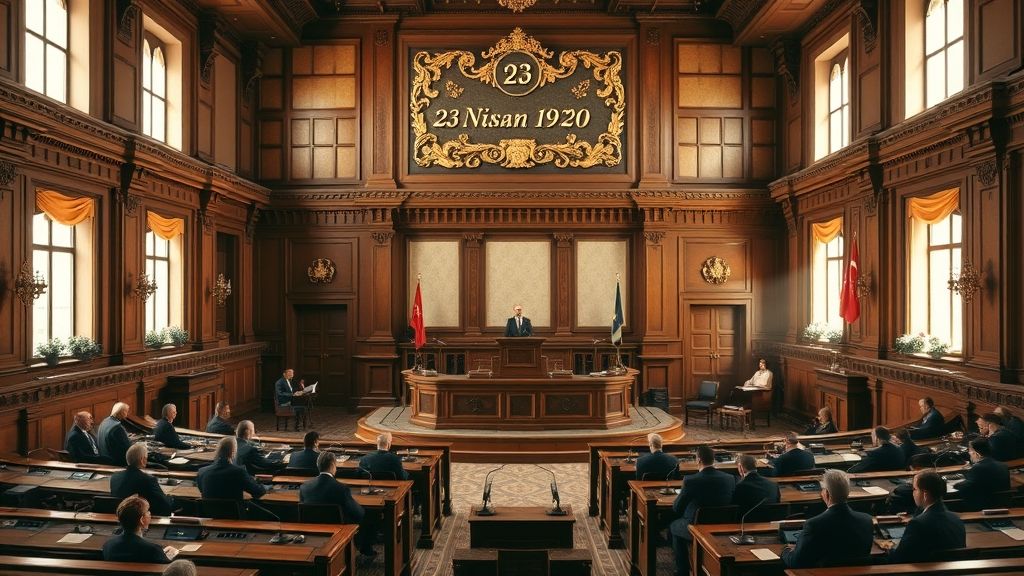
It was a cold spring day when history gathered itself in Ankara, then a modest Anatolian town far from the Ottoman capital of Istanbul. The air hung heavy with anticipation, electric with the hopes and fears of a defeated but unbowed people. On April 23, 1920, the Grand National Assembly of Turkey convened for the first time, unfolding a new chapter from the ashes of an empire swept to the edge by defeat in World War I. Delegates representing distant provinces came together not just to debate but to declare a new political order—a bold assertion of national sovereignty against foreign occupation and imperial dismemberment.
The scene was charged: a hastily prepared building filled with men whose faces carried the fatigue of war, yet whose eyes shone with defiance. Mustafa Kemal Pasha, the undisputed military and emerging political leader, took his place at the head of this historic gathering. It was more than a parliament—it was a crucible where a nation’s fate would be forged with iron will and unyielding purpose.
2. The Ottoman Twilight: Seeds of Revolution
To grasp the monumental importance of the Grand National Assembly’s first session, one must understand the twilight that enveloped the Ottoman Empire at the time. Once a sprawling dominion spanning three continents, the empire by 1920 was a shadow of itself. The catastrophic defeat in the Great War left its territories carved away by victorious Allies. The Treaty of Sèvres, imposed in August 1920—still in negotiation when the Assembly convened—promised to shatter whatever Central Anatolian integrity remained.
The Ottoman government, based in Istanbul and under Allied occupation, had long been paralyzed by internal dissent and foreign puppetry. In the vacuum of effective governance, new nationalist impulses grew. Mustafa Kemal, a former Ottoman officer, emerged as a figure willing to reject capitulation and organize resistance.
3. The Aftermath of Defeat: Istanbul’s Diminishing Sovereignty
After the Mudros Armistice of 1918, Istanbul was under the watchful eyes of the British, French, and Italians. The sultan was reduced to a figurehead, his authority stripped like a wax statue melting under foreign torches. While the Ottoman government dithered, nationalist groups organized in Anatolia to regroup and resist partition. The capital city was no longer the heart from which power emanated; that mantle passed, in spirit and action, to Ankara.
4. Mustafa Kemal’s Vision: From Battlefield to Parliament
Mustafa Kemal’s journey from the trenches of Gallipoli to the parlors of power was defined by relentless conviction. He understood that military victories alone could not secure independence. Political legitimacy was crucial. The Grand National Assembly would provide a representative forum to assume sovereign authority and unify resistance under the banner of national sovereignty.
Turkish historian İlber Ortaylı described it vividly: “Mustafa Kemal did not merely fight on behalf of territory but fought to resurrect a people’s will embodied in a new political reality.”
5. The Moment of Gathering: Delegates Arrive in Ankara
Delegates arrived from all corners of Anatolia and Rumelia amidst fraught journeys—some fleeing occupied lands, others risking arrest by the occupying forces. Among them were former Ottoman parliamentarians, local notables, and passionate revolutionaries. The Assembly was at once a mosaic of the country’s ethnic, religious, and regional diversity.
The energy was palpable. The Assembly building, a converted schoolhouse, barely contained the ferment of ideas and debates. Ankara buzzed with the urgency of a capital in the making.
6. The Symbolic Birth of the Republic: First Session of the Grand National Assembly
When Mustafa Kemal stood to open the session, the room held its breath. His opening words asserted the Assembly’s unquestionable sovereignty over Turkish lands and peoples. This was a direct challenge to the Sultan, the occupying forces, and the myriad foreign powers seeking to divide the empire.
The Assembly became the symbol of a new Turkey—one born from resistance, self-determination, and a clear national will. The date itself was later immortalized as National Sovereignty and Children’s Day, underscoring the assembly’s dedication not only to political independence but to a future shaped by new generations.
7. The Nationalist Agenda: Laws, Declarations, and Determination
In the Assembly's earliest sessions, sweeping decisions were made to legitimize the nationalist government. Delegates passed laws aimed at establishing civil authority, preparing the people for a protracted independence struggle, and organizing the military under nationalist control.
One early landmark was the abolition of the Sultanate’s legislative claims and the rejection of foreign-imposed treaties. Effectively, the Assembly proclaimed itself the sole legitimate representative of the Turkish nation.
8. Istanbul Versus Ankara: Dual Power in a Nation Divided
A tense tug-of-war defined the two capitals. Istanbul clung to Ottoman traditions and accommodationist policies, the sultan’s government increasingly compromised and contested. Ankara, by contrast, embodied the vitality of renewal—a modern nationalist vision grounded in popular sovereignty and secular governance.
In this rivalry, the Assembly’s bold stand inspired many disillusioned Ottoman officials and intellectuals to shift allegiance. Yet Istanbul’s inertia remained a potent obstacle.
9. International Reactions: Allies, Neighbors, and Intrigues
The international community watched Ankara warily. The Allies, particularly Britain, France, Italy, and Greece, saw the Assembly’s rise as a dangerous upheaval jeopardizing their imperial and territorial ambitions. The Greek government, encouraged by British support, prepared to launch incursions into western Anatolia as part of a broader plan to partition Ottoman lands.
Yet the Ankara Assembly’s legitimacy began to find sympathetic echoes in anti-colonial movements worldwide—an inspiration for those seeking to throw off imperial yokes.
10. Struggles Within: Political Factions and Emerging Leaders
Far from monolithic, the Assembly contained a spectrum of ideologies—from fervent secularists to pragmatic conservatives, from staunch nationalists to regionalist advocates. Mustafa Kemal's skillful leadership rested on balancing these tensions, forging unity without suppressing necessary debate.
Figures such as İsmet İnönü and Fevzi Çakmak emerged as indispensable commanders of both political strategy and military operations.
11. Mobilizing a People: War of Independence Ignited
With the Assembly asserting authority, nationalist forces consolidated. Local militias became national armies, funded and directed by Ankara. As Greek forces advanced and foreign powers tightened their grip, Ankara’s government marshaled the Turkish War of Independence (1919–1923).
The Assembly functioned as both a legislative body and a war council, coordinating military, diplomatic, and domestic affairs.
12. The Cultural Renaissance: National Identity and Language
Parallel to political and military resistance, the Assembly fostered a cultural awakening. Efforts began to purify and standardize the Turkish language, redefining education and civic identity. Poets, artists, and intellectuals found in Ankara’s nationalist government a patron of a renewed Turkish heritage.
This cultural renaissance was deeply intertwined with the political project to forge a homogenous and sovereign nation-state.
13. The Assembly as a War Council and a Beacon of Hope
It is incredible to think that within those modest wooden walls, future founders of modern Turkey strategized victory against overwhelming odds. The Assembly was not only a symbol but a practical engine of governance and coordination in wartime.
By asserting sovereignty, it rekindled hope among millions living under occupation, oppression, and uncertainty.
14. The Treaty of Sèvres and Ankara’s Defiance
While the Treaty of Sèvres attempted to formalize the partition of Ottoman lands, the assembly outright rejected it. Applying political and military pressure, the Ankara government nullified Sèvres by force of arms and diplomacy, leading eventually to the Treaty of Lausanne in 1923, recognition of Turkish sovereignty as defined by the Assembly.
This defiant stance made Ankara the legitimate voice of the Turkish nation on the world stage.
15. The Role of Women and Minorities in the New Assembly
Though male delegates dominated, the nationalist movement introduced important changes for women and minorities, promoting broader participation in the public sphere. It set the groundwork for rights reforms which would be pursued vigorously in subsequent decades.
The Assembly’s policies embodied a secular, civic nationalism aiming to transcend the Ottoman millet system.
16. Press and Propaganda: Voices from the Assembly
Contemporary newspapers and pamphlets reported fervently on the Assembly’s acts. Propaganda from Ankara portrayed the Assembly as the guardian of national honor, sometimes contrasting starkly with the sultanate's press—now seen as compromised or cynical.
These voices rallied popular support and shaped collective memory.
17. Economic Challenges: Funding the Struggle for Sovereignty
Amidst foreign blockades and the collapse of imperial finances, the Assembly faced daunting fiscal obstacles. Innovative taxation, national bonds, and international fundraising efforts were launched to sustain both civilian life and military campaigns.
Economic survival became inseparable from political legitimacy.
18. Links to Wider Anti-Colonial and National Movements
The 1920 assembly resonated far beyond Anatolia. Colonial subjects and nationalist leaders globally watched Ankara’s experiment with keen interest, viewing it as a beacon for self-determination.
In time, Turkey’s successful anti-imperial struggle would influence movements across Asia, Africa, and the Middle East.
19. The Assembly’s Decisions that Shaped Modern Turkey
Decisions made in those early months formed the pillars of the later republic: sovereignty resting with the people, separation from imperial structures, and secular governance. These principles led directly to the abolition of the sultanate, the proclamation of the Republic, and sweeping modernization reforms.
The Assembly’s founding moment was the crucible for all this.
20. Legacy and Commemoration: National Sovereignty and Children’s Day
Today, April 23 is celebrated as National Sovereignty and Children’s Day in Turkey, a tribute not only to the Assembly’s historic gathering but its dedication to the nation’s future generations. It speaks to a profound belief in renewal, nationhood, and the promise of liberty springing from representative governance.
21. Conclusion: The Grand Assembly as the Heartbeat of a New Republic
The convening of the Grand National Assembly in Ankara on April 23, 1920, was more than a political act—it was a rebirth. Against daunting odds, a fragmented and defeated people crafted a new sovereign voice. Through debate, sacrifice, and vision, they laid the foundation for modern Turkey.
This Assembly embodied the spirit of a nation reclaiming its identity, sovereignty, and future. Its legacy is a testament to the power of determination, unity, and hope in the face of adversity.
FAQs: Understanding the 1920 Grand National Assembly
Q1: Why was the Grand National Assembly established in Ankara and not Istanbul?
The Ottoman capital Istanbul was under Allied occupation and the sultan’s government was compromised. Ankara, beyond Allied reach and a center of nationalist resistance, became the logical seat for a new sovereign assembly.
Q2: Who was Mustafa Kemal Atatürk and what role did he play?
Mustafa Kemal was the organizer and leader of the nationalist movement. He founded and led the Grand National Assembly, providing both military and political leadership essential for Turkey's independence.
Q3: How did the Assembly’s decisions challenge the Treaty of Sèvres?
The Assembly refused to recognize the treaty, which partitioned Ottoman lands among foreign powers. By asserting sovereignty, the Assembly initiated a war of independence that eventually led to the treaty’s cancellation.
Q4: What was the significance of April 23 in Turkish history?
April 23 marks the first convening of the Grand National Assembly, symbolizing the birth of the Turkish Republic and national sovereignty. It's celebrated as National Sovereignty and Children’s Day.
Q5: What impact did the Assembly have on minority groups and women?
While initially dominated by men, the Assembly initiated reforms promoting secularism and civic nationalism, paving the way for greater inclusion and rights for women and minorities in the republic.
Q6: How did international powers respond to the Assembly?
Most Allied powers viewed the Assembly suspiciously or hostilely, fearing disruption of post-war territorial gains. However, Ankara’s rising legitimacy gradually forced recognition.
Q7: What was the relationship between the Istanbul government and the Ankara Assembly?
There was dual power and rivalry. Istanbul’s government remained loyal to the sultan under Allied control, while Ankara represented nationalist sovereignty and resistance.
Q8: How did the Assembly contribute to the cultural identity of Turkey?
It promoted a Turkish national identity independent of Ottoman imperial legacy, including language reform, education, and a cultural renaissance supporting modernization.