Table of Contents
- The Dawn of a New Threat: The Arrival of the Great Heathen Army
- Shadows Over England: The Political Landscape Before 865
- The Vikings’ Motivation: Ambition, Survival, and Expansion
- The Landing in East Anglia: A Moment That Changed History
- The Strategy and Composition of the Great Heathen Army
- East Anglia: The First Foothold of the Viking Onslaught
- King Edmund and the Fall of East Anglia
- The March Through the Kingdoms: Northumbria, Mercia, and Wessex in Peril
- The Battle for Northumbria: York’s Darkest Hours
- Mercia’s Struggle and the Rise of Æthelred
- Alfred the Great: The Resilience of Wessex
- The Cultural and Social Impact of the Viking Incursions
- The Interplay of Fear and Adaptation Among the Anglo-Saxons
- Political Upheaval and the Changing Map of England
- Legacy of the Great Heathen Army: From Conquest to Integration
- How the Viking Age Shaped Modern Britain
- Reflections from Contemporary Sources and Chronicles
- The Archaeology of the Great Heathen Army’s Campaign
- Myths, Legends, and Popular Memory of the Viking Invasions
- Conclusion: The Enduring Echo of the Heathen Horde
- FAQs: Answering Key Questions on the Great Heathen Army
- External Resource
- Internal Link
The Dawn of a New Threat: The Arrival of the Great Heathen Army
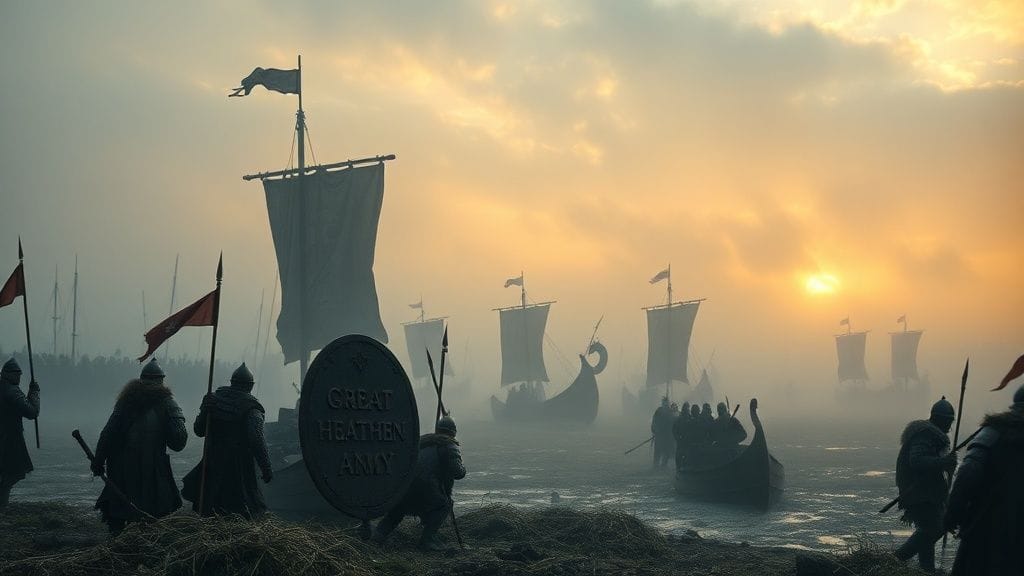
It was the spring of 865 AD, and the chill of the North Sea had barely relented when, on the coast of East Anglia, a formidable force appeared on the horizon: the Great Heathen Army. Unlike the swift raiding parties that had terrorized the English shores for decades, this was no mere band of opportunistic pirates. This was an organized, overwhelming force of Viking warriors — thousands strong — intent not on plunder alone, but on conquest and colonization.
The atmosphere among the English kingdoms was thick with unease and disbelief. Many had witnessed Viking raids before — sudden, brutal, and fleeting — but this new arrival promised something fiercer, more sustained, and remarkably strategic. The sails of the longships, dark against the bright May sky, cast shadows of impending doom over East Anglia. For the Anglo-Saxons, the hour had come to face an enemy unlike any before.
Shadows Over England: The Political Landscape Before 865
To understand why the Great Heathen Army’s landing was so seismic, one must grasp the fractured state of England in the mid-9th century. England was not yet a unified kingdom but a mosaic of autonomous Anglo-Saxon realms — notably Northumbria in the north, Mercia in the center, Wessex in the south, and East Anglia on the eastern shore.
East Anglia, with its marshes, rivers, and increasingly prosperous settlements, had withstood earlier Viking raids better than most regions but was far from invulnerable. Mercia, once the dominant power, was in decline due to internal strife and external pressures. The north, particularly the former Roman city of York (known as Eoforwic to the Anglo-Saxons), had been a target of Viking raids but also a prize due to its wealth and symbolic importance.
Wessex, under King Æthelwulf and soon his son Alfred, was emerging as a bulwark against Norse expansion but had yet to demonstrate its full resilience. Taken together, this patchwork of rivalries and shifting alliances made England ripe for the sort of coordinated Viking assault that would soon unfold.
The Vikings’ Motivation: Ambition, Survival, and Expansion
What drove the Vikings to send such a massive force across the sea was a blend of ambition and necessity. Scandinavia in the 9th century was densely populated and politically fractious. Overpopulation, limited arable land, and internecine warfare fueled the impetus to seek fortunes abroad.
While earlier Viking expeditions had been seasonal, hit-and-run affairs targeting monasteries, villages, and towns for loot, the Great Heathen Army embodied a more complex approach. These warriors were likely a coalition of different Viking bands, united under celebrated leaders such as Ivar the Boneless, Halfdan Ragnarsson, and Ubba. Their goals were grander: territorial conquest, settlement, and the establishment of lasting power bases.
It is crucial to recognize Viking society’s nuances here — these conquests were not random acts of violence but calculated expansions intended to become new homelands for their people.
The Landing in East Anglia: A Moment That Changed History
In late 865, Scandinavian longships sliced through the waters near the River Orwell or possibly the River Waveney, anchoring the Great Heathen Army on the lush shores of East Anglia. Contemporary chroniclers like the Anglo-Saxon Chronicle provide terse but telling accounts. The arrival was sudden but unmistakably aggressive.
The Vikings did not merely raid and retreat. They established fortified camps and began to forage, signaling an intention to stay. East Anglia was fertile ground, both literally and politically. The Danes quickly assessed its potential as a staging ground for incursions into Mercia and Northumbria.
This landing was a turning point, marking a shift from sporadic raiding to large-scale invasion.
The Strategy and Composition of the Great Heathen Army
Unlike the earlier solo raiding parties, the Great Heathen Army was remarkable for its size and organization. Sources suggest it numbered in the thousands, comprised of seasoned warriors, followers, and families — a full migratory force.
Military strategy combined amphibious mobility, swift horseback attacks, and devastating sieges. Its leaders, men like Ivar the Boneless, reputedly a cunning tactician, orchestrated campaigns with a keen understanding of local politics and geography.
The army’s cohesion was supported by a shared Norse cultural identity, fierce warrior codes, and religious motivations. They believed in the favor of Odin, and victory was woven into their faith. Yet practical considerations prevailed — they relied heavily on intelligence, alliances with local factions, and the exploitation of English disunity.
East Anglia: The First Foothold of the Viking Onslaught
Having landed, the Great Heathen Army wasted no time in consolidating control over East Anglia. The East Anglians, caught between fear and surprise, could hardly mount a united defense. The Vikings exacted tribute and possibly installed puppet rulers to maintain influence.
The fertile land provided resources to sustain the army, while the proximity to Mercia and the no less politically fragile Northumbria offered a springboard for expansion. The settlement patterns of Vikings in East Anglia during this period are corroborated by later place-names and archaeological finds — traces that remain visible across the landscape today.
King Edmund and the Fall of East Anglia
One of the most poignant episodes of this era revolves around King Edmund of East Anglia. Known later as Saint Edmund the Martyr, he symbolizes the tragic fate that befell many Anglo-Saxon rulers confronting the Viking tide.
Chronicles recount how Edmund was captured and killed by the Vikings around 869. His death was not merely a military defeat but a spiritual and cultural blow. His martyrdom served as a rallying cry across Christian England and injected a mythic dimension into the Viking invasions.
Yet Edmund’s demise also marked the end of independent East Anglian sovereignty and the ascendancy of Viking rule across the territory.
The March Through the Kingdoms: Northumbria, Mercia, and Wessex in Peril
With East Anglia secured, the Great Heathen Army moved with relentless purpose. In the autumn of 866, they advanced northward, surprising and overwhelming the Kingdom of Northumbria. One of their greatest victories was the capture of York, a city of vast military and symbolic value, turning it into the Viking capital known as Jorvik.
Northumbria’s internal factionalism had undermined its ability to resist, and once the Vikings were entrenched, they launched raids into Mercia. Æthelred, the Mercian ruler, was pressed into uneasy truces and lost much of his power.
The southern kingdom of Wessex, though targeted, emerged as a crucial bulwark. Its king, Alfred — then still a prince — began to conceive strategies to resist, adapt, and ultimately repel the invaders. But those years were marked by near-constant pressure, battle, and uncertainty.
The Battle for Northumbria: York’s Darkest Hours
The year 867 saw one of the most dramatic confrontations of the invasion — the Viking siege and capture of York. The city’s fortified walls and strategic river location made it a prize that had changed hands through previous conflicts.
The Great Heathen Army’s forces besieged York with determination, eventually overcoming the defenders and slaughtering their leaders. Within months, the city was firmly under Viking control and transformed into a thriving Norse settlement.
This victory was a psychological blow to the English and a tangible statement of Viking dominance. York would remain a Viking stronghold for decades, influencing culture, trade, and politics.
Mercia’s Struggle and the Rise of Æthelred
Mercia, once the paramount power in England, found itself beleaguered but unbowed. Æthelred, its king, navigated a complex diplomatic and military landscape, making alliances, paying Danegeld (tribute), and fighting skirmishes.
The Great Heathen Army’s movement through Mercian territories brought destruction but also adaptation. Mercia remained a contested space — neither fully conquered nor entirely free. This liminal state would shape later resistance efforts and alliances with Wessex.
Alfred the Great: The Resilience of Wessex
In the midst of chaos, Wessex’s fortunes heralded hope. Alfred, ascending the throne in 871, faced the daunting task of defending his kingdom from the mighty Heathen Army and its successors.
Alfred’s leadership was characterized by military innovation, including the development of fortified burhs (towns), improved naval forces, and a standing army trained for rapid response. Beyond the battlefield, he promoted learning, justice, and governance reforms.
His successes were not immediate but gradually turned the tide, laying the foundation for a unified England centuries ahead.
The Cultural and Social Impact of the Viking Incursions
The Viking invasions induced profound changes in Anglo-Saxon society. Apart from destruction and death, they also caused migrations, cultural exchanges, linguistic influences, and demographic shifts.
The Norse introduced new place-names, crafts, and even legal customs. Some Vikings settled and intermarried, their legacy visible in regions known as the Danelaw — areas of England under Danish control.
Religiously, the conflict intensified Christian identity but also led to syncretism and shifts in power structures within the church and nobility.
The Interplay of Fear and Adaptation Among the Anglo-Saxons
Faced with overwhelming invasion forces, the Anglo-Saxons experienced a spectrum of reactions — fear, despair, but also resilience and creativity. Chronicles reflect despairing laments but also tales of cunning diplomacy and heroic stand.
Communities fortified themselves, kings raised new armies, and alliances were reforged. The era sparked the rise of legendary figures whose memory endures in literature and folklore.
Political Upheaval and the Changing Map of England
The Great Heathen Army’s campaign reconfigured the political map of England. Kingdoms were shattered, borders redrawn, and an uneasy equilibrium settled in.
The emergence of the Danelaw divided England into Norse-controlled and Anglo-Saxon ruled territories for generations. This division had long-term consequences for governance, law, and identity.
Legacy of the Great Heathen Army: From Conquest to Integration
Though initially agents of destruction, the Vikings gradually integrated into English society. Their settlements became towns, their leaders became local lords, and Norse culture blended with Anglo-Saxon traditions.
The Great Heathen Army’s legacy is thus double-edged: a harbinger of devastation whose eventual settlement sowed the seeds of England’s medieval identity.
How the Viking Age Shaped Modern Britain
The echoes of the Viking invasions reverberate today in language, place-names, genetic heritage, and cultural narratives. Modern Britain’s diversity and complexity owe much to the mingling initiated by these tumultuous times.
Institutions influenced by Viking legal practices persist subtly, and national mythologies still grapple with this vibrant chapter of history.
Reflections from Contemporary Sources and Chronicles
Our primary understanding of the Great Heathen Army comes from sources like the Anglo-Saxon Chronicle, Asser’s Life of Alfred, and Norse sagas. While these accounts deliver invaluable insights, they also carry biases, necessitating careful interpretation.
Anecdotes such as Ivar’s ruthless tactics or Edmund’s martyrdom provide emotional texture, helping us connect with a world far removed but vividly real.
The Archaeology of the Great Heathen Army’s Campaign
Recent archaeological discoveries have enriched our understanding of this epoch. Excavations near Repton uncovered mass graves linked to Viking warriors, while settlements exhibit the melding of Anglo-Saxon and Norse artifacts.
These tangible remnants offer a visceral link to the people who lived, died, and rebuilt in the wake of the Great Heathen Army’s arrival.
Myths, Legends, and Popular Memory of the Viking Invasions
The Viking Age has since blossomed into legend — be it the depictions of berserkers, the charismatic Ivar the Boneless, or the sanctity attributed to Saint Edmund.
Popular culture often romanticizes or demonizes the Vikings, but beneath the myths lies a profound human story of conflict, survival, and transformation.
Conclusion
The arrival of the Great Heathen Army in East Anglia in 865 was not simply a raid; it was a seismic upheaval that reshaped the destiny of England. This force, borne of ambition and turmoil, brought death and destruction but also catalyzed political realignment, cultural fusion, and ultimately the creation of a stronger, more unified English kingdom.
We see in their story the enduring dance of civilizations — clash and communion, loss and renewal. The Great Heathen Army’s legacy endures not only in history books but in the very fabric of England’s identity, reminding us that from the darkest invasions can emerge the brightest renaissances.
FAQs
1. What was the Great Heathen Army?
The Great Heathen Army was a large Viking force that landed in England in 865 AD, composed of several thousand warriors intent on conquest rather than simple raiding.
2. Why did the Vikings invade England at this scale in 865?
Overpopulation and political instability in Scandinavia, combined with the lure of England’s wealth and division among its kingdoms, motivated the Vikings to launch a large-scale invasion.
3. Which kingdoms did the Great Heathen Army target?
Primarily East Anglia, Northumbria, Mercia, and Wessex — the most significant Anglo-Saxon kingdoms of the period.
4. Who were the key Viking leaders during the campaign?
Notable leaders included Ivar the Boneless, Halfdan Ragnarsson, and Ubba, figures known for their military skill and legendary status.
5. What was the fate of King Edmund of East Anglia?
He was captured and killed by the Vikings around 869 AD, later revered as a Christian martyr and saint.
6. How did the Anglo-Saxons eventually resist the Viking incursions?
Under leaders like Alfred the Great of Wessex, the Anglo-Saxons developed military and political strategies including fortified towns and standing armies to resist and eventually repel the Vikings.
7. What is the Danelaw?
The Danelaw refers to the region in England under Viking control following the campaigns of the Great Heathen Army, where Norse laws and customs predominated.
8. How do we know about the Great Heathen Army today?
Through a combination of contemporary chronicles, Norse sagas, archaeological evidence, and later historical analyses.

